Sanjha Morcha

What’s New

Click the heading to open detailed news

Current Events :

web counter

Print Media Reproduced Defence Related News

Army organises mini-marathon

Army organises mini-marathon
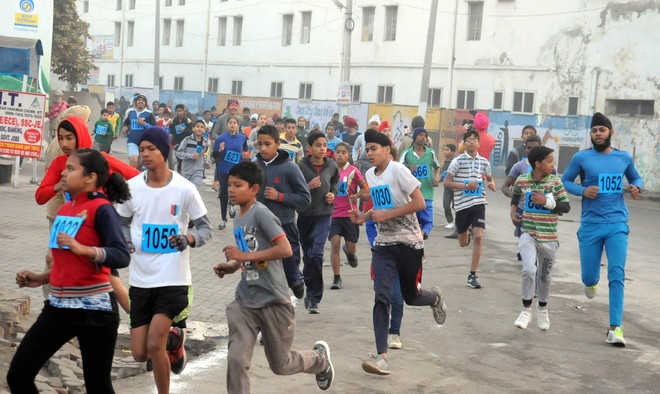
Children participate in a mini-marathon which was organised to celebrate the 70th Army Day in Bathinda on Monday. Tribune photo: Pawan Sharma

Tribune News Service

Bathinda, January 22

The Chetak Corps of the Indian Army has organised Chetak Mini-Marathon called “Lets run for the nation” to celebrate 70th Indian Army Day here today. The event was flagged off by Brigadier Tarundeep Kumar, Station Commander from Multipurpose Stadium. The DC and various other senior civilian dignitaries were also present.A total of 1,379 participants, including 342 children and 66 women, took part in the marathon with zeal and enthusiasm. The winners of the marathon were felicitated by Lieut-Gen PC Thimmaya, General Officer Commanding, Chetak Corps.In the 10 km category, the first prize was bagged by Lance Naik Mohkan Singh, second by Mr Preet Pal Singh and third by Gunner Arvind Kumar. In the 5 km category, the first prize was bagged by Sumit Awasti, second by Gurukumal Singh and third by Mohmmad Hamza.


Military families, the unsung war heroes

CHANDIGARH: What are the challenges they faced while their men were away on borders? How has marriage with the olive greens changed their lives? Wives and daughters of men in olives shared their experiences including joys and dilemmas of being a military family.

ANIL DAYAL/HT(From left) Rita JP Singh, Maj Gen AK Sengar (retd), Daulat Oberoi and Ashali Verma during a session on the ‘Joys and dilemmas of being a military family’ on Friday.

“Because the army has grown so big, the problems are much different and more difficult than earlier. The army is a very large family which is full of cohesive and disciplined camaraderie and bonding. I have met people after 20 years and that bonding is the same. I have not found this bonding anywhere else,” said Daulat Oberoi, who spoke about the book ‘wedded to the olive greens’ written specifically to help women who have married officers. The book has become a ‘bible’ for newlyweds from civil societies.

A panellist Rachna Rawat Bisht said, “The biggest joy for an army officer’s wife is that you are married to an armyman, the country’s hero. The biggest challenge, however, is that he will never put you first. For him, the army is always going to be priority. That is the biggest challenge; that a call of duty will come, he will lace up his shoes, leave for the battlefield, and may never return.”

Sharing an incident, she said, “My husband was posted with Assam rifles and was transferred somewhere far. After he left, I got to know that I have conceived and I had to convey. I contacted him through an exchange but he could not understand as there was a lot of disturbance. Finally, the guy on exchange had mercy on us and said, ‘Sahib, aapke liye khushkhabri hai (Sir, there’s a good news for you).”


Smoke billows from Bellandur Lake after fire doused::5000 Armymen deployed

Smoke billows from Bellandur Lake after fire doused
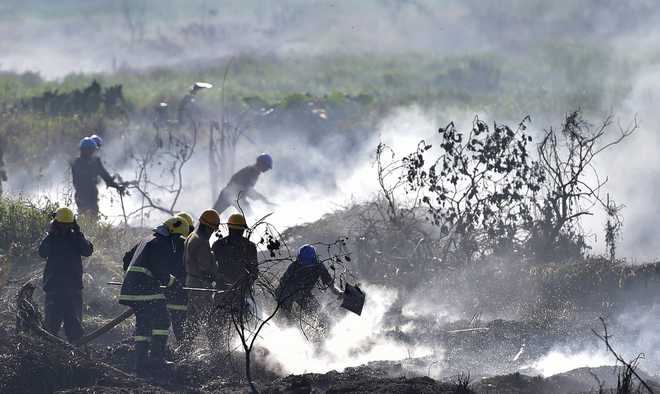
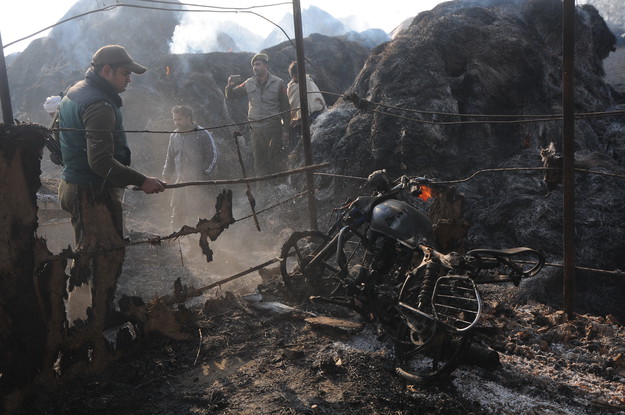
Firefighters try to put out fire at Bellandur Lake in Bengaluru on Saturday. Bellandur Lake, known for its high levels of pollution, caught fire on Friday morning billowing huge clouds of smoke on the Yemlur side of the lake. PTI

Bengaluru, January 20

Black smoke continued to billow from the Bellandur Lake on Saturday, hours after a huge fire close to a nearby Army firing range was doused in a massive operation involving more than 5,000 armymen and fire fighters.

“Major fire that was there yesterday has been doused, but there is still smoke emerging in some small pockets,” a senior fire department official said.

He said they were now trying to ensure that the embers from which the smoke emanated do not re-ignite due to wind.

Water from the lake was used to put off the fire, the cause of which would be known after investigations, officials said.

The blaze started on Saturday in the highly polluted and biggest water body of the city, giving anxious moments to hundreds of residents living nearby before it was doused last night.

It had also spread towards the nearby Iblur firing range of the Army, the officials said.

The Army last night said the fire, which had spread to the perimeter of its facility, had been doused due to the untiring efforts of more than 5,000 of its personnel and fire fighting equipment of the Army Service Corps (ASC) Centre and College.

Lt Gen Vipin Gupta, commandant ASC Centre and College, said on Saturday that things were under control.

As voices were emerging that the fire may have started due to methane burst as a result of accumulation of chemicals and pollutants in the lake, authorities also suspect the involvement of local grass harvesters in starting it.

Fire department officials said the reason behind the fire has not yet been determined and their priority was to put off the fire completely. “Later, investigation will be done to know the cause of fire,” a senior official said.

Speaking to reporters after visiting the site this morning, Lt. Gen. Gupta said: “The area that is close to our camp is absolutely under control, there is nothing. The area that is close to the lake there is still lot of smoke, but it is under control”.

“We have a lot of fire tenders there and we are ready for any eventuality,” he said.

Lt. Gen. Gupta said this was the first time the blaze had spread to their camp. “It had never interfered with our activities, but now that it has come very close to us we will definitely take up the case with civil authorities,” he said.

Asked if the Army will take up the lake’s cleaning, he said they were always ready to help the civil administration.

But as far as cleaning was concerned “it is a very technical and professional job” for which people were available on the civil side, he added.

Spread over 1,000 acres near the infotech hub, the lake is highly contaminated as it receives 60 per cent of the sewage generated in the city. It is in bad shape despite the National Green Tribunal pulling up the government and its various agencies for failing to prevent pollution and not doing enough to restore the lake.

The Bellandur lake had caught fire in May 2015 and August 2016 also.

In 2015, the lake had turned into a frothy, foam-filled water body due to high concentration of pollutants in the waters. Foam from the lake spilling onto nearby roads and surrounding areas had become a common sight each time the city received heavy rainfall.

The nearby Varthur lake was also in the focus when it caught fire in May 2017. PTI


Henderson Brooks report not being declassified to save political skin: Capt

PUNJAB CM ADMITS ARMED FORCES NOT CAREER OF CHOICE FOR TODAY’S YOUTH, SAYS NEED TO INTROSPECT

CHANDIGARH: Punjab chief minister Capt Amarinder Singh was a fauji first at the Military Literature Festival here on Friday when he minced no words, saying that the Henderson Brooks report on the Sino-Indian War of 1962 was not being declassified “only to save political skin”.

ANIL DAYAL/HT■ (From left) Lt Gen A Mukherjee (retd), Brig MS Gill (retd), Punjab chief minister Capt Amarinder Singh, The Tribune editor­in­chief Harish Khare, Brig IS Gakhal (retd) and Maj Gen Shivdev Singh (retd) at the Military Literature Festival 2017 at Lake Club in Chandigarh on Friday.

“The Henderson BrooksPrem Bhagat report should have been made public long back. It is an open secret. It has not been declassified only to save political skin,” Capt Singh said.

“After the government order, the defence minister (Krishna Menon) was literally shifting platoons. There was a compliant corps commander who didn’t give brigade commander Hoshiar Singh a chance to fight. It was not the army fighting, it was a faulty government policy at work,” said Capt Singh, who was wearing his medals. He was commissioned in 2 Sikh Regiment in 1963.

He was interacting with veteran journalist Vir Sanghvi and military historians Thomas Fraser, Alan Jefferys, Lt Gen TS Shergill (retd) and Ed Haynes at a panel discussion.

Asked about India’s provocative foreign policy in 1962 despite no preparedness, Lt Gen Shergill said, “It was the lack of understanding by the government on what it takes besides the lack of spine of certain officers to admit what can’t be done.”

There was unanimity among the panellists that then prime minister Jawaharlal Nehru “died a disappointed man”. Then defence minister Krishna Menon and he clearly misread the situation despite intelligence inputs as far back as 1959 that China was planning an offensive.

WINNER OR LOSER?

Lt Gen Shergill said that military history has taught that only a force that endures can win. “The perception is that military history is written by the winner but who is the winner in a counterinsurgency situation? There is no clear winner or loser. The lexicon of conflict is changing and caution should be exercised in usage of terms,” he said.

Asked who had won the 1965 India-Pakistan war, Capt Amarinder Singh said, “It was more or less a draw. We had no ammo left and if it continued any longer, we’d be fighting each other with stones. It was a pathetic situation. India may have gained territorially but it was a negligible gain.”

‘NO POLITICS IN FORCES’ The CM denied any politicisation in the armed forces but declined comment on political interference. “The forces are disciplined and will always be,” he said.

Like most participants at the session, Capt Singh agreed that unlike the past, today’s youth were not drawn to a career in the armed forces. “It is a concern that many don’t want to join the forces and we need to find out why,” he said.

clip

clipclipclipclip

clip

clip

clip


Army jawan from Punjab among 3 killed in ceasefire violation by Pak Educational institutes shut along IB, LoC; over 8,000 border residents migrate

A woman shows mortar shells that landed outside her house. Tribune photo: Inderjeet Singh

Damage due to cross-border shelling by Pakistan in RS Pura sector. Tribune photo:Inderjeet Singh

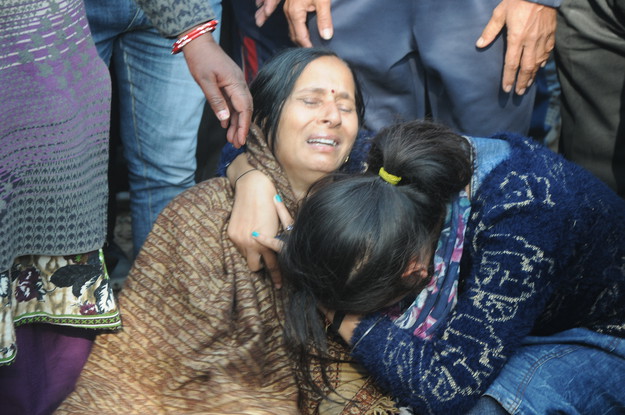
Family members of Ghara Singh of Bera village. Tribune Photo:Inderjeet Singh

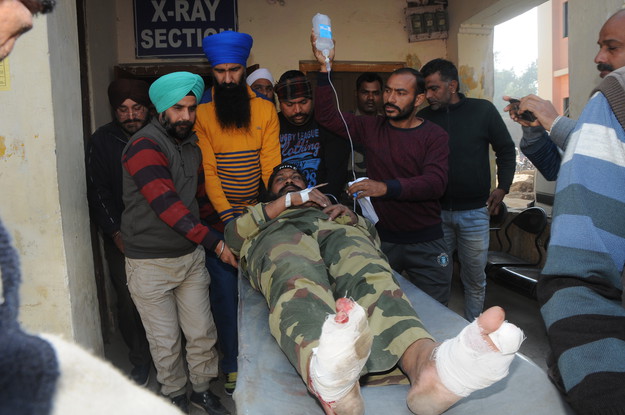
An injured in a hospital. Tribune photo: Inderjeet Singh

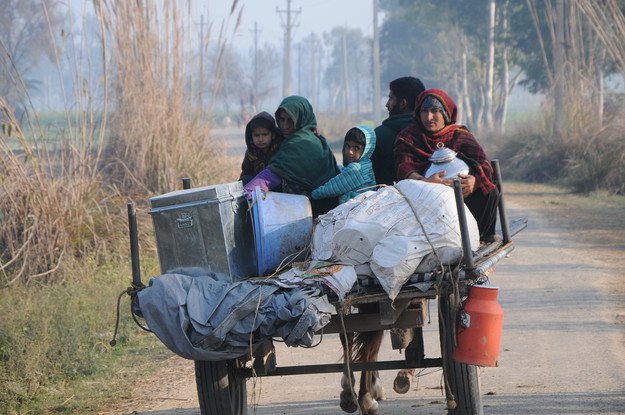
Locals move towards safer place in RS Pura. Tribune photo: Inderjeet Singh

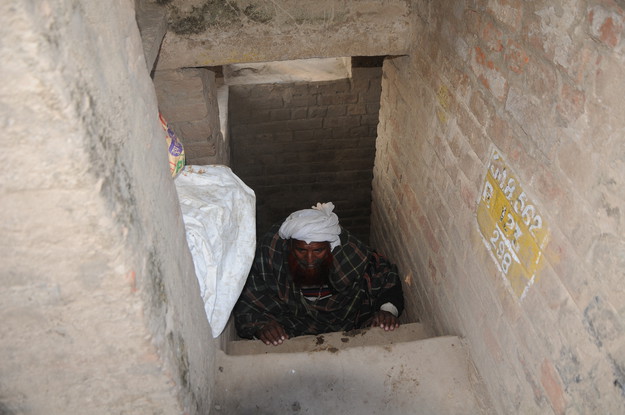
A man takes shelter in a bunker. Tribune photo: Inderjeet Singh

Mandeep Singh

Amir Tantray

Tribune News Service

Jammu, January 20

Three people, including an Army jawan, were killed and six injured in firing by Pakistani troops along the International Border (IB) and Line of Control (LoC) in Jammu division for the third day on Saturday.

Nine persons have been killed so far in ceasefire violations over three days.

(Follow The Tribune on Facebook; and Twitter @thetribunechd)

An Army jawan was today killed after being hit by a bullet during cross-border firing in Krishna Ghati sector of Poonch district.

The Tribune staff photographer Inderjeet Singh had a narrow escape when shells landed near Jora farms where he was shooting the damage occurred to temporary sheds of Gujjars.

Read: Soldier, BSF man, 2 civilians dieCentre must take effective measures to end cross-border firing: JKPCCResidents of border hamlets living in fear due to Pak firingOpposition stages walkout from Assembly over ceasefire violations

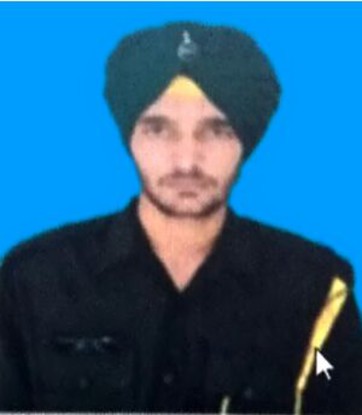
A defence spokesman identified the slain soldier as sepoy Mandeep Singh (23), a resident of Alampur village of Sangroor in Punjab.

He said the Pakistani Army initiated unprovoked and indiscriminate firing of small arms and automatics form 0820 hours in Krishna Ghati sector, resulting in grievous injuries to Singh who later succumbed.

The Indian Army retaliated strongly and effectively, the spokesman said.

The officials said two civilians, Gaura Ram (17) of Kapur R S Pura and Gour Singh (45) of Abdullian, were killed and five others injured in firing by Pakistani rangers along the IB in Jammu district.

A BSF spokesman said cross-border firing was underway in the area from Octroi to Chenab (Akhnoor) in Suchetgarh sector of R S Pura from this morning.

He said the firing in R S Pura sector stopped around 1.30 am but resumed again after four hours.

He said a BSF jawan in Pargwal sector was injured in the heavy firing and shelling and was later hospitalised.

The BSF is retaliating and the exchange of fire between the two sides was underway till the last reports were received.

A jawan of the Sashastra Seema Bal (SSB) was injured in cross border shelling in Jammu, officials said. The jawan, constable Lallu Ram, was evacuated to a nearby hospital and was said to be stable.

The jawan, who belongs to the 14th battalion of the force, was deployed for rendering law and order duties along with the Jammu and Kashmir Police at the Kanachak police station, when he was hit by splinters of a mortar shell that landed in the area.

While a BSF jawan and a teenaged girl were killed on Thursday, four people–two civilians and one BSF jawan and an Army jawan–were killed and over 40 others, including two BSF personnel, injured in the Pakistani firing yesterday.

The heavy firing had forced thousands of border residents to flee their homes and authorities announced closure of educational institutions for three days along the LoC and IB.

Between 8,000 to 9,000 people living along the IB have migrated to safer places and most of them were living with their relatives, officials said.

Over 1,000 people are housed in camps in R S Pura, Samba and Kathua areas, they said. With PTI inputs


Twin surrenders Ashraf Jehangir Qazi
Twin surrenders

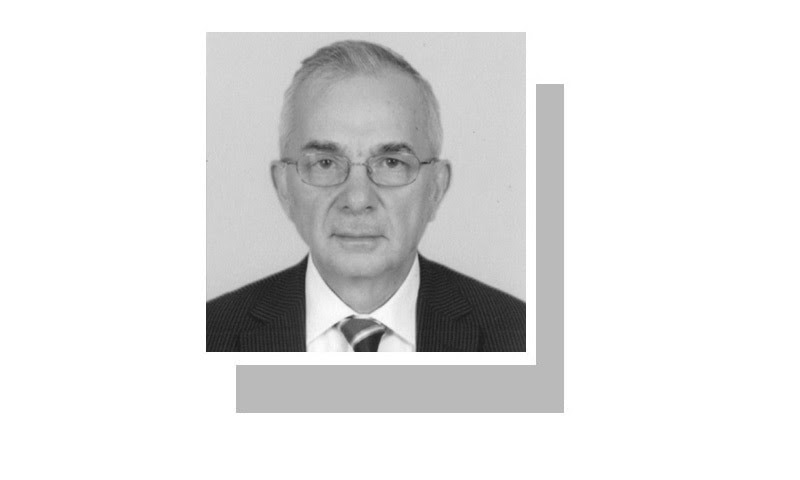
The writer is a former ambassador to the US, India and China and head of UN missions in Iraq and Sudan.

The writer is a former ambassador to the US, India and China and Head of UN Missions in Iraq and Sudan.

THE Nov 26, 2017, six-point agreement between the Faizabad protesters and the government/military was a major setback for the reputation and image of Pakistan.

There are still unanswered questions.

Was it the disqualified boss of the ruling party who engineered this episode to target the military boss? Or was it the other way around?

Whatever the answer, the government finally surrendered its constitutional authority to the military.

The military in turn transgressed its constitutional limits and ‘saved the country’ by conceding the unconstitutional demands of foul-mouthed religious politicians who threatened chaos throughout the country.

The twin messages sent by these twin surrenders are clear: at home Pakistan is for the taking by extremists; abroad it has made a laughing stock of itself.

What more could India ask for?

Pakistan’s national and foreign policy are now without a coherent governmental base.

Accordingly, they have no credibility.

Every ideal and value the Quaid’s Pakistan embodied has been betrayed.

Those who think the country has been saved need only consider: Saved from what? For whom? For how long? At what cost? Firm and just governance has been rendered impossible by corruption, fear and treachery.

The ousted prime minister; his brother in Lahore; the irrelevant current prime minister who cannot even address the nation; the bewildered remnants of the elected government; the opposition parties and their bickering and quarrelling leaders; the pathetic parliament which only produces rupee billionaires and dollar millionaires; the military and its intelligence establishment who wield unauthorized political power without knowledge or wisdom; the police who have been used, abused, discredited and finally betrayed; the bureaucrats — with honourable exceptions; some would also include the judiciary; and those violent opportunists who politically exploit the people’s passionate love for the Prophet (PBUH,) have all brought about this anti-Pakistan farce.Why should India try to destroy Pakistan when the country’s rulers are doing it themselves?

Why should India try to destroy Pakistan when the country’s rulers are doing it themselves?

Last June, the Crown Prince of Saudi Arabia referred to Pakistan as ‘a slave country’.

He can summon the prime minister and the army chief at a moment’s notice — even in the midst of a major domestic crisis.

This same crown prince is supposedly embarking on the path of ‘moderate Islam’ and clean government for his country to enter the 21st century while Pakistan chooses to sink ever deeper into the morass of religious extremism and criminally corrupt governance to stay far away from the 21st century!

Leave India and the US aside.

They are unfriendly countries.

What about China?

What must it think as it beholds the endlessly silly and scary spectacle in Pakistan?

What future can it envisage for CPEC and its strategic partnership with Pakistan?

At the very least, it will feel compelled to have alternative plans.

With religious extremism rampant in Pakistan, what assurances can Pakistan credibly extend to China or any other country with regard to stopping extremists from using its territory against them?

What are the implications of these surrenders for Pakistan’s constitutional, democratic and counterterrorism credentials?

How will an imploding Pakistan elicit support for its promotion of a just and stabilizing settlement process in India-held Kashmir, or effectively call out India for its many documented atrocities?

Learned analyses of Pakistan’s political, security, economic, social and external challenges, and discussions about road maps and timelines for their possible resolution, are all rendered irrelevant by the tragic state it has been reduced to by its rulers and guardians.

Moreover, the country’s elites, who rule without conscience or pity, readily plead their inability to address this situation while doing everything to ensure that it remains unaddressed.

They deliberately rob the people of faith in themselves.

The world sees the situation in Pakistan as not merely ridiculous, but dangerous, since it has a nuclear arsenal, which India and the US will argue has an even higher risk now of falling into the hands of extremists.

They will refer to the latest victory of the extremists over the government and security establishment.

What will Pakistan’s diplomacy — even at its best — avail in the face of such perceptions? Simple dismissals of obvious realities cut no ice at home or abroad.

Given the triumph of religious obscurantism, the politically motivated security establishment, and utterly corrupt and therefore cowardly governance, what can another election achieve even if it is held fairly and leads to a change of faces?

The parameters will still confine any elected government to tinkering on a ship that is sinking.

No amount of charisma, flamboyant rhetoric and heroic posturing will change anything.

What needs to be done is very well known. It is nonsense to suggest it cannot be done because the powers that be are too powerful and the people are imprisoned in low self-esteem and low expectations.

A mobilized, organized, informed and empowered people can get any task done.

They can defeat their indifferent and callous rulers.

All they need is the assistance, advice and participation of concerned Pakistanis.

They do not need anybody’s ‘leadership’ which sooner or later turns out to be just another betrayal.

They need devoted servants.

Pakistan is a poor country with horrible inequality and social indices.

Yet there are no significant pro-poor or progressive parties.

There are only religious, nationalist and populist leaders who are all right-wing, conservative and pro-establishment.

They all talk in the name of the poor and the weak but they walk with the mighty.

Only one national leader, within his limitations and despite his mistakes, has sincerely tried to serve the people.

Most of the rest are corrupt and all of them pander to religious and power centres.

They do not develop sustainable grass-roots movements and mobilization programmes relevant to emancipating and empowering the people.

Accordingly, most “leaders” are not worth addressing.

Only ordinary Pakistanis who still believe in the country that the Pakistan Movement envisaged are worth consulting.

Their varied talents and collective power need to be harnessed for a historic struggle to rid Pakistan of rulers without a cause, other than to escape accountability.

The writer is a former Ambassador to the US, India and China and Head of UN missions in Iraq and Sudan.

Published in Dawn, December 8th, 2017


Commandant’s parade held

Dehradun, December 7

The historic Chetwode Drill Square of the Indian Military Academy in Dehradun on Thursday played host to the commandant’s parade for autumn term 2017.Addressing the Gentlemen Cadets after reviewing the parade, IMA Commandant Lt Gen SK Jha urged them to live up to the Army’s core values of character, competence, commitment and compassion.“These values are reflected in the IMA’s Code of Conduct and Gentlemen Cadets aspiring for high ideals must demonstrate these at all times,” he added.The commandant’s parade marks the culmination of training of 409 Indian and 78 Foreign Gentlemen Cadets from seven friendly foreign countries. — TNS


6 yrs on, Major’s wife awaits DNA report Says she is unsure if mortal remains were that of her husband

Saurabh Malik

Tribune News Service

Chandigarh, August 2

Six years after an Army Major posted in North Glacier died due to “thunderstorm and lightening”, his wife still does not know whether the mortal remains shown to her are that of her husband.The “kara” on the wrist of the deceased was not of Major GS Cheema, his wife Sarabjeet Kaur claims. Her efforts to obtain a DNA report from the Army authorities too have proved futile, compelling her to move the Punjab and Haryana High Court.Taking up the petition against the Union of India and other respondents filed in 2013, Justice Rajan Gupta asserted it was inexplicable why the widow of a deceased Major had to knock the High Court doors merely to find out whether the mortal remains sent by the Army authorities were that of her husband. He also questioned the undue delay in furnishing the DNA reportCounsel for the Union of India submitted that the original record would be placed before the Bench on the next date of hearing in August.Granting an opportunity for the purpose, Justice Gupta asserted the Chief of the Army Staff may depute a responsible officer to remain present in court on the next hearing for enabling him to assist the counsel representing the Union of India.“This court shall also be apprised of procedure for identifying mortal remains in case a soldier dies in remote, inaccessible and hostile terrain, whether immediate steps are undertaken for DNA profiling for identifying bodies of such soldiers in case they die in combat, disease, natural calamity or any other reason,” Justice Gupta added.The Bench was earlier told that Major Cheema was stated to have died while he was posted at Ashoka Post in North Glacier. Serving in the 6th Armoured Regiment, he was sent on attachment to 13 Mahar for a year with effect from May, 2011, and thereafter deputed to Ashoka Post in 2011. Justice Gupta said records indicated that a fire had broken out at Ashoka Post on July 20, 2011. The Army’s stand was that Major Cheema had died in a thunderstorm. The mortal remains of the deceased were shown to his wife, but she did not accept these for lack of proof.


Confusion over death

  • Major GS Cheema was stated to have died while he was posted at Ashoka Post in North Glacier
  • The Army claims he died in a thunderstorm/lightening
  • But records indicate that a fire had broken out at the post in the evening of July 20, 2011

Army chief should not give sermons on education: J&K

No society accepts sermons on education from non­academicians. Separatism would not be anywhere if army does its job well. ALTAF BUKHARI , J&K education minister

SRINAGAR: The Jammu and Kashmir government on Saturday lashed out at Army chief Bipin Rawat over his remarks about Kashmir schools, saying the ‘well-decorated officer’ should not give sermons on issues that are not his domain.

The state government’s retort was in response to Rawat’s statement that schools in the state were teaching two maps — India’s and Jammu and Kashmir’s — to the students, which he said was radicalising youth.

Rawat’s statement was criticised on social media with many pointing out that students in all schools in the country are taught about the two maps, the country’s and the state’s.

“The army chief is a respected and well-decorated officer of this country. He is a professional. I have no doubt on his professionalism. But I don’t think he is an educationist that he will give sermons on education,” state education minister Altaf Bukhari said. “I don’t think any society accepts sermons on education from nonacademicians,” he added.

Bukhari said education was a state subject and “we know how to run our education system”.

“There are two flags, we have a state constitution (owing to the state’s special status), and maps are in every state. Every school in every state has a state map because you explain it to them,” Bukhari said. “Separatism would not be anywhere” if army does its job well, he said.

“I will be very happy if they do what they are supposed to do and leave us what we are supposed to do. They have a responsibility. Let them do their responsibility (sic). If they do their job well, all problems will be solved,” Bukhari added.


Seductive charm of ultra-nationalism

Our political discourse has inflamed the justified public anger at Pakistan’s misdemeanours, with an eye on electoral gains, thereby making our Pakistan policy hostage to the most strident voices often promoting simplistic responses to complex foreign policy problems.

Seductive charm of ultra-nationalism
Right leaders like Trump seeks to reverse the process of global economic integration and freer flow of people across borders.

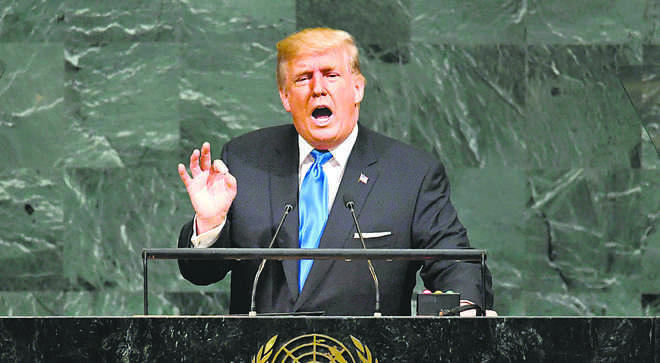
In his UN General Assembly speech last month, President Trump mentioned the words ‘sovereign’ and ‘sovereignty’ multiple times and spoke of a coalition of nations that embrace sovereignty to promote security, prosperity and peace for themselves and the world. However, his threatening language against North Korea, Iran, Cuba and Venezuela left no doubt that he was not announcing an American withdrawal into its sovereign shell, while letting other countries do as they pleased within theirs. His intent instead was to burnish his ultra-national credentials by emphasising the unbridled sovereign right of the United States to pursue its interests as, of course, defined by his parochial vision. He thus stated that he would always put America first, while paying lip service to the right of other leaders to put their countries first. Ultra-nationalism — extreme advocacy of the interests of a particular nation regardless of its effect on others — today holds sway not only in the US, but also Russia, China and Turkey and has come to increasingly characterise the strategic discourse in India. Extreme right wing parties, with an ultra-nationalist outlook, have gained ground in Europe, most recently in Germany. Trump did not explain how his idea of every country putting its interests first would square with the objective of security, prosperity and peace for the world, more so if every country defined its interests as narrowly as him. There would be no room for a spirit of compromise to promote and sustain a stable world order. How ultra-nationalism poses a threatUltra-nationalism of the Trump brand and the chauvinism accompanying it pose a threat to global stability in more ways than one:Space for rational foreign policy choices constricted: Firstly by encouraging bellicose discourse against real or perceived enemies – external and in many cases internal (such as particular religious or ethnic groups and immigrants). In his UNGA speech, Trump threatened North Korea with total destruction. He thus stood the sterling counsel of Theodore Roosevelt “Speak softly and carry a big stick” on its head, not because the Americans do not have the military capability to destroy North Korea, but the dangerous implications of such a move. Even if one were to ignore the possibility of North Korea, faced with complete annihilation, lobbing a nuclear bomb or two in its neighbourhood, such pronouncements would only make Kim Jong-un speed up his nuclear weapons programme. To be sure, leaders, have to make some tough statements to respond to public anger against annoying situations. However, it becomes a different ball game altogether when instead of being regarded as means to channelise public anger into rational approaches, such statements are used by ultra nationalist leaders to fuel  the anger for political gains. Thus, in recent years, our political discourse has inflamed the justified public anger at Pakistan’s misdemeanours, with an eye on electoral gains, thereby making our Pakistan policy hostage to the most strident voices.Promotes simplistic responses to complex foreign policy problems: During his campaign, President Trump promised to build a “great, great wall” on the Southern border and have the Mexicans pay for it to check immigration and drugs smuggling. The Mexicans have flatly refused to pay and the President now seeks funding from the Congress in the fond hope that the Mexicans would reimburse the cost later on. Trump also gave a simplistic twist to the US- Russia relations by asserting that under his Presidency, the US would not have the kind of problems with Vladimir Putin that it had under Obama, without giving a cogent explanation for his optimism. No wonder that his Russian agenda has gone completely haywire within his first few months in office. At home, the populist slogans of “Terror and talks cannot go together” and “Biryani vs muscular diplomacy” towards Pakistan have led to unravelling of the 2003 ceasefire and periodic killings on both sides of the LoC/International Border in the J&K sector. Facile and populist slogans invariably lead to unintended consequences. 3 Ultra-nationalist leaders present themselves as the best appraisers and defenders of national interest: Tactical gains are often described as strategic victories to sustain this image, thereby unduly raising public expectations. Trump declared in his inaugural address that under him, it would be ‘America first’, as if it was not so under his predecessors. He has described the recent tactical Pakistani move of securing the release of a Canadian-American family from the Haqqani network as the beginning of a much better relationship with Pakistan and its leaders. Vice-President Pence listed it amongst the President’s accomplishments to conclude that he is “achieving real results on the international stage”! Likewise, the brave surgical strikes mounted by our army after the Uri attack, though a legitimate tactical move to punish Pakistan’s criminal action, were sought to be presented in our ultra-nationalist discourse as the ultimate answer to our Pakistan problem, which they were not. Leaders try to give xenophobic answers to the economic hardships faced by their people: In a world, comprising sovereign nations, each putting its interest first, peace and prosperity can be promoted only within a framework in which the countries concerned see some gain for themselves. Ironically, Trump, who envisaged such a world in his speech, has been quick to rescind certain carefully crafted agreements that provided such a framework. He has pulled the US out of the Trans-Pacific Partnership, threatened to withdraw from NAFTA, expressed his intention to withdraw from the Paris agreement on climate change and virtually scuttled the Iran nuclear agreement by refusing to certify that Iran is complying with all its terms. He and the leaders of right/ ultra-right wing parties in Europe seek to reverse the process of global economic integration and freer flow of people across borders by giving protectionist and xenophobic answers to the economic hardships faced by their people and the wave of terrorism that has hit some European countries.The problems of economic downturn, unemployment, terrorism and irresponsible behaviour of states such as Pakistan and North Korea are real, but ultra-nationalism is not the answer to them. Its spread will make the world a more dangerous place to live in.The writer is former High Commissioner to Pakistan and former CIC.