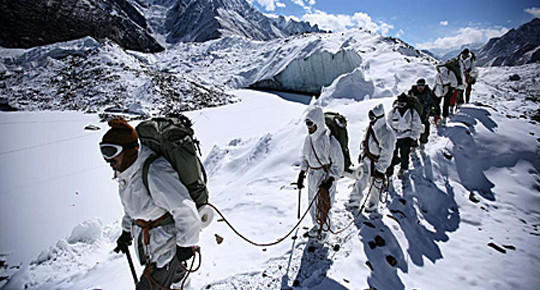
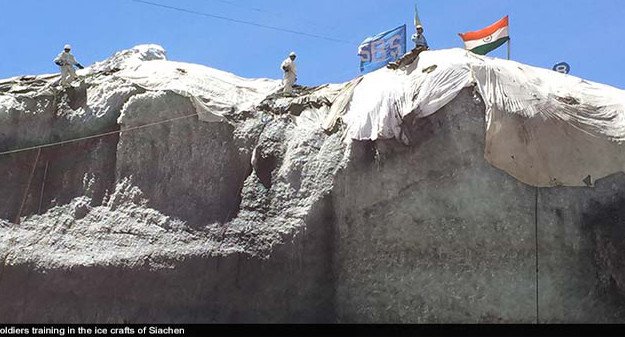
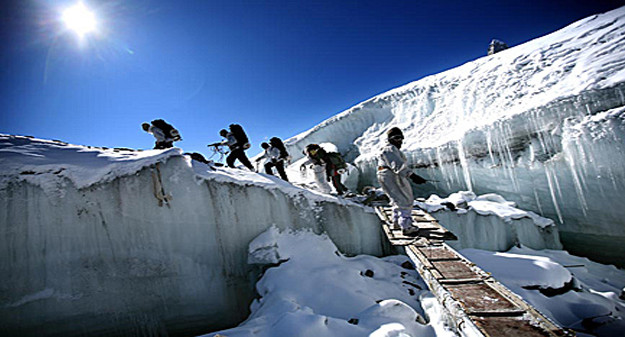
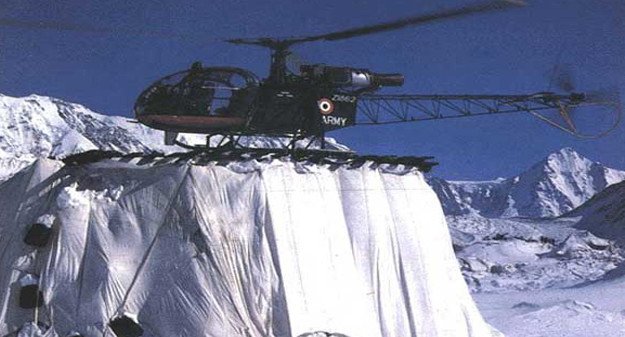
Soldiers perform Yoga on 2nd International Yoga Day in Siachen. Siachen is strategically important because so long as it is in India’s control, the Pakistani army can’t link up with the Chinese and pose a threat to Ladakh.(File photo: PTI)
Mooted by army chief, General Bipin Rawat, the proposal to give civilians access to the glacier is at an initial stage but is being considered seriously, one of the officers cited above said on condition of anonymity
The Indian Army is examining a proposal to allow civilians to visit the world’s highest battlefield, the Siachen glacier, to gain first-hand experience of the tough conditions in which soldiers operate, two senior army officers said on Tuesday.
Mooted by army chief, General Bipin Rawat, the proposal to give civilians access to the glacier is at an initial stage but is being considered seriously, one of the officers cited above said on condition of anonymity.
Siachen is strategically important because so long as it is in India’s control, the Pakistani army can’t link up with the Chinese and pose a threat to Ladakh. It acts as a wedge between the Shaksgam Valley under Chinese control and Baltistan, which is occupied by Pakistan.
“We are examining how the proposal can be implemented, the logistics involved and areas that can be opened to the public. We are looking at the possibility of allowing people to visit the Siachen base camp and some nearby posts,” said the second officer, asking not to be named. Since 2007, the army has been conducting a civilian trek to the Siachen glacier every year.
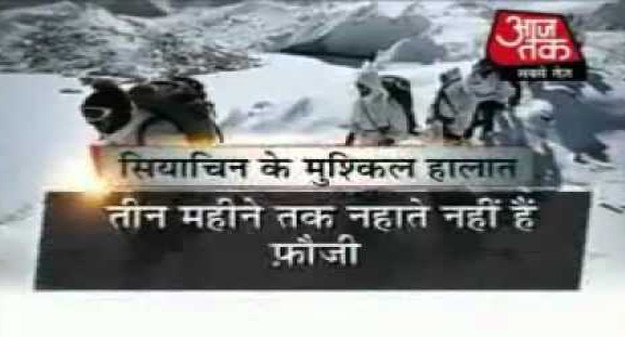
India, which spends Rs 5 to Rs 7 crore daily on guarding the glacier, has deployed around 3,000 soldiers at Siachen, where temperatures can drop to minus 60 degrees Celsius. More than 1,000 soldiers have died guarding the area since the army took control of the inhospitable glacier in April 1984, almost twice the number of lives lost in the Kargil war. While about 220 men have been killed in firing from the Pakistani side, the other casualties have been caused by extreme weather and treacherous terrain.
Guns have been silent on the glacier since the November 2003 ceasefire between India and Pakistan.
Experts welcomed the move to give civilians access to the glacier, stressing that it will give them a better understanding of India’s national security challenges.
“It will be a capability demonstration for the people of the country. They will appreciate how our brave troops are trained to fight in any kind of terrain and also the challenges they encounter daily,” said former Northern Army commander, Lieutenant General BS Jaswal (retd).
Soldiers have to trek for almost 28 days, covering a stretch of 128km to reach some of the farthest pickets on the glacier, one of the most desolate places on the planet.
Former army vice chief, Lieutenant General AS Lamba (retd), said the move will allow people to comprehend the complexities of guarding the country’s farthest frontiers at any cost. “It will also create a new sense of integration of these remote areas to the rest of the country,” Lamba added.
The Indian Army launched Operation Meghdoot in April 1984 to secure the glacier after the Pakistan army occupied the heights at Siachen, a 76km river of slow moving ice. Almost 80% posts on the glacier are located above 16,000 feet, with Bana towering above the rest at 21,753 feet.
Islamabad has made repeated demands for demilitarising the glacier, invoking long-term peace but India has taken a cautious approach on the sensitive issue. Several rounds of talks between India and Pakistan on demilitarising the glacier — a contentious issue in bilateral ties — have failed, with Islamabad refusing to authenticate troop positions on the ground.
Imran Khan assures multiple on-arrival visas for Sikhs
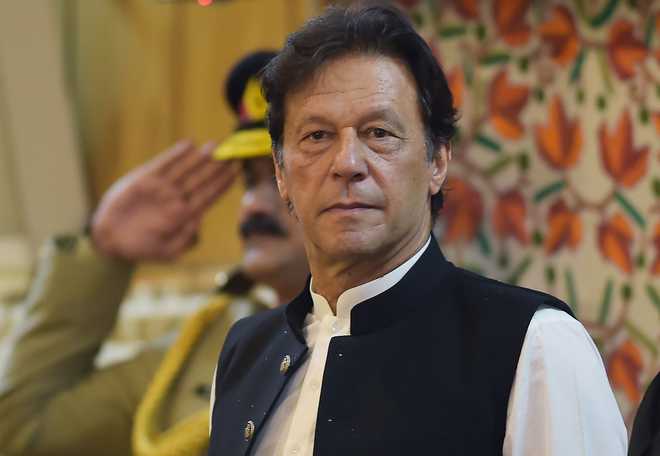
Pakistan Prime Minister Imran Khan announced that his government would issue multiple and on-arrival visas to Sikh pilgrims coming from India and abroad and provide them maximum possible facilities during their visit to the holy sites.
“I assure that you will be issued multiple visas… This is our responsibility. We will facilitate you rather will give you visas at airport,” The News International quoted Khan as saying on Monday while addressing the International Sikh Convention at the Governor House here.
“(We) will give you multiple visa to facilitate your journey,” he added.
The convention was attended by Punjab Governor Chaudhry Sarwar, federal and provincial cabinet members, and Sikh pilgrims from the UK, the US, Canada, Europe and other countries.
The Prime Minister said after coming into power, his government realized the difficulties faced by foreigners to get Pakistani visas intending to visit the country for pilgrimage or tourism.
“Though our government has changed the visa regime, the mindset of creating hurdles will gradually diminish,” he added.
Monday was the last day of the convention, which began on August 31, on the initiative of the Punjab Governor aimed at inviting suggestions regarding preparations for the 550th birth anniversary celebrations of Guru Nanak Dev, the founder of Sikhism, at the gurdwara in Kartarpur Sahib in November.
Indian Sikh pilgrims along with thousand others from across the world will visit the gurdwara in Pakistan’s Punjab province, where Guru Nanak Dev spent his final days.
All for nothing: If Trump does decide to fully pull out before the 2020 presidential elections, the Americans could well be forced to leave ignominiously.
G Parthasarathy Former diplomat
It now is evident that President Trump is determined to sign a virtual surrender document with the Taliban. This would permit him to ensure that there is no US combat military presence in Afghanistan when America goes for presidential elections, scheduled for November 3, 2020. Trump’s electoral support, drawn predominantly from a White Caucasian base, would like all their ‘boys’ back home to celebrate Christmas next year.
Figures show that US casualties from 2003 to 2018 were 2,372 killed and 20,320 wounded while an estimated 1.10 lakh Afghan soldiers and civilians paid with their lives. Is this example of the US entering conflicts and leaving the conflict zone without a decisive outcome something new? The Vietnam Conflict ended with an ignominious US withdrawal from South Vietnam. The then US ambassador, Graham Martin, was evacuated by helicopter from Saigon after North Vietnamese forces entered the South Vietnamese capital. An estimated 1.8 million Vietnamese were dead. US casualties were 31,952 killed and 2 lakh wounded.
Vietnam was united under Communist Party rule, which continues. But Vietnam did not become, as the US feared, a Communist Party ruled, Soviet/Chinese satellite. Vietnam has a close strategic relationship with the US today, aimed at containing Chinese expansionism in the South China Sea. This, after the Vietnamese gave the Chinese a bloody nose in 1979, when Deng Xiaoping promised to teach Vietnam a ‘lesson’ and invaded Vietnam.
One looks back at the Iraq conflict with similar sentiments. President Saddam Hussein was backed by the US during the Iran-Iraq war. The US, thereafter, forced Iraq to withdraw after it invaded Kuwait in the first Gulf War in 1990-1991. While the Iraqis reportedly lost about 1 lakh soldiers, US casualties were 383 killed. The Second Gulf War in 2003, based on false US allegations that Saddam was producing nuclear weapons, resulted in around 1.1 lakh Iraqi deaths. While Saddam, a Sunni, was anti-Iranian, the present Shia-dominated Iraq government avoids involvement in Arab-Iranian sectarian rivalries. US participation in conflicts has seldom produced the desired results.
Much has been written about Trump’s assertion during Imran Khan’s visit that Modi asked him to mediate on Kashmir. The Washington Post revealed last month that Trump had made 10,796 misleading statements since he assumed office in 2017! New Delhi has, therefore, been restrained in responding to his falsehoods, recognising that Trump has similarly offended countries like Canada and Mexico and European allies like France, Germany and Japan. He has no respect for international treaties like FTA, WTO guidelines, climate change and international agreement on Iran’s nuclear programme. The only ‘leader’ that Trump appears to admire is North Korea’s Kim Jong-un, who is not exactly a champion of democratic values!
It is too early to conclude how realistic Trump’s belief is that he can persuade Imran Khan, and more importantly, General Bajwa to facilitate a smooth withdrawal of US forces. Trump has bent backwards to please the Taliban and snub the elected government of President Ashraf Ghani, with presidential elections in Afghanistan scheduled for September this year. The Afghan army is, meanwhile, suffering huge casualties. Pakistan has moved deftly to persuade China, Russia, Turkey, Iran and Qatar to follow the US example of placing the Taliban and the Ghani government on the same pedestal. But Ghani has little prospect now of seriously influencing US policies.
The Taliban should not be regarded as omnipotent. It is an exclusively Pashtun organisation. Pashtuns constitute about 40% of Afghanistan’s population. The Taliban is tenacious, but survives with Pakistan’s patronage. Moreover, large sections of Pakistani Pashtuns, especially in the tribal areas bordering Afghanistan, are affiliated to groups like Tehrik-e-Taliban and Pashtun Tahafuz Movement, comprising Pashtuns with nationalistic inclinations, with scant regard for the Durand Line. These Pashtuns, on both sides of the disputed Line, will not take kindly to coercive Pakistani military actions against their brethren. With the exit of US troops, many Afghan Pashtuns are not likely to be responsive to Pakistan army’s demands to end their backing of Pakistani Pashtun brethren living across the disputed border.
Over the past two decades, India has won substantial goodwill across the ethnic divide in Afghanistan by adopting a non-interfering approach to developments within Afghanistan. The Taliban has never had a comfortable relationship with minority communities like Tajiks, Uzbeks, Turkmen and Shia Hazaras. Pashtun leaders like former President Hamid Karzai and Tajik leaders like Governor of Balkh province Atta Mohammad Noor and former Afghan intelligence chief Amrollah Saleh, regard India as a trusted friend. India’s economic and educational assistance to Afghanistan has won widespread regard. It would, however, also be prudent to keep channels of communication with the Taliban open.
Much is now dependent on how Trump plays out his withdrawal schedule. There are pressures from the State Department and the military to avoid a precipitous withdrawal and retain a residual presence. If Trump decides to fully pull out before the elections, the Americans could well be forced to leave Afghanistan ignominiously. If they phase out withdrawal and give time to the Afghan National Army and ethnic militias to be armed and trained, they would have created a credible force to face the Taliban. Finally, if southern Afghanistan is destabilised, Pakistan’s own stability will face challenges.
What’s Next for U.S-Pakistan Relations After Imran Khan’s U.S Visit?
Imran Khan made a historic visit to the US and was successful in persuading White House of his commitment towards peace in the region. Washington didn’t ask Islamabad to do more this time but calling this a reversal of the US-Pak relations is far-fetched. There is still much more to do.
Michael Kugelman July 29, 2019
For proponents of the U.S.-Pakistan partnership, there’s much to be heartened about after Prime Minister Imran Khan’s recent visit to Washington.
There were smiles and kind words all around as he met with senior officials from across the U.S. government spectrum, including President Trump. Other members of Khan’s delegation, including Army Chief Qamar Javed Bajwa, met with critical stakeholders as well.
Understandably, optimism broke out in Islamabad following what the Pakistani government rightly proclaimed a successful visit. Upon returning home, a euphoric Khan declared that he felt “not as if I have returned from a foreign trip, but as if I have returned after winning” the cricket World Cup.
U.S.-Pakistan relations have come a long way, especially given their dreadful state during the Trump administration’s early months. Still, it’s important not to overstate the improvements in the relationship. Khan’s visit cemented the two sides’ deepening cooperation in Afghanistan, as Washington rapidly pursues a deal with the Taliban to give President Trump the cover he needs to announce a troop withdrawal.
But beyond Afghanistan, the obstacles to greater cooperation remain considerable. It’s worth examining these obstacles in detail, and also what we can expect this slowly stabilizing but a still-volatile partnership to look like in the coming weeks and months.
Continued Constraints to Cooperation
A core challenge is reconciling an expectations disconnect. Islamabad is keen for a reset and broadening of the relationship, while Washington—even after Khan’s successful visit—remains fixated on orienting the relationship around reconciliation in Afghanistan and Pakistan-based terrorism. The Trump administration has stated that there is potential for cooperation beyond these two issues, but only after Washington sees Pakistan making more progress addressing them. And on this count, it will be a tall order for Islamabad to deliver in ways that Washington would like.
COAS General Qamar Javed Bajwa paying tribute to martyred US soldiers at Arlington cemetery
Afghanistan may be the easier nut to crack. U.S. officials want Islamabad to convince the Taliban to agree to a ceasefire and to negotiate directly with Kabul. That’s a mighty big ask, given that the insurgents—who enjoy ample leverage in talks thanks to all the territory they hold and a lack of urgency, relative to Washington, to get a deal—have plenty of incentive to say no.
Washington’s message is simple. Pakistan expunged Pakistan Taliban why it can’t also target the Afghanistan- and India-focused militants on its soil as well
Still, after seven rounds of U.S.-Taliban talks and a recent intra-Afghan dialogue that produced a roadmap for peace document, there is unprecedented momentum. So, Islamabad may be able to make some headway—though it won’t be easy.
The terrorism issue is trickier. U.S. officials haven’t been satisfied with Islamabad’s recent crackdowns, which have included the arrests of dozens of militants and closures of their facilities. The White House is looking for what it describes as “irreversible” steps against the entire terrorist infrastructure. It includes the prosecution and convictions of top terrorist leaders and the dismantling of all training facilities and financial networks.
Pakistan may be under pressure to crack down heavily because of pressure from the Financial Action Task Force, the terrorist financing watchdog, but U.S. officials remain skeptical. Even if there is progress on Afghan reconciliation, Washington will remain relentless in pressuring Pakistan on the terrorism front.
Indeed, for many U.S. policymakers, this is an emotional issue. A fervent belief motivates these officials that Islamabad has long been complicit in cross-border attacks, carried out by Pakistan-based militants, on U.S. troops in Afghanistan. Trump administration officials have stated that the president’s principal foreign policy goal is to protect Americans overseas. That position, in line with Trump’s “America First” strategy, suggests that Washington won’t ease up on the pressure until it’s satisfied that Americans in Afghanistan are no longer threatened by militants in Pakistan.
Washington’s message is simple. Pakistan demonstrated it has the will and capacity to expunge anti-state terrorism, given its admirable efforts to all but eliminate the Pakistani Taliban threat, so there is no reason why it can’t also target the Afghanistan- and India-focused militants on its soil as well.
Washington understands that Islamabad faces risks in targeting the latter types of militants as opposed to the anti-Pakistan ones—from alienating valuable assets to provoking blowback against the Pakistani state—but this won’t make U.S. policymakers less insistent that they are targeted in irreversible ways. To be sure, however, progress in Afghanistan leading toward a peace deal may ease these terrorism-related tensions.
If the Taliban and its allies are no longer fighting U.S. troops, then the threat to Americans from Pakistan-based, Afghanistan-focused militants would become moot. However, the issue of India-focused militancy—another core U.S. concern—would remain salient.
All this said, imagine that Islamabad helps produce a deal in Afghanistan and takes counterterrorism steps that satisfy Washington. Even then, U.S.-Pakistan relations would face significant constraints due to geopolitics. Indeed, one can’t overemphasize enough the fundamental policy divergences between the two countries. These divergences are encapsulated by Washington’s rapidly growing security ties with New Delhi and Islamabad’s alliance with Beijing.
Despite some recent bumps in these relationships—from Beijing’s concerns about the safety of Chinese workers in Pakistan to worsening U.S.-India trade tensions—the overall trend lines for these partnerships remain strongly positive. In effect, Washington and Islamabad enjoy deep partnerships with each other’s main adversary. They are also each pursuing foreign policies in Asia that depend heavily on these partnerships, and that goes against the other’s interests.
The Trump administration has taken a hard line on Beijing, America’s top strategic competitor. Significantly, the Trump White House’s first national security strategy, which was released in 2017, described strategic rivalry—not terrorism—as America’s biggest national security threat. This suggests that for Washington, Beijing isn’t a mere competitor; it’s an all-out threat. Not surprisingly, the Trump administration’s Asia policy—its Indo-Pacific strategy—revolves around pushing back against China, with hoped-for assistance from India. Meanwhile, Islamabad’s core policy involves undercutting India in the region, with Beijing’s support.
These geopolitical realities mean we’re unlikely to see the kind of moves that could help strengthen U.S.-Pakistan relations. Washington isn’t about to press New Delhi to ease up on its repressive activities in Kashmir, or—despite President Trump’s recent offer—to position itself as a mediator in that dispute, one that New Delhi believes is non-negotiable. Similarly, Islamabad isn’t about to shut down the CPEC enterprise or curtail Chinese influence in Pakistan.
Khan’s visit cemented the two sides’ deepening cooperation in Afghanistan, as Washington rapidly pursues a deal with the Taliban to give President Trump the cover he needs to announce a troop withdrawal
Additionally, these problematic geopolitical realities preclude the ability of Washington to regard Pakistan as a nation worth engaging more broadly because of the critical strategic player that it is—thanks in significant part to its size, location, and key bilateral partners.
At the very least, figuring out how to square this circle—how to deepen a partnership despite a geopolitical state of affairs heavily stacked against it—will require a lot of bilateral discussions, and over a long period of time. This is another obstacle for U.S.-Pakistan relations: The Trump administration, unlike its predecessor, is not a fan of the extended, careful, and private dialogue that can encourage new thinking and help build up much-needed goodwill and trust (it bears mentioning that in Washington, many policymakers’ views of Pakistan remain hostile and jaded, despite increased bilateral cooperation on Afghanistan). Instead, it prefers transactional diplomacy and summitry.
What’s Next?
What, then, can we expect for U.S.-Pakistan relations, given the genuine improvements in recent months coupled with the major constraints? In the coming weeks, expect bilateral ties to enjoy more wins amid intensified efforts to get a deal in Afghanistan. Some goodwill gestures, meant to signify each side’s commitment to partnering with the other in the Afghan peace process, are likely to ensue. Several such moves—Islamabad’s (latest) arrest of Jamaat-ud-Dawa leader Hafiz Saeed and Washington’s decision to provide $125 million in technical support for Pakistan’s F-16 fleet—have already been made.
Future steps might include easing up on restrictions imposed on the movements of each other’s foreign diplomats or intensifying the frequency of bilateral consultations under the Trade and Investment Framework Agreement (TIFA).
Further afield, if—and that’s a big “if”—Pakistan helps get a deal in Afghanistan and sufficiently addresses Washington’s concerns about terrorism in Pakistan, the relationship could experience a dramatic boost. Under this scenario, Washington would likely unfreeze its suspended security assistance to Pakistan and resume some broader security cooperation. This may include sharing intelligence on the movements and locations of regional terror threats—such as ISIS—that both sides view as threats, and that would not be a party to any peace deal in Afghanistan.
Additionally, the two sides may aim to expand their trade relations, which totaled nearly $7 billion last year—a new record. Based on recent White House statements, Washington may be particularly inclined to ramp up energy trade, and specifically LNG.
Prime Minister Imran Khan meeting with President Trump in White House
Perhaps the biggest medium-to-long-term question for U.S.-Pakistan ties is the impact of a U.S. troop withdrawal from Afghanistan on the bilateral relationship. On the one hand, with no more American soldiers in Afghanistan, a core reciprocal tension point—Pakistan’s role in the Taliban insurgency and its complicity in attacks on Americans—could wither away.
At the same time, if U.S. troops leave before the Taliban has agreed to stop fighting, the troubling spillover effects in Pakistan of a rapidly destabilizing Afghanistan could generate accusations in Pakistan of Washington’s having abandoned the region once again; just as it did after the Soviet withdrawal from Afghanistan several decades ago.
Furthermore, imagine if Washington, with no more troops in Afghanistan and therefore unencumbered by the risks to U.S. forces there if Islamabad retaliates harshly to hardline U.S. moves, tries to tighten the screws on Pakistan in order to compel it to crack down harder on the India-focused militants on its soil.
COAS General Qamar Javed Bajwa meeting with the US top security officials
The future trajectory of U.S.-Pakistan relations; much like that of the Afghanistan quagmire to which those relations are firmly tethered, is riven with uncertainty. There is potential for growth, but how much is unclear. Likewise, significant constraints will remain, but how severe they will be is unknown.
Ultimately, the relationship’s challenges amplify the importance of two core nonofficial (that is, non-government) components of the U.S-Pakistan partnership—the U.S.-based Pakistani diaspora and the U.S. and Pakistani private sectors. If given the proper incentives, the Pakistani diaspora and American and Pakistani companies can—through stepped-up investment, joint ventures, and other forms of engagement—help bring more trust and goodwill to a formal relationship, severely lacking in both.
In fact, those proper incentives are already emerging: Consider the diaspora’s enthusiasm for Imran Khan, and the increasing market and investment opportunities afforded by Pakistan’s young population and improved security situation.
The U.S.-Pakistan relationship can likely only go so far. Still, its relative growth potential is real—and especially if each side taps into underutilized resources outside the official partnership.
The article appeared in the Global Village Space on 29 July 2019
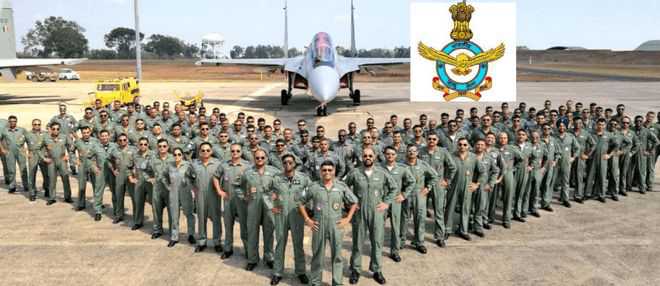
Deputy Commissioner Sandeep Hans on Wednesday called upon the youth from the district to participate in the upcoming recruitment rally of the Indian Air Force (IAF) which will be held at the Punjab Armed Police Grounds in Jalandhar on August 5.
The Deputy Commissioner said Moga was among the 12 districts in the state selected for the recruitment rally being held for posts under Group ‘Y’ (non-technical) (automobile tech and IAF police).
Sandeep Hans said the youth who were born between July 19, 1999, and July 1, 2003, could participate in this rally. He said physical fitness test and written test for youth of the district would be held on August 5 and their adaptability test I & II would be held on August 6.
Indian Army set to take on Russia, China, others in sniping, mountain warfare challenges
A 9-member Army team will take part in Sniper Frontier Competition in Belarus, while an 18-member team will compete in mountain warfare in Russia.
New Delhi: The Indian Army’s sniping and mountain warfare teams are all set to participate in next month’s International Army Games to be held in Belarus and Russia.
The first team, which will participate in the Sniper Frontier Competition in Belarus, comprises nine members.
The second team, comprising 18 members, will compete in a mountain warfare event in Russia. Called the Elbrus Ring Competition, the event will be 13-day long, involving traversing over 95 km in hilly terrain with mountain passes over 3,500 m and navigating through glaciers and streams.
Army sources said both the teams have undergone intense training ahead of their participation.
“The Army would not be carrying their own Dragunov sniper rifles for the (Sniper Frontier) competition. They would be provided sniper rifles there. It would provide parity to all the participating countries,” said an Army officer who didn’t wish to be named.
The team for the second event has trained with the Indian Mountaineering Federation and High Altitude Warfare School, said the officer.
While the Sniper Frontier Competition will see 23 participating nations, including China and Russia, the Elbrus Ring Competition will have 11 competing countries. Last year, the Sniper Frontier Competition was held in Kazakhstan.
The International Army Games 2019 will be held across 10 countries including Russia, India and China, in August. It is organised by Russia’s Ministry of Defense and has been held annually since 2015, with participation from around 32 countries.
As part of the Games, India is hosting the fifth edition of the Army Scout Masters competition, set to begin on 5 August. Eight teams, including India, will participate. Foreign military teams have already arrived in Jaisalmer for the event.
Speaking to ThePrint, another senior Army officer said such competitions are of immense training value and their progress is closely watched by the headquarters.
“Not only do such competitions involve a rigorous selection and training process, which helps in honing their skills and tests the physical and mental robustness of the participating team members, the teams also get to learn best practices and techniques from other foreign armies,” said the second officer.
“For instance, sniping in buddy teams was a late inclusion in the Army after it was seen that it was practised in many armies,” the officer added.
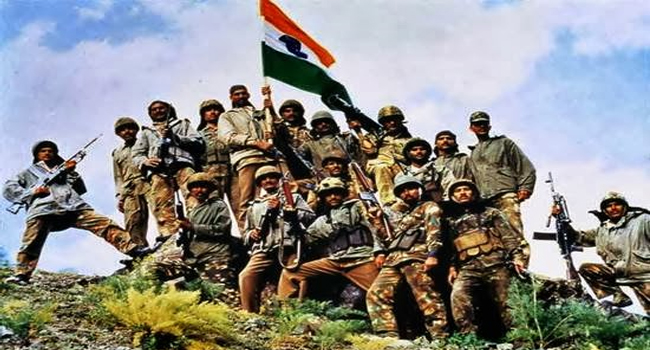
For Rifleman Kuldeep Singh (retd), who had served 13 Jammu and Kashmir Rifles unit of the Army during the Kargil war, serving the nation in a war is the proudest moment.
Hailing from the Pallanwala area of Akhnoor in Jammu district, the ex-Rifleman was invited by the National Cadet Corps unit of Government MAM College here today for celebrations of the 20th anniversary of Kargil Vijay Diwas. “I joined the Army in 1998 and got the opportunity to serve in the battlefield in one-year of my job. Our 13 JAKRIF was entrusted with the task of capturing the Tololing peak, a dominant position overlooking the strategic Srinagar-Leh highway. The three-week battle of Tololing was one of the turning points of the Kargil war,” he said.
“We suffered many casualties, including Major Ajay Jasrotia and Captain Vikram Batra, but were determined to oust the enemy from our territory,” he recalled.
ASHINGTON/NEW DELHI: Some 40,000 trained militants with experience of fighting in Kashmir and Afghanistan are based on Pakistani soil, Prime Minister Imran Khan admitted on Tuesday night, but added his country cannot be blamed for the Pulwama suicide attack as it was carried out by a Kashmiri youngster.
Khan acknowledged the presence of the large number of militants in his country during an interaction at the US Institute of Peace, a Washington-based think tank funded by the US Congress. Khan contended his government was being backed by the powerful military in efforts to disarm the militants.
Asked about his government’s efforts to crack down on terrorist leaders such as Lashkar-e-Taiba (LeT) founder Hafiz Saeed and banned groups such as the Jaishe-Mohammed (JeM), which claimed the Pulwama attack that killed 40 Indian troopers and triggered a face-off between the two countries, Khan sought to create the impression that the suicide bombing was the work of a local affected by the situation in Kashmir.
People familiar with the developments in New Delhi reacted to Khan’s remarks by saying the Pakistani leadership continues to refuse to accept the Pulwama bombing as an act of terrorism. “JeM claimed responsibility and the group and its leader Masood Azhar are based in Pakistan,” said a person who did not want to be named.
Khan contended his government was the first to decide that there would be no armed militias inside Pakistan. “Until we came into power, the governments did not have the political will,” he added.
Army monitoring Chinese activities in Doklam: Defence Ministry report
India and China have reduced their presence on the Doklam plateau post the disengagement in 2017, but the India Army is monitoring Chinese activities in the area and is adequately prepared to respond to any contingency, the Defence Ministry said in a report.
The 73-day Doklam standoff, which began on June 16 in 2017, over PLA’s plans to build a road in area claimed by Bhutan, ended on August 28 following mutual agreement between India and China. (photo credit: Reuters)
India and China have reduced their presence on the Doklam plateau post the disengagement in 2017, but the India Army is monitoring Chinese activities in the area and is adequately prepared to respond to any contingency, the Defence Ministry said in a report.
In its annual report 2018-19, the ministry also said that Pakistan should take “credible and irreversible” steps to stop supporting terrorists and terror groups operating from territories under its control and dismantle infrastructure operated by them.
It said India will continue to take “robust and decisive” steps to ensure its national security.
Following the disengagement on August 28, 2017, after a 72-day standoff at Doklam, Indian and Chinese troops were redeployed away from their respective positions.
This year, the number of Chinese transgressions have considerably reduced, so has the faceoffs, aggressive interactions during such instances.
“(But) the Indian Army is continuously monitoring Chinese activities in the area and is adequately prepared to respond to any contingency,” the defence ministry report said.
It noted that the situation along the India-China border has remained peaceful.
There are a few areas along the border where there are differing perceptions of the Line of Actual Control. Both sides patrol up to their respective perceptions of LAC, it added.
The standoff at Charding-Ninglung Nallah (CNN) junction in eastern Ladakh due to the construction of a benign track and the constant raising of construction of a temporary operating base in Arunachal Pradesh by India were the only two instances where there was a major difference of opinion between the two sides.
“Compared to last year, the number of transgressions this year has considerably reduced. Concomitantly, the percentage of faceoffs/aggressive interactions during these transgressions has also reduced this year.
“Post Wuhan Summit, there has been an increase in the number of flag meetings. This may be attributed to the intent of resolving outstanding issues through discussions at various levels,” the report said.
In 2018, Prime Minister Narendra Modi and Chinese President Xi Jinping had an “informal” summit meeting in central China’s Wuhan city where they decided that peace and tranquillity will be maintained at the border.
Why the IAF wants the S-400 missile | India Today Insight
The technological leap offered by the System-400’s capabilities far outweighs the risk of sanctions from the US and the loss of status of major non-NATO ally.
The S-400 missile system at the Almaz-Antey plant in St. Petersburg. The surface-to-air missile system will be delivered to India next year. (Photo:Sandeep Unnithan/India Today)
In a massive blue-roofed test facility outside St Petersburg, grim-faced lab coat-wearing technicians swing open 20-foot tall metal doors. Thick white clouds spread out. The long, green silhouette of an 8×8 truck lumbers out, bellowing furiously, its headlights shining through the fog, four giant missile canisters stacked horizontally on the chassis like large logs of wood. This scene from the test facility of Russian missile maker Almaz-Antey’s plant could be straight out of a Jurassic Park or Transformers movie franchise.
The 8×8 Transporter Erector Launcher (TEL), which launches Russia’s most controversial arms export in recent years-the System-400 (S-400) long-range air-defence missile-is being stress-tested in temperatures that are 50 and 70 degrees Celsius below zero. Last October, India signed a $5 billion (Rs 35,000 crore) deal with Russia to buy five systems of this missile that NATO calls the SA-21 ‘Growler’. The deal was concluded against strong objections from the US. Washington has objected to India buying the missile partly because it has applied sanctions on Russian arms firms, but it’s mainly because of the formidable capabilities of the S-400 missile. The missile, the US fears, will jeopardise future arms sales of high-performance aircraft, such as the F-35, to India.
The S-400 system is highly mobile-all radars, missiles and launchers are mounted on 8×8 cross-country trucks, which makes them harder to detect and destroy. The entire system can be made ready to fire in a matter of minutes. The S-400’s crown jewel is its 92N6E electronically-steered phased array radar, dubbed ‘Grave Stone’, that can track 300 targets over 600 kilometres away and, based on the threat and range, shoot four different missile types at them. Each S-400 system has four types of missiles from the 400-km range, 200-km range, 100-km and 40-km range, forming a nearly impenetrable interlocking grid of missiles. It can detect and destroy targets flying as low as 100 feet to as high as 40,000 feet.
The S-400 long-range air-defence missile is being stress-tested in temperatures that are 50 and 70 degrees Celsius below zero. (Photo:Sandeep Unnithan/India Today)
These missiles can address multiple aerial threats, from combat jets to cruise missiles and air-launched smart bombs, and are resistant to electronic jamming.
The Indian Air Force (IAF), which has closely studied the S-400 system for the past five years, was impressed by these capabilities. The IAF’s air defence missiles can currently only engage targets 40 kilometres away. The Medium-Range Surface-to-Air Missile or MRSAM to be acquired from Israel next year will increase its engagement range to nearly 80 kilometres. The S-400 on the other hand, more than quadruples the IAF’s missile reach.
“Deploying one S-400 system allows you to cover an entire spectrum of aerial threats,” says a senior IAF official. The missile system offers such a quantum jump in its capabilities that, the official says that the IAF advised the government to purchase it even at the risk of incurring US wrath. India also rejected US counter-offers of the Patriot Advanced Capability-3 (PAC-3) and Terminal High Altitude Area Defense (THAAD) to stop the sale.
The deal was directly concluded between the Indian and Russian governments in just two years, considerably shorter than the Indian defence ministry’s circuitous negotiations and acquisition cycle. Interestingly, transfer of technology and defence offsets, usually insisted on by the defence ministry for large volume deals, were waived. A new payment route for India to pay for the purchase, bypassing US banking networks, was recently formalised.
The IAF sees in the S-400 an answer to many of its existential woes-a dwindling fighter jet fleet and the increasing sophistication of enemy fighter aircraft. The force has only 32 fighter squadrons as opposed to a sanctioned 39.5. This is seen as inadequate for its primary tasks of securing Indian airspace from intruding enemy aircraft and conducting aerial warfare by bombing enemy targets. This crisis is likely to be exacerbated by 2027 when over 100 MiG-series fighter jets are phased out, leaving the IAF with just 19 fighter squadrons. The only acquisition by then would be two squadrons of 36 Rafale fighter jets-to be delivered by 2021. The IAF’s potential adversaries, China and Pakistan, have inducted cutting-edge fighter jets like Block 52 F-16s and, in the case of the People’s Liberation Army Air Force (PLAAF), the fifth-generation J-20 fighter. In case of war, the IAF would be hard-pressed to deploy its fighter jets in defensive and offensive roles.
This imbalance changes with the acquisition of the S-400. The missile system can undertake a bulk of the airspace defence role. From their locations in India, the S-400’s radars can look deep inside Pakistani territory and pick up enemy aircraft almost as soon as they are airborne. Deployed along the eastern border with China, the missile system can monitor fighter jets taking off from airfields along the Tibetan plateau. “In case of hostilities, the S-400s will free up our multi-role fighters for other tasks like air-to-ground bombing missions, instead of tying them up in the air superiority role of shooting down enemy fighters,” says a senior IAF official.
Russian officials confirmed that deliveries of all five systems will be completed by 2024 at the rate of one system a year, beginning 2020. The first S-400 mobile launcher could even be rolling down Rajpath as early as January 26, 2021. An air defence silver bullet if there was ever one.