Sanjha Morcha

What’s New

Click the heading to open detailed news

Current Events :

web counter

Print Media Reproduced Defence Related News

Minister says ‘jointness dear to PM’s heart’. IAF tells us why theatre command not workable

An IAF position paper instead recommends strengthening of joint operations command, says integrated theatre commands will be a strain on resources.

New Delhi: The Indian Air Force (IAF) has recommended the strengthening of the joint operations command (JOCOM) for better synergy among India’s military services, arguing that this would do away with the need for integrated theatre commands (ITC).

The IAF has argued that the integrated theatre commands would strain its resources, according to a position paper read by ThePrint.

This comes days after defence minister Nirmala Sitharaman said the government wanted the military to move towards creating theatre commands.

“We want a bottom-up approach, create the base and then add layers to it, that way it will not be top-down,” she said at a press conference Friday, adding that the “issue of jointness is very dear to Prime Minister Narendra Modi’s heart”.

The IAF position was circulated within the military and the political leadership first in August last year but it has now gained greater currency since a serving navy officer, Rear Admiral Monty Khanna, wrote in a paper for the military think-tank Centre for Joint Warfare Studies (CENJOWS), alleging that the IAF had a “hidden agenda” in opposing theatre commands.

The IAF has taken offence to the paper in which the Rear Admiral, a chief instructor with the Defence Services Staff College in Wellington, has alleged that the IAF was opposing theatre commands as it was intent on keeping avenues for promotions of its senior officers.

While the JOCOM comprises the chiefs of the armed forces or commanders designated by them to synergise operations, an ITC would essentially be helmed by a theatre commander (from any of the three armed forces) and would include within it a land forces component, a maritime forces component and an air component.

In an ITC, operational commanders at the field-level would ultimately report to the theatre commander irrespective of service. The JOCOM would maintain the independence of each service that would continue to report to the respective service chief. 

Only integrated service’

In its position paper against the ITCs, the IAF has argued that it is the only service that is integrated, bottom-up, with each of the other two armed forces (navy and army). It has stated that its assets were always readily available to the other services, including after the terror attacks at the Pathankot Air Force Station in January 2016, and after the Uri attack, when it was involved in the conduct of the September 2016 “surgical strikes”.

The IAF has further argued that since its mandate is to guard India’s territorial integrity and airspace — meaning that it is not essentially an ‘expeditionary’ force (operating way beyond the homeland) such as that of the US— a JOCOM would facilitate the distribution of its limited assets depending on the contingency. The JOCOM technically exists even today but, the IAF has argued, it must meet at least once a month in peacetime and more often depending on the exigency.

One IAF official told ThePrint that its latest Gagan Shakti exercise had tested the concept of distributing assets in three contingencies: a live western border (with Pakistan); a live northern border (with China) and with both borders being live. It swung aircraft and other platforms from the west to the east and to the north.

This was possible because of the very nature of the air force (any air force) that is mandated to guard a largely contiguous territory such as India’s, the IAF has argued. A single Hercules C-130 aircraft has flown the land borders of India in a single day without requiring to land. (It was fuelled in mid-air). “The IAF does not feel that it is constricted by space,” said the officer.

‘Surprised that Admiral went public’

The officer said it was surprising that the Navy Admiral had chosen to go public with what is essentially a “churning and head-banging within the military” on a professional issue of force restructuring and command authority “when there are service rules against doing so.”

The IAF has also repeatedly pointed out that it needs more assets. The 32 squadrons (and dwindling) of fighter aircraft that it currently has is not enough for its mandate. There is a reason why the IAF has been authorised 42 squadrons “and that is to fulfil our mandate”, explained the officer.

“It is because we can decide where and when and which platform to deploy that maintaining integration with the navy and the army at all levels is important to us. We are not against jointness. But we do not favour the imposition of foreign concepts like the ITC (Integrated Theatre Commands) whose operational value in our environment is suspect,” said the officer.

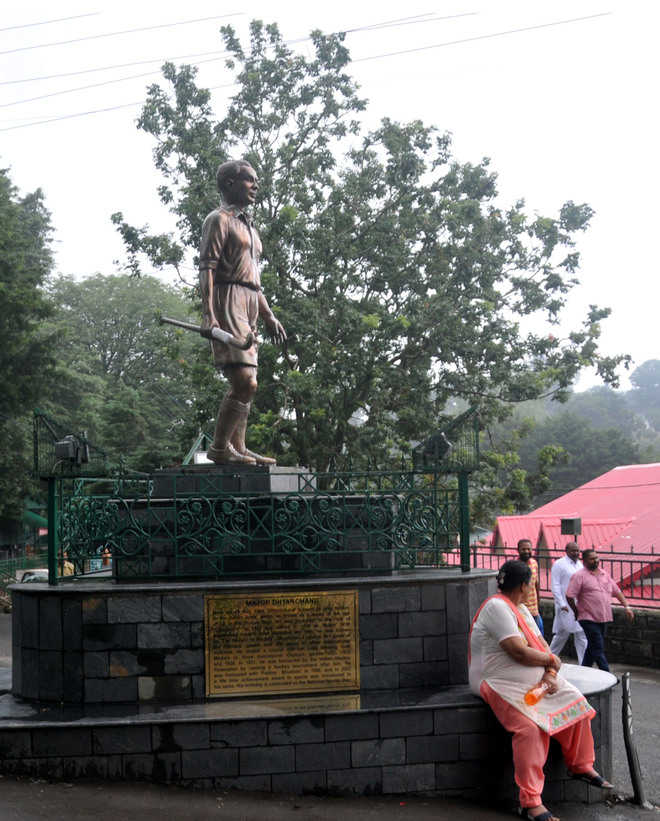


Dhyan Chand’s statue faces neglect in Kasauli

Dhyan Chand’s statue faces neglect in Kasauli

Tribune News Service

Solan, August 11

Major Dhyan Chand’s statue in Kasauli cantonment is facing neglect. It seems that the authorities did not have time to fix the damaged hockey stick, which has a white tape around it.Though the structure, named after him in 2015, catches the fancy of visitors, the white tape looks like a blot.An inscription bearing a brief history about this three-time Olympic gold medal winner has also been placed below the statue.“It is appalling to note that the authorities have no time to repair the hockey stick. Rather they have chosen to undo the damage,” said Raman Aggarwal, a tourist. He said this was an insult to the iconic player who had brought laurels to the nation through his legendary game.Junior engineer, cantonment board, Satish Kumar, said it would be rectified soon as it had not been brought to their notice, adding that the statue was installed to give respect to the hockey player who was also an Army Major.The cantonment board has undertaken a slew of measures to beautify the town by installing plaques of about 12 Param Vir Chakra awardees from Major Dhyan Chand Chowk till the Sunset Point on the upper Mall.


Firearms on file A database for gun licences is needed

Firearms on file

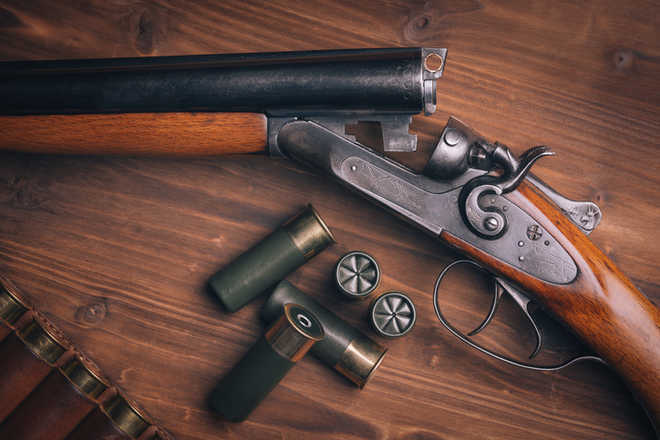
THE Centre’s move to launch a National Database of Arms Licences is a positive step in curbing the misuse of arms. It would assist law enforcement agencies in identifying weapons used for criminal activities as well as those involved in so-called “accidental” shootings like celebratory firing. Such incidents have become more common in the recent past. Firearm ownership is a privilege in our country and with it comes the responsibility to take care of the weapon, ensure its security and that of the people. Indeed, getting an arms licence is always a tough task. India has the distinction of having some of the most stringent gun laws in the world, but lack of a shared database made it difficult to keep track of licensed weapons, or to identify one if it is used in a crime. The issuance of unique identification numbers to gun owners, and the centralised, computerised database would streamline the process of tracking the ownership of weapons. The lead time given to gun owners is sufficient, and the system should be able to roll out by April next year. India has the notable distinction of being one of the toughest nations to get a gun licence in. This has allowed the country to keep a check on owners of licensed weapons, even as the security forces fight to keep illegal arms under check. While the authorities are required to establish the need for a gun before issuing a licence, there have been cases of persons of dubious character being issued gun licences. The unique identification number assigned to gun owners and the simple fact of all the data being computerised and available will also help in weeding out undesirable elements. Civilised societies do not need gun-wielding citizens. If some are licensed to carry arms, they must be open to scrutiny and checks by appropriate government agencies.


Pakistani polls, India’s stakes by Lt Gen Syed Ata Hasnain

Pakistani polls

The growing clout of deep state, coupled with a debt-ridden economy, spells doom for Islamabad

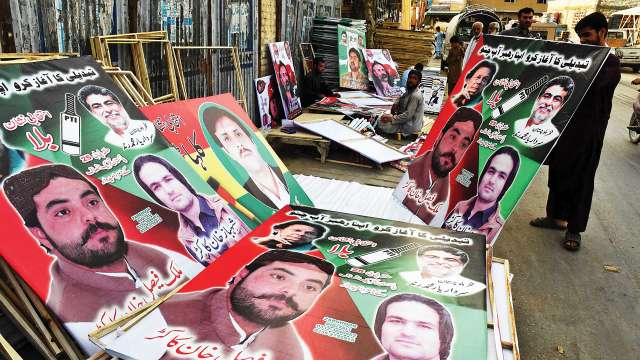
India and Pakistan observe each other’s national elections with much interest because national government formation means policy review and reformulation, which, in their mutual context, involve the handling of the none-too-peaceful relations between the two countries. Pakistan has the advantage because of India’s transparent, tested and respected democratic process through which transition occurs and yet brings near-continuity in policy. For India, there is nothing predictable or transparent about Pakistan with even the outcome of the electoral process contingent upon the Pakistan Army’s interests. With the upcoming elections on July 25, 2018, there should be much interest among Pakistan-watchers as the juncture is critical, with several events and trends occurring simultaneously.

Interestingly, in less than two weeks of the Financial Action Task Force (FATF) grey-listing Pakistan, Hafiz Saeed, the head of Jamaat-ud-Dawa (JuD) has made it known that a couple of hundred candidates owing allegiance to JuD will participate in the election. His earlier attempt at political legitimacy by forming the Muslim Milli League (MML) had come a cropper as it was turned down by the Pakistan Election Commission. He has now entered into an agreement between MML, the front group, and Allah-O-Akbar Tehreek, an Islamist party on whose back MML will ride. Almost on the day of the FATF meeting, Pakistan also removed Muhammad Ahmed Ludhianvi, the head of Ahl-e-Sunnat Wal Jamaat (ASWJ), from the designated terror list, clearing it hereafter to also participate in the elections. The ASWJ is another front for the Sipah-e-Sahaba, a virulently anti-Shia group, which is banned and was targeted under Operation Radd-ul-Fasaad. Historically, the Pakistani electorate has never inclined itself towards supporting any of the radical Islamic groups in the past. Is there a change in the offing? There has been little commentary in India on the orientation of Pakistan’s civil society which is known to be extremely weak, pliable and incapable of dictating any discourse for the future. Judging by the turn out at various sit-downs to paralyse the government in the recent past and the quality of people who thronged there, it did appear that the ghost of Mumtaz Qadri (the radical Islamist killer of late Punjab Governor Salman Taseer) continues to rule the roost. A different result at the polls could thus be on the cards. That could also be at the behest of the Pakistani Army and possibly even the higher judiciary.

How has the above situation come to be? It was clear that the Generals were unhappy with former Prime Minister Nawaz Sharif whose agenda of peace with India and promotion of trade was not in congruence with the Pakistan Army’s intent. The latter’s ambition and aim since 1977 (the coming of Zia-ul-Haq) has been to seek retribution against India through means foul or fair. Pakistan-friendly terror organisations such as the LeT (JuD) have been and continue to remain strategic assets that calibrate a hybrid proxy war against India especially in J&K, with intent to wrest the latter. The two mainstream parties, Pakistan Muslim League-Nawaz (PML-N) and the Pakistan People’s Party (PPP) may have earlier played ball with the Army but have usually been reluctant partners. The infamous ISI and a pliable higher judiciary ensured Sharif’s downfall and eventual ban. Imran Khan’s Pakistan Tehreek-e-Insaf (PTI) even without a national presence is now willing to play along with the Army in the next experiment. The shortfall in national political mainstream footprint is being probably attempted through fillers such as the radical political parties. Husain Haqqani puts it across as – “Their approach is similar to the one used to advance Sharif’s career against Benazir Bhutto in the late 1980s and early 1990s”.

Pragmatic political assessment points at a potential victory of PML-N with reduced numbers but various other activities on the political canvas of Pakistan appear to point towards an Army-assisted PTI victory. Imran Khan is willing to bend over backwards to arrange that. The Pakistani media, otherwise splendidly pro-active and critical, has been under intense pressure. The leading newspaper Dawn has been banned from various military garrisons.

Government and commercial advertising has also been withheld from many media houses, under pressure.

So what should India expect? First, whatever be the election results, it will be the Pakistani army in charge, even more than ever before. In India we had assessed a Qamar Bajwa-led Pakistani army being more rationale and setting the stage for a better environment; the much-touted Bajwa Doctrine. Instead, Pakistan is set to become a basket case; the second borrowing of a billion US dollars from China has just been done to bail it out from the financial mess it finds itself in. Earlier at least, Sharif somewhat resisted the Army pressure and recently even questioned the reasons why Mumbai was attacked and its chief perpetrator not prosecuted. With Imran Khan, the radicals and the Pakistan Army/ISI in the deep state will find new constituents and sink to even greater depth. How much backing this has from China is not known but it will surely be unhappy to see the entry of more radicals and a greater instability, although debt-trap diplomacy is almost assured over the China Pakistan Economic Corridor.
Hare-brained and crazy ideas have emanated from Pakistan in the past even when mainstream political parties with a semblance of political control existed. Now with a potentially deadly combination guiding the nation’s future, Pakistan appears headed for hara-kiri both externally and internally. The US should be worried, as should be Russia and Iran. Entrapped in debt, Pakistan will be vulnerable to manipulation by the Saudis who internally may project new moderation but externally the hemming of Iran from the East through radical Sunni ideology is too tempting. J&K in turmoil, fuelled by radical ideology, remains vulnerable with more violence on the cards. The one hope on which sanity can still rely is the feasibility of free elections under the Pakistan Election Commission and the choice of the Pakistani electorate remaining what it always was, non-radical parties; notwithstanding the popularity of the army. In a real world that is hoping against hope.

The author commanded the 15 Corps in Jammu and Kashmir. Views expressed are personal.


IAF Recruitment 2018: Apply online for 192 Short Service Commission Officer posts on afcat.cdac.in

ndian Air Force has invited online applications for recruitment of IAF Short Service Commission Officer posts. Interested and eligible candidates can apply to the IAF Recruitment 2018 online on afcat.cdac.in.

IAF Recruitment 2018 at 192 SSC Officer posts; Image Credits: careerindianairforce.cdac.in

IAF Recruitment 2018 at 192 SSC Officer posts; Image Credits: careerindianairforce.cdac.in

Indian Air Force Recruitment 2018: Indian Air Force has invited online applications for recruitment at IAF Short Service Commission Officer posts. The courses for grant of Short Service Commission in Flying branch and permanent commission and SSC in Ground duty, technical and non-technical branches. Also, interested and eligible candidates can apply to NCC special entry scheme and Meteorology branch on the official website, afcat.cdac.in. Steps and direct link for the same have been given below. The last date to apply to IAF Recruitment 2018 for SSC officer posts is July 15, 2018. Online examination will be conducted on 18 Aug 18 and 19 Aug 18 for AFCAT exam.

There are 76 vacancies available in Ground duty, technical department, 42 posts in Flying branch, 40 posts in non-technical Ground duty. For NCC special entry, 10 per cent seats out of CDSE vacancies for Flying branch are available. 24 non-technical ground duty posts are available in the Meteorology branch. Direct link to the official AFCAT notification has been given here.

Check Instructions for AFCAT 02/2018 here. The training programme is scheduled to begin in the first week of July  2019 for all courses at Air Force Academy, Dundigal, Hyderabad. The duration of training for  Non-Technical Ground Duty Branches is 52 weeks and that of Flying and Technical  Ground  Duty Branches is 74  weeks at Air Force Training Establishments. PAN Card and an account in SBI or a nationalised bank are compulsory at the time of joining Indian Air Force Academy. Also, Aadhaar Card is mandatory at the time of registration.


Gangsters ‘could target’ Op Bluestar veterans

Ajay Banerjee

Tribune News Service

New Delhi, July 2In what could pose a threat to several retired Army officers, gangsters in Punjab are reportedly looking to kidnap or target those who participated in Operation Bluestar in June 1984.Intelligence agencies have informed the Army that some of its officers who were part of the operation—launched to flush out armed militants from the Golden Temple in Amritsar—could still be serving. In the past few years, names of several gangsters have cropped up in Punjab Police records of having links with foreign-based organisations.General AS Vaidya, who was the Army Chief during Operation Bluestar, was gunned down near his house in Pune in 1986. Lt Gen KS Brar (retd), who was then (as a Maj Gen) leading the operation, survived a knife attack by youth in London in October 2012. Four people have been convicted for the same.Another senior officer who was part of the operation, Lt Gen Ranjit Dyal, the then Chief of Staff, Western Command—died of age-related causes in January 2012. The local gurdwara in Panchkula refused to conduct his final prayers and the Army then provided a Sikh priest at his home. Gen K Sundarji, former Army Chief who was then the Western Army Commander, died in 1999.Some of the Army officers who were young Lieutenants or Captains in 1984 are still serving while a majority of officers have retired. Some of them have been provided security by the local police whereever they live. Others just maintain a low profile and don’t discuss their role in Operation Bluestar even in private.Former Prime Minister Indira Gandhi, during whose tenure the operation was carried out, was killed by her guards in October 1984. In December 1999, her daughter-in-law and then Congress president Sonia Gandhi visited the Golden Temple and expressed ‘deep anguish’ and regretted the 1984 happenings. Each year in June, a ‘Ghallughara (meaning massacre) week’ is observed.


Police recovers knife ‘used’ by Major Handa to slit Army officer’s wife throat PTI

Army Major Nikhil Handa (in red t-shirt), arrested, in relation to the murder of another Major's wife, from Uttar Pradesh's Meerut. (Photo: PTI)

Army Major Nikhil Handa (in red t-shirt), arrested, in relation to the murder of another Major’s wife, from Uttar Pradesh’s Meerut. (Photo: PTI)

The investigators also found a lot of pornographic material on Major Nikhil Handa’s cell phones.

New Delhi: The Delhi Police on Thursday recovered the knife, allegedly used by Major Nikhil Handa to slit the throat of a fellow Army officer’s wife, from a spot near the Meerut-Muzaffarnagar highway.

Traces of burnt clothes were also recovered from the spot, the police said.

The investigators also found a lot of pornographic material on Major Handa’s cell phones. However, the accused had deleted his chat record and the messages exchanged with the victim, Shailza Dwivedi, the police said, adding that the phones will be sent for a forensic examination.

Shailza Dwivedi’s phone, which was broken by the accused, will also be sent for a forensic examination, though an officer said chances of data recovery were slim since its motherboard was badly damaged.

A senior officer, privy to the probe, said a CCTV grab showed that while going towards Meerut, the accused had taken a detour on the Meerut-Muzaffarnagar highway.

The accused was questioned about it and he led the police to the spot, where he had dumped the knife he had bought from Sadar Bazar, the officer added.

The police also recovered the clothes of the accused that he had burnt and will be sending those for a forensic examination, he said.

The police custody of the accused ends today and the investigators are not likely to seek an extension in the court.

The victim’s body was found with its throat slit near the Brar Square in the Delhi Cantonment area on Saturday.

Read: Army Major made 3,300 calls in 6 months to fellow officer’s wife he killed

Initially, the police were informed that a woman had died in an accident, but later, when they inspected the body, it was found that the throat was slit.

The accused had allegedly run his car over the victim’s face and body in order to make the incident appear as an accident.

Also Read: Army Major ‘obsessed’ with officer’s wife, killed her for rejecting him

The accused was arrested from Meerut in Uttar Pradesh on Sunday.


Navy men, MP girls clinch gold medals 1 SHARES FacebookTwitterGoogle+EmailPrint

Tribune News Service

Chandigarh, June 27

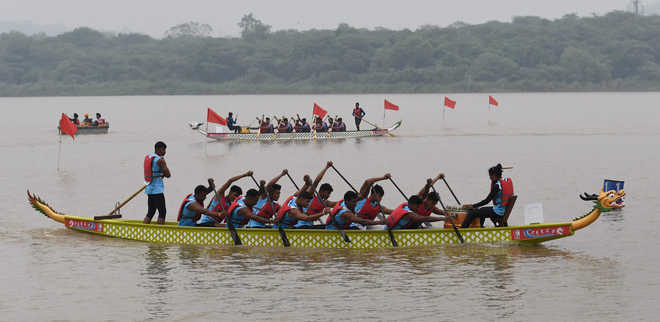
Indian Navy won the men’s 500m dragon boat race on the opening day of the 7th Senior National Championship and Federation Cup at Sukhna Lake here on Wednesday. The team clocked 2.36:12s to claim the top spot.West Bengal finished second with a timing of 2.36:76s, followed by Jammu and Kashmir (2.36:79s) in third position. SSB (2.37:20s) and Manipur (2.39:02s) bagged fifth and sixth positions respectively.In the women’s 500m final race, Madhya Pradesh clocked 2.41.92s to clinch the gold medal. SSB (2.42.47s) bagged the silver, while Haryana (2.48.09s) returned with a bronze. Chandigarh girls (2.50.16s) finished fourth. Manipur (2.50.93s) stood at fifth spot and Punjab (2.52.78s) bagged the sixth position. A total of 19 teams — Uttrakhand, Delhi, Maharashtra, Indian Navy, SSB, Himachal Pradesh, Rajasthan, Puducherry, Uttar Pradesh, Manipur, Madhya Pradesh, Telangana, Andhra Pradesh, Punjab, Gujarat, Haryana, Jammu & Kashmir, Chandigarh and West Bengal — are participating in the event. Earlier, the championship was inaugurated by Haryana Governor Kaptan Singh Solanki. 

Dragon Boat final

Men’s (500m): Indian Navy (2.36.12s), West Bengal (2.36.76s), Jammu & Kashmir (2.36.79s), SSB (2.37.70s), Manipur (2.39.02s), Delhi (2.40.46s)Women’s (500m): Madhya Pradesh (2.41.92s), SSB (2.42.47s), Haryana (2.48.09), Chandigarh (2.50.16s), Manipur (2.50.93s), Punjab (2.52.78s)


Pak J&K rhetoric won’t alter fact: India at UN

Tribune News Service

New Delhi, June 26

India has lashed out at Pakistan in the United Nations General Assembly in New York as well as the Human Rights Council in Geneva.Snubbing Pakistani Ambassador to UN Maleeha Lodhi’s reference last week to J&K in context of a recent report by the UN Human rights body, India said the report was a ‘motivated piece of disinformation’.Sandeep Kumar Bayyapu, First Secretary in India’s Permanent Mission to the UN, said: “Jammu and Kashmir is an integral and inalienable part of India and no amount of empty rhetoric from Pakistan will change this reality.”India was exercising its right of reply during a general debate on responsibility to Protect and the Prevention of Genocide, War Crimes, Ethnic Cleansing and Crimes against Humanity.Pakistan earlier this month had welcomed the proposal of the UN High Commissioner Zeid for an international probe into allegations of human rights in both sides of Kashmir. Islamabad also claimed that reference of abuse in Pakistan-occupied Kashmir the report should in no way be construed to create a “false sense of equivalence” with Kashmir. Meanwhile, exercising its right of reply at the 38th session of the Human Rights Council in Geneva, Second Secretary Animesh Choudhary said: “What is portrayed by Pakistan as a right to self-determination is actually state-sponsored cross border terrorism.”


Lashkar commander among 2 militants killed in Kashmir, one surrenders

Lashkar commander among 2 militants killed in Kashmir, one surrenders

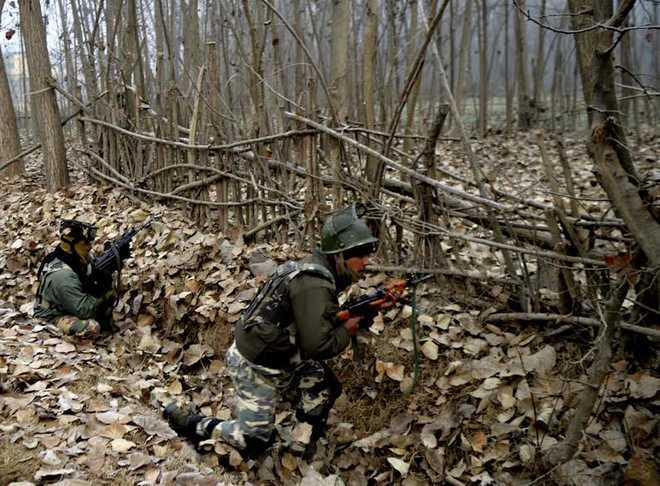
Photo for representation.

Srinagar, June 24

Two Lashkar-e-Toiba (LeT) militants, including the terror outfit’s self-styled divisional commander Shakoor Dar, were killed in an encounter with security forces, while another surrendered, in Kulgam district of south Kashmir on Sunday, police said.The police said that a tip-off had been received about the presence of some militants at Cheddar village in Qaimoh of Kulgam district this afternoon, after which a crack team of the Jammu and Kashmir Police, along with the Army and the CRPF, cordoned off the suspect house.Appeals were made to the terrorists to surrender but they opened fire at the security forces, triggering a gunfight, the police said.Shakoor Dar, a self-styled divisional commander of the LeT, was killed in the encounter along with another militant. The identity of the second militant killed in the encounter was yet to be ascertained. He is believed to be a Pakistani national, according to the police.The third militant surrendered before the forces, along with arms and ammunition.”We followed the standard operating procedure during which two terrorists were killed and one, who had joined militancy recently, surrendered. He has been taken into custody,” Inspector General of Police (Kashmir Range) Swayam Prakash Pani said here.The identity of the surrendered militant was not revealed.As the encounter was on, clashes between groups of youths and security forces were reported from the area, a police official said, adding the security forces had to use force to quell the protests.Security forces have been carrying out operations to sanitise the Jammu-Srinagar national highway ahead of the annual Amarnath pilgrimage, beginning June 28, a senior police official said. – PTI