The Indian Army honoured a 10-year-old boy from Punjab’s Ferozepur district for his unwavering committment during the India-Pakistan conflict. He helped the soldiers by bringing water, milk and other items as they fought the battle in the scorching heat.
Shravan Singh helped soldiers by bringing water, milk, lassi, ice during Op Sindoor
He showed courage and devotion despite tense border situation
Indian Army honoured Shravan Singh with memento and special treats
In the dusty and heat-soaked fields of Punjab’s Tara Wali village near the India-Pakistan border, hundreds of villagers witnessed Operation Sindoor – one of the country’s largest military mobilisations in recent times – unfold in front of their eyes. Soldiers lined up the village’s open fields, their boots tracing fresh lines in the soil, preparing for the unknown.
At the heart of this tense build-up stood a 10-year-old boy, Shravan Singh. No uniform. No weapons. But with courage that knew no measure. The boy who dreams of being an Indian Army soldier when he grows up, witnessed the war-like situation in his village in Ferozepur district. But, despite a tender age and a tough situation at the borders, nothing deterred him.
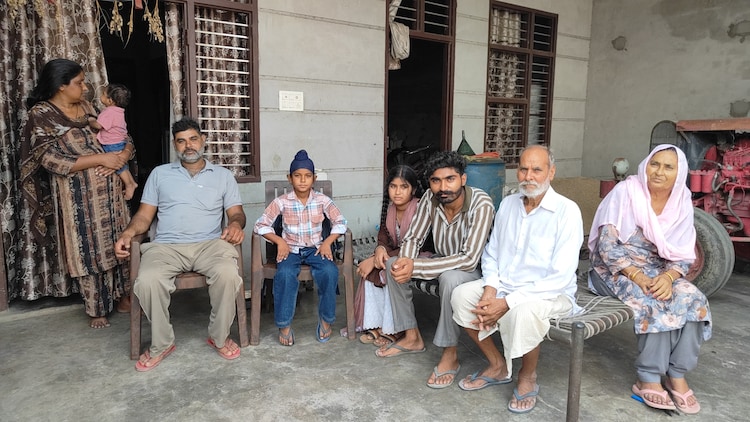
Shravan Singh, the son of local farmer Sona Singh, didn’t just watch from the sidelines. He stepped in. Armed with nothing but devotion and two small hands, he brought water, milk, lassi and even ice to the jawans camped on his family’s farmland. In the scorching heat, while fear gripped many, Shravan Singh ran daily to the troops, reminding them they were never alone.
“I wasn’t scared. I want to be a soldier when I grow up. I used to bring water, lassi and ice for the soldiers. They loved me a lot,” Shravan Singh says with a quiet confidence. His efforts did not go unnoticed. The Indian Army, moved by this young boy’s simple yet profound service, honoured him.
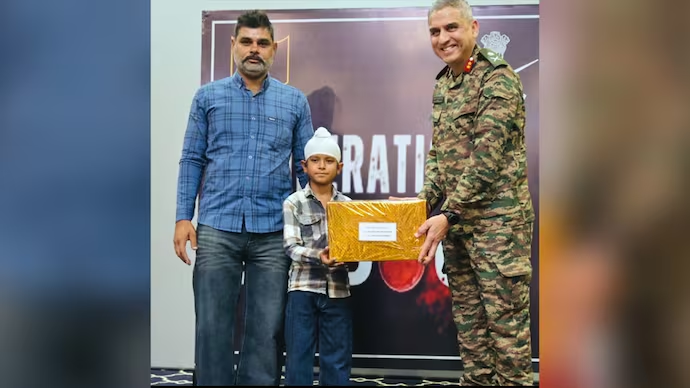
Major General Ranjit Singh Manral, the General Officer Commanding of the 7th Infantry Division, felicitated Shravan Singh in a ceremony, where the boy was gifted a memento, a special meal and his favourite treat – ice cream.”They gave me food and ice cream. I’m very happy. I want to become a soldier and serve the country,” an elated Shravan Singh said.
For Sona Singh, watching his son’s bond with the soldiers brought pride that no harvest could match.
“The Army was stationed on our fields. From the first day, Shravan began helping them – bringing milk, water, lassi and ice. He never missed a day. We stood by him. He stood by them,” Sona Singh said.In the grand retelling of Operation Sindoor, history will remember the troop movements, the strategies and the senior commanders. But in a quiet corner of that story, the name of Shravan Singh will resonate across the country – a small boy with a big heart who served his nations, not with arms, but with an unwavering spirit.
Prateek Chakraborty
Pub
Army Chief presents ‘Badge of Sacrifice’, ‘Certificate of Honour’ to DySP Himayun Muzzammil Bhat, 8 others
The presentation at the Manekshaw Centre, Delhi Cantt, took place a day after the formal Defence Investiture Ceremony, which was conducted at the Rashtrapati Bhawan on May 22
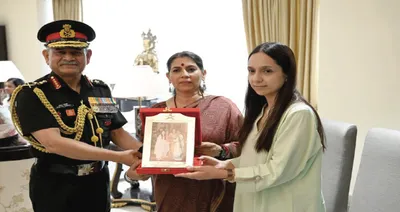
Jammu, May 23: The Chief of the Army Staff (COAS), General Upendra Dwivedi, in a solemn and emotionally charged ceremony, Friday presented the ‘Badge of Sacrifice’ and the ‘Certificate of Honour’ to the ‘Next of Kin’ (NoK) of eight Indian army personnel and JKPS officer DySP Himayun Muzzammil Bhat, who laid down their lives in the line of duty.
The presentation at the Manekshaw Centre, Delhi Cantt, took place a day after the formal Defence Investiture Ceremony, which was conducted at the Rashtrapati Bhawan on May 22.
The ‘Badge of Sacrifice’, a 24-carat gold-plated insignia, is individually engraved with the Army number, rank, and name of the soldier. On the reverse, the Indian Army insignia is inscribed, symbolising eternal remembrance. The ‘Certificate of Honour’ is equally distinguished – crafted on permanent-finish 24-carat gold foil and set within a gold-plated frame.
“Designed by the Directorate of Indian Army Veterans of Indian Army, these honours reflect both the aesthetic dignity and enduring respect the Army holds for its fallen heroes. The families, many overcome with emotion, accepted the awards with quiet pride. Their presence served as a poignant reminder of the human cost of national security and the strength that sustains those left behind,” said PRO Defence Lt Col Suneel Bartwal.
The COAS presented the ‘Badge of Sacrifice’ and ‘Certificate of Honour’ to ‘Next of Kins’ of brave-hearts Colonel Manpreet Singh; Major Aashish Dhonchak; Captain Deepak Singh; Havildar Rohit Kumar; Naik Dilwar Khan; Rifleman Ravi Kumar; Sepoy Pradeep Singh; DySP Himayun Muzzammil Bhat and OEM GDE-1 Vijayan Kutty G (Border Road Organisation).
The General Officer Commanding (GOC) of the Srinagar-based 15 Corps, Lt Gen Prashant Srivastava, visited the counter-terrorism grid operating bases in South Kashmir, according to the Army spokesperson. During the visit on Wednesday, the Corps Commander reviewed the surveillance grid
The General Officer Commanding (GOC) of the Srinagar-based 15 Corps, Lt Gen Prashant Srivastava, visited the counter-terrorism grid operating bases in South Kashmir, according to the Army spokesperson.
During the visit on Wednesday, the Corps Commander reviewed the surveillance grid and operational preparedness. He also inspected the training activities t Corps Battle School to ensure peak combat effectiveness, the spokesperson informed.
He said the Corps Commander inspired the troops to “uphold peak operational readiness, underscoring the critical need to stay vigilant, agile and be ever prepared to respond to any challenge with steadfast resolve.”
In another statement, the Army said the Chinar Corps Commander reviewed security arrangements in the Warwan Valley region and engaged with locals. “Commending troops for their unwavering dedication, he emphasised upon the need for continued vigilance for safeguarding the area as well as to render assistance to the civil community in the remote region,” Army said.
CDS to visit Singapore today for Shangri-La dialogue
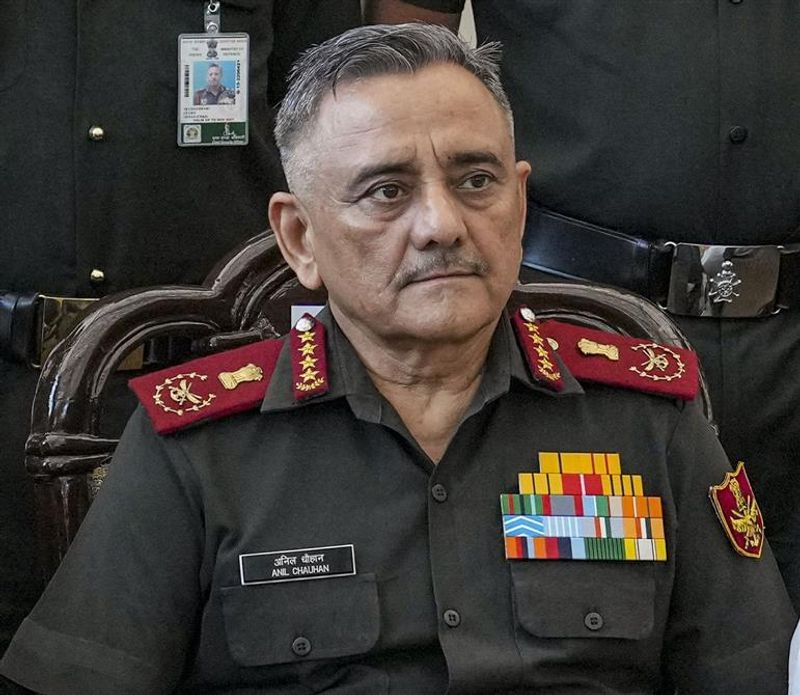
Chief of Defence Staff General Anil Chauhan will visit Singapore for three days (May 30 to June 1) to attend the 22nd edition of the Shangri-La Dialogue, hosted annually by the International Institute for Strategic Studies. During the visit, General…
Chief of Defence Staff General Anil Chauhan will visit Singapore for three days (May 30 to June 1) to attend the 22nd edition of the Shangri-La Dialogue, hosted annually by the International Institute for Strategic Studies. During the visit, General Anil Chauhan will hold bilateral meetings with Chiefs of Defence Forces and senior military leadership from several foreign countries including those from Australia, European Union, France, Germany, Indonesia, Japan, Netherlands, New Zealand, Philippines, Singapore, the UK and the USA.
The Chief of Defence Staff will address the Academia, think tanks and researchers. He will speak on the topic ‘Future Wars and Warfare’. He will also participate in the simultaneous special sessions as part of the event and address on the topic ‘Defence Innovation Solutions for Future Challenges’.
Shangri-La Dialogue is premier defence and security summit that brings together defence ministers, military chiefs, policy makers and strategic experts across the globe. The event will witness leaders from 40 nations addressing Indo-Pacific security challenges.
United Nations to honour 2 Indian peacekeepers posthumously
The medals will be presented during a solemn ceremony at the UN headquarters in New York
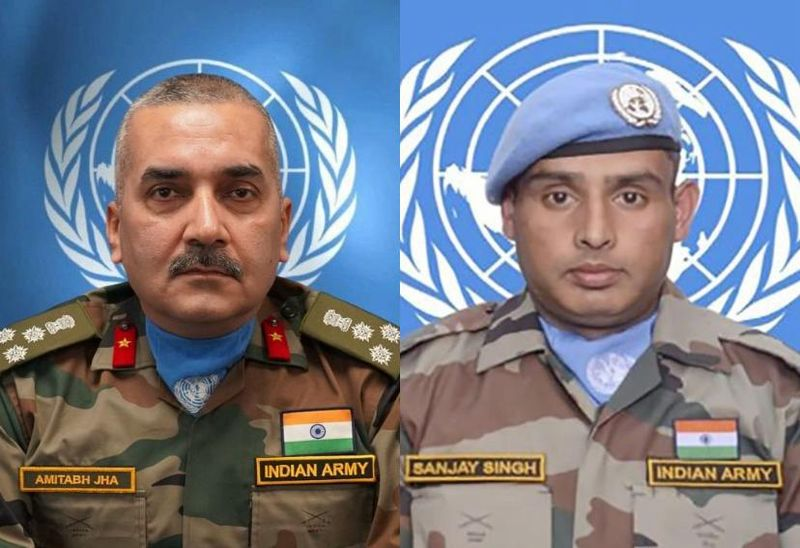
The United Nations will posthumously award the prestigious “Dag Hammarskjöld Medal” to two Indian peacekeepers — Brigadier Amitabh Jha and Havildar Sanjay Singh — in recognition of their supreme sacrifice in the service of global peace.
Brigadier Amitabh Jha was attached to the United Nations Disengagement Observer Force (UNDOF), overseeing the delicate ceasefire arrangements in the Golan Heights, while Havildar Sanjay Singh was deployed with the United Nations Stabilisation Mission in the Democratic Republic of Congo (MONUSCO), where he worked to stabilise conflict-affected regions.
The medals will be presented posthumously during a solemn ceremony at the United Nations headquarters in New York today (May 29), marking the International Day of United Nations Peacekeepers — an occasion dedicated to honouring over 4,300 peacekeepers who have lost their lives since 1948 while serving under the UN flag.
The Dag Hammarskjöld Medal, established by UN Security Council in 1997, is named after the second UN Secretary-General, Dag Hammarskjöld, who died in a 1961 plane crash while on a peace mission. The medal is awarded annually to military, police and civilian personnel who make the ultimate sacrifice while serving in UN peacekeeping operations.
India, as one of the largest contributors to UN peacekeeping missions, has provided more than 2,00,000 personnel across 49 missions over the decades, and many Indian peacekeepers have been honoured with this medal in past years.
Russia-Ukraine war: Missing Indians’ kin fight battle at home for their safe return
More than 10 families, many of them from Punjab, today protested at Jantar Mantar in New Delhi for safe return of their loved ones from Russia-Ukraine warzone. “We are not asking for the moon. We just want to know if…
More than 10 families, many of them from Punjab, today protested at Jantar Mantar in New Delhi for safe return of their loved ones from Russia-Ukraine warzone.
“We are not asking for the moon. We just want to know if our kin are dead or alive,” said Jagdeep Kumar, whose younger brother, Mandeep Kumar, has been missing since March 2024.
The aggrieved families said their loved ones were lured by agents, who promised them lucrative jobs in Europe.“We request you with folded hands to give information about the missing Indians in the Russian army. If no action is taken, we will be forced to protest twice a month,” read a letter sent by the protesters to the Ministry of External Affairs.
“Indian Embassy in Moscow offered little assistance to those who went to Russia in search of their kin,” a wailing mother whispered.“I gave everything I had to bring my brother back. But I failed,” said Jagdeep, who alleged he was duped on the pretext of sending four people, including his brother from Armenia to Italy via Russia, Finland and Germany.
Three among them sensed something was wrong and came back, suspecting the so-called ‘donkey route’ — a notorious path used for illegal migration.
“My brother was still abroad. I got threatening videos from agents, who could be seen thrashing Mandeep and subsequently demanded more money,” said Jagdeep.Though an FIR was registered and a few agents were arrested, the network was still active, he said.
Jagdeep last spoke to his brother on March 3, 2024. “He was scared. He told me they’d forced him into Russian army and he has begun training near the Ukrainian border,” he recalled.
The protesters sought permission to head to Russia, with a letter signed from External Affairs Minister S Jaishankar, asking Indian diplomats to actively assist them.“Each passing day feels like a death sentence. We will not stop until we get answers,” said another protester.
Looking beyond Pahalgam to fight Pakistan-sponsored terror
The spring season in Kashmir this year was marred by the heinous terror attack perpetrated by heavily armed militants in Baisaran meadow of Pahalgam, claiming 26 innocent lives.
The Indian political leadership has set a “new normal” in terms of response to any act of terrorism traceable to Pakistan. However, there are some stark realities which have to be squarely addressed. To fully eliminate the scourge of terrorism, it is imperative to counter any form of local support to militants. To ensure a return to normalcy in Kashmir, in terms of local commerce and tourist footfall, the bellwether would be the safe conduct of the impending Amarnath pilgrimage. This can well be achieved by intensive deployment of a professional and counter-insurgency hardened force like the Rashtriya Rifles (RR), in larger numbers.
One harsh fact has to be contended with. Baisaran is fairly deep inside India. Those who carried out the massacre on April 22 were not on some lightning raid. Their actions show familiarity with the area.
That they could simply disappear and remain untraced points to the primacy of putting our own house in order. They may very well have gone back across the LoC or may be at large in the vastness of the Kashmir valley and its forests. In both cases, they would not be surviving only on fresh air and water from mountain rivulets.
There can be no denying the fact that there is local support for such militancy. The network of overground workers in concert with the cadres of Jamaat-e-Islami, is clearly active.
It may make for good optics to showcase normalcy in Kashmir but it needs to be remembered that such inimical and anti-India elements remain entrenched in the populace. Intelligence agencies, security forces and the local police need to act in a concerted, concrete and visible manner to address this problem. Normalcy cannot be endlessly held hostage by these malevolent elements.
To remain on top of the game, the induction of state-of-the-art systems, whether indigenous or imported, has to be an ongoing process. The MoD has stated that it would focus on simplifying acquisition procedures to facilitate swifter development of capability. However, without a robust fiscal outlay, any progress may fall well short of targets.
Any armed force in the world needs a gestation period to absorb new technologies and systems for warfare and such abilities cannot just manifest in the face of impending war by letting cash flow. The bottom line for capability development is both time and money.
The allocation for defence for 2025-26 is estimated at 1.91 per cent of the projected GDP, while a figure of 3 per cent has often been cited as an optimum allocation for meeting national security needs. However, it may be more prudent and pragmatic to view the required defence Bill in terms of a gross figure, which covers the annual expenditure, both revenue and capital, for all the three Services.
It is for the government to husband national resources in a manner that ensures defence of the nation. This will require not a mere balancing of the books but a resolve at the highest levels of government.
A Year of Reform is welcome. What is truly needed is not an year but an Era of Reform and Resolve, in tune with the “new normal”.
Lt Gen Pradeep Bali (retd) is a military commentator.
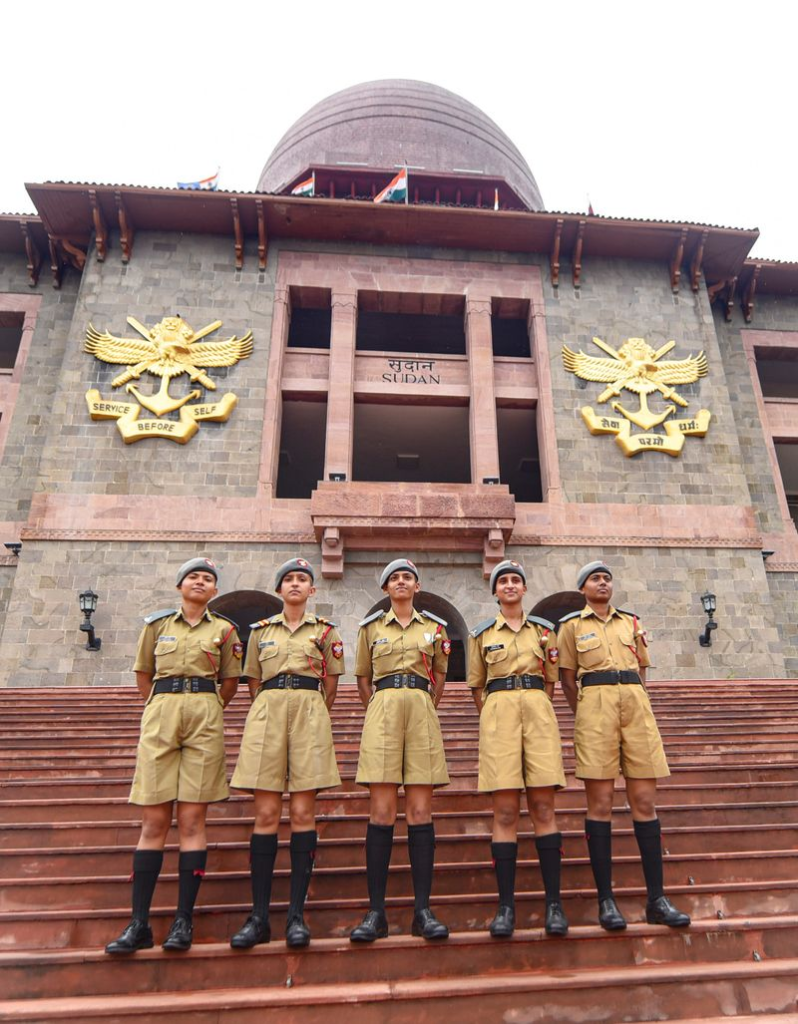
Today, the first batch of 17 women cadets (19 had joined, two dropped out) will pass out from the National Defence Academy (NDA), marking a historic milestone for the armed forces and the nation. They came from a generation accustomed to speed and instant connection — but they adapted to bugles, boots and discipline.
These cadets stepped into the precincts of the NDA to undergo one of the toughest regimens imaginable. Their journey was not just about breaking barriers; it was about setting benchmarks. A transformation not only of individuals — but of an institution.
It all began on a rain-washed afternoon in July 2022. As the girls stepped on the platform at the Pune railway station — bags on their backs, hearts in their throats — a tall, broad-shouldered ‘drill Ustad’ greeted them. His voice cut through the railway din, firm yet proud: “From this moment, you are not civilians. You wear the honour of the Indian armed forces.” That single sentence set the tone. No fanfare. No exceptions. Only expectations and the start of something historic.
The drive to Khadakwasla was quiet, each cadet lost in thought. As the Tri-Shakti Gate loomed and they entered the NDA, the imposing architecture greeted them — aircraft on display, cadets sprinting past on cross-country routes, others executing crisp drills on the parade ground. Cadets in mid-air during volleyball spikes, squads barking out drill commands — it was a world already in motion.
Everything looked rehearsed, efficient, overwhelming. 19 newly inducted girls, surrounded by over 2,200 male cadets — what were they thinking? Some wore pride, others caution. They were excited, but unsure. Brave, but still seeking belonging.
The Academy had prepared with precision. Romeo Squadron was refurbished —rooms restructured, lights upgraded, duty officers reassigned. New security protocols were drawn. A revised code of conduct was institutionalised.
Yet, the essence of training remained untouched. The NDA wasn’t creating exceptions — it was raising the bar. Traditions were respected, but inclusivity was now part of that tradition.
Training began like a thunderclap. The first term was a whirlwind of early wake-ups, punishing PT, relentless drills, academic lectures and quiet nights of aching limbs. The ‘drill Ustads’— towering, sharp-eyed and fierce —became icons of fear and respect. They roared on the parade ground, yet shielded their cadets like elder brothers. PT instructors focused not just on physical toughness but on inner resilience, adapting routines to match cadets’ progress with silent encouragement.
Academics brought a different kind of challenge. Held in the stately Sudan and Manoj Pandey Blocks, the classes offered everything from geopolitics and military history to physics and service fundamentals.
Cadets rushed in breathless from morning PT, faces still wet from drills, uniforms slightly out of place. They tried to sit upright — but heads nodded off mid-lecture, not out of disinterest but sheer fatigue. The instructors understood. They’d been cadets too. Questions flew, notes scribbled furiously and quiet moments of clarity landed like victory.
The Divisional Officers — often the first and most enduring influence on a cadet understood that these girls were not just joining a course; they were creating a legacy.
When a woman cadet faltered in a PT test or struggled with drill, it was the Divisional Officer who stood beside her — sometimes with quiet advice, sometimes with a stern word that stung, but strengthened.
They guided them into the military way of life — adjusting to routines, accepting command structures and building mental toughness. Over time, these cadets didn’t just adapt — they flourished. They led drills, topped academics and inspired juniors. By the sixth term, they weren’t seen as women cadets — they were seen as leaders.
The rhythm of the NDA gradually became their own — etched in parade commands, squadron assemblies and the quiet rustle of fatigues at dawn. For the girls, it meant trading ponytails for close-cropped crew cuts. They picked up the drill vocabulary, learned to march with poise, and synced their energy to the beat of the Academy. In this routine, they found rhythm and resilience.
The NDA has its own scent — the sharpness of polish, the earthy smell of monsoon drills, the metallic scent of rifle oil at the range and the steamy comfort of early morning chai. For the cadets, this rhythm is not imposed —it seeps in, until it becomes their own heartbeat. The NDA stopped feeling like an institution. It became home.
When the girls were integrated into squadrons, the dynamics changed. The male cadets adjusted, watched, then welcomed. Together, they competed in games, parades and obstacle courses. They failed, they won, and they cheered each other. The squadron spirit didn’t shrink — it grew. Within squadrons, bonds evolved.
As the terms rolled on, their bond extended beyond gender. Male course-mates, earlier unsure, now stood shoulder to shoulder with them in training and triumph.
By the third term, jokes flew in the ante-rooms. By the fourth term, they were picking each other up after falls — literally and figuratively. By the sixth term, they weren’t just the first women batch — they were a united course, bound not just by shared memories but a shared spirit of excellence.
When parents came during mid-terms, they found someone different. The girl who left with a small suitcase returned taller, tanned, and sharper in tone and thought. The transformation was unmistakable — and deeply moving. Even hesitant parents now carried pride in their eyes.
The Adjutant — immaculate in dress, commanding from his white charger — represented everything the NDA stood for: precision, honour and presence. Cadets lived under his gaze with a mix of fear and pride. The institution never just taught drills or strategy. It instilled values. Cadets learned that character isn’t optional — it’s non-negotiable.
The future they step into is starkly different. Operation Sindoor made it clear that warfare has moved beyond trenches and tanks. The battlefields of tomorrow will involve AI, drones, satellites and cyber strikes. These girls must lead in tactical formations as well as tech-driven command centres.
Today, as they march across the Khetarpal Parade Ground, the chief guest will salute — not 17 girls, but 17 officers-in-the-making. There will be no special reference. No gender called out.
As they walk past the Tri-Shakti Gate one last time, the NDA will not bid them farewell. It will whisper: Go lead. You are ready.
They came as nineteen girls.
They leave as trailblazers.
And in doing so, they didn’t just enter the NDA’s history.
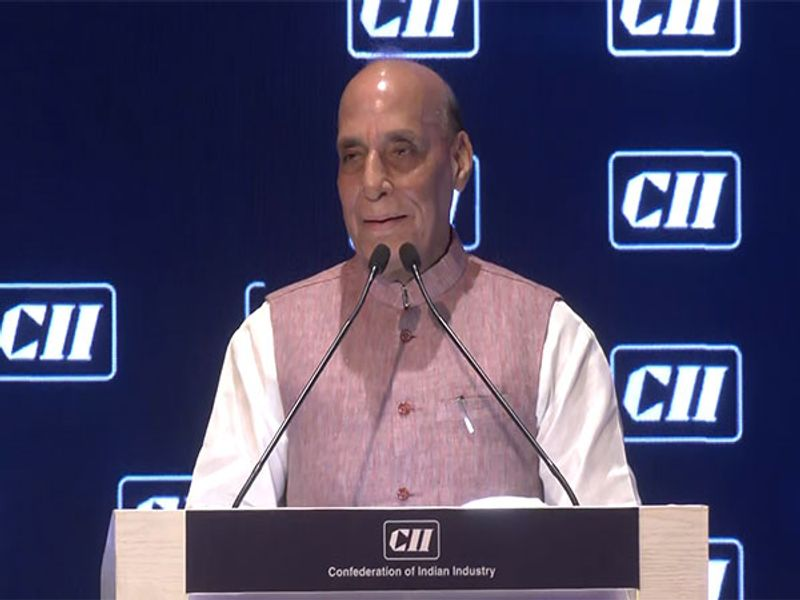
People of PoK our own, will return voluntarily: Rajnath
People of Pakistan-occupied Kashmir (PoK) are part of India’s “own family” and the day is not far when they will return to the Indian mainstream by listening to their inner voice, Defence Minister Rajnath Singh said today. Laying out India’s…
People of Pakistan-occupied Kashmir (PoK) are part of India’s “own family” and the day is not far when they will return to the Indian mainstream by listening to their inner voice, Defence Minister Rajnath Singh said today.
Laying out India’s policy approach towards Pakistan, he said New Delhi had “redesigned and redefined” its strategy and response to terrorism and that possible dialogue with Islamabad would be only on terrorism and PoK.
In an address at the CII Business Summit, the minister appeared to be attempting to reach out to people of PoK, saying “I believe that the people of Pakistan-occupied Kashmir (PoK) are our own, part of our family”.
India is committed to the resolution of ‘Ek Bharat Shreshtha Bharat’ (One India, Best India), and we have full faith that those of our brothers who are geographically and politically separated from us today, will also return to the mainstream of India someday or the other with self-respect, listening to their voice of soul, the minister added.
On PoK, Singh said the “people there feel a deep connection with India, there are only a few who have been misled”. He stressed the unification of the PoK with India depended on “the cultural, social and economic prosperity of this country”.
He cited history to say situation of our brothers and sisters living in PoK was similar to that of Shakti Singh, the younger brother of brave warrior Maharana Pratap. “Even after separation, the confidence and faith of the elder brother towards his younger brother remains intact,” Singh said.
“India always talks about connecting hearts, and we believe that by walking on the path of love, unity and truth, the day is not far when our own part, PoK, will return and say, I am India, I have returned,” he said.
In first public disclosure, Sharif says BrahMos missiles were used
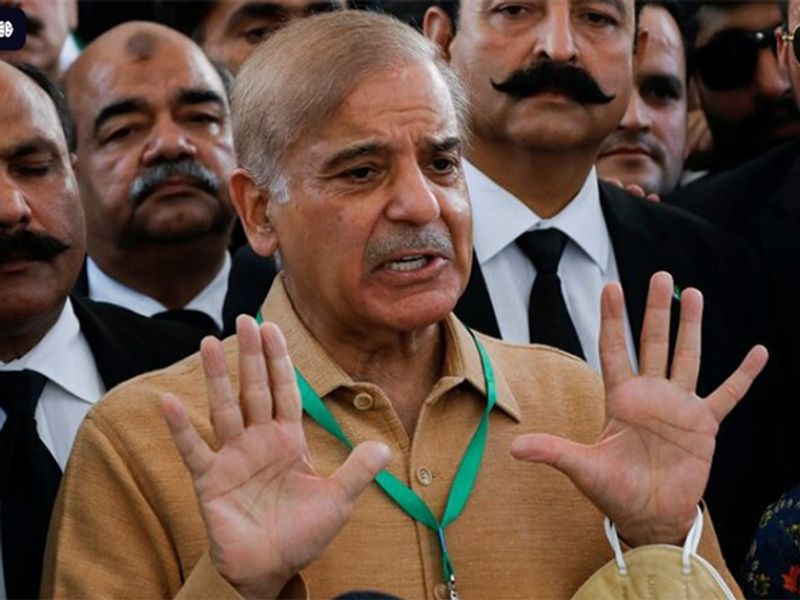
Pakistan Prime Minister Shehbaz Sharif has for the first time publicly admitted that the Indian armed forces pre-empted Islamabad’s planned offensive on the intervening night of May 9-10 when his nation’s key military bases, including Rawalpindi, were targeted using BrahMos missiles.
The Tribune was the first to report in its edition dated May 11 that the Indian Air Force’s Sukhoi-30 MKI jets had attacked Pakistan’s airbases with BrahMos, making it the first operational firing of the long-range missile.
Speaking at the Pakistan-Turkey-Azerbaijan trilateral summit in Lachin (Azerbaijan), Sharif said the Pakistani military, led by Field Marshal Asim Munir, had planned to attack India on May 10 at 4.30 am after the morning prayers.
“On the night of May 9-10, we decided to respond in a measured way to Indian aggression. Our armed forces were prepared to act at 4.30 in the morning after Fajr prayers to teach (India) a lesson. But before that hour could arrive, India again launched a missile attack using BrahMos, targeting various provinces of Pakistan and the airbase in Rawalpindi,” said Sharif.
Sharif said India destroyed Noor Khan (Rawalpindi) and Murid (Chakwal) bases before Pakistan’s planned attack. India had unleashed its BrahMos supersonic missile as part of Operation Sindoor in retaliatory strikes on Pakistani bases.
State Stalwarts
DEFENCES FORCES RANKS
ARMY, NAVY, AIRFORCE RANKS
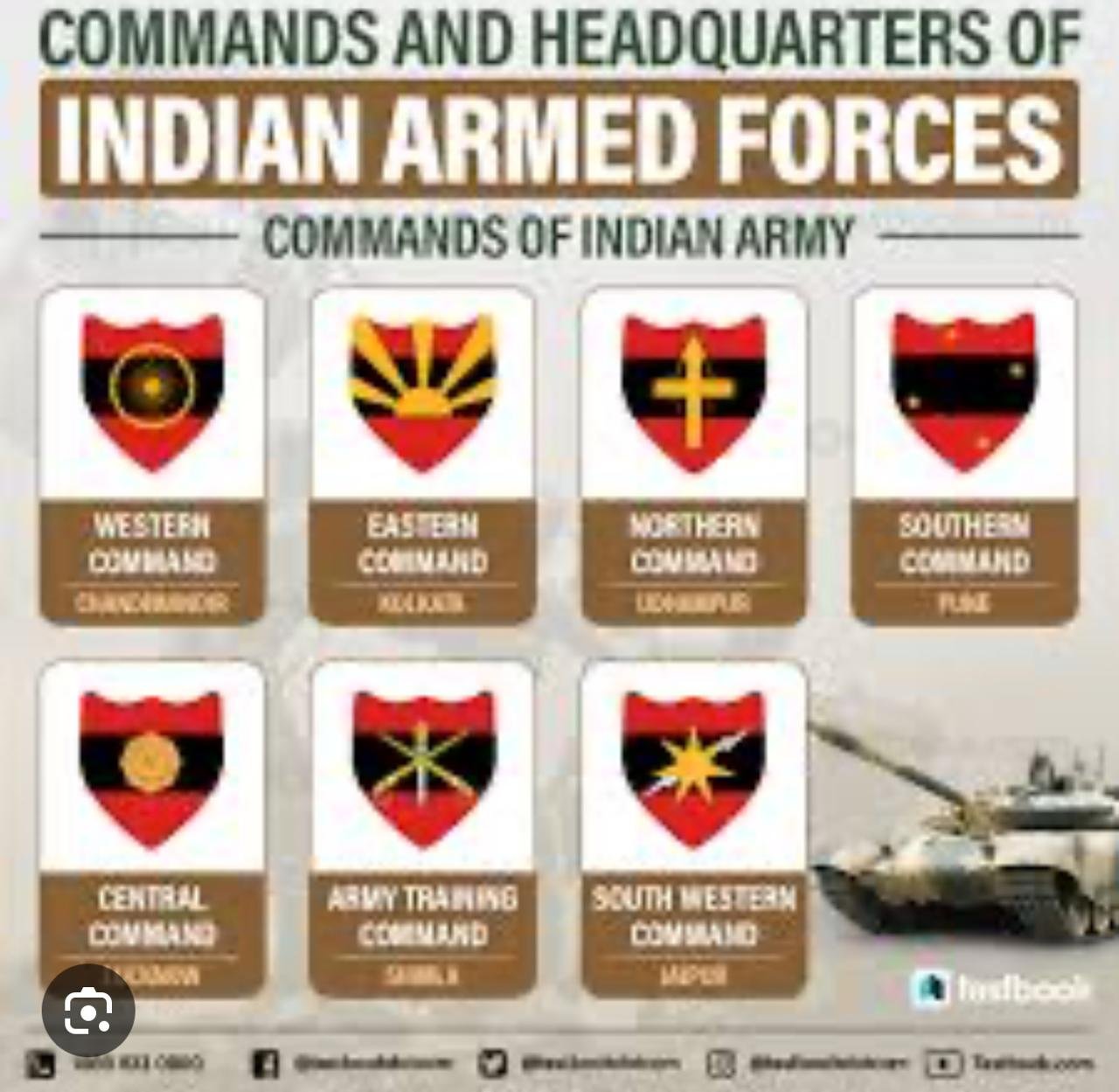
FORMATION SIGNS
FORMATION SIGNS
ALL HUMANS ARE ONE CREATED BY GOD
HINDUS,MUSLIMS,SIKHS.ISAI SAB HAI BHAI BHAI
CHIEF PATRON ALL INDIA SANJHA MORCHA
LT GEN JASBIR SINGH DHALIWAL, DOGRA
SENIOR PATRON ALL INDIA SANJHA MORCHA
MAJOR GEN HARVIJAY SINGH, SENA MEDAL ,corps of signals
.
.
PATRON ALL INDIA SANJHA MORCHA
MAJ GEN RAMINDER GORAYA , CORPS OF
sanjhamorcha303@gmail.com
PRESIDENT HARAYANA STATE CUM COORDINATOR ESM
BRIG DALJIT THUKRAL ,BENGAL SAPPERS
PRESIDENT TRICITY
COL B S BRAR (BHUPI BRAR)
PRESIDENT CHANDIGARH ZONE
COL SHANJIT SINGH BHULLAR
.
.
PRESIDENT PANCHKULA ZONE AND ZIRAKPUR
COL SWARAN SINGH
PRESIDENT SAS NAGAR (MOHALI)
COL BALBIR SINGH , ARTY
INDIAN DEFENCE FORCES
DEFENCE FORCES INTEGRATED LOGO
FORCES FLAGS
15 Th PRESIDENT OF INDIA SUPREME COMMANDER ARMED FORCES
Droupadi Murmu
DEFENCE MINISTER
Minister Rajnath Singh
CHIEF OF DEFENCE STAFF (2nd)
General Anil Chauhan PVSM UYSM AVSM SM VSM
INDIAN FORCES CHIEFS
CHIEF OF ARMY STAFF(29th)
General Upendra Dwivedi, PVSM, AVSM (30 Jun 2024 to Till Date)