Sanjha Morcha

What’s New

Click the heading to open detailed news

Current Events :

web counter

Print Media Reproduced Defence Related News

Raise retirement age of Colonels, says AFT

Raise retirement age of Colonels, says AFT

Ajay Banerjee

Tribune News Service

New Delhi, January 6

The Armed Forces Tribunal (AFT) has asked the Army to correct anomalies in the retirement age of Colonels and bring them on a par with similar ranks in the Air Force and the Navy.The AFT Principal Bench, comprising Justice VK Shali and Lt Gen SK Singh (retd), said the anomalies needed to be removed. “We strongly feel the anomalies in the retirement age of Colonels in the Army in relation to their counterparts in the Air Force and the Navy, which have got created due to recent judgments, need to be removed at the earliest by passing a comprehensive order increasing the age of retirement of Army Colonels,” the order said.Col Karunesh Kumar had moved the AFT to seek parity with IAF and Navy, where officers in the ranks of Group Captain and Captain (both equivalent to Colonel) serve till 56 years for age and not 54, as is the case with the Army.(Follow The Tribune on Facebook; and Twitter @thetribunechd)If the government does not come up with a policy on its own, it could open floodgates of litigation apart from making a particular level of officials in the Army perennially dissatisfied. “Neither such dissatisfied officers would give their best, nor would respondents be able to extract optimum. Such a situation in the force that protects the nation and its sovereignty and integrity can be ill afforded,” the Bench observed.It directed the respondents (Union of India) to increase the retirement age by two years for Colonels to 56 years to bring them on a par with their counterparts in the other two services. The Navy issued a letter dated October 14, 2015, to correct the anomaly. “The Colonels who retired during pendency of their petitions be given consequential benefits,” the Bench said, adding that the direction be enforced before April 30.


One for the motherby Col HP Singh (retd)

One for the mother

Col HP Singh (retd)

IT is a girl child…congratulations!’ These words ended hours of agony of waiting outside the labour room when my wife was undergoing an excruciating life-giving experience, and I felt helpless standing outside. Having held back the stress-induced tears, I finally let them roll down, exhibiting profound happiness and relief. I had just been promoted to the rank of a Dad.When my wife recuperated, we got down to serious parenting. There was no dearth of experienced mothers across generations to guide us on what to do and what not to. While I agreed with the traditional ways of bringing up a child, my wife believed that parenting was not only an instinct, but also a skill which could be acquired for the balanced personality of a child. She relied more on Dr Benjamin Spock, an American paediatrician, than on native knowledge that had been passed down.As we travelled along the path of parenthood, she would often say that most psychological and developmental problems of a child have their roots in the manner in which they are raised. Having undergone the grueling nine months and the D-day encounter, she had moral ascendency over rearing our child. My role was confined to babysitting, nappy-washing and being a buffoon to make our little angel laugh. I gracefully accepted my role and followed the instructions given to me. For a child, the parents are a role model and he/she has an inherent tendency to please them by emulating them. A loving and accepting parent will build the child’s self-esteem, resulting in positive relations in life, while a judgemental and critical parent will do exactly the opposite. I have had the unfortunate experience of serving under the craziest of bosses and my wife would never let my office tension affect our family life. I learnt from her that how one coped with stressful situations would teach the child more than any lectures on stress management.It is rather unfortunate that in our society, the mother does not get the recognition due to her outside the four walls of the house. While a father’s name is required to be mentioned almost everywhere, there is seldom a space provided for a mother’s name. Having taken much more pains in rearing a child, I feel our system commits a sacrilege against the creation and the creator by failing to acknowledge the mother. God could not be everywhere, they say, so He created mother. While I get visibly perturbed on this issue, my wife often remains at peace and seldom joins in, in any gender equality debate. And so, when Manushi Chillar asserted that a mother deserves the highest respect and her job deserves the highest salary, I believed she truly deserved to be Miss World.


Armed forces facing shortage of nearly 60,000 personnel: Govt

Armed forces facing shortage of nearly 60,000 personnel: Govt
File photo for representation only.

New Delhi, December 27

The armed forces are facing a shortage of nearly 60,000 personnel with the Army topping the list with over 27,000 vacant posts, the government said on Wednesday.According to the details provided by Defence Minister Nirmala Sitharaman in the Lok Sabha, the total shortage of officers in the Army, Navy and the Indian Air Force is 9,259 while the number for below officer rank is 50,363.Replying to a question, she said the total strength of the Army as on July 1 is 12.37 lakh personnel against the authorised strength of 12.64 lakh and the total shortage is 27,864.The current strength of the Navy is 67,228 personnel and the number of vacant positions is 16,255.She said the Indian Air Force is facing a shortage of 15,503 personnel against the authorised strength of 1.55 lakh.The vacancies excluding personnel in dental and medical streams come to 59,622.“The recruitment in the armed forces is a continuous process. The government has taken a number of measures to reduce the shortages,” she said.Replying to a separate question, Sitharaman said MiG fighter jets of the IAF were involved in 10 accidents since 2014-15.“10 squadrons of IAF equipped with MiG 21 and MiG 27 aircraft are scheduled to retire by 2024 on completion of their total technical life,” she said.To another question, she said procurement of two more regiments of Akash missile system has been approved for the Army. — PTI


Army Chief: Peace talks only when Pak stops backing terror

Army Chief: Peace talks only when Pak stops backing terror
Army Chief Gen Bipin Rawat with senior officers during ‘Hamesha Vijayee’ exercise in Rajasthan. Tribune photo

Jaipur, December 22

Indian Army Chief General Bipin Rawat today said peace talks with Pakistan can take place only when it stops supporting terrorists in Jammu and Kashmir. Given its actions, it doesn’t appear that Pakistan really wants peace, the Army Chief added.He was in the western sector, close to the India-Pakistan border, to witness the ‘Hamesha Vijayee’ exercise conducted by the Southern Command in Thar desert. Gen Rawat said Pakistan should stop supporting terrorists. “Only then can we say that peace talks should take place,” he told reporters in the exercise area near Barmer.(Follow The Tribune on Facebook; and Twitter @thetribunechd)“We also want relations should be better but given what kind of actions there are (from their side) and terrorism is spreading in Jammu and Kashmir, it doesn’t appear that they really want peace,” Gen Rawat said. His comments come a day after Ministry of External Affairs spokesperson Raveesh Kumar said India would like good relations with Pakistan provided Islamabad takes action against terror groups.The assertions follow Pakistan army chief General Qamar Javed Bajwa pledging his support for better ties. According to media reports, Bajwa said he will support any initiative of the civilian government to resolve issues with India through talks. In a rare move, the Pakistan army chief briefed the Senate, the Upper House of Parliament, on the security situation and regional issues on Tuesday. — PTIHAL gets copter order

  • Hindustan Aeronautics Limited (HAL) on Friday received a Request for Proposal for 15 Light Combat Helicopters from IAF and Army
  • The LCH is a 5.5-tonne class, combat helicopter designed and developed by HAL


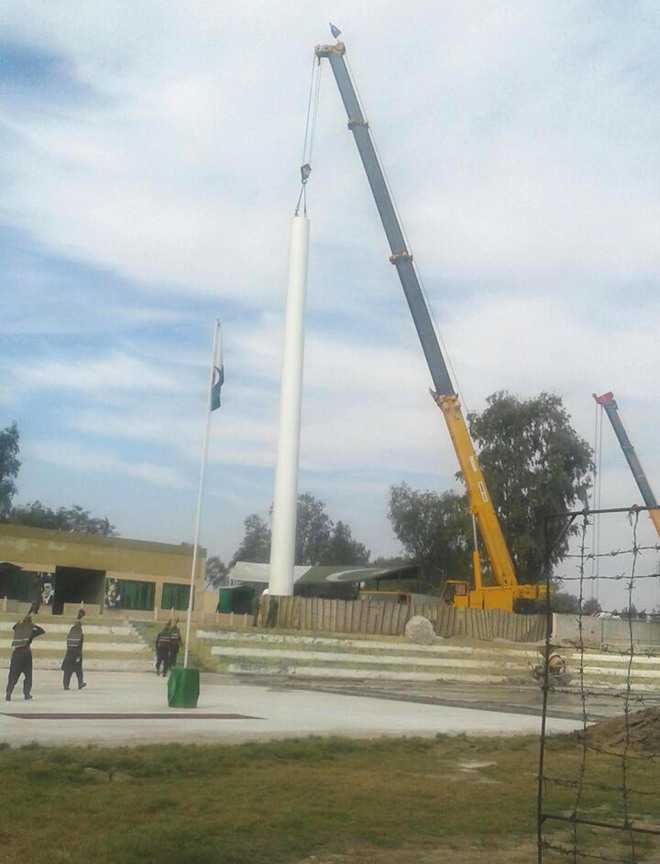
Pak 360-ft flag near border raises security concern

Pak 360-ft flag near border raises security concern
A pillar being installed on the Pakistan side near Sadiqi Joint Check Post in the Fazilka sector. Tribune photo

Praful Chander Nagpal

Fazilka, December 20

Pakistan today started the installation of a tall flag post at the India-Pakistan Joint Check Post, Sadiqi, in Fazilka sector. Sources said Pakistan would install 360-feet-high iron pillars and flag on top of them at a stone’s throw from the International Border. Big cranes have been pressed into service for the work.The BSF has expressed concern over the move. Notably, Fazilka is a strategically important area as it is surrounded by three sides from Pakistan. The security forces have to be more watchful in this area, especially during a tense situation. In 1960s, the Government of India had offered land to Pakistan in the Fazilka area in exchange of territories when India retrieved Bhagat Singh’s memorial its neighbour near the Ferozepur border. India’s concern revolves around security and surveillance issues. The security forces fear that the new masts could be used for spying. However, the BSF authorities are tight-lipped over the issue.A large number of residents who thronged the JCP, Sadiqi, to witness the Retreat Ceremony also noticed the installation of flag today.


AFPI achievers feted for making it to NDA, IMA

AFPI achievers feted for making it to NDA, IMA
The best cadet trophy being presented to Arunav Laroiya by Lt Gen TS Shergill (retd), senior adviser to Punjab CM, at the MAFPI in Mohali on Thursday. Tribune photo

Tribune News Service

Chandigarh, December 14

As many as 26 former cadets of Maharaja Ranjit Singh Armed Forces Preparatory Institute (AFPI), Mohali, who joined the National Defence Academy (NDA) and the Indian Military Academy (IMA) during the current year, were honoured and presented with “Achiever Award” by Lt Gen TS Shergill, senior adviser to the Punjab Chief Minister, during a function held at the institute today.Special prizes were given to cadets who excelled in various fields.Neerpreet Singh won the Academics Trophy, Shashank Sharma the Best Officer-Like Qualities Trophy and Loveneet Singh the Sports Trophy.Shashank had stood first in the all-India merit list for entrance to NDA’s 138th Course. The Best All-Round Cadet of the fifth AFPI course was Arunav Laroiya.Appreciating the ebullient spirit displayed by cadets as well as the AFPI’s outstanding results, Lt Gen Shergill advised the cadets to continue to work hard and bring more laurels to their alma mater. He narrated incidents from military history to highlight leadership qualities required in leaders in uniform and briefed the cadets about the Code of the Warrior.The AFPI was set up by the Punjab Government to train selected young men for a commission into the armed forces through the NDA. The first batch completed its two-year training in 2013.The institute has so far sent 83 cadets to the armed forces. This is a marked improvement over the previous years when the entire state of Punjab was contributing a mere 6-8 cadets in a batch of over 300.Maj Gen BS Grewal (retd), Director General, AFPI, said the institute had on two occasions — in January 2015 and in June this year — produced an all-India merit list topper.This year, the institute has sent as many as 26 cadets to various service academies.Further, nine cadets are expected to join NDA in Jan 2018. At present, 30 cadets of the institute are undergoing training for SSB interview after having cleared the NDA entrance examination.Maj Gen Grewal also spoke about the new venture being undertaken by the AFPI for training students in selected schools under a scheme, Cadet Training Wings (CTW). AFPI trainers would visit such schools where CTWs would be established and impart training akin to what is being given at the AFPI.


China handled Doklam with restraint: Wang

Beijing, December 11

Foreign Minister Wang Yi has said China handled the Indian troops’ “trespass” into Doklam area with “restraint” and through diplomacy, demonstrating the “value and emphasis” Beijing attaches to its ties with India.Ahead of his visit to India, Wang said China always values the good-neighbourliness and friendship with India “as we are each other’s big neighbours and ancient civilisations.” “In the meantime, China is also firm in upholding its sovereign rights and interests and territorial integrity,” Wang told a symposium here on Saturday.“We handled the Indian border troops’ trespass into China’s Dong Lang (Doklam) area in our national interest, on just grounds and with restraint,” Wang was quoted as saying by the Foreign Ministry, which posted an English version of his speech on its website. “Through diplomatic means, we engaged with the Indian side and it withdrew its equipment and personnel,” Wang said for the first-time outlining China’s approach to ties with India post Doklam standoff. — PTI


If there’s B’desh, it’s due to Lt Gen Sagat’

‘If there’s B’desh, it’s due to Lt Gen Sagat’
(From left) Brig OS Goraya (retd), Maj Gen VK Singh (retd), Maj Gen Rajendra Nath (retd) and Gp Capt CS Sandhu (retd) at a session on Lt Gen Sagat Singh.

Bhartesh Singh Thakur

Tribune News Service

Chandigarh, December 9

Lt Gen Sagat Singh was brought alive today at the Military Literature Festival when his audio recording was played at a session where he talked about his role in transporting nearly 2,500 men across Meghna river to the gate of Dhaka in helicopters.“…I was commander of para-brigade and I had full experience in the use of helicopters in offensive role… the directive was issued that helicopter could carry one company only and they also asked for my firm plans… I told them I couldn’t give firm plans…” said Lt Gen Sagat, in an audio recording of 1974.Maj Gen Rajendra Nath (retd), who fought the 1971 war on the eastern front, said Dhaka was well defended by rivers on two sides, so crossing over in helicopters was decisive. “Lt Gen Sagat was the best commander the world has ever seen. Had he not been commanding 4 Corps in the 1971 war and Group Captain CS Sandhu (retd) not been there, Bangladesh would still have been East Pakistan. He had the courage to say no to his superiors,” said Major Chandrakant Singh (retd), who was part of the first sortie of helicopters that flew across the Meghna. He won the Vir Chakra for his role in the war.Major Singh said Lt Gen Sagat crossed the Meghna without any orders as he wanted to capture Dhaka. Defying orders, Lt Gen Sagat had opened artillery fire on the Chinese to defend Nathu La in 1967. Thereafter, he was sidelined and given an administrative post. Group Captain Sandhu said they only had five Mi-4 helicopters that carried 17 troops each, five more than their capacity. Hundreds of sorties had to be carried out despite the copters being hit by small firearms. Group Captain Sandhu, squadron leader during the war, also got the Vir Chakra. Pakistan surrendered on December 16, 1971.Maj Gen VK Singh (retd), who has written biography of Lt Gen Sagat, said, “He was the best combat leader who never got any gallantry award.” About his plans to airlift troops, he said, “The Air Force Headquarters said they wouldn’t take the risk of landing at an unknown place. Group Captain Chandan Singh told them that the biggest boots had left his footprint there. He was referring to Lt Gen Sagat. So, without permission, they landed at an unknown location.”Lt Gen GS Sihota (retd), former Army Commander of the Southern Command, who too was part of the 1971 war, said, “None of us dared to say no to him. He never showed he was worried.”


Tales of battlefields create aura of amazement

Focus now shifts to festival starting Dec 7, which will see seminars on India’s defence literature, art, music, photography, among others

CHANDIGARH: Stories of hair-raising battles and humorous anecdotes from on and off the battle grounds marked the second and final day of the military parley, ahead of the inaugural Military Literature Festival.

The Government Museum and Art Gallery auditorium was abuzz on Wednesday as well with the war veterans sharing their tales. The festival will be held from December 7 to 9.

Lieutenant General JL Malhotra in the inaugural speech narrated the fearless tales of Sikh soldiers in Nagaland and Poonch sector of Jammu and Kashmir. His descriptive portrayal of the soldiers’ brush with artillery firing and their courageous retaliation, despite being wounded amazed the audience.

The Vir Chakra and Vashisht Sewa Medal (VSM) recipient, Colonel Gurmukh Singh lauded the role of Punjab Chief Minister Captain Amarinder Singh and his government for holding the Military Literature Festival and said such functions should be made an annual event. He shared his personal experiences and revealed the importance of discipline and hard work during his postings across India.

Speaking on the role of communication skills in the Indian Army, Colonel RD Singh said an army officer lacking in confidence and in-depth knowledge fails to imbibe the fighting spirit in the soldiers. He gave many tips to the children from YPS School, Mohali, on polishing the communication skills.

Colonel Singh thrilled the children with questions on general aptitude and gave chocolates to those who gave the right answers. To a query on how to become a good speaker, he said, “You can speak well if your tongue can deliver the message of your heart.”

Touching an important aspect of the Indian Army — Bridging The Gap, Colonel Avnish Sharma cited common perceptions about the Indian ‘Fauji’ in the eyes of the civilians, in contrast with the reality.

HUMOUR IN LIFE-THREATENING SITUATIONS

“A true soldier is known for his ‘short appearance and quick disappearance,’ he said, apprising the audience about several unknown facts about the soldiers by narrating incidents of humour even in life-threatening situations. He also spoke about transparency, fighting against corruption, behaviour of Pakistani soldiers in war and peace, and filling gaps between the civil society and army personnel.

Captain Amarjeet Kumar talked of his experiences in the 1971 War and the role played by the Mukti Bahini, as well as the conflict sparked by the armed liberation struggle in erstwhile East Pakistan.

He also spoke extensively about the Sikh soldiers’ bravery during this war and how the recipients of the highest gallantry awards fought for the nation without caring for their lives.

INNOVATION IN ARMY The need and role of innovation in the Indian Army was highlighted by Major General Surjit Singh, who made the audience aware of many innovative and economical techniques, swiftly adopted by the Indian Army.

He took the audience through a slideshow about how a ropeway helped in transporting material as heavy as 150 kg between Gangtok and North Sikkim after the bridge was washed away in an avalanche.

Among the speakers who enlightened and enlivened the event were Flt Lt G S Jawanda, Colonel JDS Jind, Brigadier Harwant Singh, Colonel Krishan Yadav, Major General HC Sachdev, Captain Renu Aggarwal, Major General BS Grewal, Brigadier IS Jakhal and Lt Gen PN Hoon.

Concluding the ceremony, senior adviser to Punjab CM, Lieutenant General TS Shergill thanked the organisers and Captain Amarinder Singh.

Saying that nearly 1,200 children would get the chance to interact with the recipients of the Param Vir Chakra during the festival, he said this would be an experience of a lifetime for them. He further disclosed that modalities were being worked out to conduct the military parley in the form of a book in the future.


A lot like a damp squib by MK Bhadrakumar

A lot like a damp squib
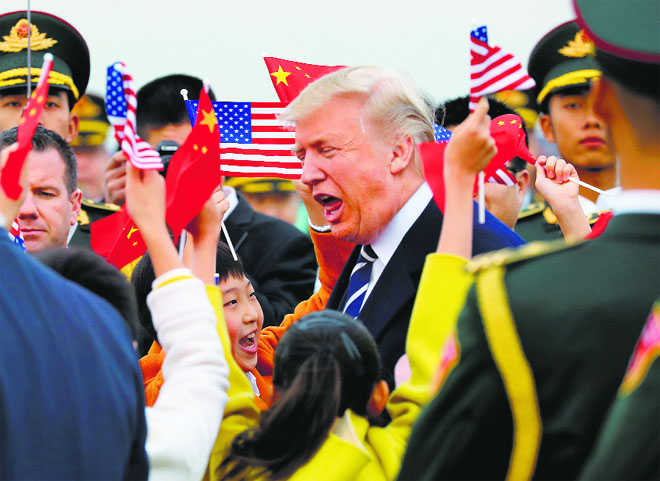
Inching close: Despite differences, the US and China are warming up to each other.

MK Bhadrakumar

WE have begun to clutch at small successes to proclaim victory — a seat in the International Court of Justice or a Western rating that we aren’t quite junk economy. But the big picture remains very depressing. An autumnal wind has been blowing the leaves and trees look bare and withered. Three hugely consequential regional events recently exposed that Indian foreign policy us adrift — the party congress of the Chinese Communist Party, President Trump’s Asian tour and the APEC and ASEAN summits. There are some profound inferences to be made. The Asian power-dynamic is making a historic transition. Indian analysts blithely borrowed from Western attitudes to view the contemporary Asian scenario through the prism of the so-called “Thucydides Trap” — coined by an ingenuous American think-tanker to expound the thesis that when an established power (read US) begins to fear a rising power (read China), things escalate toward war. The Americans do not make great historians and have a habit of encapsulating broad sweeps in neat conception. In reality, though, the strength of Spain and Portugal gradually began to decline in the early 1800s when their colonies in Latin America rebelled. The account of British decline was not different, either. Britain’s decline can be traced to its loss of relative economic dominance since the mid-19th century — although, paradoxically, Britain continued to remain the strongest European power militarily and economically until the early 1950s. The US’ decline bears striking similarity with Britain’s in modern history. Indeed, the eclipse of the Empire is always incremental. If only we had a Sardar KM Panikkar with us today, he’d have pointed a finger at the inexorable march of history in Asia (which he’d anticipated some 60 years ago in a classic work). The Party Congress in Beijing proclaimed that China is no longer “rising”, but has already “risen”. It is the principal driver of growth for Asian countries today (including, ironically, the lone Anglo-Saxon outpost of Australia). If Trump’s Asian tour has been a virtual acknowledgment that containment strategy toward China is no longer feasible, the flurry of Asian summits highlighted that the US’ continuing pre-eminence as the global military power is all but becoming irrelevant to the ASEAN region, where although military power still matters, economics has taken centre stage and infrastructure has become a more important tool for accumulating power as well as exercising it. All this leaves India in a quandary. A terrible beauty is born. The Asian Century was Nehru’s dream. But in Manila, not too far from Bandung, it was instead the China Dream that everyone within the earshot of PM Narendra Modi was compulsively talking about. The PM’s aides scheduled some meetings for him in Manila, but, largely, the impression accrued that the India which he represented has become somewhat peripheral to the animated discourses. We lurked in the shade furtively watching, holding uncertainly the can of “Act East” — for which there are no serious takers in Southeast Asia anymore. As a sideshow, the Indian officials huddled together with their colleagues from the US, Japan and Australia to explore whether to revive the moribund idea of a quadrilateral alliance of democracies (“Quad”) for marking territory on the lamppost of regional politics. They renamed the region as Indo-Pacific. (ASEAN plainly ignored the coinage.) It’s been tragi-comical in every sense. How did this burlesque happen? Who scripted it? In a nutshell, India has lost its sense of geography and history. That’s a sad remark to make for an ancient country, but it needs to be said because there is also a grievous failure of leadership involved here. Our present foreign policy elite hijacked the national interests. Geography dictates that India belongs to its region but India’s relations with China, the towering presence on Asia’s strategic landscape, nosedived during PM Modi’s watch. We barked up the wrong tree, losing precious time, crying hoarse over issues that belong to the domain of rhetoric — Masood Azhar, NSG membership, Dalai Lama, CPEC, et al. The business deals worth a staggering $250 billion agreed during Trump’s recent visit to China would create tens of thousands of new jobs in America. They not only added a new dimension to America First, but considering the very nature of the infrastructure projects on the anvil, also herald in the near term perspective the unannounced arrival of the OBOR in North America. No sooner than Trump got back from Asian tour, one of China’s top diplomats, Ambassador Cui Tiankai, nattily attired in a bow-tie suit, told an elite Washington audience of 400 invitees drawn from the US government, business and academia at a gala banquet in his honour: “We want to build a strong partnership with the US…(which) will enable each of us to better accomplish our domestic goals…(and) put both countries together in a stronger position… This is the essence of China’s policy towards the US. This is what we actually want to have in this relationship.” Aren’t we wasting time in quixotic ventures such as the Quad? At any rate, where was this “rules-based order” when Iraq was invaded or Syria brutalised or Afghanistan subjected to war crimes, which International Criminal Court plans to investigate? When Trump tossed out of the window the Trans-Pacific Partnership agreement, which was intended as the underpinning of containment strategy against China, Asian countries took note. We should have adjusted to the emergent compelling realities — like Singapore, the Philippines, Malaysia, Vietnam and South Korea did. There are signs that Japan too is trying to turn over a new leaf with China. Almost none criticised China by name at the ASEAN summit or mentioned the 2016 international ruling on the South China Sea. In fact, China and ASEAN agreed to negotiate a code of conduct. The fundamental flaw in the Modi government’s shift from “Look East” to “Act East” is that it was heavily laden with geopolitics, whereas, the Asian region as a whole — and Southeast Asian countries in particular — feel the pressure of public accountability and are focused on growth and developmental issues of trade, investment and infrastructure. India’s integration with Asia-Pacific faces serious challenges from the perspective of geo-economics. The RCEP negotiations are symptomatic of this. A leap of faith is needed. India should have the will to surrender parts of its sovereignty to regional processes, and the public opinion should be willing to support greater integration. Our predicament vis-à-vis the OBOR highlights a larger malaise. Scepticism about the benefits of the global supply chain is very high in India. Great wealth flows to the powers that dominate trade.The writer is a former ambassador