Sanjha Morcha

What’s New

Click the heading to open detailed news

Current Events :

web counter

Print Media Reproduced Defence Related News

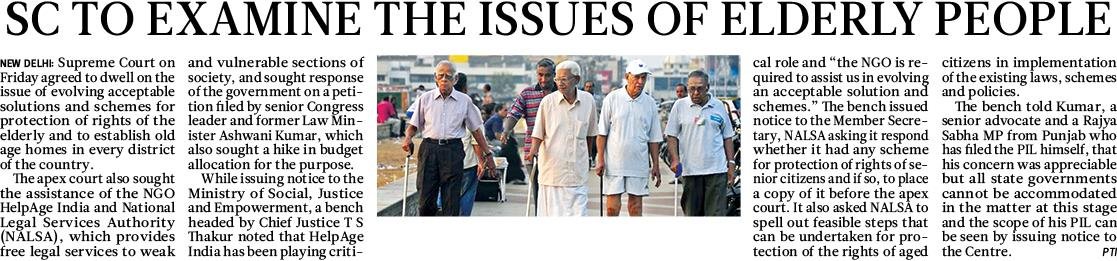
SC notice to govt on plea for old age homes

New Delhi, April 8

The Supreme Court today sought the Centre’s response to a PIL by former Union Law Minister Ashwani Kumar for setting up old age homes and exclusive hospitals for the rising population of senior citizens in each of the 622 districts in the country.Arguing before a Bench headed by Chief Justice TS Thakur, Kumar pleaded that this was necessary as most of the old people were living in poverty — without any roof over their head or proper clothes and food. They were also increasingly becoming victims of abuse and violence.Kumar acknowledged that the Centre had put in place several laws and schemes such as the National Policy on Older Persons 1999, the old age pension scheme 1995, the Maintenance and Welfare of Parents and Senior Citizens Act 2007 and the Integrated Programme for Older Persons. The government also announced a health care policy in 2010-11. — TNS

63544


TRIBUNE SPECIAL Lives scarred

Lives scarred
Jagrup Singh (right), whose father, TADA undertrial Sarvjit Singh, was beaten to death inside the Pilibhit district jail. Photo: Shahira Naim

Shahira Naim

Now 27, Jagrup Singh was five when his father, TADA prisoner Sarvjit Singh, was beaten to death inside the Pilibhit district jail and uncle Trilok Singh virtually debilitated.Growing up on the horror stories of that fateful day, Jagrup’s only mission in life is justice for his family.Their land in Jagat Kundro village under Amaria police station went under water in a subsequent flood, rendering the family landless. He now earns a living driving a truck for a transporter in Sitarganj in Uttarakhand.After reading a news item in a local paper last month about the jail staff of Pilibhit district jail going scot-free after beating to death his father and six other prisoners, he wrote a letter to the head of the Shiromani Gurdwara Committee of the historic Nanak Mata Sahib near Sitarganj in Uttarakhand, asking to ensure the reopening of the murder cases against the Pilibhit jail staff.He also asked the gurdwara management to press for compensation for the families of the victims and jobs for their children.Showing a copy of the letter, Jagrup brings out stacks of sepia-coloured papers relating to the case. He has preserved every bit of paper related to the case at his rented house in Bara Dunwa village, not far from his village.A father of two, Jagrup regrets that his mother Jasbir Kaur died three months ago before she could see him getting the guilty punished.The family lives with his maternal aunt while he works in Sitarganj. Tarsem Singh, brother of the maternal aunt’s husband, had brought his father’s body from the Pilibhit hospital in his tractor in 1994.“The sole of his feet had been reduced to pulp. The nails had been pulled out. The police did not let us call anyone for the last rites and insisted on disposing of the body quickly,” he recalls.Jagrup’s uncle Trilok Singh, who survived the beating, cannot walk without support. After being released from Pilibhit jail in 1997, he shifted to Rasul Kalan village under Jandiala police station in Amritsar. Speaking to this reporter from Amritsar, he said that fateful night inside the jail ruined his life. “I have rods inside my leg; I am in pain most of the time and can barely walk with a stick.”He lives with his brother Lakhwinder Singh, who retired from the Border Security Force. Similarly, there was another set of brothers incarcerated under TADA from Saddarpur village under Amaria police station. Jeet Singh was killed inside the jail while his younger brother Harbhajan Singh was brutally beaten up and moved to Amritsar after he left the prison. The wife and family of the third brother, Gurmej Singh, now live in the family house and look after a 10-acre farm.“Our whole family split up after that incident,” reminisces Sukhwant Kaur. She recalls that Jeet had been married for barely four years. After his death, his widow remarried when Harbhajan did not marry her.Too bitter by the experience, Harbhajan sold off his share of the family property and moved to Punjab. Sukhwant Kaur says that he neither keeps in touch with the family, nor has anything to do with Pilibhit.“Pained by all this, my husband died of a heart attack eight years ago. Since then, I and my children are fending for ourselves”.Recalling the horror of those days Sukhwant says that one lived in constant dread.“So-called terrorists from Punjab hid in the fields and forests out here and demanded food from us. If we obliged, the police would get us and if we refused, they gave us hell.”In her family’s case, some alleged terrorists were hiding in their fields and caught hold of her brothers-in-law when they had gone to water the fields. “We were forced to feed them and they went away. After some time, SHO of Amaria police station Rajinder Singh and SI Harpal Singh came in a jeep and started questioning us about that incident. My brothers-in-law refused having sheltered any terrorist. Just then this man came out of the police jeep and reminded them of the food that they had provided. The police immediately arrested and took away both my brothers-in-law,” recalls Sukhwant Kaur.Incidentally, the SO and SI who had visited her house to pick her brothers-in-law are among the policemen sentenced to life imprisonment by a CBI special court for carrying out fake encounters in 1991 in Pilibhit.Jail staff chargesheetedVindhyachal Singh Yadav (Jail Supdt)

Shahjehan Hussain Jafri (Jailor)

Ram Kishore Tripathi

Munna Lal Dwivedi

Liaqat Ali

Bharat Singh Chaudhury

Rajendra Prasad Dikshit

Hem Chand

Girija Shankar

Harpal Singh

Hardwari Lal

Chote Lal

Janki Prasad Gangwar

Rameshwar Dayal 1

Bhagwan Das

Yashwant Singh

Mohammad Sulaiman

Mohan Lal

Ram Swaroop

Rameshwar Dayal 2

Rampal

Anil Kumar Singh

Rampal Singh

Parmanand

Ram Bahadur

Hira Singh

Shanti Swarup

Mewa Ram

Krishan Pal

Sukhlal

Janki Prasad

Lal Bahadur

Jagat Narayan

Kallu Singh

Nokhey Singh

Bharatji

Gangaram

Shyam Singh

Malkhan Singh

Devi Singh

Khempal Singh

Anokh Singh


Peace process is suspended: Pak India questions envoy’s statement

Peace process is suspended:  Pak

Simran Sodhi

Tribune News Service

New Delhi, April 7

Pakistan High Commissioner Abdul Basit today said the peace process with India stood “suspended”, and there were no talks scheduled between the two countries as of now.    The statement is being seen as a setback for bilateral ties as the word “suspended” had so far not been used by either nation to define the delay in holding a dialogue. Interacting with the media here, Basit said, “There is no meeting scheduled as of now. I think at present the peace process is suspended.” Basit was also non-committal on the visit by an NIA team to Pakistan: “It is not about reciprocity, but cooperation between the two countries.” He went on to state that dialogue was not a favour by one country to another, and that if India was not ready for talks, Pakistan could always wait. New Delhi was quick to hit back on both the issues. Ministry of External Affairs spokesman Vikas Swarup cited today’s response of a Pakistan Foreign Ministry spokesperson, who said: “I will again state that negotiations are the best means to resolve the issues. I have read the statement of the Indian Foreign Secretary you are referring to and in that also, there was an indication that the talks would take place.”India, as such, has questioned Basit’s statement on “suspension of talks”.Swarup said on March 26, before the visit of the Pakistan JIT, the Indian High Commission had formally conveyed to the Pakistani Foreign Ministry that “the terms of reference had been broadly agreed upon with the proviso that these would be on the basis of reciprocity and followed in accordance with extant legal provisions”.Basit also sought to push the Jammu and Kashmir dispute back in the forefront. “It is the Jammu and Kashmir dispute that is the root cause of mutual distrust and other bilateral issues. Therefore, its fair and just resolution, as per the aspirations of the people of Jammu and Kashmir, is imperative. Attempts to put it on the back burner will be counterproductive,” he said.The Pakistan envoy also raised the recent arrest of alleged Indian spy Kulbhushan Yadav by Pakistan security agencies, and said that it once again “irrefutably corroborates what Pakistan has been saying all along — we all are well aware of those who seem to create unrest and destabilise the country”.On India’s request for consular access to Yadav, Basit said, “The request is under consideration, but can’t say when they would be given consular access.” He also said that Pakistan “subscribed to China’s viewpoint on  Jamaat-ud-Dawa (JuD) chief Masood Azhar”. India tried getting the JuD chief designated as a terrorist at the United Nations recently but the Indian move was stalled by the Chinese over a “technical hold”. China had subsequently said that Azhar was not a terrorist.


U.S.-China ‘War’: US, India To Conduct Anti-Submarine Warfare Vs. Chinese Navy

A U.S.-China war seems to be up ahead in the horizon as the United States is reportedly in talks with India to help each other track submarines in the Indian Ocean in response to China stepping up its undersea activities in the area.

The United States and India will be holding talks on strengthening cooperation on anti-submarine warfare (ASW) in order to devise strategies to keep in Chinese submarines, reports Reuters.

With the tension in South China Sea growing over China’s continued militarization of the area, the United States is seeking help from New Delhi, who so far has remained reluctant to be drawn into America’s embrace.

But troubled by Beijing’s repeated incursions into the Indian Ocean, New Delhi agreed to open up its military bases to the U.S. in exchange for access to weapons technology to help it narrow the gap with China. Indian naval officials say Chinese submarines have been sighted on an average four times every three months. Some are seen near India’s Andamans and Nicobar islands that lie near the Malacca Straits, the entry to the South China Sea through which more than 80 percent of China’s fuel supplies pass.

Neither India nor U.S. military officials, however, have officially revealed details of the talks. “These types of basic engagements will be the building blocks for an enduring navy-to-navy relationship that we hope will grow over time into a shared ASW capability,” a U.S. official told Reuters.

According to an Indian naval source, this year’s Malabar naval exercise taking place in the northern Philippine Sea in June will allegedly include Indo-U.S. ASW drills.

India and the United States already operate variants of the Boeing P-8A Poseidon maritime patrol/anti-submarine warfare aircraft, says The Diplomat. The Indian Navy currently operates eight P-8I Neptune, an export version of the P-8A, and has placed an order for four more aircraft in July 2015. The P-8I is equipped with some of the most modern U.S. ASW technology including a Telephonics APS-143 OceanEye aft radar system and a cutting-edge magnetic anomaly detector. The aircraft is also armed with U.S. weapons systems including Harpoon Block-II missiles, MK-54 lightweight torpedoes, rockets and Mark 82 depth charges.

On the other hand, China is seeking to break up nations of the Association of Southeast Asian Nations (ASEAN) on the South China Sea dispute in a push against Washington. China’s foreign minister Wang Yi recently announced in Laos that Beijing had reached a four-point consensus with three of 10 countries including Brunei, Cambodia and Laos of the ASEAN on the South China Sea issue.

They agreed that the sovereign states were free to choose their own ways to solve disputes; and there should be no attempt to unilaterally impose an agenda on other countries. They further asserted that territorial and maritime disputes should be resolved through consultations and negotiations by parties directly concerned; and that China and ASEAN should be able to maintain peace and stability in the South China Sea through cooperation.

China is attempting to secure diplomatic support from states on the disputed islands that they hold, ahead of the verdict on the Philippines’ case against Beijing at The Hague expected in May or June.

So the tensions in the region continue to rise and with the Hague verdict nearing, the possibility of war also nears in case China refuses to let go of the disputed area that the International Court of Arbitration may give to Philippines.


Two top militants of Hizbul killed in Shopian encounter

Two top militants of Hizbul killed in Shopian encounter
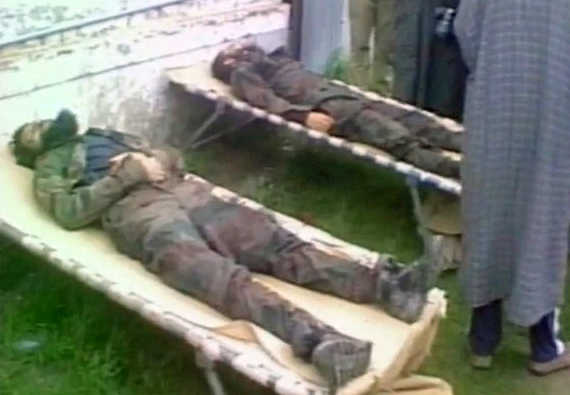
Bodies of two Hizbul Mujahideen militants killed during an encounter in Shopian, Jammu and Kashmir. ANI photo

Srinagar, April 7

Two top Hizbul Mujahideen militants, including a former policeman, were killed on Thursday in a gunbattle with security forces in Shopian district of south Kashmir.

An encounter broke out between security forces and militants in Vehil village of Shopian, 55 km from here, after the troops of 62 Rashtriya Rifles launched a search operation in the area, an Army official said.

Two militants were killed in the encounter, he said, adding that two weapons were recovered from them.

The dead militants have been identified as Naseer Ahmad Pandit and Inamul Haq, alias Waseem Malla, both wanted militants of the Hizbul Mujahideen, the official said.

Pandit had joined militant ranks after deserting police force last year. He was posted on security duty at the residence of PDP MLA and then Works Minister Altaf Bukhari at the time of quitting the force. — PTI


Brothers in arms G Parthasarathy China, Pak are rattled by the Panama expose but it shall pass

Brothers in arms
Best friends forever: The China-Pakistan ties have no parallel in the world.

PRIME Minister Nawaz Sharif described his country’s relations with China as: “Sweeter than the sweetest honey”. Pakistan’s ambassador to China gushingly described the Sino-Pakistan relationship as: “Deeper than the ocean, higher than the mountains and stronger than steel”. In the meantime, we are learning more about the real implications of this relationship, which is based on “strategic containment” of India.  The China-Pakistan relationship has no parallel anywhere in the world, as nowhere has any country transferred nuclear weapons designs, nuclear enrichment and reprocessing capabilities, ballistic missile designs and manufacturing facilities, as China has done to Pakistan. These details have been described in the book authored by the Washington-based scholar, Andrew Small, titled: “The China-Pakistan Axis: Asia’s New Geopolitics”.The recent revelations of those involved in holding “offshore” accounts in Panama brought out the names of relatives of both Pakistan Prime Minister Nawaz Sharif and of Xi Jinping, China’s all-powerful President, who is also head of the Communist Party’s apex Military Commission. Following domestic political pressure, evidently backed by army chief Raheel Sharif, Nawaz Sharif’s influence has been further eroded. He has, however, hit back at the army, drawing attention to the protection from prosecution it has provided to General Musharraf who has acquired valuable properties in London and Dubai. The Panama revelations have also drawn attention to offshore accounts of the family/relatives of  Xi Jinping and of other top Chinese leaders. At least eight current and former members of the standing committee of the Communist Party politburo find distinguished mention in the Panama documents, as does Deng Jingui, who is President Xi’s brother-in-law. Deng has reportedly set up two companies in the British Virgin Islands. While Sharif is showing signs that he is feeling the heat, President Xi has reacted defiantly, enhancing his already extensive powers. He is the first leader since Deng Xiaoping to head the party’s powerful Military Commission. He has gone a step further by nominating himself as the commander-in-chief of the country’s armed forces, while unprecedentedly clad in army camouflage uniform. This has predictably led to speculation of President Xi wanting to make sure that the army remains directly under his command. While Xi has taken a tough posture against corruption, it is well known that members of his family/relatives have wide-ranging business connections and interests.  It was also no secret that family members of former Prime Minister Wen Jiabao, led by his mother, had business assets exceeding $2 billion.All this is occurring when China is going through a painful economic transition. Its export-driven economic growth over the past three decades has been unparalleled in contemporary history, with growth rates of around 10 per cent over the past two decades. While its present growth rates of around 6.9 per cent may appear problematic for China, it is still around the highest in the world. But the days of China being the sole exporting hub for manufactured goods are slowly declining. As China moves towards becoming a consumption-based economy, huge capacities built for manufacturing will have to be shut down, though some relief can be obtained from supplies to ventures abroad like its Silk Road economic belt and the Maritime Silk Road. With the prospects of growing unemployment, as surplus capacities in manufacturing are shut down, one will likely be staring at the face of a jingoistic China ready to divert attention by becoming more aggressive on its maritime and land border claims. While China would remain primarily focused on its maritime boundaries, it will also be unlikely to agree on issues like demarcating the Line of Actual Control along its borders with India.  But both countries will gain by moving ahead with confidence-building measures and better communications between the border forces. Xi Jinping has restructured the command of the PLA along borders with India, with a unified command now established in Chengdu. China appears unlikely to embark on a large-scale military adventure, though pressures will be maintained for keeping us unsettled along our borders. Nothing, however, can be taken for granted. New Delhi would be well advised to hasten the establishment of a Mountain Strike Corps and modernisation of its air power. Beijing’s “one belt one road” initiative across Pakistan, involving an investment of $46 billion, and its virtual takeover of the Gwadar Port in Baluchistan will require new initiatives by India, involving regional and extra-regional powers, to balance Chinese maritime power across the sea lanes of the Indian Ocean, which will be reinforced by continuing supplies of submarines and frigates to Pakistan.We should have no illusions of how China views India. Beijing has built Pakistan’s nuclear, missile and conventional arsenals. It welcomes political leaders and visitors from POK and Gilgit-Baluchistan, while treating visitors from J&K on an entirely different footing. It denies normal visas to Indian nationals from Arunachal Pradesh. Beijing aids and trains members of Northeastern insurgent groups like ULFA, along the Myanmar-China border. It seeks to constantly undermine Indian influence and promotes anti-Indian forces in all our SAARC neighbours. It blocks India’s membership in multilateral forums like the Nuclear Suppliers Group. It protects Pakistan-based terrorist groups like the LeT and JeM from international sanctions in the UN. Given China’s domestic economic and political problems and its aggressiveness with neighbours, there has to be a sustained dialogue to address tensions that will arise periodically along the Sino-Indian border. The trade, economic and investment relationship with China should be expanded. New Delhi should continue cooperation with China in forums like BRICS, the Asian Infrastructure Bank and G20. China’s policies of undermining India’s relations with its South Asian neighbours should be countered by a robust relationship with China’s maritime neighbours like Vietnam, Japan and the Philippines. Military exercises with the US, Japan, Australia and Indonesia in the South China Sea and the Indian Ocean should be expanded.  Military cooperation with Vietnam must include supplies of Brahmos Cruise missiles, which will serve as a deterrent to Chinese maritime adventurism. Given China’s links with armed separatist groups in the Northeast, India need not be apologetic about the Dalai Lama’s presence in India, or about the carefully nuanced support for democratic and religious freedoms. India must adopt a policy of cooperation combined with containment, in partnership with like-minded powers, in dealing with China.


A moment of light relief The budget is a mixed bag but lacks holistic vision

A moment of light relief
A push in roads construction will boost the economy, like it always does.

FINANCE MINISTER Arun Jaitley seems to have been third time lucky this year. This is his first budget which has broken out of the mould of the past. The proposals for 2016-17 give little in the form of an impetus to investment, but he has managed to  stick to the fiscal deficit goals laid down in the Fiscal Responsibility and Budget Management legislation. The very fact that India has kept to its fiscal deficit target of 3.5 per cent is bound to enthuse global credit rating agencies, for whom meeting this criteria is a vital factor in giving a country a high investor rating. It is a different matter that these same rating agencies remained clueless about the viability of leading western financial institutions just before they crashed and burned in 2008. Nonetheless, it improves the investment climate in India in the eyes of foreign corporates.It will also please RBI Governor Raghuram Rajan who has been persistent in pleas for the government to conform to the fiscal deficit targets. In turn, the central government will now expect the RBI to oblige with cuts in interest rates, which may possibly provide a stimulus to kick-start the investment cycle.The second achievement has been the effort to carry out tax reforms, though these are rather piecemeal and patchy. Undoubtedly, however, Mr Jaitley is finally trying to take power out of the hands of the tax official and bring a system where there are less discretionary powers and thus less scope for corruption. The decision to avoid any more retrospective taxation is also welcome, as are the moves to create a better dispute resolution mechanism to reduce tax litigation.The third positive element is the focus on raising public investment in roads and highways. The investments are pegged at a massive Rs 2.18 lakh crore, though this includes the funding for the railways. A push in roads construction has always provided an impetus to the economy as it did when Atal Behari Vajpayee launched the Golden Quadrilateral project.On the other hand, there is virtually nothing for exporters on the grounds that global headwinds are weak and the country needs to focus on the domestic market. This is a rather defeatist approach as exports are clearly a drag on the economy currently. It is surely time to provide support to export industries which had been growing consistently till about two years ago. The plans for the agriculture sector and the rural economy appear to be more political grandstanding with an eye to the forthcoming state elections, as many targets seem unachievable like the expansion in irrigation over 80.6 lakh hectares. Besides, the aim of doubling farm incomes in five years is laudable, but not possible unless minimum support prices are raised sharply. This could, in turn, lead to a spiralling of food prices and raise prices significantly. Interestingly, the budget proposals also highlight the fact the highest-ever allocation of Rs 38,500 crore has been made for the MGNREGA, UPA’s flagship programme which had been severely criticised by the BJP before winning the elections. It has now been adopted, wisely so, by the NDA as a scheme that can alleviate the problems of the rural populations after two years of failing monsoon.Yet the biggest lacuna in the budget is any real stimulus for the creation of jobs. Barring the proposals for sops to fresh recruitment by companies, there is hardly any incentive for increasing the setting up of manufacturing units. Companies will hire new employees only when they are needed and not just to avail of these relatively minor benefits. In the roads sector, for which big public investments are being made, employment is available largely on a temporary basis and for unskilled workers. The only push to manufacturing, and hence large scale employment, in the proposals are the excise concessions being given to sectors covered by the ‘Make in India’ scheme.As far as the recapitalisation of banks is concerned, the amount of Rs 25,000 crore is far too little compared to the lakhs of crores of stressed assets in this sector. At the same time, the effort to move forward on a new insolvency code as well as the plans for the legislation to prevent illicit deposit scams that ensnare many is laudable. The proposals have little succour for the common man facing rising prices especially of food products. The cost of services will go up across the board with the new 0.5 per cent Krishi Vikas cess. The middle class may welcome the new provisions for pension schemes and the higher deduction for housing loans,  but there is little that is heartening for a segment that used to be the traditional constituency of the BJP. Even the crash in world oil prices has not been passed on by way of lower petrol or diesel prices to consumers. In this context, it is amazing to find a special scheme proposed to lure foreign oil majors to invest in highly expensive projects of deep sea and ultra deep oil and gas exploration. At a time when oil prices are at historic lows, no oil company is likely to venture into the highly risky and costly job of deep sea exploration. Such ventures become cost effective only when prices are ruling at high levels. There are some definite plus points in the proposals, like the scheme to provide LPG stoves to women in rural areas as well as the plan for the modernisation of land records and the digital literacy mission. The allocation for the social sector has also been raised significantly, clearly in response to severe criticism over the cuts made last year. However, it abounds in a mass of trivia about individual concessions especially on the tax side. Mr Jaitley’s third budget is thus a mixed bag. It is a definite departure from the past in terms of presentation, and also in firmly adhering to fiscal goals. But it lacks a holistic vision and, most importantly, fails to provide the much-needed push to investment and employment growth. In the absence of such a stimulus, it may be difficult for the economy to reach the goal of a high growth path of 8 to 10 per cent in the years to come. 


Parrikar to visit China on April 18 to shore up defence ties

Parrikar to visit China on April 18 to shore up defence ties
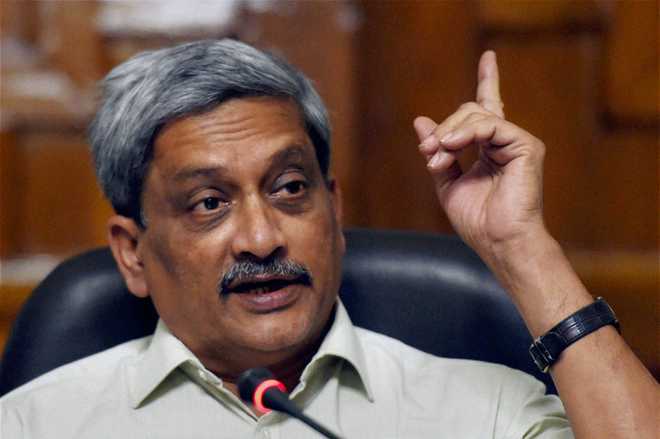
Defence Minister Manohar Parrikar. — PTI file

Beijing, April 6

Defence Minister Manohar Parrikar will visit China later this month to strengthen military ties despite strains in bilateral relations over Beijing’s move to block India’s attempts in the UN to clamp a ban on Pakistan-based terror group JeM chief Masood Azhar.Parrikar, the first Indian defence minister to visit China since 2013, will pay a three-day visit starting from April 18 during which he is expected to hold talks with top Chinese political and defence leaders, official sources here said.His predecessor AK Antony visited China in 2013.No agreements were expected during Parrikar’s visit which is being regarded as bilateral visit aimed at firming up ties, officials said.His trip follows high-level visits by top Chinese defence officials, including Central Military Commission (CMC) Vice-Chairman General Fan Changlong, to India last year.CMC headed by President Xi Jinping is the highest commanding authority of the 2.3-million strong People’s Liberation Army.While the two sides had set up a dialogue mechanism under Special Representatives of both the countries to find a solution to the vexed boundary dispute spanning 3,488 km, they also operationalised a Working Mechanism for Consultation and Coordination to address tensions arising out of aggressive patrolling of the disputed boundary.The Special Representatives have held 18 rounds of talks so far. The two sides also opened more border points for regular interactions between their officers and men to build friendly rapport between them.Chinese officials say the border situation is generally stable and the two militaries should take concrete actions to implement the consensus reached by their leaders on the issue.Parrikar’s visit also comes as concerns were rising in India about China’s move to block its bid to have JeM chief Azhar designated as terrorist by the UN in the aftermath of the terror attack on an air base in Pathankot in January.While Indian officials say that strains resulting out of this controversy will not affect Parrikar’s visit as both sides attached importance to improving military ties, reports say India mulled to re-clamp security checks on Chinese firms investing in India to show its concern over the issue.India is also concerned by reports of presence of Chinese troops in the forward positions in Pakistan-occupied Kashmir.China has termed such reports as baseless. — PTI


Restoring rule of law A court-monitored SIT is in Haryana’s interest

It will take Haryana quite some time to recover from the painful events it has just witnessed. The Chief Minister may be living in delusion if he thinks an investor summit would bring back private investment and send out a signal of normalcy. The top priority at this critical juncture is not wooing investment but restoring public faith in the rule of law. The trauma that the state has undergone during the 10-day Jat agitation cannot be allowed to be forgotten and forgiven without bringing those guilty of acts of commission and omission to justice. It is a tough job. Identifying faceless criminals who caused death and destruction will not be easy. Rape victims may be too scared to come forwards to testify. Even in normal times the way the Haryana police functions does not inspire much confidence. Since tempers have cooled and a semblance of law and order has been restored, it is time to take a hard look at what went wrong and who was sleeping at the wheel. Since the entire state machinery broke down and people of the state were left to fend for themselves for days together as rampaging mobs had a free run, an inquiry to be held by the same set of people under the same administration will clearly lack credibility. For the first time Haryana stands divided between Jats and non-Jats. The Cabinet itself is split with ministers saying they are not aware what is going on and who is deciding what. The Centre has either remained a mute spectator or the little intervention it made was woefully inadequate. Post-destruction too, the government seems clueless as to what needs to be done. A few suspensions here and there are not enough. Actually, the state administration has a vested interest in a cover-up. Since the Punjab and Haryana High Court has taken note of the Murthal rapes, it should constitute a special investigation team (SIT) of the CBI and monitor its investigation to deliver time-bound justice. The Khattar government itself has a lot to answer and a lot to cover up. A fair and impartial probe is the last thing one would expect it to do.

Let there be no more denials for ‘mobocracy’

he violence in Haryana is a setback to the ideas of peace, hard-work and values. In addition to an impartial probe, an intellectual audit is needed to find out why the situation crossed the boiling point of social order.
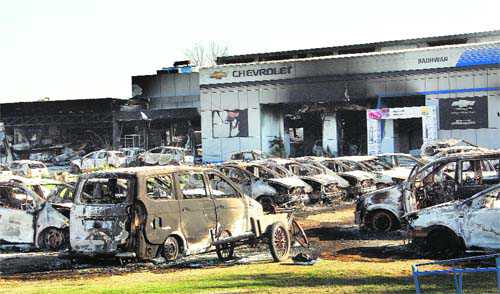
Let there be no more denials for ‘mobocracy’
The fear-psychosis due to the mayhem far exceeded the impact of Dinanagar or Pathankot terror strikes.

The hard-hitting reality is that the last nail in the coffin has been pierced through the heartland of Haryana. Its air has got choked with the smothering ashes of pain, flames, resentments and deep anguish, thus furthering the ever-increasing historical gap between the Jats and non-Jats in the political, social and cultural landscape of the State which is already quite notorious for its diktats of ‘khap panchayats’ and the remarkably low-sex ratios.In the words of layman’s analysis, Haryana has been critically paralysed, destroyed and decimated like never before. India stands shocked and surgically numb over the stark fact that the State has been engulfed by politically venomous propaganda and mercilessly razed to the ground. Sadly, this devilish act has been done, not by any outside non-state actor or terrorist. The destruction has been choreographed and performed by the legally domiciled inhabitants of the State itself. It will not be far-fetched to declare that the trail of damage and fear-psychosis which has gripped the collective conscience has far exceeded the impact caused by recent terror attacks, whether in Dinanagar or Pathankot. Today, a mind-boggling debate rages on as to whether the country needs to be fearful of being attacked by external forces or be more cautious of being demolished from within by its own inimical hostilities. The concerns are not without any basis as the common man has actually lost hope in the laws of the land.   Death, destruction and devastation cannot be rationalised or justified by any means. On the face of it, the endemic issue seemed to be revolving around the demand by ‘Jats’ for reservation. But it actually turned out to be a free-for-all ‘goondaism’ and brazen anarchy, with hooligans, arsonists and hoodlums creating havoc akin to the flames of demonising hell. The gory images carried by the media of burnt business houses, vandalised malls and car-showrooms gutted in fire sends chills down the spine of any human being who believes and practices the ideas of peace, hard-work, sincerity of virtues and values.  The public perception is that an orchestrated scheme of savage style brutality was unleashed to pull back Haryana into the pre-ancient times. Indeed, the state has backpedalled in terms of progress and it will take real painstaking years of new hardships to again achieve any desired levels of reasonable development.  The decision involving merits versus demerits of demand for reservation by the ‘Jat community’ can be discussed, debated and dissected at length by a plethora of well-educated scholars, legal luminaries, and constitutional experts, but the real question by every citizen of this nation which begs for an honest answer is that whether mobs, unruly violence and anarchism plays a decisive role in drafting and finalizing the crucial policymaking key decisions of our country’s future. Is the national security, citizen’s welfare, protection and prosperity so easy to be violated and prone to being breached at anyone’s sundry will of perceived disillusionment?The common man on the street simply wants to know if there actually exists any prevalent working mechanism to successfully prevent and stop the national prestige, life and property from getting bruised, beaten and tortured time and again at the cruel hands of nonsensical vested interests resorting to unmindful blockades, protests and agitations. The voice of the nation wants to know whether something similar happened in Haryana akin to the mini-1984 riots or Godhra carnage? The comparisons are obvious. The state machinery was brought on its knees, the law and order took an unexpected beating, the national highway was hijacked, road and rail networks obstructed, airlines reaped bumper profits, water-taps in Delhi ran dry, and to add salt to the national wound, reports of rapes and molestations surfaced which bombarded our trust and immense faith in the spirit of legislature, executive and judiciary. No matter how reasonable anybody’s demands are, resorting to such inexplicable proportions of violence, looting and arson for securing the ends amounts to ‘mobocracy’ and not democracy. The dangerous levels of destruction unleashed by agitators in Haryana is a blot on the nation’s psyche as a whole, whereby immeasurable losses caused to human life, public and private property, have to be borne by the state from the treasury of its law-abiding taxpayer’s pockets. The Supreme Court has rightly asked the concerned quarters to detail out the modalities for recovering the losses from the protesters as a part of its efforts to prevent any such blatant acts in the near future. Apart from this financial assessment, an intellectual audit is also needed to understand the reasons as to why the situation crossed the boiling point of reconciliation. The role of police and others responsible for containing violence needs to be probed effectively and accountability fixed for any dereliction of duty within the defined boundaries of law.   Also, a hunt needs to be launched on a war-footing for tracing persons who incited as well as participated in the mob violence for meting out an exemplary punishment for their calculated misdeeds.  It also requires a mention that the Army cannot be reduced to just controlling mobs; it has its own demarcated criteria of operations. The requirement is to make the State police forces as well as the concerned paramilitary forces self-sufficient in dealing with any emerging law and order situations of volatility. The Prevention of Damage to Public Property Ac, 1984, also needs to given more teeth to act as a formidable deterrent.This is not an occasion to score brownie points and indulge in political games of vendetta. We need to collectively nurse the broken spirit of Haryana and resuscitate the shattered hopes of the nation. By the way, is there anyone still wondering as to why no one is ready to invest in Haryana anymore?The writer is a senior Deputy Superintendent of Police (DSP) in Punjab Government

Suicidal path

Badal govt selling public land like there is no tomorrow

Farmers on the brink in Punjab look to the government for help. The government, unfortunately, is no better than them; broke. Under such unmanageable debt that it is hard to pay even the interest. Credit worthiness is so low that banks are refusing to give loans to its development and infrastructure agencies. To somehow still carry on the charade of administration and development, the SAD-BJP government has all through its second term been executing a nefarious plan of selling off public property — just like that. It takes extraordinary boldness to come up with a ‘development plan’ based almost entirely on auctioning the state’s assets. What is worse, the money is not being all spent on development. A significant chunk of the proceeds is going into paying salaries, which are still not paid regularly.The ever-mounting debt of the state has shown no sign of easing during the Badals’ two terms. Among the major reasons for this ‘mismanagement’ is the massive unwarranted expense on the fleet of ministers with a taste for luxury. Perpetually on overdraft with the RBI, the Chief Minister personally goes around literally showering benefits on political and social constituencies, as was seen last in the Khadoor Sahib byelection. This amounts to using public money to bribe the voter. The surge in ‘development’ planned in the last year of the government is also just that. Public land is meant for future requirements of public facilities and infrastructure. The assets being sold cannot be recreated.Unfortunately for the SAD, which had been hoping for a debt waiver from the ally BJP at the Centre, what has come Punjab’s way is only a cut in the Centre’s contribution to most social sector expenditures, including education. The land sale worth thousands of crores could well be the biggest scandal in the state. No one, however, is speaking up because no private interest is immediately hurt. In the long term, however, the state will not only have a nearly unserviceable debt, but also no assets to mortgage.http://www.tribuneindia.com/news/editorials/suicidal-path/202360.html



23 Medium Regiment celebrates Platinum Jubilee of The Battle Honour “AD TECLESAN “

IMG-20160403-WA0009
Mobile War Memorial Trophy



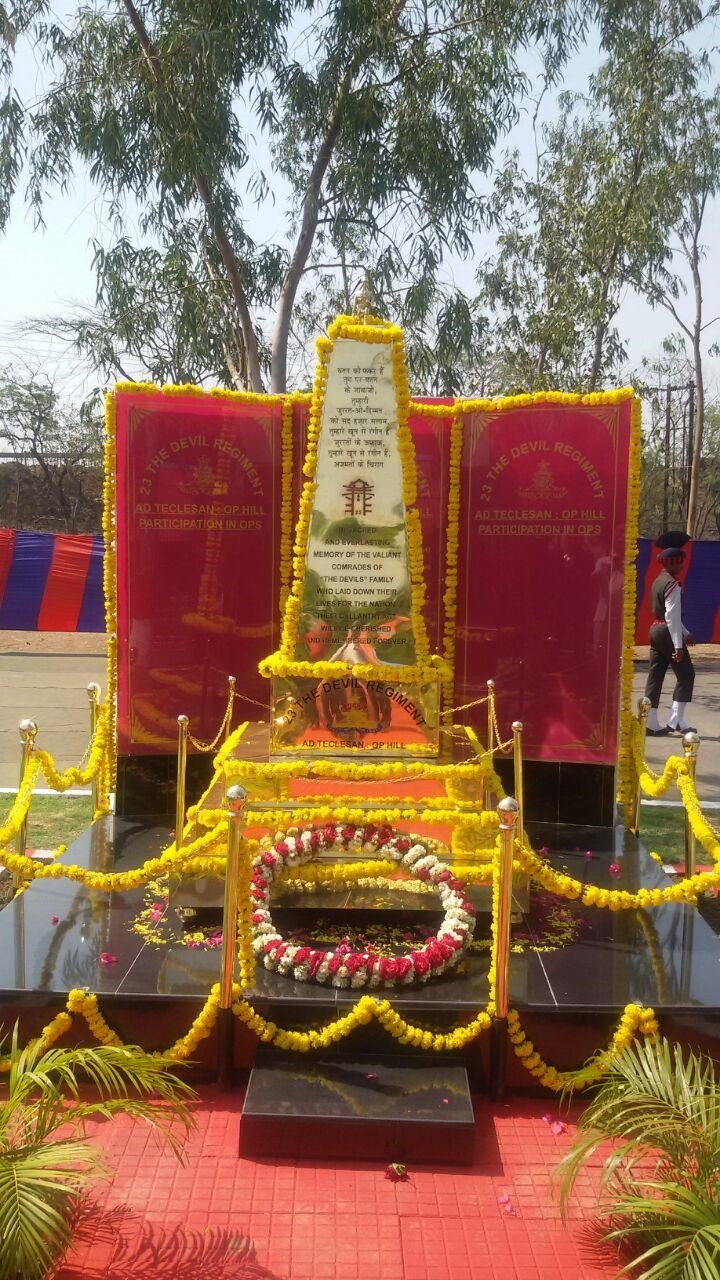
Aurangabad ::    23 Medium Regt  Celebrate the Platinum Jubilee of The Battle Honour “AD TECLESAN “bestowed for Battle in 1941 in Eretrea, Ethiopia.
Above is picture of Mobile War Memorial Trophy installed in the Unit Yesterday.

Besides, Regiment also has another Battle Honour ” OP Hill ” for 1965 War in Balnoi, J&K.

IMG-20160403-WA0010

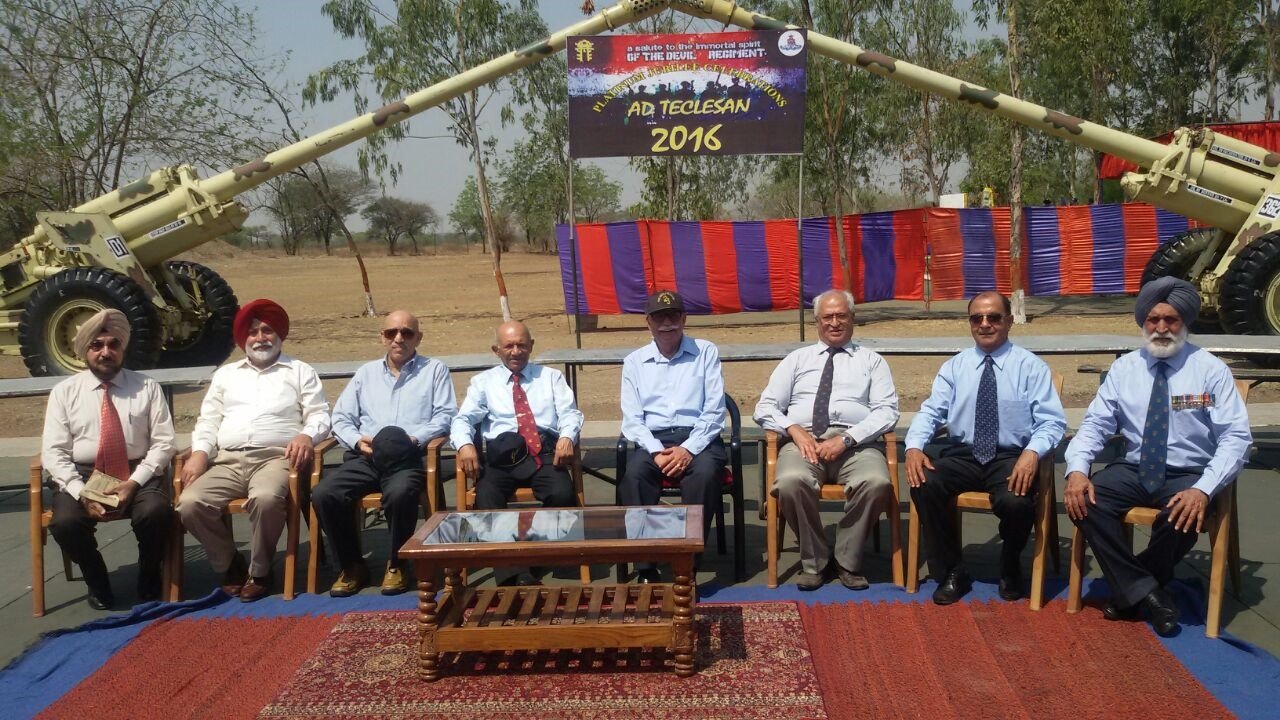
War Veterans of 1971 got together in the Regiment to commemorate Platinum Jubilee of ” AD TECLESAN ” Battle Honour.
From Lt to Rt:-
Col RS Dhidsa, Col Bahadur Singh, Brig NK Hegde, Maj Uday Sathe VrC, Col Kewal Puri, Col VK Datta, (whose father Raised J& K Bty & his Uncle Capt KK Datta attained martyrdom in 1944), Col Ajit Singh Gularia, Col Swarajinder Singh, 2nd Generation in the Regiment.

Recieved From,Col Bhadur Singh+919316555794

BRIEF

The Regiment of Artillery is an operational arm (a regiment/corps) of the Indian Army. Today it is the second largest arm of the Indian Army, and with its guns, mortars, rocket launchers, unarmed aerial vehicles, surveillance systems and missiles, artillery fire-power, constitutes almost one-sixth of its total strength.

http://