









Sanjha Morcha

What’s New

Click the heading to open detailed news

Current Events :

web counter

Print Media Reproduced Defence Related News

Putting Sri Lanka together G Parthasarathy India’s development assistance in several core areas is laudable

Putting Sri Lanka together

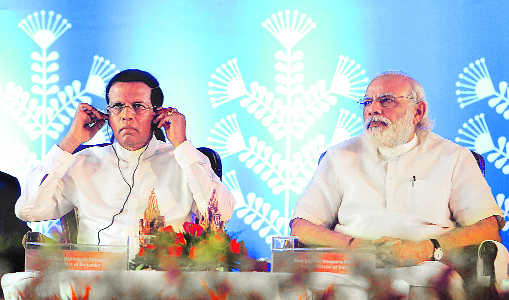
RETURNING to Jaffna last week after three decades, on a visit to see the reconstruction after the end of the brutal civil war, was an emotional experience. My first visit to Jaffna, accompanying the Indian force commander, Lt Gen Depinder Singh, was in October 1987. The sound of AK-47 rifle fire, as our helicopter landed in Jaffna, is etched in my memory. Things were very different now, when I landed at Jaffna’s Palaly Airport. While the wounds of war will take decades to heal, one could not but be impressed at the manner in which things have changed. There is an air of expectation of better times, as Jaffna is now a bustling town, with children cycling to school and the university looking forward to better times. There is an assured supply of electricity and water, and even a brand new hotel full of visitors! Happily, there is now an Indian Consul General in Jaffna, to oversee the comprehensive rehabilitation assistance that India is providing.India’s imaginatively crafted development assistance to Sri Lanka, particularly to the war-torn Northern and Eastern provinces, has been a little publicised success story, which few,  even in India, are aware of. India has helped around 46,000 Tamil families to move into new homes. Moreover, rehabilitation assistance has also been extended to small businesses across the Northern Province, together with the establishment of an industrial estate in Jaffna. Indian assistance has included the construction and equipping of hospitals, clinics and water supply projects. Tamil fishermen in the Jaffna Peninsula have been assisted with the supply of boats, fishing nets and cold storages. These fishermen make no secret of their anguish at the manner in which fishing trawlers from Tamil Nadu, equipped with lethal wire nets, are denuding their fishery resources and depriving them of their livelihood by reckless exploitation of their fishery resources. Jaffna residents speak of Indian fishing trawlers operating within sight. This is a genuinely humanitarian issue on which they expect some understanding and support from their brethren in Tamil Nadu.After clearing up the Kankesanthurai harbour and renovating the Palaly airfield, there are now possibilities of Indian investment in converting the Palaly airfield into a hub for tourism across the Palk Straits. Moreover, one cannot but be impressed by the speed and efficiency of the restoration of the railway link to Jaffna from Colombo, with Indian assistance. Power shortages could be addressed soon, if an expeditious decision is taken in Colombo on the long-pending Sampur Power Plant in the Eastern Province, to be built in collaboration with the NTPC. Moreover, there is need for some imaginative thinking on how India can join in regional efforts to make Trincomalee a regional hub, given the fact that it has an interest and role in the development of petroleum storage facilities in the strategically located port. The Petroleum Minister, Mr Dharamendra Pradhan, is scheduled to visit Sri Lanka. This will, no doubt, be an important item on his agenda.Following provincial elections, the Northern Province now has an elected government with a distinguished Chief Minister, Justice Vigneswaran. There are predictably complaints about the need for greater devolution of power to the provincial government. While the government in Colombo is committed to significant political changes, it would be unrealistic for the Tamils in the North to expect a merger of the Northern and Eastern Provinces, as virtually the entire Tamil Muslim population has fled to the East and has little interest in living with their erstwhile northern neighbours. Any call for merger of the north and east will be rejected in any referendum by a combination of Sinhalas and Tamil Muslims in the Eastern Province. In the meantime, Sri Lanka seems headed for major constitutional changes. The new Constitution will hopefully address issues, which led to ethnic alienation in the past. The new Sririsena-Wickremasinghe dispensation, which unites both national parties, the UNP and SLFP in Sri Lanka, came together because people across the political spectrum were alienated, by the authoritarian Rajapakse family dispensation. It is to their credit that many of the authoritarian excesses of the previous government have been discarded, through steps, which have won widespread public support. It is still not clear if such a broad coalition will enter the next elections in a similarly united manner. But, the present dispensation has been sensitive to India’s security concerns. This should be acknowledged and reciprocated. While it will be unwise and unaffordable to look at every Chinese initiative in Sri Lanka with suspicion, New Delhi has to ensure that it retains its influence in Trincomalee, while ensuring that China’s presence in Colombo and elsewhere does not pose a security challenge. Sri Lanka has avoided acquiring Chinese-Pakistani JF-17 fighter aircraft. It is prepared to look at acquiring the superior Indian Light Combat Aircraft (LCA) instead.  No effort should be spared to ensure that Sri Lanka receives a sufficient number of Indian LCA expeditiously.Trade and investment ties with Sri Lanka are steadily growing. India is today Sri Lanka’s largest trading partner. Investment ties are growing, or set to grow in areas like retail, petroleum and petro-chemicals, tyres, cement and infrastructure. There is now an Indian Consulate and promising prospects for Indian investments in areas like sugar refineries, even in former President Rajapakse’s constituency, the Chinese built port of Hambantota. What one should never forget is that a vast majority of Sri Lankans are devout Buddhists. India could act much more imaginatively in not only cultivating the Buddhist clergy, but also in focusing on its shared spiritual heritage with countries in the Bay of Bengal rim, including Bhutan, Myanmar and Thailand.  The next BIMSTEC Summit meeting is to be held in New Delhi later this year. Members — India, Nepal, Bhutan, Bangladesh, Myanmar and Thailand — have a shared Buddhist heritage and developing this entire region as a tourism hub would be of immense interest to the estimated 535 million Buddhist population spread across the world. Heritage tourism is now becoming increasingly popular worldwide. And recent estimates suggest that there are 250 million practicing Buddhists in China alone. Sadly, India has a along way to go before it can be regarded internationally as being an attractive tourist destination, especially in comparison to its eastern neighbours.

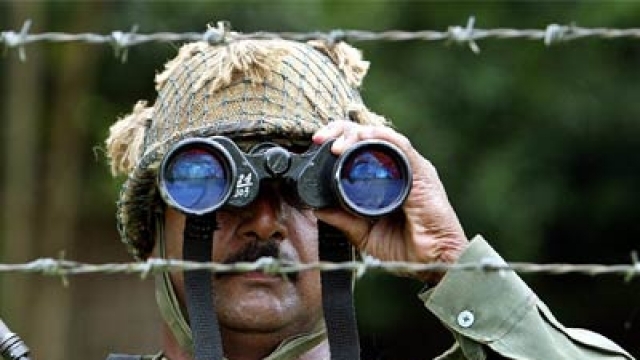
HC relief for Armyman tried twice for same offence

Tribune News Service

Chandigarh, May 17

The Punjab and Haryana High Court has stayed, till further orders, disciplinary proceedings initiated for a second time against an Armyman after it was contended that he had been tried and sentenced by a court martial for the same offence earlier.Justice Fatehdeep Singh today observed that the petitioner, Munish Kumar, was tried under military law on the basis of a chargesheet dated Decmeber 12, 2014, leading to sentence by a summary court martial. Again the impugned chargesheet dated May 12, 2016, on the same very allegations has been issued. The Summary Court Martial, which had held the petitioner, a naik posted to an artillery regiment, guilty for allegedly using criminal force on a person subordinate to him, had ordered that he be reduced to the ranks.


Army celebrates Siachen Day

Army celebrates Siachen Day
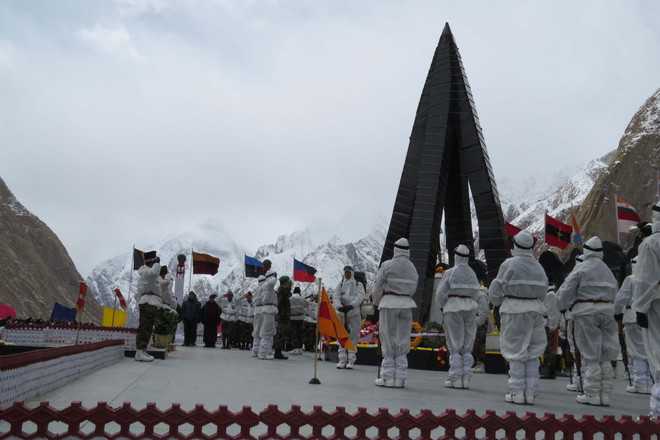
The Army pays tributes to martyrs at the Siachen War Memorial on Wednesday. A Tribune Photo

Tribune News Service

Jammu, April 13

On the occasion of Siachen Day, a wreath-laying ceremony was held at the Siachen War Memorial in the base camp to pay tributes to fallen heroes of the frozen frontier.On this day in 1984, soldiers of the 4 Kumaon had landed at the glacier and pre-empted Pakistan’s move aimed at capturing it.The chief guest for the event, Commander of the Siachen Brigade, felicitated gallantry award winners, ex-servicemen and ‘veer naris’.The wreath-laying ceremony was attended by government and civilian officials and locals of the Nubra valley and Shyok valley. An ex-serviceman rally was also organised.The celebration of Siachen Day on April 13 is a very important annual event for the personnel deployed on the frozen frontier of the Siachen glacier.On April 13, 1984, ‘Operation Meghdoot’ was launched with the aim to deny Pakistan control over the Saltoro ridge.


Soldier’s death leads to scuffle between jawans and officers near China border

The Indian Army denied any ‘mutiny-like’ situation.

The death of a soldier during a routine training drill led to a clash between officers and jawans of a unit positioned near the India-China border in the North-East. An Indian Army officer suffered injuries in the scuffle, officials at Army headquarters here said.

Denying some social media reports of it being a “mutiny- like” situation, the Army said in a statement: “A case of death of a jawan during routine training activity has taken place in an infantry unit in the North-East. It is not a case of any mutiny. The jawan complained of chest pain prior to the route march. He was checked by the unit MO (Medical Officer) and found fit. The jawan later collapsed during the march. He was brought to the field ambulance where he succumbed.

A few jawans got emotional and on being consoled by the adjutant, got agitated and this led to a minor scuffle. No one was seriously injured. The incident is being investigated.”

The Army also denied reports that the situation went out of control and reinforcement unit was called in.

The 10-km march, according to unconfirmed reports, was a punishment drill, following a verbal spat between a jawan and an officer. The Army headquarters denied the report.

In a similar incident, at the Nyoma sector of eastern Ladakh, in May 2012, jawans had attacked officers in an artillery unit during field firing following a confrontation. Though the Army played it down that time as a “minor scuffle,” inquiries later revealed major disciplinary lapses and failure of command and control.


Govt mulls creation of new top military post

short by Nihal Thondepu / 05:12 pm on 09 Apr 2016,Saturday
According to Hindustan Times, the government is considering a proposal to create the post of the Permanent Chairman of the Chiefs of Staff Committee. The Permanent Chairman will be a four-star officer who will act as the government’s single-point military adviser. This reportedly was part of reforms aimed at ending the “turf war” between the Army, Air Force and Navy.

Govt set to give permanent status to top post in Indian military

  • Shishir Gupta, Hindustan Times, New Delhi
  • |

  • Updated: Apr 10, 2016 01:47 IST
The Narendra Modi government is set to create a post of permanent chairman, chiefs of staff committee (COSC) — a four-star officer who will be the single-point military adviser to the Centre — four years after a recommendation by the Naresh Chandra task force on higher defence reforms.

The Narendra Modi government is set to create a post of permanent chairman, chiefs of staff committee (COSC) — a four-star officer who will be the single-point military adviser to the Centre — four years after a recommendation by the Naresh Chandra task force on higher defence reforms.

Top government sources confirmed to Hindustan Times that the process of appointment of chairman, COSC, would begin after Modi’s in-principle approval next week. It is understood that a presentation on higher defence reforms and future air power planning will be made before the PM on April 12. The proposal has already been vetted by the cabinet secretary, national security adviser and defence minister.

“Once the presentation is cleared by the Prime Minister, a formal proposal will be moved for approval in the cabinet committee on security (CCS). The entire exercise should be over in a couple of months,” a senior official said.

The government envisages the permanent chairman to have a two-year tenure and equivalence in rank and protocol with the army, navy and air force chiefs of staff.

Selected on the basis of merit and from any of the three arms, the officer will be responsible for all military hardware acquisition processes, tri-service command in the Andaman and Nicobar Islands, cyber command, special forces, and for inculcating “jointmanship” within the forces for optimum utilisation of resources.

A single- point military adviser’s post in the form of chief of defence staff was proposed by the K Subrahmanyam Committee set up by the Atal Bihari Vajpayee gover nment after the 1999 Kargil war.

In 2011, the UPA regime revisited higher defence reforms under a committee led by former cabinet secretary Naresh Chandra. The committee, which submitted its report in 2012, recommended a watered down version of the CDS and called it the PCOSC (permanent chairman of the COSC).

“The whole idea behind appointing a PCOSC is to break down silos within armed forces and create synergy in the fighting force. The problem with the existing separate military headquarters is that there is a turf war between the three wings with each seeing things with its own perspective and requirement,” a senior official said.


World’s biggest cruise ship set for delivery

Saint-Nazaire (France): The world’s biggest-ever cruise ship, the 120,000-tonne Harmony of the Seas, capable of accommodating more than 8,000 passengers and crew in the most luxurious conditions, was set for delivery on Thursday from a French boatyard. At 66 metres, it is the widest cruise ship ever built, while its 362-metre length makes it 50 metres longer than the height of the Eiffel Tower. The floating town has 16 decks and will be able to carry 6,360 passengers and 2,100 crew members. AFP‘World’s ugliest dog’ wins Hero award London: Mugly, crowned as the world’s ugliest dog in 2012, has won the Hero award for serving as a therapy dog and helping adults and children with disabilities. The 12-year-old Chinese Crested dog has been working as a voluntary therapy pet for the past six years, participating in reading programmes for children and visiting adults with physical disabilities and learning challenges. Mugly was abandoned by a breeder when he was three days old. PTI




Canadian PM to offer apology in House

OTTAWA: Canadian prime minister Justin Trudeau on Monday said he will offer a full apology in the House of Commons next month for the infamous Komagata Maru incident that has been remembered as an example of Canada’s discriminatory immigration policies in the early 19th century.

Of 376 passengers aboard Komagata Maru, majority were Sikhs.According to a Canadian daily, ‘The Globe and Mail’, the apology for the Komagata Maru incident will be delivered nearly 102 years after the ship from Hong Kong arrived off Vancouver only to have nearly all of its 376 passengers denied entry due to the immigration laws at the time.

The ship was eventually sent to Calcutta and least 19 people were killed in an ensuing skirmish with British soldiers, while others were jailed. While speaking at a Baisakhi celebration in Ottawa on Monday Trudeau said the Komagata Maru passengers were refused entry to Canada due to “discriminatory laws of the time”. A video on the website shows Trudeau — his head covered with a saffron cloth carrying a Sikh religious symbol — saying he would stand in the Canadian House of Commons on May 18 to deliver the full apology; at which there are cheers and raising of the Sikh slogan ‘Bole So Nihal, Sat Sri Akal’ by the audience.

“The passengers of the Komagata Maru like millions of immigrants to Canada since were seeking refuge and better lives for their families,” said Trudeau.” With so much to contribute to their new home, they chose Canada and we failed them utterly. As a nation, we should never forget the prejudice suffered by the Sikh community at the hands of the Canadian government of the day. We should not and we will not.” Trudeau says he will stand in the House of Commons on May 18 to deliver the full apology.

Meanwhile, Punjab deputy chief minister Sukhbir Singh Badal hailed Trudeau’s decision. “It’s very heartening to see that the Canadian government has acknowledged the hurt caused to the community by the 1914 incident,” he added.


India Fiddles, China Plays: Major Shift in Nepal, Pakistan Policy

India’s sad and bad relations with her neighbours—in particular Pakistan and Nepal—has given a huge boost to China in the region, much to the dismay of Indian diplomats who are passively watching diplomatic initiatives taken in the past to keep South Asia secure go up in smoke as it were.

India’s relations with Nepal, a Kingdom that many would boast of “eating out of our hands” till not so long ago has moved decisively towards the East. The recent recall of Nepal’s Ambassador to India Deep Kumar Upadhyay charged with conspiring with the Indian Ambassador in Kathmandu to topple the Oli government is a serious case in point.

The cancellation of Nepal President’s five day visit is the second indicator that Nepals PM Khadga Prasad Sharma Oli has more or less succeeded in what was initially seen as just a threat, in moving out his eggs from the Indian basket and transferring them safely to Beijing. And despite the Ambassador’s warnings of spoiling relations with India when these were just moving back on track, has adopted the “I do not care” approach that keeps the road between Nepal and China open and well tarred.

Indian diplomacy took a hostile turn after Kathmandu did not allow Prime Minister Narendra Modi to address a series of public meetings in that country just before the Saarc summit. Responding to local pressure, Kathmandu called off these meetings. The cold Indian response turned positively hostile on the Nepal Constitution controversy when New Delhi used the Madhesi concerns to start an economic blockade of Nepal.

This blockade, as a senior Nepal officer told The Citizen at the time, was perhaps the most traumatic event in India-Nepal relations as it completely deprived the country of essential commodities and placed the Nepalese in deep deprivation leading their government to panic.

At that time PM Oli decided to move towards China but as the sources said, he was well aware that the transition of dependency would take a minimum of six months if not more. Beijing responded very positively to the overtures and stepped in almost immediately with a supply of essential gas to help Nepal tide over the bitter winter months. As the sources said, the hardship to the people was unimaginable and the anger against India reached new heights in Nepal.

Subsequently PM Oli has had a very successful week long visit to China, several agreements have been signed, and reports from both Kathmandu and Beijing suggest a burgeoning relationship that are intended—at least for the moment—to eclipse Nepal-India ties. China’s Belt and Road Initiative, that involves the land and maritime old Silk routes has a strong taker in Nepal now, even as New Delhi continues to regard it with deep suspicion and has opted to stay out of it.

A few steps taken recently by India and Nepal to bridge the widening chasm in relations has now received a severe setback with the recall of the Nepalese Ambassador to India, yet another charge on India for trying to topple the government of a sovereign state, and the cancellation of the Presidential visit at the last moment. New Delhi has been caught by complete surprise, and in more knowledgeable and sensitive sections of the foreign policy establishment, deep dismay.

More so as China, despite efforts, had earlier not been able to replace India in Nepal for political, social, economic and geographical reasons. But the economic blockade and what Nepalese describe as the “arrogance” of the Indian government, have now placed Nepal-China relations on the fast track with sources pointing out that PM Oli is determined never to allow his country to be held “ransom” by such blockades again. There is palpable anger in Nepal about New Delhi’s “tendency to treat as as your backyard,” as a Nepal journalist said.

Significantly, the Chinese footprint in Pakistan has grown larger over the last months with now Chinese soldiers being sighted at the Line of Control between India and Pakistan. This has rung alarm bells here, as it is a clear indication of the growing bonhomie between Pakistan and China as seen in the frequent high level visits for several years now, and the almost intimate strategic and political relationship that has been placed, rather effectively, under an economic umbrella. The large scale presence of Chinese officials, workers and now even soldiers at is being explained as part of the projects undertaken by Beijing—from the Gwadar port, to the occupied land of Kashmir, to now the LOC.

What is not making an impression on Indian foreign policy makers, at least not publicly so, is the evidence that Pakistan has rejigged its policy assessment to conclude that talks with the Modi government are not possible in the foreseeable future. And has been indicating that while the lip service in support of the comprehensive dialogue will remain in place, it will open new doors for China at what now seems to be an escalating pace.

New Delhi seems to be remain mired in a tit for tat policy, but both Pakistan and China are using the atmospherics of this to forge stronger strategic bonds. Even as both ratchet up pressure on India to ensure that the basic status quo with each remains, and when tampered with, is restored. For instance the Indian objections to the Pakistan High Commission’s dialogue with the Hurriyat leaders, because of which bilateral talks were cancelled, has been restored. New Delhi, under pressure from Washington where Islamabad took its case, has conceded ground on this and said it has no objections. These talks with the Hurriyat leaders carry great symbolic value for Pakistan, as these demonstrate its claim over Kashmir, and establish the state as ‘disputed.’

Insofar as China is concerned, the recent climbdown on the Chinese dissidents conference in Dharamshala is a case in point. New Delhi in its tit for tat foreign policy decided to grant visas to controversial Chinese dissidents for this conference, after Beijing used what India described as a “hidden veto” on its proposal to declare Jaish e Mohammad chief Masood Azhar a terrorist.

At the end of the controversy, India has cancelled the visas, and the conference as well to appease China on the Tibet issue that remains a bottom line in these bilateral relations, while China has not given an inch at the United Nations on Azhar. It will not, as this ‘technical hold’ on the Indian proposal was also to strengthen its relationship with Pakistan that has given it a big strategic and economic foothold in its land, and so is clearly more important to Beijing at this point in time.

Interestingly,indications from Pakistan suggest a shift in policy wherein a decision seems to have been taken to end this strategic obsession with talks with India. Pakistan is moving away from its obsessive preoccupation with India, opening all doors to China, forging new relations with Russia, keeping Washington on its side, and unlike India keeping out of thorny issues in South Asia. The equations have changed ever sine the Pakistan Army replaced civilian NSA Sartaj Aziz with a military general, with Islamabad now clearly looking at forging new relations, and becoming a player out of the Indian and Kashmir shadow in the world. A shift that is attracting world attention through high level visits, even though it not being noticed in New Delhi.