Sanjha Morcha

What’s New

Click the heading to open detailed news

Current Events :

web counter

Print Media Reproduced Defence Related News

Army chief’s statement aimed at strangulating ongoing Kashmir movement: KPI

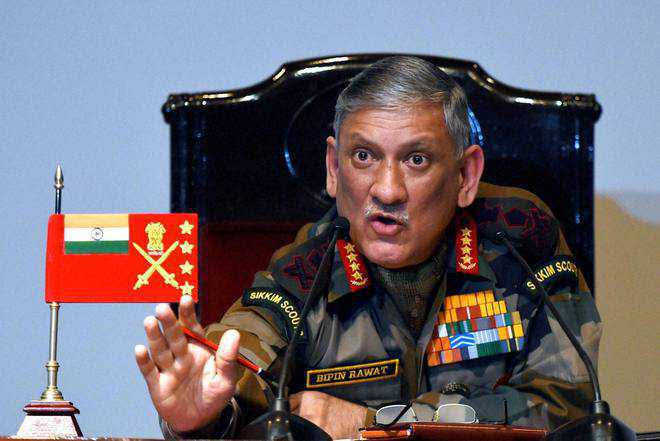
Gen Bipin Rawat had on Saturday said that Indian army can resort to “other actions” too, if Islamabad continues to support cross-border militancy

Army chief's statement aimed at strangulating ongoing Kashmir movement: KPI

Secretary General, Kashmir Peace Institute, Syed Hameed Shaheen Alvi on Sunday said the statement of Indian army chief in which he “threatened” Pakistan “smacks of New Delhi’s jingoism” and that it seems a “calculated move to strangulate ongoing Kashmir movement”.

Gen Bipin Rawat had on Saturday said that Indian army can resort to “other actions” too, if Islamabad continues to support cross-border militancy.

“It [threat] seems a calculated move to strangulate ongoing Kashmir movement against the occupation of Jammu and Kashmir by India by force,” said Alvi while urging Pakistan to raise “this latest provocation at the UN forum.”

Alvi said this while talking to a group of Kashmiri students in Pakistan capital Islamabad who wanted to know the situation in Kashmir region, said a statement.

He told the youth that UN Security Council back in 1948 and 1949 had given clear cut verdict on the peaceful solution of Kashmir dispute, via UN supervised plebiscite, said the statement.

General Rawat’s statement, he said, is a virtual military attack against Pakistan and Kashmiris.

He accused India of withholding UN-recommended plebiscite in Kashmir and questioned why “India has stationed over 800,000 armed forces in Kashmir?”

Alvi said that in 2008 the then Indian Premier Dr Manmohan Singh in his address to the Annual session of the UN General Assembly had re-assured the international community that India would settle all outstanding disputes with Pakistan through negotiations.

“In the light of that UN statement of Dr Singh, India should have taken appropriate measures towards resolutions of all the unresolved issues,” he said.

Kashmiris are struggling for their birth right of self-determination, he said, adding that “it is India that blocks the forward way.”


Demand for Ahirwal regiment in Army gains momentum

Demand for Ahirwal regiment in Army gains momentum

Ravinder Saini

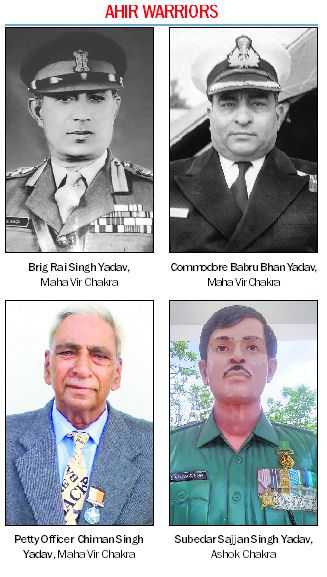
The demand for the creation of an Ahir regiment in the Indian Army has become a hot issue in the Ahirwal region of Haryana comprising Rewari, Mahendragarh and Gurugram districts. Leaders of various political parties and representatives of social organisations are raising the issue to mount pressure on the Central Government to accede to the demand of the Ahir community.

Union Minister of State for Chemicals and Fertilizers Rao Inderjit Singh has written to Defence Minister Nirmala Sitharaman, urging her to consider the demand positively. Chiranjeev Rao, national secretary of the Youth Congress, is carrying out a signature campaign in various states to give an impetus to the issue. Besides, the Akhil Bharatiya Yadav Sewak Samaj (ABYSS), a social outfit, has already orgainsed a padyatra from Gaud-Balaha in Mahendragarh to Jantar-Mantar in Delhi in support of the issue.

Members of the Ahir community had organised a protest in Rewari city recently and submitted a memorandum, addressed to the President of India, to the Deputy Commissioner, seeking the creation of an Ahir or Ahirwal regiment in the Indian Army.

Political observers say the issue has become politically significant as people have started asking parties to include it in their election manifestoes. The ABYSS has given the slogan “Vote vahi paayega jo Ahir regiment ko laayega” to strengthen its ongoing campaign.

“No doubt, the demand for an Ahir regiment will be a rallying point in the coming Lok Sabha elections, as people are coming together in its favour. Ahirs and people of Ahirwal had played a leading role in the mutiny of 1857 and also revolted against the British in Singapore in 1939-40. Around 19,600 and 39,000 soldiers belonging to the Ahirwal region took part in World War-I and World War-II, respectively,” says Ishwar Yadav, a social activist.

He says almost all regional regiments existing today had contributed a lesser number of soldiers to the two world wars than the Ahirwal region. Besides, people from Ahirwal had also made valuable contributions to all other battles fought before and after Independence, he claims.

“Right from World War-I the Ahirwal area had been considered a nursery of soldiers. A large number of soldiers and officers from the region are still serving on various ranks in the Indian Army. I understand that post-Independence the Central Government decided not to raise any regiment on caste lines but the ban should not be extended to regiments named after areas,” says Rao Inderjit in a letter sent to the Defence Minister.

Rao says a regiment may be raised in the name of the Ahirwal region of Haryana as has been done in the case of Rajputana Rifles, and Assam Rifles that have troops belonging to all castes from their regions. The new Ahirwal regiment can also cater to all castes from this region, he adds.

Chiranjeev Rao says his signature campaign got a marvelous response in various parts of Madhya Pradesh, Gujarat and Haryana. A large number of people participated wholeheartedly in the campaign for an Ahir regiment. “The campaign will now be run in Gurugram, Delhi and Uttar Pradesh in the coming days. Since the issue also strikes an emotional chord with people of the Ahirwal region, it has the potential of becoming the deciding factor in the elections,” he adds.

Satish Khola, vice-president of the ABYSS, says that besides organizing a padyatra, they had also written to Prime Minister Narendra Modi, Union Home Minister Rajnath Singh and all MPs in support of the demand.

“When several regiments have already been formed on regional and caste lines, then why an Ahir regiment can’t be raised? People will raise the issue with political parties in the forthcoming elections,” says Khola.


Afghan peace may cost India dearly by MK Bhadrakumar

At the negotiating table with Khalilzad, the Taliban are unlikely to settle for anything short of the restoration of the Islamic Emirate of Afghanistan. A situation as traumatic as the Afghan transition from communist rule in 1991-92 could be staring at India.
Afghan peace may cost India dearly

MK Bhadrakumar
Former ambassador

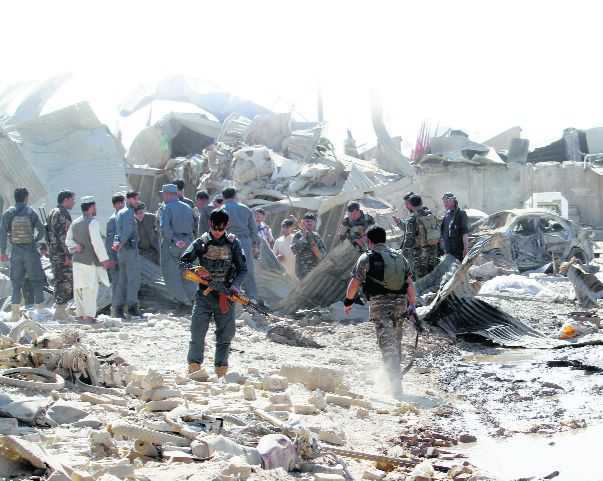
Seventeen years is a long time for a war. Watching the 17-year-old Afghan war — and having witnessed the 18-year-old war that preceded it — nerves have become numb. Reports of violent incidents are an almost daily occurrence and they have ceased to catch the mind’s eye. But the incident in Kandahar city, the throbbing heart of southern Afghanistan, in the afternoon of October 18 was truly stunning.

An attack on a gathering of Afghan and US officials inside the Kandahar Governor’s compound left dead the province’s intelligence chief and police commander, General Abdul Razeq. The NATO-led mission said three of its personnel were wounded, including a US brigadier-general, but that the top US commander in the country, General Austin Miller, who was in the meeting with Razeq, escaped unharmed, thanks to his body armour. The Taliban claimed the strike.

The death of Razeq will have great consequences. He was in reality the unrivalled regional warlord of the entire Afghan south who was admired and courted by the US military and the CIA for his ruthlessness and anti-Taliban prowess. Razeq was an extremely brutal man and in May last year, the United Nations Committee Against Torture released a report describing credible allegations of Razeq’s “complicity, if not of personal implication, in severe human rights abuses, including extrajudicial killings and … secret detention centres.” But he was an indispensable ally for the US, being their most effective warlord and the “kingpin” in the fight against the Taliban in its homeland of southern Afghanistan bordering Pakistan.

There is high probability that with the departure of this charismatic warlord, southern Afghanistan will spin out of control — Afghan forces fragmenting and local commanders vying for power and the security situation dramatically deteriorating. Clearly, Taliban’s intention in eliminating Razeq is to reduce the entire southern region of Afghanistan to turmoil. And with that, Americans will have irretrievably lost the war.

Coincidence or not, in the week after Razeq’s killing, Pakistan released from prison three senior Taliban members, including Mullah Baradar, Mullah Abdul Samad Sani and Mullah Mohammad Rasul. Out of the three, it is Mullah Baradar who makes the headlines. He is a co-founder of the Taliban movement and was the deputy of Mullah Mohammed Omar, the legendary emir of the Islamic Emirate of Afghanistan who died in 2016. Pakistan has been holding Baradar in custody since 2010 on grounds of his perceived inclination to hold peace talks directly with then President Hamid Karzai to end the insurgency.

Baradar’s release has been apparently at the request of the newly appointed US special representative on Afghanistan Zalmay Khalilzad (an ethnic Pashtun himself) who is pursuing a mandated mission by the Trump administration to engage Taliban in talks.

Meanwhile, this is all playing out against the backdrop of a growing realisation in Washington that a face-saving deal with the Taliban can still enable the US to head for the exit door and leave the Hindukush without the appearance of having lost the war. President Trump has not yet announced a timetable for withdrawal, but the growing impression is that a drawdown is on cards and time is running out. It is patently obvious that Trump himself stands disconnected from the war effort — he’s never once visited Afghanistan and has outsourced to Vice-President Pence any conversations needed periodically with Afghan President Ghani.

The Taliban, who control more than half of Afghanistan, and Pakistan, who mentors its leadership, know that the US is desperate to leave. They have begun pushing the envelope in a calibrated way, as the attack in Kandahar city shows, to keep the Americans on the razor’s edge. On the other hand, there is much dismay within Afghanistan, especially among non-Pashtun ethnic groups, that Khalilzad, who is an ambitious careerist and a go-getter, will be in a hurry to report to Trump about Mission Accomplished. Plainly put, Afghans fear that Khalilzad may cut a secret deal with Pakistan. The release of Mullah Baradar, therefore, will set alarm bells ringing in Kabul.

The big question is what is it that the Taliban may be willing to settle for at the negotiating table with Khalilzad? Make no mistake. The Taliban are unlikely to settle for anything short of the restoration of the Islamic Emirate of Afghanistan. Any assumption that the Taliban leadership will reconcile with Ghani government is misplaced. The Taliban have always insisted that only an Islamic system is legitimate.

Succinctly put, in the emergent circumstances, the possibility of the Taliban reconciling with Afghan government and participating in a political process is virtually nil since they are already ruling over much of the country. Perhaps, they may agree for tactical reasons to joining an interim government as a provisional step toward the resurrection of the Islamic Emirate of Afghanistan, which was liquidated by the US through force in 2001. And, of course, Pakistan has no good reason to rein in the Taliban.

A situation as traumatic as the Afghan transition from communist rule in 1991-92 could be staring at India in the face in the near future. Alas, there has been a catastrophic misjudgement by our foreign and security policy establishment.

The right thing to do should have been to welcome the overture by Pakistan’s army chief for dialogue alongside making discreet efforts to have a conversation with the Taliban. Neither happened. Hardliners prevailed.

Our capacity now to leverage US approach is zero. Trump’s Afghan strategy was formulated by then US National Security Adviser HR McMaster with Indian inputs and now that the strategy has failed spectacularly, Indian credibility also takes a hit. The wheel may come full circle if a Taliban regime reopens training camps for Indian militants. Therefore, hasty steps must be avoided.




Blast after gunfight kills 6 locals in Kashmir KULGAM 20 sustain bullet, pellet injuries in unsanitised area after three ultras shot

Blast after gunfight kills 6 locals in Kashmir

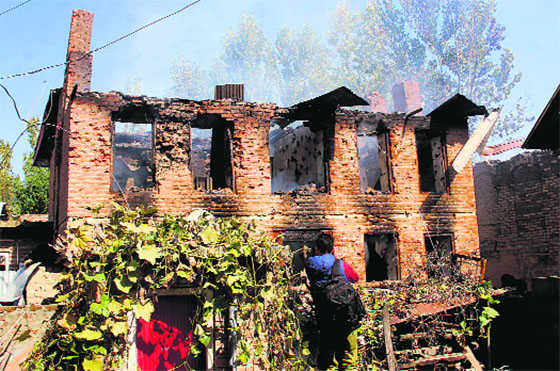
A local resident looks at a house at Laroo village in South Kashmir’s Kulgam district that was damaged in an encounter between security forces and militants on Sunday. Tribune Photo

Suhail A Shah

Anantnag, October 21

Three militants and six civilians were killed in Laroo village of south Kashmir’s Kulgam district on Sunday — the former in a gunbattle and the latter in a blast at the ‘unsanitised’ encounter site. Also, more than 20 persons were injured, a few

sustaining bullet and many pellet injuries as the security forces tried to disperse the protesters. 

The dead civilians were identified as Irshad Ahmad Padder, Zubair Ahmad Lone, Talib Maqbool Laway, Uzair Ahmad Dar, Aqib Ahmad Sheikh and Mansoor Ahmad Dar, all residents of villages in Kulgam district.

The militants who were gunned down, all members of Jaish-e-Muhammad, are Shahid-ul-Islam Tantray of Shopian, Yazil Makroo of Anantnag and Zubair Lone of Kulgam.

Police sources said a cordon and search operation was launched in Laroo village on the outskirts of Kulgam at about 2 am. “While searches were on, the militants at 3.30 am opened fire. The forces retaliated and a gunfight ensued that lasted till about 10 am. All three militants were neutralised.”

As the forces began to evacuate the area after the encounter, hundreds of residents marched to the site. “A fire caused by explosives was still to be put off and the site yet to be sanitised,” a source said.

An eyewitness claimed people were standing on the rubble of the house razed during the encounter when a deafening explosion took place, injuring seven. “They were rushed to the Kulgam district hospital where three of them were declared dead,” a health official said. Two more succumbed at the SMHS Hospital in Srinagar and another at the SKIMS in Soura.

The locals blamed the security forces for the tragedy. A police source said the forces had to leave in a hurry because of incessant stone-pelting and, therefore, could not sanitise the site.

Inspector General of Police (IGP) SP Pani said the people had been warned to keep off, but paid no heed. Despite the authorities snapping mobile and Internet services, intense clashes erupted at the site and the forces fired pellets and bullets to disperse the protesters, leaving more than 20 injured.

Adviser to the Governor K Vijay Kumar and DGP Dilbag Singh expressed regret over the loss of lives and sent condolences to the bereaved families.


How events unfolded 

2 am: Cordon and Search Operation launched by forces following inputs on militants’ presence 

3:25 am: Militants open indiscriminate fire on the forces from a house they were hiding in

4 am: Amid the gunfight, mobile and Internet services terminated in Kulgam district as a precaution

7 am: Locals assemble at the encounter site in large numbers, throw stones at forces, fired upon

9 am: Several blasts at the site as the security personnel try to flush out the holed-up militants

10 am: Militants are killed and 30 minutes later, the forces leave the site with the bodies and arms

10:50 am: A blast pierces through the area, leaving seven injured, six of whom succumb later

Shutdown today

Separatists in Kashmir valley have called for a strike on Monday over the death of civilians in a blast in Kulgam district. The strike has been called by the Joint Resistance Leadership (JRL).


Army cell to counter social media misuse Will identify, monitor fake messages against forces

Army cell to counter social media misuse

Ajay Banerjee

Tribune News Service

New Delhi, October 15

Alarmed at misuse of social media to spread falsehoods about the Indian Army and its personnel, top military commanders led by Army Chief General Bipin Rawat have discussed the issue of setting up a dedicated cell that will identify, monitor and inspect fake and inflammatory messages against the Army.

The aim is to nail and expose those with malicious intent and bring them to book, sources told The Tribune.

The cell will work round the clock to counter any propaganda. The Army presently has a small (three-officer) social media team but that is not enough. The top Army commanders who are meeting in Delhi (October 9 to 15), have been apprised of the seriousness of the situation.

The Army believes “too much” of wrong information has been spread on the Facebook, Twitter and WhatsApp. The misuse of social media is part of asymmetric warfare (from across border) aimed at lowering the morale of the Army through rumours and falsehood. These messages exaggerate issues and tell half-truth.

A possible trigger was in June when fake and morphed videos showing “strong action” by the Army in Kashmir were circulated on WhatsApp.

Some of these videos were not even shot in India, but were passed off as new “policy” in Kashmir. Such fake videos showing “strong action” were seen as propaganda from Pakistan, which was eyeing to discredit the Indian Army during the then ongoing session of the United Nations Human Right Council (UNHRC).

Videos of the Army bringing down houses, mishandling people and dragging terrorists were all fake. These videos are a soft and oblique way to spread a false narrative of human rights violations.

Last year, falsehood was spread saying “one rank, one pension” was only for officers and how the 7th CPC delayed all benefits to jawans, but not officers.

Then came two fake letters circulated listing emoluments of the 7th Central Pay Commission. One of these had the complete format of a government gazette. The Ministry of Defence had to intervene and deny having issued any such letter.

The Army was also alerted about a message on WhatsApp with phone numbers of leading TV channels exhorting jawans to share videos and audio recordings of any act of corruption or exploitation with media houses. Army men are not allowed to have media contact unless authorised in writing.

Nailing culprits

  • Given the seriousness of social media misuse to target forces, top Army commanders have discussed setting up a dedicated cell
  • The cell will work round the clock to counter propaganda. The aim is to nail and expose those with malicious intent and bring them to book
  • The Army currently has a small social media team but that is not enough

Army begins disposing off 555 Gulf War missiles brought as scrap 14 years ago

In 2004, 16 containers had brought the scrap of the Gulf War from Tughlaqabad in Delhi to SD Steel Factory, Kashipur for melting. The scrap had a total of 556 objects which were later established as missiles. One of the missiles exploded on December 30, 2004 when it was being melted at the factory, leading to the death of a worker.

indian army,gulf war scrap,gulf war missiles buried in kashipur

The Indian army began disposing off the 555 missiles on Wednesday that were brought with scrap to Jaspur in Udham Singh Nagar in 2004.

The work began with teams of the Indian army digging out the buried missiles that would be taken in special vehicles secured with sandbags to the disposal site by the banks of the Feeka river, 4.5km away. Here all the missiles would be blown up in a controlled explosion.

Captain Vikas Malik of the Counter Explosives Device Unit, Indian army, who is leading the group of one junior commissioned officer (JCO) and 10 Jawans from Lucknow, said that the procedure might take 4-10 days.

“The missiles would first be dug out from the ground where they have been buried since the past 14 years. They will then be transported to the disposal site on the banks of the Feeka river,”he said. They would then be blasted under the ground with explosives such as RDX and TNT. After the blast, the missiles would beconverted into dust, he said.

Captain Malik said that the explosion will follow the procedures laid down by the Indian army. He was also a part of the disposal of explosives at 55 places in Jammu in 2016-2017, he added.

Additional superintendent of police, Jaspur, Jagdish Chandra, said that the work ofdisposalofmissileshas begun. “Onthe first day, the digging work was carried out by the Indian army,” he said.

In 2004, 16 containers had brought the scrap of the Gulf War from Tughlaqabad in Delhi to SD Steel Factory, Kashipur for melting. The scrap had a total of 556 objects which were later established as missiles. One of the missiles exploded on December 30, 2004 when it was being melted at the factory, leading to the death of a worker named Satpal. Taking serious note of the mishap, the administration brought the 555 missiles to a plot near the Patrampur police station and buried them there. A police contingent had been posted at the site so that the missiles were not tampered with.

The local people had been had been demanding the buried missiles be disposed off scientifically so that they do not lead to sudden detonation in future. The matter was being looked after by the defence ministry and the approval for the disposal of the missiles was received on June 26 this year.

A team of the Indian army based at Lucknow visited the site and devised a method of disposal of the missiles after which the work began.First Published: Oct 12, 2018 15:08 IST


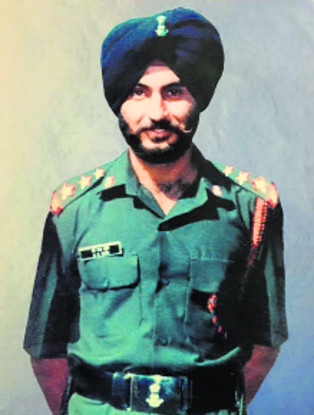
Capt Suri — the Sikh warrior from Ambala

He was awarded Maha Vir Chakra for sacrificing life while clearing enemy bunkers in J&K

Col Dilbag Dabas (Retd)

Gurjinder Singh was born into a soldiers’ family at Ambala on July 4, 1974. His grandfather Subedar Gurbaksh Singh had participated in overseas campaigns during World War II and also on mainland India during the wars in 1947-48 and 1962. His father Lt Col TP Singh Suri, a Sikh Light Infantry veteran, took active part in the 1971 war with Pakistan in the Naushera sector of Jammu and Kashmir.

Gurjinder studied in Army Public Schools at military stations wherever his father was posted. He went on to join the National Defence Academy, Khadakvasla, in July 1993 and was commissioned into Army Ordnance Corps in June 1997. He had opted for Sikh Light Infantry as his parental claim but at that time, due to paucity of vacancies, he could not get the infantry regiment of his choice. Nonetheless, he was destined to be a part of a combat arm in the most glorious period of his Army career. And that combat arm happened to be 12th Battalion of Bihar Regiment, the regiment the hero and role model of which, Birsa Munda, figures on top among freedom fighters from Bihar. Capt Gurjinder Singh Suri, commissioned in Ordnance Corps, while on attachment to 12 Bihar Battalion in their finest innings, did something which made the Ordnance, the logistic arm of the Army and 12 Bihar, the sword arm, proud of this young Khalsa.

During 1999, Capt Gurjinder Singh Suri was attached to 12 Bihar when the battalion was deployed in the Gulmarg sector of Jammu and Kashmir. It was here at Faulad Post situated at a height of 11,200 feet that Captain Suri attained martyrdom by sacrificing his life in the defence of the motherland.

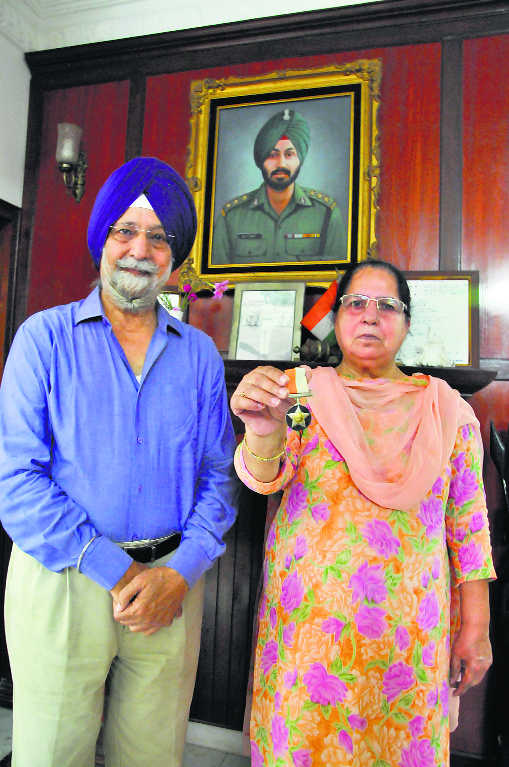
For his conspicuous act of bravery and supreme sacrifice, Capt Gurjinder was awarded the Maha Vir Chakra posthumously. The battle account of his gallant action is available in the War Diary of 12 Bihar. After Captain Gurjinder Suri’s martyrdom, his younger brother Randhir Singh Suri left his lucrative corporate job with a resolve to fill the void. Randhir is today a serving Lieutenant Colonel in the Indian Army. People at Ambala rightly say that Randhir is not part of the third generation of the Suris in uniform, he carries the legacy in the fourth since he joined the Army after his elder brother’s martyrdom. Capt Suri was the lone recipient of Maha Vir Chakra, the second highest military decoration for gallantry, during the investiture ceremony on August 15, 2000.

(The writer is a veteran Gunner, 6 Field Regiment)


The summary of the gallant action in War Diary of 12 Bihar reads..

Captain Gurjinder Singh Suri was Ghatak platoon commander and was located at Faulad Post in the Forward Defended Locality of the battalion in the Gulmarg Sector of Jammu and Kashmir. On November 9, 1999, the enemy launched an attack on the post, which was successfully repulsed and the enemy retreated. Seizing the opportunity, the Ghatak Platoon was launched to pursue the fleeing enemy. Captain Suri immediately deployed his support group to take care of any reinforcements/ interference and set out to clear the enemy bunkers one by one. When he saw that one of his comrades was grievously injured in the process, he quickly moved on with his buddy to clear the bunker. He killed two enemy soldiers with his AK 47 rifle and silenced the enemy machine gun. However, he got a burst in his left arm in the process. Unmindful of his injury, Captain Suri continued to inspire his men to accomplish the task. He then lobbed two hand grenades into a bunker and entered inside spraying bullets with his rifle, killing one more enemy soldier instantly. At this point the officer was hit by an enemy rocket-propelled grenade and was critically wounded. He refused to get evacuated and continued to exhort his men till he breathed his last. The officer displayed extraordinary junior leadership, inspired by which the Ghataks fell upon the enemy with vengeance and annihilated them. Captain Gurjinder Singh Suri, thus, displayed conspicuous bravery and exceptional junior leadership in the face of the enemy.


दूरदराज के पूर्व सैनिकों को अब नहीं होगी फजीहत नजदीकी पॉलीक्लिनिक से ही मिल जाएगी ईलाज की अनुमति

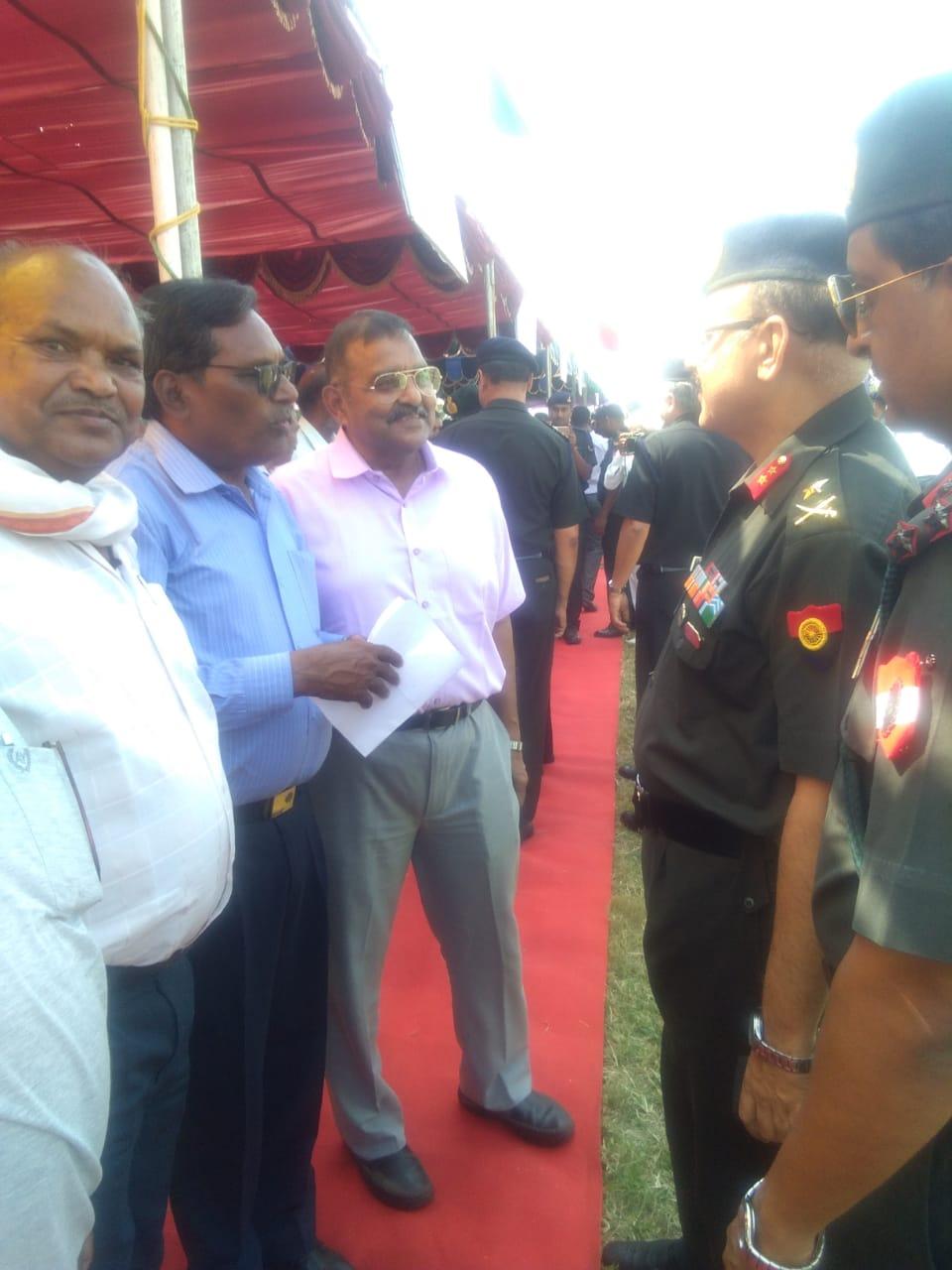
बैतूल। भोपाल के जित स्टेडियम में मध्यप्रदेश के पूर्व सैनिकों की रैली आयोजित की गई। रैली में कोर कमांडर लेफ्टिनेंट जनरल आर.पी.सिंह एवीएसएम, वीएसएम जीओसी 21 कोर मेजर जनरल टीपीएस रावत, वीएसएम मेजर जनरल अशोक कुमार मैनेजिंग डायरेक्टर ईसीएचएस शामिल हुए। इस अवसर पर मेजर जनरल अशोक कुमार ने पूर्व सैनिक एवं उनके परिजनों को संबोधित करते हुए कहा कि ईसीएचएस विश्व की सबसे बड़ी पूर्व सैनिकों को नि:शुल्क चिकित्सा सुविधा प्रदान करने वाली संस्था है। इसमें किसी भी पूर्व सैनिकों को किसी प्रकार का व्यय नहीं करना पड़ेगा। यदि आपके नजदीकी पॉलीक्लिनिक नहीं है तो किसी भी मान्यता प्राप्त अस्पताल से इलाज करवा सकते हैं। वहां किए गए भुगतान का क्लेम मिल जाएगा। गौरतलब है कि बैतूल जिले के पूर्व सैनिक सेवा परिषद के अध्यक्ष अनिल वर्मा ने विगत दिनों पूर्व ब्रिगेडियर आर.विनायकम वीएसएम के माध्यम से यह मांग की थी कि दूरदराज के पूर्व सैनिकों को गंभीर बीमारी के ईलाज के लिए अनुमति लेने के लिए नागपुर, भोपाल जाना पड़ता है। जिसके चलते पूर्व सैनिकों को अतिरिक्त वित्तीय भार उठाना होता है। इस समस्या का समाधान करते हुए मेजर जनरल अशोक कुमार ने बताया कि किसी भी पूर्व सैनिकों को अब नागपुर-भोपाल नहीं जाना पड़ेगा। पूर्व सैनिकों को अब अपने नजदीक के पालीक्लीनिक से अनुमति प्राप्त हो जाएगी।


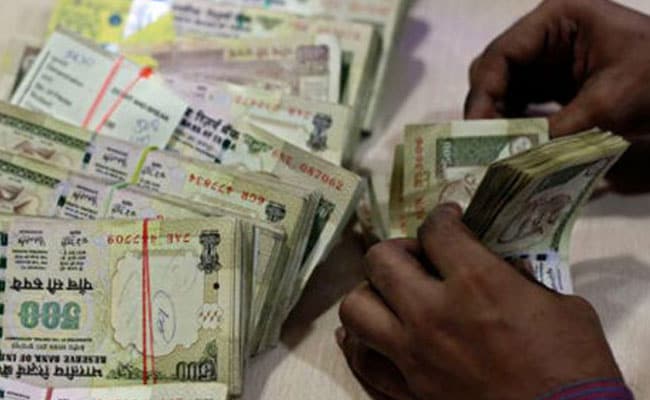
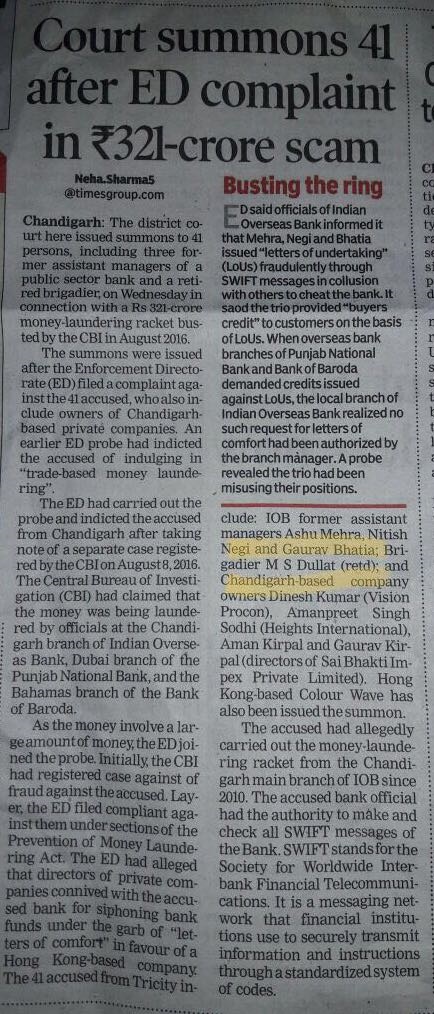
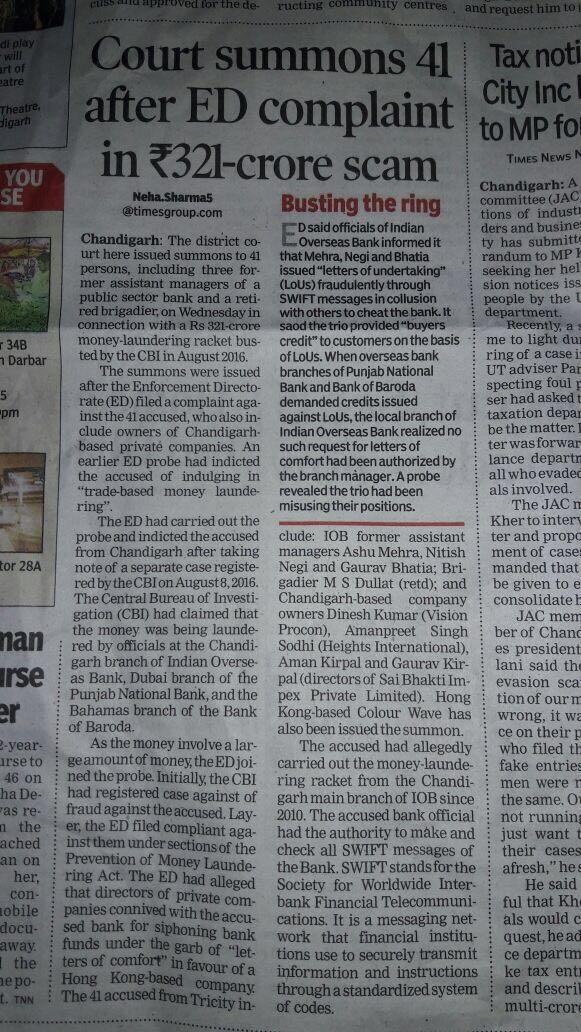
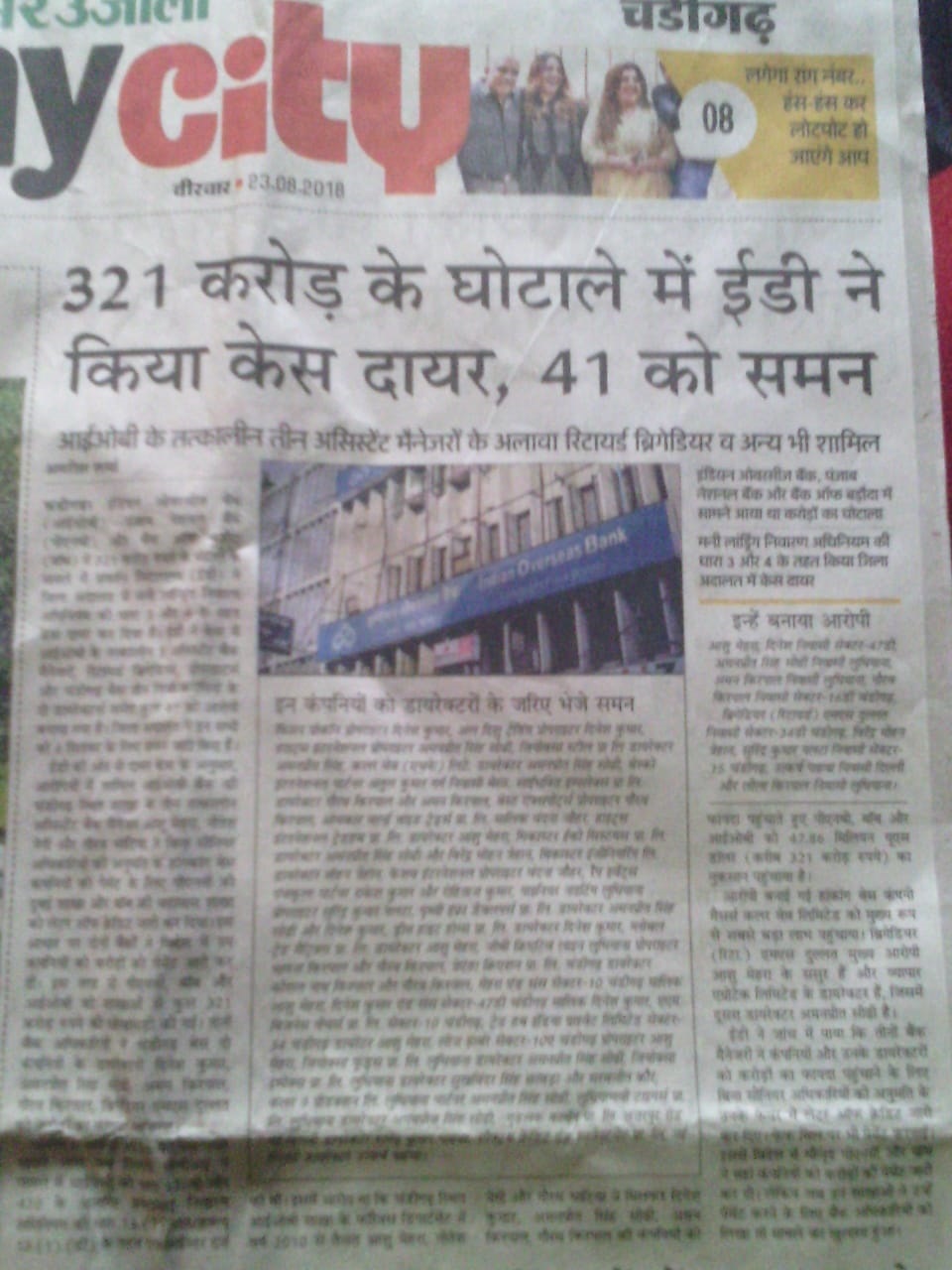
CBI Busts Gang That Duped Government Banks Of Rs. 321 Crore :: Brig MS Dullat involved

CBI Busts Gang That Duped Government Banks Of Rs 321 Crore

On Wednesday, CBI claimed to have busted a racket of Indian Overseas Bank officials.

NEW DELHI:  CBI on Wednesday claimed to have busted a racket of Indian Overseas Bank officials and businessmen who allegedly managed to siphon off Rs. 321 crore of public money to a Hong Kong-based company using fake guarantee issued by the bank.

The agency carried out searches at 14 locations spread across Chandigarh, Ludhiana, Panchkula, Amritsar and Zirakpur (Punjab) of 11 people and companies against whom a case has been registered by it, CBI sources said.

They alleged that the mastermind of the conspiracy is Ashu Mehra, an assistant manager with the bank, who helped a company get Letters of Comfort — a kind of guarantee — from the bank in favour of a Hong Kong-based company which managed to avail credit from Bank of Baroda (BoB), Bahama branch and Punjab National Bank (PNB), Dubai branch between 2014 and 16.

CBI has named in its FIR two more then Assistant Managers of the Chandigarh branch of the bank — Nitish Negi and Gaurav Bhatia, Proprietor of Chandigarh-based Vision Procon Dinesh Kumar, owner of Heights International Amanpreet Singh Sodhi, Directors of Sai Bhakti Impex — Aman Kirpal and Gaurav Kirpal, the company Sai Bhakti Impex, Hong Kong-based Colour Wave (HK) Ltd and other unknown officials. Sodhi also owns the Hong Kong-based company.

The sources said Mehra not have the power to issue such Letters of Comfort. His father-in-law M S Dullat, a retired Brigadier, has also been named in the FIR.

They said officials of BoB and PNB are also under scanner of the agency.

“It was alleged that the accused persons in connivance criminal conspiracy with the branch officials and with each other siphoned off the bank funds under the garb of Letter of Comforts in favour of the Hong Kong-based company purportedly issued by officials of Indian Overseas Bank, Chandigarh to PNB, Dubai and BoB, Bahamas,” CBI spokesperson R K Gaur said in New Delhi.

He said based on these fraudulently issued Letters of Comfort, the banks issued buyers’ credit to the account of accused abroad.

1 COMMENT

An alleged loss of around Rs. 321 crore was caused to the complainant bank (IOB) and the foreign branches of PNB and BoB, the spokesperson said.

IMG-20180909-WA0053 IMG-20180909-WA0055 IMG-20180909-WA0060


RS 321-CRORE FRAUD

CBI books officials of Indian Overseas Bank

Syed Ali Ahmed

Tribune News Service

New Delhi, August 10

The CBI registered a cheating case against three officials of the Chandigarh branch of Indian Overseas Bank (IOB), proprietors and two directors of three Chandigarh-based private firms and four others on alleged charges of fraud that caused Rs 321 crore loss to the IOB, Punjab National Bank (PNB) and Bank of Baroda (BOB).

The agency also conducted raids at 14 locations in Chandigarh, Ludhiana, Panchkula, Amritsar and Zirakpur to recover documents relevant to the case, sources said.

The sources said the case was registered against the accused on the basis of a complaint of the IOB, Delhi Zone. The accused were identified as ex-Assistant Managers of the Chandigarh Branch of the IOB – Ashu Mehra, Nitish Negi and Gaurav Bhatia: proprietors of two Chandigarh-based private firms – Dinesh Kumar of M/s Vision Procon, Amanpreet Singh Sodhi of M/s Heights International; Aman Kirpal and Gaurav Kirpal, Directors of Chandigarh based M/s Sai Bhakti Impex Private Limited; Brigadier (Retd.) MS Dullat of Chandigarh and M/s Colour Wave (HK) Limited in Hong Kong. The Vision Procon and Heights International are also accused in the case.

The agency registered the case under sections 120-B, 420 of the IPC and sections 13(2), 13(1) (d) of the Prevention of Corruption Act, 1988, said spokesperson of the CBI, RK Gaur.

“It was alleged that the accused persons in criminal conspiracy with the branch officials and with each other siphoned off the bank funds under the garb of Letter of Comfort in favour of Hong Kong-based company purportedly issued by the officials of the Indian Overseas Bank, Chandigarh, to Punjab National Bank (PNB), Dubai, and Bank of Baroda (BoB), Bahamas in West Indies. Based on these fraudulently issued Letters of Comfort, these Foreign Banks issued Buyers’ Credit to the account of accused companies abroad,” the spokesperson said.

“An alleged loss of Rs 321 crore (approximately) was caused to the complainant bank (IOB) and the foreign branches of PNB and BoB, he said.


Tributes to soldier killed in Anantnag

Srinagar, September 28

The Army on Friday paid befitting tributes to late Sepoy Happy Singh who was killed during a gunfight in south Kashmir’s Anantnag district on Thursday.

Local Lashkar-e-Toiba commander Asif Malik was also killed in the gunfight that broke out in the wee hours on Thursday when security forces launched a search operation at Gazi Gund, Dooru in Anantnag.

In a solemn ceremony at Badamibagh Cantonment, Lt Gen AK Bhatt, commander, Chinar Corps, and all ranks, paid homage to the slain soldier on behalf of a proud nation. J&K DGP Dilbag Singh and representatives from various security agencies also joined in paying their last respects to the soldier. “Sepoy Happy Singh sustained a bullet injury during the gunbattle in Anantnag. He was provided first aid and evacuated to 92 Base Hospital, but unfortunately he succumbed to his injuries,” an Army statement said. — TNS