Sanjha Morcha

What’s New

Click the heading to open detailed news

Current Events :

web counter

Print Media Reproduced Defence Related News

Retd Major gets bail in Malegaon blast

Mumbai, September 26

The Bombay High Court today granted bail to Army Major Ramesh Upadhyay (retd), an accused in the 2008 Malegaon blast case, on the ground of parity.Since the other prime accused in the case have been granted bail by the high court and the apex court, a Bench of justices Ranjit More and Sadhna Jadhav granted Upadhyay bail against a personal bond of Rs 1 lakh and two sureties each of the same amount. While National Investigating Agency (NIA) counsel Sandesh Patil opposed the bail plea, the Bench said its hands were tied in view of the apex court’s directions on the grounds of parity.The court also asked if Upadhyay’s role in the blast was larger than that of prime accused Lt Col Shrikant Purohit, who was granted bail by the apex court in August. Upadhyay’s counsel denied it and told the court about Purohit having been granted bail. He also told the court that on September 19, a trial court had granted bail to two other accused in the case — Sudhakar Chaturvedi and Sudhakar Dhar Dwivedi — on grounds of parity.“Upadhyay played a role in hatching the conspiracy for the blasts. He attended several meetings of the Abhinav Bharat group and we have video recordings to prove his presence in some of such meetings,” Patil said. “However, while the high court recorded our opposition to the bail plea, it took cognisance of the fact that several other accused were already out on bail,” he said.Last November, the trial court had denied bail to Upadhyay following which he had filed an appeal in the high court challenging the order. — PTI


Accidental Death & Compensation: (Income Tax Return Required)

Knowledge is Power….
If a person has an accidental death and the person was filing income tax returns for the last three years, then the government is obliged to give ten times the average annual income of the last three years to that person’s family.
Yes, you will be surprised by this, but this is right and it is Government rule. 
For example, if someone’s annual income is  4 lakh 5 lakhs and 6 lakhs in the first, second and third years respectively, its average income is ten times of five lakhs.. means fifty Lac rupees, family of that person is entitled to receive from the Government.
In the absence of much information, people do not take this claim with the Government.
If any return is missing, mainly last three years, this could lower the claim amount or even no claim because court takes ITR as only evidence. 
NO wealth record, FD’s; business etc. is given that much importance as compared to ITR in the eyes of law.
Many a time,  people do not file ITRs regularly..or it will be taken lightly..
Due to lack of information the family receives no economic benefits.
Source – forwarded
Section 166 of the Motor act, 1988 (Supreme Court Judgment under Civil/ Appeal No. 9858 of 2013, arising out of SLP (c) No. 1056 of 2008) Dt. 31 Oct. 2013.


Army pays tributes to soldier killed in Kupwara

Tribune News Service

Srinagar, September 21

The Army on Thursday paid tributes to Rifleman Rajesh Khatri, who was killed in a ceasefire violation on Wednesday along the Line of Control (LoC) in north Kashmir’s Keran sector.“Lt Gen JS Sandhu, commander of the Srinagar-based 15 Corps, and all ranks paid homage to the soldier on behalf of the nation,” the Army said in a statement.“In a show of solidarity, representatives and officials from the state government and other security agencies also joined in paying their last respects to the martyr,” the Army said.The rifleman had sustained bullet injuries “due to enemy fire while he was deployed at a forward post in the Keran sector,” the Army said.“He was provided immediate first aid and evacuated from the post but, unfortunately, succumbed to the injuries,” it said.The 27-year-old soldier had joined the Army in 2011 and hailed from Torayan village in Dailekh, Nepal.


OBITUARY Arjan Singh — a man of few words and a fearless pilot

Arjan Singh — a man of few words and a fearless pilot
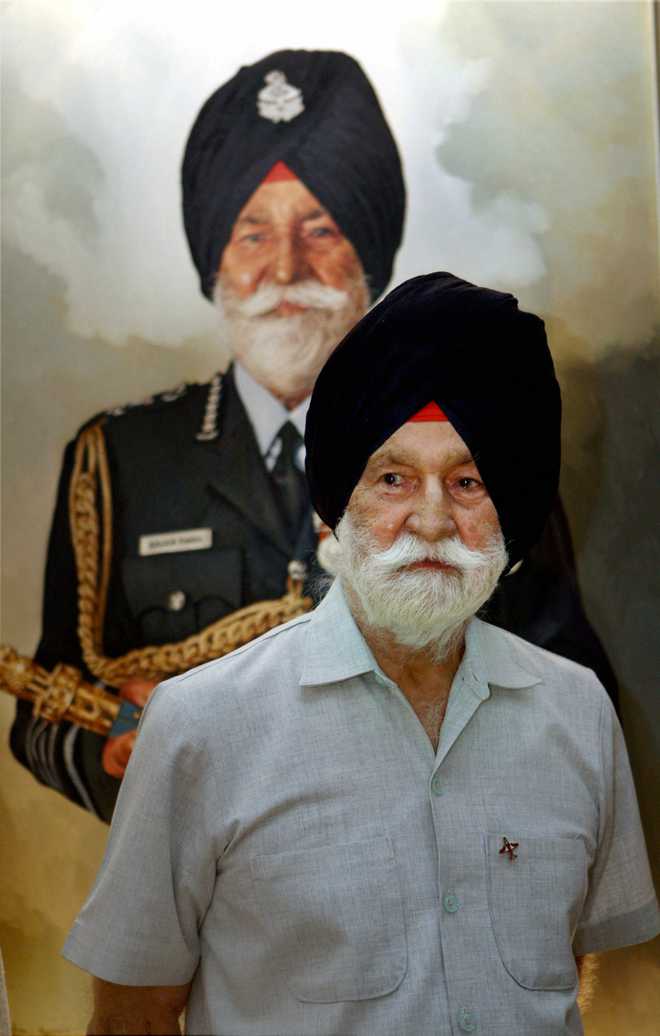
File photo of Marshal of the Indian Air Force Arjan Singh. PTI

New Delhi, September 16Air Force Marshal Arjan Singh, an icon of India’s military history, will always be remembered as a war hero who had successfully led a young IAF during the 1965 Indo-Pak war.The only officer to attain the highest post of Marshal, the Air Force equivalent to the Army’s five star field marshal, Singh was a fearless and exceptional pilot who had flown more than 60 different types of aircraft.(Follow The Tribune on Facebook; and Twitter @thetribunechd)He played a major role in transforming the IAF into one of the most potent air forces globally and the fourth biggest in the world.”His contribution to the Indian Air Force is monumental to the least. The IAF grew with him. He was epitome of military leadership in classical sense and it is, therefore, not surprising that he was honoured with the rank of Air Force Marshal,” former Vice Chief of IAF Kapil Kak said.Singh was honoured with the rank of Marshal on the Republic Day in 2002. Sam Hormusji Framji Jamshedji Manekshaw and K M Cariappa were the only two army generals honoured with the rank of field marshal.Known as a man of few words, Singh was not only a fearless pilot but had profound knowledge about air power and applied it in a wide spectrum of areas.Singh had assiduously led the IAF during the 1965 war and denied success to Pakistani air force though it was better equipped with American support.”His most outstanding contribution was during that war,” said Kak.Commending his role in the war, Y B Chavan, the then Defence Minister had written: “Air Marshal Arjan Singh is a jewel of a person, quiet efficient and firm; unexcitable but a very able leader.”In 1944, the Marshal had led a squadron against the Japanese during the Arakan Campaign, flying close air support missions during the crucial Imphal Campaign and later assisted the advance of the Allied Forces to Yangoon.In recognition of his feat, he was awarded the Distinguished Flying Cross (DFC) on the spot by the Supreme Allied Commander of South East Asia, the first Indian pilot to receive it. — PTI


PM hails Marshal’s role in ’65 war

PM hails Marshal’s role in ’65 war
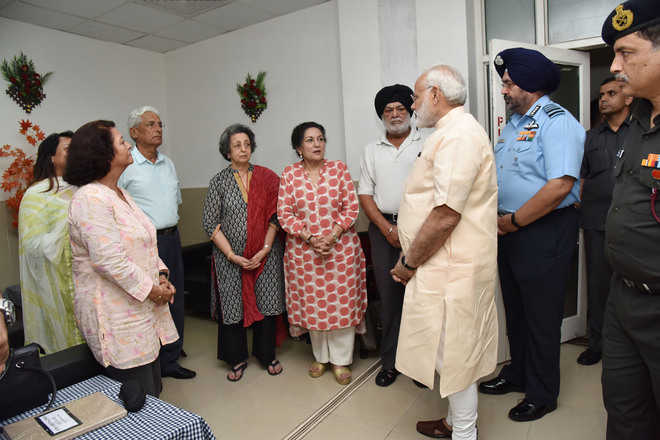
Prime Minister Narendra Modi with the family of Marshal Arjan Singh in New Delhi on Saturday. pti

New Delhi, September 16

Prime Minister Narendra Modi today mourned the death of Marshal Arjan Singh and said India will never forget his excellent leadership in the 1965 India-Pakistan war when the Indian Air Force saw substantial action.”India mourns the unfortunate demise of Marshal of the Indian Air Force Arjan Singh. We remember his outstanding service to the nation,” he tweeted. Modi said the determined focus of Singh, who was promoted to the five-star rank of Marshal of the Air Force in 2002, on capacity building in the IAF added great strength to India’s defence capabilities. “India will never forget the excellent leadership of Arjan Singh in 1965, when the IAF saw substantial action,” the PM said in a series of tweets. Modi recalled how the ageing war hero stood up to salute him despite his ill health.”Sometime back I met him, who despite his ill health tried to get up to salute even though I said no. Such was his soldier discipline,” he said.

J&K Guv mourns death

J&K Governor NN Vohra condoled the Marshal’s death. Vohra recollected how since the time he was posted as Defence Secretary (1990-1993) he had been interacting with the Marshal on several issues of importance and national security. Vohra is a 1959-batch Punjab cadre IAS officer. — TNS/PTI


He won nation’s gratitude: PrezPresident Ram Nath Kovind on Saturday condoled the demise of war hero Marshal Arjan Singh, saying he won the nation’s gratitude for his military leadership in the 1965 Indo-Pak war. “Sad at demise of a great air warrior & Marshal of the Air Force Arjan Singh. Condolences to his family & IAF community. Marshal of the IAF Arjan Singh was a WW II hero & won our nation’s gratitude for his military leadership in 1965 war,” Kovind said in a series of tweets. PTI‘Outstanding soldier & diplomat’Arjan Singh was an outstanding soldier and a diplomat who led from the front. He will be particularly remembered for his successful operation tenure on the Burma front during World War II. He was a jewel in the throne of our armed forces and his extraordinary contribution as an air warrior would always be a source of inspiration to us.— Sonia Gandhi, Congress President‘Great loss to country’The kinds of aircraft he has flown, the positions he held, the awards he has received and number of years of service. It is very rare for any country to have a soldier of that kind of potential. It is a great loss to the country.— Nirmala Sitharaman, Defence Minister


British officers salute Sikh bravehearts

Gurvinder Singh

Tribune News Service

Ludhiana, September 11

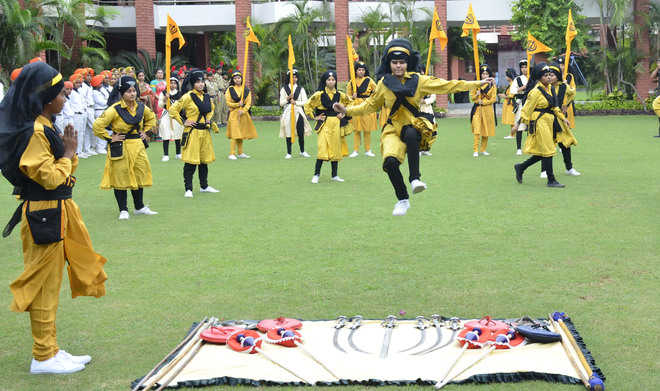
British army officers paid tributes to the martyrs of the epic battle of Saragarhi, when the contingent of mere Sikh soldiers overcame the might of 10,000 Afghan soldiers. Despite losing their lives, they brought with them the best displaying extraordinary courage and valour on September 12, 1897.In an event organised to commemorate the 120th anniversary of Battle of Saragarhi, a delegation from British High Commission having several officers of the British army and representatives from different organisations saluted the Sikh brave hearts at Nirvana Club.The event began at Guru Ram Das Academy, where students of the school presented gatka and cultural programme, from where the delegation went to the Nirvana Club nearby.The delegation comprised members from England, including Major Gen Duncan Francis, Col John Richard Kindall and others. Speaking on the occasion,Col Kindall said it was a hugely inspiring story of not only courage, but loyalty for fellow soldiers, for their regiment, the army and the country.“This is the story of two nations — the British and the Sikhs, who first met in the battle field and left as friends. The Sikhs in the British army carry on that tradition of valour,” he said.They were bestowed with gallantry award — Indian Order of Merit. A retired army officer present on the occasion, said: “Generally individuals are given gallantry awards, but it is very rare that the entire unit is bestowed with a gallantry award.”Major Sartaj Singh Gogna, who is part of the British Royal Army, said he was two, when his family migrated to Britain from India. He studied pharmacy, but realised his true calling and joined the British Royal Army at the age of 21.He said the Battle of Saragarhi has been an inspiration and so has been the participation of Sikhs and Indian Regiments during World War I and World War II. There are around 187 Sikhs, who are part of the British Army, he said.Ranvir Singh, who is serving the British army, said they were following Sikh values and ethos in the British Army.

About the battle…

  • The battle was fought before the Tirah Campaign on September 12, 1897, between Sikh soldiers of the British Indian Army and Pashtun Orakzai tribesmen in the North-West Frontier Province (now Khyber Pakhtunkhwa in Pakistan.
  • The British Indian contingent comprised 21 Sikhs of the 36th Sikhs (now the 4th Battalion of the Sikh Regiment), who were stationed at an army post attacked by around 10,000 Afghans. The Sikhs, led by Havildar Ishar Singh, chose to fight to the death, in what is considered by some military historians as one of history’s greatest last-stands. The post was recaptured two days later by another British Indian contingent.
  • Sikh military personnel commemorate the battle every year on September 12, as Saragarhi

108 soldiers honoured at investiture ceremony Four J&K Police personnel, 14 civilians and 31 units also awarded

108 soldiers honoured at investiture ceremony
Lt Gen Devraj Anbu, GOC-in-C of the Northern Command, with the awardees at the investiture ceremony in Udhampur on Thursday. Tribune Photo: Inderjeet Singh

Tribune News Service

Udhampur, September 7

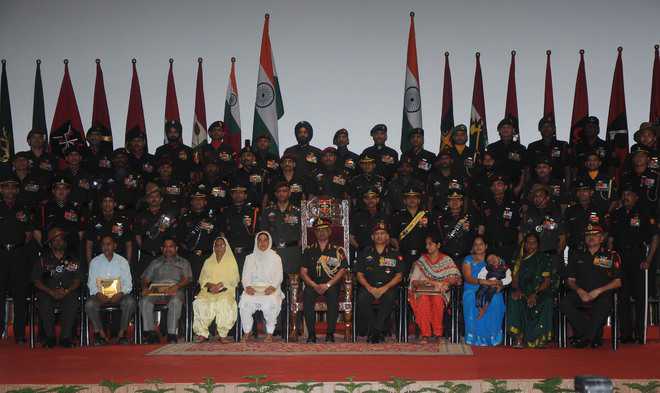
An investiture ceremony of the Northern Command of the Army was held here today and General Officer Commanding-in-Chief, Northern Command, Lt Gen Devraj Anbu presented the gallantry and distinguished service awards to 108 officers and other ranks.The Army Commander presented a Sarvottam Jeevan Raksha Padak, two Yudh Seva Medals, two Bar to Sena Medals (Gallantry), 76 Sena Medals (Gallantry), 10 Sena Medals (Distinguished Service) and 17 Vishisht Seva Medals to the recipients, which were bestowed upon them for their act of valour and distinguished services.Meanwhile, 14 civilians were also given the certificate of appreciation and cash awards by the Army Commander for their yeoman service. Unit appreciation to 31 units for their outstanding performance in the Command Theatre in 2016 was also awarded.The Army Commander also honoured four personnel of the J&K Police for their act of gallantry and devotion.Lt General Anbu commended all ranks of the Northern Command for their dedication and devotion to duty. He exhorted them to rededicate themselves to the cause of the nation.He congratulated those who were decorated for bravery and distinguished service.During the event, the regional president family welfare organisation, Northern Command, also interacted and presented gifts to the next of kin of the posthumous awardees.


The Army In Aid To Civil Authority: From Agitation To Agitation by Lt Gen Syed Ata Husnain

The Army In Aid To Civil Authority: From
Agitation To Agitation

SNAPSHOT

An overview of the Indian Army’s internal security duties – the hard and soft approach it adopts when there is a breakdown of law and order.

In the public mind, the deployment of the Indian Army in ‘aid to civil authorities’ remains a grey area and merits some explanation for education and confidence building. I am writing this because, on social media, I found myself at the receiving end of hundreds of queries as very few veterans get down to writing on such issues. With the complete breakdown of law and order a third time in Haryana, reliance on the Army in the public mind is a foregone conclusion. How does the Army function in such operations that are being repeated once too often for comfort?

I remember my days at the Indian Military Academy, where a lecture demonstration was conducted for Gentlemen Cadets (GCs) on Aid to Civil Authority each term. It was a fun demonstration with a short playlet added to it. We never took much of it seriously because rarely did one have to physically execute what one learnt. Today, it is different; I think the GCs would have to be prodded to remain awake and take notes, which may come in handy some day and that too very soon.

When is the Army called in (requisitioned) to aid the civil authority? The regulations permit civil authorities to requisition the Army for controlling law and order, maintaining essential services, assisting during natural calamities such as earthquakes, and any other type of help that may be needed by the civil authorities. The scope in this commentary does not include assistance in natural calamities, and essentially looks at the law and order and maintenance of essential services. The state should always depend on the steadfastness, technical capability and leadership of its armed forces to save as many lives as possible in natural disasters. In such circumstances, the simultaneity aspect is as important so that all resources of the state are deployed for the people’s safety; overkill in such contingencies has its advantages.

However, the situation is different in the case of law and order. The Army remains the resource for employment as a last resort as both the central and state governments have police forces available to them who are designed and maintained for this very purpose; that is the broad principle and it should be rare for soldiers to come to such aid as there is such a plethora of police forces. This issue is discussed later in the commentary.

An issue needing clarification at this stage is the difference between the Army acting against mobs in Kashmir and in Haryana. Regulations for the Army, Chapter VII, Paragraphs 301 to 327 and Manual of Indian Military Law, Chapter VII lay down the guidelines for the routine aid to civil authorities. It does not give the Army the right to be the decision-makers, except in deciding what means they will employ to bring the situation under control. They are to be always accompanied by civilian magistrates, one with each column, who discern the severity of the situation and give written or verbal instructions (to be followed in writing or corroborated by two witnesses) to quell a mob or bring any situation under control. The magistrate does not have the power to direct the Army authorities on the means to be employed; for that the local column commander or his Commanding Officer (CO) are the empowered authorities.

In the case of Kashmir or any other area it is different. Afflicted by intense terrorist activity and anti-national sentiment bordering on existential threats to the integrity of the nation, there is a need to empower the Army to operate on its own without the presence of a magistrate. This is because the Army is deployed on 24×7 duty and cannot await arrival of magistrates or written orders to act upon intelligence, which is generated from time to time at different levels.

To legally authorise the Army to operate in this mode, legislation such as the Armed Forces Special Powers Act (AFSPA) is enacted by Parliament. AFSPA – 1990 for Jammu and Kashmir empowers the Army among other things to operate without reference to civil authority. This issue came to the fore in 2008 when the Army was requested to come to the aid of civil authorities to control the huge stone-throwing mobs during the Amarnath Shrine Board agitation. Since the Army was already deployed under AFSPA – 90, there was no need for any requisition and no need for any accompanying magistrates. That is valid even today.

What the public may be unaware of is that in every formation and unit of the Army, there is a folder marked ‘Aid to Civil Authority’. There is a quarterly stock taking of the checklist and at least once in six months or every time during relief of a unit, liaison is carried out with the local Deputy Commissioner and Senior Superintendent of Police, while the formation headquarters does the same at a higher level. If there is a warning of an impending law and order issue, like it was this time in Sirsa, Panchkula or other towns, units immediately stop all other activity and get into internal security (IS) mode, although classically this is not IS duties. Each unit has some steel boxes kept aside and marked for quick retrieval with items required for such duties; these include necessary forms to be signed by magistrates, a copy of the Manual of Indian Military Law and Regulations of the Army, town maps and charts, lists of names of all civil officials with telephone numbers, loudspeakers and megaphones. Warning signs on placards and flags with poles are kept in unit mobilisation stores, along with broad white tape, angle iron pickets and bundles of concertina wire coils.

Off late it has become necessary to fabricate barricades, which can be set up rapidly to keep mobs at bay. Troops operate from behind these barricades or wire obstacles to prevent being overwhelmed by mobs. However, troops never open indiscriminate fire on unarmed mobs. It is under strict control of the senior most functionaries. The magistrate has no authority on them as to the means they use. He can only request that the mob be dispersed. Minimum force, impartiality and good faith are the basic guiding principles, which are to be applied after the necessity for such call up or requisition has been established. Usually the authority to approve deployment for such duties lies with the Army HQ (MO Directorate), who is in touch with the Ministry of Defence (MoD). Once deployed, the authority to operate gets delegated according to the need.

The issue is how soon the Army should be called up in an impending situation of dilution of law and order. Take the current Panchkula situation as a case study. The intelligence was crystal clear. The police authorities should have displayed more professionalism to assume that since they did not get directions to disperse the over one lakh supporters, who had concentrated near about the courts, every single supporter was a potential member of a mob which could go violent. They did not identify the leadership who should have been detained to leave the mobs leaderless. In such an eventuality they went wrong in the assessment of the strength of policemen required. If that was also not wrong then obviously the police showed little pluck and even less leadership in controlling violence once it commenced. All this while, the Army authorities would have been in constant touch. Officers at different towns would be sitting at police control rooms to get a better idea and pass on the earliest warnings based on their own assessments. This was undoubtedly done because the Army takes these things rather seriously. With mistakes made galore by the administration there was no other option but to call up the Army, which became once again the virtual first responder.

The Army has to be always careful about assessing how much manpower to deploy. Under strength deployment will not achieve the ends and the Army itself will get a bad name. An optimum figure must be arrived at and involvement of senior leadership in such a decision process is necessary. I questioned the decision regarding six columns sent to Panchkula. It was too little. You cannot have a situation of reinforcement in driblets. The decisions have to be bold and correct even if there is a slight overkill.

When the Army deploys in the face of ongoing violence, it has no time to undertake flag marches. It just gets into action. It will never run after mobs. The task is to disperse unlawful assembly and protect public property. Its presence must send home a message of the state’s intent to maintain law and order at any cost. However, contingencies can arise when the situation gets out of hand and becomes extremely dangerous with mobs not deterred. It is then the task of the Army to calibrate violence to control the situation. Its officers know how many notches they need to go higher in the intensity of violent means used for such control. It is only under the extreme contingency of threat to itself that the Army column may open fairly heavy fire; this fire will always be single rounds and not in automatic mode.

One aspect needs to be clarified. The police forces must not include Army resources in their ‘troops to task’ to ascertain that they have sufficient strength. If that mistake is made then you can deploy a hundred policemen in Panchkula and depend on 5,000 troops from Chandimandir to assist them. That is no professionalism. The Army is for extreme contingencies, when the police are being overwhelmed. The Army’s arrival and flag march must send the message that the degree of violence will increase if necessary. The police use batons, lathis and tear gas; before firing they warn by firing in the air. The Army does none of this. It fires below the knee, on ring leaders after giving adequate warnings. This concept must be known to the public, especially that element of the public, which tends to break law and order. This is what needs to be constantly announced by megaphones and during curfew by doing rounds of the neighbourhoods.

Army personnel take out a flag march to handle the situation as Jat community protests on the roads demanding reservations in government services on 20 February 2016 in Rohtak, India. (Manoj Dhaka/Hindustan Times via GettyImages)

It is interesting to remember what happened during the Jat agitation just 18 months ago, from which no lessons appear to have been learnt. We had the ridiculous situation, where the Army had to prove to the public that it had actually arrived, by displaying placards above their heads saying ‘ARMY’ in oversize lettering. Why was this ridiculous action necessitated? Shri Prakash Singh, the highly respected former Director General of Uttar Pradesh Police, who investigated the failure of police effectiveness in the Jat agitation of 2016 also observed that the Army’s arrival did not make the same impact as before.

There was a single reason for this. All and sundry in the police forces have over a period of time adopted the Army’s system of wearing disruptive pattern clothing for operations. Thus the Army, out of the olive green uniforms, looks akin to every other force. Any and everyone even from state police forces wears myriad jackets and caps of the Army pattern. The exclusivity of the force, which is separate (the Army) and works on a different concept of operations needs to have a distinct appearance in such operations. It won’t be long before a public interest litigation (PIL) will probably be lodged on this subject by some worthy.
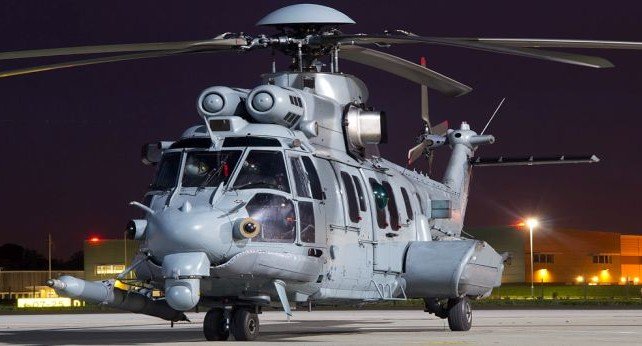
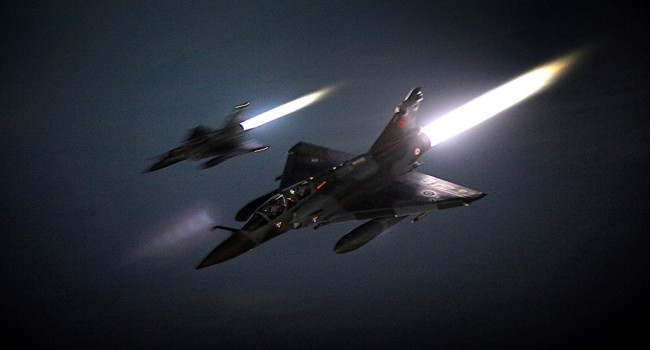


Lastly, I do believe that the Army to be effective without resorting to violent means has to project itself impeccably. It must take initial guidance and have police liaison personnel with it but thereafter its actions have to be seen to be decisive and with a moral ascendancy of its known discipline. To that end whenever I was responsible for such actions I insisted that the Army’s vehicles would appear absolutely clean and well maintained, with well rolled camouflage nets, looking professional and ready to go. The soldiers must project the best demeanour and they must be rehearsed for this. They must make a difference by also displaying the greatest empathy for women and children, the sick and the old. If necessary they must use their authority to allow milk stocks for children and restock medicine shops. The Regimental Medical Officer is the most important asset in such circumstances as he or she ensures that medical assistance is always available to the needy.

These are a few basics which emerge from experience and must remain in focus for effectively projecting the professionalism of the Army and its soft power capability. After all, at the end of such operations the people must remember that soldiers are a breed apart, hard where required and the softest when needed.


A tale of two Sants Politicians hold their counsel

A tale of two Sants

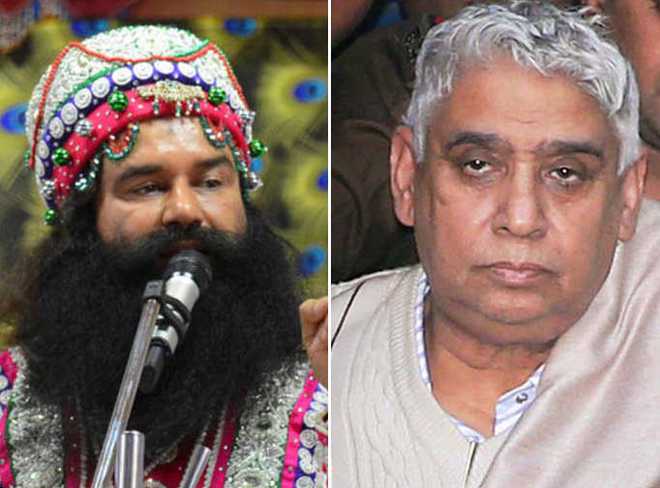
THE entire country witnessed the collapse of governance will in the events leading to the conviction and sentencing of Dera Sacha Sauda chief Gurmeet Ram Rahim. And a day after he earned two decades in prison, another self-proclaimed godman Rampal was arraigned before the court. He was acquitted for allegedly masterminding a spell of riotous frenzy by his supporters in a case whose denouement is also close. For that matter, though Ram Rahim was convicted of a charge that involved betraying the trust of vulnerable women, he too will shortly be arraigned for charges of murder. The only difference between the two godmen, both of whom ran veritable empires that brooked no challenge to their suzerainty, was that Rampal wasn’t charged with grave moral turpitude.But what was common between the two was that for all their teachings about egalitarianism and piety, they had assumed that their empyrean status among their apostles would grant them immunity from the temporal world of rules and regulations outside their dera gates. Once that was not to be, there is tacit encouragement to the bereft followers to go on a riotous frenzy. Another common element behind the travails of both self-anointed saints was the strange radio silence from politicians. The televised spectacle in the run-up to Ram Rahim’s sentencing was tailor-made for politicians to weigh in. Rarely has the political class willingly passed up an opportunity to insert itself in an event that had the whole country riveted.The politician is ever-willing to overlook indiscretions by the Babas because of the nature of the battle for votes where only the winner matters. Very few contestants, mostly those in it for a token contest, are loath to allow even a single unsolicited vote to escape their grasp. The Babas, with a complete sway over lakhs of followers, are a temptation a politician can hardly overlook. The politician is willing to let matters rest and wait for another day, perhaps when the Baba walks free, rather than risk antagonising his captive vote bank by taking a stand. Principles can wait for another day. 


Now, make a privacy law by Madabhushi Sridhar

A nine-judge bench of the Supreme Court, in a path-breaking judgment ruled that the right to privacy is a fundamental right, like the right to life. This verdict will impact national and global jurisprudence on privacy vis-a-vis information-based economy and governance.

Now, make a privacy law
Need of the hour: Parliament has to perform its constitutional obligation of making a law on privacy. Tribune photos

Madabhushi Sridhar

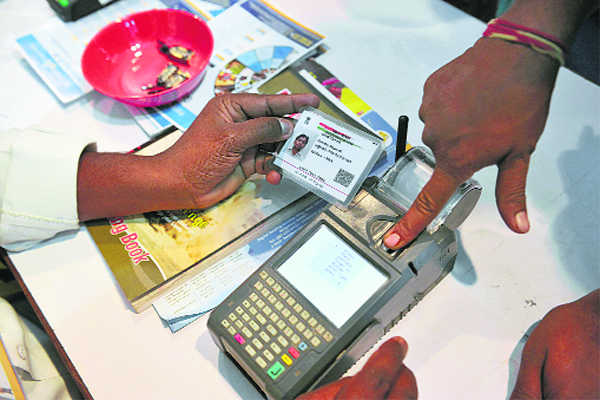
THE basic concept and definition of privacy rendered by Justice BP Jeevan Reddy in the Rajgopal case (1994) and the emphatic dissent of Justice Subbarao in the MP Sharma case formed the solid basis of the nine-judge bench recognising and declaring that the right to privacy is the intrinsic part of life under Article 21 and a part of the freedoms guaranteed by Part III of the Constitution. Now the Aadhaar link has to be decided on the Aadhaar of this unanimous order of the Supreme Court. Justice Chandrachud referred to the landmark order of Justice Jeevan Reddy, who said: “The right to privacy is implicit in the right to life and liberty guaranteed to the citizens of this country by Article 21. It is a ‘right to be let alone’. A citizen has a right to safeguard the privacy of his home, his family, marriage, procreation, motherhood, child-bearing and education among other matters. None can publish anything concerning the above matters without his consent — whether truthful or otherwise and whether laudatory or critical. If he does so, he would be violating the right to privacy of the person concerned and would be liable in an action for damages. The position may, however, be different, if a person voluntarily thrusts himself into controversy or voluntarily invites or raises a controversy”.  Recently, in the Ram Jethmalani case, the Supreme Court held the revelation of the details of the bank accounts of individuals without the establishing wrongdoing would be a violation of the right to privacy. The judges cited catena of orders from India and abroad to explain how privacy assumed fundamental importance as a basic right. This judgment will have a significant impact on the Government’s Aadhaar scheme, under which the state is collecting huge personal details and biometrics to identify beneficiaries for accessing social benefits under various welfare schemes.  The question that another five-judge bench of Supreme Court is going to decide is: Whether the Aadhaar programme is a breach of privacy, informational autonomy and bodily integrity?The Union contended that the right to privacy was not fundamental, while four state governments — Karnataka, West Bengal, Punjab and Puducherry —where non-BJP political parties are ruling, opposed the Centre’s contention and pleaded for the right of privacy. The Maharastra government said that it is a concept and not a stand-alone right.  This landmark declaration that it is a fundamental like the right to life will impact national and global jurisprudence on privacy vis-à-vis information-based economy and governance.The Supreme Court overruled its earlier verdicts in MP Sharma and Kharak Singh. As an eight-member bench in MP Sharma decided against the fundamental right status of privacy, this nine-member bench was necessitated. The Supreme Court prepositions subsequent to the Kharak Singh case were held to be correct position in law. The Attorney General’s argument of doubtful status of privacy based on the Supreme Court orders in the MP Sharma and Kharak Singh cases was rejected emphatically. In MP Singh, the Supreme Court held that a power of search and seizure is in any system of jurisprudence an overriding power of the State for the protection of social security and that power is necessarily regulated by law.  The Court felt that the Constitution makers did not subject the regulation by law of the power of search and seizure to a fundamental right of privacy. The decision in the Kharak Singh case held that clause (b) of Regulation 236, which provided for domiciliary visits at night, was violative of Article 21. The bench observed that Kharak Singh regards the sanctity of the home and the protection against unauthorised intrusion an integral element of “ordered liberty”.  The Supreme Court agreed with the dissent of Justice Subbarao in Kharak Singh. He held that the rights conferred by Part III have overlapping areas. Where a law is challenged as infringing the right to freedom of movement under Article 19(1) (d) and the liberty of the individual under Article 21, it must satisfy the tests laid down in Article 19 (2) as well as the requirements of Article 21. Justice Subba Rao recognised a constitutionally protected right to privacy, considering it as an ingredient of personal liberty.  Justice Chandrachud’ draft was signed by Chief Justice Khehar, Justices RK Agrawal, Abdul Nazeer, and approved by  Justices Chalameshwar, S A Bobde, R F Nariman, Abhay Manohar Sapre, Sanjay Kishan Kaul, by separate judgments.  Referring to the informational privacy, he says: “In aggregation, they disclose the nature of the personality: food habits, language, health, hobbies, sexual preferences, friendships, ways of dress and political affiliation. In aggregation, information provides a picture of the being: of things which matter and those that don’t, of things to be disclosed and those best hidden”.The bench finally cautioned that the judicial recognition of the existence of a constitutional right of privacy is not an exercise in the nature of amending the Constitution nor is the Court embarking on a constitutional function of that nature which is entrusted to Parliament.  The Parliament has to perform its constitutional obligation of making a law on this vital point. Such a law if made should not encroach upon privacy, and if it does it has to withstand the touchstone of permissible restrictions on fundamental rights. Such a law shall stipulate a procedure which is fair, just and reasonable.  Thus, a law of privacy with reasonable restrictions to advance security and public interest is the need of the hour. The writer, a Central Information Commissioner, is a former Professor of Law at NALSAR University of Law, Hyderabad.