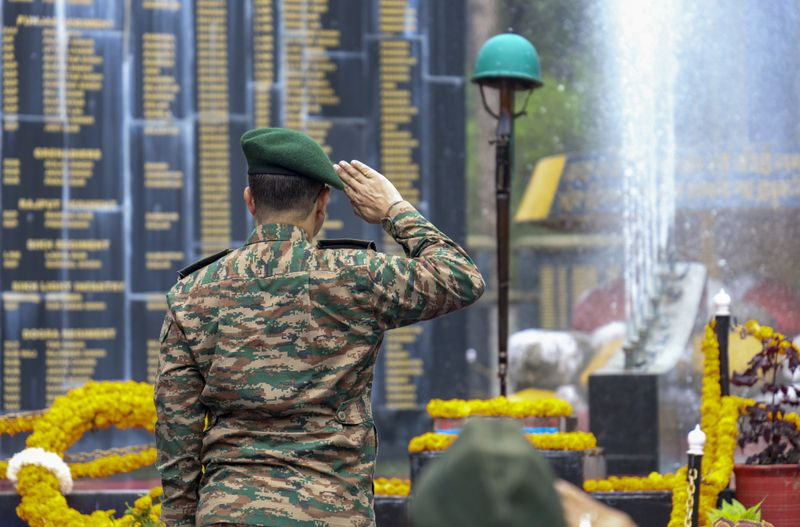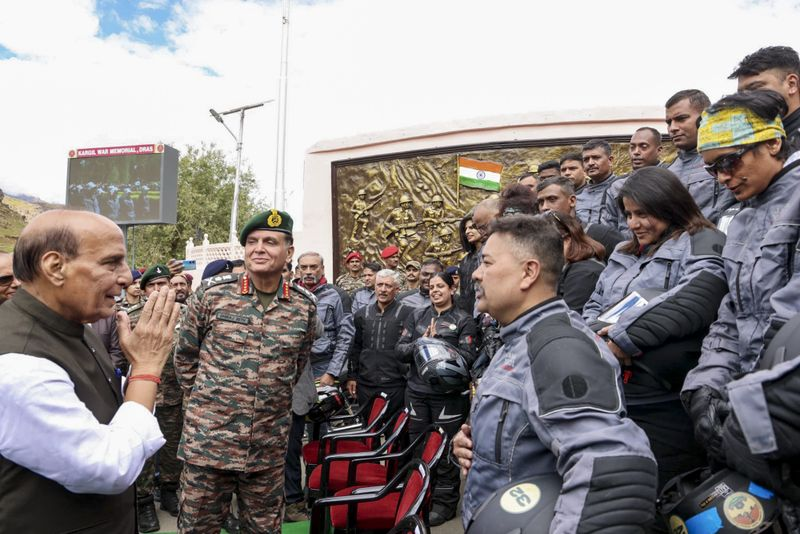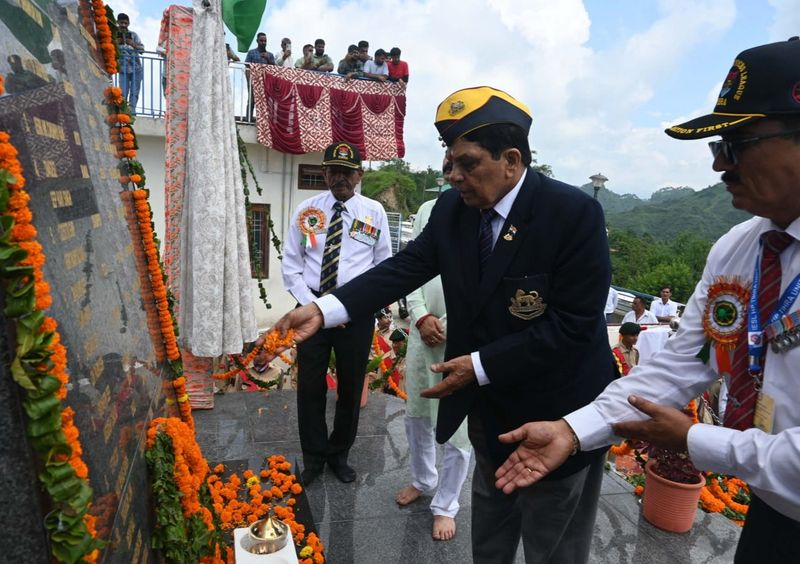










Not just one, but five brothers from the Dehradun-based Kukreti family took to the front lines together during the 1971 Indo-Pak war—a feat that stands as one of the rarest examples in Indian military history. Of the five brothers, three served in the Rajput Regiment and two in the EME Corps. Displaying valor across various fronts, they contributed to India’s victory. Lieutenant Colonel Rakesh Kukreti, a Shaurya Chakra awardee, was among these brave soldiers.
The family resides in the Defence Colony area of Dehradun. While the brothers served in different units—three in the Rajput Regiment and two in the EME Corps—and were deployed on different fronts, they shared a singular resolve: the victory of Mother India.
Five brothers from one family took to the front lines:
Among these five heroes, the most prominent name is that of the Shaurya Chakra awardee, retired Lieutenant Colonel Rakesh Kukreti. He recalls that the impending war became palpable as early as the last week of November 1971. Tensions were escalating at the borders, and the Pakistani army was plotting to sever the Indian Army’s supply lines; yet, Indian soldiers remained prepared for every challenge.
During the war, a reconnaissance mission that involved penetrating enemy territory from Dharamnagar to Ghazipur altered the strategic course of operations. Lieutenant Colonel Kukreti remembers trekking nearly 93 kilometers on foot over three days without food or water. Despite a relentless barrage of shells raining down around them, their morale never wavered. The memory of that time remains vivid—moments when death loomed close, yet nothing mattered more than the nation.
The heroic saga of the Kukreti family is not confined to mere memories; it has been chronicled in the book *Kahani 1971 Yuddh Ki* (The Story of the 1971 War) so that future generations may understand the sacrifices that underpin freedom and victory
MRSAFPI SENDS 25 CADETS TO DEFENCE TRAINING ACADEMIES IN 3 MONTHS, TOTAL SELECTIONS REACH 175 UNDER MANN GOVT
Satluj director Honey Trehan said Diljit Dosanjh charged just Re 1 to play the role of human rights activist Jaswant Singh Khalra. He also said the film would not have been possible without the actor’s support.
Filmmaker Honey Trehan revealed Diljit Dosanjh charged Re 1 to star in Satluj after telling him it would be shameful to take money to play human rights activist Jaswant Singh Khalra. Trehan said the 42-year-old was the first actor he thought of for the role and added that the film would not have existed without him.
Satluj was blocked in India within 48 hours of its release and was later removed from ZEE5 globally. A public interest litigation has since been filed in the Punjab and Haryana High Court, seeking the film’s restoration on ZEE5 and disclosure of the reasons for its takedown.
Does Satluj promote pro-Khalistan narrative? What Diljit Dosanjh film really says
For all the debate around Khalistan, Satluj asks a very different question. Honey Trehan’s film refuses to argue ideology, choosing instead to confront the unresolved human cost of Punjab’s counter-insurgency years and the accountability they continue to demand.
In Honey Trehan’s Satluj, the story of Punjab’s militancy years is told from a new, largely less-approved and far more intimate angle. It is not told through terrorism, the conversation around Khalistan, the aftermath of Operation Blue Star or the anti-Sikh riots of 1984. It is told and remembered through missing sons, unmarked cremation grounds, unidentified bodies, and a lingering atmosphere of fear and silence. Which is what makes Satluj such a personal watch.
Starring Diljit Dosanjh as the celebrated human rights activist Jaswant Singh Khalra, the film never distracts itself by trying to become anything else. It never concerns itself with being a political weapon or answering the wider questions surrounding Punjab’s long history of militancy.

Throughout its two-hour-and-43-minute runtime, Satlujkeeps circling back to one question: who will take accountability for the extrajudicial killings in the state? Who will tell the families of those who went missing that they never disappeared, but were killed? Who will distinguish between militants and ordinary citizens whose bodies were illegally cremated?
Satluj doesn’t shy away from establishing that the 1995 counter-insurgency period remains one of the darkest chapters in Punjab’s history. It also invokes the 1984 anti-Sikh riots and the assassination of Punjab Chief Minister Beant Singh. But every time it gives the viewer a glimpse of where it all began, it asks a far bigger question: where it went later?
Satluj scene that sums up its political stand
A scene featuring Arjun Rampal’s CBI officer Samudra Singh and Suvinder Vicky’s SSP Surjit Singh Sugga best captures the film’s position. Confronted with allegations of thousands of abductions and extrajudicial killings carried out during Punjab’s counter-insurgency years, Sugga immediately turns the conversation towards the 1984 anti-Sikh riots. He questions Singh about the Sikh killings in Delhi’s Trilokpuri, asking whether those deaths were “judicial or extrajudicial”, and suggests that the truths of 1984 remain buried.
It is then that Singh quietly cuts through the argument: “Chaurasi (1984) ginane se ’95 ke aankde badlege nahi” [Mentioning 1984 won’t change the reality of 1995].
The point is not to dismiss 1984 or diminish the trauma of the anti-Sikh riots. Rather, it is a refusal to let one historical tragedy become the justification for avoiding another. Singh is, in effect, telling Sugga that the scale of violence in 1984 cannot explain away, or reduce the accountability for, the thousands of alleged killings and disappearances that followed during the counter-insurgency years.
That scene is crucial in establishing how Satluj never tries to become a Khalistani apologist; its intention lies in painting a bigger picture that risks being diluted if diverted towards other political debates. It does so by not making Khalistan its central subject, referring to militancy only as the setting, and creating an environment in which its characters are forced to confront the weight of the time they live in.
The film is not presented as a dismissal of 1984 or an attempt to minimise the trauma of the anti-Sikh riots. It challenges a pattern commonly visible to anyone who has followed Punjab’s political discourse: the tendency for one historical tragedy to be invoked in response to another, often leaving neither fully confronted on its own terms.
As the same scene continues, Samudra Singh bluntly asks Sugga for accountability for the killing of thousands in the name of the counter-insurgency programme – something the film itself repeatedly demands: “Hisaab toh dena padega” [There will have to be accountability].
The scene goes on to show Sugga saying that Punjab has had a complicated history. Referring to the militancy in the state, he says, “Hisaab toh Punjab ka hai hi complicated. Hum unse lad rahe hain jo pakde nahi jate, bas maare jate hain. Ye vo log hain jinhe maarne ke liye army bulani padti hai. Topey kam pad jati hain” [Punjab’s accounting is complicated. We’re fighting people who are never caught, only killed. These are the kind of people you have to call the Army in to fight. Even cannons aren’t enough].
No mention of Khalistan, separatism or the demand for a separate Sikh homeland ever becomes the film’s ideological centrepiece. That is Satluj’s most conscious narrative decision. The film acknowledges that it is set during Punjab’s years of militancy. However, Trehan constantly shifts the camera away from ideology and towards consequence. Politics remains in the background, while the human cost occupies the foreground.

hroughout its runtime, Satluj appears less interested in asking why militancy emerged than in asking what happened when the State responded to it. It is a film about records, affidavits, police registers, cremation logs and families waiting for someone who would never return home. Its emotional vocabulary is built around absence and mourning rather than political conflict.
Popular culture has often approached Punjab’s militancy years through binaries: terrorist versus patriot, police versus militant, State versus separatist. Satluj resists this familiar narrative. Instead of attempting a sweeping chronicle, it deliberately narrows its gaze, choosing to stay with one documented human rights investigation rather than trying to become a definitive account of an entire political movement.
Which is also why Khalra’s work becomes the perfect lens through which to tell this story.
Satluj’s portrayal of Jaswant Singh Khalra
Khalra was not investigating the politics of Khalistan. He was investigating allegations that thousands of unidentified bodies had been illegally cremated and that countless families had never been told what had happened to their loved ones. The hero in this film does not wield weapons; he carries documents. His fight is not against an ideology but against disappearance itself – the disappearance of bodies, identities and official memory – making Satluj politically compelling in an entirely different way.
19,000 files relating to India’s largest nuclear power plant ‘exposed’ in data breach
Purported blueprints of parts of facilities, supplier details exposed
Ransomware group World Leaks has posted on the dark web a huge cache of files related to India’s largest nuclear plant, including purported blueprints of parts of its facilities and supplier details — information it labelled as coming from Reliance Group.
The Kudankulam Nuclear Power Plant, located in Tamil Nadu, is the largest of India’s seven nuclear plants and central to PM Narendra Modi’s ambitious plans to expand the country’s atomic energy capacity.
Indian businessman Anil Ambani’s Reliance Group, one of the plant’s contractors, told Reuters in a statement that there had been a “partial breach” of its data on a server hosted by third-party Indian data centre service provider Yotta, and that the government has been informed about the incident. Reliance did not disclose what data had been breached.
The data breach could pose a “serious” risk to the safety of the plant, says Nickolas Roth, a senior director at the Nuclear Threat Initiative, which advises governments and benchmarks countries’ preparedness on nuclear security. The breach also underscores how hacks have become more common in India, where many companies are ill-equipped to deal with such threats.
Nearly 19,000 files totalling 14.3 gigabytes that appear for the search term “KKNP” – an acronym for the nuclear plant – in the data have been online since June 11, according to independent cybersecurity researcher Rakesh Krishnan, who first alerted Reuters to the leak.
Reuters reviewed the documents, which were dated from 2016 to mid-2025, but could not verify their authenticity. In addition to some blueprints and supplier details, they purportedly show meeting and inspection records, equipment reviews and insurance policies.
The 19,000 files appeared to be the most sensitive of a total 858,000 Reliance files on the World Leaks website.
One of the conglomerate’s subsidiaries, Reliance Infrastructure, won a contract in 2018 to design and build infrastructure for the plant’s Unit 3 and Unit 4. Both units, still under construction, are due to be operational by 2027 and are slated to provide a combined 2,000 megawatts of capacity.
World Leaks, a well-known ransomware group that has previously targeted Nike and India’s Tata Group, did not respond to Reuters queries on the Reliance data breach. The group typically posts stolen corporate data on its website after companies decline to pay the ransom demanded. Its website can only be accessed with a specialised browser.
In June, World Leaks told Reuters it had sought $1.5 million in ransom for Tata Group files that contained confidential component designs of clients Apple and Tesla, adding that it posted the data after Tata “ignored” its demand.
The Nuclear Power Corporation of India, which commissions and operates the country’s nuclear power plants, has been communicating with Reliance about the breach and India’s main cybersecurity agency — the Indian Computer Emergency Response Team (CERT-In) — is looking into the incident, according to a source familiar with the matter. The source declined to be identified. Nuclear Power Corporation Chairman Rajesh Veeraraghavan, CERT-In and the government’s main press office did not respond to repeated requests for comment
West Asia War: US airstrikes hit northern Iran as it disables ship trying to run blockade
US strikes have killed more than 35 people and wounded more than 300, say Iranian officials
The United States intensified its strikes targeting Iran early Thursday, hitting targets further north as American forces also fired into a ship it accused of trying to break its naval blockade on the Islamic Republic. Iran retaliated with missile and drone fire targeting Bahrain and Kuwait before dawn.
Days of back-and-forth strikes by the US and Iran across the Middle East — and renewed threats to the Strait of Hormuz — have shredded the interim deal to end the Iran war and could tip the region back into all-out war. Already, Iranian officials say US strikes have killed more than 35 people and wounded more than 300 others. Strikes also reached into areas around Iran’s capital, Tehran, for the first time of this latest round of violence.
When the US and Israel launched the war on Iran on Feb. 28, Tehran effectively closed the strait to shipping traffic – a move that sent the price of oil, fertilizer and many other goods soaring far beyond the region and gave Iran major leverage in negotiations.
US and Iran trade threats as attacks intensify
Those rising prices pose a particular challenge to US President Donald Trump and his Republican Party, which hopes to retain control of Congress in elections in November. But Washington has struggled to successfully reopen the waterway, leading to Trump reimposing the naval blockade Wednesday.
Iran’s parliament speaker and lead negotiator, Mohammad Bagher Qalibaf, said Iran was prepared for a fuller military confrontation if the US does not live up to the terms of the interim deal, and Iran’s paramilitary Revolutionary Guard threatened to halt all energy exports from the Middle East over the blockade.
“The export of oil and gas from the region will be either for everyone or for no one,” the Guard said.
Trump again insisted Iran was ready to strike a peace deal, but he did not elaborate.
“They don’t like what we’re doing, and they do want to settle. We’ll find out whether or not we settle with them, or we just finish it off,” he said Wednesday at the US Army War College in Pennsylvania.
Both the US and Iran launch attacks as the blockade is reimposed
The US strikes early Thursday hit around Tehran, state media reported. It also reported American attacks targeted Semnan province, home to Iran’s ballistic missile production and space program.
On Wednesday, the US resumed striking Iran during daylight – further showing the increasing tempo of the attacks. Its attack on Greater Tunb Island, a strategic point in the Strait of Hormuz – targeted Iranian defense and missile sites, Central Command said.
Meanwhile, the US military said it opened fire on the Curacao-flagged oil tanker Belma sailing toward Kharg Island, Iran’s main oil export terminal in the Persian Gulf. After the ship “ignored multiple warnings,” a US aircraft disabled the merchant vessel by firing a missile into the ship’s smokestack.
Another American strike Wednesday targeted a barracks for Iran’s 388th Mechanized Infantry Brigade, which operates tanks and armoured vehicles, in Sistan and Baluchestan province, Iranian state television reported. The report said Americans fired at least 13 missiles in the attack and the seven dead included conscripts and career soldiers. A number of troops were wounded.
The Strait of Hormuz remains at the heart of the fighting
The latest round of fighting is focused on the Strait of Hormuz. How to reopen the strait has bedeviled the US since Iran choked it off in the early days of the war.
During the interim deal, some ships began moving through the passage using a route near Oman overseen by the US military that is outside Tehran’s control.
In recent days, Iran attacked ships using that route – and back-and-forth attacks ensued. The US has threatened to reopen the strait by force – but experts say that would require a much bigger armada if not tens of thousands of ground troops. Imposing the blockade is another way to put pressure on Iran.
But in the meantime, oil prices are rising. The price for Brent crude oil, the international standard, traded above $85 a barrel on Thursday – more than 15 per cent higher than the price before the war, but still well below the nearly USD 120 reached at the height of the conflict.
FIFA World Cup 2026: Defending champions Argentina reach final by beating England 2-1
Anthony Gordon had given England the lead, but Lionel Messi and Co. had other ideas
No “Hand of God” this time. Argentina didn’t need it.
Instead it was the hallowed feet of Lionel Messi and the unbreakable spirit of a team that has repeatedly fought back at this year’s World Cup that is now one step away from back-to-back titles.
Trailing 1-0 going into the 85th minute, Argentina rallied for a 2-1 victory over England on Wednesday with goals from Enzo Fernandez and substitute Lautaro Martinez.
“I dreamed it, I swear. I told Alexis (Mac Allister) that I was going to score. I told him that I was going to come on and I was going to win it,” Martinez said. “I can tell you this team keeps showing what it’s made of.” At the final whistle, Messi fell to his knees in celebration while England players collapsed in disbelief – again.
Add 2026 to 1986 and 1998 on the list of games when Argentina has extinguished English hopes at the World Cup.
“I’m gutted for the team, the staff, the fans,” England captain Harry Kane said. “We worked so hard to be here. The lads have given every bit of blood, sweat and tears. To fall short like we did is just gutting.”
The defending champions will take on European champion Spain in the final on Sunday in East Rutherford, New Jersey. The best that South America has to offer against the best of Europe.
The loss for England will hurt a new generation of fans in a similar way to Diego Maradona’s infamous handball goal in the 1986 World Cup quarterfinals and the penalty shootout loss in 1998 when David Beckham was sent off for kicking Diego Simeone.
The difference is there can be no sense of injustice this time, even if England had victory in its sights after Anthony Gordon scored the opening goal in the 55th minute.
The team was hanging on as the game wore on. England goalkeeper Jordon Pickford made vital saves while Mac Allister sent a header off the post as wave after wave of Argentina attacks came.
Messi had largely been kept quiet. But when he’s on the field, anything seems possible.
He fed the ball to Fernandez to sweep in the equalizer from outside the box in the 85th minute. And two minutes into stoppage time, Messi sent in a cross for Martinez to head in the winner.
It almost felt inevitable. Especially given the amount times Argentina has simply refused to give in at this year’s World Cup. From Cape Verde to Egypt, Messi and Co. always seem to find a way.
England, in contrast, came up short in the World Cup semifinals for the third time after losses to Germany in 1990 and Croatia in 2018. And it’s another occasion in recent years when England’s players have squandered a winning position in the later stages of a major tournament.
They led 1-0 against Croatia in the semifinals eight years ago and lost 2-1. They were up 1-0 against Italy in the European Championship final in 2021 and lost on penalties.
On Wednesday, England coach Thomas Tuchel’s substitutions seemed to be more intent on holding on, rather than killing the game off with another goal.
“We played a good game for the majority of it. When we went 1-0 up, we seemed to just try to hold on, which at this level is not enough,” Kane said. “We talk about knocking on the door. We’re close, we just need to find that missing piece in the final stage of the tournament.”
In contrast, Argentina is one step away from history. Messi, now 39 and likely playing at his last World Cup, is one win away from further strengthening his case to be considered the greatest soccer player of all time.
“We’re going to try to win, we’re going to leave everything out there,” Argentina coach Lionel Scaloni said. “It’s very difficult to get people to understand what these players are showing. It’s incredible. We are unique, truly, and it’s not arrogance, it’s from the heart. We are unique.”
Satluj risks rekindling anger & distrust in Punjab. It’s not about the film, but the votes
Diljit Dosanjh-starrer Satluj doesn’t blame any political party or individual politicians. We only know the demographic in Punjab it’s bound to trigger the most.
Even in the most innocent times nobody in Punjab would believe that the OTT release and then sudden withdrawal of Honey Trehan/Diljit Dosanjh’s Satluj was without political motives. And then sudden withdrawal of Honey Trehan/Diljit Dosanjh’s Satluj was without political motives.
In this era of conspiracy theories, everybody in Punjab seems to have their own ‘insight’ into this. If the BJP wanted to stop the film, as CBFC’s 127 proposed cuts showed, it could’ve easily made sure Zee wouldn’t release it. It’s also owned by somebody close to it politically.
Then, why would he pull it in 48 hours? Everybody would’ve known that once out in digital form, it will be shown widely. If anything, the controversy will give it more fire and fury. The buzz in Punjab headed for elections early next year is: who benefits the most from this controversy? Or who will it hurt the most? As usually happens, one outcome leads to the other.Show Full Article
India needs fair, non-hyphenated and questioning journalism, packed with on-ground reporting. ThePrint – with exceptional reporters, columnists and editors – is doing just that.
Sustaining this needs support from wonderful readers like you.
Whether you live in India or overseas, you can take a paid subscription by clicking here.
Ravneet Bittu unnecessarily raising issue of those already dead: Capt Amarinder Singh on ‘Satluj’ row
Former Punjab Chief Minister warns against using the past to polarise the present
Former Punjab Chief Minister and senior BJP leader Capt Amarinder Singh has warned against using the past to polarise people in the present, asserting that there can be no escape from history.
Speaking on the political fallout of the film ‘Satluj’, Amarinder, in an exclusive interview with The Tribune, said Union Minister of State for Railways Ravneet Singh Bittu was “unnecessarily raising the issue”.
The senior BJP leader was reacting to posts on Bittu’s social media feed about ‘Satluj,’ including video clips of deceased and clean-shaven men, and persistent statements that the BJP did not ban the film and should not be held responsible for it.
Instead of piecemeal efforts like the movie, the former Chief Minister said, the entire gamut of incidents should be brought out. “If 25,000 were killed, there were 1,800 policemen who also died fighting these terrorists, as did thousands of other innocent persons. The names of all those who committed excesses on both sides should come out,” he said.
Asked what he thought about public screenings of the movie across Punjab, he said he didn’t know who was behind the movie being pulled down.
“But let me tell you that the BJP or the Congress will not gain from this. Only the Shiromani Akali Dal, Waris Punjab De and the Akali Dal (Punar Surjit) can probably foresee political gain. That is why these parties are encouraging public screenings,” he said. He pointed out that only after the movie was pulled down had it aroused massive public interest. “Had it remained on the platform, it would probably not have garnered such public interest,” he said.
The former Chief Minister also said there was “no point in running away from history, but that didn’t mean history should end up polarising the present”. “Jaswant Singh Khalra was collecting evidence of those who went missing. He was not doing anything wrong. Six policemen were also convicted later. How can this be denied? We need to own our past and remember it to the extent where we do not repeat the mistakes of the past. One does not want to carry these things to the future and get the younger generation worked up for past incidents,” he said, warning that it was a “very tricky business”.
Amarinder, who had resigned as an MP in 1984 to protest the Army entering the Golden Temple during Operation Bluestar, said that even during the worst phase of militancy in Punjab, the Hindus and the Sikhs remained united.
Recalling how the Hindus had always held the Darbar Sahib in the highest reverence, he said, “In days preceding Operation Bluestar when I was trying to facilitate dialogue between the Centre and Jarnail Singh Bhindranwale, I would go to meet him at Guru Nanak Niwas at 1 am and come out at 3 am. About 80 per cent of those cleaning the Darbar Sahib parikarma were Hindus. If Hindus were killed by militants, the Sikhs always sympathised with them. Be it the incident at Dhilwan where people were pulled out of a bus and killed or such targeted killings in Dera Bassi, Lalru or my own constituency, the common Sikh was totally against it. Back then, all were Punjabis–not Hindus or Sikhs,” he said.
The former Chief Minister also came out in support of the late KPS Gill, a former Punjab DGP. “He was brought to Punjab and assigned a specific task. He delegated work to his junior officers posted in different districts and police stations. If some of his juniors did things that were uncalled for, he cannot be blamed for it. His role in eliminating terrorism should not be undermined,” he added.
Indian Army woman shooter Neeru Dhanda wins country’s first international gold in trap shooting
Naib Subedar Dhanda of the Army Marksmanship Unit clinched the gold at the International Shooting Sport Federation World Cup in Lonato, Italy
An Indian Army woman shooter has created history by winning country’s first-ever international gold medal in shotgun trap shooting, finishing ahead of champions from several European nations.
Naib Subedar Neeru Dhanda of the Army Marksmanship Unit (AMU) clinched the gold medal at the International Shooting Sport Federation (ISSF) World Cup in Lonato, Italy. The prestigious event featured top shooters from the United States, France, Spain, Italy, Sweden and the United Kingdom.
“She delivered a stellar performance, scoring 121/125 in qualifications and 27/30 in the finals, finishing ahead of world champions from France and Spain,” the Indian Army said on Sunday. “A landmark moment for Indian Army shooting and a major boost ahead of the Asian Games,” the Army’s statement added.
In June, Sejal Raju Kamble from the Army Girls Sports Company, who had also trained at AMU, secured the individual gold medal in the junior women’s 10m air pistol event at the ISSF Junior World Championships at Suhl in Germany. Cadet Navya clinched the team gold, while Cadet Himanshi secured the bronze in the same event.
Hailing from Haryana’s Jind district, 26-year old Neeru joined the Corps of Military Police after entry into the rank and file was opened for women. She trained at the AMU located at the Infantry School in Mhow, that trains military personnel, para-athletes and civilians in precision sports shooting for international competitions under the Indian Army’s Mission Olympics Wing. It trains military personnel for Olympic and national competitions.
Earlier, Neeru had won the gold medal in trap shooting at the Asian Shooting Championship in 2025.
Trap shooting is a popular target sport where participants use a shotgun to shoot flying targets known as clay pigeons, which are launched from a concealed ‘trap house’. The objective is to break as many targets as possible, requiring excellent focus, quick reflexes and precise aim.
Remaking that Neeru triumphed in dramatic Trap Women final to secure the first ISSF World Cup gold after producing a composed performance, the ISSF said the Indian shooter finished with 27 hits to secure her maiden ISSF World Cup gold medal, holding off a strong challenge from France’s Carole Cormenier and Italy’s Erica Sessa.
Neeru established herself among the front-runners from the opening stages of the final and remained remarkably consistent throughout the 30-target contest. Entering the decisive phase with a narrow advantage, she maintained her composure to finish on 27, sealing an impressive victory in one of the strongest fields of the season, the ISSF said.
Founded in 1907 and headquartered at Munich in Germany, the ISSF is the global governing body for Olympic shooting events and several other non-Olympic disciplines covering rifle, pistol, and shotgun. It oversees several international tournaments.
While Neeru is the first Indian gold medallist in the shotgun event, Esha Singh has been an ISSF World Cup gold medallist and junior world record holder in the women’s 25m pistol event and Abhinav Bindra was the first-ever individual Olympic gold medallist for India in the men’s 10m air rifle event. There have also been other Indian medallists at various international events.
State Stalwarts
DEFENCE MINISTER
Minister Rajnath Singh
ALL HUMANS ARE ONE CREATED BY GOD
HINDUS,MUSLIMS,SIKHS.ISAI SAB HAI BHAI BHAI
CHIEF PATRON ALL INDIA SANJHA MORCHA
LT GEN JASBIR SINGH DHALIWAL, DOGRA
SENIOR PATRON ALL INDIA SANJHA MORCHA
MAJOR GEN HARVIJAY SINGH, SENA MEDAL ,corps of signals
.
.
PATRON ALL INDIA SANJHA MORCHA
MAJ GEN RAMINDER GURAYA ,MADRAS REGIMENT
sanjhamorcha303@gmail.com
PRESIDENT SOUTH ALL INDIA SANJHA MORCHA
COL SS RAJAN BOMBAY SAPPERS,
PRESIDENT UTTARAKHAND ALL INDIA SANJHA MORCHA
COL B M THAPA ,BENGAL SAPPERSS
PRESIDENT HARAYANA STATE CUM COORDINATOR ESM
BRIG DALJIT THUKRAL ,BENGAL SAPPERS
PRESIDENT TRICITY
COL B S BRAR (BHUPI BRAR)
PRESIDENT CHANDIGARH ZONE
COL SHANJIT SINGH BHULLAR
.
.
PRESIDENT PANCHKULA ZONE AND ZIRAKPUR
COL SWARAN SINGH
INDIAN DEFENCE FORCES
DEFENCE FORCES INTEGRATED LOGO
INDIAN AIR FORCE
Air Officer C-in-C WESTERN AIR COMMAND
AIR MSHL S PRABHAKARAN AVSM VM
AOC-IN-C, EASTERN AIR COMMAND
Air Marshal Inderpal Singh Walia
AOC-in-C SOUTH WESTERN AIR COMMAND
Air Marshal Vikram Singh
AOC-IN-C, SOUTHERN AIR COMMAND
Air Marshal J.Chalapati
AOC-IN-C TRAINING COMMAND
AIR MARSHAL SK GHOTIA VSM
AOC-IN-C MAINTENANCE COMMAND
Air Marshal Jagdish Chandra
Flag Officer Commanding in Chief, Western Naval Command
ice Admiral R Hari Kumar, PVSM, AVSM, VSM
Flag Officer Commanding in Chief, Eastern Naval Command
Vice Admiral Sanjay Bhalla, AVSM, NM
Flag Officer Commanding in Chief, Southern Naval Command