









Sanjha Morcha

What’s New

Click the heading to open detailed news

Current Events :

web counter

Print Media Reproduced Defence Related News

Ready to manufacture F-16 jets in India: Lockheed Martin

But the American corporation’s executive did not commit any time-frame to have the plant operational.
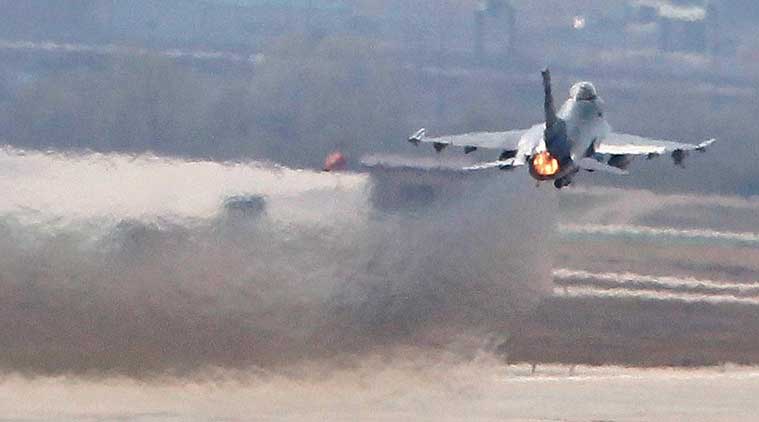
f 16, f 16 india, f 16 jets india, india f 16 jets, india fighter jets, fighter jets india, india news, india f 16 fighter jets, indian air force, air forceUS Air Force F-16 fighter jet takes off from a runway during a military exercise. (File/AP Photo)

US fighter jet maker Lockheed Martin today said it is ready to manufacture F-16 aircraft in India and supports the ongoing talks between the two countries to set up the first manufacturing facility, one of the largest projects under the ‘Make in India’ initiative.

“We are ready to manufacture F-16 in India and support the Make in India initiative,” Phil Shaw, chief executive of Lockheed Martin India Private Ltd told reporters at the Singapore Airshow 2016.

But the American corporation’s executive did not commit any time-frame to have the plant operational, saying the group supports the ongoing government-to-government talks.

Shaw expressed strong interest in having the F-16 made in India “soon” without elaborating on the time-frame, linking it to the progress of the government-to-government talks.

Currently, Lockheed Martin manufactures one jet a month from its plant in the US and has a series of contracts and joint ventures in India with over 1,000 employees.

It has supplied six C130J Super Hercules planes to India in 2011 and will be delivering another six helicopters next year.

Industry observers said Lockheed Martin’s “wish to manufacture F-16 is based on the strong demand from the Indian armed forces and would want to lower the cost of the planes for exports by using the low-cost capability in India”.

“Certainly, Lockheed Martin would want to exploit the engineering skill and low cost capabilities in India and make F-16 very competitive in the fighter jet markets,” awell-informed source told PTI.

“Both the US government and Lockheed Martin see the advantage of placing a manufacturing base in India and make F-16 affordable for emerging markets,” the source said.

The making of F-16, which will be among the largest projects under the Make in India initiative, will be conditional to the Indian government making contractual commitment to buy the fighter jets for its armed forces, said the source.

“Washington, in return, would ensure technology transfer to the Indian engineering sector and a huge boost to Indian exports,” he said.

If the two government reach an agreement this year or2017, putting aside all differences on the mega project and the US’ move to supply eight F-16 to Pakistan, Lockheed Martin could roll out the first made in India jet in 2019-2020, said the source.

Lockheed Martin has already decided on India as its best option for low-cost and highly qualified engineering workforce, and the final go on this is dependent on approval from New Delhi and Washington.

– See more at: http://indianexpress.com/article/india/india-news-india/ready-to-manufacture-f-16-jets-in-india-lockheed-martin/#sthash.k9eIth9t.dpuf
Army officers discuss best practices of IIMs

Tribune News Service,Dehradun, February 18

The Army Management Studies Board deliberated on innovative and high impact ideas and best practices requiring cross-pollination between the Indian Institutes of Management, academia and the Indian Army on the first day of the two-day meeting that began at the Indian Military Academy (IMA) here yesterday. Lt Gen PM Hariz, GOC-in-C, Army Training Command, chaired the meeting that is being attended by the Officiating Deputy Chief of Army Staff (Information System and Training), Military Secretary from the Army Headquarters, representatives of various Indian Institutes of Management, directors of the National Institute of Financial Management, Faridabad, and the Army Institute of Management, Kolkata.On the first day of the meeting, the board deliberated on innovative and high impact ideas and best practices requiring cross-pollination between the Indian Institutes of Management, academia and the Indian Army.Management studies that are being jointly carried out by the Army and the management institutes were reviewed and fresh proposals were considered. The board also considered holding seminars on “Shaping of Tomorrow’s Strategic Leaders”.Lt Gen PM Hariz, chairman of the Army Management Studies Board, emphasised on a road map for reaping the benefits by utilising management expertise being made available by various IIMs and other institutions. The board is the apex body on management-related studies and training in the Indian Army.


Siachen bravehearts’ bodies flown home

Siachen bravehearts’ bodies flown home
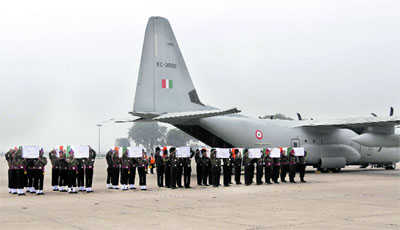
Soldiers carry coffins containing bodies of nine avalanche victims, in New Delhi. A Tribune photograph

Tribune News Service

New Delhi, February 15

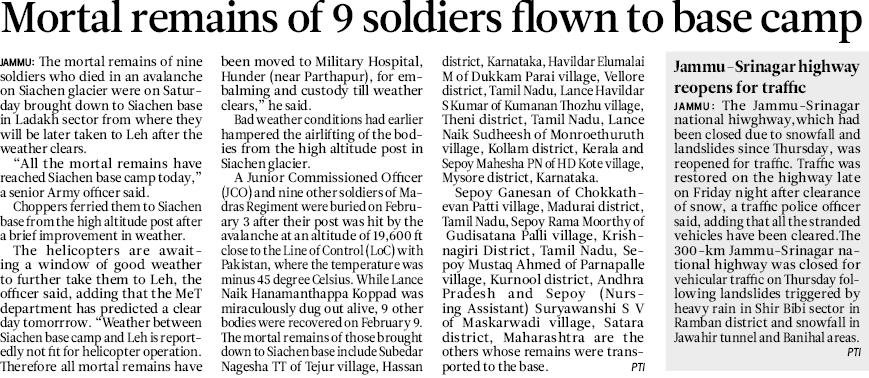
The bodies of nine soldiers buried alive in an avalanche on the Siachen glacier on February 3 were flown in here from the Ladakh region today.The bodies were later flown to Pune, Bengaluru, Hyderabad, Madurai, Chennai and Thiruvananthapuram for sending these to the native villages of the deceased soldiers.After a C130J Indian Air Force aircraft carrying the bodies of the soldiers touched down at the Palam airport here, Minister of State for Defence Rao Inderjit Singh and Army Chief General Dalbir Singh were among those who laid wreaths on the coffins to pay their last respects to the bravehearts.On February 3, 10 soldiers were buried under nearly 30 feet of ice and snow when an avalanche hit Sonam Post at an altitude of around 20,000 feet.Lance Naik Hanumanthappa Koppad was the only one found alive although he remained trapped under the snow for about six days. He died due to multi-organ failure at the Army Hospital Research and Referral in New Delhi on Thursday. Koppad was cremated in his home town in Karnataka on Friday.The bodies of the remaining nine soldiers were retrieved a week after the tragedy. Bad weather in the region hindered the process of flying the bodies out of Ladakh.The nine soldiers who died in the avalanche were: Subedar Nagesha TT of Tejur village in Karnataka; Havaldar Elum Alai M of Dukkam Parai village in Tamil Nadu; Lance Havildar S Kumar of Kumanan Thozhu village in Tamil Nadu; Lance Naik Sudheesh B of Monroethuruth village in Kerala; Sepoy Mahesha PN of HD Kote village in Karnataka; Sepoy Ganesan G of Chokkathevan Patti village in Tamil Nadu; Sepoy Rama Moorthy N of Gudisa tana Palli village in Tamil Nadu; Sepoy Mustaq Ahmed S of Parnapalle villagein Andhra Pradesh; and Sepoy (Nursing Assistant) Suryawanshi SV of Maskarwadi village in Maharashtra.

58420

2016_2$largeimg15_Monday_2016_17184519758821


India’s reaction to F-16 deal disappointing: Pak

Islamabad, February 14

Pakistan today said it is “surprised and disappointed” at India’s reaction over the US’ decision to sell eight F-16 fighter jets to Pakistan, arguing that India is “the largest importer” of defence equipment and its arsenal stock is “much larger”.Pakistan reiterated the Obama Administration’s justification that the acquisition would enhance the country’s precision strike capability to combat terrorism.“We are surprised and disappointed at the Indian Government’s reaction. Their (India’s) army and arsenal stock is much larger and they are the largest importer of defence equipment,” the Foreign Office said in a statement in response to media queries.“As regards F-16 sale, Pakistan and the United States closely cooperate in countering terrorism. US spokesperson clearly announced that the sale is to enhance precision strike capability,” it added.Pakistan’s reaction comes a day after India summoned US Ambassador Richard Verma to convey its “displeasure and disappointment” over Obama Administration’s decision to sell eight nuclear-capable F-16 fighter jets worth nearly USD 700 million to Pakistan. — PTI

Part of legacy announcement: US envoy

  • Mumbai: US Ambassador to India Richard Verma on Sunday said the sale of F-16 jets to Pakistan was “part of a legacy announcement” and his country expected Islamabad to do “more” on eliminating terror safe havens on its soil. “The reality is there are dangerous groups operating within Pakistan… More action needs to be taken by Pakistan on terror groups. Safe havens need to be eliminated,” he said.

0bf996cb-fade-4e6f-ab8c-d2f82db384d2


The never ending battle for Siachen veterans and families

High Court lawyer Maj Navdeep Singh who has fought numerous such cases on behalf of Siachen veterans says, “Hopefully this tragedy would be a catalyst for change in the military and civil establishment who must realise that at times the nature can be more lethal than bullets.

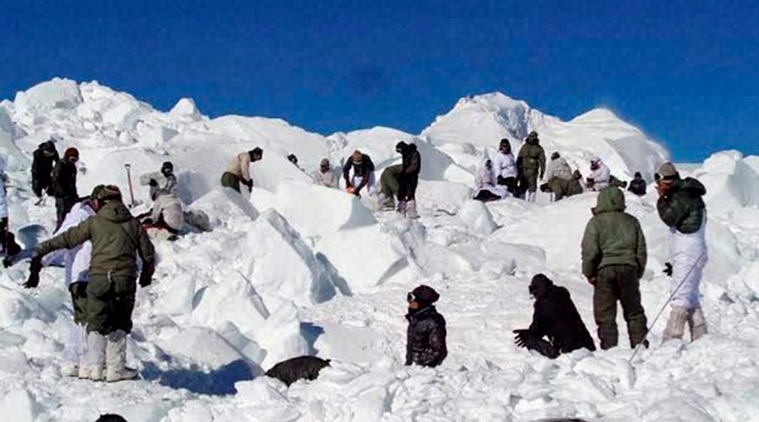
Specialised rescue teams who were carrying out the operations to search for the bodies of the soldiers hit by an avalanche, in Siachen on Tuesday. (PTI Photo)Specialised rescue teams who were carrying out the operations to search for the bodies of the soldiers hit by an avalanche, in Siachen on Tuesday. (PTI Photo)
While the death of ten soldiers in an avalanche in Siachen has once again brought into limelight the vagaries of nature that soldiers have to face in the area, yet the families of soldiers who die in Siachen or those who are disabled on the highest battlefield have to fight another battle with pension disbursing authorities to get their due benefits.

Take for example the case of Harjinder Singh, whose son Lance naik Gurjant Singh of Sikh Light Infantry died on Siachen Glacier in 2008 due to extreme climatic conditions. The liberalized family pension which was entitled to the father was refused to him on the pretext that the death had not taken in actual fighting but due to extreme weather. It was on judicial orders that the pension was finally granted but the government chose to appeal till the Supreme Court which ultimately dismissed the appeal and granted the pension.

Explained: The Miraculous Rescue Of The Siachen Soldier

https://youtu.be/WXGzDMUrZhE
http://

A military widow, Harjinder Kaur, lost her husband Sepoy Malkit Singh of Punjab regiment after he suffered a heart attack in Operation Falcon just after another tenure at Siachen. She was refused the correct entitlement of liberalized family pension and she too was granted relief on judicial intervention.

In another case, Gunner Jai Lal Pal of Artillery was medically boarded out in 1989 after his fingers were amputated after suffering frostbite in Siachen. He is still making the rounds of courts to get his correct pension released while the slow moving military bureaucracy has not been able to complete the paper work even 27 years after his release.

A short service commissioned officer, Captain SP Singh, who volunteered to serve in Siachen, and whose disability of Psoriatic Arthropathy during his Siachen tenure was wrongly diagnosed as ‘excessive dandruff’, was not granted permanent commission due to his disability and also refused disability pension on the pretext that his disability was not affected by service conditions despite the medical opinion that his condition was aggravated due to wintry conditions. The officer finally got his disability pension on judicial intervention.

Officers dealing with such cases say that though the rules are quite liberal and the High Courts and the Supreme Court have also strongly ruled in favour of granting benefits to such disabilities and deaths in Siachen and other operational areas, the Defence Ministry, Army Headquarters and Defence Accounts authorities routinely reject claims on technical reasons due to a textual interpretation, forcing affected families of personnel into litigation and unnecessary heartburn. Siachen veterans say that the nature is a bigger killer than bullets at the glacier and also in other tough operational areas.

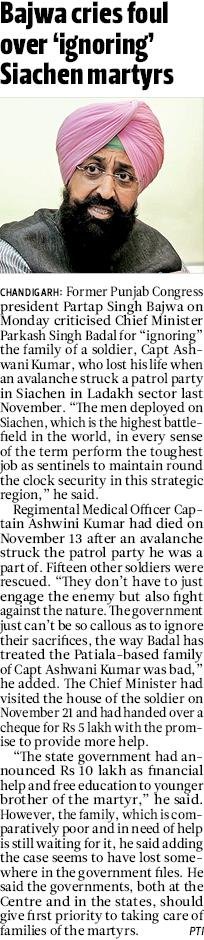
High Court lawyer Maj Navdeep Singh who has fought numerous such cases on behalf of Siachen veterans says, “Hopefully this tragedy would be a catalyst for change in the military and civil establishment who must realise that at times the nature can be more lethal than bullets. We must also salute the judiciary, especially of Delhi and Punjab and Haryana high courts for always standing behind such

– See more at: http://indianexpress.com/article/india/india-news-india/siachen-siachen-soldiers-siachen-avalanche/#sthash.CnnvdBm2.dpuf


ON THE FRONTLINE Siachen glacier — Avalanche deaths unacceptable

Arun Joshi

We have been condemned to count casualties in the Siachen glacier. Ten more soldiers have died as their post was swamped by a giant snow wall on February 3. This tragedy is greater as they did not die fighting the enemy. “There are remote chances” of now finding their bodies buried under tonnes of snow.Why should they die like this? The Ministry of Defence and the top brass of the Army have to answer this. Soldiers have been stationed at the glacier since 1984 to guard the nation’s strategic asset. That strategic assets have to be guarded whatever the cost, is an argument well taken. But those who guard it deserve extraordinary protection too from blizzards, frostbites and mental ailments to maintain vigil at the highest battlefield of the world. Over the decades, the Centre could not install an effective avalanche warning system at the glacier where billions of rupees of taxpayers are being spent every year.In the 1990s, it was claimed that an effective avalanche warning system was in place. That system rarely seems to work. Soldiers were asked to celebrate the installation of a satellite phone with which they could talk to their families. The facility was provided to help them battle the isolation of their snow-bound station. But there was no internal communication system to forewarn them at 19,600 feet that they were in an avalanche-prone area. The whole glacier is not avalanche-prone but still posts were set up where snow rivers can hit them any time.The problem is four-fold. Firstly, it is the glacier itself, which has not been properly delineated. The cartographers while drawing the Line of Control (earlier the ceasefire line) after the Simla Agreement in 1972 left things undefined. Secondly, the bureaucracy does not have much knowledge of the weather and terrain but decides what the soldiers should or should not have. They sit on the files while the soldiers wait and die.Thirdly, the plague of corruption has brought soldiers in harm’s way at the glacier. Corruption is as deadly as the hostile surroundings. The former Defence Minister had been put in the picture about the poor quality of shoes and socks. He had been told that the stockings provided to soldiers failed to protect them from frostbites. But, there is yet no word suggesting that the soldiers deployed and operating in – 45 degrees Celsius should get an adequate gear. Their special rations are sold on the black market in Leh. A few inquiries indicted low-rung officers; others were closed without telling anyone what happened to the men involved in brazen corruption. In 2005, water was passed off as diesel. Fourthly, there are ceremonial visits which make headlines while the soldiers are made to wait for years for the promised substantive things.The soldiers are told that the whole nation salutes them for their bravery and fortitude for standing high at the highest battlefield of the world. The saga of bravery, however, is not written with the burial of soldiers under avalanches.In the 21st century, there is a need to devise a clear, political, diplomatic and military strategy. The political leadership should summon the courage to take a call about how to save the soldiers from such unnatural deaths.

BATTLING THE ELEMENTS

iachen acts as a wedge between Shaksgam valley under China’s control and Baltistan, which is occupied by Pakistan

India launched Operation Meghdoot in April 1984 after the Pakistani army occupied dominating heights on the glacier, a 76km river of slow moving ice

India currently sits on dominating positions overlooking Pakistani posts located 3,000 feet below

India has deployed around 3,000 soldiers at Siachen where temperatures can drop to minus 60 degrees Celsius

Soldiers have to trek for almost 28 days covering a stretch of 128km to reach some of the farthest pickets

‘Removing troops not a solution’

VISAKHAPATNAM: Terming the recent death of 10 soldiers in an avalanche on the Siachen glacier “painful”, Defence Minister Manohar Parrikar said on Sunday that withdrawing troops from the world’s highest battlefield could not be a solution. “This incident is painful to me personally, but the solution that is suggested is not a proper analysis,” he said, referring to demands that Indian soldiers be withdrawn from the glacier.

Asked if the proposal to convert Siachen into a “peace mountain” still exists, the minister said: “The decision (on deploying troops) on Siachen is based on the security of the nation.”


Despite risk to soldiers, Siachen is vital to India’s security

The death of 10 soldiers in an avalanche at Siachen has brought the spotlight back to the harsh conditions faced by troops at the world’s highest battlefield and also its strategic importance to India.

Islamabad has made repeated demands for demilitarising the glacier invoking the aspect of long-term peace but India has always taken a cautious approach on the issue.Defence officials say that as long as the glacier is under India’s control, the Pakistani army can’t link up with the Chinese and pose threat to Ladakh. It acts as a wedge between the Shaksgam valley under China’s control and Baltistan, which is occupied by Pakistan.

The Indian Army launched Operation Meghdoot in April 1984 to secure the glacier after Pakistan army occupied the heights at Siachen, a 76-km river of slow moving ice.

Several rounds of talks between India and Pakistan on demilitarising the Siachen glacier — an old sore in bilateral ties — have failed with Islamabad refusing to authenticate troop positions on the ground.

In fact, India deployed its soldiers on Siachen after Pakistan began allowing international mountaineering expeditions to the glacier, sending out a signal that it controlled the area. Different interpretations of the 1949 ceasefire agreement by the two countries also aggravated the dispute.

India, which spends Rs 5 to Rs 7 crore daily on guarding the strategic glacier, has deployed around 3,000 soldiers at Siachen where temperatures can drop to minus 60 degrees. The location at 19,600 feet where the 10 soldiers died often sees temperatures plunging to minus 42 degrees.

Soldiers have to trek for almost 28 days covering a stretch of 128 km to reach some of the farthest pickets on the glacier, one of the most desolate places on this planet.

Almost 80% posts on the glacier are located above 16,000 feet, with Bana towering above the rest at 21,753 feet. Bana post is named after Subedar Bana Singh who was awarded the Paramvir Chakra for his helping secure the glacier in 1984.

Indian Army has cautioned against withdrawing from Siachen until Islamabad authenticates troop positions on the ground as it would be a formidable task to reclaim the glacier.

India currently occupies dominating positions on the Saltoro ridge with Pakistani posts located 3,000 feet below.


WW-II veteran awaits gallantry reward promised in 1944

Archit Watts

Tribune News Service

Khirkian Wala (Muktsar), Feb 5A 94-year old World War-II veteran, Karnail Singh of Khirkian Wala village, claims he is still to get the gallantry award promised to him for showing exemplary courage in 1944 in Italy.A Lance Naik in the British Army, Karnail Singh was honoured with the Indian Distinguished Service Medal (IDSM) on May 11, 1944. “The award carried a medal and Rs 5,000 or 25-acre land. Though I was given Rs 2,500 by the then Deputy Commissioner of Ferozepur in 1946, the remaining amount has not been given till date,” claimed Karnail Singh.Showing a bunch of documents, Karnail Singh said, “I am not seeking any favour, but demanding what was promised to me. The correspondence done over the past 58 years, which I started in 1958, has so far failed to have any result. I have contacted everyone, right from top state politicians to the Army and British High Commission too. Everyone has passed the buck to another authority by forwarding a letter. Even the applications sent to the Sainik Welfare Office have failed to give me any satisfactory reply.”Recalling his service days, Karnail Singh said that he served in various countries, including Iran, Africa, Sudan, Alexandria and Italy. “I proved my mettle in Italy when all the soldiers except me and platoon commander were killed while fighting the enemies. Suddenly, they hurled a bomb which wounded me badly. But I continued firing and killed a number of enemy soldiers. Later, they surrendered to me. I, along with my commander, was admitted to a hospital there,” he claimed.Notably, this old man was once honoured in 1998 by the district administration during the Republic Day function. Further, Kripa Shankar Saroj, the then Deputy Commissioner of Muktsar, had sent a letter on February 1, 1999 to the then Principal Secretary, Defence Services Welfare, Punjab, with his recommendation of giving the remaining amount to this former soldier.Karnail Singh now lives with his adopted son Iqbal Singh and his family at his ancestral house in the village that is located 10 km from Muktsar town.He joined the British Army in 1939 as a sepoy in Sialkot Depot and after Independence, he was shifted to 4 Sikh Regiment. He retired as a havildar in 1958 and is getting a monthly pension of nearly Rs 20,000 and Rs 1,650 annuity.Further, during a visit to the Sainik Welfare Office, Karnail Singh’s framed photograph was found displayed on a wall and a huge file had been made on his name.Commander Baljinder Singh Virk (retd), District Sainik Welfare Officer, who holds the additional charge of Muktsar district, said, “As per a letter received in 1997 from the Directorate, there is no provision to give cash award to pre-Independence gallantry awardees in the state. The state government gives annuity to them. But this is a very old case and we will have to find out all the related documents from Ferozepur, Faridkot offices as Muktsar was earlier part of these two districts. Besides, we will put up this case before our Director.”When contacted, Brig JS Arora (retd), Director, Sainik Welfare, Punjab, said, “He should meet us and we will definitely honour him. But I am not aware of this case. He should have taken up the matter with the Centre.”