Sanjha Morcha

What’s New

Click the heading to open detailed news

Current Events :

web counter

Print Media Reproduced Defence Related News

In the militancy plagued valley, joining Indian Army is a new craze

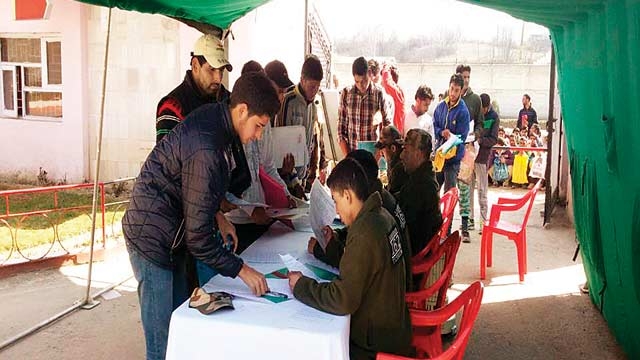
For those who raise alarm over the radicalisation of youth and home grown militancy, this should come as a good news. Shunning taboos, hundreds of Kashmiri youth thronged the army recruitment rallies to become the proud soldiers in order to serve the country.

Such was the enthusiasm that more than 2,300 Kashmiri youth applied for less than 50 posts in different branches of the Indian Army. Over 1,500 candidates turned up for the 30 vacancies of soldiers at Jammu and Kashmir Light Infantry (JAKLI) Regimental Centre in the first phase of recruitment rally for Shopian and Srinagar districts.

In the second phase of recruitment to fill two vacancies of tradesmen, over 700 candidates appeared in the rally from almost all districts of Jammu and Kashmir with maximum representation from Baramulla, Bandipora and Anantnag districts.

“The army offers a lifetime opportunity of adventure, education, progression besides dignity and self-esteem to a soldier, as also to his family. The overwhelming response to the rally is but a reaffirmation of the Kashmiri youth’s growing aspirations to embrace the noble profession of soldering for the nation,” said Colonel NN Joshi, defence spokesman at Srinagar.

Given the huge craving among the youth to join the forces, Indian Army has planned several recruitment rallies across Jammu and Kashmir in coming months.

“Army is sensitive to the growing desire of Kashmiri youth and has started conducting recruitment in a phased manner. The rallies for recruitment into all categories of the army will be held in Sunjuwan in Jammu, Bandipora in Kashmir and Drass in Ladakh in the coming months,” said Colonel Joshi.

The huge response to army recruitment rallies comes in the backdrop of the reports of rising radicalisation of youth and home grown militancy in the valley. Figures reveal that over 60 local and highly educated youth joined the militancy in the last year alone sparking fears about the new breed of radicalised ultras overtaking the foreign counterparts in the valley.

In contrast, 242 young soldiers of the state passed out from JAKLI centre on Saturday after grueling training of eleven months. What was icing on the cake was the huge rush of people thronging the JAKLI centre on Saturday to watch the parade by the young soldiers.

Over 3,000 spectators including proud parents and relatives of the soldiers, veterans and other guests watched the parade of the young recruits turned soldiers.

Lieutenant General Satish Dua, General officer Commanding (GOC), in his address praised their contribution in encouraging more youth from J&K to come forward to join security forces. “He even highlighted the vital role played by their parents in motivating their children and wards to join this noble profession,” said Colonel Joshi.


Army to act against ‘encounter protesters’

Tribune News Service

Srinagar, March 10

With an increase in incidents of violence around gunfight sites, the Army today warned of “appropriate action” against protesters who took the law in their hands.The warning came a day after a large number of protesters in south Kashmir’s Pulwama district threw stones on security men during a major counter-insurgency operation that left two foreign militants dead.The police said stone throwers helped over half a dozen trapped militants, including a self-styled commander of the Lashkar-e-Toiba, to escape from the encounter site.Two civilians were injured in Army firing in the Aishmuqam area of Anantnag during a cordon and search operation on Tuesday.“In case a crowd takes the law in its hands and threatens life and property, security forces will initiate appropriate action to counter it,” said an Army spokesman. The spokesman said security forces were “forced to open cautionary fire” in Aishmuqam.“The Aishmuqam incident was investigated and it was established that security forces were forced to open cautionary fire to prevent any further injury, loss or damage to personnel, weapon equipment and other government property, in which two persons resorting to stone throwing were injured,” he said.Of late, there has been a trend, mostly in districts of south Kashmir, of locals throwing stones near encounter sites to ensure that holed up militants manage to escape the cordon.


Jammu Kashmir Trans-border tunnel in Jammu spurs quest for detection tools

Trans-border tunnel in Jammu spurs quest for detection tools
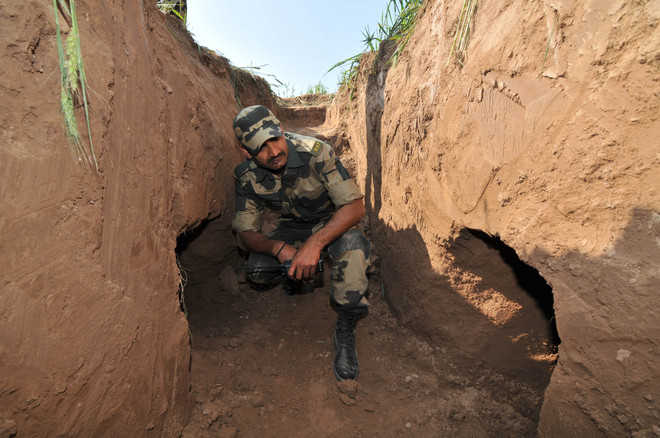
A tran-sborder tunnel originating from Pakistan that opened 30m inside Zero Line on the Indo-Pak border in RS Pura sector of Jammu district.

Shaurya Karanbir Gurung

Tribune News Service

New Delhi, March 9

The discovery of a 30-foot-long and 10-foot-deep tunnel running through the international border (IB) in the RS Pura sector of Jammu district has highlighted the need for a tunnel-detection technology.India has been finding it difficult to fulfil its plan to equip the new anti-infiltration system with a tunnel-detection technology. It has sought information on the tunnel-detection system from Israel, which claims to have used such technology to guard its borders and prevent cross-border attacks.“The possibility of more tunnels being found along the IB cannot be ruled out. The BSF discovered the tunnel in the RS Pura sector only after a portion of the tunnel had caved in. But what if there is a tunnel made of concrete? India needs technologies to detect such tunnels,” said a government official.“The Israelis claim to have seismic technology and ground-penetrating radars. But these tools can only work up to a certain depth. They are useful for Israel which has a shorter border with the West Bank and Gaza strip as compared to our border (IB). It is yet to see how to use the radar technology along the Indian borders,” said a security official.A 2012 BSF committee, constituted to submit a report on patches along the IB where the water level is low and the soil is conducive to digging tunnels, said there were areas vulnerable to tunnelling in Jammu and Punjab.The committee report said the radar technology would not be able to detect deep tunnels like the one found in Jammu in 2012 which was 30-foot-deep.At present, the BSF has been using counter-measures such as driving tractors over areas vulnerable to tunnelling and second-tier deployment along the IB in Jammu. But even these measures cannot pinpoint the exact location of a tunnel.Besides, the BSF believes persons (from Pakistan) may use underwater and aerial means to infiltrate into the country. “This could be done using machines to move under the surface of a river meandering between India and Pakistan,” said the official.

Anti-infiltration system

The anti-infiltration system with the tunnel-detection technology, which India plans to procure, is called the Comprehensive Integrated Border Management Solution (CIBMS). It integrates sensors, communication, infrastructure, response, and command and control. It will be set up along the IB with Pakistan, including the unfenced gap. The CIBMS system has also been planned to counter infiltration with the use of technologies such as SONAR.


Delhi put on terror alert, NSG rushes to Gujarat

Half a dozen militants may be in state, Somnath festival cancelled

NEW DELHI/ISLAMABAD/ AHMEDABAD: The national capital was put on high alert on Sunday following intelligence that more than half a dozen Pakistan-based militants had sneaked into Gujarat and could stage attacks anywhere ahead of Maha Shivratri festival.

PTI PHOTOAhmedabad police inspect a vehicle after high alert was sounded in the city. Around 160 commandos from the NSG have been rushed to the state, many of them to guard the Somnath temple.Authorities rushed four teams of National security Guards (NSG) commandos were rushed to Gujarat and cancelled Monday’s Maha Shivratri festival at the Somnath Temple, where millions of pilgrims were expected to gather.

In Delhi, security personnel fanned out across crowded markets such as Sarojini Nagar and Lajpat Nagar, put up barricades to check vehicles at many places and frisked visitors to popular temples across the city.

The alert was sounded out after Pakistani national security adviser Naseer Khan Janjua reportedly informed Indian counterpart Ajit Doval about the threat late on Saturday night. No militants have been traced so far.

Also, on Friday, aBS F patrolling team discovered an abandoned boat – allegedly from Pakistan – off Gujarat’s Koteshwar coast. Nothing suspicious was found on the vessel but it was the fifth such spotting in less than three months.

Janjua’s tip-off , an usual gesture on the part of Islamabad, comes at a time when New Delhi has linked any progress in peace talks with action against antiIndia militant groups said to be behind the January attack on Pathankot air base.

“Like all intelligence inputs, this input is being dealt with requisite seriousness,” said a home ministry official who didn’t want to be named. Union home minister Rajnath Singh and his top aides are monitoring the situation, he said.

Gujarat director general of police, PC Thakur, said three NSG teams were on standby in Ahmedabad while one was deployed at the Somnath temple.

“A counter terror task force of the NSG reached Ahmedabad at 2am in the morning to deal with any possible terror threat,” said an NSG official.

Pathankot on high alert after agencies intercept call to Pak

Police begin search operation, Mahashivratri fair at historical temple put on hold

SOURCE VILLAGE IS ONLY A FEW KILOMETRES FROM THE RAILWAY LINE OF DINANAGAR, WHERE TERRORISTS HAD PLANTED RDX BEFORE LAUNCHING AN ATTACK LAST YEAR

From page 1 PATHANKOT: The security agencies were on their toes again in Pathankot on Sunday morning after intelligence inputs from the technical wing in Delhi about a telephone call to Pakistan from Katruchak village near here.

HT PHOTOSecurity personnel at Katruchak village near Pathankot on Sunday.After the alert was sounded, Punjab Police SWAT (special weapons and tactics) team and other cops surrounded the village and launched a search operation in the surrounding forest area for the mystery caller. Pathankot senior superintendent of police RK Bakshi and, later, additional director general of police (law and order) Hardeep Dhillon and deputy inspector general (border range) Kunwar Vijay Partap joined the operation. “There is nothing for the people to fear. We are in, and we are capable of dealing with any situation,” the DIG told a news agency.

The Mahashivratri fair at Chat Pat Bani near Katruchak was put on hold and heavy security deployed around the historical temple where a huge number of pilgrims have gathered for the festival on Monday. The disappointed devotees of Lord Shiva, who had planned to spend two days at the temple, cursed the neighbouring country and called for decisive action against it. The temple is only 2 km from where the telephone call to Pakistan was made. On Saturday, western army commander lieutenant general KJ Singh had talked about “disturbing inputs” about a terrorist plot to strike during the Mahashivratri festival and the ongoing Parliament session.

Lal Singh, husband of Kataruchak sarpanch Urmila Devi, said the Mahashivratri festival drew devotees from far-off places and now 150-odd security personnel had cordoned off the area where they were to gather. On March 2, an alert was sounded at Pathankot villages after Border Security Force (BSF) spotted three-to-five men on the Pakistani side who were preparing to cross the fence.

At the time of filing this report, even the army and the air force had been put on high alert. Katruchak is only a few kilometres from the railway line of Dinanagar, where Pakistani terrorists had planted a heavy amount of RDX explosive before attacking the Dinanagar police station on July 27 last year. Local vendor Ram Lal said security agencies had got all vendors in Pathankot to wind up their business. After the terror attack on the Pathankot airbase in January, security agencies are taking every intelligence input seriously.

63704

84f9899f-9b3b-4e40-9a9f-4614882fbeac


Relief for 84’ riot victims: CPS Sidhu meets PM, seeks probe into Rs 440-cr scam

Relief for 84’ riot victims: CPS Sidhu meets PM, seeks probe into Rs 440-cr scam
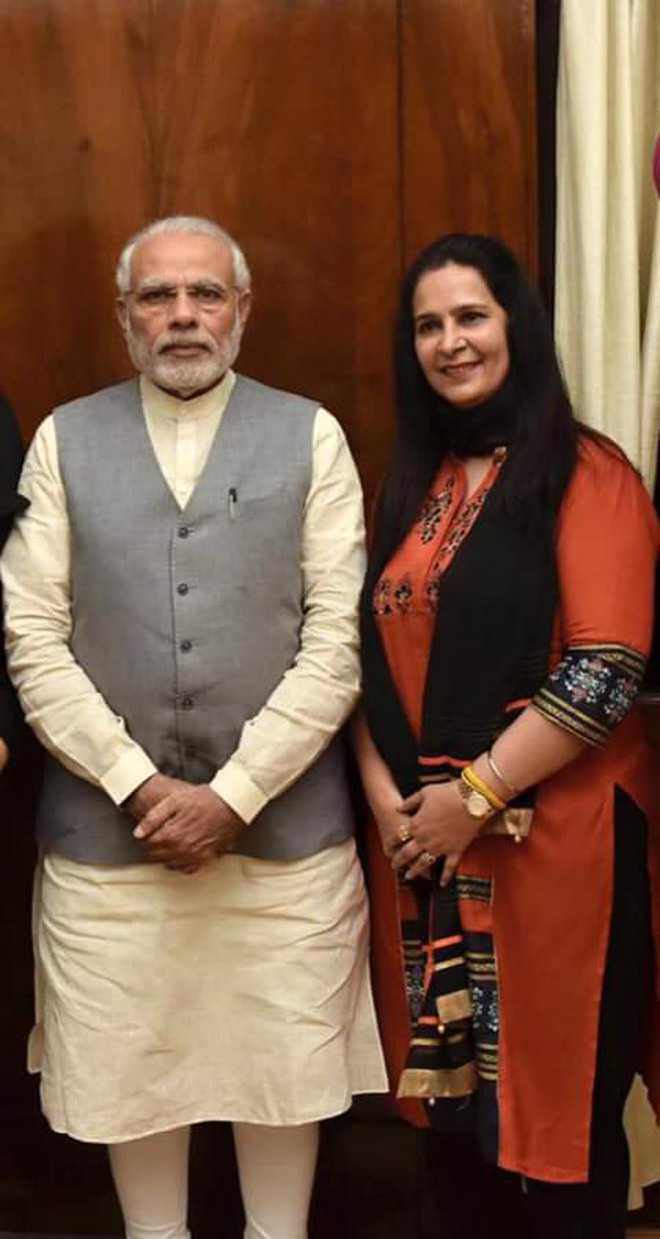
The Chief Parliamentary Secretary, Dr Navjot Kaur Sidhu, meets Prime Minister Narendra Modi in Delhi on Wednesday.

Tribune News Service

Amritsar, March 2

Chief Parliamentary Secretary Navjot Kaur Sidhu sought the intervention of Prime Minister Narendra Modi yesterday in detecting the alleged multi-crore scam related to the misappropriation of funds given by the Centre for the rehabilitation of victims of the1984 anti-Sikh riots in Punjab.Approximately 22,000 riot-affected families came to Punjab, out of which around 15,000 families had come to Ludhiana. In June 2006, the then Union Government sanctioned Rs 2 lakh as compensation per family and an amount of Rs 440 crore was forwarded to the SAD-led Punjab Government.She alleged that in connivance with some Akali leaders, the money was siphoned off in the name of bogus beneficiaries. She demanded a CBI inquiry into the alleged scam and asked for the assistance of the CAG to expose the guilty leaders.A three-member committee comprising the then DC, the ADC and an Akali leader, was constituted to disburse the amount.“Thousands of identification cards for distribution of Rs 2 lakh per family as compensation were found bogus. Also, those who were given the grants, received only Rs 1 lakh each and Rs1 lakh was taken as bribe.Thousands of card holders who did not receive their compensation were shown in papers to have already received it,” she said.She visited the PMO and discussed the matter at length. “The affected families met me and narrated their problems. More than 500 government flats were forcibly acquired, sold and hundreds of such flats were being illegally rented out. I brought every detail to the notice of the Prime Minister with proofs. I have urged him to reopen the inquiry, so that the aggrieved families can get their dues,” she said.The Ludhiana Vigilance Department investigated the matter on the basis of the complaints filed by the affected families and it had found gross discrepancies in the report it filed subsequently, but these were never probed.The affected families knocked at the door of the high court which directed that action be taken against the culprits, but the Punjab Government remained silent, she alleged.


Pathankot attack by non-state actors of Pakistan: Parrikar

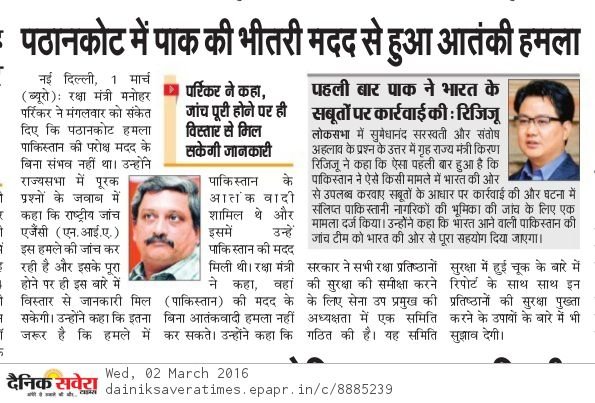
NEW DELHI: The terrorist strike on Pathankot Airbase in January was carried out by Pakistan’s “non-state actors” who operate with support of the Pakistani establishment, government indicated in the Rajya Sabha on Tuesday.

“Complete details will come out in the NIA investigation. But in this, non-state actors from Pakistan are surely involved. Any non-state actors there, they cannot function smoothly without full state support,” defence minister Manohar Parrikar said.

The minister was responding to a question by Shiv Sena member Sanjay Raut, who wanted to know whether it was merely a terror attack or an armed operation carried out with the support of Pakistani army.

Parrikar also said intelligence was received about the possible attack indicating Pathankot Army installations as suspected targets. Following the attack, steps are underway to ensure that vital defence installations in the country are secure.

“We have now done a security audit in addition to the normal security and are in the process of ensuring that all army installations will be properly secured,” he said.

Asked if the Airbase would be shifted from Pathankot in Punjab as it is perilously close to the border, Parrikar ruled it out. He refused to share further details of the attack, saying the NIA is already investigating the matter and investigations are on.

In a written reply, the minister said: “Government has constituted a committee under the chairmanship of a former vice chief of army staffs to inter-alia suggest measures to strengthen security of various military establishments across the country.”

fd25b17a-d825-41ce-abe1-eb51c34971af


No hike in rail fares; increase in quota for senior citizens,women

Railway Minister announces a capital plan of Rs. 1,21,000 crore for 2016-17; claims action initiated on 139 budget announcements made last year.

India’s first rail auto hub, boost to e-catering, connectivity to North-East and no hike in passenger fares. Here’s a quick recap of all major announcements made by Railway Minister Suresh Prabhu.

This is Mr. Prabhu’s second rail budget.

1 No hike in passenger fares.
2 Action has been initiated on 139 budget announcements made last year.
3 Eliminate all unmanned level crossings by 2020.
4 Swacch Bharat: 17000 biotoilets and additional toilets in 475 stations before the close of this financial year.
5 Increased quota for senior citizens and women travellers this year.
6 Wifi at 100 stations this year and 400 stations next year.
7 Enhanced capacity of e-ticketing system from 2,000 tickets/min to 7,200/min. Supporting 1.2 lakh concurrent users now, as opposed to 40,000 earlier.
8 All major stations to be brought under CCTV surveillance in a phased manner.
9 Deen Dayal coaches for long distance trains for unreserved passengers. These coaches will include potable water and higher number of mobile charging points.
10 IRCTC to manage catering service in phased manner. Local cuisine of choice will be made available to passengers.
11 Cleaning of toilets by requests through SMS.
12 Children’s menu, baby foods, baby boards to be made available for travelling mothers.
13 GPS-based digital display in coaches for showing upcoming stations.
14 Will open cancellation facility through 139 helpline number.
15 Introduce bar-coded tickets on pilot basis to tackle menace of ticketless travel.

On new projects to be implemented this year:

1 Overnight double-decker trains to be introduced on business travel routes.
2 1,600 km of electrification this year and 2,000 km proposed for the next year.
3 Broad Gauge Lumding-Silchar section in Assam, connecting Barak Valley with rest of country.
4 North-East India, especially Mizoram and Manipur, to be connected through broad gauge soon.
5 Special purpose vehicle for the Ahmedabad-Mumbai high speed corridor registered this month.

IAF has lowest combat power in decade With only 32 squadrons, Indian Air Force is now in the ‘middle of shortage’

IAF has lowest combat power in decade
MiG-21 (above) and MiG-27 were phased out on Jan 1. file

Ajay Banerjee

Tribune News Service

New Delhi, February 24

In a damning reality, the Indian Air Force (IAF) is now at its lowest combat strength in more than a decade.The IAF has informed the government about the gravity of the situation that the force is now in the middle of the shortage. Three squadrons of the vintage single-engine Soviet Union origin MiG-21 and MiG-27 have been phased out as on January 1 this year, leaving the IAF with only 32 squadrons (some 16-18 planes in each). This is some 10 short of the government mandated 42 squadrons needed to tackle a simultaneous two-front war with China and Pakistan.In simple words, the IAF will have some 576 fighter jets and will be short of the 750-strong fighter jet fleet mandated by a government sanction to wage a simultaneous two-front war with Pakistan and China.Of the 32 squadrons, the vintage MiG-21 and MiG-27 will form 11 squadrons. The Sukhoi 30-MKI populates 10 squadron, the 1970’s design British Jaguar is in six squadrons, followed by French Mirage 2000 and Soviet Union’s MiG-29 in two and three squadrons, respectively. The last three are being upgraded with better missiles and avionics.The country is now facing the reality of projections on IAF fighter fleet made, separately, over the past 10 years, by the Indian Air Force, strategic thinkers, successive reports of Parliamentary Committees on Defence and the reports of the Comptroller and Auditor General (CAG). Warnings on the “lackadaisical” pace of induction of new fighter jets into the Indian Air Force and the resultant lose of “combative edge” in battle are now ringing true, sources say.A senior official admitted: “We are in the middle of the predicted shortage.”It is the replacements which bother the IAF. The IAF will be raising a squadron of the twin-engine Russian-origin Sukhoi-30-MKI within this year but much depends on the speed of Hindustan Aeronautics Limited (HAL), which is licensed to produce it in India.HAL, a Ministry of Defence (MoD)-owned public sector undertaking, was mandated by the Cabinet Committee on Security in March 2006 to produce 16 planes annually and deliver 180 in phases by 2017. The project is running three years behind schedule. Till 2011, the HAL had the capacity to produce just eight Sukhoi-30 jets annually, said a report of the CAG in 2014.The Sukhois were ordered in phases since 1997, the IAF wants 272 of these in its fleet by 2020. The other choice for the IAF is to seek faster induction of the 106 Tejas “Mark-1A” which have been ordered.The MoD has set a 2018 deadline for the first aircraft to be ready with a target to complete its production by 2022-23. In September, new specifications were agreed upon and the IAF accepted 43 modifications that could be carried out without changing the existing design.10 squadrons short for two-front war with China, Pak

  • Three squadrons of the vintage single-engine Soviet Union origin MiG-21 and MiG-27 have been phased out on January 1, leaving the IAF with only 32 squadrons (some 16-18 planes in each)
  • This is 10 short of the mandated 42 squadrons needed to tackle a simultaneous war with China and Pakistan

Much depends on HAL’s speed of production

  • The IAF will be raising a squadron of the twin-engine Russian-origin Sukhoi-30-MKI this year but much depends on the speed of HAL, which is licensed to produce it in India
  • HAL was mandated by the Cabinet Committee on Security in March 2006 to produce 16 planes annually and deliver 180 in phases by 2017. The project is running three years behind schedule
  • Till 2011, the HAL had the capacity to produce just eight Sukhoi-30 jets annually, a 2014-CAG report said

Martyr’s only dream was a ‘pucca’ house

Bravehearts cremated with full state honours at their native villages

Martyr’s only dream was a ‘pucca’ house
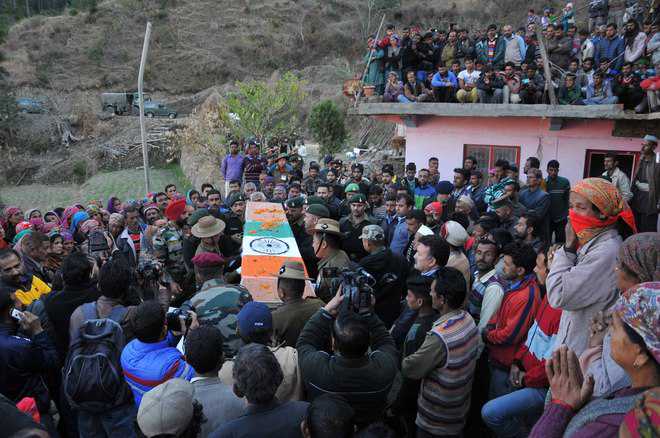
The body of Lance Naik Om Prakash arrives at Chikher, 50 km from Shimla. Photo: Amit Kanwar

Bhanu P Lohumi,Tribune News Service,Chikher (Shimla), February 22

The braveheart—Lance Naik Om Prakash, who was killed in an encounter near Pampore on the Jammu-Srinagar highway—had a dream of having a ‘pucca’ house at his native village.Om Prakash of the 9 Para (Commando) battalion, who was awarded the Asadharan Suraksha Seva Praman Patra Gallantry Award on Independence Day in 2013, was to proceed on leave from March 7.The 32-year-old’s body was airlifted to Chail in Solan district and brought to his native village Chikher in Satlai panchayat, about 50 km from Shimla.The Army paid a befitting tribute with full military honours to its valiant soldier who attained martyrdom during an operation in Pampore.Homage was paid to the valour and sacrifice of the late soldier in a solemn ceremony held at Army Cantonment, Chail (HP). Pride and honour for the martyr were palpable as the Commander of Kasauli Brigade, Brigadier Deepak Sharma, laid wreath to salute the soldier.His mortal remains, accompanied by contingents and SDM (Rural) Shimla were brought to Chikher, where he was cremated with full military honours. The pyre was lit by his younger brother. Hundreds of villagers joined the funeral and gave tearful adieu to the brave son. Army contingents presented guard of honour to the deceased. The villagers were consoling the family members saying “your son has sacrificed his life for the nation so that we can live here in peace”… you should be proud of him.His wife and elder daughter broke down as soon as the body arrived. His three-year-old younger daughter was unaware of the tragedy.Om Prakash had last spoken to his family on February 20. He informed them about his leave. His wife Krishna Devi said: “I will pursue my husband’s dream to construct a house and give quality education to my daughters Muskan (7) and Simran (3).”His father Nek Ram said: “I am proud of my son and will not shed tears, but we are now concerned about the future of the girls who have lost their father.” His grandmother did not say a word and watched everything silently.Om Prakash’s sister-in-law Poornima, who is also the pradhan of the panchayat, said Om Prakash believed in simple living and was friendly. He always used to tell kids to study well and serve the nation.Nita ram, his cousin, said since childhood, Om Prakash wished to join the Army and used to give the kids training.Om Prakash passed Class X from High School, Juger, and joined the Army 13 years ago. Kasumpti MLA Anirudh Singh was also present. As a tribute to the martyr, Koti residents shut their establishments.

Guv, CM mourn death of Om Prakash

  • Governor Acharya Devvrat and Chief Minister Virbhadra Singh have mourned the death of Lance Naik Om Prakash, who was killed while fighting terrorists at Pampore in Jammu and Kashmir on Sunday.
  • In his message, the Governor conveyed his heart-felt condolences to the bereaved family. He prayed to the Almighty to grant peace to the departed soul and give strength to the bereaved family.
  • CM Virbhadra Singh said he was pained to know that another soldier from the state laid down his life fighting valiantly with terrorists at Pampore

Lance Naik Om Prakash

  • Age — 32 years(date of birth May 2, 1983)
  • Father name — Nekram
  • Service — 13 years
  • Survived by wife and two daughters
  • The martyr was awarded the Asadharan Suraksha Seva Praman Patra on August 15, 2013.

LAWLESS, HAPLESS, CLUELESS

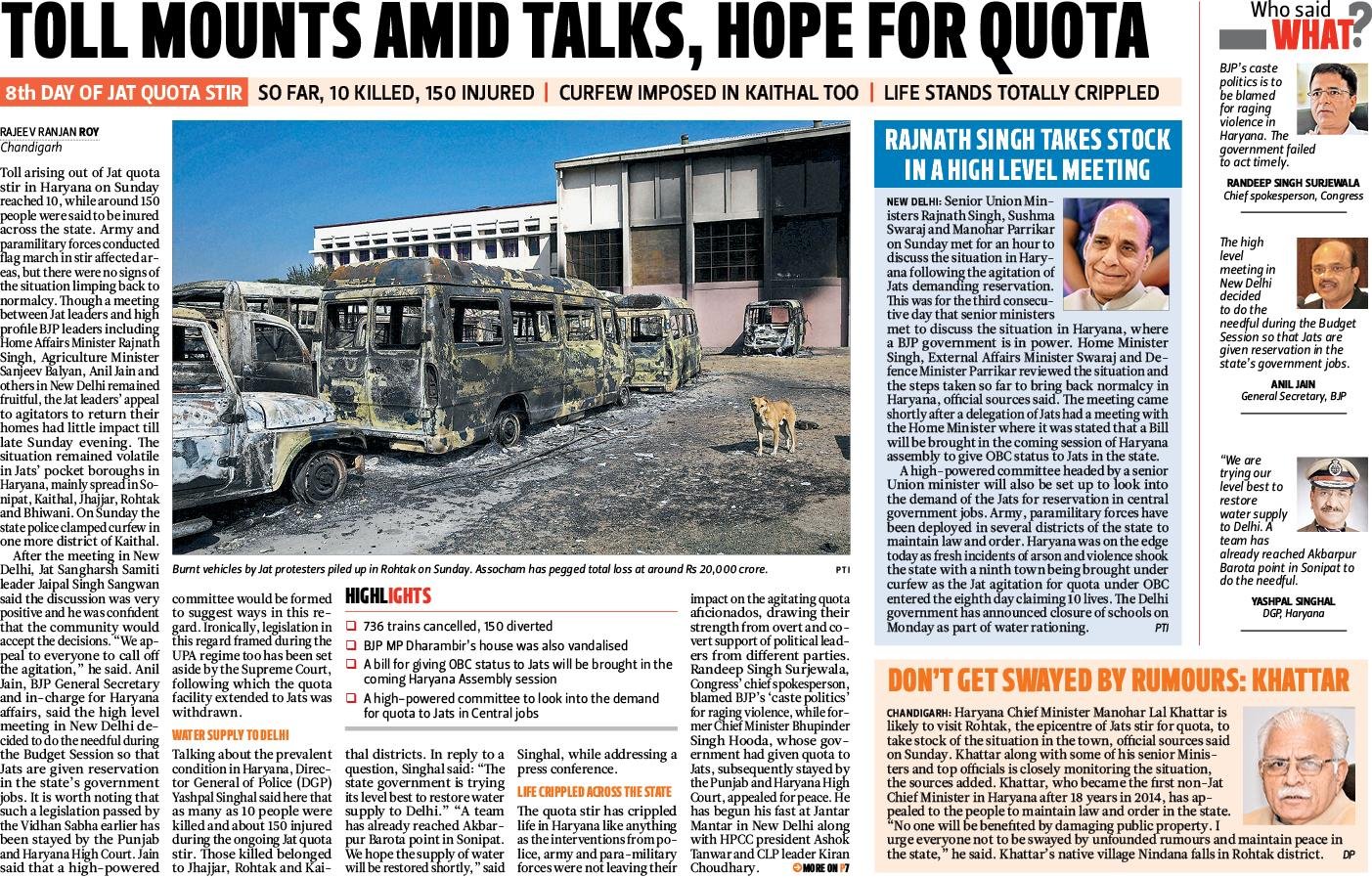
QUOTA CHAOS IN HARYANA Violence, blockades keep region cut off from Delhi, thousands stranded on roads, rail platforms; toll touches 15 DANGEROUS TURN Caste war erupts at many places, protesters clash with army, snap water supply to NCR, 20 buses burnt in

THE CENTRE HAS SENT ADDITIONAL 1,700 PARAMILITARY PERSONNEL TO DEAL WITH THE SITUATION.

ROHTAK/HISAR/CHANDIGARH: Fresh incidents of arson kept Haryana on the edge as the toll in the Jat quota agitation mounted to 15, with seven more deaths reported on Sunday.

MANOJ DHAKA/RAVI KUMAR/HT(Top) Haryana Roadways buses on fire at Tosham in Bhiwani district on Sunday. The traffic jam on Grand Trunk Road near Karnal due to a blockade by Jat protesters on Sunday.Despite heavy presence of army and paramilitary forces, Jat protesters in Bhiwani and Sonepat districts torched two police chowkis, shops and an ATM. As sporadic attacks continued in different areas, Union home minister Rajnath Singh held discussions with Jat leaders and a delegation of khap representatives from Haryana to douse the stir. Road and rail traffic remained paralysed, leaving thousands of passengers stranded as major land and road arteries, including national highway No 1, remained blocked.

Industry body Assocham pegged the loss to industry so far due to the ongoing agitation at ` 20,000 crore. With agitation taking caste colour, two persons belonging to a non-Jat community were allegedly killed by agitators in Jhajjar.

Several properties of non-Jats were targeted in Rohtak and Jhajjar cities as security forces failed to bring situation under control. There were also reports of backlash from non-Jats at some places in these two districts, besides Gohana and Bhiwani.

Three people were allegedly killed in firing at Delhi Gate in Jhajjar, while two were killed in the Chawni area. Another person was shot dead in Safidon of Jind district. There were reports of a person being killed in firing at Garhi-Bindroli village in Sonepat district where security forces had gone to remove Jat protesters who had laid siege to the Munak canal disrupting water supply to Delhi. The supply of the Yamuna water to the national capital was not restored even after a daylong paramilitary action.

Officially, the government said 11 persons have been killed so far in the ongoing stir. “11 persons have been killed and about 150 injured during the ongoing Jat stir,” director general of police Yashpal Singhal told reporters.

The Centre decided to set up a committee to examine the demand of Jats for quota in central jobs, giving in to them. Another decision was to move a bill in the Haryana assembly for giving OBC status to the community.

While the BJP brass is hopeful the agreement would help ease the situation, the state officers, who have been monitoring the situation closely, are not too sure. “Blockades have been lifted from roads at Gurgaon, Palwal, Panchkula, Yamunanagar and Bhiwani in the evening, but it is too early to say anything,” a top bureaucrat told HT.

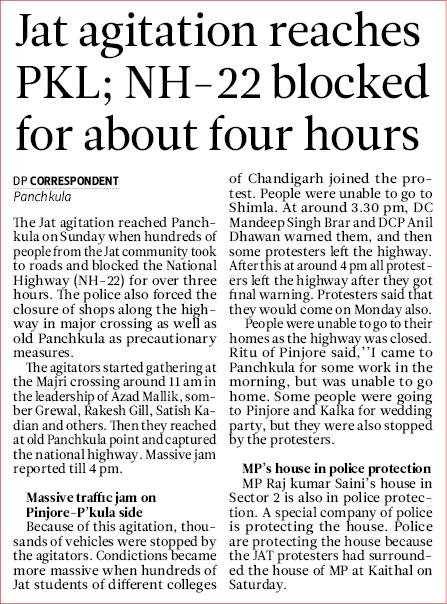
Authorities had to clamp curfew in Kaithal city in view of the prevailing tension due to protests by Jats and counter demonstrations by non-Jats. The curfew was later lifted. The ongoing pro-quota protest, meanwhile, spread to Panchkula district adjoining Chandigarh with agitating Jats blocking the Zirakpur-Shimla highway at the old Panchkula intersection for three hours.

Jat protesters vandalised a college owned by an MP and a hotel in Sonepat where a rice mill was also set on fire. Over two dozen Haryana Roadways buses were set ablaze at Tosham in Bhiwani district. BJP MP Dharambir’s house was also vandalised in Bhiwani.

Over 40 shops and two police stations were set afire in Kalanaur in Rohtak. A showroom and a hotel were also set on fire in Hansi, Hisar.

Violence was reported in Gohana in Sonepat district, where a mob set on fire several shops, two buses and two motorcycles. A police post was set afire in Barota village of Sonepat district. Protesters also vandalised about dozen dhabas on the GT road and an engineering college in Sonepat. The protesters blocked the national highway at Rewari, disrupting traffic. Ganuar railway station in Panipat district was vandalised. The booking office and station master’s room were damaged.

With violence continuing unabated, chief minister Manohar Lal Khattar cancelled his upcoming Bangalore roadshow.

State minister Anil Vij said talks cannot be held with a “mob” and that the Jat agitators should form a committee to hold parleys with the state government. He said the agitation was leaderless and “mobocracy” was prevailing.

“Our government, be it in the state or at the Centre, is committed to reservation to Jats, but it is for them to decide whether they want to give us time so we can come up with something concrete which later does not get struck down by the courts,” Vij said.

The Centre has sent additional 1,700 paramilitary personnel to deal with the situation.

The civil aviation ministry has asked airlines to operate additional flights from here to Chandigarh, Amritsar and Jaipur to enable stranded people reach their destinations.

The agitation has hit rail services hard in the northern states, affecting around 1,000 trains with 736 trains cancelled and 105 diverted besides damage to rail property.

Jats using women as shields against security forces

ROHTAK: Jat protesters are using women as shields against thousands of security personnel deployed to quell the violent pro-quota demonstrations in Haryana that have left at least 10 people dead.

PARVEEN KUMAR/HTWomen from the Jat community blocking the old Delhi-Gurgaon road during their agitation in Gurgaon on Sunday.Women, mostly from agricultural families, are participating in the movement in large numbers following reports that the army may act firmly against demonstrators in a bid to end road blockades that have crippled traffic and transportation of essential goods.

The plan received a boost when a group of female protesters forced soldiers to end a flag march in Rohtak district and turn back. The demonstrators are of the view that the army will not target the women as they do not have female personnel on the ground.

HT spoke to some of the women participating in the protests and they said they had joined of their own free will.

“We have to come out of our houses as our sons are being killed by security personnel,” said Sangeeta who had come from Jhajjar district.

Reports said some protesters wanted to draft the residents of the girls’ hostel at the district’s Maharshi Dayanand University into the movement but the institute authorities did not allow them to enter. “We are fighting for our children’s future. We will do what our family members want us to do,” said Sunita, another participant.

Media reports quoted sources saying the defence ministry had given the army a free hand, for the first time, to take action against those involved in looting and rioting.

“It is wrong to allege that women are being used as shields, but they have joined the protest as they want to support their husbands and sons,” said local khap leader and Kurukshetra University professor Santosh Dahiya.

a768b165-c8ed-4a40-8cf5-120e88d24221

59169

63422


27556