Sanjha Morcha

What’s New

Click the heading to open detailed news

Current Events :

web counter

Print Media Reproduced Defence Related News

Gen Rawat wants talks with Taliban; Navy Chief: China rise unparalleled

Gen Rawat wants talks with Taliban; Navy Chief: China rise unparalleled

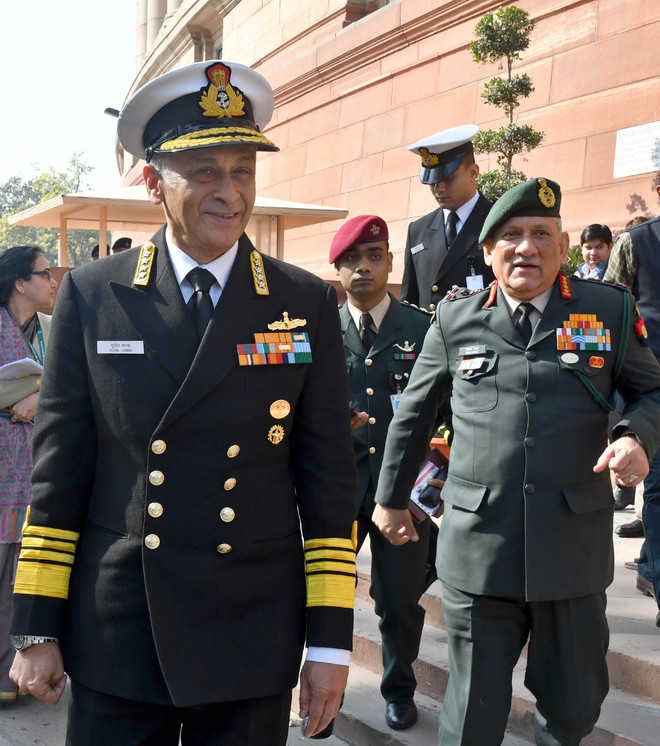
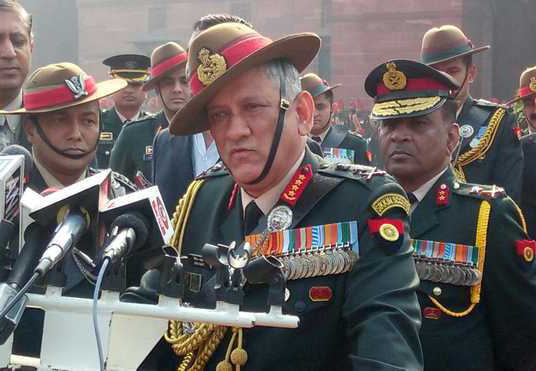
Navy Chief Admiral Sunil Lanba and Army Chief Gen Bipin Rawat (R) at Parliament on Wednesday. Tribune photo: Manas Ranjan Bhui

New Delhi, January 9

On a day when China said it had deployed nuclear-tipped missiles after a US warship “transgressed” into its territory, India Navy Chief Admiral Sunil Lanba warned China’s rise was unparalleled.

Admiral Lanba, speaking at the ‘Raisina Dialogue’, said China had been in the Indian Ocean as part of anti-piracy patrol since 2008 and at any given time, their five-six warships were stationed there. “They have deployed submarines for anti-piracy, which is unusual. No navy has grown as big as China’s,” he said.

Admiral Philip Davidson, who heads US’ Indo-Pacific command, said, “Our strategy is not aimed at China containment.” Asked if the US was feeling the burden of maintaining presence in Asia, he said the US had been well supported by the UK, Japan, Australia and had jointly operated in South China Sea.

French Navy Chief Admiral Admiral Christophe Prazuck said if needed, France could back India in Indian Ocean.

Earlier, Indian Army Chief Gen Bipin Rawat said there should be negotiations with the Taliban, but without conditions. “Terrorism is here to stay as long as states continue to use it as a policy.” — TNS


Talks in J&K not possible as long as there is violence: Gen Rawat

Talks in J&K not possible as long as there is violence: Gen Rawat

Army chief Gen Bipin Rawat. File photo

Ajay Banerjee
Tribune News Service
New Delhi, January 10

Army chief General Bipin Rawat on Thursday said talks with various groups in Jammu and Kashmir could not be possible if there is violence.

He said the suggestion of talks with the Taliban did not fit into the J&K scenario.

Gen Rawat was addressing a press conference here ahead of the Army Day on January 15.

Talking about Kashmir, he said, “Come to the negotiating table, we can talk. But you have to shun the gun. Also, the number of conditions laid down make it difficult to hold talks.”

He was answering a question if talks in Kashmir should be held with Hurriyat since he (Gen Rawat) had suggested that India should look at the talks with the Taliban.On Wednesday, speaking at the Raisina Dialogue, Gen Rawat had suggested that India should be part of the talks with the Taliban.

He clarified that some nations were in favour of speaking to the Taliban. “If India thinks it has stake in Afghanistan then we must step in. I am not saying we should take the lead. But at least, go and listen to what is being discussed in Afghanistan.”

The same did not apply to J&K as it’s a bilateral issue with our western neighbor, he added.

On the situation in J&K, he said, “I am not saying it’s totally under control”, adding that there was no change in the situation at the LoC since Imran Khan had taken over.

“There is always the endeavour to bring peace. We are only facilitators of peace for the Valley. People say let’s tone down operations; can anyone give the guarantee that no convoy would be attacked in Kashmir.”

He said the situation is fine on the western and northern fronts and there was no cause for concern.

Answering a question on changes in tackling China after the Wuhan summit, Gen Rawat said, “We are maintaining peace and tranquillity of the kind that we wish.”

On the proposed restructuring of the Army, he said that in mid-2019 the restructuring of the Army headquarters would begin. The setting up of the Integrated Battle Group (IBG) would be tested on ground in May then the Army would move to implement it; The IBG would not be a ‘Mini Strike Corps’, he said.

On being asked if the recent Supreme Court verdict on decriminalisation of extra-marital affairs and homosexual relations, Gen Rawat was categorical, “We will continue to charge people under the Army Act for both. Sorry, the Army is conservative and intends not to change on these issues.”

“Some of the rights and privileges do not exist for us,” he said.

On his tenure, he said the time had come to consolidate on issues now under progress. “In the third year (of his tenure) I will strive to bring the issues to conclusion.”

He said he had involved Army commanders in discussion on restructuring. “There can never be 100 per cent consensus. We cannot take a decision on 100 per cent consensus, it’s about leadership. There are some issues which go beyond consensus, yes a majority view has to be taken,” he said.

On the soldiers who are genuinely disabled, Gen Rawat said, “To address disparity in disability pensions is top of my agenda.”

Answering a question, he said, “We are coming up with a plan. We have address disabilities. The Army will observe this year for the next of kin of the disabled or killed soldiers. We will identify those who need help.”

On the misuse of social media, he said those flouting the guidelines would invite action.


Magsaysay awardee Sonam solves Army’s winter woes Ladakhi innovator builds solar-heated bunkers and residential quarters

Magsaysay awardee Sonam solves Army’s winter woes

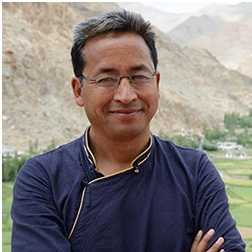
Sonam Wangchuk

Azhar Qadri

Tribune News Service

Srinagar, January 6

An award-winning innovator from the remote Ladakh region has found the answer to the Army’s winter worry by preparing a prototype hut which taps solar energy and increases the room temperature by nearly 40°C.

Sonam Wangchuk, the Ramon Magsaysay Award winner and a celebrated innovator and engineer, solved the Army’s struggle with the arctic climatic conditions of Ladakh by going back to the “ancient method” of using straw and clay for the construction of bunkers and residential quarters.

“We only attuned the ratio of clay and straw to make it more insulated for better heating and light weight for easy transportation,” Wangchuk told The Tribune over the phone from Ladakh.

He said the Army had shown “more than just interest” in his prototype solar-heated huts which would “not require any other energy” and also ease the pressure on the environment by cutting on pollution-causing methods of heating.

The Ladakh region, where an Army Corps is stationed on two frontiers with Pakistan and China, is one of the coldest places of the world and also home to the second-coldest inhabited town, Drass, where the lowest recorded temperature was -60°C on January 9, 1995.

The solar-heated hut will allow sunlight inside and use straw-clay walls to tap it, having the potential to create a temperature gap of up to 40°C.

“If the outside temperature will be -20°C, inside the hut it will be 20°C,” Wangchuk said.

The celebrated innovator, whose life story inspired Bollywood blockbuster ‘3 Idiots’, said the idea of building huts of pre-fabricated bricks of clay and straw — which he described as fibre-reinforced clay for housing purposes, was initially used to solve the problems of people in Ladakh who faced rigid climatic conditions which shortened the work period to a few months and also made it labour cheap.

The Army, Wangchuk said, had approved the prototypes to solve its trouble with the freezing weather in Ladakh, where soldiers guarded a mountainous frontier throughout the year, even when the temperatures routinely dropped 20°C to 30°C below the freezing point in the winter. “They want us to build more…we hope to be ready with low production this summer and may be fully by the next summer,” Wangchuk said.

Use of straw to curb pollution in Punjab

  • Sonam Wangchuk said once the huts were in the production stage, they would also solve the pollution problem in Punjab and New Delhi as they would procure straw, which is otherwise burnt, for the construction purpose. “We hope to get the straw from Punjab where it is burnt, solving the environmental problem there,” he said. “So we will be reducing the pollution in Punjab and Delhi and also in Ladakh, where people and the Army use coal and kerosene for heating,” he said.

Army okays prototype

  • Sonam Wangchuk has solved the Army’s struggle with the arctic climatic conditions of Ladakh by building the prototype of a solar-heated hut. Wangchuk said the Army had approved the prototypes to solve its trouble with the freezing weather in Ladakh.

The danger in over-hyping Army operations by Maj Gen Ashok Mehta (Retd)

Maj Gen Ashok Mehta (Retd)

Whether it was the raid inside Myanmar, the Doklam standoff or the surgical strikes, the Army high command should have informed the political leadership about hyping such operations. Since then, demonetisation and Yogi Adityanath’s insertion have attracted the sobriquet of surgical strikes, both with negative consequences.

The danger in over-hyping Army operations

NO CHOICE? Left to it, the Army would have preferred to maintain secrecy as it has done in the last 60 years astride the LoC.

Maj Gen Ashok Mehta (Retd)
Former GoC, IPKF, Sri Lanka

Two and a half years after its execution, the key architect of the military operation, former Northern Army Commander, Lt Gen DS Hooda finally said this month at a military literature festival that surgical strikes were hyped and politicised: ‘If you start having political resonance in military operations, it is not good’.

The common malady among senior military commanders and service chiefs has been their failure to provide prudent advice to the political leadership on military operations. Instead of waiting for 30 months, Lt General Hooda and other commanders in the loop should have warned Prime Minister Modi against turning military strikes into a political football as he and his party have done by keeping operations under wraps. Lt General Hooda said: ‘In hindsight, it would have been better had we done surgical strikes secretly’.

Rewind to September 2016. Modi’s decision to go public was contingent upon two factors: no casualties and no escalation. Surgical strikes were kept below this threshold by targeting terrorist launch pads, not army posts. When the two conditions were met, it was Modi, not Army Chief Gen Dalbir Singh or Lt General Hooda who decided on announcing the successful launch and recovery of Special Forces. It was a calculated risk that Modi used to his political advantage. Left to it, the Army would have preferred to maintain secrecy as it has done in the last 60 years astride the LoC.

Instead of dissuading the government from, in Lt General Hooda’s words, ‘employing the constant hype’ of surgical strikes (politically flogged for two and a half years) the military leadership went along with the politicisation of operations (and the Army) to the detriment of established military norms and values. After Lt General Hooda set the cat among the pigeons, Army Chief Gen Rawat was the first to intervene: dismissing his observations as ‘individual perceptions’ and ‘personal views’. Almost synchronised were comments lauding the operations by two other military commanders — Vice-Chief of the Army Staff, Lt Gen Anbu, and Northern Army Commander Lt Gen Ranbir Singh, who was the pivot to the surgical strikes as then DGMO.

Never before has a single modest operation been politically milked as much as to make the government order the Army to commemorate the second anniversary countrywide without celebrating its first anniversary. The Army should have resisted that. When Lt Gen Hooda was asked what about the need to hype the operation, he said: ‘This should be asked of the politicians.’ A similar but more spectacular raid inside Myanmar against NSCN-K rebels who had ambushed a Dogra Battalion patrol was also needlessly hyped and politicised. If the military was not so subservient to the political and bureaucratic class, the Army high command should have emphatically informed the political leadership  of the present  and real danger of hyping surgical strikes which instead of retarding infiltration and curbing terrorism as claimed, have only given a leg up to both.

In October 2016, Uttar Pradesh was warming up to the Assembly elections. Posters and banners began appearing in Lucknow glorifying the surgical strikes. Emblazoned on them were three pictures: Lt Gen Ranbir Singh flanked by Modi and Amit Shah. Defence Minister Manohar Parrikar was supervising preparations of election rallies. He had been taking credit publicly for preparing the Army for more than one year for operations, invoking in soldiers the ‘Hanuman’ spirit.

A few days later, Modi was hailed in Lucknow as the ‘conqueror in chief’ and awarded the war mace. In the ceremonies that followed, surgical strikes were billed as the BJP’s single biggest achievement with Modi its tallest leader. The Army did not demand the recall of the offending posters and banners.

The BJP chief, Amit Shah, also made no bones about using the surgical strikes to further his party’s political fortunes. Rarely did an election rally addressed by Modi or Shah not seen prominent mention of surgical strikes. While praise for the jawans was in the passing, the party leadership’s deification was supreme. RSS chief Mohan Bhagwat also does not shy away from comparing Swayamsevaks with a regular Army.

Modi has secured political dividends from the Doklam standoff too. On October 4, 2017, while addressing the Institute of Company Secretaries of India, he indulged in subtle self-praise over India’s capability of standing up to China, drawing a leaf from the Mahabharata. Doklam was invoked at political rallies but did not find the resonance of surgical strikes. Since then, demonetisation and Yogi Adityanath’s insertion in recent state elections have attracted the sobriquet of surgical strikes, both with negative consequences.

Senior IAF officers were asked to publicly justify at a seminar the Rafale contract, the pricing and choice of offset partners. During Defence Minister Sitharaman’s regurgitation of these issues, the Chief or Vice-Chief of Air Staff was deployed beside her. The former has even endorsed the Supreme Court judgment when he should have avoided entering the political domain.

Former Deputy NSA Arvind Gupta who now heads the BJP’s Vivekanand Foundation had the courage to write in his recent book How India Manages its National Security, that political parties (read BJP) freely used the Army’s name in UP state elections which is dangerous politicisation of the Army’s surgical strikes.  For the political leadership Lt General Hooda’s afterthoughts on surgical strikes (and military operations)   carry a statutory warning: Do Not Politicise. Equally, senior military commanders have a constitutional duty to deter political leaders from crossing military red lines. The use-by date of surgical strikes was long over.


Lt Gen Sharma is Northern Command’s Chief of Staff

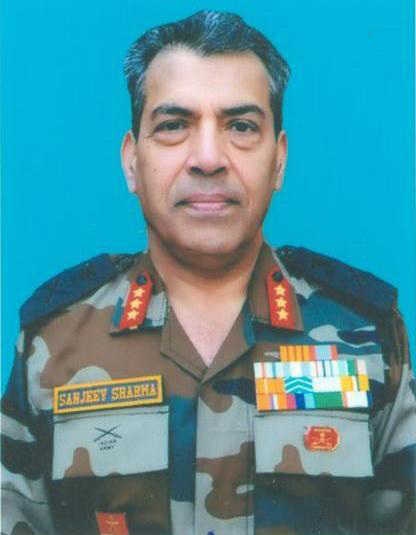
Lt Gen  Sharma is Northern Command’s Chief of Staff

LIEUTENANT GENERAL SK SHARMA

Jammu, December 31

Lt Gen SK Sharma was appointed as the Chief of Staff, Northern Command, in Udhampur, on Tuesday.

He relieved Lieutenant General JS Nain, who will be taking over a Corps shortly.

Lieutenant General Sharma was commissioned in the Rajputana Rifles on December 17, 1983, and has commanded the 11th Battalion of the Rajputana Rifles, an Infantry Brigade along the Line of Control in Kashmir and an Infantry Division in Jammu.

He has also held staff and instructional appointments, including a military-observer tenure at the United Nations Mission in Liberia. He also served as an instructor at the Indian Military Academy, Dehradun, and has had tenures in military operations and intelligence branches at the Army headquarters. — TNS


Major put on trial for killing officer’s wife

Major put on trial for killing officer’s wife

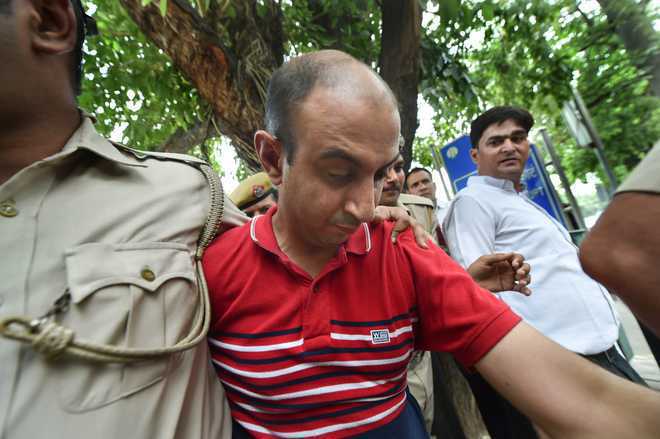
Major Nikhil Handa. — File photo

New Delhi, December 17

A Delhi court today put an Army Major on trial for allegedly killing another officer’s wife he was obsessed with and destroying evidence in the case.

Special Judge Rakesh Syal framed the charges against Major Nikhil Handa under Sections 302 (murder) and 201 (destruction of evidence) after the accused pleaded not guilty and claimed trial.

The court has fixed the matter for January 19, when it will start recording the prosecution evidence.

In the chargesheet, the police had alleged it was a planned murder. It had claimed that a night before the incident, the accused had watched Youtube videos on how to kill someone, which indicates his intention to murder the woman. They claimed the accused was “obsessed” with his fellow officer’s wife and wanted to marry her.

Major Handa knew the women and her husband, also a Major, since 2015 when both of them were posted in Nagaland. If convicted for murder, he may get a maximum of death penalty. — PTI


Pak infiltration ops shifting to Jammu border: NIA report

Agency finds international border, not LoC, route of choice for militants who carry out attacks in Valley

NEW DELHI: A National Investigation Agency (NIA) probe has revealed that in the last three years over 40 terrorists were pushed by Pakistan into India through the international border in Jammu, and then transported deep into the Kashmir Valley to carry out targeted strikes, said multiple government, intelligence and security officials familiar with the matter.

NIA has drawn its conclusion about the number of infiltrators after interrogating half-a-dozen overground workers (OWGs) — a nomenclature used by the J&K police for civilians who help militants — linked to Pakistan-based terror group Jaish-e-Mohammad (JeM) — who were arrested over the past year, the officials added.

“NIA submitted a detailed report to the Union home ministry last week, underlining the fact that Pakistani terrorist outfits were no longer solely using the Line of Control (LoC), the de-facto border between the Valley and the Pakistan-occupied-Kashmir (PoK) to infiltrate terror operatives, and they were using the international border as well. That as many as 40 terrorists have used the international border to enter India is particularly alarming,” said a home ministry official who spoke on the condition of anonymity.

“In its report, NIA said that OWGs, during their interrogation, disclosed that they picked up over a dozen groups, consisting of three to four terrorists, mainly from Jaish, from the Samba sector’s Bei Nullah area in the last two to three years. In one case, a group of Jaish terrorists after infiltrating from the international border attacked the Nagrota army installation in November, 2016 in Jammu. In another case, in September this year, the Jammu and Kashmir police intercepted three terrorists in Jhajjar Kotli and the whole group was neutralised. The rest of the groups were taken to the Tral area of the Valley from where they scattered to other parts,” the official added.

An NIA official, who asked not to be named, confirmed that a report on infiltration through the international border has been sent to the home ministry.

“Since the OWGs were regularly talking about picking up terrorists from the Jammu area, we decided to alert the government about it in the form of a report. The NIA report is just not a compilation of the interrogation reports, but has used mobile phone data to confirm the location of the OWGs when they claimed to pick up the groups of terrorists. The OWGs were taken to the spot from where they picked up the group of terrorists in the Bei Nullah area, and their journey onward to the Valley was tracked,” the official added.

Valley remains tense, army calls for peace

Separatists call for march towards cantonment, army advises not to fall prey to ‘anti-national forces’

› The objective of [the security] forces is to bring peace and normalcy in the Valley with the people’s support ARMY STATEMENT

From page 01 SRINAGAR: The army on Sunday advised people against marching towards Srinagar’s Badami Bagh cantonment a day later in response to a separatist call for it to protest against the killing of seven civilians in South Kashmir in security forces’ firing on Saturday.

PTI■ CRPF personnel stand guard during restrictions imposed to thwart any possible protest called by separatists over civilian killings in Srinagar on Sunday.

The civilians were killed in the firing when residents gathered at the scene of a fire-fight and threw stones at security forces battling militants in an orchard in Pulwama district’s Sirnoo village.

The Kashmiri separatists called for a three-day strike and asked people to march towards the cantonment on Monday in protest against the killings. “We will all march towards Badami Bagh on Monday and ask the Army that instead of killing us daily, it should kill us all,” separatist Mirwaiz Umar Farooq said.

The Army called the march call an attempt to sabotage peace at Pakistan’s behest. “We advise the people not to fall prey to such designs of anti-national forces. The Indian Army is always with the people of Kashmir and would foil all such evil attempts of terrorist-separatist-Pakistan nexus to pit the civilian population against the security forces,” the army said in a statement.

“The objective of [the security] forces is to bring peace and normalcy in the Valley with the people’s support.”

The statement said the security forces make “every attempt to avoid any loss of civilian lives in cross-fire and minimise collateral damage to property”.

Restrictions imposed on the people’s movement in Srinagar would continue on Monday while the roads leading to the cantonment would be sealed to prevent the march, according to officials aware of the developments.

They said the Mirwaiz will be placed under house arrest to prevent him from leading the march.

Separately, a shutdown was observed across the Kashmir Valley in protest against the civilian killings on Sunday. Restrictions were imposed on the people’s movements in Pulwama and adjoining areas.

In Pulwama, the people were asked to stay indoors while additional forces were deployed across the district and other sensitive places in Kashmir to prevent protests.

“The situation is tense and the people have been asked to remain inside their homes. It is just like an unannounced curfew,” said Abdul Qayoom, a Pulwama resident.

Train services between Baramulla in North Kashmir and Banihal in Jammu region were also suspended as shops and businesses remained shuttered and the traffic was off the roads across the Valley.


5th generation, 4th generation officers carry on family tradition

DEHRADUN : The passing out parade of autumn term, 2018 in Indian Military Academy (IMA) witnessed the passing out of 347 newly commissioned Indian Army officers.

VINAY S KUMAR/HT■ (Above) 4th generation Army officer Manveer S Jodha (second from left) with his parents and brother; (Left) 5th generation army officer Gurveer Talwar with his father at IMA in Dehradun on Saturday.However, among them, there were two officers who were proudly carrying their family’s legacy of serving in the army for five and four generations.

One of the two officers was Gurvir Singh Talwar, who was the fifth generation army officer from his family. Hailing from Panchkula in Haryana, Gurvir’s father KS Talwar is serving as a Colonel in the army.

His great-great-grandfather Subedar Major Sardar Bahadur Honorary Captain Diwan Singh served in the British Indian Army in Turkey during first world war (WW1) while his greatgrandfather Colonel Waryam Singh served in the British Indian Army during second world war (WW2) in Myanmar.

Taking forward the legacy, his grandfather Maj Gen HS Talwar served in the Indian Army during 1962 Indo-Sino war in which he was held as prisoner of war by the Chinese army only to be later released.

Gurvir, who has been commissioned into army’s Gorkha Rifles regiment, is also the winner or silver medal for gentleman cadet (GC) standing second in the order of merit.

Speaking on the decision of joining the army, he said: ‘”Serving in the army runs in his family’s blood.” “Knowing that elders of four previous generations of my family were and are proudly associated with the army, I always wanted to serve in the army. There was no other career option in my mind but the olive green uniform,” he said.

He pursued his education from Rashtriya Indian Military College, National Defence Academy and then got inducted in the IMA for the one year training course before being commissioned as officer in the Indian Army.

His father Col KS Talwar while speaking to HT on his family’s legacy of serving in army proudly said, “Donning the olive green uniform runs in the DNA of our family which now runs in my son Gurvir. I am proud of him.”

Newly commissioned officer Lieutenant Manvir Singh Jodha, from Jodhpur in Rajasthan, also shares a glorious story similar to Gurvir except the fact that he is a proud fourth generation army officer. Manvir’s great-grandfather Lt Col Aman Singh Jodha, served during WW1 in Haifa. His grandfather also served in the British Indian Army during WW2 while his father Brigadier Mahendra Singh Jodha is at present serving in the Indian Army. His elder brother KV Jodha is also a serving in the Army as captain with Gorkha Rifles.

Aman, who has been commissioned as lieutenant in Engineers Core, said he always wanted to serve in the army. “The inspiration to join army was in my family. The Teen Murti Haifa Chowk in Delhi to commemorate the sacrifices of Indian soldiers in the battle of Haifa in WW1 comprises name of my great-grandfather Aman Singh Jodha,” he said.


Xi a mystery man, decode him to know China: Expert Says West’s belief that communist nation will fail unfounded

Xi a mystery man, decode him to know China: Expert

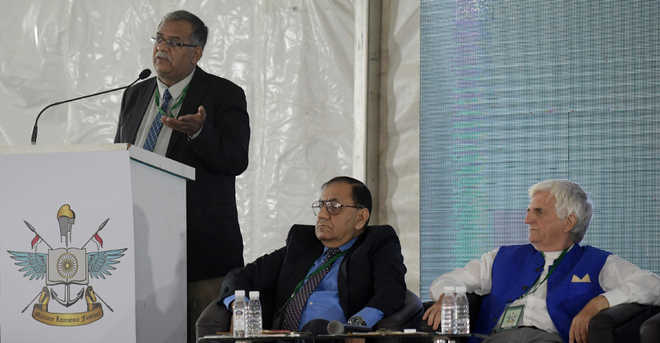
Author SK Verma speaks as Maj Gen Govind Dwivedi (retd) looks on during their session ‘Overhang of the Sino-India war in 1962 and today’.

Ajay Banerjee

Tribune News Service

Chandigarh, December 8

In what is a significant assertion, a “China-watcher” on Saturday suggested it is imperative to “decode” Chinese President Xi Jinping to understand modern China and termed him as a “mysterious person”.

Major General Govind Dwivedi (retd), a former Defence Attache to China and North Korea who is now with the Faculty of International Studies, Aligarh Muslim University, while speaking at the Military Literature Festival, used a phrase from the early 20th century and termed the present regime as ‘Xi — the Long March’. The ‘long march’ is a term used for the tactic used by Army Generals of China in the 1910s.

“Until you decode Xi you cannot understand China. He is the ‘new emperor’ and President for Life (China okayed an amendment in March this year to remove the two-term cap on Presidents). The West thought China will fail, but China is not going to fail,” he said at a session ‘Overhang of the Sino-India war in 1962 and today’.

China, he said, was on a mission to ‘buy’ and ‘rent out’ friends, the obvious reference to China funding smaller countries in Africa.

Claude Arpi, a noted France-born author, who is now holding the Field Marshal KM Cariappa chair of excellence at the United Service Institution of India, for his research on the Indian presence in Tibet during 1947-1962, suggested “India should declassify all papers relating to Tibet. At present, we (researchers) depend on CIA (US spy agency) documents. Today you can get more Chinese documents than Indian documents”. He went on to warn “China will select its own Dalai Lama, be prepared”.

In another key opinion, Shiv Kunal Verma, author of 1962: The War That Wasn’t asserted there was “no point in talking what Nehru did, it’s like today saying a Brigade Commander will hinge his actions on what Nirmala Sitharaman is doing or what (Narendra) Modi is doing. We need to understand what happened. Time has come to hold a mirror to our face. We need to wipe the slate clean and look at China differently”.

In his opinion, “had a one brigade commander stood up, we would have a different story to tell (of the 1962 war).” Maj Gen PJS Sandhu (retd), who authored 1962: A view from the other side of the hill, said several questions prevail why India did not use air power. “There was unrealistic assessment of Chinese air capabilities by intelligence”.


Disabling litigation against a wounded soldier by Lt-Gen DS Hooda (Retd)

Lt-Gen DS Hooda (Retd)

In this world of instant media and viral tweets, impressions are important. Today, there is a feeling that the government is battling its own soldiers and that the latter can hope for justice only from the courts.Disabling litigation against a wounded soldier
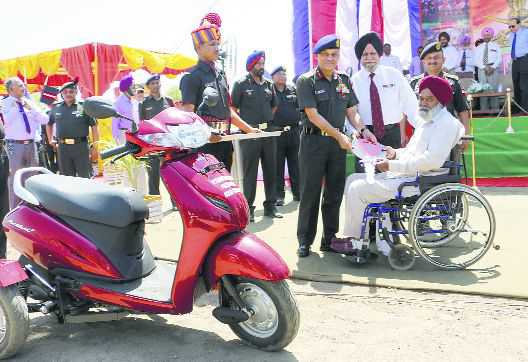
Unjust: A disabled soldier has to, at times, spend a lot in fighting cases in the court.

Lt-Gen DS Hooda (Retd)
Former Northern army Command Chief

In April 2018, in the case of Union of India Vs Prithwi Singh, concerning the grant of disability pension to a soldier, the Supreme Court observed, “The couldn’t-care-less and insouciant attitude of the Union of India with regard to litigation, particularly in the Supreme Court, has gone a little too far as this case illustrates….it is adding to the burden of this Court and collaterally harming other litigants by delaying hearing of their cases through the sheer volume of numbers… this is an extremely unfortunate situation of unnecessary and avoidable burdening of this Court through frivolous litigation which calls for yet another reminder through the imposition of costs on the Union of India while dismissing this appeal.”

Unequal battle

The Supreme Court’s observations are reflective of the problems plaguing the very emotive issue of disabled soldiers fighting cases in the courts for their pensionary dues. It is both an unequal battle and an unjustified one. The government had been routinely challenging Armed Forces Tribunal rulings, forcing veteran soldiers and widows to appear in the Supreme Court, where they faced a battery of government lawyers, whose costs possibly exceed the payout for the disability grant. 

The Supreme Court’s comments in the Prithwi Singh case are telling, “To make matters worse, in this appeal, the Union of India has engaged 10 lawyers, including an Additional Solicitor-General and a Senior Advocate… In other words, the Union of India has created a huge financial liability by engaging so many lawyers for an appeal whose fate can be easily imagined on the basis of existing orders of dismissal in similar cases.”

More importantly, the volume of appeals filed in the Supreme Court has created the impression of an insensitive government disrespecting the sacrifice of soldiers who suffered medical disabilities while serving the country in the most challenging of conditions and the harshest of terrains. There is an unseemly squabble on whether the disability has been caused by service conditions, and certifications of commanders on the ground are disregarded by financial advisors and pension sanctioning authorities.  

Move to cut litigation

It was, therefore, an extremely welcome step when the current government moved to reduce litigation and improve the system of redressing grievances among the military veterans. The Defence Minister constituted a Committee of Experts that submitted its report in November, 2015. Among the 32 recommendations that were immediately accepted by the minister, an important one was the withdrawal of litigation in all cases that had been settled by the high court/Supreme Court. The minister gave 45 days to implement the recommendations approved by him.

Despite this display of political will by the government, and a passage of three years, the implementation of the recommendations of the Committee of Experts remains tardy. In June 2017, the Ministry of Defence’s (MoD) Department of Ex-Servicemen Welfare issued instructions that no further appeals would be filed on legally settled cases, but pending appeals would not be withdrawn. This is not only a completely petulant approach but also bad in law.

Service HQ’s role

The Service headquarters have also not moved proactively to follow up on the recommendations approved by the Defence Minister in 2015. While it is accepted that changes in policy can only be done by the MoD, a narrow interpretation of policies by military officers in the headquarters, despite legal rulings to the contrary, cannot be considered a shield to deny due benefits to the soldiers.

As reported in a leading newspaper on November 22, the MoD, on September 7, had communicated that “Litigations (should) be viewed in an impersonal, non-adversarial and dispassionate manner and should not be made a prestige issue or a win/loss situation. The tendency to the continuous unethical filing of appeals in issues that have attended finality at the high court or Supreme Court should be checked and all such pending appeals should be identified and immediately withdrawn.” Despite this, only 180 cases out of the total of 7,676 are being withdrawn by the three services.

Financial implication

Contrast this with the other ministries. The Income Tax Department, in July this year, moved to reduce its litigation load. The threshold limits for filing appeals was raised to Rs 1 crore in the case of Supreme Court, and Rs 50 lakh and Rs 20 lakh in case of high court and tribunals, respectively. As per media reports, this amounted to a withdrawal of 41 per cent cases with a revenue impact of Rs 4,800 crore.



It is often argued that the military is a large organisation and rulings by the courts impact a great number of serving and retired officers and men. The financial implication of implementing the court orders is huge and this would put additional pressure on the already stressed revenue budget. Such an argument needs to be dismissed outright. Justice cannot be sacrificed at the altar of budgetary constraints. Also, spare a thought for the disabled soldier spending a significant part of his hard-earned pension in fighting cases in the Supreme Court.

In this world of instant media and viral tweets, impressions are extremely important. Today, there is a feeling that the government is battling its own soldiers and that the latter can hope for justice only from the courts. This is despite the political leadership clearly conveying its intent to reduce litigation in courts. How will this intent get translated into action?

There is little future in the blame game. A concerted effort has to be made to address this very vexing problem that shows everybody concerned in poor light. The first step is to adopt a more liberal outlook towards disabled soldiers. It is only then that we will be able to craft policies that show a more sympathetic approach. There must be ruthlessness to withdrawing past cases from the courts and filing new appeals. This scalpel will have to be wielded by the Defence Minister.

The Indian military is not a mercenary force that works only for monetary incentive. Values and an honour system are rated highly in the profession. However, the soldier, particularly after he sheds his uniform, must not feel abandoned.