










Sanjha Morcha

What’s New

Click the heading to open detailed news

Current Events :

web counter

Print Media Reproduced Defence Related News

Imran Khan’s US Visit-Implications for India by Brig Anil Gupta; Veteran

Pakistan Prime Minister Imran Khan’s recently concluded three-day visit to the United States of America and his one on one meeting with the POTUS Donald Trump has evoked mixed reactions in India not only due to the controversial statement of Trump but also due to a lukewarm concern displayed by the US authorities with regards to terrorism. The relations between Pakistan and US have been strained ever since the Trump Administration assumed power in US on the issue of Pakistan’s support to the global jihadi terrorist organisations and its involvement in cross-border terrorism in India and Afghanistan. Though, Pakistan’s involvement in cross border terror in Iran is also well established, US does not show much concern due to its strategic concerns in the Gulf region. However, Pakistan’s continued support to the Taliban and Haqqani network operating in Afghanistan including providing the safe havens within its territory irked the new US administration which put Pakistan on notice threatening to suspend all aid including the package for the Pakistan Army. Pakistan failed to read the US intent as in the past it has been getting away playing the nuclear card. The Western world with US in particular is scared of its nuclear arsenal falling in the hands of the jihadi terrorists operating from its soil and succumb to the Pakistani black mail by continuing to dish out doles to successive governments in Pakistan. Trump, however, is made of a different stuff.

“The United States has foolishly given Pakistan more than 33 billion dollars in aid over the last 15 years, and they have given us nothing but lies & deceit, thinking of our leaders as fools. They give safe haven to the terrorists we hunt in Afghanistan, with little help. No more!” is what Trump tweeted on the first day of 2018. Pakistan went to the extent of blaming Trump for “flinging accusations at Pakistan,” as he was disappointed at “US defeat in Afghanistan.” Trump responded by blocking the US aid of approximately three billion US dollars that also included the 300 million USD for Pakistan Army. The Army to Army contact between the two armies, a long-term allies, was also suspended. It was a big set-back for Pakistan with a severe economic crisis already staring at its face. Pakistan did try to put up a brave front initially but its dwindling economy, India’s diplomatic offensive in exposing Pakistan, the firm stand of US administration and the strictness of Financial Action Task Force (FATF) compelled Pakistan under Imran’s leadership to take certain stern measures against the terror industry that was flourishing in Pakistan. Whether, these measures are only a “show window” to win trust of Trump and US authorities as a prelude to Imran Khan’s visit to US or have a sense of seriousness or permanency only time will tell?

Meanwhile, the US has begun preparations for the next Presidential election and Trump has also thrown his hat in the race. He is desperate to have one major diplomatic victory about which he can boast to the American people. His initiative in the Korean Peninsula is not making much headway. The strained relations with Iran are harming him more than helping him boost his image. His high headed tactics of dealing with other countries has won him more enemies than allies. Both China and Russia are also having tense relations with America. Despite India likely to be granted the status of most favoured non-NATO ally and already designated with special STA-1 status, the relationship between the two countries at best can be dubbed as hot and cold. Many in India perceive US as a fickle ally. In nutshell, Trump has more negatives to his credit than positives as far as foreign and strategic relations are concerned. Thus, Trump is desperate to win the Afghan tangle which is not possible without placating the Taliban. US also knows that only Pakistan can exert the desired influence on the Taliban. This forms the background of Imran Khan’s visit to Pakistan as far as American perspective is concerned and unblocking the US aid as far as Pakistan is concerned.

Let’s first discuss Afghanistan. India has emerged as a major soft power in Afghanistan and has a major stake in whatever final settlement takes place. Taliban has been recognised as the key impediment to end of conflict in Afghanistan. Earlier, India was elbowed out of the direct negotiations with Taliban, as claimed by a section of the media. To my mind, it is a deliberate decision by the government to stay away from direct negotiations with the terror group due to adverse ramifications at home. India, however, cannot be ignored and sooner than later would have to be involved in any final settlement in Afghanistan. India remains steadfast on its traditional position of supporting only an “Afghan led, Afghan owned, and Afghan controlled” process which includes the duly elected government in Kabul.

With Pakistan forming as a key partner in Trump’s South Asia Strategy for achieving a political settlement in Afghanistan; defeating al-Qaeda and ISIS- Khorasan; providing logistical access for US forces and enhancing regional stability, it certainly has gained. That is why Pakistan was included for the first time in the trilateral consultations with Russia, China and USA on the Afghanistan peace process held at Beijing on July 10-11.
The entire focus of the US was concentrated on Afghanistan during Imran’s visit which included the Pakistan Army Chief and the ISI chief in the entourage. While Imran Khan has agreed to work with Trump to prod Taliban to strike a peace deal with the aim of extricating the US Army from its longest war, Trump has dangled the offer of unblocking three billion USD aid to Pakistan if Imran succeeds. Imran said, “I want to assure President Trump Pakistan will do everything within its power to facilitate the Afghan peace process. The world owes it to the long-suffering Afghan people to bring about peace after 4 decades of conflict.”

There is no doubt that US is desperate to exit from Afghanistan but is the negotiation with Taliban the best solution? Taliban has not been reformed and its five year brutal rule is still fresh in the mind of the Afghans. It certainly suits Pakistan because it helps it achieve its aim of achieving strategic depth and use Afghan territory for promoting terrorism. It will also put an end to the hope of a democratic Afghanistan, disappointing millions of Afghans who are hoping for a brighter future. India must therefore press for its involvement in the peace talks and ensure that Taliban do not elbow out the elected Afghan government. Trump’s desperation can be gauged from this statement, “I could win that war within a week, and I don’t want to kill 10 million people. Afghanistan could be wiped off the face of the earth. I don’t want to go that route.” India has lot at stake because Afghanistan holds significant economic, security and strategic implications for India. India cannot be a mute spectator but has to ensure that democracy survives in Afghanistan.
As far as counter-terrorism is concerned not much time was devoted to the same possibly to avoid public embarrassment to the visiting premier whose services US badly needs in view of its leverage over the Taliban, thanks to the safe havens it provides to the group’s leadership. But as admitted by Imran Khan himself that more than 40 terror groups exist in Pakistan, the situation is very fragile. Any terror attack in Afghanistan or India with mass causalities with proven links to Pakistan will reverse the new fond relationship between the US and Pakistan. Pakistan will have to tread the path very carefully. Pakistan which considers India a quintessential threat is not going to so easily give up the low cost option of bleeding India through thousand cuts and will attempt to promote the idea of home-grown terror in India due to her inherent fault lines. His statement claiming that Jaish e Mohammad (JeM) operates from Kashmir as well must be seen in this light.

Imran Khan was successful in raising the Kashmir issue during the one on one meeting with President Trump. It was a spin doctored question asked by a correspondent to prevent difficult questions on Pakistan’s involvement in terrorism which would have caused a lot of embarrassment to Pakistan. The question successfully diverted the topic to Kashmir in which Imran lost no time in seeking Trump’s mediation and assistance in resumption of Indo-Pak dialogue on which India has made her stand very clear by stating that talks and terror cannot be held together. “We’ve made all overtures to India to start dialogue, resolve our differences through dialogue. But, unfortunately, we haven’t made headways as yet. But I’m hoping that President Trump would push this process,” Khan said.

Trump surprised everyone with his signature trademark off-the-cuff remark. Trump has developed a habit of speaking or tweeting without preparation or proper briefing. His remark raged a controversy to which New Delhi reacted promptly in order to set the record straight. Fearing a strain in Indo-US relations a number of American bureaucrats and leaders also jumped in to save the situation from worsening. But Trump is Trump and his remark should be seen in the light of his desperation for an early Afghan exit. But Imran has succeeded to once again internationalise Kashmir, after numerous failed attempts by Pakistan in last many years. India has to be careful and thwart ISI’s design to portray home grown terror groups in India by promoting the proxies of ISIS like ISJK, al-Qaeda like Ansar Ghazwa-ul-Hind, Hizbul Mujahideen (HM) and other ISIS affiliate or ISIS inspired terror outfits across the country. ISI will certainly attempt to influence the Left Wing Extremism as has been exposed by the Pune Police disclosing links between urban Naxals and HM.

Imran Khan’s attempt at reviving bilateral trade, as was evident from the large number of businessmen and traders that formed his entourage, and unblock the US aid has failed for the time being and is in no way going to help Imran to come out of the current economic mess. It may force Imran to continue and persist with the various counter terrorism mechanisms put in place including arrest of Hafiz Saeed and more arrests likely provided the Army and ISI permit. The imminent danger of being placed in Black List by the FATF may tie the hands of ISI and Army. Axe is likely to fall more on Afghan specific terror groups like the Taliban and Haqqani network.

The visit has been significant as far as bilateral security cooperation and military-to-military relations are concerned. There is a bright chance of resuming suspended military training programmes for Pakistan. At one point during President Trump’s meeting with Imran, the former also hinted at resumption of the security assistance for Pakistan depending on what both countries achieve concerning Afghanistan.

The major plus point of the visit has been the personal rapport the two have established. There is a great likelihood of a direct tele line between the two leaders further cementing their bonhomie and smoothen any bureaucratic hiccups that may erupt while the two nations are working for the common goal. Islamabad would like to use such an opportunity to sort out other issues in the bilateral realm.

Will there be a change in the Indo-Pacific strategy of the US and will Pakistan succeed in elbowing out India from the US equation in the region, Indian diplomats will have to work hard to ward off any such possibility. Though, the present bonhomie between the two is Afghan specific, what shape it takes in future in case Imran succeeds to placate the Taliban will have to be watched carefully.

(Author is a Jammu based political commentator, columnist, security and strategic analyst. He can be contacted at anil5457@gmail.com)

Hits: 21

Army’s junior officers and jawans gain from new canteen store policy aimed to bring in ‘parity’

The Indian army has revised its policy for the p ..

Read more at:
https://www.businessinsider.in/indian-army-brings-in-new-rules-for-its-officers-and-jawans-for-csd-facility/articleshow/69988073.cms?utm_source=contentofinterest&utm_medium=text&utm_campaign=cppst

From June 1, only vehicles with an engine capacity up to 2,500 CC and costing up to Rs 12 lakh will be available through Canteen Stores Department for serving and retired officers of Indian defence forces.

Sale of cars through CSD

erving and retired officers of the Indian defence forces will not be able to buy cars above Rs 12 lakh from the subsidised CSD (Canteen Stores Department) from June 1, as per new rules.

As per a letter issued by Quarter General Branch of the Army on May 24, along with curb on four-wheel vehicles above Rs 12 lakh and engine capacity of 2,500 CC, a restriction has also been imposed on the frequency of purchase of vehicles.

The duration of the purchase of vehicles has been increased from four to eight years for serving and retired officers.

“From June 1, only vehicles with engine capacity up to 2,500 CC and costing up to Rs 12 lakh (excluding GST) will be available through Canteen Stores Department,” news agency PTI said, quoting officials.

Till now, there was no limit on the capacity or price of vehicles that could be purchased through the CSD.

The decision will hamper plans of those officers who were looking to buy SUVs that cost more than Rs 12 lakh or come with an engine capacity of more than 2,500 CC.

As per the new order, other ranks or jawans, in the pay level of 3A to 9, will be allowed to buy a car once during their regular service and once after retirement not above 5 lakh – with the gap being eight years.

Officials said those in the pay level of 3A and 9 can purchase vehicles with a capacity up to 1,400 CC.

Earlier, NDTV had reported that outgoing Navy Chief Admiral Sunil Lanba bought a brand new Jeep Compass from the CSD a few days before the new rule is implemented.

The basic variant of the Jeep Compass has an on-road price over Rs 15 lakh. The top variant is priced at over Rs 20 lakh.

WHY CURBS HAVE BEEN IMPOSED

In the CSD canteens, defence personnel, including civilians working there, get a minimum saving of around Rs 75,000 on purchase of cars in comparison with the market price.

Explaining the reasons, Army officials said approximately Rs 17000 crore annually is sanctioned by Parliament for CSD under miscellaneous heads.

“CSD does a price negotiation for all items introduced and then a 50 per cent GST rebate is given by govt on that reduced price. Though the CSD creates a profit of almost 500 cr annually as CTS and deposits another approximately Ra 150 crore into the consolidated fund of India, the 50 per cent rebate is viewed as a loss to exchequer by finance authorities,” they said.

In the last two years, more variants being introduced in market and CSD, easy loans and higher purchasing power, sale of cars has shot up by over 200 per cent.

“Last year only, the car sales were over 6000 cr resulting in the budget being overshot and a carryover liability of payment to car manufacturers of Rs 4500 crore,” the officials said.

(with agency inputs)

READ | Defence Budget 2019: Why highest ever Rs 3 lakh crore grant is still not enough


The BJP agenda J&K loses its special status after seven decades

The BJP agenda

Abrogation  of Article 370, implementation of the uniform civil code and building a Ram temple at Ayodhya have been the cornerstones of the BJP’s political programme and prime promises in its poll manifesto over many decades. Of these, abrogation of Article 370 of the Constitution that gives a special status to the state of Jammu and Kashmir has been the oldest ideological argument of the RSS and its political offshoots, the Jan Sangh and the BJP. Jan Sangh founder Syama Prasad Mookerjee had quit Jawaharlal Nehru’s Cabinet in 1950 primarily over this issue. This special status was offered at a time when most princely states, which had acceded to the Indian Union, still hung on to old practices, hierarchies and bureaucracies; when former rulers were termed Raj Pramukhs and their coats of arms and flags were in vogue. Sheikh Abdullah wanted this status to convince and reassure his people to join a Hindu-majority nation and Nehru offered it to enhance the prestige of a multicultural, diverse India and to defeat Jinnah’s identity politics.

Now, after seven decades, J&K loses its special status and gets reorganised into two union territories: one for Ladakh and the other for the divisions of Jammu and Kashmir. This doesn’t come as a surprise because the RSS had passed a resolution in 2002 seeking the trifurcation of J&K into three administrative units comprising Jammu, Kashmir and Ladakh. It cannot be a coincidence that the Centre has moved the resolution to abolish Article 370 in the Rajya Sabha on Monday, soon after criminalising triple talaq — a step in the direction of a uniform civil code. So, of the core issues of the Sangh Parivar, only the Ram temple is now left on the table.

The BJP can claim that it is merely fulfilling its election mandate; the promises it has made to its voters all these years and particularly during the highly polarising General Election, which concluded less than three months ago. But has the government thought it through? Has it factored in all the international ramifications, the UN resolutions and the neighbourhood’s response? The government, at home, could have acted with a lot more transparency in Delhi and in the Valley.

http://


Capt lashes out at Canada for support to Khalistan movement

TOUGH STANCE Urges Centre to mount pressure on Trudeau govt to end anti-India activities from its soil

› By allowing the conspirators of the mass murder, the Canadian government has exposed its true intent. CAPT AMARINDER SINGH, chief minister

From page 01 CHANDIGARH: Chief minister Amarinder Singh on Monday lambasted the Canadian government for its overt and covert support to the Khalistani movement, warning that Trudeau government’s failure to check anti-India activities being carried out from its soil would be detrimental to its own security in the long run.

Citing the findings of the John Major Commission into the 1985 Kanishka bombing as a clear endorsement of Canada’s failure to act against the Khalistanis operating from its soil, the CM said by allowing the conspirators of the “mass murder”, the Canadian government had exposed its true intent.

It was more than apparent that Canada had been extending its support to Khalistanis despite New Delhi’s protestations, he said in a statement here.

The commission report point out that “despite the principal conspirators being put under surveillance before the bombing, their conversations recorded, their acquisition and testing of explosives witnessed by state agents, and ample and repeated warnings that they intended to bomb a specific flight, Canadian agencies failed to act at each stage, and at a scale that cannot be explained away as mere errors, but that appear to have the taint of intentional negligence, if not collusion”.

Pointing out that he himself had been raising the issue with the Canadian government, Amarinder noted that he had in fact given a list of wanted terrorists in Canada to Prime Minister Justin Trudeau during the latter’s India visit last year. The lack of response from their government so far has exposed their intent, he said.

Amarinder urged the Narendra Modi government at the Centre to take cognisance of these reports/disclosures to mount global pressure on Canada to end use of its soil to unleash terror against India, particularly the Sikh community being targeted by Khalistani terrorists.


‘I vowed to fight war crimes’

DHARAMSHALA: Twenty years have passed since the 1999 Indo-Kargil war, but for Captain Saurabh Kalia’s parents, the war for justice is not over.

ARVIND SHARMA/HT PHOTO■ NK Kalia stands next to a garlanded photograph of his sonNK Kalia, 70, received the mutilated body of his son — one of the first casualties of the war — on June 10. “Eyes punctured, eardrums pierced, vital organs chopped off and body bearing burn marks. I had never heard or seen such brutality,” said Kalia, a retired scientist who worked with the Council of Scientific and Industrial Research (CSIR).

Captain Kalia of 4 Jat Regiment was 22 when he and five others went on a reconnaissance off Bajrang Post in the Kaksar sector of Jammu and Kashmir to investigate reports of incursion. They were taken captive by Pakistani troops on May 15, 1999, and tortured contrary to all international conventions on war.

“The day he returned home wrapped in the tricolour, I vowed to fight for justice against war crimes. Whether we achieve success or not, this war will end with our death,” said Kalia.

He moved the top court in 2012, seeking direction to the Centre to take up his son’s case at the International Court of Justice (ICJ). The Centre told the court in 2015 that since this was a bilateral issue between two countries, India could not raise it in ICJ without Pakistan’s consent. The matter is now pending and has not been listed for hearing in the past two years.

“Successive governments have failed to do what should have been done back in 1999. Still we are thankful what they have done for our cause and do not regret what they [haven’t done],” said Kalia. “My fight is not only for Saurabh or the five soldiers, but for the respect and honour of the Indian Armed Forces,” he added.

“Naughty [as he was called at home] was very happy when he was selected in NDA. I do not regret sending him to army. What happened to him was destiny,” said mother Vijaya, 67, who has framed the blank cheque that her son gave her before he left for his first posting.


The 24-hr run-up to Balakot We didn’t miss: At Mirage base, recall of historic strike

http://

Ajay Banerjee
Tribune News Service
Gwalior, June 24

Just 24 hours before the Indian Air Force launched the airstrikes on Balakot in Pakistan, the Mirage 2000 fighter jet base at Gwalior was abuzz with activity.

The young pilots knew something was on since they had been sent on regular combat air patrols at night. Like all other fighter bases in North India, Gwalior was on operational readiness after the February 14 terror attack on a CRPF convoy, that killed 40 troops at Pulwama.

Around 4 pm on February 25, things became clear when technical teams started to ‘feed’ the Spice 2000 bombs with geo-coordinates of the Jaish-e-Mohammad terror camp, which was finally attacked some 12 hours later at 3.30 am on February 26.

A small chip in the Spice 2000 holds the key information on how the bomb will travel and hit the target. After its release, it travels on an inbuilt ‘seeking device’ to hit the target. “No target was missed,” say the teams.

The town hosts three squadrons of Mirage 2000 — BattleAxes, Tigers, Wolfpack.

That night, the strike pack flew off at 2 am, like on a combat patrol. A small number of Sukhoi 30 MKI fighter jets showed up at the western front over Rajasthan. In this backdrop, the Mirage pilots flew almost behind the Himalayan ridge line to avoid Pakistani radars.

The last “90 seconds” of the mission meant every  communication equipment was switched off. The pilots then turned back. Some landed at Agra, some at Adampur. Their mates back in Gwalior were all smiles,  this was the first hit into Pakistan since the 1971 Indo-Pak War.

For feb 26 air attack

The Mirage 2000 jets were armed with two separate types of Israeli ammunition.  While the Spice 2000 is designed to penetrate deep inside the structures, the Crystal Maze was to send back video feed.

When pak tried to repeat kargil in 2002

Gwalior: The IAF on Monday publically admitted that Pakistan tried to repeat a Kargil-type intrusion in July-August 2002, but was rebuffed. IAF jets straffed Pakistan occupation some 3-4 kms on the Indian side of Line of Control in ‘Kel’ sector in north-west part of J&K. Air Marshal Rajesh Kumar, who is commanding Central Air Command, said, “We wanted to send a message without declaring war. It was a secret affair.” TNS


Kashmir Situation Is Potentially Dangerous: by Lt Gen Ata Hasnain

Security is a term which applies comprehensively to an entire environment. Most people apply it to selected situations and segments only. In the current situation in J&K security covers not just the ongoing Amarnath Yatra, which incidentally stretches from the Holy Cave to Jammu, but also the towns and rural areas of Kashmir and the routes within. It also goes beyond the Pir Panjal and stretches to Doda, Kishtwar, Poonch, Rajouri, Udhampur, Jammu and Kathua.

Most importantly it also covers the LoC belt which can be classified as a ribbon of territory along the LoC approximately 15 kilometers in depth, or more in some areas. It includes the people, commerce, institutions and infrastructure.

The idea of stating this is to correct the perception of those with restricted vision.

(Catch all the lives updates on Kashmir unrest here.)

Also Read : After Terror Alert, J&K Govt Asks Amarnath Yatris to Leave Valley

Indian Government’s Changed Strategy in Kashmir

J&K has all along been a proxy hybrid conflict with ups and down in the situation. India has relied upon the concept of counting bodies of terrorists, maximizing that each year, minimizing own losses and waiting for the next season. Those who have served in J&K are familiar with this concept – commonly referred to as summer and winter strategy. While efforts to engage with the people of J&K have been made from time to time, little has been done to counter the support organizations which actually help keep the terror campaign in the state alive.

Suddenly things started to change and since 2017 the Central Government started to adopt a new strategy by going after the financial networks aiding militancy in J&K. These were deeply embedded and would take some years to dismantle. With the coming of the new government at the Centre in May 2019, this line of action started to expand and not only the financial networks but also the entire ecosystem which has run the J&K proxy war came under the scanner.

“Der aaye, drust aaye” (came late, yet came rightly) is a common Hindustani phrase; it applies most appropriately here.

‘Operation All Out’ Against Terrorists & their Facilitators Caused Panic in Pakistan

Operation All Out since 2017 has focused on neutralization of terrorists. It achieved good results evident from the fact that many other terrorist groups tried to unsuccessfully make an entry to fill emerging voids. This was not good enough. When the network of over ground workers (OGWs) started to erode under the intelligence and police vigilance and many powerful personalities earlier in authority started to get targeted there was panic.

The writ of the separatists was gradually diluting, good times for them getting over. That is one of the reasons why the summer of 2019 was largely quiet so far. On the other side of it, Pakistan has been on the back foot with attention focused upon Afghanistan and an economic bailout based upon its ability to project its level of usefulness to the US. The situation in Kashmir has been slipping from under Pakistan’s feet. It stopped infiltration and the sponsorship of major terror acts to remain in the best books of the FATF.

Also Read : Pak Eyes Terror Escalation in J&K After Trump’s Mediation Offer

Newly-Emboldened Pak Wants to Re-activate Terror Outfits in Kashmir

Things changed after Prime Minister Imran Khan met Donald Trump in Washington in Jul 2019. Clearly, he is Washington’s hope for US withdrawal from Afghanistan. Bolstered by the successful visit, Pakistan’s deep state reprioritized its security concerns; J&K returned right to the top and the tasking was probably done to the concerned agencies that were in touch with the networks in the Valley.

The feedback from Kashmir to Islamabad would probably have been about panic stations among the pro-Pakistan networks but a potential chance which was still available; the ongoing Amarnath Yatra could be targeted for effect. Large scale casualties to yatris would convert the Jammu region into a communal cauldron and the chances of the same spreading deep into hinterland India would be bright; exactly what the deep state’s long term vision has been all about all these years. For this, there was a need for some hard core terrorist cadres to be infiltrated and some wherewithal.

Intelligence appreciations do not depend only on visible or evident inputs and results but invariably look at second and third order effects. When you take the incumbent GOC 15 Corps’ assessment given at the special media briefing on 02 Aug 2019, not even a tenth of the inputs and assessment would have been shared with the public and that is rightly so. The displayed American sniper rifle and the Pakistan marked mines were probably the tip of the iceberg. After all, caches still lie undiscovered and are being hunted even now.

A Lot is Happening at LoC, Away from Public Eyes

The happenings at the LoC are outside the focus of media. A lot is happening there. For the first time we find a focus of Pakistan Army on the Kashmir segment of the LoC. Ceasefire violations are extending to artillery duels; it has not happened exclusively there for long. Risk are being taken in the Nilam Valley where Pakistan is very vulnerable. The Bagtor infiltration route at the edge of Gurez—the shortest route to the Valley, reaching Bandipur in a night’s hop—has been activated.

Anyone with experience of Valley based operations can read these inputs and deduce the level of desperation in Pakistan’s J&K focused planners. Doing something while the iron is hot, re-energizing militancy and street turbulence, and reactivating the networks which are getting extremely vulnerable appeared the best option for Pakistan. The situation could be assessed to be akin to that which was probably presented to Benazir Bhutto in 1989 by Mirza Aslam Baig and Hamid Gul (the then Pakistan Army Chief and DG ISI respectively). ‘Now or never’, was probably the brief and the advice which was taken and acted upon.

Govt’s Response to Threat Perception is Efficient

I can assess that the quantum of CAPF troops flown in is not for deployment in Kashmir alone but as much for the communally vulnerable segments south of the Pir Panjal, which could be the actual target of the strike against yatris. Placing myself in the shoes I once occupied, my brief would have been to temporarily reinforce the counter-infiltration grid in the vicinity of the LoC belt with regular troops of the Army and let the CAPFs occupy their billets to keep the space under control. That is probably what is happening.

Doubts about Amarnath Yatra and the advisories to the tourists and yatris turned tourists have been raised because it appears difficult to appreciate the exact seriousness of the threats presented above. Authorities, however, must remain in full control of administrative confidence.

Also Read : ‘Unnecessary Panic Created by Vested Interests’: J&K Governor

Post-Panic Action Needed

The panic at the Valley’s petrol pumps and written memos for stocking up logistics must also be followed by well-publicized measures to ensure that the Valley does not suffer logistically. Fuel, fresh stocks, medicines etc. must be sent in sufficient quantities unlike 2008 when there was administrative paralysis. That itself will take out much of the venom of accusation that India is only interested in J&K’s territory and not its people. There is also a need for progressively increasing transparency which the senior commanders and administrators will no doubt follow.

The problem with intelligence assessments is that if threats are successfully countered no one will credit the assessments. No one is really looking for those credits as long as the people, security forces and the administration of J&K remain safe. The security situation is potentially dangerous as assessed above.

(The writer, a former GOC of the Army’s 15 Corps, is now the Chancellor of Kashmir University. He can be reached at @atahasnain53. This is an opinion piece and the views expressed above are the author’s own. The Quint neither endorses nor is responsible for the same.)


UK Sikhs demand war memorial for martyred community members in WWI and II

UK Sikhs demand war memorial for martyred community members in WWI and II

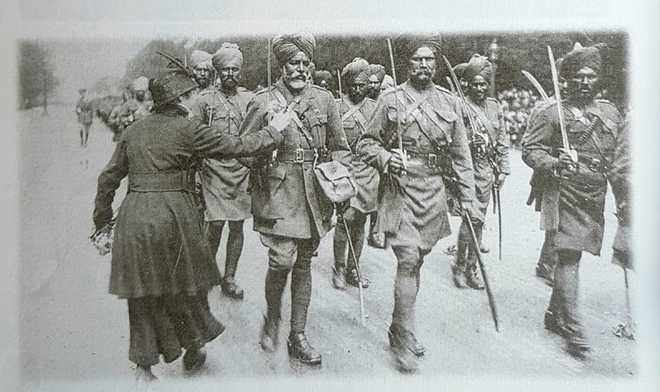
War-footing: Soldiers of 15th Ludhiana Sikhs were among the first Indian troops to disembark at Marseille. Photo courtesy: USI, New Delhi

Singapore, June 21

Sikhs in the United Kingdom have demanded a war memorial to be dedicated to the martyred community members who fought for the British during World Wars I and II, a senior community member has said.

Statistical data has been used effectively to lobby the government and other public authorities to ensure that a space can be found in central London for the memorial, Jasvir Singh, who chaired the British Sikh Report 2019, said.

“A vast majority of Sikhs want to have a war memorial in central London dedicated to Sikhs who died in the First and Second World Wars,” he said.

“There have been memorials that have been made across the country as well and dedicated to those who died in the two wars,” he said.

Singh was in Singapore to attend the International Conference on Cohesive Societies from June 19-21.

Singh leads the ‘Grand Trunk Project’ which brings Hindu, Muslim, and Sikh communities of British-Asian heritage, along with smaller communities from the Subcontinent, together in dialogue and understanding.

In his work on Sikhs, Hindus and Muslims as minority in the UK, Singh hopes “that people are able to see the similarities, respect and celebrate the differences”. Expressing his views on the 100th anniversary of the Jallianwala Bagh massacre, he referred to the British Sikh Report 2019 and said 85 per cent of British Sikhs believe that events like this should be taught in schools in the United Kingdom.

According to the survey in the report, 79 per cent of respondents believe that the British Government should apologise for the Jallianwala Bagh massacre.

“This view was shared across the age groups with those aged 19 and under and those aged 65 or more, (who) most likely to want an apology,” Singh said.

The survey included nearly 2,500 respondents spread across the United Kingdom. PTI


Will work for you, sure of success: Rajnath Singh on military veterans’ distrust on government

Union Defence Minister Rajnath Singh’s statement comes after a recent controversy among military veterans which led to their discontentment over government policies.

Will work for you, sure of success: Rajnath Singh on military veterans' distrust on government

nion Defence Minister Rajnath Singh on Sunday, while addressing the Army, said, “I will work for you, and I am sure we will succeed.”

Rajnath Singh said this at an event on Kargil Vijay Diwas in New Delhi. The event was organised by Veteran India, which is an organisation led by ex-servicemen.

Rajnath Singh’s statement comes after a recent controversy among military veterans which led to their discontentment over government policies.

In a recent order, the Army had asked its personnel not to be on WhatsApp groups where they do not know the identity of all its members.

The move was seen as an attempt to ensure that serving officials do not engage with groups where current government policies regarding the armed forces, in particular, were being criticised.

Apart from this, the government’s decision to make disability pension taxable has also been criticised by the veterans.

Other than taxable pension and restriction on using WhatsApp, the government’s stand on issues like Non-Functional Upgrade was also condemned by veterans.

The Non-Functional Upgrade, which is entitled to be a part of a higher pay scale just like other services, has not gone down too well with the veteran community which has been quite vocal in expressing discontent on social media.

In his speech at the event, Rajnath Singh heaped praise on the valour and sacrificial spirit of the Indian soldiers during the Kargil War.

Referring to his visit to Dras on July 20, Rajnath Singh said, “Our soldiers had fought against all odds to re-take one peak after another,” while referring to the Kargil War.

Rajnath Singh said that his visit to Siachen, soon after assuming office, signaled that the Indian soldier would remain at the centre of decision making process.

“After the Balakot strikes, the country’s pride and confidence in its armed forces has increased,” he said.

In the event, Rajnath Singh felicitated family members of some martyred soldiers.


MoD restores ration to officers on peace postings after 2 years

MoD restores ration to officers on peace postings after 2 years

Reversing a two-year-old order, the government today okayed the restoration of ration supply in kind for officers of the armed forces. File photo

New Delhi, June 18

Reversing a two-year-old order, the government today okayed the restoration of ration supply in kind for officers of the armed forces.

In July 2017, the government had stopped rations to officers on peace postings and instead started giving a monetary allowance per man per month as per instructions.

The allowance for the ongoing fiscal was Rs 117.29 per month. The decision had led to confusion as officers on peace posting frequently went out with their units for field exercises, where their troops were getting rations, but they had to make “own arrangements”. 

In the Army, when in a field exercise or on a forward location, the officers are supposed to have the same food as the troops. Similarly, some of the special forces of the Army, Navy and the IAF are based in what are classified as “peace postings” but are constantly training and the troops and officers again eat the same food. A large chunk of the forces, especially the Army, is deployed in forward areas.

The move had outraged the serving community and a serving Colonel sent a legal notice to the government, warning he would go to court if the order was not rolled back. 

Officers are required to have a daily calorie intake of 1,800 to 2,000, which was not possible with the allowance.

And the existing supply of rations was not resulting in a major fiscal outgo as bulk purchases meant cheaper rates of items. The forces have ‘scale’ of ration, which could be two eggs a day, some grams of chicken or mutton, or paneer and fresh vegetables. — TNS