Sanjha Morcha

What’s New

Click the heading to open detailed news

Current Events :

web counter

Print Media Reproduced Defence Related News

BRO uses concrete block technique on Zojila

BRO uses concrete block technique on Zojila

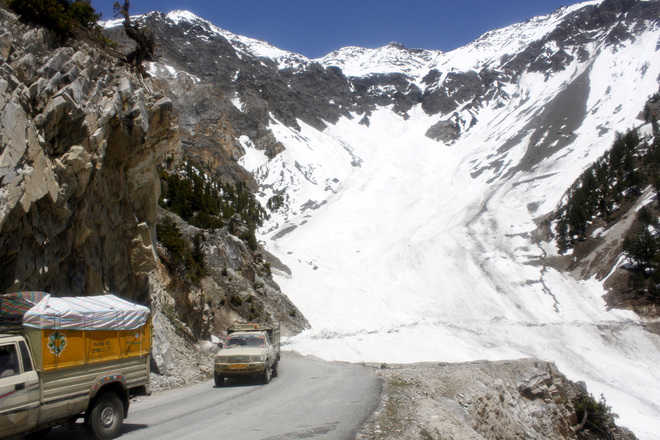
Vehicles in the Zojila area. Tribune Photo: Mohd Amin War

Tribune News Service

Jammu, October 4

The Border Roads Organisation (BRO) is laying the Srinagar-Leh road at Zojila with concrete blocks which can bear extreme weather conditions on one of the highest motorable roads.

According to a BRO official, 3-km stretch of the upper alignment of the Zojila has been completely paved with the “interlocking concrete block” on which vehicles can move smoothly.

“The laying of concrete blocks will provide smooth road access to the vehicles. As the stretch is located at a very high altitude faced with extreme weather, the blocks provide friction and can withstand extreme weather in freezing cold and icy surface. The block laying is a fine replacement for black topping, which is not possible at such an unfavourable spot,” the official said.

The official said the plan was to lay concrete blocks for 6 km of the Pass and thus far, 2.5 km had been completed.

“The pending work will be completed in the upcoming season. Because of the heavy rush of transport due to stocking time, this season won’t provide much time for the laying of blocks on the stretch,” he said.

As the road is vulnerable to landslides due to snowfall and frequent rainfall which damage the road surface, the interlocking technique of concrete blocks offers much resistance against weather and has a longer life.

“The concrete blocking is best for such conditions. Blocks will not slide or move as these are fixed on all four sides for strong and firm grip,” the official said.

The Srinagar-Leh highway remains closed for half of the year due to snow and slides during winter, and restoring and repairing Zojila is a daunting task for the BRO.

The highway sees a daily rush of hundreds of heavy truckloads and passenger vehicles from the Ladakh region, putting a lot of pressure on the stretch.


Bipin Rawat’s plan to train jawans for officer role is Army admitting staff shortage, quality idrw.org .Read more at India No 1 Defence News Website https://idrw.org/bipin-rawats-plan-to-train-jawans-for-officer-role-is-army-admitting-staff-shortage-quality/ .

Army Chief Bipin Rawat inaugurated the Young Leaders Training Wing at the Officers Training Academy in Chennai last week. The belated attention to personnel training is a laudatory effort that addresses several issues the Army is facing – the shortage of officers and stagnation. It is also an admission that despite the extra focus on nationalism, the Army is not getting, retaining and upgrading the quality of officers. The Army needs to rebrand and market itself again. Tackling twin issues The Young Leaders Training Wing (YLTW) at the Officers Training Academy (OTA) aims to better the prospects of jawans through a structured ‘personality enrichment programme’ so that they are better equipped to clear the tough Services Selection Board (SSB) and join the military academies to become officers. There are three schemes in vogue – regular entry through Army Cadet College/Indian Military Academy, Special Commissioned Officers, and Permanent Commission (Special List). For each of these schemes, there is a written examination. Selected candidates have to clear the SSB tests and interviews, which the soldiers find tough to crack, resulting in intake shortfall. Earlier, such training was being carried out in an ad hoc manner within the formations and in a semi-structured manner at the Army Education Corps Training College, Pachmarhi, Madhya Pradesh. The results were not up to the mark. The soldiers also resorted to going to private institutions run by retired officers and paid hefty fees to improve their prospects. General Bipin Rawat emphasised the dual benefit of YLTW: “We will get more officers and there will be a further promotion opportunity for JCOs (Junior Commissioned Officers) and NCOs (Non Commissioned Officers).” The Army Chief also made an interesting observation when asked about the shortage of 7,680 officers in the Army: “Promotion within the Army is very tough. This shortage is actually helpful because otherwise the promotion will become even tougher. The Army is managing very well.” The establishment of YLTA and the Chief’s observation with respect to the shortage of officers raises two important, interlinked issues – the empowerment of soldiers and junior leaders, and the management of the officers corps. Empower junior leaders, build academies For the last three decades, the shortage of officers has been a major issue within the Army, adversely affecting the operational efficiency in operational and counter-insurgency areas. The situation was such that it was made mandatory for young officers commissioned into the services to do a three-year stint with infantry/Rashtriya Rifles units in operational/insurgency areas. The Parliamentary Committee on Defence has raised this issue on several occasions. The shortage of officers is a result of rapid expansion of the Army, inadequate capacity of military academies, poor quality of candidates, an increase in authorisation of officers in units to compensate for non-empowerment of junior leaders, and poorly managed short service commission. A related problem is poor career prospect for the officer corps due to the rank hierarchy in the Army – more the number of officers, greater the frustration due to supersession. A lopsided rank-related pay structure as well as a strict premature retirement policy have only compounded the problem. Through concerted efforts on increasing the capacity of the military academies, the shortage has been reduced from an alarming 20 per cent to a manageable 15 per cent, which, as the Chief said, actually “helps the rest”. All other things being equal, and based on the capacity of military academies, it shall take 15 years at the rate of 1 per cent per year to completely wipe out the deficiency. The Army needs to have a visionary approach towards management of the officer cadre, and the linked issue of empowerment of soldiers and junior leaders. During World War 2, an infantry battalion fought the war in Burma, with 11 officers and 24 JCOs authorised in a unit. Today, we have 21 officers and 55 JCOs authorised in a unit. Similar situation persists in other arms and services. Grassroots fighting still takes place at the section and platoon level and both these are commanded by NCOs/JCOs. If officers have to step in to ‘lead them from the front’ in the battle, then it reflects poorly on the calibre of the junior leaders. We need to optimise the authorisation of officers in the units and not view them as a tool to compensate for poor junior leadership. To empower our junior leaders, we need to raise the standard of educational qualification from matriculation to 10+2 and graduation at the time of recruitment. Graduates are required for technical operations and high technology weapons and support systems. Dedicated junior leaders’ academies must be set up. No one must become a section or a platoon commander and equivalent without requisite formal training in a junior leaders’ academy. Deal with stagnation About 15 years ago, it was decided that to deal with the stagnation issue, the intake of regular and short service commissioned officers must be in the ratio of 45:55. We have failed to make the short service commission attractive. The Indian government does not absorb them laterally in the Central Armed Police Forces (CAPFs) or give them any weightage for selection in civil services. Compounding the problem, the Army itself is liberal in giving permanent commission as a ‘welfare measure’, defeating the aim of reducing stagnation. The Chennai-based OTA, which trains cadets for short service commission, has a capacity of 750 cadets but is functioning at 500 due to poor intake. This reduced capacity of 500 is itself undersubscribed by 16 per cent. Even the Indian Military Academy is functioning at 11 per cent below its capacity. There is a need to make it mandatory for students passing out of the state-subsidised Sainik schools and military schools to apply for the National Defence Academy (NDA). The Army should look at reducing the contractual liability to reduce stagnation. All western armies have taken this route – reduced contractual period with attractive incentives for a second career. There is a strong case for reducing the contractual period to 15 years in our case. Premature retirement also must be liberalised. It is not the gun but the ‘man behind the gun’ that matters. The more we invest in human resource the better would be the dividends. The shortage of officers was a bogey call. While a reformed short service commission, reduced contractual obligation and liberalised premature retirement will help, the key to better manage the officer cadre is through empowerment of soldiers and junior leaders. Posted in India


Capt meets Modi, proposes canalisation of Punjab’s major rivers

Capt meets Modi, proposes canalisation of Punjab’s major rivers

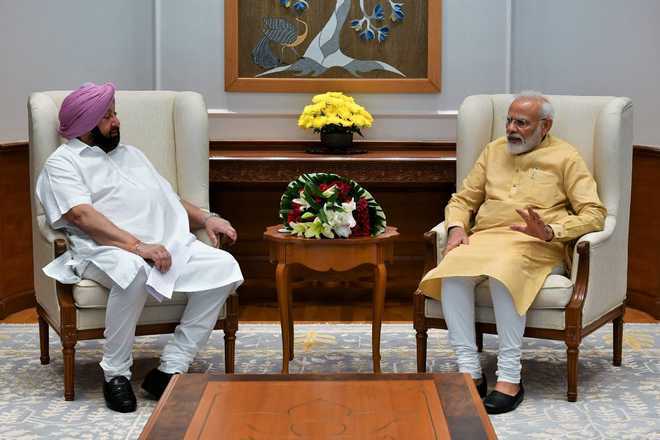
Captain Amarinder Singh and PM Narendra Modi.

Tribune News Service
New Delhi, October 3

Punjab Chief Minister Captain Amarinder Singh on Thursday urged the Central Government to take up canalisation of the state’s three eastern rivers of the Indus water system as a national project, to enable conservation of water and enhancement of the region’s economic growth.

In his proposal presented to Prime Minister Narendra Modi during a meeting here, the Chief Minister suggested construction of high-speed economic corridors on 985 km long river embankments, apart from river training works, flood protection measures and lining of internal side-slopes of the Sutlej, Ravi and Beas.

The move, Capt Amarinder said, would help the state enhance its ‘jal shakti’ (water power) to encourage diversification of agriculture, promote quality urbanisation and colonisation, and to speed up industrialisation for better and quicker economic emancipation of our citizens.

Complimenting the Prime Minister on his initiative to provide drinking water to each household in the country, through the creation of the new Ministry of Jal Shakti, and the inception of Jal (water) Jeevan (life) Mission and the “Nal se Jal” (tap water) scheme, Captain Amarinder said his government also stands committed to the cause of providing drinking water to its citizens under the initiative ‘Har Ghar Pani, Har Ghar Safai’ (water and sanitation for every household).

The Chief Minister, while expressing concern over the state’s reduction in ‘jal shakti’ at the time of India’s Partition and against during the reorganisation of the state in 1966, pointed out that the three perennial rivers of the Sutlej, Ravi and Beas irrigate only about 27 per cent of the state’s cultivated area, leading to over-exploitation of the ground water. It is apprehended, he further noted, that seven districts of the state will transform into a desert in the near future, with sure signs of poverty revisiting these areas.

Underlining the need to increase water productivity through augmentation and strengthening of water management, control and regulation infrastructure, Captain Amarinder suggested launch of the cannalisation project with the Sutlej river, which would require an investment of about Rs.4000 crore (US $ 0.7 billion) over a period of 3 to 5 years, exclusive of external incentives such as commercial exploitation of Government and private land and waiver of taxes, duties and cesses, as relevant.

The task may begin with a feasibility study that may be assigned to techno-economic experts of international repute, he suggested.

The Chief Minister assured that the state would extend its full cooperation to get the proposal realised in terms of sending a team of officers from the Punjab Government to engage and discuss the same with the officials of the Union Ministry of Jal Shakti.

Captain Amarinder also underlined the need to harness the river water which was currently flowing into Pakistan during the monsoons. Pointing out that the three rivers as of now have kutcha (earthen) embankments, measuring 945.24 km; (Sutlej 484.12 km, Ravi 245.28 km and Beas 215.84 km), covering almost over 60 per cent of state’s area, he observed that the 1/3rd of the state’s population living in the riverfront areas was also suffering due to the flooding that occurs during the monsoon period.

The canalisation of rivers and development of riverfront areas will expand activities leading to widening of the base of Punjab’s economy, diversifying economic activities and sources of livelihood for State’s rapidly growing younger generation, he added.



Vigil up, more bunkers, ‘prohibited areas’ in J&K

Vigil up, more bunkers, ‘prohibited areas’ in J&K

Srinagar, September 29

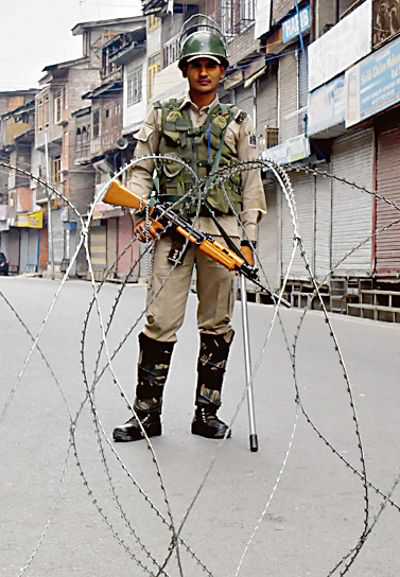
Security forces have intensified surveillance and area domination operations in Kashmir following Saturday’s militancy-related incidents, including a grenade attack on security forces in old city, a senior security official said.

Anti-insurgency operations were intensified as part of a proactive strategy to foil any plans of militants to stage any attacks on security forces in the Valley, the official said.

The official said: “As the situation has more or less normalised on the law and order front, the anti-terrorist operations have been intensified to ensure ultras do not stage any attacks.”

As part of the drill, security has been beefed up around vital installations, including the Srinagar airport and police offices. Security bunkers were being constructed in the Valley, the official said.

Extended security perimeters had been established around police offices and other vital installations, he added. — PTI


New IAF chief Bhadauria says fully prepared to deal with any contingency

New IAF chief Bhadauria says fully prepared to deal with any contingency

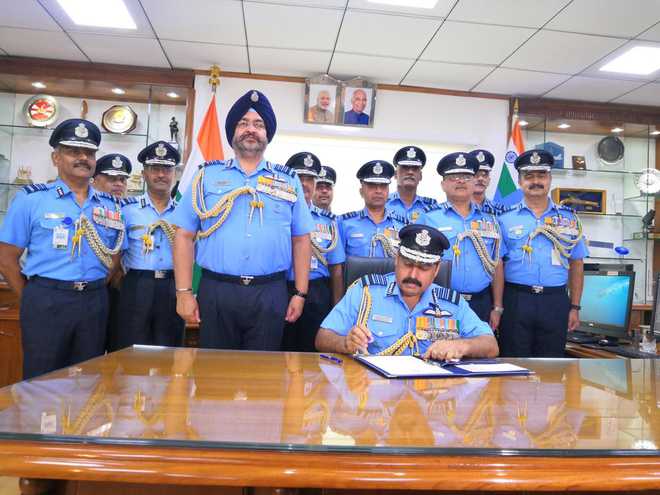
Air Chief Marshal Rakesh Kumar Singh Bhadauria took charge as the 26th chief of the Indian Air Force. Image: Twitter/@IAF_MCC

New Delhi, September 30

Hours after taking charge as the Chief of Air Staff, Air Chief Marshal RKS Bhadauria on Monday said his force is monitoring the evolving “developments” in the region and is fully prepared to deal with any “contingency”.

The IAF chief also said induction of Rafale aircraft into the force will enhance combat capabilities of IAF over India’s adversaries.

“We are monitoring the developments and I reassure the country that we are ready to deal with any situation where our services are required by the nation. We are always vigilant and are fully prepared to deal with any contingency,” Bhadauria told PTI.

Asked about Army Chief Gen Bipin Rawat’s recent comments that the Balakot terrorist training camp in Pakistan has been reactivated, the Air Chief Marshal said, “We are prepared for any eventuality and will carry out any mission as directed by the government.”

Earlier, Bhadauria took charge as the 26th chief of the Indian Air Force. He succeeds Air Chief Marshal BS Dhanoa, who retired after 41 years of service in the IAF.

Air Marshal Bhadauria was commissioned in the fighter stream of the Indian Air Force in June 1980, and has held various command, staff and instructional positions.

An alumnus of the National Defence Academy, Bhadauria was commissioned into the fighter stream of the IAF in June 1980 and won the coveted ‘Sword of Honour’ for standing first in the overall order of merit.

During his nearly four-decade career, Bhadauria commanded a Jaguar squadron and a premier Air Force Station.

He devised a method for carrying bombing from the Jaguar aircraft using the Global Positioning System (GPS). This was especially relevant for the bombing role of Jaguar aircraft in Operation Safed Sagar in 1999.

Bhadauria also has 4,250 hours of flying experience on 26 types of fighters and transport aircraft.

Indian Air Force@IAF_MCC

Air Chief Marshal Rakesh Kumar Singh Bhadauria, took over as 26th Chief of the Indian Air Force today.
He was commissioned into the fighter stream of IAF in Jun 1980.


Bhadauria is one of the few Air Force pilots to fly a Rafale jet. In July, during Exercise Garuda between the Air Forces of India and France, Bhadauria had flown the Rafale aircraft.

He was the Air Attache at the Indian Embassy in Moscow, Assistant Chief of the Air Staff (Projects), Commandant of the National Defence Academy, Deputy Chief of the Air Staff at Air Head Quarter and Air Officer Commanding-in-Chief of Southern Air Command. —PTI


Lt Col Parmar’s cremation today

Lt Col Parmar’s cremation today

Lt Col Rajneesh Parmar

Our Correspondent
Palampur, September 28

The mortal remains of Lieutenant-Colonel Rajneesh Parmar of the Army Aviation Corps, who died in a copter crash in Bhutan, could not reach here till this afternoon.

Official sources said because of certain formalities at the Army headquarters, the arrival of the body of Col Parmar was delayed. It is likely to reach late today and the cremation will take place tomorrow morning. Col Parmar was imparting training to pilots of the Bhutanese army.

Ved Parmar, his uncle, expressed disappointment over the delay in replacing the obsolete helicopters. “We will appeal to the government to replace these. My nephew will never come back, but the lives of others can be saved with the introduction of new choppers,” said he. It was his birthday yesterday. His father called him up in the morning but he was busy. He just said, “Thanks Papa, I will speak to you in the evening,” said the father of Rajneesh.

His father said 42-year-old Rajneesh had left behind his wife and a 12-year-old child, who studies in Army school at Bikaner. Rajneesh lost his life when an Army chopper ‘Cheetah’ crashed near Yongphulla in Bhutan.


Second Kalvari-class submarine INS Khanderi commissioned into Navy

Second Kalvari-class submarine INS Khanderi commissioned into Navy

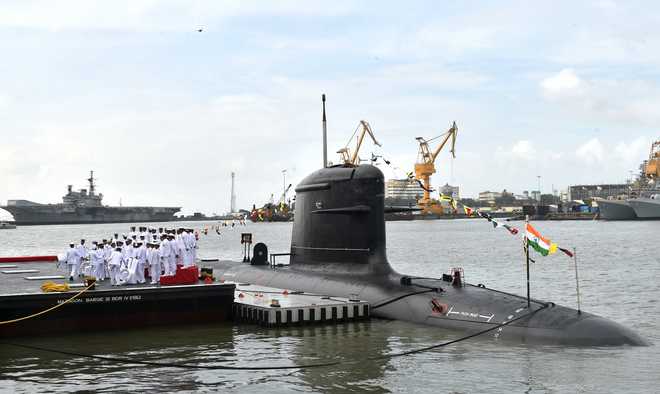
A view of the INS Khanderi at the Naval Dockyard in Mumbai on September 28, 2019. PTI

Shiv Kumar
Tribune News Service
Mumbai, September 28

India’s second Kalvari-class submarine INS Khanderi was on Saturday commissioned into the Indian Navy at a function here in the presence of Union Defence Minister Rajnath Singh.

According to the Indian Navy, the Khanderi is the second of its six Kalvari-class submarines which are being built in India. Designed by French defence company DCNS, the Kalvari-class submarines are
diesel-electric attack submarines with stealth features.

The submarines will be equipped with precision guided weapons like torpedoes, tube-launched anti-ship missiles which can be launched from under water as well as on the surface of the sea.

The submarine can be deployed in a variety of missions, including anti-surface warfare, anti-submarine warfare, intelligence gathering, mine laying, area surveillance, according to the Indian Navy.

Speaking on the occasion, Singh said the construction of the submarine would take Indian partnership with French technology providers to greater heights. “The construction of this submarine in India is benefiting a number of Indian industries through the Make in India
program,” Singh said.

Singh also praised the Indian Navy of eradicating piracy in international waters. “Our Navy has done great work in the eliminating piracy in the region. The impact of this is visible in the trade in the region,” the Minister added.

The submarine was built by Mazgaon Dock Limited and underwent sea trials for over two-and-a-half years before its commissioning, according to the Navy.

In his speech, Singh said the name Khanderi was inspired by the Sword Tooth fish which is known to hunt while swimming in the ocean’s depths.

The Minister also used the occasion to hit out at Pakistan. “Pakistan should understand that we can deliver a big blow to it with additions like the INS Khanderi,” Singh said.

He further added that attempts by some countries to carry out Mumbai-style attacks along India’s coast would not be allowed to succeed.

Singh was due to inaugurate the Navy’s biggest dry dock later in the day.


Ex-servicemen from Rewari seek tickets

Home to the largest number of defence personnel, Rewari is seeking increased representation of the fraternity in the government.

In a letter to the state BJP, the community has sought allotment of at least five tickets in the Haryana Assembly elections. Col (retd) Mahavir Yadav, president of The Martyrs’ Welfare Foundation, put forth the demand saying this was required to change the face of Ahirwal.

“Ahirwal has maximum defence families who have some specific expectations and requirements. An ex-serviceman will be able to understand and connect better with our issues and voice them. The BJP has done a lot for us but much is still required to be done,” he said.

He said the southern region of Ahirwal had contributed significantly to the nation and also supported the BJP in 2014 and 2019 Lok Sabha elections. It was high time that it got due representation to voice the welfare concerns of defence personnel.


Amid net shutdown, govt invites e-tenders for works

Amid net shutdown, govt invites e-tenders for works

Srinagar, September 20

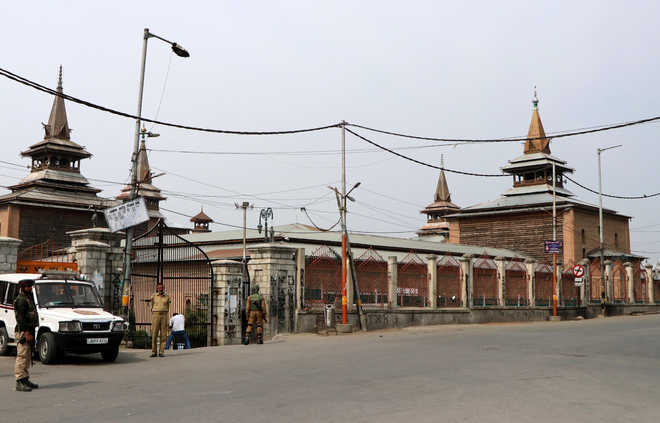
Even as the Internet remains suspended across Kashmir for more than a month, the state government this week invited e-tenders for several construction and renovation works.The e-tenders were invited by the roads and buildings (R&B) department of the state government “for and on behalf of the Governor, J&K state”.The works for which the online tenders have been invited include the upgrade and improvement of the road surface at Khan Colony, Firdousabad, in Srinagar’s Batamaloo locality, at Batapora, Hazratbal, and construction of a culvert at Rainawari and manholes at Balhama.

The e-tenders were also invited for the construction of drains at Laribal and Yamlar in north Kashmir’s Handwara sub-district, construction of Badkoot link road and seven other works there.The state government also invited e-tenders for eight works of upgrade, installation and construction in Sumbal sub-district of north Kashmir.

The R&B department, which invited these e-tenders, also instructed the bidders that only those tenders which were submitted online would be accepted. “The bidders have to submit their bids online in electronic format with digital signature. No bid will be accepted in physical form,” the department said.


The department asked the approved and eligible contractors registered with the state government, CPWD, Railways and other state and Central governments that the date and time of bids will be notified on the website of www.jktenders.gov.in and conveyed to the bidders through an e-mail.

“The bids of responsive bidders shall be opened online on the same website,” it said.

It also instructed the bidders to download the ‘bid submission manual’ from the ‘Downloads’ option as well as from the ‘Bidder Manual-J&K’ on the same website.

The invitation to file the e-tenders has come at a time when the Internet remains suspended across the Kashmir valley. The internet and mobile phones have remained suspended since August 5 when the Union Government announced the abrogation of Article 370. The landline phones, which were initially suspended, were restored in recent weeks but there is no official word about the restoration of mobile phones and the Internet.


Western Command GOC-in-Chief superannuates, gets warm send-off

Western Command GOC-in-Chief superannuates, gets warm send-off

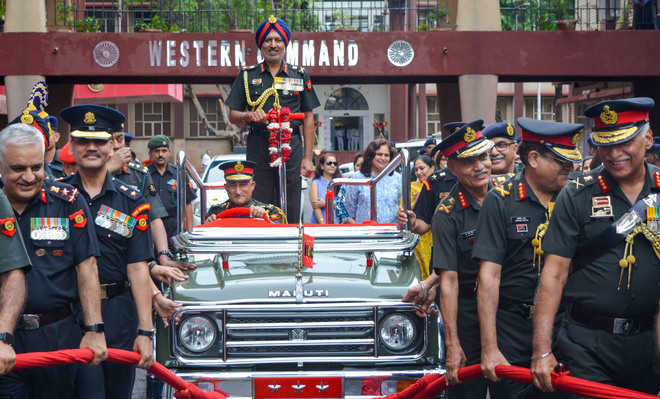
Lt Gen Surinder Singh, the outgoing GOC-in-C of Western Command, being given a ceremonial guard of honour at Chandimandir on Wednesday. Tribune photo

Tribune News Service

Chandigarh, July 31

Lt Gen Surinder Singh relinquished the charge of the General Officer Commanding-in-Chief, Western Command, on his superannuation today after having rendered about 40 years of service.

Lt Gen RP Singh, presently General Officer Commanding 21 Corps in Bhopal, will take over as the GOC-in-C, Western Command.

A ceremonial send-off was given to Lt Gen Singh by officers and men at Chandimandir. He laid a wreath at the Veer Smriti to pay homage to martyrs and inspected a guard of honour.

Commissioned into the 2nd Battalion of Brigade of The Guards in 1979, he later commanded the same unit. Besides commanding a division in Strike Corps and an operationally committed Corps in the Eastern Command, he has served in the Military Operations Directorate and the Perspective Planning Directorate at the Army Headquarters.

A recipient of the Param Vishisht Seva Medal, Bar to Ati Vishisht Seva Medal and Vishisht Seva Medal for distinguished services, he was also the Colonel of the Brigade of The Guards.

During his tenure as GOC-in-C, Western Command, Lt Gen Surinder Singh was closely involved in formulating futuristic operational concepts in offensive and defensive employments and also paved the roadmap for restructuring and modernisation. He also ensured improvement in the functioning of various Army institutions like Paraplegic Rehabilitation Centre, Mohali, the Army Institute of Law, Veteran Sahayata Kendra and Army Placement Node.