









Sanjha Morcha

What’s New

Click the heading to open detailed news

Current Events :

web counter

Print Media Reproduced Defence Related News

North’s first cable-stayed bridge opened in Kathua

The bridge will connect Jammu and Kashmir, HP and Punjab

A CABLE-STAYED BRIDGE IS A DECK WITH ONE OR TWO PYLONS ERECTED ABOVE THE PIERS IN THE MIDDLE OF THE SPAN. CABLES ARE ATTACHED DIAGONALLY TO THE GIRDER FOR SUPPORT

BASOHLI: North India’s first cablestayed bridge — the fourth of its kind in the country — that will provide connectivity to three states of Jammu and Kashmir, Himachal Pradesh and Punjab was on Thursday thrown open to traffic.

Defence minister Manohar Parrikar inaugurated the bridge named ‘Atal Setu’ on the Ravi at Basholi, situated on the DuneraBasohli-Bhadharwah road in Jammu and Kashmir’s Kathua district and dedicated it to the nation. Union minister of state in Prime Minister’s Office Dr Jitendra Singh and army chief Gen Dalbir Singh Suhag were also present.

Described as an engineering marvel in this part of the country, the Basohli bridge is the fourth of its kind in India. The other three cable-stayed bridges are — Hooghly bridge at Kolkata, Naini bridge in Allahabad and Rajiv Gandhi Sea Link in Mumbai, officials said. The bridge is strategically important from the defence point of view as well.

With the bridge thrown open, connectivity and tourism among the three states are expected to improve. The work on the maiden cable-stayed bridge in the state started in September 2011 on the demand of people of Basohli where over 22 villages were submerged in water and evacuated to other places after the construction of Ranjit Sagar dam.

The 592-metre span bridge was constructed by the Border Roads Organisation (BRO) at a cost of `145 crore. It is a joint venture of Indian Railway Construction Company Limited (IRCON) and SP Singla Construction group.

Out of the 592-metre span bridge, 350 metres is cable-stayed while rest is plain bridge. “A typical cable-stayed bridge is a deck with one or two pylons erected above the piers in the middle of the span,” officials said, adding, “The cables are attached diagonally to the girder to provide additional supports.” “The pylons form the primary load-bearing structure in these types of bridges. Large amounts of compression forces are transferred from the deck to the cables to the pylons and into the foundation,” they said.

The officials said these bridges have a low centre of gravity which makes them efficient in resisting earthquakes.

“Cable-stayed bridges provide outstanding architectural appearance due to their small diameter cables and unique overhead structure,” they added. UPA chairperson Sonia Gandhi set into motion the bridge’s construction by laying the foundation in May 2011.

India, Pak to resume composite dialogue, vow to eliminate terror

2015_12$largeimg10_Thursday_2015_015537326
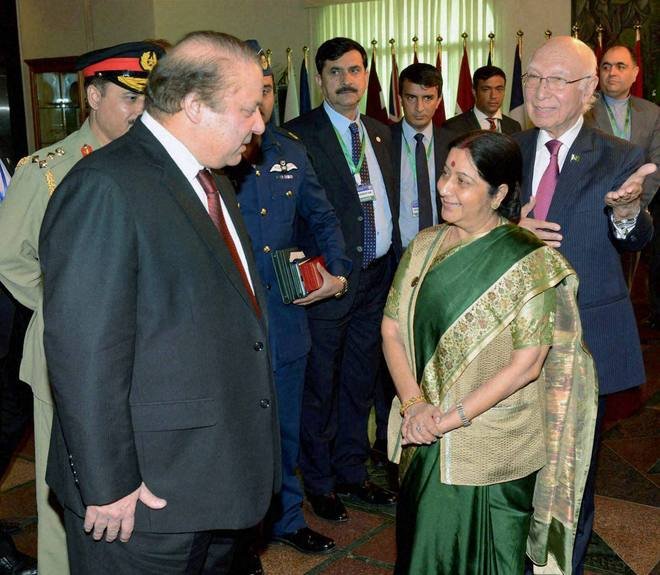
External Affairs Minister Sushma Swaraj with Pakistan Prime Minister Nawaz Sharif as Pakistan’s Foreign Affairs Adviser Sartaj Aziz looks on in Islamabad on Wednesday. PTI

Sushma meets Sharif, Aziz; Islamabad assures of speeding up probe into Mumbai attacks
Afzal Khan & Simran Sodhi
Tribune News Service
Islamabad/New Delhi, Dec 9
Ending months of deadlock, External Affairs Minister Sushma Swaraj today in Islamabad announced the resumption of a comprehensive dialogue between India and Pakistan that will include peace and security, Jammu and Kashmir and Siachen.
In a joint statement issued after Swaraj met Sartaj Aziz, Adviser to the Pakistan PM on Foreign Affairs, both sides condemned terrorism and resolved to cooperate for eliminating it.
Addressing the media after the meeting, Swaraj announced that the Foreign Secretaries of the two countries would meet and discuss the modalities to hold the comprehensive bilateral dialogue. “India and Pakistan have decided to restart the composite dialogue. It will now be called comprehensive bilateral dialogue. It will include all issues from composite dialogue and much more,” she said.
The two leaders noted the successful talks on terrorism and security-related issues in Bangkok by the two NSAs and decided that the NSAs would continue to address all issues related to terrorism. Pakistan has assured India of “steps to expedite the early conclusion” of the Mumbai attack trial, something that India has been pressing for long.
Both sides decided to ask the Foreign Secretaries to work out the modalities and schedule of the meetings under the dialogue, including peace and security, confidence-building measures, Jammu and Kashmir, Siachen, Sir Creek, Wullar Barrage/Tulbul Navigation Project, economic and commercial cooperation, counter-terrorism, narcotics control, humanitarian issues, people-to-people exchanges and religious tourism.
Earlier today, Swaraj called on Prime Minister Nawaz Sharif. Their hour-long meeting centred on improving bilateral ties and removing the irritants that have dogged the relation. Officials at the Pakistan PM’s house described the meeting as cordial and constructive.
Swaraj was received by Sharif’s daughter Maryam Nawaz on her arrival at the PM’s residence. Greeting the External Affairs Minister with a smile, Sharif thanked her for coming to Pakistan.

Logjam off, talks on

  • The Foreign Secretaries of the two countries to meet and discuss modalities for dialogue
  • Comprehensive dialogue to include discussion on security, confidence-building measures, J&K, Siachen, economic and commercial cooperation, counter-terrorism
  • The national security advisers of the two sides will address all issues related to terrorism

India’s no to cricket ties

  • India on Wednesday told Pakistan that there could be no cricket series between the two countries
  • Sources in the foreign establishment said India conveyed the message during the bilateral meeting between External Affairs Minister Sushma Swaraj and Sartaj Aziz, Adviser to the Pakistan PM on Foreign Affairs
  • Pakistan Cricket Board chief Shahryar Khan also confirmed the news in Pakistan

Army constructs water tank for Poonch village

Tribune News Service,Jammu, December 20

A Rashtriya Rifles Battalion under the Romeo Force has set up a water supply project for the locals of Hillkaka village in Surankot tehsil of Poonch district. The project was dedicated to the locals today.The village was facing shortage of drinking water.Under the project, a water tank of 15,000-litre capacity has been constructed near a perennial spring and pipes connected to it supply water to the village.The sarpanch of Hillkaka village said government employees, teacher and locals were present on the occasion. He thanked the Army for providing the much-needed facility.

About the project

  • Under the project, a water tank of 15,000-litre capacity has been constructed near a perennial spring and pipes connected to it supply water to the village.

Silent Features of One Rank One Pension questioned by MPs in Lok Sabha

GOVERNMENT OF INDIA
MINISTRY OF DEFENCE
LOK SABHA
UNSTARRED QUESTION NO: 1117
ANSWERED ON: 04.12.2015
One Rank One Pension
GOPAL CHINAYYA SHETTY
SUDHEER GUPTA
SANTOSH AHLAWAT

SATISH KUMAR GAUTAM
BHOLA SINGH
SUSHIL KUMAR SINGH
SUNIL BALIRAM GAIKWAD
K. ASHOK KUMAR
PARASURAMAN K.
GAJANAN CHANDRAKANT KIRTIKAR
T.G. VENKATESH BABU
KUNWAR HARIBANSH SINGH
FAIZAL P.P. MOHAMMED
K. C. VENUGOPAL
GAURAV GOGOI
N.K. PREMACHANDRAN
NAGENDRA KUMAR PRADHAN
SHIVKUMAR CHANABASAPPA UDASI
P. KUMAR
NARANBHAI KACHHADIA
GANESH SINGH
ANTO ANTONY
C. N. JAYADEVAN
VIJAY KUMAR S.R.
ELUMALAI VELLAIGOUNDER
KAPIL MORESHWAR PATIL
GEETHA KOTHAPALLI
SRINIVAS KESINENI
JYOTIRADITYA MADHAVRAO SCINDIA
SUMEDHANAND SARASWATI
RAVINDRA KUMAR PANDEY
ASHOK SHANKARRAO CHAVAN
RAMA KISHORE SINGH

Will the Minister of
DEFENCE be pleased to state:-

(a) whether the Government has notified the One Rank One Pension (OROP) scheme for ex-servicemen and widows;

(b) if so, the details and the salient features of the scheme;

(c) whether ex-servicemen have expressed their dissatisfaction with the nature of the OROP scheme notified by the Government and if so, the details thereof;

(d) the corrective measures taken / being taken by the Government in this regard; and

(e) whether the Government proposes to extend OROP to premature retirees and proposed to recalculate pensions every five years instead of annually and if so, the details thereof and if not, the reasons therefor?

ANSWER
MINISTER OF STATE (RAO INDERJIT SINGH)
IN THE MINISTRY OF DEFENCE

(a) Yes, Madam. Government order on One Rank One Pension (OROP) has been issued on 07.11.2015.

(b) Salient features of the OROP are as follows:

(i) Pension of the past pensioners would be re-fixed on the basis of pension of retirees of calendar year 2013 and the benefit will be effective with effect from 01.07.2014.
(ii) Pension will be re-fixed for all pensioners on the basis of the average of minimum and maximum pension of personnel retired in 2013 in the same rank and with the same length of service.
(iii) Pension for those drawing above the average shall be protected.
(iv) Arrears will be paid in four equal half yearly instalments. However, all the family pensioners including those in receipt of Special / Liberalized family pension and Gallantry award winners shall be paid arrears in one instalment.
(v) In future, the pension would be re-fixed every 5 years.

(c) Certain ex-servicemen associations have been demanding for changes in methodology for fixation of pension, periodicity of its revision, coverage of future PMR cases etc.

(d) The Government has decided to appoint a Judicial Committee to look into anomalies, if any, arising out of implementation of OROP.

(e) Personnel who opt to get discharged henceforth on their own request under Rule 13(3) 1(i)(b), 13(3)1(iv) or Rule 16B of the Army Rule 1954 or equivalent Navy or Air Force Rules will not be entitled to the benefits of OROP. It will be effective prospectively and in future, the pension would be re-fixed every 5 years.

Source: PDF/WORD(Hindi) PDF/WORD

Read more: http://www.staffnews.in/2015/12/silent-features-of-one-rank-one-pension.html#ixzz3tjl2sYhR
Under Creative Commons License: Attribution Share Alike
Follow us: @karnmk on Twitter | cgenews on Facebook


US asks Pak to hold back N-plans

Washington, December 17

2015_12$largeimg18_Friday_2015_013758533

Voicing concern over Pakistan’s nuclear and missile programmes, the US has asked it to restrain them and avoid any developments that might lead to increased risk to nuclear safety and strategic stability.“I wanted to say that we do share your concerns particularly about the development of Pakistan’s nuclear arsenal. We’re concerned most by the pace and the scope of the Pakistan’s missile program, including its pursuit of nuclear systems,” Special US Representative for Afghanistan and Pakistan Richard Olson told lawmakers during a hearing on Pakistan convened by House Foreign Affairs Committee.“We are concerned that a conventional conflict in Southwest Asia could escalate to include nuclear use as well as the increase security challenges that accompany growing stockpiles. We have had a very active dialogue at the highest levels with the Pakistanis in which we have made clear the nature of our very specific concerns,” Olson said yesterday in response to a question from Congressman Brian Higgins.He said the United States has asked Pakistan to restrain its nuclear and missile programmes.“As with all nuclear-capable states, we have urged Pakistan to restrain its nuclear weapons and missile development and stressed the importance of avoiding any developments that might invite increased risk to nuclear safety, security, or strategic stability,” he said.“We are not negotiating a 123 agreement with Pakistan,” he said. His remarks came after US lawmakers asked the American government to be tough on Islamabad as it does not seem to be sincere in improving ties with India and has accelerated the pace of arsenals’ production.Higgins during the hearing alleged that Pakistan is not sincere in improving its relationship with India.“Pakistan is involved in an arms race against what it believes is its existential threat with India. According to the Carnegie Endowment for International Peace, Pakistan could have 350 nuclear warheads in the next decade, becoming the world’s third biggest nuclear power, outpacing India, France, China, and the UK,” he said.“There is no positive sign of any improved relations with India because Pakistan justifies its nuclear proliferation as a deterrent against aggression from the outside. So the United States has to get tougher with Pakistan. We have to call them out on this double game they have been playing, not this year, not last year, not five years but for the past 15 years,” Higgins said.“Pakistan, let’s be truthful about this, plays a double game. They’re are military partner, but they’re the protector and the patron of our enemies. And this has been going on for 15 years. Since 2002, US aid to Pakistan, economic and military, has averaged about $2 billion a year. Pakistan’s annual defence budget is only about $5 billion a year.”He said if Pakistan falls apart or if Islamic extremists take over, it’s a nightmare scenario for the US.“It’s a big country, about 180 million people, it has a lot of Islamic extremists, and it has nuclear weapons. And to have Islamic extremists with nuclear weapons is a primary goal of al-Qaida and it would be major victory for them and the outgrowth of al-Qaeda, the Islamic state and a major defeat for us, the US,” Higgins added. — PTI

Concerned’ at Pak’s nuke arsenal

  • Richard Olson (in pic), Special US Representative for Afghanistan and Pakistan, has said the US is concerned at the pace and scope of the Pakistan’s missile programme, including its pursuit of nuclear systems
  • The US is worried that a conventional conflict in Southwest Asia may escalate to include nuclear use, he said
  • He asked Pakistan to ‘restrain its nuclear weapons and missile development’ and avoid any developments that might invite ‘risk to nuclear safety, security, or strategic stability’

ISI spy ring: J&K teacher held

Tribune News Service
Rajouri/New Delhi, Dec 5
The crime branch of the Delhi Police today arrested a schoolteacher for his alleged involvement in the recently busted ISI-supported espionage network on the Border Security Force (BSF) and Indian Army deployments in the state.
The man has been identified as Sabar, who is a teacher at a government school in Rajouri, J&K. He was apprehended from Rajouri and booked under the Official Secrets Act. Sabar’s arrest is the fourth one in this case.
Sources said a team of the crime branch had been camping in Rajouri for the past few days. The team today raided the house of Sabar, whose name was figured during the sustained interrogation of Abdul Rashid, a serving BSF head constable, and Kafait Ullha Khan, a library assistant at Higher Secondary School, Manjakote, in Rajouri. They were earlier arrested for providing sensitive and national security information to the ISI.
As the crime team cordoned the house of Sabar in Amiti village in the vicinity of Rajouri town, he tried to escape after jumping from the rare window, but was nabbed by the team. He was immediately rushed to the district hospital and after initial treatment and legal formalities brought to Jammu.
On Friday, the crime branch sleuths had raided the house of ex-serviceman Munawwar Hussain Mir in Khablan village and arrested him for being part of the espionage network.
Mir was introduced to Kafait Ullha Khan by Sabar and both used to provide information related to nation security to Kafait, who was in touch with Pakistan ISI handler. Kafait was arrested last Saturday along with sensitive documents from the Delhi railway station while on the way to Bhopal to meet ISI agents on the plea to attend religious congregation.
On his disclosure, Abdul Rashid was arrested from the BSF sector headquarters where he was posted in the intelligence cell. Besides a government employee, Sabar used to run a cyber cafe in the Gujjar Mandi area.
The clue
Sabar’s name figured during the interrogation of Abdul Rashid, a serving BSF head constable, and Kafait Ullha Khan, a library assistant at a school in Rajouri. They were arrested earlier for providing sensitive and national security information to the ISI.


Ex-servicemen rally in Delhi against OROP announcement

Ex-servicemen agitating over the ‘One Rank, One Pension’ (OROP) issue today threatened to intensify the protest if their demands were not met by the Centre within three weeks.

Ex-servicemen from across the country on Sunday held a ‘Sainik Akrosh’ rally in New Delhi to protest the government notification on the ‘One Rank One Pension’ (OROP) issue.

They threatened to intensify the protest if their demands were not met by the Centre within three weeks even as they decided to not vote for BJP in the upcoming assembly elections.

The United Front of Ex-servicemen (UFES), an umbrella body of associations of ex-servicemen which is leading the protest, demanded that the Centre appoints “formally” former Army Chief and Union Minister V K Singh as the mediator between them and the government to resolve the issue “immediately”.

The protesting ex-servicemen, who have been agitating at the Jantar Mantar for the last 183 days, claim the OROP scheme announced by the government is different from its original definition that was agreed upon between the two sides.

“There is no demand… the (OROP) scheme that parliament approved and the notification issued are different,” Major General Satbir Singh (retd), who is spearheading the ex-servicemen’s agitation, said.

“There are seven major mistakes. They (government) are telling the nation they have given the OROP but they have actually finished it,” he said.

Singh also slammed Finance Minister Arun Jaitley for his alleged statement that more ex-servicemen were satisfied with the OROP scheme announced by the government.

“We are sad (that) Jaitley said most veterans have agreed to the scheme… it is a lie… look at the number of people who have come,” he said.

“The number would be even bigger had our other colleagues reached here in time. Jaitley claims their OROP is acceptable to most of us, it is a lie. More than 99.99 per cent of us are against it,” he claimed.

Aiming to mount pressure on the NDA government, the UFES urged its members to not vote for the BJP in the upcoming assembly elections in several including Assam.

The veterans claimed it were the votes of ex-servicemen which helped BJP improve its tally in the 2014 Lok Sabha – more than what the NDA major itself had expected, they claimed.

However, the government has “cheated” veterans by not giving the OROP they wanted and BJP had promised to give, Singh said.

“You saw what happened to the party in Delhi and recently Bihar. We urge the members to not vote for it in upcoming polls now if our demands are ignored,” he added.

The UFES also called upon ex-servicemen present at the rally to boycott Republic Day celebrations this year.

Singh also announced the UFES rejected 7th pay commission report, saying it is over and above OROP.

The government came out with a notification on OROP on November 7 but the veterans still remain unsatisfied. They have demanded that OROP should be implemented from April 1, 2014 and not July 1, 2015 as in the government notification.

OROP principle is in perpetuity and cannot be fiddled with, they maintain.


INDIA SPENDS MORE ON MILITARY OFFICIALS THAN US, UK, SAYS IDSA

Indian_Army_16
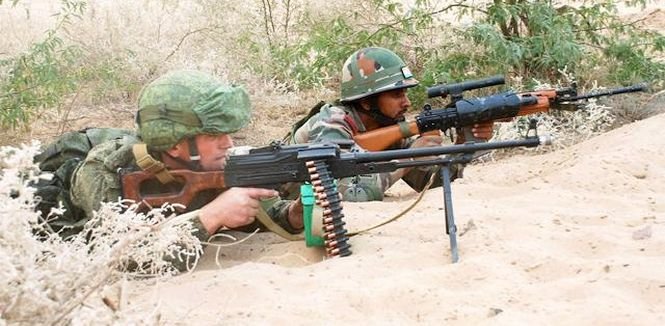
Indian & U.S. Soldiers during a Drill in the Rajasthan Desert

A comparative study on defence expenditure of ten top military nations including US, UK, Russia, China, France and Germany besides India and Pakistan has raised concern at India’s growing expenditure on defence personnel which has adversely affected its operation and war preparedness.

The study was conducted by the Institute for Defence Studies and Analyses (IDSA) for the 7th Central Pay Commission (CPC) which has recently submitted its report to the government. The report has analysed strength of top militaries and their expenditure on personnel, operations and equipment procurement as proportion of total defence budget.

“In so far as expenditure on operation and maintenance is concerned, India finds itself at a low ninth place in 2007 and 10th place in 2012 (among ten top defence forces),” the pay panel has observed.

The reason, it says is because India is spending much more on personnel (salary and allowances) as a proportion of its total defence budget, directly affecting operation and maintenance expenditure. The expenditure on personnel (in India) has increased from 27% of the total defence bud get in 2007 to 41% in 2012 while that on operation and maintenance has decreased from 25% to 15% during the same period.

In comparison, the US spends only 26% of its total defence expenditure on personnel while keeping aside 37% for operations and maintenance. Its share in equipment purchase remains highest between 35% and 41%. China has earmarked almost equal share of funds towards expenditure on personnel, operations and equipment purchases and infrastructure construction.

Even Pakistan which spends 42% of its total defence expenditure on personnel has been spending 26% on operations and maintenance, a higher proportion than India.

In its comments on the findings of the IDSA, the pay panel has observed that the pattern of the defence expenditure brings to fore the need to balance the requirements of the defence forces with the availability of resources.

“The commission recognises the need to calibrate growth in expenditure on pay and allowances…so as to ensure that the composition of defence expenditure be tween capital and revenue and within revenue between pay and allowances and others is not skewed so as to adversely affect the operational and strategic objectives of the forces,” the 7th CPC has noted.

One of the arguments for the larger expenditure on personnel in India is the relative mix of the strength of the services that constitute the armed forces. The IDSA has reported that the share of the Army in the total personnel strength of the Indian armed forces is over 85% while those in the US and UK are 39% and 59% respectively , the pay panel noted, short of suggesting that policy-makers may shift focus to modernising the armed forces and spending more on operational capabilities rather than building huge contingents of boots on the ground.


INDIAN ARMY CONDUCTS HUGE MILITARY DRILLS NEAR PAKISTAN BORDER

Indian_Army_Exercise_2

Tensions between the two nuclear-armed neighbors is high as India is conducting massive military exercises on its western front with intensive armoured, artillery and infantry manoeuvres to practise swift, high-intensity attacks into enemy territory.

It includes more than 50000 troops of Southern Army Command as well as hundreds of T-90S and T-72 main-battle tanks, artillery guns and multiple-launch rocket systems, all backed by “real-time battlefield transparency” provided by satellites and drones, ground and airborne radars.

Indian military drills also include Bhopal based 21″strike corps” and 12 Corps of Jhodpur . The Indian military exercise will conclude on 10th December 2015.

The aim is to ensure a realistic war-like situation without actually going to war.

The exercise, which will peak towards end-November, will also include a major airdrop of paratroopers behind (simulated) enemy lines. Such a large exercise is usually held once in four years to validate, fine-tune war-fighting strategies

Pakistani government was informed of the scheduled military exercises, in accordance with the “advance notice” protocol in place between the two nations.

On the other hand , Indian and Russian armies were conducting joint military exercises ‘Indra 2015’ that starting on November 7 and concluded on November 21at the Mahajan firing range just north of the city of Bikaner in Rajasthan, which borders neighbouring Pakistan.

The city of Mahajan is not far from India’s border with neighbouring Pakistan and ties between the two countries have not been exactly good in recent months, with several ceasefire violations and civilian deaths on the Pakistan side by Indian army shelling along the Line of Control and Working Boundary.


ISIS may join hands with LeT to launch attacks in India: Army

433534-islamicstate700
Jammu: A top Army commander on Thursday said there was a “possibility” that global terror outfit Islamic State (IS) may join hands with Pakistan-based Lashkar-e-Taiba to launch attacks in India.

“Yes, that (IS joining hands with LeT to launch attacks in India) can be a possibility as the motive of the terrorists is to spread their propaganda.

“They want their name and for that, they can do anything. And if they get successful, they can take advantage of it by using any name. Yes it is a possibility,” General Officer Commanding of the 16 corps of the army Lt Gen RR Nimbhorkar told reporters here today.

He was replying to a question whether IS can join hands with other terrorists outfits like LeT to launch Paris-type attacks in India.

Lt Gen RR Nimbhorkar also said there are around 700 active militants in Pakistan occupied Kashmir (PoK) who.

On a question about the number of terrorist training camps active across the Line of Control in the POK, he said that from the inputs that the captured terrorist Navid has given there are around 37 active camps in that region.

“See, there are a number of launching pads and we are all aware of it as it is in the open domain. So, therefore, I will not exactly say as to how many are there,” he said.

The army commander said,”There are sufficient number of launching pads and if you calculate that way… Take the statement which is given by terrorist captured in Udhampur attack so you can easily co-relate what he said and calculate…

“So to my mind in the entire PoK there may be about 600-700 terrorists.”

He said that out of the 700 militants present in the PoK, half of them are ready and waiting for a chance to infiltrate into the Indian side.
“Out of them, half are ready to be launched so they can come in the launch pad and get launched,” he said.
PTI
Download the all new Zee News app for Android and iOS to stay up to date with latest headlines and news stories in Politics, Entertainment, Sports, Technology, Business and much more from India and around the world.

Watch: Indian Army trains for tough times!

vedia Indian Army training