


















Sanjha Morcha

What’s New

Click the heading to open detailed news

Current Events :

web counter

Print Media Reproduced Defence Related News

War hero’s widow relives his bravery in Tripura

RANCHI: Param Vir Chakra winner Lance Naik Albert Ekka’s septuagenarian widow could hardly walk in her Jharkhand village as old age, ill-health and working in the fields till a couple of years ago had taken a toll on her knees.

HT PHOTOParam Vir Chakra awardee Albert Ekka’s widow, Balamdina Ekka, (centre) with army men in Agartala.On Sunday, Balamdina Ekka hobbled up the stairs of Tripura Sundari temple to offer prayers, took a boat ride in the Rudrasagar Lake and adored every corner of the historic Neer Mahal in Tripura escorted by dozens of Assam Rifle soldiers.

“I can see my Albert everywhere, in the hills, lake and temple. I am happy that I could visit this place,” she said over the phone from Agartala.

When nobody thought she would be able to get out of her native village of Jari, she defied age and physical impairment to relive memories of her husband, the Ranchi’s brave heart who died fighting for the country in the 1971 IndiaPakistan war.

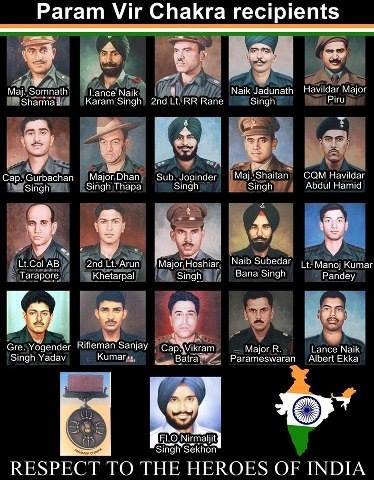
Lance Naik Ekka of the army died in the Battle of Hilli. He was posthumously awarded the Param Vir Chakra, India’s highest award for valour in war.

In Tripura for the past two days, Balamdina’s boundless energy and excitement have surprised family members as well as army officers from Jharkhand accompanying her in the trip. The widow demanded that she be taken to every place her late husband went to when he was posted there.

The primary purpose of her journey is to visit her husband’s grave after 45 years of his death and bring sacred soil from the place of his burial.

Ever since she reached Agartala on Friday evening, where the Assam Rifles rolled out the welcome carpet, her excitement and energy abruptly multiplied.

Son Vincent Ekka and daughter-in-law Rajni Ekka are equally excited. “The mere sight of army jawans thumping their boots and saluting us in honour is overwhelming. Now we know how great the sacrifice of my father was,” Vincent said.

Ride out the China storm

India should focus on how to mitigate the effects of turmoil in an integrated world economy

The two slides in Indian stock markets over the past week have only served to underline what has become increasingly evident: Our economy is strongly integrated with the Chinese one, and there is no escaping the impact of a slowdown in what was until recently the engine of global growth. So hapless Indian investors catch the mother of all colds when their northern neighbour sneezes, and there is little to suggest that their sniffles will die down anytime soon. For, the Indian companies in which they invest are battling several fallouts: Poor demand for their products in China due to slow growth and a weaker yuan, the prospect of dumping of Chinese goods in India, and higher costs of servicing dollar debt due to downward pressure on the rupee.

The yuan has fallen nearly 6% since August, exacerbating a trade imbalance. Steel plants are prominent on the nonperforming asset list of Indian banks and the current situation is likely to make things worse. Global commodity prices have tanked due to a fall in Chinese demand and a combination of tepid offtake and oversupply has kept crude oil prices low. This is a big silver lining for crude importer India, on the face of it, but the underlying message is disturbing: Economic growth in some key export markets is unravelling. The falls in Chinese stocks are also disturbing for another reason. They suggest that the totalitarian regime is struggling to come to grips with financial markets, and that markets are not fully reflecting what is happening in the economy. In July the Chinese market regulator had said people who owned more than 5% in a company were prohibited from selling stocks for six months, the reason being that the markets had been falling “irrationally”. As a result, over 1,000 companies had stopped trading. In the first week of January, partly owing to the rumour that the ban would be lifted and partly because of the weak manufacturing data, the markets in China fell hugely, wiping out $2.5 trillion of wealth. Then followed a second round of devaluation of the yuan and its ripple effect: The shaving off of $194 billion from the wealth of the world’s 400 richest people. The market injection of $20 billion by the Chinese authorities could not do much to improve the situation.

The rupee has fallen sharply against the dollar, but Indian exports are still struggling because other currencies such as the euro have fallen further. India will have to come to grips with the fact that in an integrated world, much is beyond its control and it needs to focus on the things it can change: Slashing red tape, boosting investments and generating jobs. The next big opportunity for action is next month’s Budget.


Turn the Pakistan prism

2016_1$largeimg10_Sunday_2016_230922488

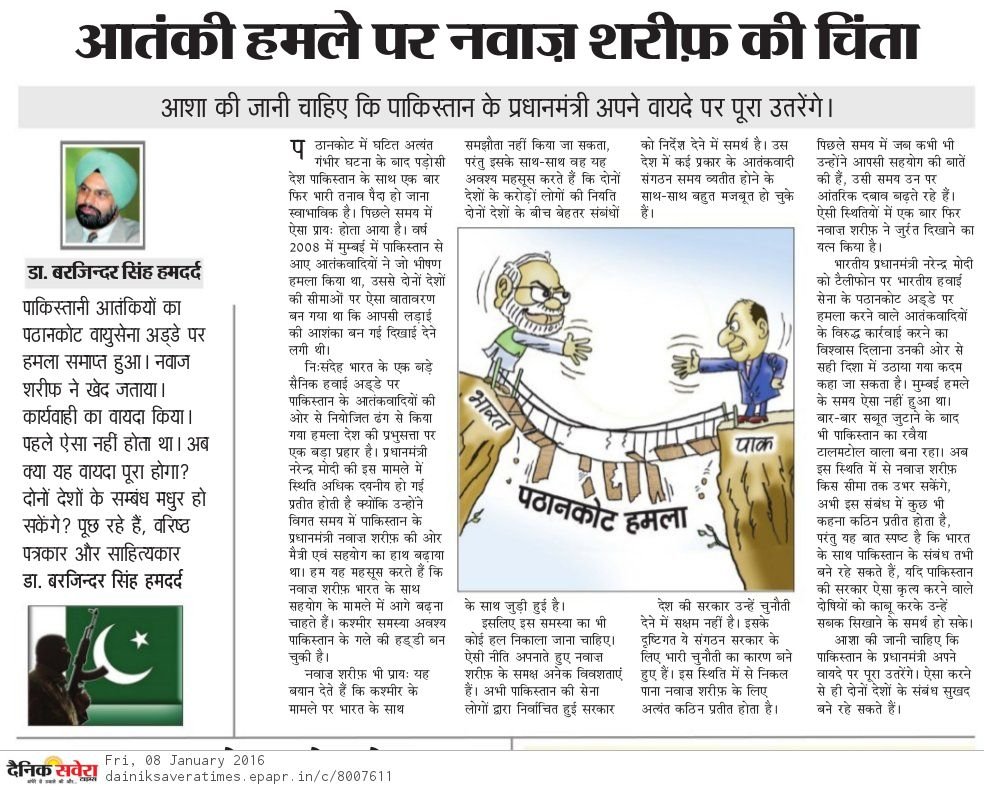
WHEN Pakistan Prime Minister Nawaz Sharif called up Prime Minister Narendra Modi to commiserate on the Pathankot air base attack, it was a déjà vu moment. The same effusiveness was in full play about seven years back when the Mumbai attacks had rocked India. The then Pakistani President Asif Zardari had even offered to send the ISI chief to discuss the extent of culpability of rogue officers in the military while top Lashkar-e-Taiba commanders, including its ideologue Hafiz Saeed, were jailed and a special anti-terrorist court set for their speedy prosecution.This was unprecedented in Indo-Pak cooperation on terrorism. The offers yielded little because the Pakistani military’s strategy of using militants in Afghanistan and India at that time kept their intelligence agencies busy from exerting a similar counter-pressure.Three years after the Mumbai attacks, Pakistani public perception of its military’s prowess took a beating when US marines came and killed Osama bin Laden, and then, half of Pakistan’s maritime surveillance fleet got decimated in the Mehran air base attack that exposed the involvement of men in uniform.There was a window of opportunity in 2011 but the Zardari-controlled Pakistan People’s Party’s was unable to deliver on its promise to swiftly prosecute the Mumbai attack masterminds. Is it different now? Can Nawaz Sharif act on his promise given to Narendra Modi? Just over a week before the Foreign Secretaries of both countries are slated to meet in Islamabad, New Delhi seems to have taken the Pakistan Prime Minister on his word and added a few conditions of its own. One of them appears to be the arrest of Jaish-e-Mohammed chief Masood Azhar of the Kathmandu-Kandahar plane hijack notoriety who has remained unprosecuted for the crime for 16 years.The state of play in Pakistan that encouraged Nawaz Sharif to make the “assurance” looks more promising than during Zardari’s tenure as Pakistan President. Nawaz Sharif’s third-time ascension as Prime Minister is unprecedented in the annals of leadership turnover in Pakistan. This was the only occasion when a democratic government completed its mandate of five years in office and gave way to another of the same make. The consequent ebb in the political clout of the Pakistan military has led to the democratic government getting a firmer handle on the tools of governance and policy making than its earlier predecessors.But the Indian Government could be indulging in an over-optimistic reading of tea leaves in the Pakistani security apparatus when National Security Adviser Ajit Doval crafted a stern message of take it or leave it to Nawaz Sharif. In a signal via the media, Doval claims that India has handed over all evidence, including phone intercepts, mobile phone numbers of the handlers behind the Pathankot attack, along with their names and locations. All of this again sounds familiar. India had gone through exactly the same drill after the Mumbai attacks. The then civilian government in Pakistan, a couple of shades more secular than Nawaz Sharif and therefore less complicit with radical groups, tried hard to deliver. The other side strove equally hard to thwart this attempt. When all else failed, the lawyer prosecuting the seven masterminds of the Mumbai attacks was shot dead. His successor also died mysteriously. The rapid-fire conclusion by Indian media commentators detected the ISI’s hand.It is not as straightforward and uncomplicated. A large section of Pakistan society is radicalised and tends to subscribe to the methods and philosophy of the radicals. This is mainly due to the unwillingness of all governments, both military and democratically elected, to change the intensely feudal and crony dominated arrangement at the top and intermediate layers. This setup has rarely allowed the subaltern to join them in governance and policy making, leading them to view the radicals as some sort of a revolutionary force that could give them deliverance from perpetual political subjugation by the landlords-cum-industrialists from Raiwind (the Sharif clan), Larkana (the Bhutto family) and several like them who get co-opted in Central Cabinets.The era of socialist and Left activism, the main drivers for resolving this structural problem and providing a solution, is over. India has continuously accommodated the less deprived by tools such as reservations and should understand this flaw better than the Europeans and the Americans who undertook other means, including domination of resource-rich nations, to keep their citizen satiated. Neither Pakistan nor India can ever resort to this technique perfected by the West for over four centuries. It is the Pakistani elite’s incapacity to effect changes in the system that draws its youth to the aesthetics of violence and self-destruction.India’s security managers in New Delhi’s South Block could take heart from the halving of terrorist attacks in Pakistan last year as compared to the previous year. Yet the country continues to host, often against its interests, a medley of violence-addicted groups who have the ability to turn the clock back on the current spell of sociability between the two Prime Ministers.  For example, Pakistan marked the end of the year with the murder of its top anti-terrorism manager in Punjab and a blast that killed 29. Both were suspected to be the handiwork of groups operating independently of Pakistani military and intelligence agencies. Much like the Mumbai attacks, they were assisted by some former military officials who had branched out after Pervez Musharraf’s post 9/11 U-turn on using militant groups in Afghanistan. Some militant groups also began attacking their former mentors in the military after Musharraf’s ceasefire with India in 2004 had bottled up the Kashmir channel.If the bonhomie between the two establishments is for real, Doval’s conditionalities should maintain the pressure on Islamabad-Rawalpindi to keep in check India-focussed vendors of violence. But it will be unrealistic to expect a total cessation. Instead the leaderships of India and Pakistan need to turn their attention to policies that produce economic deliverance for their people. For India that would mean shorter trade routes for its merchandise exports into Central Asia and Afghanistan.For Pakistan, it should translate into access to energy and increase in the domestic investment rate to wean it from perpetual dependence on foreign aid which makes it susceptible to tutoring from the benefactors. Nawaz Sharif is best placed to deliver near-total peace with India. Not only is the international opinion ranged against military takeovers, Nawaz Sharif is a major beneficiary of the Zardari government’s annulment of a Constitution provision authorising the President to remove the Prime Minister. But India must move on multiple fronts with Pakistan. Holding it accountable only to the metric of terror will be insufficient and impractical.



DRDO successfully conducted test new tank ammunition

DRDO successfully test-fires new tank ammunition

short by Ankur Vyas / 01:19 pm on 09 Jan 2016,Saturday
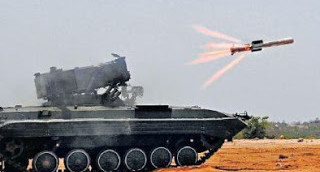
The Defence Research and Development Organisation (DRDO) claimed on Saturday that it successfully test-fired new tank ammunition – PCB (Penetration-Cum Blast) and TB (Thermobaric) – on January 6, 2016. The tests were conducted at Chandipur in Odisha. Designed for the Main Battle Tank (MBT) Arjun, the new ammunition will “give a quantum leap” in its fire-power, Ministry of Defence claimed.

India links talks to terror action

72785521-0ae3-4fbd-bf51-df7137daf493 e32bb622-09c8-49bd-bf03-5490ba2ed440 b2da2ed8-c6ec-4b20-b6ba-06c74ae5ea6d

PATHANKOT ATTACK MEA says ‘actionable’ intelligence given, ball in Pak court; India identifies 5 key Jaish ‘handlers’

HT Correspondent

KAMALJIT SINGH/HTArmymen at Pandher village after reports of two suspected terrorists hiding in sugarcane fields, in Gurdaspur on Thursday.NEW DELHI: Talks between the foreign secretaries of India and Pakistan slated for January 15 seemed to be on thin ice as New Delhi on Thursday linked the event with “decisive and prompt” action by Islamabad on the deadly terror attack at the Pathankot airbase.

The foreign ministry stated the position without setting a deadline for Pakistan, even as Prime Minister Nawaz Sharif discussed the terrorist strike at a high-level meeting in Islamabad. He was reportedly briefed about the status of a ban on the Jaish-e-Mohammad (JeM), which is suspected to be behind the attack.

On Thursday, Prime Minister Narendra Modi told his cabinet colleagues that bilateral talks would not resume until Islamabad took action against the terror group and he had made this clear during a phone call with Sharif. “Action is a must. We are going to be very strict about it,” Modi was learnt to have said at the meeting.

Indian security agencies have identified five key figures from JeM who were involved in the conspiracy and New Delhi wants Islamabad to act against them. The terrorists under the scanner are the group’s chief Maulana Masood Azhar, his brother Rauf Asghar, Maulana Ashfaq Ahmad, Hafiz Abdul Shakur and Kasim Jan.

Unlike in the 26/11 Mumbai attacks case where it remained in constant denial, Pakistan has not rejected India’s assertions about the role of the terror outfit in the Pathankot attack.

“India wants peaceful ties with all neighbours, including Pakistan but will not countenance cross-border terrorism. Actionable intelligence was given to Pakistan. Ball is in Pakistan’s court now,” ministry of external affairs spokesperson Vikas Swarup told reporters on Thursday.

He, however, parried questions about the possibility of the talks being cancelled, maintaining that India was not fixing any deadline for Pakistan to respond, nor was it “foreshadowing” the talks.

“Prime Minister Narendra Modi spoke to Prime Minister Nawaz Sharif, who assured us a prompt response… India now awaits a prompt and decisive action,” said Swarup. “Eight days remain for the foreign secretary-level talks between the countries; let’s see what happens in the days before January 15.”The meeting Sharif chaired in Islamabad was attended by his national security adviser, Naseer Khan Janjua, foreign secretary Aizaz Chaudhry and foreign policy chief Sartaj Aziz.

Janjua, according to sources, briefed them about his discussions with his Indian counterpart, Ajit Doval.A brief statement issued after the meeting by Sharif’s office only said “issues pertaining to national and regional security were discussed” but did not give details.

Pakistan has condemned the Pathankot attack and said it wants to build on the goodwill created by a December 25 meeting between Modi and Sharif when Indian PM called up his Pakistani counterpart from Kabul and took an impromptu decision to fly down to Lahore on the latter’s invitation.

Gurdaspur on the edge as troops prepare to take on two ‘militants’

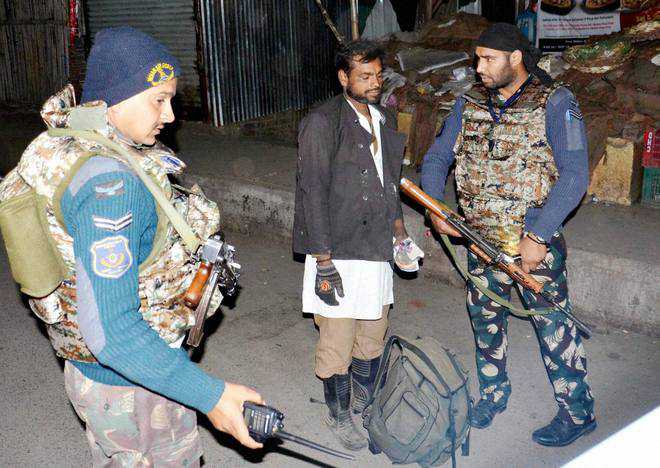
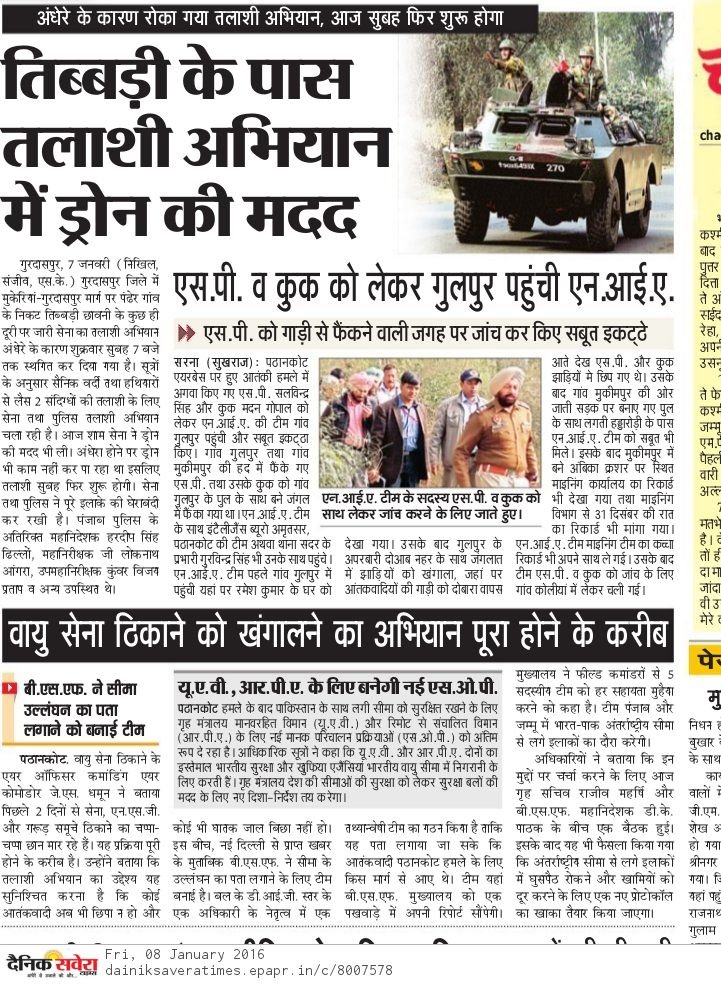
GURDASPUR: Security personnel, including an Israel-trained SWAT team, spilled into the fields and byways of Punjab’s Pandher village on Thursday to flush out two suspected terrorists, with the authorities fearing an attack on a key military facility days after a terror siege at the nearby Pathankot airbase.

Sources confirmed that government forces were prepared for an offensive a day after locals reported seeing two men in military fatigues acting suspiciously near the army cantonment in Gurdaspur district. When confronted, the men took cover in a sugarcane field, witnesses said.

Punjab Police deputy inspector general (border range) Kunwar Vijay Partap Singh said: “We are not taking any chances. Aerial surveillance and troop movement is on.” “A drone helped locate their location and by Thursday afternoon, the army and police teams took position,” a police source said.

Soldiers concealed themselves on rooftops, behind trees and at a brick kiln as armoured vehicles rolled into the village in the afternoon. A helicopter had conducted surveillance sorties earlier in the day. By night, the sugarcane field spread over 30 acres was lit up by searchlights.

Pandher village is nearly 20km off the India-Pakistan border and about a stone’s throw from the Tibri military cantonment. The facility is not far from the Pathankot air force station that saw a four-day long counterterror operation in which six terrorists were killed.


Rapid-fire communication

Govt betrays nervousness in Pathankot bulletins

Patriotism was the emotion of the moment as our soldiers battled foreign intruders on the premises of a premium defence establishment in Pathankot over the weekend. The national mood was entirely in keeping with the developments. In hindsight, however, one can discern instances where those at the helm of steering the security operation too seemed to get carried away by the need to respond to the heightened emotions. Both the government and the media did well to give out as few operational details as possible; a lesson from Mumbai, perhaps. But the government made a few attempts to sound as if they were on top of the situation when in reality the various agencies were themselves perhaps not sure of what was happening.Because of the very nature of such operations, clarity on the exact ground situation cannot be expected till all is over. Union ministers in their tweets and senior officers of the security establishment (a few in bullet-proof jackets at a press briefing) made statements that later proved premature. All of this unnecessary confusion caused by ham-handed communication made the security forces seem inept, when that may not have been the case. The electronic media was equally caught up in the patriotic fervour, repeatedly broadcasting long clips of mourning of bereaved families of soldiers. All of this affects the national mood, which is quickly reflected in social media. And the present government is acutely sensitive to what goes on in the virtual world.The Defence Minister has referred to certain “gaps” in the security response to the attack. The government now needs to show confidence in being able to acknowledge wherever the lapses were so that appropriate remedy may be applied. The NDA government has the advantage of nationalistic credentials and the security of numbers in Parliament. That should give it the confidence to remain silent when there is nothing to be said and only give facts when it does speak. The media management of the government has been shown lacking once again. Hope the decisions it takes are not in response to the gallery.

IAF BASE ATTACKED

Army, NSG may see joint training

Vijay Mohan,Tribune News Service,Pathankot, January 6

2016_1$largeimg07_Thursday_2016_013520270

While the rationale of employing the National Security Guard (NSG) on a military installation to deal with a terrorist attack is a topic of intense debate in the security circles, the first-ever joint operation could possibly see the armed forces and the NSG working together in the future.Defence Minister Manohar Parrikar said during his visit to the Pathankot air base that he has asked the Army and the NSG to conduct regular training together. Joint training, according to an officer, translates into joint operations being undertaken further down the road.The armed forces, all branches of which have their own Special Forces to undertake extraordinary missions, function under the purview of the Ministry of Defence, while the NSG comes under the administrative control of the Ministry of Home Affairs.While the Army and to some extent the Navy’s Marine Commando Force have been undertaking anti-terrorist operations, they have never jointly engaged the same adversary. The last time the armed forces and the NSG operated simultaneously was during the terror strike in Mumbai in 2008, but they were deployed at different sites.Parrikar had claimed that the NSG was deployed at Pathankot because it was “better trained” to deal with terrorist situations, a remark that has not gone down well in the Army fraternity, considering that the Army has been involved in counter-insurgency and counter-terrorist operations for decades and its Special Forces and well trained and highly experienced in this arena.The NSG has two functional groups: the Special Action Group (SAG) and the Special Operations Group (SOG).‘Terror activities up in BJP rule’Raising these questions, ex-Home Minister and senior Congress leader Sushil Kumar Shinde alleged that terror activities escalated whenever there was a BJP government at the Centre.

Cong’s 5 posers to govt

  • Why it took Pakistan PM Nawaz Sharif five days to call up PM Narendra Modi and condemn the Pathankot attack?
  • Why India failed to immediately summon Pakistan High Commissioner after the terror strike?
  • Why India did not attempt to isolate Pakistan internationally on the issue?
  • India’s anti-terror stand and policy have both been compromised with and serious lapses have occurred in Pathankot. Why even today India is not calling these terrorists Pakistanis?
  • What is the connection between these Pakistani terrorists and Punjab drug cartels?

Ex-servicemen to boycott R-Day celebrations over OROP

0a1ad70a_2655731f

Giving the government 15 days to begin discussions with them to resolve the impasse on the issue of One Rank One Pension (OROP), ex-servicemen on Sunday announced that they would boycott the Republic Day celebrations on January 26 unless OROP is implemented in its rightful form.

“We will give the government 15 days to begin discussions and a notice period of another seven days beyond that. After that we will take the protest to the people. We will boycott the Republic Day celebrations and we will also request the ex-servicemen contingent that marches on Rajpath on January 26 to boycott the parade, Maj. Gen. Satbir Singh (retd), Chairman of Indian Ex-Servicemen Movement (IESM) said at a rally in Delhi.

Early this month, the ex-servicemen had announced that the government has agreed to appoint V.K. Singh, Minister of State for External Affairs to mediate between the government and veterans. However, Maj. Gen. Singh said that the government failed to adhere to that and demanded immediate action.

Maj. Gen. Singh said that the veterans would not vote for the BJP or its allies till OROP is implemented in its rightful form. “We voted for the BJP in the Lok Sabha elections because of their assurance on OROP. But they have failed to honour it,” he told The Hindu.

Col. Anil Kaul (retd), media advisor, IESM, said that the notification issued by the government on November 7 is flawed and deviates from the accepted definition of OROP.

Veterans have listed seven points of deviation in the notification. The major issues of disagreement are the issue of pre-mature retirement (PMR) and pension equalisation. The notification stated that “those opting for PMR henceforth on their own accord will not be eligible for OROP”, which caused major concern among the serving community. On the equalisation, veterans have been demanding it annually as against five years proposed by the government in the spirit of the definition of OROP.


Veterans meet Jaitley, want OROP notification rectified

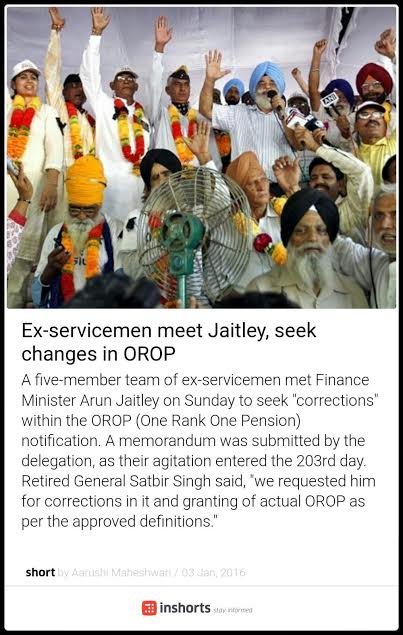
NEW DELHI: A delegation of ex-servicemen from Punjab, Haryana, Uttar Pradesh and the National Capital Region on Sunday met finance minister Arun Jaitley and submitted a memorandum seeking corrections in the One Rank One Pension (OROP) notification.

PTI PHOTOEx-servicemen during a protest outside finance minister Arun Jaitley’s residence in New Delhi on Sunday.Their protest on the issue entered 203rd day on Sunday.“A five-member delegation met the finance minister and told him that the actual OROP has not been granted. The notification has serious flaws and we requested him to rectify them and grant the actual OROP,” Gen Satbir Singh (retd) said.“The minister has assured us that he will speak to the defence minister about our demands,” he said. About 100 ex-servicemen also protested outside Jaitley’s residence and then moved to Jantar Mantar.“For last six months, ex-servicemen are protesting at Jantar Mantar demanding OROP which has been passed by both Houses of Parliament. But the government has been neglecting our demands time and again. It is our request to give us the real OROP,” Arif Ali Khan, one of the protesters, said.Lieutenant Kameshwar Pandey (retd) said, “We feel cheated as this is not the real OROP. A proper parliamentary procedure must be followed to make any amendments. We just want the government to refrain from such manipulations.”

4e1542ce-7e03-4770-8d4d-6563f25d13a2 62656

ef7cbd4c-f4b8-4dc8-8b43-3490606fa362


India, Japan agree on N-pact

Simran SodhiTribune News Service,New Delhi, December 12

2015_12$largeimg13_Sunday_2015_002518202

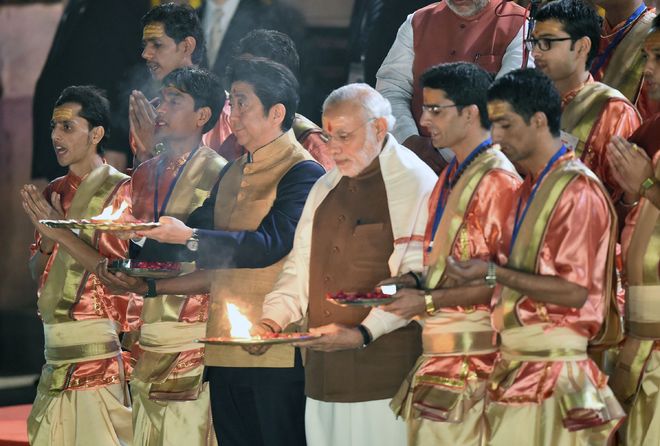
India and Japan today signed an agreement on Peaceful Uses of Nuclear Energy, bringing to end years of tough negotiations between the two countries. The agreement was signed during the visit of Japanese Prime Minister Shinzo Abe to India. Another hallmark agreement signed between the two countries is building of the first bullet train network between Mumbai and Ahmedabad at a cost of about Rs 98,000 crore.The memorandum of understanding (MoU) on nuclear energy was signed by Prime Minister Narendra Modi and Abe. “No friend will matter more in realising India’s economic dreams than Japan. We have made enormous progress in economic cooperation as also in our regional partnership and security cooperation,” said Modi after signing the deal.Abe in return said his country’s public and private sector would act in unison to support the growth of India. It is also learnt that during the one-hour summit meeting between the two Prime Ministers, Abe said he was pleased that the two countries had an agreement and that it ‘wouldn’t have been accomplished by other Prime Ministers. No other leaders could have done it”.While the MoU on nuclear deal brings an end to the negotiations between India and Japan, the process is yet to be completed. Yasuhisa Kawamura, Press Secretary accompanying Abe, at a media briefing explained that the final document will have to “withstand the scrutiny of the Diet (parliament)” before Japan can go ahead with the implementation side of the deal. In other words, the MoU today lays the groundwork for the final agreement which will be signed after technical details have been sorted out.Kawamura also said if India was to go in for another nuclear test, “It will be quite natural for Japan to review the cooperation”. But he added Japan did not see that happening. The joint statement issued at the end of the summit states: “The two Prime Ministers welcomed the agreement reached between the two governments on the Agreement between the Government of Japan and the Government of the Republic of India for cooperation in the Peaceful Uses of Nuclear Energy and confirmed that this agreement will be signed after the technical details are finalised, including those related to the necessary internal procedures.”Another significant announcement was in the area of defence that Japan would now be a regular partner in the India-US Malabar exercises.

Key pacts signed

  • Transfer of defence equipment and technology; Security measures for protection of classified military information
  • Regular consultations on maritime safety and security of sea lanes of communication; Japan to be a regular partner in the India-US Malabar exercises
  • Amendment of Double Taxation Avoidance Agreement (DTAA) to help reduce tax avoidance
  • $12 bn Japanese fund for its companies to manufacture in India. Another $5 bn under Overseas Development Assistance to India
  • India to extend ‘visa on arrival’ to Japanese people from March 1 next year PTI

Japan to import Maruti cars

  • In a first, Japan will import cars from India. ‘Maruti (Suzuki) will manufacture here… The Japanese company will manufacture here and export it to Japan,” PM Narendra Modi said. Maruti expects to export Baleno to Japan from January 2016 with a target of 20,000 to 30,000 units a year. — PTI

Along India-China Border, Dominance Is Best Claim On Territory, Says Army

lac-arunachal_650x400_61451052658

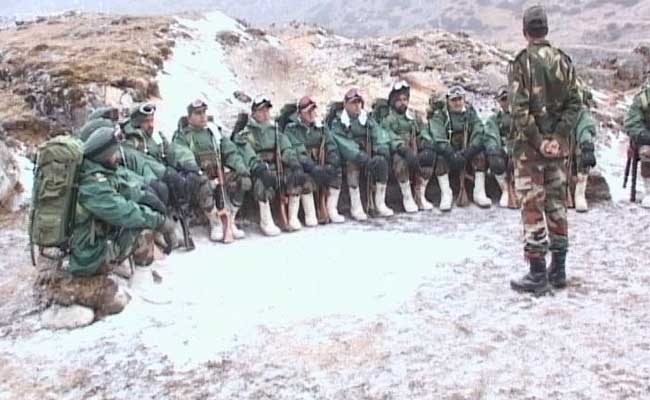
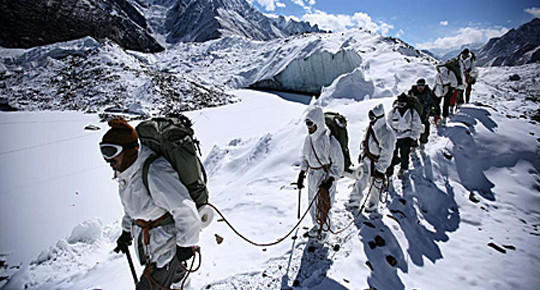
ALONG THE INDIA-CHINA BORDER IN ARUNACHAL PRADESH:  “You will be out for the next five days,” the Indian Army Major said in a matter of fact tone. The group of 12 men he was addressing sat on a Mountain ridge. It had been snowing since morning. The brown rocky sliver of land was slowly turning white. “Your job will be maintain the sanctity of the Line of Actual Control, watch out for movement of Chinese troops, take note of their new locations and report back,” was his brief.

No matter how bad the weather is, long-range Foot Patrols of the Indian Army are regular along the nearly 900 km McMohan line – drawn by the then British Foreign Secretary Henry McMohan in 1914 to demarcate the border – that is now the de-facto border between Indian and China. There are several areas along the line claimed by both, often leading to face-offs and transgressions.
On mountain peaks over 14000 feet high, a literal cat and mouse game plays out every day.  “We have to ensure that the Chinese not only know we present but that we constantly watch them,” a senior military commander told NDTV.

In the past, China has claimed not only Tawang but the entire Arunachal Pradesh. Therefore, as a counter, India tries to dominate every ridge and mountain pass through foot patrols and border posts. The Chinese People’s Liberation Army instead is positioned deep inside Chinese territory.

“Our aim is to meet Chinese patrols whenever they cross what we consider our territory. This gives a clear message that we are serious about our claims,” the commander said.
On average, every foot patrol covers over at least 25 km of mountainous territory often climbing over several peaks. For the past few years, Indian soldiers are also being trained to speak Chinese dialects. “It is easier to tell them that they have crossed over to our territory,” an official said.

India and China signed the Border Defence Cooperation (BDCA) in 2013 – an agreement to reduce misunderstandings and improve communications between the two nuclear-armed states along their disputed border.  Both sides now meet regularly. “The agreement has helped us solve local issues,” Brigadier Kushwaha adds.

Back in Tezpur, the 4 Corps Headquarters – which protects Tawang and the western Arunachal Pradesh – the assessment is that as India bridges the infrastructure, military and economic gap – the Chinese will become more aggressive.


NAND SINGH WAS:::STATE GOVT FORGETS his family and village.

He died defending Kashmir, his own land was grabbed

LONE WINNER OF MVC AND VICTORIA CROSS, DAUGHTER REGRETS FORGOTTEN MEMORIALS

MANSA: Remembering Mansa’s naib subedar Nand Singh — lone winner of the twin bravery awards of Victoria Cross and Maha Vir Chakra — on the eve of 68 years of his martyrdom, his daughter, Amarjeet Kaur (68), regrets that the state government has forgotten his family and village.

She is the only child of the naib subedar. His wife, Joginder Kaur, passed away in 2001. In 1944, as jemadar in the British Indian army, Nand Singh of Bahadurpur village near Bareta received its highest military honour — Victoria Cross — for showing bravery against the Japanese forces on the Arakan front in Burma during World WarII. On December 12, 1947, he laid down his life fighting Pakistani intruders in Jammu and Kashmir.

“After my father died, my uncles from Bareta forced my mother to move to Sangrur. I was born in the same year. They then forced us to shift to Patiala, where I received my education and got married. They grabbed the 60 acres given to my father for his bravery, and no one even from the defence services came to our help,” said the martyr’s daughter, who now stays in SAS Nagar, and whom HT contacted after a commemoration event on Friday.

The state government has named a polytechnic, a bus stand, and even a street after the martyr but not looked after any. District defence services welfare director brigadier Jatinder Singh Arora on Friday attended a programme at Nand Singh’s village but no one from the district administration was present. Asked to explain, deputy commissioner Isha Kalia said: “I am not aware of any such event.”

The villager of the Bahadurpur are surprised that the state government did not care to send a representative to the commemoration event organised a year before the assembly elections. “The last commemoration was in 2011,” said Baldev Sharma of Bareta.