Sanjha Morcha

What’s New

Click the heading to open detailed news

Current Events :

web counter

Print Media Reproduced Defence Related News

As Pak adds fuel, separatists write letter to world leaders

Azhar Qadri

Tribune News Service

Srinagar, July 17

As Pakistan has gone into an overdrive to internationalise the K-issue, separatist leaders in the Kashmir valley — which has been in the midst of a major unrest — also initiated a campaign to reach out to world leaders.Syed Ali Shah Geelani, who heads a faction of separatist amalgam Hurriyat Conference, wrote a letter on Sunday which, his party said, has been sent to Prime Ministers of Pakistan and Turkey, King of Saudi Arabia, presidents of China and Iran.The copies of the letter have also been sent to the United Nations Security Council, heads of UNSC permanent members, European Union, Organisation of Islamic Countries, South Asian Association of Regional Countries and the Association Southeast Asian Nations.The letter, which requested the international community to intervene and urge India to take confidence-building measures, comes at a time when Pakistan has upped the ante on Kashmir amid an unrest in the region that was triggered by the killing of militant commander Burhan Wani.At least 38 civilians have been killed as the Jammu and Kashmir Police and the Central Reserve Police Force made attempts to quell the protests that have continued across the Kashmir valley since Saturday last week.India has strongly reacted to Pakistan’s attempts to internationalise the Kashmir issue even as Islamabad has shown no intent of backing down despite the United States’ appeal for reducing “rhetoric and violence”.Geelani, who has been demanding Kashmir’s accession to Pakistan, in his letter asked the world bodies and leaders to urge India to take six confidence-building measures which include acceptance of “disputed nature” of Jammu and Kashmir, rapid demilitarisation of population centres, repeal AFSPA and the Public Safety Act, release political prisoners, allow various international human rights groups to work in Kashmir and ensure free political space.

For intervention

  • Syed Ali Shah Geelani, who heads the hardline faction of separatist amalgam Hurriyat Conference, has written to Prime Ministers of Pakistan and Turkey, King of Saudi Arabia, presidents of China and Iran
  • He has asked international community to urge India to take confidence-building measures

World War-II veteran passes away

Tribune News Service

Patiala, July 13

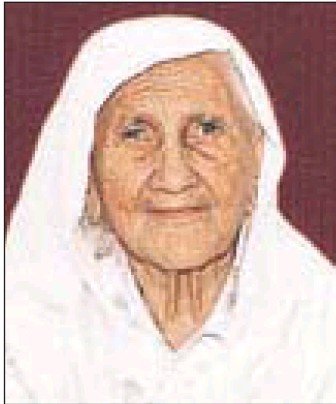
The World War-II veteran and a member of the Indian National Army, sepoy Harnam Singh, died in Patiala, today. He was 94 and the recipient of the Tamar Patra in recognition of his contribution for upholding and promoting democracy principals in the country.His family had shifted to Patiala a couple of years ago and was residing at Urban Estate, Phase-II.  Harnam Singh was born in 1922 in Hazara, now in Pakistan. He was captured and detained by the enemy during the World War.He was cremated with full honours at the Bir Ji cremation ground. He is survived by two sons— Devinderpal Singh and Bhupinder Singh—and daughter Raminder Kaur Lekhi.“My father was not keeping well for the past some time. He lived a life of integrity and served the nation when it mattered the most,” said harnam Singh’s son Devinderpal Singh.


WW-2 veteran’s widow gets 5.4 lakh pension arrears since 2012

5.4 lakh has been released as arrears for the widow of an Indian, who was a soldier of the Burmese army. JUNE 8 ARMY RELEASE

getimage (2)

CHANDIGARH: The chain of command in the army finally woke to up the plight of the widow of a World War 2 veteran. Denied pension and told to ‘Rangoon’ to get the records of her husband’s service before she could be paid pension after his death, the army has released `5.44 lakh arrears to Sangrur resident 99-year-old Gurdial Kaur. In a March 20 report, ‘Army tells war widow to get husband’s record from ‘Rangoon’, HT had highlighted that the It was Artillery Records department of the army had had told her to go to Myanmar (Burma) for her husband’s record.

Gurdial, the widow of Naik Harnam Singh of the Burmese (earlier Burma) Army, was entitled to family pension on the death of her husband in 2012, but had not been paid a penny since. The last pension her husband has been paid was `8,400 a month. She also petitioned the Punjab and Haryana high court.

In a July 8 statement, the army said, “On March 20 2016, the Hindustan Times published an article “Army tells war widow to get husband’s record from ‘Rangoon’. The article highlighted the hardships faced by Gurdial Kuar, 99, wife of late Naik Harnam Singh of the Myanmar Army (erstwhile Burma Army) in finalisation of her pension claim.”

“In spite of the individual not being from the Indian Army, efforts were made for expeditious settlement of the case …. `5.44 lakh has been released as arrears for widow of an Indian, who was a soldier of the Burmese Army,” the statement added. THE ISSUE

After the British annexed Myanmar to the Indian province during their rule, a uniform system of administration throughout the colonial government was established. The system remained even after Myanmar’s separation from British India in 1937; whereby, many Indian nationals continued serving in Myanmar, as in the case of Harnam. He even served with the Burmese Army during World War II. As per the Myanmar government, in the event of death of the military personal concerned after retirement, the family pension was restricted to the period remaining up to 10 years from the date of retirement or up to the date on which the concerned personnel would have attained the age of 65 years, whichever is earlier. In 2009, the Indian government brought out a policy for paying pension to such employees. Harnam gained from the policy and continued to get pension till his death in 2012.


SC seeks govt’s response on plea by veterans on OROP

New Delhi: The Supreme Court on Monday sought the government’s response on a plea of an ex-servicemen’s body seeking implementation of One Rank-One Pension (OROP) as recommended by the Koshyari Committee with an automatic annual revision, instead of the current policy of periodic review once in five years. A bench comprising Justices Dipak Misra and C Nagappan issued notice and sought the response from the government in eight weeks. The Indian Ex-servicemen Movement and others have challenged the government’s policy of periodic review of pension once in five years saying it was dilution of the 2014 announcement. PTI


India, S Africa to deepen ties in defence, manufacturing sectors

India, S Africa to deepen ties in defence, manufacturing sectors
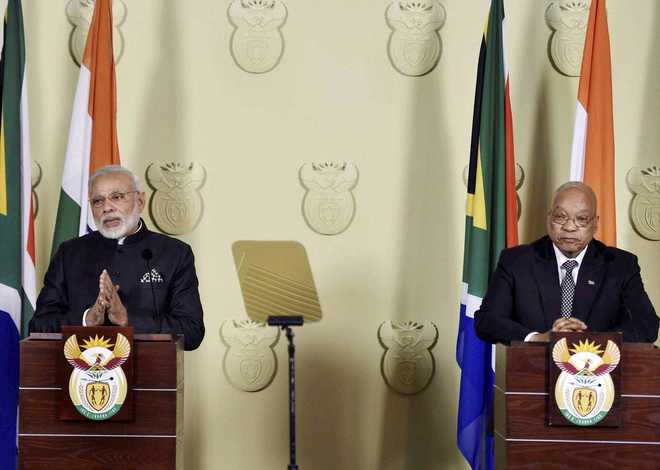
Prime Minister Narendra Modi speaks as South African President Jacob Zuma looks on during their joint press statement in Pretoria, South Africa, on July 8, 2016. PTI photo

Pretoria, July 8

India and South Africa on Friday agreed to deepen engagement in key areas of defence production, manufacturing, mining and minerals while vowing to cooperate “actively” in combating terrorism and dealing with issues at multilateral forums, ratcheting up their traditional ties.

After extensive talks with South African President Jacob Zuma, Prime Minister Narendra Modi projected India as an attractive destination for manufacturing of defence equipment and platforms and said both countries could join hands in not only meeting needs of each other but also to respond to regional and global demand.

South Africa is a major player in defence production globally.

During the meeting, Modi thanked President Zuma for South Africa’s support to India’s membership bid to the Nuclear Suppliers Group.

“We know that we can count on the active support of our friends, like South Africa,” he said. There were reports that South Africa was among countries which had reservations about India’s bid to join the 48-nation grouping.

Holding that ties between India and South Africa have been a story of strong advances and concrete achievements, Modi said there was potential to ramp up cooperation in trade and investment, especially in areas of minerals and mining, chemicals and pharmaceuticals, manufacturing and information technology.

In a joint press interaction with Zuma, Modi invoked Mahatma Gandhi and said he belongs as much to India as to South Africa.

“For me personally, this visit is an opportunity to pay homage to two of the greatest human souls to have ever walked this Earth — Mahatma Gandhi and Nelson Mandela,” said Modi.

Talking about combating terrorism, Modi said it attacks the very foundations of society and that both countries agreed to combat it with active cooperation.

“Terrorism is another shared threat that puts at risk the safety and security of our people. It attacks the very foundations of our society. The President and I agreed that our two nations need to stay vigilant and cooperate actively to combat terrorism, both in our region and in the world,” he said.

Referring to opportunities in the defence and security sector, Modi said companies from both countries could pool their capacities to jointly develop or manufacture defence equipments and platforms.

“Beyond economic ties, and links of business, trade and investment, we can also partner in the field of defence and security. Both, at the level of industry and for our strategic and security needs,” he said.

He said defence sector in India is one of the sectors witnessing a complete transformation and that it offers exciting opportunities.

“Our companies can also pool their capacities to jointly develop or manufacture defence equipments and platforms.And, not just to meet our defence needs, but also to respond to regional and global demand,” he said. — PTI


Nepal probing ‘fake Everest claims’ of Pune Police couple

Nepal probing ‘fake Everest claims’ of Pune Police couple
Other climbers say the couple never reached the summit and used some trick photography to earn their climbing certificates.

Kathmandu, July 4

Nepal has launched a probe to verify the claims made by an Indian police couple of having scaled the Mount Everest after it was alleged that they faked their expedition to the peak’s summit by morphing photographs.

Tarakeshwari and Dinesh Rathod, who are serving as constables in Pune Police, had claimed on June 5 that they became the first Indian couple to scale the Everest on May 23.

They had obtained summit certificates from Nepal’s Department of Tourism by allegedly submitting doctored photos showing them on the top of world’s highest peak.

(Follow The Tribune on Facebook and Twitter @thetribunechd)

Laxman Sharma, chief at the Mountaineering Department under Nepal’s Ministry of Tourism, said authorities are probing the Everest climb made by Rathore and his wife.

“The climbers have already returned to India and we have asked Makalu Adventure, the local agency that managed the expedition for clarification regarding the matter within 24 hours,” he said.The couple was issued climber’s certificates from the Nepal government after they presented a photograph of themselves on the 8,850-metre (29,035-foot) summit.Other climbers, however, say the couple never reached the summit and used some trick photography to earn their climbing certificates.Satyarup Siddhantha, a climber from Bangalore, accused the couple of plagiarising his summit photos which were taken when he scaled the Everest on May 21, the Himalayan Times reported.A source at the Tourism Department also said they have a doubt about the genuineness of the claim made by the Indian couple.If the accusation is found to be true, the couple would lose their certificates and be banned from climbing any mountains in Nepal, officials here said.A probe has also been ordered in India to verify their claims after a group of mountaineers approached Pune Police alleging that the two have faked their expedition.During the busy climbing season this year, which follows two years of disasters on the mountain, 456 people scaled the Everest. — PTI


Ultras not gaining upper hand in J&K Lt Gen Syed Ata Hasnain (retd)

Security forces have suffered losses in recent months, but most were soft targets hit by a militancy on the back foot

Ultras not gaining upper hand in J&K
Road Opening Procedure is the weakest link of any counter-terror operation. Tribune photo

The last two weeks have witnessed multiple contacts between terrorists and the Army and police in Jammu and Kashmir. In the LoC segment, marked successes have been witnessed against infiltrating elements from PoK in Uri, Naugam, Handwara, Tangdhar and Lolab. All these lie within the counter-infiltration zone where response capability has ensured failure of Pakistan in enhancing the terrorist numbers in the hinterland.In South Kashmir too, where a new militancy is supposedly in place, with local content, the operations have been largely successful despite a few losses. The Army, J&K Police and the CRPF have got their act together to establish SOPs to defeat the new tactics adopted by terrorists in instigating flash mobs at encounter sites with the help of social media. South of the Pir Panjal, in the Jammu sector, the situation is largely peaceful although threats in Jammu and Kathua are ever present.A single incident of ambush of a CRPF bus on June 25 at Pampore, causing a loss of eight precious lives, has upset the ratio of achievements this summer.  Prior to this, in February, a CRPF bus was similarly ambushed at Pampore, leading to a standoff at the EDI building which saw the loss of two Special Forces officers. In early June, Anantnag saw the ambush of a BSF bus with the loss of three policemen; two more policemen were killed in Anantnag town shortly thereafter. Preceding this was a strike against unarmed traffic policemen in Srinagar city. A 5kg IED was also discovered in time in Srinagar.Does all this negate the achievements in North Kashmir? Do they indicate a loosening hold on the security situation? These are the questions many of our countrymen are asking through social media. There is also another question that many casual observers of the J&K situation ask. Is this back to the Nineties, when terrorists supposedly held sway over much of the Valley and could strike at will? This needs professional, truthful and reassuring answers.Firstly, I did warn a summer ago that the situation emerging in J&K is typically one which is termed the “last mile”. It is characterised by low terrorist strength and high security force casualties. In addition, it results from the choice of the softest targets by the terror groups and no upfront operations to confront the troops. In their hurry to finish the remnants of the terror movement (140 to 180 terrorists is the figure being spoken of) the Army and the police tend to take more risk, and some degree of complacency sets in.Secondly, we need to rest any conjecture that this is loss of control over the situation. In dying moments of militancy, it is usual to witness spurts of terror activity. Apprehensions that a huge number of Lashkar linked terrorists have infiltrated and are responsible for these actions need to be placed at rest. It does not need more than two terrorists to execute such acts if they are willing to sacrifice their lives. That is exactly what has been happening in the last few weeks.The soft targets which have taken hits have all been on roads and mostly on the national highway between Srinagar and Anantnag. To me it appears the realisation by the terrorist planners and leadership that the weakest link in the chain of activities which make up the counter-terror (CT) grid lies in road protection.Ask any experienced military professional or practitioner and he will tell you that in CT operations it is the Road Opening Procedure (ROP) which is the weakest link of any force. It is also the practice which is given least focus. Ideally, the ROP, to protect movement of logistics and other soft elements of the forces in the Pampore area, should involve domination by patrolling, of an area approximately 3 km on either side of the road, i.e., a 6 km corridor.There should be some presence of troops near the villages in the corridor to prevent unchecked movement. The road itself needs a physical check every morning for presence of IEDs near and under culverts and thereafter a presence of personnel on the road itself or just a few meters away to observe the area beyond. At the time when convoys are expected to arrive, and there are many such convoys in the Valley, a special alert needs to be sounded through the communications available. A proper vigil will render impossible the entry of any alien and inimical elements near the road if the alert is sounded and SOPs adhered to.Unfortunately, it does not happen that way because the ROP in the Valley and south of the Pir Panjal is executed every day and usually by the same units and sub-units. It is routine, extremely tough on the mind, and exasperatingly boring. A human cannot be alert through 12-hour stretches on duty looking at the same scenery and awaiting the same situation. The Valley’s huge troop deployment, political seat of authority and commercial activity forces the ROP every day. If a proper ROP has to be followed, no road will be declared open for traffic before 8 am; the Army and CRPF convoys will then depart and Srinagar will come to a crawl in terms of traffic with massive delays for office-goers.In 2011, facing this dilemma and challenged by demands to do something, the Army risked moving its convoys very early in the morning with only road dominating patrols ahead and half-done ROP. It left the national highway free for the public at office time; it was much appreciated and no incident occurred, but it cannot go on. With repeated incidents on the highway, the CRPF is now under pressure and will have to follow procedures with full supervision to arrest the current trend. This will have a cascading effect on public movement and will lead to frustration, the very thing we wish to avoid in the mood of the public at a time when the situation moves towards normalcy.Can the security convoys move at night? They did many times during the agitation of 2008-10. ROP at night is difficult; it was done with greater risk than day primarily to avoid mobs. Adopting this as a routine may not be possible.The answer to road security lies in frontline police leadership, taking all measures to break the monotony of the CRPF men, improving their welfare during off duty hours, restricting the number of days on duty in a week and other such soft measures. Equally, the Army’s Rashtriya Rifles invariably reinforces ROPs at hot spots and at crucial timings. This informal arrangement needs more coordination so that enhanced corridor domination is ensured. These are issues for the Unified Command and the Core Group but even more so for coordination at tactical levels.A temporary situation arising out of a negative incident and some losses in the season is no reason for despondency. If you understand CI operations, the ‘last mile’ effect still prevails.

8


The writer, a former commander of the Srinagar-based 15 Corps, is a Fellow with the Vivekananda International Foundation & Delhi Policy Group.


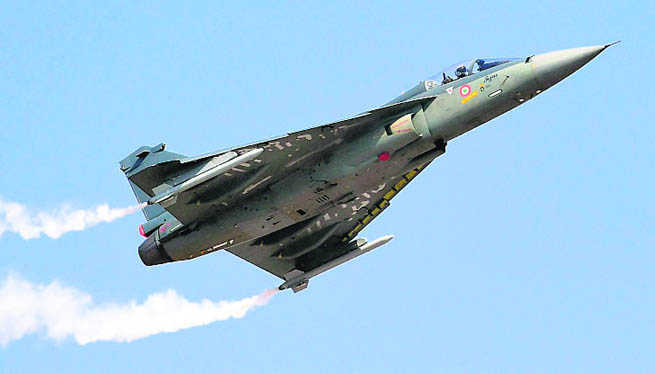
IAF to get 1st squadron of Tejas in July

IAF to get 1st squadron of Tejas in July
India’s indigenous Light Combat Aircraft, the Tejas

New Delhi, June 16

After a wait of over three decades, the IAF will finally get its hands on the first squadron of indigenous Tejas next month with the delivery of the fourth Light Combat Aircraft.However, the first squadron will be made of up of just four Tejas aircraft, in stark contrast to at least 16 aircraft that usually makes up for one squadron globally.State-run Hindustan Aeronautics Limited, manufacturer of Tejas, will hand over the fourth aircraft to the Air Force on July 1.The four aircraft will be used for training and familarisation.Rather than waiting for LAC Mk II, IAF had decided to go in with an upgraded version of the existing Tejas with over 40 modifications.IAF currently plans to acquire 120 Tejas aircraft, with 100 of these having major modifications.The force wants Active Electrically Scanned Array (AESA) Radar, Unified Electronic Warfare (EW) Suite, mid-air refuelling capacity and beyond the vision range missiles.As per the production plan, six aircraft will be made this year (2015-16) and HAL will subsequently scale it up to eight and 16 aircraft per year. — PTI

IAF to get 1st squadron of Tejas in July
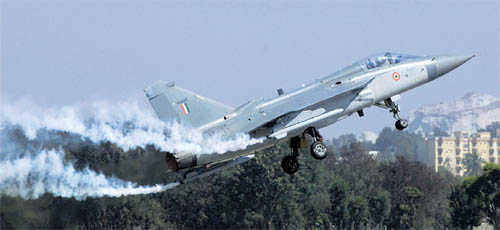
IAF to get 1st squadron of Tejas in July
A file photo of the Tejas aircraft performing during the inauguration of the Aero India at Yelhanka air base in Bengaluru. PTI

New Delhi, June 16

The Indian Air Force will finally get its hands on the first squadron of indigenous Tejas next month with the delivery of the fourth Light Combat Aircraft after a wait of more than three decades.

However, the first squadron will be made of up of just four Tejas aircraft, in stark contrast to at least 16 aircraft that usually makes up for one squadron globally.

State-run Hindustan Aeronautics Limited, manufacturer of Tejas, will hand over the fourth aircraft to the Air Force on July 1.

The four aircraft will be used for training and familarisation.

Rather than waiting for LAC Mk II, IAF had decided to go in with an upgraded version of the existing Tejas with over 40 modifications.

IAF currently plans to acquire 120 Tejas aircraft, with 100 of these having major modifications.

The force wants Active Electrically Scanned Array (AESA) Radar, Unified Electronic Warfare (EW) Suite, mid-air refuelling capacity and beyond the vision range missiles.

According to the production plan, six aircraft will be made this year (2015-16) and HAL will subsequently scale it up to eight and 16 aircraft per year. — PTI

VVIP chopper deal: Michel was eager about Sea King payments
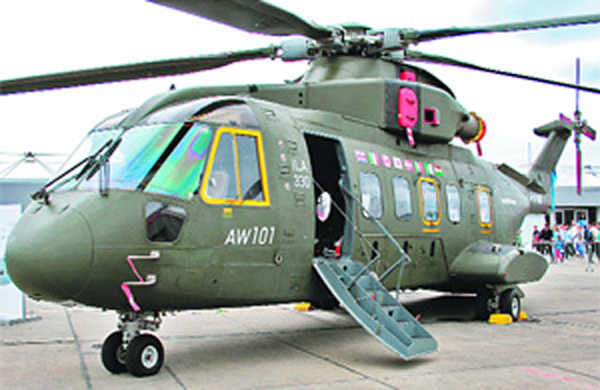
VVIP chopper deal: Michel was eager about Sea King payments
The verdict of an Italian court that found former heads of Finmeccanica guilty of misdealings changed the course of investigations into the Rs 3,600 crore AgustaWestland deal. File photo

New Delhi, June 16

British national Christian Michel James — the suspected middleman who has been accused of having been involved the alleged corruption in the Rs 3,600 crore chopper deal — was “keenly interested” in details about certain government payments made to AgustaWestland for Sea King helicopters used by the Indian Navy, a report by the Enforcement Directorate has said.

The ED — which has filed a second charge sheet in which it delves deep into the role of Michel — also said that he was curious if  “certain documents” had reached the Central Bureau of Investigation (CBI).

According to the report, Michel was last dropped by his driver Narayan Bahadur on February 12, 2013, at the Indira Gandhi International airport after which he probably never returned to India.

The charge sheet mentions Michel’s numerous visits and meetings with people in Delhi when the deal for supply of 12 AgusatWestland helicopters to the IAF was struck. It also refers to an incident that took place few years back in a hotel in Italy.

The report mentioned that Michel had offered about Euro 2,500 to a person Vimal Nagpal, Manager, of the helicopter firm’s services division in India, to “offer lunch/dinner” to a Navy team that was also staying in the same hotel that time.

“The Indian Navy team declined the offer for lunch/dinner by him (Nagpal) and Chris Cornish. However, we insisted and paid the dinner bill once,” Nagpal said in his statement to the ED.

He also told ED investigators that Michel “wanted to know details” of payments made by the Indian Government to AgustaWestland pertaining to Sea King helicopter and status of the VVIP choppers and other issues.

“On one such occasion, Michel wanted to check with him (Nagpal) whether the documents — approximately 9,500 pages of them —were delivered to the CBI,” the charge sheet said, adding Nagpal told him he would have to find out.

The records also mention an instance recorded by Bahadur in which he claimed that Sanjeev Tyagi — cousin of former IAF chief SP Tyagi — received three of Michel’s “friends” at a bungalow in the posh Sainik farm area in 2008 after the middleman asked him to pick them from a luxury hotel in central Delhi.

The driver — whose statements have been used extensively to help trace Michel’s activities in India — also told investigators that the middleman once gave him Rs 5 lakh for purchasing a house that cost Rs 16 lakh in the Kalkaji area, where he also lives now. The driver had to pay the remaining sum.

According to, the charge sheet said, an embassy of an African country functions at the bungalow currently.

Nagpal had also told ED that Bahadur had once delivered him cash amounts sent by Michel as AgustaWestland had proposed to IAF to have “six-axis full flight simulators for training pilots on regular basis” for the AW-101 VVIP choppers.

He also told ED that Michel had assured him that he will get “approvals from higher officials of AgustaWestland” to allocate the simulator project to a chosen firm in India.

However, the plan never worked out as IAF “did not” approve the simulator programme.

The 1,300 page charge sheet of the ED was placed before a special Prevention of Money Laundering Act (PMLA) court here last week.

The agency accuses Michel of having received around Euro 30 million (about Rs 225 crore) from AgustaWestland as “kickbacks” paid by the firm for sale of 12 helicopters to India in favour of the firm.

The court is expected to soon take cognisance of the supplementary charge sheet.

Apart from Michel, the agency has named Ms Media Exim Private Limited and its directors, RK Nanda and J B Subramaniyam in the charge sheet. The firm was created by Michel along with the two individuals.

Michel is one of the three middlemen being probed in the case, apart from Guido Haschke and Carlo Gerosa, by the ED and the CBI. Both the agencies have asked for an Interpol red notice after the court issued a non-bailable warrant against him.

A red notice is issued “to seek the location and arrest of wanted persons with a view to extradition or similar lawful action” in a criminal investigation.  — PTI


No special status for India, US move fails

Washington, June 15

The Senate has failed to recognise India as a “global strategic and defence partner” of the US after a key amendment necessary to modify its export control regulations could not be passed.A day after Prime Minister Narendra Modi’s recent address to a joint session of Congress, top Republican senator John McCain had moved an amendment to the National Defence Authorisation Act (NDAA-17), which if passed would have recognised India as a global strategic and defence partner.The US had recognised India as a “major defence partner” after Modi held talks with President Barack Obama, which supported defence-related trade and technology transfer to the country which would now be treated on par with America’s closest allies.NDAA was passed by the Senate with an overwhelming bipartisan vote of 85-13. But some of the key amendments, including the (SA 4618), could not be passed.The McCain amendment asked the President for actions as may be necessary “to recognise the status of India as a global strategic and defence partner” of the United States through appropriate modifications to defence export control regulations.It also asked the President to approve and facilitate the transfer of advanced technology in the context of combined military planning for missions such as humanitarian assistance and disaster relief, counter piracy, and maritime domain awareness. — PTI


Sri Sri holds meditation session for disabled soldiers

Sri Sri holds meditation session for disabled soldiers
Art of Living founder Sri Sri Ravi Shankar interacts with inmates of Paraplegic Rehabilitation Centre in Mohali on Friday. A Tribune photo

Chandigarh, June 10

Ahead of International Yoga Day, an inaugural meditation session was held today at Paraplegic Rehabilitation Centre (PRC), Mohali, under the guidance of the Art of Living founder, Sri Sri Ravi Shankar. He was in the city in connection with the yoga day preparations. During his brief stay at the centre, which caters to rehabilitation of 100 per cent disabled soldiers who have lost the use of their lower limbs, he interacted with the inmates and gave them some tips to remain happy and content.Two specially designed Art of Living courses, including chair yoga, have been conducted in the recent past for the inmates of the PRC under the aegis of Western Command HQ.On the occasion, Lt Gen KJ Singh, General Officer Commanding-in-Chief, Western Command, said a sports complex would shortly be inaugurated on the PRC complex for the fitness of the inmates. — TNS