Sanjha Morcha

What’s New

Click the heading to open detailed news

Current Events :

web counter

Print Media Reproduced Defence Related News

‘Human shield’ voted before he was tied to army jeep, say cops

TWIST Report says after casting his vote, Dar left for a condolence meeting; Major Gogoi had said he was leading a stone­pelting mob

SRINAGAR: An interim report of a police probe into the infamous ‘human shield’ episode in Kashmir last April backs the claim of Farooq Ahmad Dar who was tied to an army vehicle and driven around for five hours, that he had gone out to vote that morning.

HT FILEFarooq Ahmad Dar was tied to an army vehicle for five hours in April this year.

CM MEHBOOBA HAD ASKED THE POLICE TO FILE A REPORT AFTER THE VIDEO WENT VIRAL FOLLOWING A TWEET BY HER PREDECESSOR OMAR ABDULLAH

An Army officer Major Leetul Gogoi who ordered Dar to be tied to a vehicle, had claimed Dar was the ring leader of stone pelters and was leading a mob.

“Police saw voter mark on Dar’s finger the day we went to investigate the case,’’ a senior police official in Budgam who did not want to be identified told Hindustan Times.

The police report also corroborates the same. “During investigation, it came to light that the victim Farooq Ahmad Dar had cast his vote at polling booth in his native village, Chill.

After casting his vote, he along with Hilal Ahmad Magrey left for Gampora for a condolence meeting,” the report says.

The interim report says “the investigation of the instant case is going on and after obtaining reports from District Election office Budgam/Coy Commander 53 RR Camp Beerwah and analysing of video clips the investigation of the instant case will be concluded on its merits.”

A news story in a local newspaper Greater Kashmir, said report has been submitted to director general of police S P Vaid. However, Vaid refused to comment on the issue.

Hindustan Times had reported that the 26-year-old had spent his morning queuing up outside a polling booth in Arizal’s Chill Bras area for the Srinagar Lok Sabha bypolls, defying a separatist boycott call that contributed to the lowest turnout in almost three decades.

“Please check my name in the list of voters. If I voted for democracy, why would I stop others from voting and pelt stones?” Dar, a shawl artisan had told HT. He insisted he had showed the indelible ink mark to security personnel.

Jammu and Kashmir chief minister Mehbooba Mufti had asked for a report after the video went viral following a tweet by her predecessor Omar Abdullah who condemned the incident.

Army chief General Bipin Rawat had, however, hailed Gogoi’s action and awarded him a commendation card for ‘sustained efforts’ on counter-insurgency operations.

HT had about a month later retraced Dar’s journey on the jeep. HT had reported how Major Gogoi drove him around five hours across 17 villages over 28 kilometers on April 9.

clip


The flood of Rohingya refugees can pose a security risk to India by Lt Gen Ata Husnain

Rohingya refugees at a camp in New Delhi
Rohingya refugee camp in New Delhi | Source: Nayanika Chatterjee/ThePrint

India must work with Myanmar, Bangladesh to minimise effect of violence on Rohingya refugees so that they are not susceptible to exploitation.

Until the latest round of violence erupted in the Rakhine area of Myanmar, most in India were unaware that close to 40,000 displaced Rohingyas were already living in India — the largest section being in the Jammu region. The Rohingya crisis is an issue which must draw public interest in the context of its security impact.

Like any other poverty-stricken region in the world, which has ethnic diversity, Rakhine’s demography has a majority Buddhist population with a Muslim minority. Traditional antipathy based on competition for socio-economic space has produced repeated bouts of violence. Nations without democratic credentials have a propensity for not protecting and empowering ethnic or religious minorities. That’s the case with Myanmar too. The moment such displacement becomes transnational, the impact of violence in a remote part of the globe can have a cascading effect elsewhere in the world.

Given the crisis within Islam and the emergence of extremist groups, there is always the potential of displaced youth becoming their cannon fodder. Thus a group such as ISIS whose charm may be wearing thin, would have no difficulty to penetrate camps of displaced persons wherever they be. The Taliban was in fact born in the seminaries set up in refugee camps as they poured out of Afghanistan in the early Eighties, after the Soviet invasion.

The impact of violence in Rakhine has been the outpouring of refugees into Bangladesh. There is little that a nation can do to stop such an influx unless it wishes to use counter violence and face international ire. The paradox is also that no one will rush to assist it either in the management of refugees. The UN agencies are active but they have also been asked to leave Myanmar.

Boundaries have become increasingly fragile despite better technology for border management. This was so clearly demonstrated through the recent outpouring of hordes of displaced people from North Africa and from Syria into Europe. The migration crisis in Europe has also led to a change in the nature of threats. No one knows this better than India where demographic change in the areas adjoining Bangladesh has been underway for several years.

The 250,000 Rohingyas who are reported to have entered Bangladesh this time may aspire for a future in India. The concern is not just human migration but susceptibility to violent extremist ideology, aided by the tools of the information revolution. The Rohingya crisis is affecting Bangladesh and India due to proximity but it is having an impact in South-East Asia too.

The current concern is also about potential recruits for the ISIS in the Mindanao province of Phillipines. That is where the ISIS has had attained marked success outside the Syrian theatre, in the city of Marawi where a regular army is reluctant to engage it in street battles.

Southeast Asia is brimming with shades of violent extremism — from the attempted radicalisation in Bangladesh to the Rohingya issue in Myanmar, the Islamic insurgency in southern Thailand, the Moro militancy in the Philippines and the ever present threat of Jemmah Islamiyah in Indonesia — all of which could get netted to create pan regional radical Islamism, the dream of ISIS.

Expanding regional surrogates working with loose ISIS linkages, like in Africa and portions of West Asia, have serious connotations for South-East Asia.

Where does that leave India? With uncontrolled Rohingya presence and the threat of arrival of more, the potential of their exploitation remains high. India must work with both Myanmar and Bangladesh to minimise the effects of violence. State violence emanating from within Myanmar needs to be controlled although the trigger was the attack by the Arakan Rohingya Salvation Army (ARSA). There is also much concern that India’s North-Eastern militant groups may find expanded sanctuaries in either Myanmar or Bangladesh if the current Rohingya crisis is allowed to fester and India is perceived to be taking sides.

The big bad boys from across the western international border would be looking upon the crisis as yet another opportunity to exploit the rising communal divide in India.


Pakistan is now ‘terroristan’: India tells UN after Abbasi’s attack

Pakistan is now ‘terroristan': India tells UN after Abbasi's attack
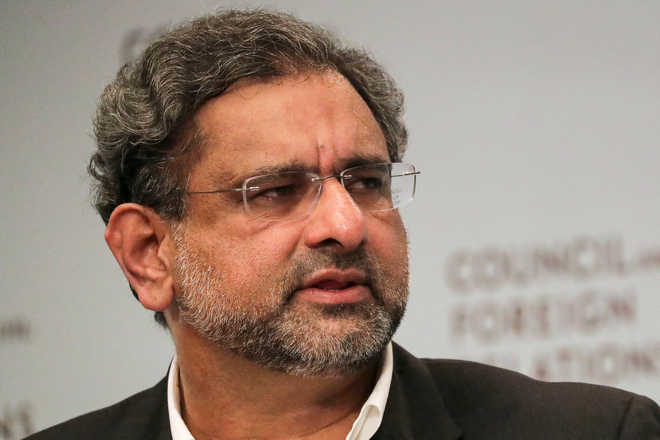
In his first remarks to the UN general assembly, Pakistan PM Shahid Khaqan Abbasi had attacked India, accusing New Delhi of carrying out war crimes in Kashmir. Reuters

New York, September 22

Pakistan has now become ‘terroristan’, India told the United Nations in response to its Prime Minister Shahid Khaqan Abbasi’s emphasis that Islamabad was not prepared to be anyone’s scapegoat.“In its short history, Pakistan has become a geography synonymous with terror. The quest for a land of pure has actually produced the land of pure terror. Pakistan is now Terroristan,” India said, in a statement addressed to the United Nations general assembly president.

Follow The Tribune on Facebook; and Twitter @thetribunechd)

In his first remarks to the UN general assembly, Abbasi had attacked India, accusing New Delhi of carrying out war crimes in Kashmir.”Pakistan demands an international investigation into India’s crimes in Kashmir,” he said and demanded an inquiry Commission be sent to Kashmir “to verify the nature and extent of India’s human rights violations, secure the punishment of those responsible and provide justice and relief to the victims.” “It is extraordinary that the state which protected Osama Bin Laden and sheltered Mullah Omar should have the gumption to play victim. Even as terrorists thrive in Pakistan and roam around its streets with impunity, we have heard it lecture about protection of human rights in India. The world does not need lessons on democracy and human rights from a country whose own situation is charitably described as a failed state,” India led a retaliatory attack on Pakistan.”Pakistan must understand that the state of Jammu and Kashmir is and will always remain an integral part of India. However, much it scales up the cross border terrorism, it will never succeed in undermining India’s territorial integrity,” India’s statement added.The Pakistan prime minister had also added that India was not willing to resume dialogue to resolve the dispute.”To this end, the UN Secretary-General should appoint a Special Envoy on Kashmir,” he said.During his address, Abbasi further said Pakistan has been consistently active in the war against terrorism and that it has lost more to the cause than any other nation.Speaking about the issue of terrorism and the Afghan conflict, the premier said that Pakistan had sacrificed a lot of lives in the war on terror, and nobody desired peace in Afghanistan more than Pakistan.”Our counter-terrorism credentials cannot be questioned. We have lost 2,700 lives and sustained 50,000 injuries in this war,” he said.”From sixteen years of the ongoing war in Afghanistan, it is clear that peace could not be restored by the continuing resort to military force. Neither Kabul and the coalition nor the Afghan Taliban can impose military solution on each other.” “Apart from Afghanistan, Pakistan and its people have suffered the most from four decades of foreign intervention and civil wars in Afghanistan,” he added.During his 20-minute speech, Abbasi stated that Taliban safe havens are located not in Pakistan but in large tracts of territory controlled by the Taliban in Afghanistan.The Pakistan Prime Minister also maintained that Islamabad was not prepared to fight the Afghan war on Pakistan’s soil. “Neither can we endorse any fair strategy that prolongs and intensify the sufferings of the people of Afghanistan and Pakistan,” he said.He also identified two flaws in the global counter-terror strategy. One of this, Abbasi remarked, was state-sponsored terrorism, and the failure of the UN to reign in states that use this as an instrument of their foreign policy. —ANI


A tale of two uniforms by Lt General Bhopinder Singh (Retd)

A tale of two uniforms

The political state of Haryana is the catchment area for some of the most gallant and decorated regiments of the Indian Army, namely, Grenadiers, Jats, Rajputana Rifles, Rajputs, besides the region also feeding a host of other regiments, corps, and the service arms. The average Haryanvi soldier is the epitome of martial instincts – from sheer unmatched physical bearing to the age-old reverence to morality, ethics, simplicity, and large-heartedness (with a unique sense of sarcastic humour and risqué language); these hardy soldiers are much feted and doted on, in the battle-fields or moments of functional tribulation. From Risaldar Badlu Singh (Victoria Cross from Jajjar), Havaldar Chelu Ram (Victoria Cross from Bhiwani), Col Hoshiar Singh Dhaiya (Param Veer Chakra from Sonipat), the dust-bowl districts of Haryana have given an endless list of some of the finest displays of soldiering valour and professionalism, that makes them second-to-none.
Yet, the parallel optics of the meltdown, capitulation, and disarray of the Haryana Police, for the third successive time in the last couple of years is symptomatic of the contrasting institutional health of the two broad security services, i.e. the Indian Armed Forces vis-à-vis the Police forces (including both the State force and the Central Armed Police Forces). The 57,000 strong Haryana Police, with a logically sounding mission statement and commitment to the common man to, “provide him security and to create a peaceful and law abiding community,” has been found severely wanting in the recent Panchkula rampage, the handling of the earlier sectarian strife, as indeed, in the ham-handed botch-up in raiding yet another self-styled godman in Hisar, preceding these two incidents. The seemingly magical impact of just six army columns, when the large posse of hapless policemen was scurrying aimlessly and hurriedly, reiterated the difference that institutional ethos, training and leadership can make. In Haryana, where the same household gives a military soldier and a policeman simultaneously, the opposite efficacy levels of the two uniforms is not a reflection on the genealogical bearing of the two individuals.

The cry for police reforms is a very old hat, that has persisted and resisted efforts to change, despite efforts to address the institutional malaise. Even the judiciary that has earned unequivocal plaudits for standing up to the crumbling national narrative in recent times, was at its wits end when the Supreme Court bench headed by the then Chief Justice of India, JS Kehar lamented, “Police reforms are going on and on. Nobody listens to our orders.” The well-meant tone of anguish belies the multiplicity of vested interests that seek to maintain the status quo.

Unfortunately, the colonial-minded Police Act of 1861, that was understandably loathed and distrusted by the mainstream populace, still stands as the fundamental governing guide. The later day constitutional framework of affording the State police to a ‘state subject’ (List II, Schedule 7 of the Indian Constitution), with open channels of outside (read, political) influence and interference have ensured negative perceptions of lackadaisical commitment, oppressive conduct and worse, corruption. Piles of paperwork have been generated to suggest and usher in the much-needed Police reforms from the Gore Committee, the Ribeiro Committee, the Padmanabhaiah Committee, the Prakash Singh Committee (ironically, following the sectarian violence in Haryana itself) to the SC directives for Police Reforms and Soli Sorabjee Committee – all ignored in varied degrees of disinterest (in 2006, the Supreme Court had issued 7 binding directions to the State/UT’s). The comparative proximity of the political classes with the State police forces versus the autonomy and non-interference in the conduct of the Armed Forces has steered the culture of professionalism, vested interests and leadership conduct, diametrically. The police-political equation can be dangerously mutually-gratifying, thus, efforts to correct the unholy nexus runs the risk of a very systemic and effective counter-block. Neither barrackised nor conflict-deployed Military, is insulated from the systemic-rot that afflicts the ‘system’. Perversely, the politician-agnostic Armed Forces pay a personal price for maintaining the distance from the civilian-masters and the top-heavy bureaucracy of the Police forces, gets further top-loaded and ‘looked-after’ by the ‘system’, whereas the ‘politically insignificant’ soldier of the Armed Forces is served the occasional dosage of condescending platitudes and patriotic appropriation, every time a Pampore, Pathankot or now, even when a ‘Panchkula’ happens. While there is an undeniable issue of shortfalls (global average ratio of police-population is 270 to one lakh, in India, it is approx. 120) – this ratio was not applicable in Panchkula. Actually, the issue of ‘outstretch’ is far more acute for the Armed Forces, as besides their conventional duties they are today increasingly deployed in regular ‘policing’ tasks and operations in J&K and the insurgency-infected areas of the North Eastern States. It really boils down to leadership – the contrast of the tenor, balance, and maturity in the phraseology of the press conferences held post the Panchkula incident vis-à-vis that of the then DGMI (Lt Gen Ranbir Singh) following the ‘surgical strikes’, is a case study in political slant versus the apolitical functionality and correctness. Again, it is the wiring, construct, and defined conduct of the two different institutions that chisels out the exact opposite output and impact, in a ‘Panchkula’. There have been outstanding Police officers and men who have defied the systemic morass and delivered supreme results (often paying the ultimate price), however, these instances of individual brilliance are not because of the operative ‘system’ and environment that they are subjected to, but despite them; therefore even more laudable! Whereas the Armed Forces is a well-oiled engine that routinely churns out a certain behaviour pattern (ignoring instances of individual culpability), as the system invests and ordains ‘izzat’ above all; the emotional import of cowardice or dereliction in a combat-situation is an unimaginable, unaccountable, and unlivable insult to the individual concerned, and by that extension, his paltan – hence, the shame of not ‘living up’ to the soldering ethos is unexplainably, heavy. The taint of ‘combat refusal’ goes beyond the penal laws, and unlike the order of ‘suspension’ in the police forces, a sense of collective humiliation owing to the conduct of any individual can drive a unit towards almost inhuman bravery in the face of hopeless odds, to redeem honour. Behind the different flags of the overall Indian security apparatus that bestow the legal, moral and social legitimacy, lays the singular flag of ‘India’ that does not differentiate a soldier wearing a Khakhi uniform, from one wearing an Olive Green uniform. It is not the uniform or the soldier, but the ‘system’ that has failed us and needs immediate addressing. Haryana was, is, and will always remain the land of pride for soldiers. Lt General Bhopinder Singh (Retd) is Former Lt Governor of Andaman and Nicobar Islands & Puducherry. The views expressed are strictly personal.


Battle of Saragarhi: How 21 Sikhs Held Off Over 12,000 Pashtuns

http://

The Battle of Saragarhi has gone down in history as one of the fiercest last-stands executed in battle. It refers to the clash of 21 Sikhs of the 36th regiment of the British army (now the 4th battalion of the Sikh regiment of the Indian Army) with an attack by over 10,000 Afghan tribesmen – the Sikhs held their ground.

In the September 1897, when over 10,000 Afghan tribesmen of the Orakzai and Afridi tribe attacked Saragarhi, North Western Frontier Province (NWFP) (modern day Pakistan), the defending Sikh regiment, under the leadership of Havildar Ishar Singh, knew their fate had already been decided. Yet they held their ground and fought the thousands of enemy troops for several hours.

The fierce bravery of the 21 Sikhs sent ripples across the world. The British Parliament halted their session mid-way to give a standing ovation to the 21 martyred in September 1897.

The entire regiment was posthumously awarded the Indian Order of Merit, the highest bravery award given to Indians at the time. It was also the only time when an entire unit received the highest gallantry award for the same battle.

Every year, 12 September is celebrated as the Saragarhi Day by the Sikh regiment, which is also the most decorated regiment of the Indian army.


Military readiness, welfare of soldiers’ families priority: NS

Military readiness, welfare of soldiers’ families priority: NS
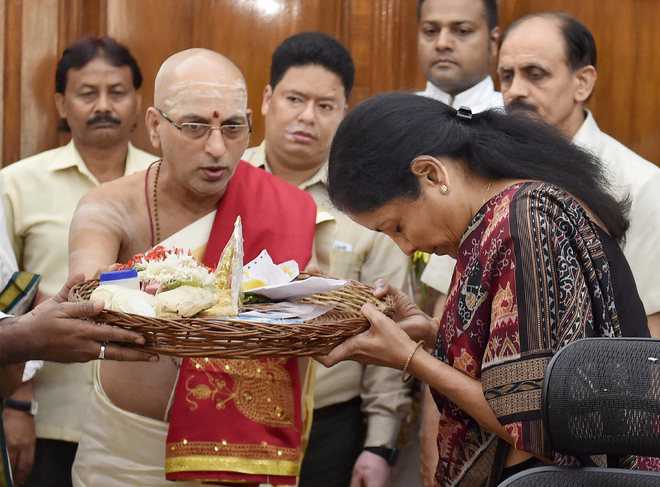
Defence Minister Nirmala Sitharaman receives prasad from a priest as she arrives to take charge in New Delhi on Thursday. PTI

Tribune News service

New Delhi, September 7

Newly appointed Defence Minister Nirmala Sitharaman today listed out an ambitious agenda for her tenure.Military preparedness, sorting out long-pending issues, thrust towards ‘Make in India’ and welfare of families of soldiers will be areas of focus, said Sitharaman as she commenced her innings at South Block in the national capital this morning. Outgoing Defence Minister Arun Jaitley and the Minister of State for Defence Dr Subhash Bhamre were present at the ceremony.In a brief statement after assuming charge, Sitharaman said: “My priority will definitely be the Armed Forces’ preparedness. It is important that the Indian Armed Forces receive all the attention in terms of giving them every necessary endowment and equipment to perform their duty.”Promising to address long-pending issues, she said: “I shall address all long-pending issues in consultation with the PM and the Cabinet to ensure that all of them are resolved.”Sitharaman stressed upon ‘Make in India’. India is the world’s biggest importer of weapons and military equipment. “To strengthen our defence capability, it’s very important to focus on Make in India. We shall ensure that it’s given full play for defence production.”She said with the technology improving, indigenous production should be ensured so that the nation benefits and also exports weapons to the international market.Sitharaman said one of her priorities would be the families of the Armed Forces personnel. “Soldiers and their families should remain absolutely assured that their interests are watched,” she said.The taking over of Sitharaman had been scheduled for Thursday and was consequent to Jaitley’s return from Japan. She was appointed Defence Minister on Sunday after the PM reshuffled his Cabinet


MAJ GEN SATBIR SUCCEEDS IN HIS IESM GB ELECTION DESIGN BUT CHANGEABLE IN COURT :::WRITES LT GEN RAJ KADIYAN

Dear Colleagues,
          Some half truths are being spread on the net. The District Registrar’s document was put before the court on 25/8/2017. Inter alia the Registrar made the following points:
1.    The planned elections are against the court order of 9/5/2017.
2.    The elections are against the Registration & Regulation of Society’s Act, 2012 of Haryana.
3.    The elections cannot be held  at a place other than the place of registration of the society.
 
        The court agreed to the illegality of the elections but brought out a technical point that the election process once set in motion cannot be legally stopped. Adding further, that it can be challenged.
 
        Question has been asked as to why I gave my consent on 9/5/2017. I did so because I have been pushing for elections all along. I asked for fresh elections in three months on 2/12/2012 during the AGM; again on 28/7/2013 during the general body meeting; supported the District Registrar when on 29/8/2013 he asked for elections in three months; supported the State Registrar when on 31/7/2014 he asked for elections in four months time. All these decisions were challenged by Veteran Gandhi before the higher authority or the court.
       
        In the same vein I agreed to the court’s suggestion on 9/5/2017 and gave a written consent laying down certain conditions. Unfortunately, the court order violated those conditions. I therefore filed an LPA and my appeal was heard on 3/7/2017 when the double bench gave me the liberty to revert to the same judge for reviewing his order. (Copy of the order is attached). Since that has not happened I have the option to go the double bench. A consent order not based on the consent given, is bad in law and is liable to be set aside.
 
        There is no question of my contesting the elections the legality of which I am myself questioning.
 
        I had already pointed out that minutes of GB meeting of 3/6/2017 (as also previous meetings) are all fiction. Even the simple fact of number of attendees is manipulated. Of the total 20 members of the GB, Veterans Jaini, Chaturvedi, Ahuja and Phatak were absent on 3/6/2017. Still Veteran Gandhi says 19 members attended. Minutes drafted by Veteran Gandhi himself, are always a record of convenience and never of facts.  
 
        Whatever farcical exercise they are doing on 27/8/2017 has no relation to any law, norms or rules. For example, among the criteria for eligibility, they have laid down that the ‘candidate should not be a whole-time member of any political party’. If the Returning/election officers were to do their job with honesty and sincerity, even veteran Satbir is not eligible to contest for any post because he is a member of the Fauzi Janta Party and his affidavit is available with the Election Commission (copy attached). 
         I will continue my crusade till elections are held through a collegium and IESM has a pan India representation in decision making bodies. 
With best regards,
Lt Gen Raj Kadyan
Chairman IESM
262, Sector-17A
Gurgaon – 122 001
On 26 August 2017 at 10:14, Ravindra Pathak <raviwarsha@gmail.com> wrote:
Dear All
Pls see the mail from Gp Capt Gandhi.
Finally the court has cleared all issues and the Elections will be held as scheduled.
Many have tried to sabotage the process by threatening to go to court and quoting only one letter from the Registrar . All those lies have now been exposed and critics silenced on the process leading to elections.
I would like to thank the Ad-hock committee and the election team that have taken efforts to make the process as flawless as possible.
Some have criticized the list of nominees for the election.Well non one was prevented from filing his nomination papers and none were rejected. So please stop being a keyboard lawyer and keyboard terrorist now.You had your chance and missed the bus.
I for one have not opted to stand for elections and thus had no interest in it except to see a new look GB that may take the IESM back to its old days of glory and harmony.
Who ever get elected must ensure they remove the short comings of the past and create a system that is transparent and participation based  by all.Issues of regional representation,
all India voting based on electronic means,doing away with direct elections to various posts etc are some of the issues we tried to tackle but failed. Hope the new dispensation will be able to carry out the reforms.
I wish those who will get elected all the best and warn you that the battled with Kadyan is not over. He will bite again.
Brgds
Pathak
FALSE PROPAGANDA BY VINOD GANDHI AS USUAL MISLEADING THE ESM
On 25 August 2017 at 20:13, Vinod Gandhi <vk_gandhi@yahoo.com>wrote:
Dear IESM Members and Veterans
 Further to my mail of 24 Aug 2017, the court hearing for the petition filed by Lt Gen RS Kadyan was heard on 25 Aug as planned in Pb and Har High Court. The Honorable justice has disposed of the petition Lt Gen RS Kadyan asking  for stay on IESM election. Honorable justice has not passed any comments on election procedure after hearing reply of State Registrar. Detailed court order could not be obtained in view of the tense situation in tricity. It will be circulated asap we receive it.
Dear Members it is established that GB IESM wants these elections to ensure that a democratically elected GB takes control of IESM and administers it as per will of members. The Stand of GB IESM has been vindicated after a fight of five years. Plan of Lt Gen RS Kadyan to stick to position has been shattered by the HHC.
In view of Honorable High Court order, It is for information of all that election of IESM will be held as planned on 27 Aug 2017 from 0900h to 1300h  at AVCC Sector 37 NOida. All members are requested to come and elect a GB of their choice to run the administration of IESM.
AMEN
Regards
Gp Capt VK Gandhi VSM
From: “Vinod Gandhi vk_gandhi@yahoo.com [indianveterans]” <indianveterans@yahoogroups.co m>
To: “indianveterans@yahoogroups.co m” <indianveterans@yahoogroups.co m>
Cc: Ravindra Pathak <raviwarsha@gmail.com>; Satbir General <satbirsm@gmail.com>; CK Sharma <seekayess@gmail.com>; Raj Kadyan <rajkadyan8@gmail.com>; Brig SC Kamboj <chander.kamboj@itintellectual s.com>; Col SS Rajan <colonelrajan44@gmail.com>; LT Gen S. K. Bahri <skbahri1@yahoo.com>; Aditya Jaini <ajbjaini@hotmail.com>; Yahoogroups <tsewa@yahoogroups.com>; Yahoogroups <triservicesveterans@yahoogrou ps.com>; M. V. <militaryveterans@yahoogroups. com>; Sivasankar Vidyasagar <csvidyasagar@gmail.com>; Indianveterans <indianveterans@googlegroups.c om>; “gsnijjar47@yahoo.in” <gsnijjar47@yahoo.in>
Sent: Thursday, 24 August 2017 12:06 PM
Subject: [indianveterans] IESM Elections 2017 at AVCC on 27 Aug 2017 will be held as planned
Dear IESM Members
You are aware that AGM and Election of IESM are planned under the order of HHC order dated 9 May 2017. This order was given after petitioner and respondent gave their consent for the plan. Our reason for consenting for election was simple that term of GB elected in 2014 had expired and hence a new GB needs to be elected democratically. Present GB does not want to administer IESM without proper mandate.
What was the reason of other party that is Lt Gen Raj Kadyan to give his consent for election is not known to us.
A governing body meeting was held on 3 June, It was decided to follow the order of HHC in letter and spirit.  The meeting was attended by Lt Gen RS Kadyan with as Chairman with full GB strength of 19 members .  As per order it was decided to plan elections asap. Nearest possible date for election turned out to be 27 Aug 2017. It was therefore decided to conduct elections to GB of IESM from 0900h to 1300h on 27 Aug 2017 at AVCC Noida.
An Ad hoc committee was formed minus Gp Capt VK Gandhi and Lt Gen RS Kadyan as per order of HHC. Brig CS Kamboj was unanimously elected as coordinator of Ad hoc Committee. All preparations for Elections have been done under his supervision.
Lt Gen RS Kadyan, who had consented for the election, appealed for stay of elections in HHC. The reason given by him is that order of HHC is not as per consent given by him. Whereas the actual reason for asking for stay in election is very clear that he is afraid of contesting election in face of sure defeat in the elections for him as well as for his friends. He has not even filed nomination papers for any post in GB. The case has had at-least four hearings and final hearing is on 25 Aug. The only ground which has been extended by him is that IESM GB has not requested Registrar for detailing a Returning officer. It is surprising that he claims to be Chairman of IESM, agrees for elections, does not write any letter to Registrar for planning elections even after being present in the GB meeting on 3 June 2017. Now he goes to court that GB has not planned elections as per order of HHC. Whereas the fact is that GB has written nine letters to Registrar on following dates requesting for detailing an observer/RO and clearly listing out every step of elections and execution of planned elections.
22 May2017
10 July 2017
18 July 2017
24 July 2017
26 July 2017
4 Aug 2017
9 Aug 2017
21 Aug 2017
23 Aug 2017
Some veterans have started a campaign to create doubts in the mind of ESM Family. Why and on whose behalf this campaign is being undertaken is not difficult to understand. It is very surprising that while everyone is patiently waiting for the order of HHC, these few veterans are giving their final judgment against the election. It is surprising that many of them are not even member of IESM but they must interfere in internal issues of IESM, as their birthright!!!!!!!!!!!!!.
Friends the truth is that IESM is committed to following HHC order in letter and spirit. IESM has planned the elections as ordered by HHC and is executing the order in letter and spirit. IESM has announced the elections program and is meticulously following the schedule. IESM election schedule has reached the stage of printing of ballot papers and final briefing to all candidates at the site is planned on 25 Aug.
There is only one candidate each for Chairman, Treasurer, Gen Sec and Jt Gen Sec and these candidates will be declared elected unopposed. There are two candidates for the post of Vice Chairman. Total of 24 nominations have been found valid for 16 vacancies in GB.
Election will therefore be conducted for Vice Chairman and sixteen post of GB members.
It is for the information of all IESM members that election process is continuing without any hinderance. Members have confirmed their attendance from 10 states to participate in election process. Members are therefore requested to not to believe the rumours being spread by few veterans about the elections. ALL MEMBERS ARE THEREFORE REQUESTED TO TAKE PART IN IESM GB ELECTIONS WITH ENTHUSIASM AND ELECT THE MEMBERS OF THEIR CHOICE TO RUN ADMINISTRATION OF IESM.
Election will be conducted by the independent Election team from 0900 to 1300h on 27 Aug Sunday at AVCC sector 37 Noida. Easiest way to reach AVCC Noida is to take blue line Metro to Botanical Garden stn. After alighting please follow the indicator. You will see a water tank about 300m in front of the station. AVCC is just next to Water tank.
 Account statement and Balance sheet for FY 14-15,15-16 and 16-17 will also be presented to the house for approval in AGM. Any other relevant points raised by members will be discussed.
ELECTIONS TO GB IESM WILL BE HELD AS PLANNED FROM 0900 TO 1300H AT AVCC NOIDA ON 27 AUG 2017. MEMBERS ARE REQUESTED TO PARTICIPATE IN ELECTIONS TO CHOOSE GB MEMBERS OF THEIR CHOICE.
Regards
Gp Capt VK Gandhi VSM
OROP is our right. Dilution in OROP will NOT be accepted.

HC slams Haryana on law and order, asks Centre to provide forces

HC slams Haryana on law and order, asks Centre to provide forces
In its detailed order, the Bench directed the Centre through the Home Secretary to provide forces “keeping in view the gravity of the situation”.

Saurabh Malik

Tribune News Service

Chandigarh, August 24

Coming down heavily on the Haryana government for its apparent inability to maintain law and order in the state ahead of the Dera verdict, the Punjab and Haryana High Court on Thursday asked the Centre to forthwith provide forces, including paramilitary force.Asserting that it could initiate action against the Director General of Police in case of the state’s failure to ensure security, the Division Bench of Acting Chief Justice Surinder Singh Saron and Justice Avneesh Jhingan said it did not want a situation similar to the Jat reservation stir.

(Follow The Tribune on Facebook; and Twitter @thetribunechd)

The Bench said it also expected “full cooperation” from the Dera. Taking into consideration the sensitivity of the situation, the Bench posted the matter for post-lunch session.

Read more stories

In its detailed order, the Bench directed the Centre through the Home Secretary to provide forces “keeping in view the gravity of the situation”.The Bench asked the Centre to make its own assessment in the matter, while asking Haryana to afford its own estimation and requirement as might be necessary from time to time.Taking a note of CBI standing counsel Sumeet Goel’s submission that its investigating officer, witnesses in the case, and public prosecutor in trial and the High Court were facing threats, the Bench directed Advocate General BR Mahajan to make arrangements to provide protection to them.The Bench also asked Dera counsel SK Garg Narwana and Virat Amarnath to submit in the post-lunch session the steps being taken to defuse the situation. The Bench made the Centre through Home Secretary, the CBI and the Dera parties to a PIL in the matter before calling to the Court Additional Solicitor General Satya Pal Jain.The Bench asked Haryana Additional Advocate General Pawan Girdhar, Satya Pal Jain and advocate Dheeraj Jain to intervene in the matter. Punjab Additional Advocate General PPS Thethi was also requested to assist the court.“The Centre will provide adequate security and force to the state government for maintaining peace and law and order in Panchkula and its surrounding areas forthwith,” the Bench added.A lawyer on Wednesday had moved the High Court for directions to Haryana and its officials to make adequate security arrangements, especially in Panchkula district and surrounding areas, for the expected pronouncement of verdict in the criminal trial against Gurmit Ram Rahim Singh on August 25.Petitioner-advocate Ravinder Singh Dhull had also prayed that the security arrangements might be monitored by the High Court. He claimed that more than 1.5 lakh people had already entered Panchkula district despite prohibitory orders under Section 144 of the CrPC.

http://www.tribuneindia.com/news/haryana/hc-slams-haryana-on-law-and-order-asks-centre-to-provide-forces/456837.html

clip

clip


Colour Presentation for Ladakh Scouts at Leh by the President

President dedicates maiden Ladakh visit to armed forces

President dedicates maiden Ladakh visit to armed forces
President Ram Nath Kovind presents the President’s Colours to all five Ladakh Scouts battalions and Ladakh Scouts Regimental Centre at Leh on Monday. PTI

Jammu, August 21

President Ram Nath Kovind today dedicated his maiden visit to Ladakh, the first outside Delhi since assuming office, to the armed forces of the country.He also presented Colours to all five Ladakh Scouts battalions and the Ladakh Scouts Regimental Centre. The President said, “In capacity as the Supreme Commander of the armed forces, I dedicate the visit to the armed forces of the country.”(Follow The Tribune on Facebook; and Twitter @thetribunechd)He said it had been 54 years since the Ladakh Scouts became part of the Army. “This period has been replete with tales of heroism, honour and glory. The genesis of the regiment was in the invasion by Pakistani raiders in 1947-48 and the resolve with which Ladakhis defended their motherland. This continues to remain a matter of pride for the entire country,” he said.The President said in little over half a century, the regiment has earned 605 honours and awards for conspicuous gallantry and distinguished service. “This speaks for the exceptional valour and spirit of the regiment personnel and is a model for all soldiers and officers of the armed forces,” he added.He said at the colour-presentation ceremony that he would like to pay homage to the martyrs of the Ladakh Scouts Regiment. “Their blood and sacrifice has secured our sovereignty, brought glory to our nation and protected our people from harm,” he said.Among the dignitaries present were Governor NN Vohra, CM Mehbooba Mufti, Deputy CM Nirmal Kumar Singh, other ministers and Chief of Army Staff General Bipin Rawat.The President also released a documentary on Col Sonam Wangchuk, a recipient of Maha Vir Chakra.Later, he laid the foundation stone of the Buddha Park for World Peace at Leh’s Mahabodhi International Meditation Centre. — TNS
 

http://


LAC ‘war-gamed’, no free run for China

LAC ‘war-gamed’,  no free run for China

Ajay Banerjee

Tribune News Service

New Delhi, August 20

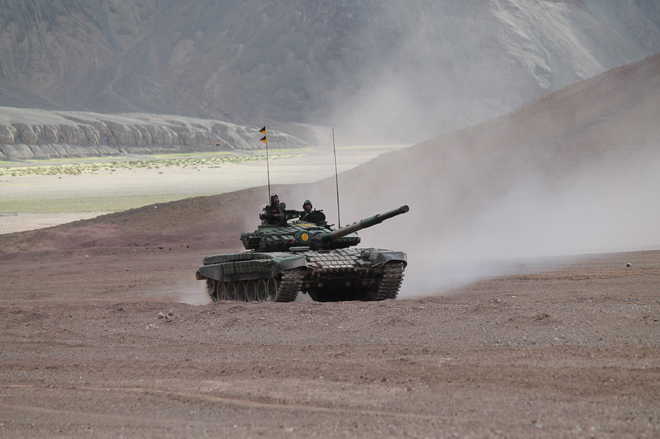
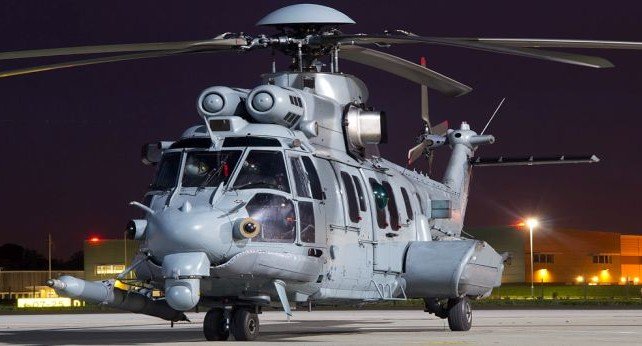
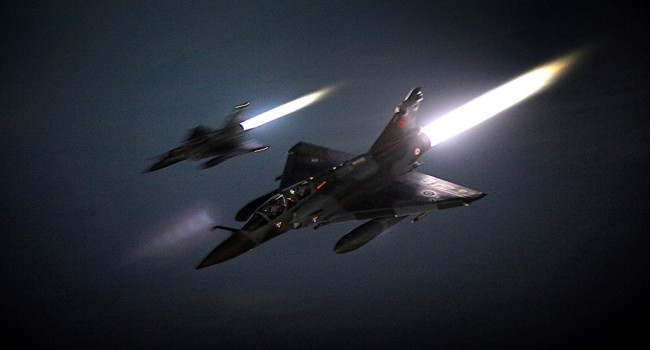
In the past decade or so, India has “militarily tailored” its defences along the Himalayas and China could be surprised if an armed clash breaks out.A repeat of the 1962 debacle, when Peoples Liberation Army of China, with a few exceptions, literally overran the Indian military defence, is just not possible in 2017, is an assessment in India.In early 2004, India stepped up efforts to secure areas along the 3,488-km Line of Actual Control (LAC) — the de facto boundary. Every possible route of ingress is continuously “war gamed” by the Army. “War-gaming” is an art of predicting future outcomes of military postures of rivals, fine-tuned by regular military exercises with the IAF, study of satellite imagery and available inputs.Since 2004, around 60,000 troops have been added along the LAC. This includes three new Army divisions and three additional brigades. Part of these form the newly raised Mountain Strike Corps. As of now, India has some 14 divisions (13,000-14,000 troops in each) — facing China that has 15-16 divisions facing India.Over the past five years, a few regiments of tanks have been added to the mechanised forces at specific places in eastern Ladakh and northern Sikkim. In Arunachal Pradesh, India has added troops. It has converted six British-era mud-paved runways into fully paved landing grounds for the IAF. One of these can be a forward base for the Sukhoi-30 MKI fighter jets. Leh has an airfield with abilities to launch 24×7 strikes. Kargil and Thoise in Ladakh have functional airfields.(Follow The Tribune on Facebook; and Twitter @thetribunechd)A complement of Sukhois at Hashimara (at the base of Bhutan) has been tasked to take on offensive in Chumbi Valley — the Doklam plateau stand-off is in the same valley. Tezpur in Assam has Sukhoi tasked to take an offensive role, so is Bareilly in Western UP. A squadron (18 planes) of MiG 29 jets has been added to Adampur (Punjab) to swing over Himachal Pradesh into Tibet.Modern US-procured planes C-130-J add to the fleet of Russian AN 32. Within hours, fully equipped troops can be dropped in Arunachal Pradesh and eastern Ladakh.The Indian stance along the LAC is not akin to Jawaharlal Nehru’s 1960-1961 “forward policy”, but it mandates holding on to own claim lines. The “forward policy”, as explained by Neville Maxwell in his book “India’s China war”, entailed taking up permanent positions along the high ridgelines of eastern Ladakh.There are 12 spots of major disputes along the LAC besides several minor ones. The sanctity of these spots is maintained by getting real-time satellite updates on Chinese movement; countering their LAC patrols with own patrols; and maintaining a level of firepower. The Army and the Indo-Tibetan Border Police (ITBP) have been tasked with conducting joint patrols along the LAC at designated points, identified by the high-power China Study Group.

What it is About

It is an art of predicting future outcomes of military postures of rivals, fine-tuned by regular military exercises with the IAF, study of satellite imagery and available inputs.Indian preparation

  • Since 2004, around 60,000 troops have been added along the 3,488-km Line of Actual Control
  • India has around 14 divisions (13,000-14,000 troops in each) facing China that has 15-16 divisions facing India
  • Over the past five years, a few regiments of tanks have been added to the mechanised forces at specific places in eastern Ladakh and northern Sikkim
  • In Arunachal Pradesh, India has added troops and converted six British-era mud-paved runways into fully paved landing grounds for the IAF

AC jackets for Indian Special Forces soonPanaji: Trials for introducing air-conditioned jackets for the Special Forces soldiers are on, former Defence Minister and Goa Chief Minister Manohar Parrikar has said. “In a Special Forces operation, there is extensive exercise. Body heats up, he (soldier) is very uncomfortable. At that time if he has an AC jacket, he is more comfortable. Trial is on,”said Parrikar, who served as the Defence Minister between 2014 and 2017. IANS