Sanjha Morcha

What’s New

Click the heading to open detailed news

Current Events :

web counter

Print Media Reproduced Defence Related News

Army preferred choice in times of crises: Rlys

New Delhi, October 31

In times of crises, India always relies on its armed forces, the Railways said today, amid criticism over the government’s decision to take the help of the Army to build a new foot-over bridge at Mumbai’s Elphinstone Road station.”We have always relied on the Army during a crisis,” a Railway official said. The Army had strong operational expertise in the construction of roads and bridges and in developing infrastructure and had been used during many civilian crises in the past, ministry officials pointed out.”Why should we wait for another disaster to happen before seeking help? If the Army can help rebuild the structure then why not get them to build it,” said an official. The ministry officials pointed out that the Army had been called in to join operations when the Mumbai-Goa highway bridge collapsed in August 2016, in rescue and rehabilitation work in Jammu and Kashmir during an earthquake in 2005 and floods in 2014 and the construction of a bridge during the Commonwealth Games in Delhi in 2010.A railway official also listed instances where the Army had been called in not just to repair and rebuild, but to manage fires as in 2008 when it helped control a blaze in a 13-storeyed building in Kolkata. — Agencies


Helping hand

  • The Army had helped construct a foot overbridge during the 2010 Delhi Commonwealth Games when an under-construction bridge outside Jawaharlal Nehru Stadium, collapsed days before the games were to start. The new bridge was built within five days
  • The Army was also involved in making pontoon bridges across the Yamuna last year when a World Culture Festival was organised on the flood plains of the river by the Art of Living group

Army to bring back remains of WW-I soldiers

Dehradun, October 30

A team of the Garhwal Rifles will travel to France in November to identify and bring back remains of its two soldiers killed during World War-I, an Army official said.The decision came after the French government recently found the remains of four soldiers, including the two unnamed Indian soldiers, at a construction site near Laventie, about 70 km from Dunkirk, in France.During World War-I, the now Garhwal Rifles regiment was known as ‘39 Garhwal Regiment’. The other two remains found from the site are said to be of British and German soldiers. — PTI


SOLDIER FIGHTS FOR ACTION AGAINST WIFE’S MOLESTERS

ROHTAK : Joginder Giri, a sepoy posted in Jammu and Kashmir with the Mechanised Infantry Regiment of the army, has been struggling to get justice for his wife who was allegedly molested by some miscreants at their residence in Sonepat’s Datauli village.

Giri said it all started with protests against an “illegal” liquor vend in their village in April. Upset at the opening of the vend, the village women vandalised it on April 22.

The army jawan said his mother was among 10-15 women who were booked under various sections of IPC and arrested by police.

He said on the same night, six miscreants who ran the alcohol vend came to his house when his wife and little daughter were alone, to get back at them for their family’s involvement in the day’s act. The miscreants molested his wife and robbed Rs 12,000 from house, Giri alleged.

“My wife lodged a complaint with the police, on which they did nothing. They lodged an FIR on July 28, more than three months after the incident, under Sections 148, 149, 354, 380, 452, 457 and 506 of IPC. But the police still have not made any arrest so far,” he said. “This is my fifth leave in this time span. It is affecting my duty,” he added. The police, on the other hand, claimed Giri’s complaint was false. “His wife filed a crosscomplaint because his mother was booked for the violent act and arrested. We did lodge an FIR on his complaint, but their claims have turned out to be false,” said DSP Aryan Chaudhary. However, Giri maintained that the local police was protecting the miscreants.


Online radicalisation a challenge: NS

Online radicalisation a challenge: NS
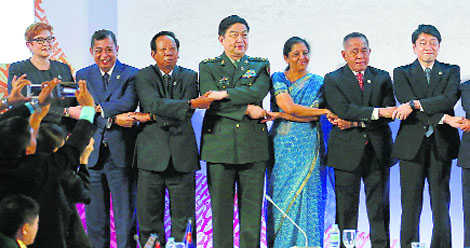
(From left) Defence Ministers Marise Payne (Australia), Mohammad Yasmin bin Haji Umar (Brunei), Samdech Pichey Sena Tea Banh (Cambodia), Gen Chang Wanquan (China), Nirmala Sitharaman (India), Ryamizard Ryacudu (Indonesia) and Itsunori Onodera (Japan) link arms for a photo session at the two-day ASEAN defence ministers’ meeting at Clark near Manila in Philippines. AP/PTI

Manila, October 24

Terrorism and radicalisation through social media pose a “serious” security challenge to all countries and a strong collective action is required to fight the “scourge”, Defence Minister Nirmala Sitharaman said today.Addressing the 4th ASEAN Defence Ministers’ meeting here in the capital of the Philippines, she said the global strategic and security situation was constantly evolving and had thrown up fresh and serious challenges.(Follow The Tribune on Facebook; and Twitter @thetribunechd)“The defence and security scenario in our shared region has also witnessed significant changes recently. Our countries now need to simultaneously prepare for traditional (military) and non-traditional threats,” Sitharaman, who is on her first foreign visit since taking over as India’s first woman Defence Minister last month, said.Terming terrorism a “trans-national phenomena” which needed strong collective action, Sitharaman praised the Philippines for resolutely addressing the threat posed by terrorists in the southern part of the country.“New developments in social media and cyberspace have expanded the threat as these are exploited by terrorists to develop less visible but lethal ways and means of manipulating minds of the people,” she was quoted as saying in an official statement.“I wish to commend the Philippines for reiterating India’s zero tolerance for terrorism anywhere and under any circumstances. There are no good terrorists,” she said.Sitharaman said the transnational activism of terrorist groups and the “spectre” of returning foreign fighters as well as the conduct of irresponsible states that provide safe havens, funding and even encouragement to terrorist groups all needed to be addressed jointly and comprehensively.“Terrorism anywhere is a threat everywhere,” she said. “India has taken resolute measures to fight the scourge of terrorism from across its borders. We fully recognise the role of joint mechanisms with our partners and the role of international and regional forums in fighting this menace. “The recent, BRICS Summit Declaration condemning all forms of terrorism and identifying a number of terrorist organisations engaged in dastardly acts was a positive step. We should be clear and unequivocal in our condemnation of terrorism,” she was quoted as saying in the statement. — PTI


PM Modi celebrates Diwali with troops along LoC in J&K’s Gurez sector

PM Modi celebrates Diwali with troops along LoC in J&K’s Gurez sector
Prime Minister is also visiting the far-flung Tulial area near the LoC in Gurez sector to spend some time with the soldiers there.

Srinagar, October 19

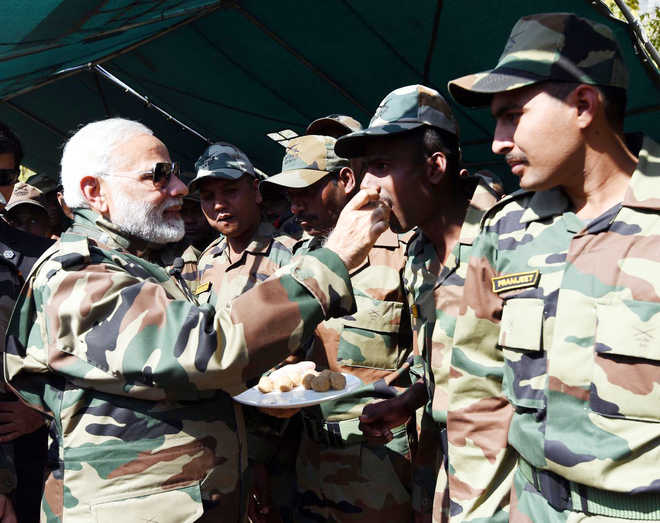
Prime Minister Narendra Modi on Thursday celebrated Diwali with troops posted along the Line of Control in Jammu and Kashmir’s Gurez sector and lauded the soldiers for their penance and sacrifice saying he considered them his family.In an unannounced visit, Modi arrived at Gurez on Thursday morning to celebrate Diwali with the army and BSF soldiers posted along the LoC, officials said.He spent two hours with the soldiers in Gurez valley, which is shouting distance of Pakistan-occupied Kashmir and has witnessed many gunfights with infiltrating militants in the past 27 years.

(Follow The Tribune on Facebook; and Twitter @thetribunechd)

This is the fourth successive Diwali that the Prime Minister has celebrated with jawans on the border.Chief of the Army Staff Gen BS Rawat and other senior Army officers were present on the occasion.Modi offered sweets and exchanged greetings with the jawans, the officials said.Addressing the jawans, he said like everyone else, he too wished to spend Diwali with his family.Therefore, he had come among the jawans of the armed forces, whom he considered to be his “family”, he said.Modi said he got new energy when he spent time among the jawans and soldiers of the armed forces and appreciated their penance and sacrifice, amid harsh conditions.The Prime Minister said he had been told that the jawans present at the gathering regularly practised yoga. He said this would definitely enhance their abilities, and give them a sense of calm.He said jawans, who left the armed forces after completing their duty tenure, could become excellent yoga trainers subsequently.The Prime Minister spoke of the new resolve that each Indian citizen must make for 2022, the 75th anniversary of Independence.He also encouraged the jawans to innovate, so that their routine tasks and duties became easier and safer and mentioned how best innovations were now being recognised and awarded at the Army Day, Navy Day, and Air Force Day.Modi said the Centre is committed to the welfare and betterment of the Armed Forces, in every way possible.In this regard, he mentioned the implementation of One Rank, One Pension, which had been pending for decades.Protecting the motherland, far from your loved ones, displaying the highest traditions of sacrifice, all soldiers at the nation’s borders, are symbols of bravery and dedication, Modi said.“I have an opportunity to spend the festival of Diwali with you. The presence of brave soldiers at the border, on this festive occasion, lights the lamp of hope, and generates new energy among crores of Indians,” the Prime Minister wrote in the visitors’ book.“To accomplish the dream of ‘New India’, this is a golden opportunity for all of us to work together. The Army too is a part of it,” he added. PTI


Turbulence In Officer Ranks Of The Indian Army: Comprehending A Problem That Needs Immediate Resolution by Lt Gen Syed Ata Husnain

Indian Armed Forces. 

SNAPSHOT

An Army doesn’t run only on the basis of the quality of weapons, technology, doctrine and tactics. The men behind all these are far more important.

Given its resilience and unity, the Army should itself set the issues in order through a consultative approach and prove to the courts that there is no necessity of arbitration in its internal affairs.


There have been a series of reports in the media about restiveness in the ranks of the officer cadre of the Indian Army. Some of these relate to issues regarding equivalence with civil services cadres as also non-functional financial upgradation (NFFU). These are relevant in their own way but do not have an immediate impact on the effectiveness of the force. A much more important issue, which is still under judicial scrutiny, but is causing heartburn and more than sufficient concern is the intra ‘department’ (term used for easier understanding) share of promotion vacancies for select ranks in the officer cadre. Ideally this is an issue completely internal to the Army’s cadre management.

However, since there has been some media noise on the subject, a case is in the courts and morale of the Armed Forces is a matter the public has a right to be aware about; I am expressing some basic facts for clarity. Admittedly, not many outside or inside the Army are fully conversant with the issues at stake. I claim that I am one of those who know the issue rather well.

Mercifully for the system, the Army Chief General Bipin Rawat and his current Adjutant General, Lieutenant General Ashwani Kumar, are fully aware of the intricacies having handled policy as staff officers at the Military Secretary’s Branch in their long service experience. Reflective of the seriousness as also a good understanding is the timely Press Information Bureau (PIB) note put out by the Army on 12 October 2017 reassuring its officer cadre that apprehension regarding the Services and other arms not getting their due in the share of promotion vacancies at select ranks was being addressed at the latest Army Commanders’ Conference, which is the highest forum in the Army for addressing policy issues. The fact that a PIB note was issued as against an internal service communication is sensible and projects the seriousness with which the Army appears to be transparently addressing a problem, which is potentially debilitating for the service. What is this issue all about?

From the rank of Colonel and upwards the Army’s rank structure is steeply pyramidal. The ranks are filled through promotion by selection, forcing high attrition rates at every stage. For every rank there are a fixed number of vacancies. Complexity becomes greater in populating the appointments held by various ranks because each of such appointment requires a mix of core experience of the Combat Arm, Combat Support Arm (CSA) or Service to which an officer belongs. These terms relate to the specific department such as Infantry, Armoured Corps or Mechanised Infantry (Combat Arms); Artillery, Engineers, Air Defence Artillery or Signals (CSA); and Ordnance, Electrical and Mechanical Engineers (EME) and Army Service Corps (ASC) which are designated as Services.

The appointments are divided into command, staff and extra regimental employment (ERE). They are specified for a given Combat Arm, CSA or Service on the basis of core competence acquired in pursuance of duties. There are also unspecified appointments which are tenable by all officers irrespective of department. A department’s cadre in a rank consists of the total of specified and unspecified appointments.

With the above minimal explanation, the real issue is the distribution of the sum total of promotion vacancies in each rank. That distribution should ideally ensure two things.

First, that batches of officers with same seniority should pick up higher rank at the near similar service level (years of service).

Second, that there is near similarity in percentage of officers being promoted from a batch but belonging to different departments. This will ensure uniform satisfaction levels for all. A system earlier in existence distributed the vacancies on a pro rata, based upon the total strength of a base rank such as Major from where the officers aspired to rise to the first select rank (Colonel).

That was a fair one but another factor, that of deprivation and risk for the Combat Arms had to be catered for; for that a fixed percentage each of the vacancies accruing to the CSA and Services was deducted and credited to the Combat Arms to keep them marginally ahead in promotion for sake of motivation (it was referred as combat edge). The system worked perfectly well except that much depends on the size of batches of each of these segments which is never uniform. Applying near uniform percentages of approval for promotion skewed the system and in 2001, for example, the ASC was four years ahead of the Infantry in promotion in spite of the combat edge.

After Kargil 1999, there was a need felt for keeping the Combat Arms with younger profile of commanding officers (COs). As additional vacancies accrued from the cadre review done by the Ajay Vikram Singh Committee (AVSC), a different mathematical model was adopted for vacancy distribution as against the combat edge model. This was called the command exit model. The basic assumption here was that more vacancies were needed for the Combat Arms to keep their age profile young (faster turnover) and the tenure shorter because of the greater stress and risk factors in command. There were various other reasons in this model, such as the larger number of command vacancies in some Arms or CSA, which gave a skewed and much higher percentage of vacancies to two entities, the Infantry and Artillery (although the latter is not a Combat Arm).

The result of the decision above was that a very distinct differential emerged in the batch parity between various departments (Arms/Services). Even this would not have created much turbulence because it happened in the past too and is usually a passing phase at a point in time due to batch strength. What really upped the angst was the percentage approval rate in which a very high differential has emerged by virtue of the command exit model. There have been times when in the Infantry and the Artillery 50-55 (or higher) per cent of a batch gets approved for promotion to Colonel.

However, the approval rate for some others such as Engineers, Signals and ASC goes down to well below 30 per cent. This means highly-competent and well-qualified officers of these CSA and Services get stalled as Lt Cols and do not get promoted to even the first select rank of Colonel (14-17 years of service or 36-40 years of age).

Officers who are qualified on the Defence Services Staff College course and also acquired an M Tech degree get stalled at the first level for promotion; obviously a major cause for dismay. That is the crux of the problem which is accentuated further by one other phenomenon, which needs a slight explanation.

The Army has been short of officers now for almost 25 years. Against 21 officers authorised to an Infantry unit on the LoC, only 13-14 are posted. Even this strength is achieved by attaching officers from the Services on commission from the pre-commissioning training academies, for a varying period of one to three years. They do the work of Infantry officers and bear the same risk. Later, in five to 10 years of service, all are required to do a tenure of 30 months with Rashtriya Rifles (RR) or Assam Rifles (AR) in active counter insurgency operations. Thus with approximately five years of operational service they perceive they are as much exposed to risk as Infantry officers. They question the rationale of their lower promotion avenues through lesser percentages. This is a contributory argument in their favour but is not the clinching one under any circumstances because the overall professional content of an officer’s worth does not come only through operational experience. There are many other factors which add to it.

Attempts were made to resolve this problem by scaling down the vacancies of the Infantry and Artillery and distributing these to others as a quick fix but a final decision was never taken; perceptions on the command exit model vary as per Arms/Service loyalty and have divided the officer cadre. It may be good for organisational interest in ensuring lower age profile of the COs of some Arms but organisational interest also includes the overall motivation and morale of the Army. Towards that end, the current situation surely calls for a review.

When a few officers decided to seek the legal route for redress, the Army was reported to have given an affidavit that officers from the Services were non-combatants purportedly because their duties did not entail risks of the combat zone. I have not come across such an affidavit although it is often quoted. This description apparently riled a lot of officers from the Services especially since in the first 10 years of service in the Army, most of them have equal if not more operational service than many Infantry officers, due to attachment only in field conditions and tenures with RR/AR. However, none of this justifies the position taken by some of them that being labelled as non-combatants they were not duty bound to serve in operational conditions. This is an unnecessary, immature, emotional and uncalled for response. No officer of the Indian Army is a non-combatant; such a category does not exist. Every one of them is trained for the first and foremost job of battling the enemy.

The Indian Army, known for its unity in diversity, in more ways than one, cannot afford such responses from within the ranks of its officer cadre. Yet, the question should be why the situation has been allowed to deteriorate to such a level. Obviously hard decisions devoid of any emotions or linkages to parent Arms and colour of lanyards need to be taken. There cannot be such yawning differential in the human resources practices that disallow reasonably uniform aspirations among all who have trained together but entered different Arms and Services due to the requirements of the organisation.

The Army Chief has been extremely mature in issuing the PIB note. He and the Army Commanders, along with the Adjutant General and Military Secretary, are the custodians of the values and ethos of the Army. A consensus decision to review the command exit model, and do it very early, is the call of the hour. An equitable system which still guarantees reasonable command tenures for all and ensures a maximum variation of 10 per cent in the percentage approval rates is something which needs to be sought. In the process, all archaic policies which seem to have outlived their utility need to be reviewed and shelved. In fact, the whole concept of quantified selection system introduced in 2008-2009 needs a fast track review.

An Army doesn’t run only on the basis of the quality of weapons, technology, doctrine and tactics. The men behind all these are far more important. If those men happen to form the leadership of the army then their lack of motivation and morale will ensure that every other advancement is neutralised. Given its resilience and unity, the Army should itself set the issues in order through a consultative approach and prove to the courts that there is no necessity of arbitration in its internal affairs.



New Delhi is too soft on Islamabad

Calling Pakistan ‘Terroristan’ on a global stage is not enough. India must back it with tough action

Recently, India branded Pakistan “Terroristan”. External affairs minister Sushma Swaraj told the United Nations that Pakistan, as the world’s “pre-eminent terror export factory”, has just one national accomplishment to boast of. Yet New Delhi is loath to back its words with even modest action, such as downsizing Pakistan’s bloated, Inter Services Intelligence (ISI)-infested high commission in New Delhi, withdrawing the unilaterally granted Most Favoured Nation status, leveraging the Indus Waters Treaty (IWT), or halting the barter trade across the Line of Control (LoC) that the National Investigation Agency (NIA) has identified as financing terrorism.

Despite playing to the gallery at home, India has done nothing to treat Pakistan as a terrorist nation. Indeed, behind its rhetoric, India pursues a cautious approach. Successive governments have shied away from slapping sanctions of any kind on Pakistan, yet not been coy to press other powers and the United Nations for sanctions.

India seems reluctant not just to back words with action but also to back words with just words on some issues. Take Balochistan, Pakistan’s Achilles heel which is becoming the new East Pakistan because of military killings and mass graves. When Prime Minister Narendra Modi raised Balochistan in his Independence Day speech in 2016, it seemed to signal an important policy shift. Yet India has remained conspicuously silent on the Balochistan issue. Even as Pakistan uses fake photographs to peddle a false narrative on Jammu and Kashmir (J&K), India is unwilling to spotlight the brutal Pakistani campaign against the Baloch people.

Another example is India’s rhetorical stance that the only outstanding issue on J&K relates to the part occupied by Pakistan. Other than slamming China’s One Belt, One Road (OBOR) initiative for infringing its sovereignty, India has said precious little to show that it is serious about its claim to that occupied region. It has actually kept quiet on matters of substance, including China’s new dam and other strategic projects in Pakistan-held J&K. Had China been in India’s place, it would have raised a hue and cry over each and every project.

As for lack of Indian action, look no further than the IWT issue. Modi vowed that “blood and water cannot flow together”. But instead of action, what has followed is visible backsliding — from reviving the suspended Permanent Indus Commission to allowing the partisan World Bank to insert itself as a mediator between India and Pakistan. The IWT grants the World Bank no mediatory role. Such mediation, besides setting a dangerous precedent, breaches India’s traditional policy of not allowing a third party to intercede in bilateral disputes. Worse still, the Modi-appointed committee of secretaries on the Indus waters has fallen by the wayside, with not a single new project launched.

On the issue of cross-border terrorism, Modi, after the deadly attacks that followed his surprise Lahore visit, sought to salvage his credibility by launching a cross-LoC surgical strike on militant launch pads. But it was always clear that such a limited, one-off operation by itself would not be able to tame Pakistan. The surgical strike was followed by a terror attack on yet another military base. India must mount sustained pressure to keep Pakistan off balance and deny it room to pursue its strategy of seeking to inflict death by a thousand cuts.

The battle against Pakistan’s State terrorism is India’s fight alone. Why would the United States designate Pakistan a terrorist State when the main victim of Pakistan-scripted terror, India, is reluctant to impose any sanctions on its scofflaw neighbour? Indeed, the NDA government persuaded Rajeev Chandrasekhar to withdraw his private member’s bill in Rajya Sabha for declaring Pakistan a terrorism sponsor. New Delhi is even unwilling to declare the rogue ISI a terrorist organisation. Actually, in a stunning display of naiveté, India hosted an ISI-linked Pakistani team at Pathankot so that it could probe the attack ISI orchestrated there.

The plain fact is that India is all talk when it comes to imposing costs on “Terroristan” next door. India is not the UN that can remain content with all talk and no action.

Words not backed by action carry unquantifiable costs. They not only affect India’s credibility but also undermine its deterrent posture. Isn’t it telling that Pakistan continues to gore India although it is seven times smaller demographically, eight times lesser in terms of GDP, and militarily weaker? Such aggression is the bitter fruit of India’s all-talk-no-action approach under successive governments. It is still not late to reverse course. The best actions to deter a congenitally hostile foe will be those that speak for themselves.


After 30 years of service, armyman told to prove he is Indian

GUWAHATI:A retired army officer was asked to prove his Indian nationality as Assam police branded him a Bangladeshi, an action that reflects the long and contentious conflict over illegal immigrants in the northeastern state.

FILEMohd Azmal Hoque being honoured during his service days.

A foreigners tribunal served a notice to Mohammed Azmal Hoque, who retired as a junior commissioned officer (JCO) last year after serving the army for 30 years.

The Guwahati-based Hoque maintains that his family is indigenous Assamese and his father’s name is mentioned on the voters list of 1966. His mother’s name was listed in the 1951 national register of citizens.

“I’ve no doubt that I will get justice. But it pains me when my daughter questions me if this is how the country treats those who serve it for so many years,” he said on Sunday.

Hoque enlisted in 1986 in a non-combat role technician and retired from the corps of electronics and mechanical engineers (EME) as subedar. He served at frontiers in Punjab and Arunachal Pradesh.

His wife, Mamtaj Begum, was summoned by a tribunal in 2012. She was cleared.

The couple son is studying in the Rashtriya Indian Military College in Dehradun and daughter at Army Public School in Guwahati.

“This incident has saddened me a lot. Even after 30 years of service to the nation, we are asked to prove our identity. This is unnecessary harassment,” he said.

The tribunal had served notices to government officials before and a talked-about instance is Assam police constable Abu Taher Ahmed, who was accused of being an illegal immigrant.


BSF detects 14-foot tunnel near border in Arnia sector

BSF detects 14-foot tunnel near border in Arnia sector
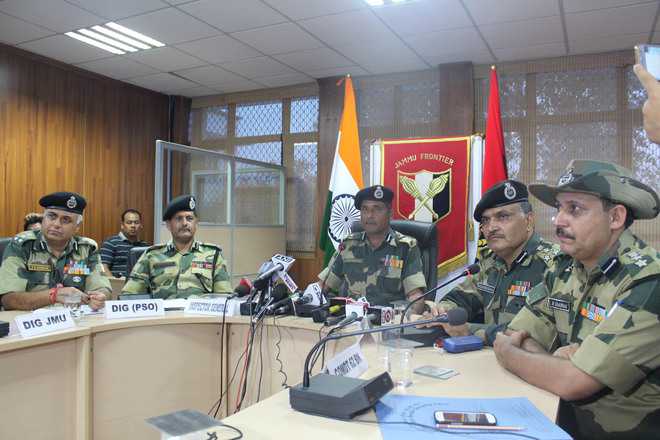
BSF IG Ramawtar addresses the media in Jammu. Inderjeet Singh

Amir Karim Tantray

Tribune News Service

Jammu, September 30

Alert Border Security Force (BSF) personnel today detected a 14-foot cross-border tunnel in the Arnia sector along the International Border. They also recovered ammunition, eatables and other ‘war-like’ stores from the spot.The tunnel was detected near the Mukesh border outpost this morning when the area domination party was sanitising the area.Addressing a press conference, Inspector General (IG) of the BSF, Jammu frontier, Ramawtar said after seeing suspicious movement 10-12 armed Pakistani nationals near the Dhamala nullah on the Pakistani side, the area domination party surveyed the area and detected the tunnel. “The BSF party taking all risk in a thick forest area, having a number of unexploded mortar bombs fired from Pakistan, reached close to the area. On observing the BSF party, the Pakistani nationals ran away, leaving their huge ‘war-like’ stores. The BSF began a detailed search in the area and found an unfinished tunnel which is about 12-14 feet long and approximately three feet in height,” the IG said. Charging Pakistan Rangers with backstabbing, he said, “On their invite, we held a flag meeting on Friday only and today the tunnel was detected. We remain alert and it was due to our alacrity that the tunnel was found,” Ramawtar added. The IG said the recovery of digging tools and freshly dug earth in the area indicated that the tunnelling had started recently with an intent to infiltrate terrorists across the border. He said regular inputs regarding the movement of anti-national elements across the border had kept the force on a highest alert.During the search operation, the BSF recovered two AK 47 magazines, one hand grenade, 7.62 ammunition, one magazine pouch, three head lamps, compass, three haver sacks, three forest hats, four sleeping bags, six digging tools, six wooden planks and eatables among other things.