All posts by webadmin

China defends raising Kashmir issue at UNSC to de-escalate Indo-Pak tensions

China defends raising Kashmir issue at UNSC to de-escalate Indo-Pak tensions

China’s comments came a day after India asserted that Beijing’s latest attempt to raise the Kashmir issue at the UNSC on Pakistan’s behalf has failed.

Beijing, January 17

Stoutly defending its decision to raise the Kashmir issue at the UN Security Council as an attempt to de-escalate Indo-Pak tensions and out of “good will”, China on Friday claimed that “most of the members” of the Council have voiced their concern over the situation in the Valley.

China’s comments came a day after India asserted that Beijing’s latest attempt to raise the Kashmir issue at the UNSC on Pakistan’s behalf has failed, with an overwhelming majority of the 15-member body expressing the view that it was not the right forum to discuss the bilateral issue between India and Pakistan.

China, Pakistan’s ‘all-weather ally’, on Wednesday made the fresh pitch to raise the Kashmir issue under “other matters” during a closed meeting in the UN Security Council Consultations Room.

Answering a barrage of questions at a media briefing here on why China is backing Pakistan to raise the Kashmir issue in the UNSC, Chinese Foreign Ministry spokesman Geng Shuang said, “China’s position is consistent and clear. This issue is a dispute left from history and should be properly resolved following the UN charter, UNSC resolutions, and bilateral treaties and in a peaceful way.”

“As requested by Pakistan, the Security Council reviewed the Kashmir issue on January 15. The Security Council members are concerned about the current situation and they called the relevant parties to observe the charter and resolve disputes peacefully, through political dialogue and exercise restraint and work on de-escalation,” he said.

Replying to a questing on why only China, among all the members, is making such claims, whereas no other member of the body has spoken about it, Geng said, “Indeed the UNSC reviewed the Kashmir issue on January 15 and there was no statement. But China as a permanent member participated in the review meeting and what I said was in line with the review. But if you think this is not true then you can look at other sources.”

When asked to name other countries he referred to, the Foreign Ministry spokesman said, “If you do not trust our views you may refer to other sites for information.”

At a press briefing in New Delhi on Thursday, Ministry of External Affairs Spokesperson Raveesh Kumar, while replying to questions about the developments in the UNSC, said the overwhelming majority of the UNSC was of view that it was not the right forum for such issues. Pakistan’s attempt to peddle baseless allegations and show an alarming scenario failed as it lacked credibility, he said.

Commenting on India’s statement, Geng said, “India’s attitude and views, we understand them. But what I said was China’s views and stance. I believe that India is aware of that and we have been in contact on that.”

To a question on why China is raising the Kashmir issue at the UNSC, when the top leaders of India and China made efforts to improve relations through informal summits, creating a negative perception among Indians, Geng said, “Because we want to work for de-escalation and work for regional peace and stability. This is out of good will. However, if the Indian side interprets it in other way, that will be a wrong interpretation.”

Following the Indian government’s revocation of special status granted to Jammu and Kashmir and bifurcating it into two union territories on August 5 last year, China has criticised New Delhi for making Ladakh a union territory. China lays claim over several parts of Ladakh.

Responding to a question that the Russian envoy in India has said that the Kashmir issue should be resolved bilaterally between India and Pakistan, he said during the review most UNSC members expressed concern on the current situation in Kashmir and called for restraint and de-escalation of tensions through dialogue.

“Russia is a member of the UNSC and its position has been fully expressed during the review,” he said.

Replying to a question on why China, which in the past has advocated that the Kashmir issue should be peacefully resolved between India and Pakistan, has now changed its stand by including UNSC resolutions and UN charter, Geng said Beijing’s position on Kashmir is very clear.

“We haven’t changed our position. The issue between India and Pakistan has always been on the UNSC agenda. The UNSC should pay attention to the issue in Kashmir based on the latest developments. And in this region, there are still International Observer Groups and it has always been on UNSC agenda,” he said.                      About India’s decision to invite Pakistan Prime Minister Imran Khan in the meeting of the Heads of the governments of the Shanghai Cooperation Organisation (SCO) countries, Geng said, “SCO is a regional cooperation organisation. India and Pakistan are members of it. Both the countries, we hope, can work together closely under this framework for the healthy development of this organisation.”

“India and Pakistan are important countries in South Asia and I hope they can resolve their issues through dialogue and improve their relations,” he said.

To a question on allegations of human rights violations in Kashmir during the past five months, Geng reiterated China’s stand, saying that Beijing stood for enhancing dialogue and mutual trust between India and Pakistan and exercise restraint and work for de-escalation of tensions.

“As a responsible country, we have been in contact with both India and Pakistan, and are playing a constructive role on this,” he said. PTI


More to China’s outreach than meets the eye

China has offered the Belt and Road Initiative to Myanmar in a bid to strengthen its hold on India’s eastern flank. Drawing Nepal into its strategic sphere, China has facilitated consolidation of Pakistan’s ISI in that country. Handing over India’s 5G network to China will be a strategic blunder.

More to China’s outreach than meets the eye

Lt Gen PC Katoch (Retd)
Military commentator

AFTER meetings with Sri Lankan President Gotabaya Rajapaksa and Prime Minister Mahinda Rajapaksa on January 14, Chinese Foreign Minister Wang Yi said, “We will not allow any outside influences to interfere with matters that are essentially internal concerns of Sri Lanka.” Earlier, on a visit to Nepal on October 12, 2019, Chinese President Xi Jinping fired a warning by saying, “Any attempt to split China will be crushed.” These utterances indicate a measure of conceit emanating from Beijing’s financial muscle and debt trap policy, also signalling the lien China has on India’s neighbourhood.

After the 22nd round of boundary talks between NSA Ajit Doval and Wang Yi at Agra on December 21, 2019, China tried to show it was eager for an early resolution of the border by suggesting that both should “promote early harvest consultations.” This proposal relates to the boundary along Sikkim only, which China wants tackled in order to pressure Bhutan on Doklam. This, despite the India-China agreement of 2005 that states a resolution must be a ‘package deal’ involving the complete border.

During 2019, Chinese media went on a charm offensive in praising PM Narendra Modi, calling him a ‘rock star’ and saying “the US strongly promoted its Indo-Pacific strategy which has the clear intentions of provoking a confrontation between China and India. But Modi did not fall for the trap.” After the informal Modi-Xi summit at Mamallapuram in December 2019, Sun Weidong, China’s Ambassador to India, said China was keen to promote defence and security cooperation with India, adding that China respected India’s decision on the RCEP and was willing to work to resolve the issues.

The eighth India-China joint training exercise ‘Hand-in Hand 2019’ was held in India last year (December 7-20) with 130 People’s Liberation Army (PLA) troops participating; company-level counter-terrorism exercise with respective battalion headquarters controlling it. This was followed by a five-day visit by an Indian military delegation led by Lt Gen Ranbir Singh, Northern Army Commander, to China, to interact with PLA generals (including General Han Weiguo heading the PLA ground forces and Western Theatre Commander General Zhao Zongqi) and visit military and civil establishments in Beijing, Chengdu, Urumqi and Shanghai.

In February 2019, China objected to Modi’s visit to Arunachal Pradesh, saying that it had never recognised it as part of India and the Indian leadership should refrain from “complicating the boundary issue.” China raised similar objections to Defence Minister Rajnath Singh’s visit to Arunachal Pradesh last November. Notably, China laid claim only to Tawang Plateau prior to 2005 but when the 2005 India-China Agreement mentioned that the boundary settlement must be a ‘package deal’, China overnight extended its claim to the entire Arunachal Pradesh under the euphemism of ‘South Tibet’.

Spending $126 billion to influence countries in South and Central Asia has earned China poor results and India is China’s key target. These are the findings from the study ‘Silk Road Diplomacy’ done by AidData in collaboration with the Asia Society Policy Institute and the CSIS. The study also brings out that military diplomacy is part of Beijing’s toolkit to influence countries of its core strategic interests. This is logical, but China’s stance changes as per its priority. Joint India-China exercises were being held even before China deliberately intruded in Bhutan, resulting in the 73-day Doklam standoff.

The current bonhomie by Beijing is mainly aimed at grabbing India’s 5G network. China’s political warfare is acknowledged worldwide. It spans ASEAN countries, Australia, Africa and many countries in South Asia. India is no exception. During the UPA-II regime, the National Security Council Secretariat (NSCS) issued an advisory against ZTE and Huawei for valid reasons of these two companies being inexorably linked to the PLA. But within three months, the MHA headed by Sushilkumar Shinde opened the floodgates for them in India. How much money and what else exchanged hands will never be known, but are we now entering the same league by ignoring China’s immense cyber warfare prowess? Surely, this can’t be part of what the political hierarchy expounds as ‘other ways to avoid war’.

China’s immense capabilities in backdoor Trojans which can be activated at its behest are a clear and present danger to foreign telecommunication networks that submit to Chinese technologies. There is no way that countries, leave aside India, can verify that China exports technology without backdoor Trojans. Yet, Huawei is reportedly partnering with Bharti Airtel for trials in Bengaluru with Vodafone Idea to eventually hold trials in Delhi. The government appears to have conveniently left the issue to telecom operators whose sole aim is to make money, national security being their last priority.

Have we ever wondered why China has infused massive state subsidies into Huawei’s 5G network price to cut out competition? Besides, what is so great about Huawei’s 5G technology that is not matched by Nokia, Samsung, Ericsson etc? Above all, what is the mad rush about 5G technology to ignore indigenous private players, which, given time, are capable of developing 5G and 6G networks? Should we sacrifice national security on the altar of new technologies?

China views India as its prime adversary in Asia and has no intention of resolving its boundary dispute with India. China approached the UN over Kashmir at Pakistan’s behest. China continues to oppose India’s membership of the UNSC. The China-Pakistan nexus enables a proxy war against India and Indian interests in Afghanistan as China supplies military hardware, including drones and firepower, to Pakistan for trans-border operations.

Xi Jinping has now offered the Belt and Road Initiative (BRI) to Myanmar in a bid to strengthen its hold on India’s eastern flank, in addition to its proxies in the Arakan Rohingya Salvation Army and United Liberation Front of Western Southeast Asia. Drawing Nepal into its strategic sphere, China has facilitated the consolidation of Pakistan’s ISI in Nepal. Handing over India’s 5G network to China will be a strategic blunder compromising our security and sovereignty.


Sepoy from Hoshiarpur ‘shoots himself dead’ at army camp in Udhampur

Sepoy from Hoshiarpur 'shoots himself dead'  at army camp in Udhampur

Sepoy Prince Kumar (25), a resident of Hoshiarpur in Punjab, was posted in 112 Territorial Army.

Jammu, January 18

An Army jawan committed suicide by shooting himself with his service rifle in a camp in Jammu and Kashmir’s Udhampur district, police said on Saturday.

Sepoy Prince Kumar (25), a resident of Hoshiarpur in Punjab, was posted in 112 Territorial Army and was on guard duty when he shot himself at Chinar camp in Rehambal area on Friday, a police official said.

The official said the motive behind the extreme step was not known immediately.

The body would be handed over to his unit after the completion of medical and other legal formalities which were under way, he said. PTI


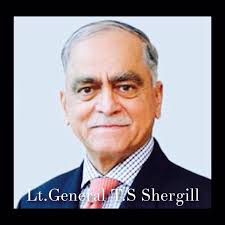
BHOG AND AMTIM ARDAS OF SONIA RAJINDER SINGH M/O LT GEN T S SHERGILL ON 19 JANUARY AT 14TH SIKH GURDWARA

7d44863f-9653-4492-a6ae-d949b89808a4

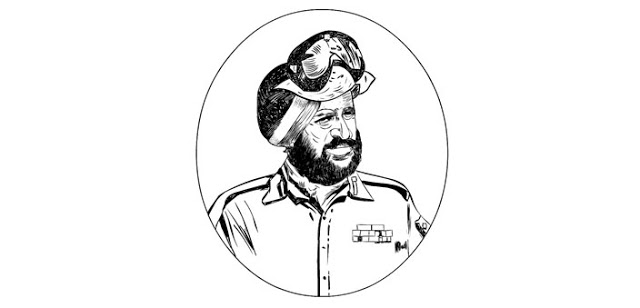
W/O  Major General Rajinder Singh ‘Sparrow’ – The legend people have forgotten!

0597

Major General Rajinder Singh MVC** (3 October 1911 – 15 May 1994) was an Indian Army officer and a two time member of the Lok Sabha, the lower house of the Indian parliament. He was nicknamed ‘Sparrow’. He is credited as the man with the most spectacular success against Pakistan. The man was responsible for destroying the largest number of Pakistani Patton tanks. He was awarded the Maha Vir Chakra twice in his career. In this article, we are going to talk about this forgotten legend!

MILITARY CAREER

He served in the ranks of the British Indian Army from 3 October 1932 to 31 January 1938. He attended the Indian Military Academy, Dehradun, and was commissioned onto the Unattached List, British Indian Army on 1 February 1938. He spent the next year attached to The King’s Regiment (Liverpool), a British Army regiment, stationed on the North West Frontier(now Khyber Pakhtunwa, Pakistan).He was then admitted to the Indian Army and joined the 7th Light Cavalry on 24 February 1939. He was promoted to lieutenant on 30 April 1939, and served during World War II. He was promoted temporary captain and acting major on 16 April 1942, to war-substantive captain and temporary major on 9 January 1943 and to substantive captain on 31 January 1945.

After independence, he joined the Indian Army and commanded the 7th Light Cavalry from September 1947 to May 1949. He was promoted to colonel on 30 January 1957 and held the appointment of regimental colonel of the 7th Light Cavalry from July 1959 to July 1969.
STORY BEHIND THE NICKNAME ‘SPARROW’

During the battle for Zojila, Lt. Col Rajinder Singh was assigned the near-impossible task of transporting his 7th Cavalry Regiment comprising of Stuart tanks to the battleground at 11000 ft. When everyone thought that the task was impossible, his unit accomplished the task in record time and Pakistani forces had to fly away from there..

A foreign war correspondent covering the battle said to Rajinder Singh, “You are an Eagle!”. Rajinder Singh replied, “Not Eagle, I am just a Sparrow”. He was called ‘Sparrow’ since then.
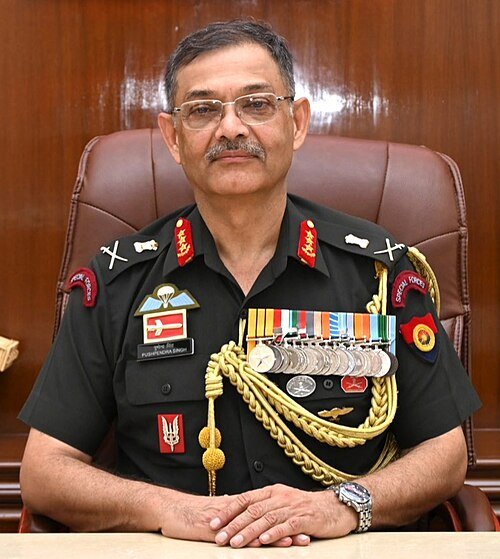
 Rajinder Singh

FIRST MAHA VIR CHAKRA

C7RCtMfX4AAkvg0

In the Indo-Pak War of 1947-48, the Indian Army had to assault and capture Zoji La, Dras and Kargil district in Ladakh codenamed as Operation Bison. At that time, Rajinder Singh was serving as a Lieutenant Colonel in the 7th Light Cavalry regiment. When nobody could’ve even imagined that the tanks could be deployed at high altitudes, Rajinder Singh led the Indian tanks on the Zoli La and cleared the road to Ladakh during the Kashmir Operation in 1948. He was awarded Mahavir Chakra for his role in that action.

SECOND MAHA VIR CHAKRA

In 1965, infiltration by a large number of militants and attack by Pakistan in Akhnur sector led to a general war between the two countries. The 1 Armoured Division under command of Major General Rajinder Singh Sparrow was assigned the task of capture of Phillora and Pagiwal in the Sialkot sector. The enemy had two regiments of armour in the area. The attack on 11 September resulted in the biggest tank battle since the Second World War. Lt. Col. Tarapore, commanding officer, 17 Horse, displayed outstanding leadership and was awarded PVC(Read more about him here). Sixty nine Pakistani tanks were destroyed against nine of our own. Phillora was cleared by 16 September. Major General Sparrow had led his formation to win against a better equipped and numerically superior enemy. He was awarded the MVC again.

During the Pakistan aggression in 1965 Maj Gen Rajinder Singh Sparrow was General Officer Commanding I Armoured Division. As a result of his brilliant handling of the Division, Pakistani Armoured Corps, pride of Pakistan Army was defeated. Major General Rajinder Singh got a bar to his Maha Vir Chakra.
SON
 LT GEN TAJINDER SINGH SHERGILL
download
download (1)

Kashmir-Bihar: Tale of two veteran soldiers, now close friends

Idrees Bukhtiyar

chandigarh@hindustantimes.com

Mohali : They’re victims of militant attacks. One, a Muslim from Jammu and Kashmir (J&K) and the other, a Hindu from Bihar. The one thing, however, that has kept these two veteran soldiers going, despite being confined to wheelchairs, is their close bond, forged over a passion for basketball.

Mohammad Latief Bhat, 40, and Ajit Kumar Shukla, 40, are admitted to the Paraplegic Rehabilitation Centre (PRC) in Phase 6, Mohali.

Both were posted in Rajouri, with Bhat from Anantnag in J&K, a sepoy in the Indian Army’s JAK Light Infantry Regiment and Shukla, an ex-gunner with 104 Army Air Defence. Both did not know each other.

Bhat suffered grievous spine injuries on August 3, 2001, when his vehicle, escorting an army convoy in J&K’s Rajouri, was hit by a mortar shell, sending it plunging down a 250-feet deep gorge.

As fate would have it, around four years later, Shukla suffered spinal injuries after two bullets fired by militants during an encounter in Rajouri district hit the left side of his abdomen on February 25, 2005.

They were shifted to the Army Hospital in Udhampur and referred to the Western Command Hospital in Chandimandir from there. Bhat joined the PRC in March 2003 while Shukla joined three years later in March 2006.

“We did not know each other but we connected over wheelchair basketball games,” Bhat said.

He said they both started teaching wheelchair basketball to other soldiers in the centre and gradually started learning more about each other which led to forging of deeper bonds.

They have represented the country in multiple international wheelchair basketball tournaments.

“We played the first one in 2017 in Indonesia and bagged the bronze medal. In the same year, we played a national tournament in Nepal and won a silver,” Shukla said. “We also played a tournament in Lebanon in 2018 and got the bronze medal. We also played a tournament in 2019 in Tokyo,” he added.

Shukla believes the game will keep them friends forever.

“The army has taught us to never judge and make friends on the basis of religion and caste. It teaches us to be humans first. Humanity is the greatest religion,” he said.

Latief and Shukla are living in the government quarters in the centre. They said their time in the PRC has given them a new lease of life.

Bhat says their similarities also connected them.

“We were posted in Rajouri, have married for love, have a passion for basketball and have no children of our own,” he said. “These similarities are the thread that connects our friendship,” he added.

PRC director Colonel GS Nagra spoke on their friendship: “We are proud they are a part of the centre.”

Established in 1978, PRC is a charitable institution that undertakes rehabilitation of paraplegic and tetraplegic soldiers and provides them therapeutic facilities and vocational training in various fields to make them economically self-sufficient.


Avalanche hits army post in Kargil, soldier dead, 3 others injured

Avalanche hits army post in Kargil, soldier dead, 3 others injuredwhite coat Over 5,000 vehicles stranded on as Jammu-Srinagar remains shut, 1 dead in south kashmir
Stranded trucks on the Jammu-Srinagar national highway in south Kashmir on Thursday. Waseem Andrabi/ht

HTC & Agencies

letterschd@hindustantimes.com

Srinagar/Jammu : A soldier was killed and three others were injured when an avalanche hit an army post in Drass belt of Ladakh’s Kargil district on Thursday, officials said.

The avalanche hit the army post in Mushkoh valley in which four soldiers were buried, they said. One soldier died while three injured were rescued, they added.

A man was also killed after he fell while clearing snow from the roof of his house in south Kashmir’s Sathora Tral village on Thursday, as the Valley continued to receive more snow.

Fresh landslides struck the Jammu-Srinagar national highway which remained closed for the fourth consecutive day.

Snowfall on Kashmir side of the highway since Sunday has resulted in blockade of the highway. As a result of the blockade, over 5,000 vehicles are stranded at various places en route from Lakhanpur in Kathua district to Banihal belt of Ramban district and also on the Kashmir side.

At least 10 flights bound for Kashmir valley were cancelled due to bad weather on Thursday.

The weather department has predicted another spell of moderate to heavy snowfall from next week. Srinagar MeT director, Sonum Lotus, said that for next five days there will be improvement in weather conditions. “We expect another spell of snow from January 21.” Several parts of south Kashmir have been observing heavy snowfall since Wednesday night. htc & Agencies


Pak cornered at UNSC, faces heat on terrorism

Pak cornered at UNSC, faces heat on terrorismPak cornered at UNSC, faces heat on terrorismFATF BLACKLIST All options on table if Islamabad fails to take action, says UK

Rezaul H Laskar

rezaul.laskar@htlive.com

New Delhi : The UK on Thursday called for more action by Pakistan to counter terror emanating from its soil against the backdrop of a majority of the members of the UN Security Council rejecting an effort by Islamabad to rake up the Kashmir issue with Beijing’s backing.

Gareth Bayley, the UK prime minister’s special representative for Afghanistan and Pakistan, said “all options are on the table” if Islamabad fails to implement the Financial Action Task Force’s (FATF) action plan to counter terror financing and crack down on terrorists operating from Pakistani soil.

India strongly criticised Pakistan and China for raising Kashmir during closed-door consultations at the UN Security Council on Thursday, saying Islamabad’s attempts to “peddle baseless allegations” lacked credibility.

While India has directed its criticism of recent efforts to raise Kashmir at the UN mostly at Pakistan, the external affairs ministry also called on China not to persist with such actions given the lack of support from the world community.

China’s effort to discuss Kashmir at the UN Security Council, the second such move since December, ended without any outcome after members of the body such as the US, the UK and France made it clear the issue should be handled bilaterally by India and Pakistan, people familiar with developments said.

Speaking at the Raisina Dialogue, a think tank event backed by the external affairs ministry, Bayley said: “It is absolutely clear terrorist groups are operating from within Pakistan. They pose a serious challenge to the government of Pakistan and to South Asia’s regional stability.”

Britain has “engaged hard” on this issue with the top Pakistani leadership and underlined the importance of action against proxy groups, terrorism and extremism, he said.

“So far, there is definitely some progress that has been made, there is so much more progress that needs to be done. We say to Pakistan…a step change is required and Prime Minister [Imran] Khan and army chief [Gen Qamar] Bajwa have made very clear commitments (which) can be seen on public record,” Bayley said.


It’s a soldier’s duty to uphold Constitution

General Naravane’s reference to the Preamble and its core values follows young students regularly reading them out during the ongoing protests. This is a timely reminder to the men and women in uniform that it is the Constitution — to which they swore allegiance on joining the military — which is their holy grail, not any party or ideology. Pursuit of these ideals is facilitated by the military imbibing from its own ethics.

It’s a soldier’s duty to uphold Constitution

Shining ideals: The armed forces remain uniquely apolitical, professional, secular and committed to civilian political control. The tradition has prevented unconstitutional activity.

Maj Gen Ashok Mehta (retd)
Military commentator

Never before in recent memory has an incoming Army Chief made crystal clear the constitutional role of the Army. During his first annual press conference ahead of Army Day, General MM Naravane stated unequivocally that the Army owes allegiance to the Constitution of India and the core values it embodies in its preamble: Justice, liberty, equality and fraternity. The defence of these values, he said, was achieved by protecting the borders and safeguarding the country’s sovereignty and territorial integrity. He outlined this belief and conviction in his opening remarks, and not in response to a question.

His remarks will certainly set to rest, for the time being, the controversial political statements made by his predecessor, General Bipin Rawat, and others in uniform, endorsing the government’s policies before and after the ongoing CAA/NRC protests.

Just last month, the Eastern Army Commander, Lt Gen Anil Chauhan, lauded the government for taking difficult legacy decisions — from abrogation of Article 370 to Ram Mandir and from CAA to bringing to near closure the Naga peace process. This same script was paraphrased by External Affairs Minister S Jaishankar at a book launch recently, suggesting that the government’s distinguished record of achievements was being distributed to the military also. It was inevitable that the armed forces would be sucked into backing the government policy and its implementation.

General Naravane’s reference to the Preamble of the Constitution and its core values follows young students regularly reading them out during the ongoing protests. This is a timely reminder to the men and women in uniform that it is the Constitution — to which they swore allegiance on joining the military — which is their holy grail, not any political party or ideology. General Naravane’s bottom line was: “We are an Army of the people and for the people”, which translates into pursuing national interest and not partisan interests of the ruling establishment and the party in power. The General’s sermon was required to set the record straight and insulate soldiers from politicisation.

It is widely understood that over the last few years, especially following the Uri surgical strike and the Balakot air strike, the government glorified the soldier largely for its own electoral benefit, thereby politicising sections of the military, especially when Uttar Pradesh Chief Minister Yogi Adityanath called the Indian Army, ‘Modiji ki sena’, at election rallies last year.

After the Uri surgical strike, pictures appeared at election rallies of the now Northern Army Commander, Lt Gen Ranbir Singh, the architect of the strikes, flanked by Prime Minister Modi and Home Minister Shah.

While publicly defending the integrity of the Rafale contract with Dassault, Defence Minister Nirmala Sitharaman was invariably accompanied by an Air Marshal, usually now the Chief of Air Staff, Air Chief Marshal RKS Bhadauria.

This dangerous misuse of the Army and Air Force in claiming political success has swayed several serving and retired soldiers towards the ideology of the ruling party.

The Indian armed forces remain uniquely apolitical, professional, secular and committed to civilian political control. Pursuit of these ideals is facilitated by the military imbibing from its own set of ethics, ethos, customs and traditions that have prevented any unconstitutional activities by them.

In his book, A Chequered Brilliance, former Congress minister Jairam Ramesh describes former Defence Minister VK Krishna Menon’s efforts in creating a rift among the senior Army officers, separating the pliant from the self-opinionated. He trained his guns on the charismatic Army Chief, General KS Thimayya (during Karnataka elections last year, Modi erroneously named Field Marshal KM Cariappa, when he meant Thimayya, while blaming Prime Minister Nehru and the Congress for mistreating him) and the legendary Field Marshal Sam Manekshaw to get them removed and replaced by his chosen lot of generals that included the likes of PN Thapar, BM Kaul and others. Menon’s politicisation of the Army was one reason for the Himalayan debacle of 1962.

The only other crisis in the Army was when a former chief took his own government to court over an age row. When asked why he took no action to discipline the Army Chief, Defence Minister AK Antony, alarmed at the question, and in awe of the General, replied: “But how…? The Army Chief is such a big man.”

When officers of my vintage graduated in 1957 from the Indian Military Academy in Dehradun, it was not the Constitution we swore allegiance to, but the credo and motto scripted by Field Marshal Philip Chetwode: “The safety and honour of the country come first, always and every time; the honour, welfare and comfort of the men you command come next; your own ease, comfort and safety come last, always and every time.”

As for soldiers of the time, at their attestation parade, they swore over copies of their faith to unstintingly obey the orders of their seniors, to protect the country on land, at sea and in the air, in India and overseas. It was a multi-faith avowal for defending the sovereignty and territorial integrity of the country as priests of different faiths snaked through the rank and file of recruits being turned into soldiers.

Thank you, General Naravane, for reminding soldiers (and us veterans) of their constitutional duties, including upholding the democracy’s core values.


People take road safety pledge at Attari-Wagah Retreat ceremony

People take road safety pledge at Attari-Wagah Retreat ceremony

Participants during a road safety campaign at Attari-Wagah border on Sunday. Tribune photo

Tribune News Service

Neeraj Bagga

Amritsar, January 12

People took road safety pledge collectively during the Beating the Retreat ceremony at Attari-Wagah border on Sunday.

The NGO, Drive Smart Drive Safe, along with SIAM, CII and many other like-minded organisations, launched the campaign to create awareness among masses.

Crores of Indians travel on roads and 415 never come back home, everyday. There are many reasons of these deaths but one sure solution and improvement possibility is transforming public traffic sense, encouraging good road behaviour through a Citizen’s Movement.

Believing in “Sadak Suraksha Jeevan Raksha”, these NGOs launched the campaign titled IndiaAgainstRoadCrash #IARC2020 during the 31st National Road Safety Week as announced by the Ministry of Road Transport and Highways.

Team of ClubD2S educated more than 50,000 citizens at Wagha border about need to bring urgency to arrest road deaths and putting it on national priority.

Rama Shankar Pandey, MD-Hella India Lighting Limited, said: “Travelling on Indian roads is extremely risky and there are many overlapping reasons for such alarming road crashes in the country, but one sure solution to change ourselves.

For masses, road crash is yet seen as an unfortunate act of God. This psychology needs to be changed.


Gen Rawat calls for US-style approach to tackle terror

Gen Rawat calls for US-style approach to tackle terror

Gen Bipin Rawat, Chief of Defence Staff

New Delhi, January 16

Newly appointed Chief of Defence Staff, Gen Bipin Rawat, on Thursday called for a US-style approach to tackle terrorism, like they did after the 9/11 attacks.

Speaking at the Raisina Dialogue 2020, Gen Rawat said, “Terrorism is here to stay as long as there are states which use terror as policy and till there are proxies who provide weapons. We have to bring an end to terrorism and that can only happen the way Americans started after the 9/11 terror attacks.” “They said let’s go on a spree on global war on terror.

To do that you have to isolate the terrorists and anybody who is sponsoring terrorism has to be taken to task,” he added.

Gen Rawat was part of a panel discussion on the evolving nature of counterterrorism. The consensus among the speakers was that threat of terrorism was pervasive and continues to warrant international attention and greater cooperation within the intelligence community.

“Anyone sponsoring terrorism has to be taken to task,” the CDS added. On being asked by the moderator of the discussion if he was referring to Pakistan, he said, “I am referring to any such country.”

On Pakistan, Gen Rawat said, “You have to bring about accountability. Denial that they (Pak) are victims of terror is not an answer. Time has come to take the bull by its horns.”

He lauded the pressure exerted on Pakistan at the recent Financial Action Task Force (FATF) , which he said was a reflection of global recognition of Pakistan’s role in harbouring terrorists.

On being asked if the Army had been heavy-handed in Kashmir, Gen Rawat said there was an impression that the Army was heavy-handed, but that was wrong. “We used hard measures in early 1990s. Look at the casualties we are suffering,” he argued his opinion.

The UK Special Representative on Afghanistan and Pakistan, Gareth Bayley, responded to allegations of the UK being too close to Pakistan. “It is a simple matter of necessity,” he added. “We have to be engaged with countries across South Asia, having robust conversations across all levels about what needs to happen urgently.”

Responding to allegations that social media platforms are often used as propaganda tools by those seeking to promote violent extremism and hate, Facebook Policy Lead Erin Saltman acknowledged their inability to ascertain the threat and scope of its influence. However, she stressed that in the past five years, Facebook had redoubled its efforts to identify and counter such extremist online content. — TNS