
In the quaint town of Condé-Sur-Vire, nestled in the heart of Normandy, Vivek Singh stands out as the only Sardar in a sea of French culture. The son of a former Chief of the Indian Army, Vivek’s journey to becoming the first elected Sikh Municipal Commisioner in France is a powerful story of resilience, acceptance, and integration. Follow his inspiring path as he overcomes cultural differences, earns the trust of his community, and proves that identity and tradition can coexist with a new way of life. “The Sardar of Condé-Sur-Vire” is a heartfelt tale of breaking barriers and thriving against the odds.
All posts by webadmin
650 join ITBP after completing training
The grand Passing Out and Oath-Taking Ceremony of the 490th GD Male and Female Batch were marked by a parade and demonstrations of combat readiness
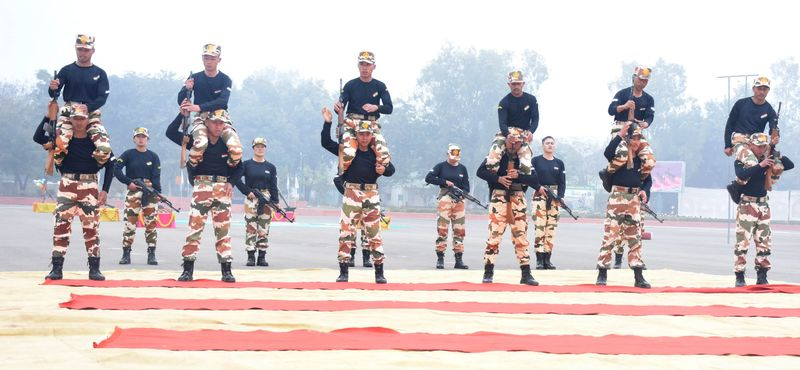
A new contingent of 570 Himveers and 80 Himveeranganas officially joined the Indo-Tibetan Border Police (ITBP) after completing an intensive 44-week training programme at the Primary Training Center, Bhanu.
The grand Passing Out and Oath-Taking Ceremony of the 490th GD Male and Female Batch were marked by a parade and demonstrations of combat readiness.
ITBP Director General Rahul Rasgotra, who was the chief guest at the event, administered the oath to the new recruits, emphasising the honour of serving the nation in a disciplined force.
He encouraged them to uphold the values of hard work, resilience, and continuous learning throughout their service.
During the training, the recruits were equipped with expertise in weapon handling, combat tactics, self-defence, counter-terror operations, and internal security. Representing 24 states and union territories, the batch included a significant number from Arunachal Pradesh (211), Sikkim (161), and Ladakh (57).
The ceremony features multiple performances, including PT drills, tactical conditioning and a pipe band display. To recognise outstanding performance, Constables Pawan Singh, Aman Negi, Tashi Nangyal Bhutia, and Muslim Appa were honoured with trophies.
Brig GS Gill, Deputy Inspector General, expressed gratitude to the dignitaries, trainees’ families, and retired officers present.
Two Chinese vessels in Arabian Sea, India keeps a close watch
Delhi has flagged presence of 175 ships since Nov last year

Ajay Banerjee Tribune News Service

The presence of two Chinese survey vessels in international waters of the Arabian Sea has been reported with Indian security agencies closing monitoring their activities. The vessels — capable of mapping the sea-bed for resources and identifying optimal submarine routes — have been operating in the area since November last year, although these have remained outside India’s Exclusive Economic Zone (EEZ), which extends 370 km from the shore.
Classified as “science vessels” and officially tasked with “fishing surveys”, these ships are also known to perform strategic roles for the Chinese Navy, including recording underwater submarine sounds, monitoring warships of other nations and intercepting radio communications on open channels.
A similar Chinese survey vessel had conducted surveys around the Maldives in April 2024. It again returned to the region in November last year, sources said.
China has a huge “distant-water fishing fleet” in the Arabian sea. Many countries have raised concerns over the presence of illegal fishing fleets in the region. Indian security agencies too have flagged the presence of 175 Chinese vessels in international waters of the Arabian sea since November last year. These vessels are now permanently operating in the Arabian Sea, except during the May-August fishing ban.
The activities of Chinese survey ships in the Arabian Sea have raised concerns among several countries, including India. These vessels are equipped with advanced technology to conduct oceanographic and hydrographic surveys, including studying marine environments, currents, climatic patterns and mapping the ocean floor. India has often questioned China’s intentions since such data collection could have significant strategic implications, including the potential to undermine regional security.
The Arabian Sea is a critical maritime zone, serving as a vital transit route for global energy supplies and connecting major economies. China has been expanding its fleet of survey vessels, which it claims are for scientific purposes.
US deports Indian migrants on military aircraft amid Trump’s immigration crackdown
The C-17 aircraft had departed for India with migrants aboard but would not arrive for at least 24 hours

A US military plane is deporting migrants to India, a US official said on Monday, the farthest destination of the Trump administration’s military transport flights for migrants.
President Donald Trump has increasingly turned to the military to help carry out his immigration agenda, including sending additional troops to the US-Mexico border, using military aircraft to deport migrants and opening military bases to house them.
The official, speaking on the condition of anonymity, said the C-17 aircraft had departed for India with migrants aboard but would not arrive for at least 24 hours.
The Pentagon has also started providing flights to deport more than 5,000 immigrants held by US authorities in El Paso, Texas, and San Diego, California.
So far, military aircraft have flown migrants to Guatemala, Peru and Honduras.
The military flights are a costly way to transport migrants.
Reuters reported that a military deportation flight to Guatemala last week likely cost at least $4,675 per migrant.
BUDGET 2025 : TAXES DETAILS
Here is how salaried class will benefit from new Tax regime
No income tax up to Rs 12 lakh as Nirmala Sitharaman gives major relief to middle class in Union Budget

Individuals earning up to Rs 12 lakh annually will not have to pay any income tax under the new tax regime as Finance Minister Nirmala Sitharaman on Saturday gave relief to middle class by raising exemption limit and rejigging slabs.
For salaried employees, this nil tax limit will be Rs 12.75 lakh per annum, after taking into account a standard deduction of Rs 75,000.
Higher exemptions and rejigs have been effected under the new income tax regime.
“I am now happy to announce that there will be no income tax payable up to income of Rs 12 lakh (i.e. average income of Rs 1 lakh per month other than special rate income such as capital gains) under the new regime,” the finance minister said.
“The new structure will substantially reduce the taxes of the middle class and leave more money in their hands, boosting household consumption, savings and investment,” Sitharaman said in her Budget speech.
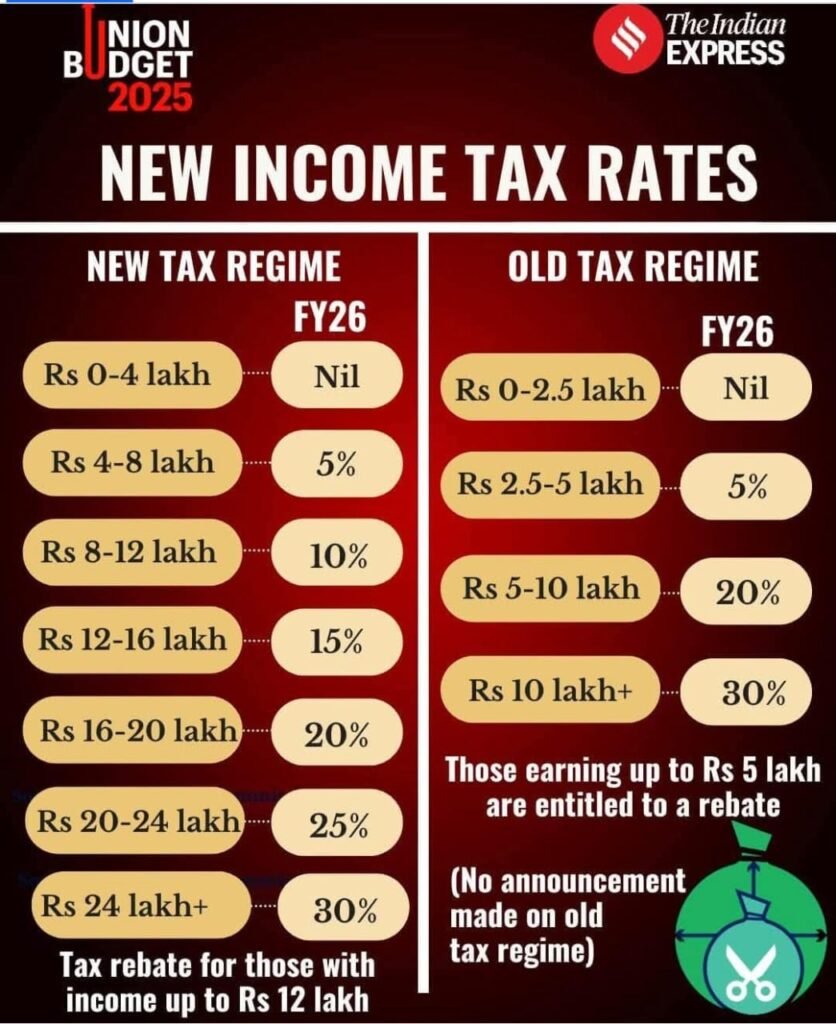
As per the rejig, for people earning more than Rs 12 lakh per annum, there will be nil tax for income up to Rs 4 lakh, 5 per cent for income between Rs 4 and 8 lakh, 10 per cent for Rs 8-12 lakh, 15 per cent for Rs 12-16 lakh.
A 20 per cent income tax will be levied on income between Rs 16 and 20 lakh, 25 per cent on Rs 20-24 lakh and 30 per cent above Rs 24 lakh per annum.
A tax payer in the new regime with an income of Rs 12 lakh will get a benefit of Rs 80,000 in tax. A person having income of Rs 18 lakh will get a benefit of Rs 70,000 in tax.
A person with an income of Rs 25 lakh gets a benefit of Rs 1.10 lakh.
The opposition, however, has criticised the timing of the announcement. Some leaders termed it an “election gimmick”, questioning why such relief wasn’t introduced earlier. A few others expressed skepticism, suggesting that the government was leveraging fiscal policies for electoral gains.
Budget 2025: Here’s what all will get cheaper and costlier as FM rejigs basic customs duties
Finance Minister Nirmala Sitharaman as part of her Budget presentation proposed a host of tweaks in basic customs duty (BCD) for various products or items
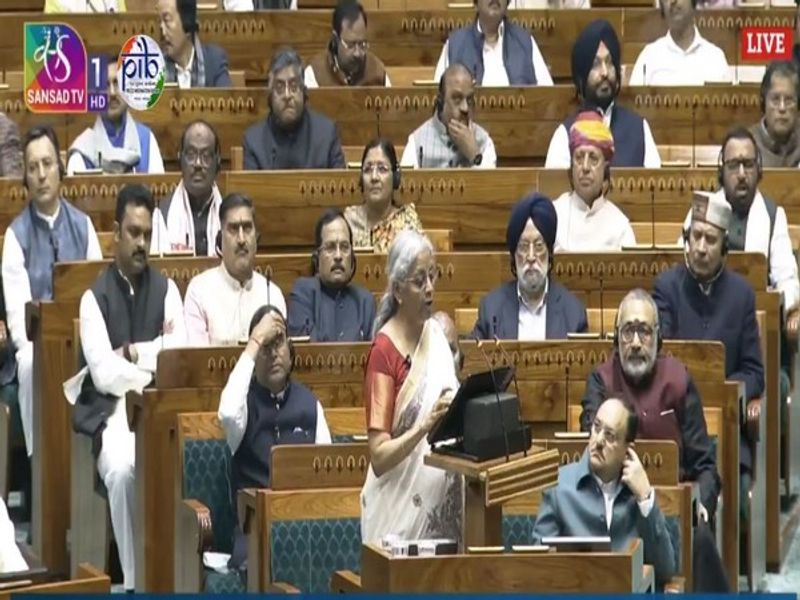
New Delhi [India], February 1 (ANI): For the layperson, the highlight of the Union Budget has always remained on what all have become cheaper and which of them has got costlier to buy.
This year too the first full budget of Prime Minister Narendra Modi government’s third term in office has been no exception.
Finance Minister Nirmala Sitharaman as part of her Budget presentation proposed a host of tweaks in basic customs duty (BCD) for various products or items that are critical for manufacturing or for day-to-day needs. In some cases prices were raised to make domestic manufacturing robust.
Relief on import of drugs and medicines:
To provide relief to patients, particularly those suffering from cancer, rare diseases and other severe chronic diseases, Sitharaman proposed to add 36 lifesaving drugs and medicines to the list of medicines fully exempted from Basic Customs Duty (BCD).
She also proposed to add six lifesaving medicines to the list attracting concessional customs duty of 5 per cent. Full exemption and concessional duty will also respectively apply on the bulk drugs for manufacture.
Specified drugs and medicines under Patient Assistance Programmes run by pharmaceutical companies are fully exempt from BCD, provided the medicines are supplied free of cost to patients.
The minister has now proposed to add 37 more medicines along with 13 new patient assistance programmes.
Support to domestic manufacturing and value addition:
In the July 2024 Budget, the government had fully exempted BCD on 25 critical minerals that are not domestically available.
The government had also reduced BCD on two other such minerals to provide a major fillip to their processing especially by MSMEs (micro, small and medium enterprises).
Now, the government proposed to fully exempt cobalt powder and waste, the scrap of lithium-ion battery, Lead, Zinc and 12 more critical minerals.
“This will help secure their availability for manufacturing in India and promote more jobs for our youth,” the FM said.
Textiles:
To promote domestic production of technical textile products such as agro-textiles, medical textiles and geo textiles at competitive prices, the Finance Minister has proposed to add two more types of shuttle-less looms to the list of fully exempted textile machinery.
She also proposed to revise the BCD rate on knitted fabrics covered by nine tariff lines from “10 per cent or 20 per cent” to “20 per cent or Rs 115 per kg, whichever is higher”.
Electronic goods:
In line with ‘Make in India’ policy, and to rectify the inverted duty structure, she proposed to increase the BCD on Interactive Flat Panel Display (IFPD) from 10 per cent to 20 per cent and reduce the BCD to 5 per cent on Open Cell and other components.
In the 2023 -24 Budget, for the manufacture of Open Cells of LCD/LED TVs, the government has reduced the BCD on parts of Open Cells from 5 per cent to 2.5 per cent .
“To further boost the manufacture of such Open Cells, the BCD on these parts will now stand exempted.”
Lithium ion battery:
To the list of exempted capital goods, she proposed to add 35 additional capital goods for EV battery manufacturing, and 28 additional capital goods for mobile phone battery manufacturing.
“This will boost domestic manufacture of lithium-ion battery, both for mobile phones and electric vehicles,” she said.
Shipping Sector
Considering that shipbuilding has a long gestation period, she proposed to continue the exemption of BCD on raw materials, components, consumables or parts for the manufacture of ships for another ten years.
“I also propose the same dispensation for ship breaking to make it more competitive,” she said.
Telecommunication:
To prevent classification disputes, the government has proposed to reduce the BCD from 20 per cent to 10 per cent on Carrier Grade ethernet switches to make it at par with Non-Carrier Grade ethernet switches.
Export Promotion
Handicraft Goods:
To facilitate exports of handicrafts, the government proposed to extend the time period for export from six months to one year, further extendable by another three months, if required.
Besides, she also proposed to add nine items to the list of duty-free inputs.
Leather sector:
The government proposed to fully exempt BCD on Wet Blue leather to facilitate imports for domestic value addition and employment. She also proposed to exempt crust leather from 20 per cent export duty to facilitate exports by small tanners.
Marine products:
To enhance India’s competitiveness in the global seafood market, the government proposed to reduce BCD from 30 per cent to 5 per cent on Frozen Fish Paste (Surimi) for manufacture and export of its analogue products. She also proposed to reduce BCD from 15 per cent to 5 per cent on fish hydrolysate for manufacture of fish and shrimp feeds.
Domestic MROs for Railway Goods:
In July 2024 Budget, to promote development of domestic MROs (maintenance, repair and overhaul) for aircraft and ships, the government extended the time limit for export of foreign origin goods that were imported for repairs, from 6 months to one year and further extendable by one year.
“I now propose to extend the same dispensation for railway goods,” she said.
In Budget 2024-25 too, the government reduced the number of customs duty rates. (ANI)
(The story has come from a syndicated feed and has not been edited by the Tribune Staff.)
Budget 2025 highlights: Tax relief for middle class, interest-free loans to states, PM Krishi Yojana for farmers
Tax cuts, infrastructure push, and a ‘focus on growth’

Highlights of the Union Budget 2025-26 presented by Finance Minister Nirmala Sitharaman in Parliament on Saturday:
DIRECT TAX
No personal income tax for income up to Rs 12 lakh under the new regime
Advertisement
Limit will be Rs 12.75 lakh for salaried taxpayers due to a standard deduction of Rs 75,000
Revenue of about Rs 1 lakh crore in direct taxes will be forgone
Read More
Business
1 crore more people will pay no income tax due to hike in rebate: FM’
Advertisement
New Income-Tax Bill to be clear and simple
INDIRECT TAX
Removes seven tariff rates
Social Welfare Surcharge on 82 tariff lines that are subject to a cess exempted
INSURANCE SECTOR
Foreign Direct Investment (FDI) in the insurance sector to be hiked to 100 per cent from 74 per cent
GOVT RECEIPTS
Total receipts other than borrowings at Rs 34.96 lakh crore; total expenditure at Rs 50.65 lakh crore Net tax receipts at Rs 28.37 lakh crore
Fiscal deficit at 4.4 per cent of GDP
Gross market borrowings at Rs 14.82 lakh crore
Capex expenditure at Rs 11.21 lakh crore or (3.1 pc of GDP)
AGRICULTURE SECTOR
Prime Minister Dhan Dhanya Krishi Yojana – The programme to be launched in partnership with states, covering 100 districts, to benefit 1.7 crore farmers
Government to launch 6-year ‘Mission for Aatmanirbharta in Pulses’ with focus on Tur, Urad and Masoor NAFED and NCCF to procure these pulses from farmers in next 4 years
Comprehensive programme for vegetables and fruits
Makhana Board to be established in Bihar to improve production, processing, value addition, and marketing of fox nuts
Urea Plant with an annual capacity of 12.7 lakh metric tonnes to be set up at Namrup, Assam
MSME SECTOR
Investment and turnover limits for classification of all MSMEs to be enhanced to 2.5 and 2 times, respectively
Customised credit cards with Rs 5 lakh limit for micro-enterprises registered on Udyam portal, 10 lakh cards to be issued in 1st year
New Fund of Funds, with expanded scope and a fresh contribution of Rs 10,000 crore to be set up
New scheme for 5 lakh women, SC and ST first-time entrepreneurs to provide term-loans up to Rs 2 cr in the next 5 years announced
Focus product scheme announced to facilitate employment for 22 lakh persons, generate a turnover of Rs 4 lakh cr and exports of over Rs 1.1 lakh crore
Scheme to create high-quality, unique, innovative, and sustainable toys, making India a global hub for toys announced
National Institute of Food Technology, Entrepreneurship and Management to be set up in Bihar
National Manufacturing Mission covering small, medium and large industries for furthering “Make in India” announced
INVESTMENT AS ENGINE OF DEVELOPMENT
50,000 Atal Tinkering Labs to be set up in Government schools in next 5 years
Broadband connectivity to be provided to all government secondary schools and primary health centres in rural areas under Bharatnet project
Additional infrastructure to be created in the 5 IITs started after 2014 to facilitate education for 6,500 more stud
Centre of Excellence in Artificial Intelligence for education to be set up with a total outlay of Rs 500 crore 10,000 additional seats to be added in medical colleges and hospitals next year, adding to 75,000 seats in next 5 years
PM SVANidhi scheme to be revamped with enhanced loans from banks, UPI-linked credit cards with a Rs 30,000 limit, and capacity-building support
Government to arrange for identity cards, registration on e-Shram portal and healthcare under PM Jan Arogya Yojana for gig workers
Infrastructure-related ministries to come up with a 3-year pipeline of projects in PPP mode; states also encouraged
Support to states for infrastructure – Outlay of Rs 1.5 lakh crore proposed for the 50-year interest-free loans to states for capital expenditure and incentives for reforms
Asset Monetisation Plan – Second Plan for 2025-30 to plough back capital of Rs 10 lakh crore in new projects announced
Nuclear Energy Mission for research and development of Small Modular Reactors (SMR) with an outlay of Rs 20,000 crore to be set up, 5 indigenously developed SMRs to be operational by 2033
Modified UDAN scheme announced to enhance regional connectivity to 120 new destinations and carry 4 crore passengers in next 10 years
SWAMIH
Fund 2 – A fund of Rs 15,000 cr aimed at expeditious completion of another 1 lakh dwelling units, with contributions from the government, banks and private investors announced
‘BharatTradeNet’ (BTN) for international trade to be set up as a unified platform for trade documentation and financing solutions.
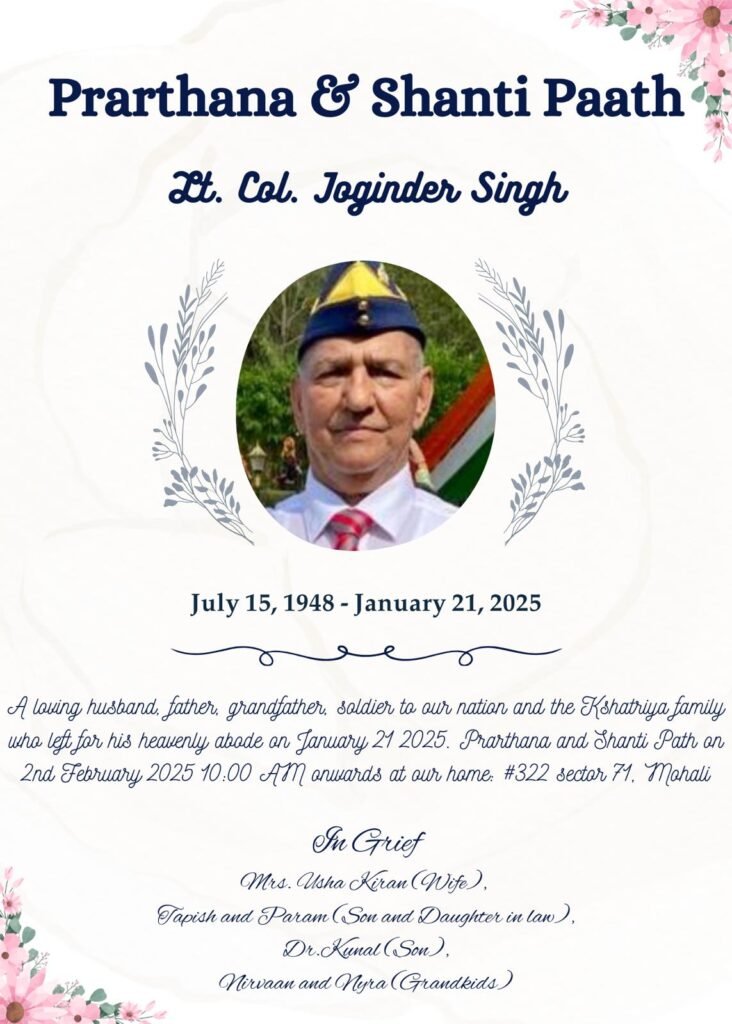
SS-15-Late Col Joginder singh Prarthana & Shanti Paath on 02 Feb 2025 @#322 sector 71 Mohali
ਕਿੰਨੀ ਮਜ਼ਬੂਤ ਜਾਂ ਕਮਜ਼ੋਰ Indian Army ? Fighter Plane ‘ਤੇ ਪਿੱਛੇ ਕਿਉਂ ਦੇਸ਼ | Republic Day ( How Strong and how weak in Indian Army) Brig Kuldeep S Khalon
































