No explosive was found in the shells, Punjab Police’s Deputy Inspector General Mandeep Singh Sidhu said
Seven rocket shells were found from a garbage dump in Punjab’s Patiala district, a senior police officer said on Monday.
No explosive was found in the shells, Punjab Police’s Deputy Inspector General Mandeep Singh Sidhu said.
He said the rocket shells were found from a garbage dump in Patiala.
Further investigation is underway, police said.
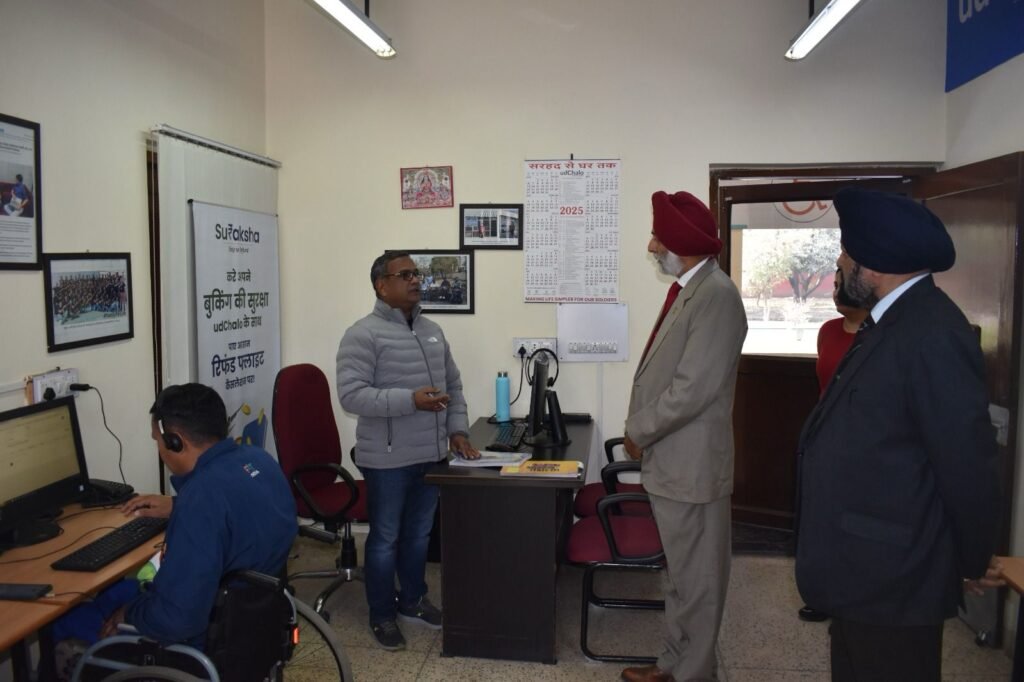
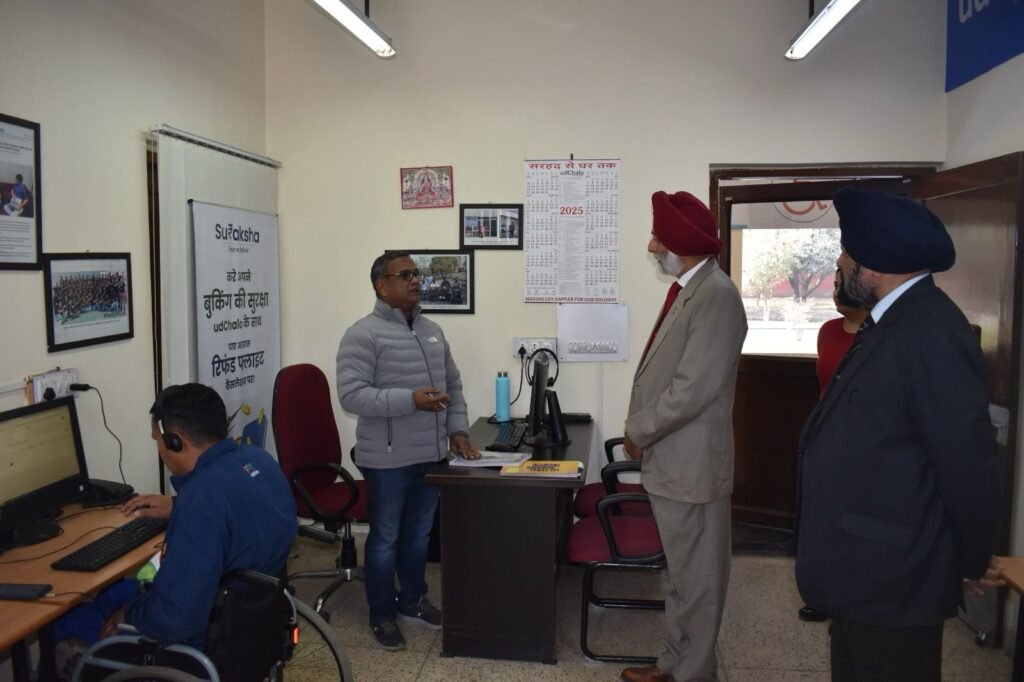
Brig HPS Bedi (Retd),PRESIDENT HARYANA STATE UNIT SANJHA MORCHA and Founder Trustee, Sāttvikam Charitable Trust: Donate Rs one Lakh to Paraplegic Rehabilitation Centre (PRC) in Mohali,
Brig HS Bedi (Retd) VSM ,JAK Rifles shares his recent experience that has deeply touched all Sanjha Morcha Members and Trustees as he donated and had the honor of presenting a cheque of ₹1,00,000 to Ex-Rifleman Devinder Singh, a brave soldier who has given so much for our nation. a at the Paraplegic Rehabilitation Centre (PRC) in Mohali, and In addition, Sāttvikam Charitable Trust has sanctioned a monthly stipend of ₹4,000 to support his ongoing needs.
Visiting the PRC, he says he was profoundly moved by the dedication and compassion exhibited by the Director and the entire staff. Their unwavering commitment to the care and rehabilitation of our wounded and disabled soldiers is truly commendable.
He consider himself fortunate that God has granted him this opportunity to assist and support a disabled soldier. He also earnestly appeal to my fellow veterans and compassionate citizens to contribute generously towards such noble causes. Together, we can make a meaningful difference in the lives of those who have sacrificed so much for our country.
Warm regards,
Brig HPS Bedi (Retd) Founder Trustee, Sāttvikam Charitable Trust and PRESIDENT HARYANA STATE UNIT SANJHA MORCHA
487 more Indians face final removal orders, verification underway: Misri
The US has shared a list of 487 individuals presumed to be Indian citizens who face final removal orders, meaning they are slated for deportation. Foreign Secretary Vikram Misri on Friday disclosed that details of 298 of these individuals had been received by India for document verification.
Misri was addressing the media ahead of Prime Minister Narendra Modi’s visit to France and the US, where he was questioned about the deportation of Indian nationals, particularly in light of a broader list of 18,000 names of illegal Indian immigrants shared by the US. Sources said the list of 487 individuals was in addition to the 96 persons whose documents had already been verified for deportation. These 96 individuals were initially part of the first batch of 204 deportees, 104 of whom arrived in Amritsar on a US Air Force plane on February 5.
Four individuals from this batch were currently being re-verified, they said. Regarding the list of 487 individuals, Misri stated, “We have sought details, which have been provided to us with regard to 298 individuals… We have been very transparent on this issue with our US counterparts.”
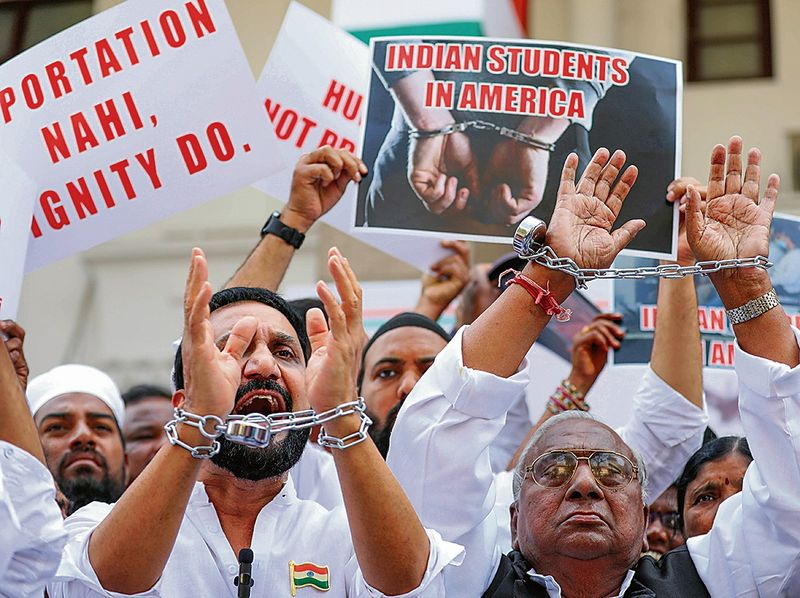
When asked about reports of handcuffing and shackling of deportees, the Foreign Secretary said, “The mistreatment of deportees is a valid issue to raise. We continue to emphasise to the US authorities that there should be no mistreatment of deportees… We will continue to take up any instances of mistreatment that come to our attention.”
He also noted that the recent deportation involving a military plane was “somewhat different” from routine deportation flights. “The process of deportation is not new. It is something that the External Affairs Minister S Jaishankar also emphasised in Parliament yesterday,” said Misri.
Jaishankar, addressing the issue in Parliament on Thursday, explained that the US Immigration and Customs Enforcement (ICE) followed a standard operating procedure from 2012, which allowed for the use of restraints under certain conditions. However, he clarified that women and children were not restrained, and deportees were unrestrained during toilet breaks.
Misri highlighted the importance of cooperation between India and the US on deportation matters, stating, “Any country in the world, if it wants to accept its nationals back, will want to have the assurance that whosoever is coming back is a citizen of that country. There are issues of legality and security associated with it.” He also stressed the need for systemic action against the ecosystem that promoted illegal immigration.
Cabinet clears new tax Bill, to be tabled in Parl next week
Union Cabinet on Friday approved the new Income Tax Bill to replace the Income Tax Act, 1961, the aim being to modernise the tax system and simplify the legal jargon so that taxpayers can easily understand its provisions. The Bill…
Union Cabinet on Friday approved the new Income Tax Bill to replace the Income Tax Act, 1961, the aim being to modernise the tax system and simplify the legal jargon so that taxpayers can easily understand its provisions.
The Bill was announced on February 1 by Finance Minister Nirmala Sitharaman during her Budget speech and is likely to be brought to Parliament next week.
The Bill won’t introduce new taxes and rather focus on simplifying tax laws, reducing legal complexities and making compliance easier for taxpayers, said sources. It would have shorter sentences, provisos and explanations, they said.
The government has also said that the new law would be 50 per cent shorter than the current one, with the major goal being to reduce litigation. The Bill may introduce lower penalties for certain offences, making the tax system more taxpayer-friendly. The new tax system will take effect from the 2025-26 financial year and apply to taxpayers from the assessment year 2026-27. In other decisions, the Cabinet okayed the revision of the divisional jurisdiction under the proposed South Coast Railway division of the Indian Railways, retaining the Waltair division in a truncated form and renaming it as Visakhapatnam division, thus doing away with the colonial name, Minister for Information and Broadcasting Ashwini Vaishnaw informed mediapersons after the meeting.
The Cabinet also approved the continuation and restructuring of the Skill India programme till 2026 with an overlay outlay of Rs 8,800 crore from the period 2022-23 to 2025-26.
The Army honoured a sniffer dog for exemplary service in detecting explosive materials, including Improvised Explosive Devices (IEDs) in Jammu, officials said. Teena, a highly skilled specialist in explosive detection, was honoured by General Officer Commanding, Tiger Division, Major General…
The Army honoured a sniffer dog for exemplary service in detecting explosive materials, including Improvised Explosive Devices (IEDs) in Jammu, officials said.
Teena, a highly skilled specialist in explosive detection, was honoured by General Officer Commanding, Tiger Division, Major General Mukesh Bhanwala, at headquarters in Jammu on Wednesday, the defence spokesperson said.
Teena’s remarkable career has been marked by her unwavering dedication and expertise in detecting explosive materials. Her exceptional service has been a testament to her rigorous training and resilience,” an Army spokesperson said.
Teena has been stationed in Jammu and Kashmir for over two years in her current assignment and has participated in various important events and operations, providing critical support to the security forces, he added.
“As Teena retires from active duty, she leaves behind a legacy of bravery, loyalty and selflessness. Her contributions to the security forces will never be forgotten, and she will always be remembered as a hero and a loyal companion” the spokesperson said.
Govt Scraps 3 Deals To Procure 400 Defence Drones With Chinese Parts Fearing Cyber Threat: Report
The Indian government has cancelled three contracts to procure 400 defence drones due to security concerns over the inclusion of Chinese components. The contracts, valued at over ₹230 crore, were with a Chennai-based company and included 200 medium-altitude, 100 heavy-weight, and 100 light-weight logistics drones. These drones were intended for deployment along the 3,488-km Line of Actual Control (LAC) with China.
The presence of Chinese components in the drones raised alarms about potential cybersecurity threats, including data leaks and cyber vulnerabilities. Chinese-made parts could contain malware or backdoors that could lead to leaks of sensitive defence information. There is concern that adversaries could seize control of the drones or compromise their operations through “backdoor” access points.
The cancelled contracts encompassed 200 medium-altitude drones, 100 heavy-weight drones, and 100 light-weight logistics drones.
The defence establishment is implementing stricter mechanisms to ensure that future military drone acquisitions are free of Chinese parts, electronics, and malicious code. This includes more comprehensive certifications from drone manufacturers.
There have been instances of operational failures in UAV deployments for ISR missions along the borders with China and Pakistan. In one case, an infantry unit lost control of a UAV, which then veered into Pakistan-occupied J&K. Adversaries could seize control of drones through jamming or exploit backdoors in the electronics to bypass security measures.
“Unfortunately, some Indian companies are using Chinese components and electronics in the drones they are producing for the armed forces. This is a major cybersecurity threat, with the possibility of data security and operations being compromised,” the report quoted a source as saying.
“An adversary can seize control of a drone or `soft kill’ it through jamming. There may be a `backdoor’ in the electronics that bypasses security protection measures.”
The government is also considering stringent measures to ensure the defence drones do not have “any Chinese parts or electronics as well as malicious codes”, the report said.
This move aligns with India’s “Aatmanirbhar Bharat” initiative to promote self-reliance in defence manufacturing and reduce reliance on foreign technology. The focus is shifting towards domestically manufactured drones, with investments in various types of drones to bolster defence capabilities.
Agencies
Model of India’s Fifth-Generation Fighter, TEJAS MK-1A, TEJAS MK-2, LUH To Be Major Attractions At Aero India 2025
Aero India 2025, Asia’s largest air show, will occur at the Air Force Station, Yelahanka, Bengaluru, from February 10–14, 2025. The first three days will be reserved for business, and the remaining two will be open to the public. The theme for the air show is “The Runway to a Billion Opportunities”.
HAL’s participation Hindustan Aeronautics Limited (HAL) will showcase its indigenous products and technologies at the India Pavilion, centred on the theme ‘Innovate. Collaborate. Lead’. The Light Utility Helicopter (LUH) and the CATS Warrior will be the main attractions.
The major attractions at its indoor pavilion (HALL-E) will be the LUH, Hindustan Turbo Trainer (HTT)-40 Simulator, scaled models of TEJAS MK-1A fighter, TEJAS MK-1 Trainer, Hindustan Jet Trainer (HJT)-36, HTT-40, LCH PRACHAND and DHRUV MK-IV. The scaled models of Hindustan 228 and its amphibian variant will also be displayed.
The outdoor display adjacent to HAL stall will feature the TEJAS MK-1A and HJT-36. HTT-40, TEJAS MK-1 Trainer, Hindustan 228, Do-228 and LUH will be on static display.
The flying display will witness a unique TEJAS MK-1A formation, HJT-36, HTT-40 and LUH.
A detailed scale model of the TEJAS MK-2 will be displayed, revealing enhancements and armament configurations. The TEJAS MK-2, designed by the Aeronautical Development Agency (ADA) and manufactured by HAL, will feature 11 hardpoints. The rollout of the TEJAS MK-2 is expected by the end of November 2025.
The aerial displays are expected to be a major attraction, with displays in the morning and afternoon. The fifth-generation Russian Su-57 stealth fighter (Felon) is expected to perform its aerial display for the first time in India. The Indian Air Force (IAF) Surya Kiran Aerobatic Team (SKAT) will also perform.
Other Aircraft The indigenous flying display will include the Light Combat Aircraft TEJAS MK-1A, Light Combat Helicopter (LCH) Prachand, Light Utility Helicopter (LUH) and Hindustan Turbo Trainer-40 (HTT-40). There may also be displays from the Sukhoi Su-30MKI and Rafale jets.
In addition to aerial displays, Aero India 2025 will feature static displays and technology demonstrations. Lockheed Martin will showcase the Vast TM Experience System, C-130 Super Hercules Tactical aircraft, F-21 fighter aircraft, MH-60 “Romeo” Seahawk helicopter, Javelin anti-tank weapon system, and S-92 Multi-role helicopter.
Agencies
SAAB Delivers AT4 Anti-Tank Weapon To Indian Armed Forces
The AT4 is a man-portable, disposable, 84 mm unguided anti-tank weapon manufactured by Saab Bofors Dynamics. Saab has seen considerable sales success with the AT4, making it one of the most common light anti-tank weapons in the world. In early 2025, Saab completed delivery of its new generation AT4 anti-armor weapon systems to the Indian Armed Forces. In 2022, the Indian Army awarded Saab a contract for the lightweight, single-use rocket launcher. The weapon will also be used by the Indian Air Force (IAF).
The AT4 is designed to destroy or disable armored fighting vehicles and fortifications. It is most effective against medium-to-light armored vehicles from any direction, or against heavier tanks from the sides or rear. It can also be used as an assault weapon against buildings.
The AT4 is designed for ease of use, regardless of the user’s experience level. A soldier simply aims, fires, and destroys the target before discarding the tube.
The AT4CS (Confined Space) variant is specially designed for urban warfare and allows troops to fire from enclosed areas by using a saltwater countermass to absorb the back blast.
Several types of projectiles can be used with the AT4, including high-explosive anti-tank (HEAT), high-explosive dual purpose (HEDP), high penetration (HP), anti-structure tandem-warheads (AST), extended range (ER), and high explosive (HE).
The AT4 family can engage armored vehicles, buildings, soldiers, and explosives. The AT4 HEAT, AT4CS HP, AT4CS RS, and AT4CS ER are particularly suitable for combating armored vehicles, with steel armor penetration up to 460 millimeters at operating distances of up to 600 meters.
The AT4 is lightweight, man-portable, and fully disposable. It provides the capabilities required for mission success, including night and confined space abilities.
SAAB will also showcase its Gripen E fighters, Carl-Gustaf M4 weapon system, Next-Generation Light Anti-tank Weapon, AUV62 system, Land Electronic Defence System (LEDS), and Integrated Defence Aids Suite (IDAS) at Aero India 2025, which will be held in Bengaluru beginning on February 10.
Agencies
Ex-serviceman killed, 2 others hurt in Kulgam terror attack
An ex-serviceman was killed and his wife and another woman relative were injured in a militant attack in south Kashmir’s Kulgam, officials said on Monday. Police officials said the retired jawan, identified as Manzoor Ahmad Wagay, was present with his…
An ex-serviceman was killed and his wife and another woman relative were injured in a militant attack in south Kashmir’s Kulgam, officials said on Monday.
Police officials said the retired jawan, identified as Manzoor Ahmad Wagay, was present with his wife and niece when they were fired upon at Behibagh village of Kulgam district by unidentified gunmen.
A police official told The Tribune that while Manzoor Ahmad Wagay, who retired in 2021, was hit in the abdomen, his wife and another woman suffered injuries in the legs in the attack. They were immediately shifted to the hospital, where sources said Wagay succumbed to injuries. The two others are said to be stable.
Soon after the incident, joint forces launched a search operation in the area to nab the attackers.
Another police officer said that they were attacked in the village at some distance from the couple’s home and the area was cordoned off after the incident. “We are looking at the CCTV footage and working to nab the attackers,” said the south Kashmir-based officer. Wagay’s son demanded justice. “My only request to the Government of India is to give us justice,” he said.
Jammu and Kashmir Lieutenant Governor Manoj Sinha, who controls the Home Department, condemned what he described as a “heinous terrorist attack” on ex-serviceman and his family in Kulgam. “I strongly condemn the heinous terrorist attack on Manzoor Ahmad Wagay and his family in Kulgam. The entire nation stands in solidarity with the bereaved family in this hour of grief. I have instructed the officials to provide the best possible treatment to the injured. Praying for their speedy recovery,” he said in a release. Chief Minister Omar Abdullah wrote on his official account, “My heartfelt condolences to the family and prayers for the swift recovery of the injured. Such heinous violence has no place in our society and must be condemned in the strongest terms. May peace and justice prevail.”
Srinagar-based Chinar Corps termed it “a cold-blooded incident.” The Army said three “innocent citizens” Manzoor Ahmad Wagay (ex-serviceman, 39), his wife Aaina Akhtar (32) and niece Saina Hameed (13) “were shot at by terrorists.” While Manzoor succumbed to his injuries, the others have been evacuated to District Hospital Anantnag, the Army said.
The Navy operates seven of these submarines, which are capable of vertically launching Russian-made Klub missiles
The Indian Navy’s Russian-origin Sindhughosh-class submarines will be equipped with a new set of long-range anti-ship missiles.
The Navy operates seven of these submarines, which are capable of vertically launching Russian-made Klub missiles. These missiles have a strike range of 300 km, enabling long-range operations. Each submarine can carry up to eight such missiles.
The Sindhughosh class is the Indian variant of Russia’s ‘Kilo-class’ submarines. It is the Navy’s largest submarine fleet, which also includes six Kalvari-class and four Shishumar-class submarines. All 17 of these vessels are conventional, powered by diesel-electric engines.
On Tuesday, the Ministry of Defence announced that it had signed a contract with Russia for the procurement of anti-ship cruise missiles for the Navy’s submarine fleet.Sources indicate that the missiles are likely to be ‘Klub-S’, the export version of Russia’s Kalibr missile. However, details regarding the number of missiles and the delivery timeline have not been disclosed. The acquisition is part of longstanding Indo-Russian defence cooperation, which has facilitated the supply of various military technologies over several decades.
The Sindhughosh-class submarines are equipped with advanced combat systems. Over the years, the fleet has undergone multiple modernisation programmes, including upgrades to sonar and communication systems, as well as life-extension initiatives.
State Stalwarts
DEFENCE MINISTER
Minister Rajnath Singh
ALL HUMANS ARE ONE CREATED BY GOD
HINDUS,MUSLIMS,SIKHS.ISAI SAB HAI BHAI BHAI
CHIEF PATRON ALL INDIA SANJHA MORCHA
LT GEN JASBIR SINGH DHALIWAL, DOGRA
SENIOR PATRON ALL INDIA SANJHA MORCHA
MAJOR GEN HARVIJAY SINGH, SENA MEDAL ,corps of signals
.
.
PATRON ALL INDIA SANJHA MORCHA
MAJ GEN RAMINDER GURAYA ,MADRAS REGIMENT
sanjhamorcha303@gmail.com
PRESIDENT SOUTH ALL INDIA SANJHA MORCHA
COL SS RAJAN BOMBAY SAPPERS,
PRESIDENT UTTARAKHAND ALL INDIA SANJHA MORCHA
COL B M THAPA ,BENGAL SAPPERSS
PRESIDENT HARAYANA STATE CUM COORDINATOR ESM
BRIG DALJIT THUKRAL ,BENGAL SAPPERS
PRESIDENT TRICITY
COL B S BRAR (BHUPI BRAR)
PRESIDENT CHANDIGARH ZONE
COL SHANJIT SINGH BHULLAR
.
.
PRESIDENT PANCHKULA ZONE AND ZIRAKPUR
COL SWARAN SINGH
INDIAN DEFENCE FORCES
DEFENCE FORCES INTEGRATED LOGO
INDIAN AIR FORCE
Air Officer C-in-C WESTERN AIR COMMAND
AIR MSHL S PRABHAKARAN AVSM VM
AOC-IN-C, EASTERN AIR COMMAND
Air Marshal Inderpal Singh Walia
AOC-in-C SOUTH WESTERN AIR COMMAND
Air Marshal Vikram Singh
AOC-IN-C, SOUTHERN AIR COMMAND
Air Marshal J.Chalapati
AOC-IN-C TRAINING COMMAND
AIR MARSHAL SK GHOTIA VSM
AOC-IN-C MAINTENANCE COMMAND
Air Marshal Jagdish Chandra
Flag Officer Commanding in Chief, Western Naval Command
ice Admiral R Hari Kumar, PVSM, AVSM, VSM
Flag Officer Commanding in Chief, Eastern Naval Command
Vice Admiral Sanjay Bhalla, AVSM, NM
Flag Officer Commanding in Chief, Southern Naval Command