A gurdwara in Canada’s Vancouver has been vandalised with pro-Khalistan graffiti, with its leaders blaming a small group of Sikh separatists for the act, a media report said. The local police said they were investigating graffiti sprayed on Saturday at…
A gurdwara in Canada’s Vancouver has been vandalised with pro-Khalistan graffiti, with its leaders blaming a small group of Sikh separatists for the act, a media report said. The local police said they were investigating graffiti sprayed on Saturday at the Ross Street Gurdwara.
Vancouver Police Department spokesperson Sgt Steve Addison said as of now, the police did not have a suspect. The Khalsa Diwan Society, which runs the gurdwars, said the act was part of an ongoing campaign by extremist forces to instil fear among Canadian Sikh community.
“Their actions undermine the values of inclusivity, respect and mutual support that are foundational to both Sikhism and to Canadian society,” it said, urging Canadians to stand strong in the face of extremism.
Over the past decade, India has rapidly ascended into the elite global league in the defence, space, and semiconductor sectors, driven by a strategic focus on self-reliance, innovation, and indigenous technological advancement.
This transformation has been propelled by national initiatives such as Atmanirbhar Bharat and Make in India, which have fostered a robust ecosystem for research, public-private partnerships, and investment in cutting-edge science and technology.
In the defence sector, India has achieved a series of technological breakthroughs that have placed it alongside global superpowers. A landmark achievement was the successful trial of a laser-based directed energy weapon (DEW) system, capable of disabling fixed-wing aircraft and swarm drones.
This accomplishment has positioned India among an exclusive group of only four countries—the United States, Russia, and China being the others—that possess such advanced capabilities.
The Defence Research and Development Organisation (DRDO), particularly through its Centre for High Energy Systems & Sciences (CHESS), has been at the forefront of this innovation, with successful field demonstrations of the DEW MK-II(A) system.
This system has proven effective against unmanned aerial vehicles and drones, causing structural damage and disabling surveillance sensors, thereby underscoring India’s readiness for modern, technology-driven warfare.
Further reinforcing its elite status, India has recently joined the select group of nations testing Active Cooled Scramjet technology for hypersonic missiles, and in November 2024, DRDO test-fired the country’s first long-range hypersonic missile capable of carrying both conventional and nuclear warheads at speeds exceeding Mach 5. These advancements not only enhance India’s strategic deterrence but also demonstrate its ability to innovate in next-generation military technologies.
India’s space sector has similarly witnessed record-breaking achievements. The Indian Space Research Organisation (ISRO) made history in 2023 by becoming the first country to land on the Moon’s South Pole, making India the fourth nation ever to achieve a soft landing on the lunar surface after the US, Soviet Union, and China.
Additionally, India has joined the elite group of countries demonstrating satellite docking and undocking technology, further establishing its credentials in advanced space operations.
In the semiconductor sector, the launch of the Semicon India initiative has marked India’s entry into the global race for chip manufacturing. Backed by significant investments from global technology giants and strategic partnerships, India is now among the few nations seriously competing to become a semiconductor hub, which is crucial for technological sovereignty in defence and space applications.
The Indian Army’s transformation has been equally remarkable, with a strong emphasis on indigenisation and technological absorption. Initiatives such as the Army Design Bureau and a host of Make I and Make II projects have led to the development and deployment of indigenous platforms including light tanks, tactical communication systems, precision munitions, and advanced drone technologies.
The focus on innovation is not only enhancing operational capabilities across diverse terrains but also reducing dependency on imports and strengthening India’s position as a global leader in defence technology.
India’s concerted push for self-reliance and technological innovation has resulted in its entry into the elite league of nations in the defence, space, and semiconductor sectors. These achievements reflect a paradigm shift in India’s global standing, transforming it from a technology follower to a pacesetter and strategic competitor on the world stage.
Army Facilitates Mobile Connectivity Across Ladakh Region Including Galwan, Siachen Glacier
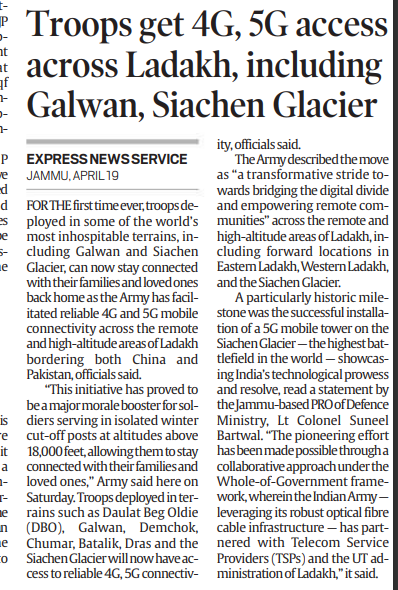
In a landmark development for connectivity and national integration, the Indian Army has successfully facilitated high-speed mobile connectivity across the remote and high-altitude regions of Ladakh, including some of the world’s most inhospitable terrains such as Galwan, Siachen Glacier, Daulat Beg Oldie (DBO), Demchok, Chumar, Batalik, and Dras.
For the first time, troops stationed at these isolated posts—often cut off during harsh winters at altitudes above 18,000 feet—now have reliable access to 4G and 5G networks, enabling them to stay in touch with their families and loved ones, which has significantly boosted morale among the personnel.
This transformative initiative was accomplished through a collaborative Whole-of-Government approach. The Indian Army, leveraging its robust optical fibre cable infrastructure, partnered with Telecom Service Providers (TSPs) and the Union Territory administration of Ladakh.
The Fire and Fury Corps played a pivotal role in this synergy, facilitating the installation of multiple mobile towers on Army infrastructure, including at least four key towers in the Ladakh and Kargil districts. Notably, a 5G mobile tower was successfully installed on the Siachen Glacier—the world’s highest battlefield—marking a historic technological achievement and underscoring India’s resolve to bring development to its most remote frontiers.
The impact of this initiative extends well beyond troop welfare. By integrating border villages—referred to as ‘First Villages’—into the national digital network, the project is bridging the digital divide and transforming the socio-economic fabric of these regions.
Local communities, previously deprived of modern communication, now benefit from improved access to education, telemedicine, government services, e-commerce, and new opportunities in border tourism and local enterprise. The enhanced connectivity is also expected to bolster strategic preparedness, facilitate faster troop mobilization, and improve surveillance and supply chain logistics, thus strengthening India’s border security.
Residents and local leaders have expressed overwhelming gratitude, describing the connectivity as a lifeline that brings dignity, inclusion, and economic opportunity to these remote areas. The initiative is widely seen as a testament to the Indian Army’s enduring commitment to national integration and development, echoing the vision of ‘Viksit Bharat – India@2047’. By overcoming extreme weather and logistical challenges to install 4G and 5G towers in such high-altitude, isolated locations, the Army has not only empowered its personnel but has also set the stage for a digital revolution in Ladakh’s border communities.
PTI
Why IAF Bridging The Bomber And ALCM Gap Is A Critical Strategic Requirement
The Indian Air Force (IAF) faces a critical strategic gap in its long-range strike capabilities due to the absence of dedicated strategic bombers and limited air-launched cruise missile (ALCM) deployment. However, the Indian Air Force (IAF) is actively working to enhance its air-launched cruise missile (ALCM) capabilities to counter China’s advanced long-range strike assets.
Bridging this bomber and ALCM gap is essential for enhancing India’s deterrence posture and operational reach, particularly in the context of evolving regional threats from China and Pakistan, both of whom have significantly modernised their air forces with advanced bombers and missile capabilities.
Unlike adversaries possessing long-range bombers capable of striking deep into Indian territory, the IAF currently relies primarily on fighter aircraft, which, while versatile, lack the sustained range and payload capacity of bombers to conduct prolonged strategic missions.
This shortfall constrains India’s ability to project power and respond effectively in a two-front conflict scenario, especially given the IAF’s current squadron strength of around 31 against a sanctioned requirement of 42, compounded by shortages in force multipliers such as mid-air refuellers and AEW&C platforms.
The introduction and integration of ALCMs like the BrahMos missile on platforms such as the Su-30MKI have provided the IAF with a potent precision strike capability at stand-off ranges, enhancing its ability to target high-value land and maritime assets.
However, the limited number of platforms capable of deploying such weapons and the absence of a dedicated strategic bomber fleet restrict the full exploitation of ALCM potential.
To address this, innovative approaches such as leveraging the C-17 Globemaster-III transport aircraft to launch Nirbhay ALCMs have been proposed, offering a cost-effective and flexible means to extend strike reach without the immediate need for new bomber acquisitions.
This strategy could enable the IAF to saturate enemy defences with multiple cruise missiles launched from deep within Indian territory, thereby enhancing deterrence and operational flexibility.
From a strategic perspective, possessing dedicated bombers confers significant advantages beyond mere payload capacity. Bombers serve as a powerful psychological and political tool, signalling resolve and capability through their mere presence and potential for rapid, deep strikes.
Historical lessons, such as the 1962 Sino-Indian War where Chinese bombers influenced Indian strategic calculations, underscore the importance of matching adversaries’ long-range strike capabilities. Moreover, modern bombers can carry larger electronic warfare suites and emerging technologies like directed energy weapons, further augmenting their battlefield utility.
While current IAF priorities rightly focus on replenishing fighter squadrons, force multipliers, and indigenous platforms like the HAL Tejas, the eventual induction of strategic bombers remains a critical long-term objective to ensure parity with regional powers and to secure India’s airspace and strategic interests comprehensively.
While immediate focus must remain on addressing fighter shortages and enhancing force multipliers, innovative interim solutions such as C-17 launched cruise missiles and accelerated indigenous missile programs can partially mitigate current limitations.
Ultimately, the acquisition or development of dedicated strategic bombers, complemented by advanced ALCMs, will be indispensable for the IAF to project power effectively, safeguard national security, and maintain a technological edge over adversaries in the decades ahead.
In conclusion, the IAF urgently needs to develop and operationalise air-launched cruise missiles and suitable delivery platforms to effectively counter China’s advanced long-range strike capabilities. Efforts are well underway with the Nirbhay and LR-LACM programs, BrahMos integration, and a strategic pivot toward air-launched ballistic missiles. These developments will enhance India’s strategic deterrence, operational flexibility, and survivability in a contested regional security environment.
State Stalwarts
DEFENCE MINISTER
Minister Rajnath Singh
ALL HUMANS ARE ONE CREATED BY GOD
HINDUS,MUSLIMS,SIKHS.ISAI SAB HAI BHAI BHAI
CHIEF PATRON ALL INDIA SANJHA MORCHA
LT GEN JASBIR SINGH DHALIWAL, DOGRA
SENIOR PATRON ALL INDIA SANJHA MORCHA
MAJOR GEN HARVIJAY SINGH, SENA MEDAL ,corps of signals
.
.
PATRON ALL INDIA SANJHA MORCHA
MAJ GEN RAMINDER GURAYA ,MADRAS REGIMENT
sanjhamorcha303@gmail.com
PRESIDENT SOUTH ALL INDIA SANJHA MORCHA
COL SS RAJAN BOMBAY SAPPERS,
PRESIDENT UTTARAKHAND ALL INDIA SANJHA MORCHA
COL B M THAPA ,BENGAL SAPPERSS
PRESIDENT HARAYANA STATE CUM COORDINATOR ESM
BRIG DALJIT THUKRAL ,BENGAL SAPPERS
PRESIDENT TRICITY
COL B S BRAR (BHUPI BRAR)
PRESIDENT CHANDIGARH ZONE
COL SHANJIT SINGH BHULLAR
.
.
PRESIDENT PANCHKULA ZONE AND ZIRAKPUR
COL SWARAN SINGH
INDIAN DEFENCE FORCES
DEFENCE FORCES INTEGRATED LOGO
INDIAN AIR FORCE
Air Officer C-in-C WESTERN AIR COMMAND
AIR MSHL S PRABHAKARAN AVSM VM
AOC-IN-C, EASTERN AIR COMMAND
Air Marshal Inderpal Singh Walia
AOC-in-C SOUTH WESTERN AIR COMMAND
Air Marshal Vikram Singh
AOC-IN-C, SOUTHERN AIR COMMAND
Air Marshal J.Chalapati
AOC-IN-C TRAINING COMMAND
AIR MARSHAL SK GHOTIA VSM
AOC-IN-C MAINTENANCE COMMAND
Air Marshal Jagdish Chandra
Flag Officer Commanding in Chief, Western Naval Command
ice Admiral R Hari Kumar, PVSM, AVSM, VSM
Flag Officer Commanding in Chief, Eastern Naval Command
Vice Admiral Sanjay Bhalla, AVSM, NM
Flag Officer Commanding in Chief, Southern Naval Command