The Border Roads Organisation (BRO) has made considerable progress in clearing snow along the Manali-Leh highway, reaching up to Zingzingbar beyond Darcha in Lahaul and Spiti district. However, frequent snowfall and harsh weather conditions are delaying complete restoration of this…
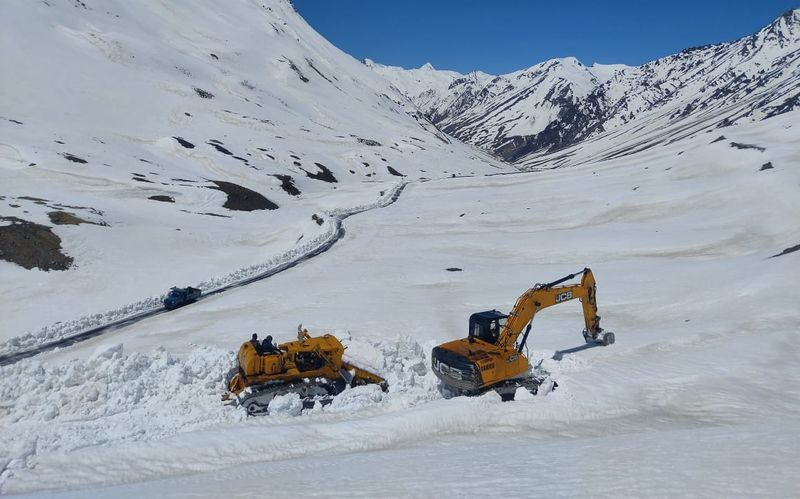
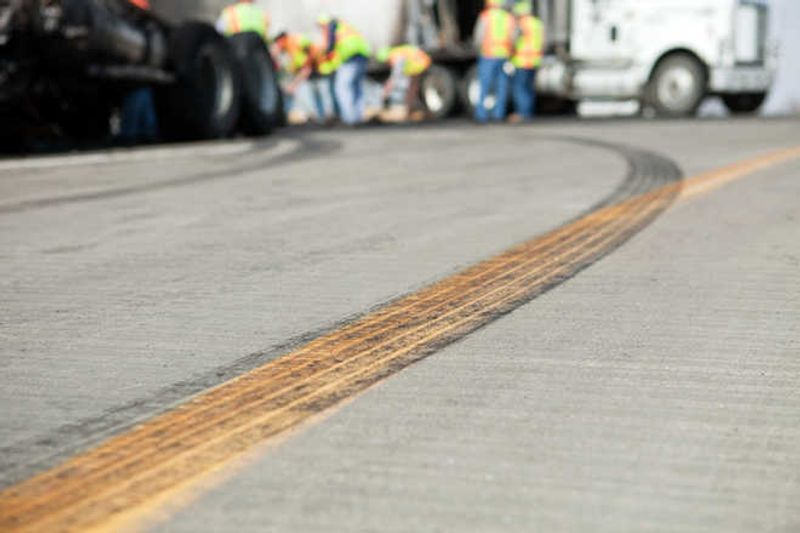
The Border Roads Organisation (BRO) has made considerable progress in clearing snow along the Manali-Leh highway, reaching up to Zingzingbar beyond Darcha in Lahaul and Spiti district. However, frequent snowfall and harsh weather conditions are delaying complete restoration of this crucial route, which connects Himachal Pradesh with Ladakh.
Traditionally, the Manali-Leh highway is opened to traffic by late April, with last year’s reopening recorded on April 23. This year, however, BRO officials anticipate delay owing to prolonged winter conditions and fresh snowfall that continue to hamper snow-clearing efforts.
The 70 Road Construction Company (RCC) unit of the BRO has deployed 12 heavy machines and is pushing forward aggressively from the Darcha side. They have managed to clear snow up to Zingzingbar — a location roughly 12 kilometres short of the formidable 15,910-foot-high Baralacha La. From this point, nearly 57 kilometres of snow-covered road still remains to be cleared before reaching Sarchu, a vital milestone en route Ladakh.
“Due to heavy snow accumulation and ongoing snowfall, daytime temperatures in the region remain well below zero, complicating operations,” said a BRO official. The freezing conditions are not only slowing down machinery but also posing a serious challenge to the personnel engaged in snow-clearing efforts.
On the Ladakh side, Project Himank — another BRO unit — is working from the Sarchu onwards to ensure connectivity from both ends of the highway. This coordinated approach aims to expedite the reopening of this strategically significant route.
Snow clearance along the Manali-Leh highway typically begins in March, starting from Jispa and progressing through Darcha towards Sarchu. This year, however, massive snow walls beyond Darcha and frequent fresh snowfalls have delayed the process.
The Manali-Leh road serves not just as a lifeline for military logistics but is also a major artery for local transportation and tourism. With continued efforts from both the 70 RCC and Project Himank teams, officials remain optimistic about reopening the route in the coming weeks depending on the weather conditions.
US Military Academy team visits IMA under cadet exchange programme
Besides fostering strategic ties, the exchange programme enables cadets to learn about each other’s military systems, structural hierarchy, training methods and philosophies
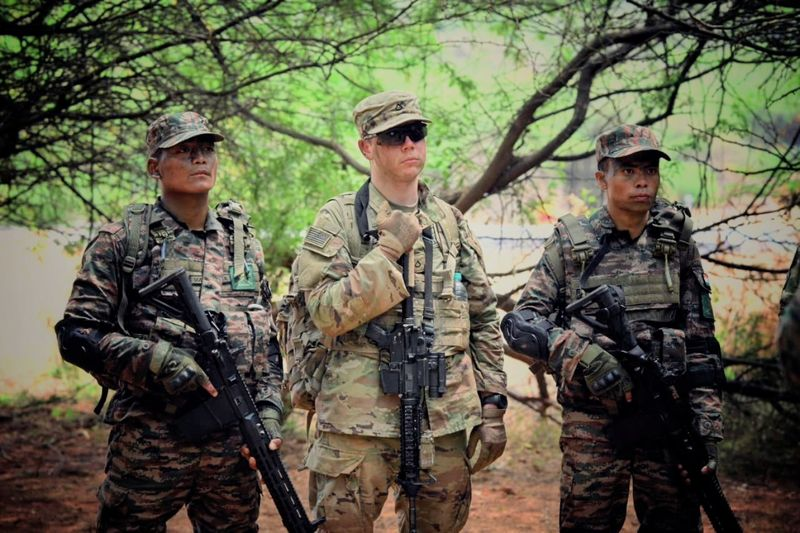
As part of Indo-US defence cooperation, a delegation from the United States Military Academy (USMA) visited the Indian Military Academy (IMA), Dehradun, under a week-long cadet exchange programme.
A three-member team comprising one officer and two cadets from USMA engaged in various training events at the IMA and were given a glimpse of the modern training infrastructure and facilities at the Indian Army’s premier pre-commission training institution.
Established in 1802, USMA is located at West Point in New York and is the oldest of the five American service academies that educates and trains cadets for service as commissioned officers in the US Army.Unlike the IMA, which conducts an 18-month training programme for direct entry cadets and a 12-month course for those who come through the National Defence Academy, the USMA offers a four-year course after which the cadets are awarded a Bachelor of Science degree.
The IMA was established in 1932 during the British era and besides Indian cadets, it also trains cadets from friendly foreign countries. Over the years, more than 30 countries have sent their cadets to the IMA.
Besides fostering strategic ties, the exchange programme enables cadets to learn about each other’s military systems, structural hierarchy, training methods and philosophies. It also gives cadets an insight into different cultures, traditions and ways of life and helps build cross-cultural bonds and friendships.
Besides cadet exchange at service training academies, the National Cadet Corps (NCC) also has an annual youth exchange programme, under which members of youth organisations of several countries, including the US, visit each other. The NCC hosts foreign cadets every year during the national Republic Day camp in New Delhi.
6 Naxalites killed in encounter with security forces in Jharkhand’s Bokaro
Two INSAS rifles, a self-loading rifle and a pistol seized
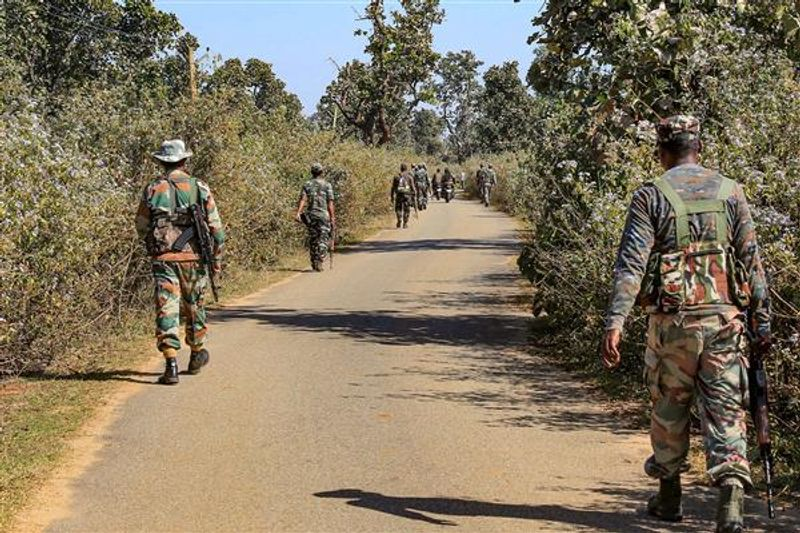
Six Naxals were killed in an encounter with CoBRA commandos of the Central Reserve Police Force (CRPF) and police in Bokaro district of Jharkhand on Monday morning, officials said.
The troops of 209 Commando Battalion for Resolute Action (CoBRA) conducted the operation in which six Naxals were killed and two INSAS rifles, a self-loading rifle (SLR)and a pistol were seized, the officials said.
The exchange of fire, which started around 5.30 am in Lugu Hills of the Lalpania area of the district, is still going on, they said.
No injuries have been reported among the security personnel, they said.
The CoBRA is the special jungle warfare unit of the CRPF.
Galwan, Siachen get mobile link as Army boosts Ladakh infra
In a step towards bridging the digital divide and empowering remote communities, the Army has facilitated mobile connectivity across the remote and high-altitude areas of Ladakh, including forward locations in Eastern Ladakh, Western Ladakh and the Siachen Glacier. “For the…
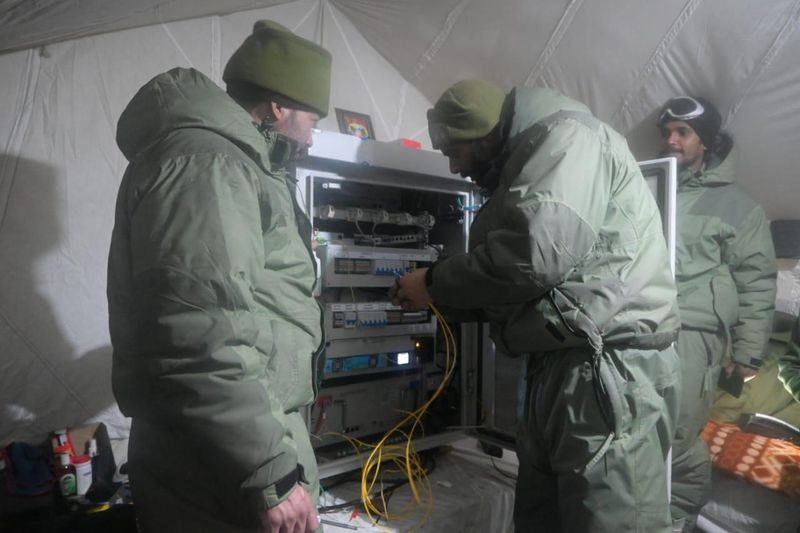
In a step towards bridging the digital divide and empowering remote communities, the Army has facilitated mobile connectivity across the remote and high-altitude areas of Ladakh, including forward locations in Eastern Ladakh, Western Ladakh and the Siachen Glacier.
“For the first time ever, troops deployed in some of the world’s most inhospitable terrains—such as Daulat Beg Oldi, Galwan, Demchok, Chumar, Batalik, Dras, and the Siachen Glacier—now have access to reliable 4G and 5G mobile connectivity. This initiative has proved to be a major morale booster for soldiers serving in isolated winter cut-off posts at altitudes above 18,000 feet, allowing them to stay connected with their families and loved ones,” defence spokesperson Lt Col Suneel Bartwal said in a statement.
He informed that the pioneering effort has been made possible through a collaborative approach under the Whole-of-Government framework, wherein the Indian Army— leveraging its robust optical fibre cable infrastructure — has partnered with Telecom Service Providers (TSPs) and the administration of Ladakh. The Fire and Fury Corps has played a leading role in enabling this synergy, resulting in the installation of multiple mobile towers on Army infrastructure, including four key towers in Ladakh and Kargil districts alone.
“The impact of this initiative extends far beyond troop welfare. It is a significant nation-building endeavour that is transforming the socio-economic fabric of remote border villages. By integrating ‘first villages’ into the national digital network, this effort is bridging the digital divide, boosting local economies, promoting border tourism, enhancing medical aid and emergency services, enabling educational access, strengthening local commerce, preserving cultural heritage and arresting migration from border villages” the spokesperson said.
A particularly historic milestone was the successful installation of a 5G mobile tower on the Siachen Glacier—the highest battlefield in the world—showcasing India’s technological prowess and resolve.
The accident occurs near Chopra market in the town when a bus carrying the soldiers was on its way to a nearby campPTI
Six Army personnel were injured as their vehicle skidded off the road and plunged into a roadside ditch in Jammu and Kashmir’s Udhampur district on Sunday, officials said.
The accident occurred near Chopra market in the town, 65 km from Jammu, when a bus carrying the soldiers was on its way to a nearby camp, the officials said.
They said a rescue operation was immediately launched and the injured soldiers were rushed to hospital.
BSF troops recover three Pak drones, drugs from Amritsar, Tarn Taran, Ferozepur areas
Continuing its campaign against narco-drones, vigilant BSF troops today recovered three Pakistani drones and a consignment of narcotics from the border districts of Amritsar, Tarn Taran and Ferozepur. A search operation by BSF troops, conducted on the basis of specific…
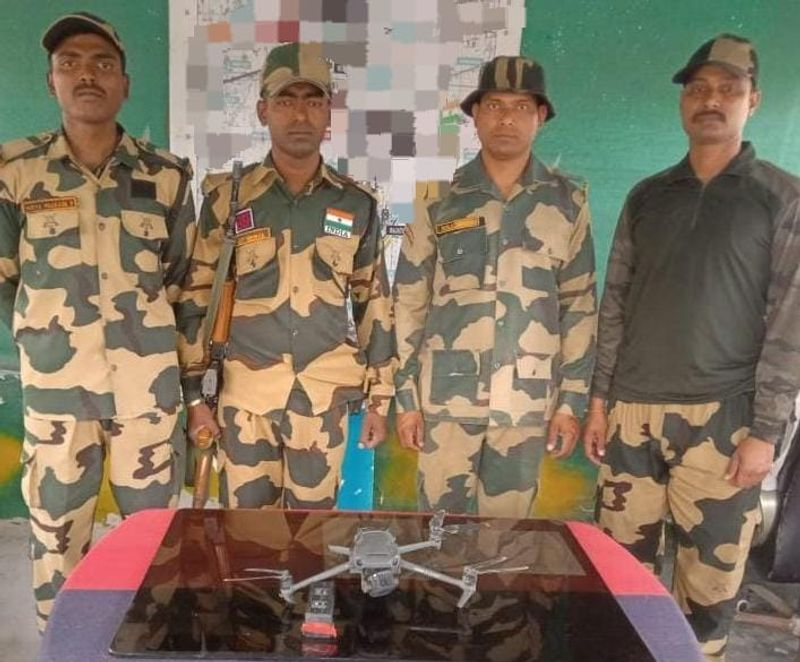
Continuing its campaign against narco-drones, vigilant BSF troops today recovered three Pakistani drones and a consignment of narcotics from the border districts of Amritsar, Tarn Taran and Ferozepur.
A search operation by BSF troops, conducted on the basis of specific information, culminated in the recovery of one DJI Mavic-3 Classic drone in damaged condition at about 11:50 am from a harvested field adjacent to village Rajatal in Amritsar.
In another instance, based on the disclosure of a smuggler apprehended last week, a joint search by the BSF in collaboration with Punjab Police led to the recovery of a packet containing suspected heroin (gross weight 545 gram) today at about 3:05 pm, from a harvested field adjacent to village Dal in Tarn Taran district.
Yet another DJI Mavic-3 Classic drone was recovered by the BSF troops at about 3:30 pm today, on the basis of specific inputs, from a field adjacent to village Gatti Rajoke in Ferozepur district.
The third DJI Mavic-3 Classic drone was recovered today at about 6 pm from a farming field adjacent to village Daoke in Amritsar district.All these drones are presumed to have crashed due to technical counter-measures deployed on the border.
The Chandigarh Residents Associations Welfare Federation (CRAWFED) today launched a signature campaign against the three-fold hike in property tax rates. A decision to launch the campaign was taken in the executive committee meeting of the federation held in the Sector…
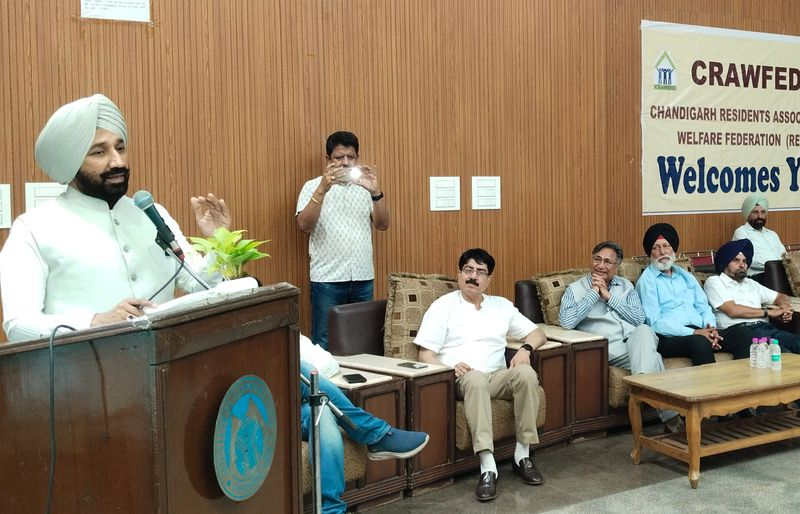
The Chandigarh Residents Associations Welfare Federation (CRAWFED) today launched a signature campaign against the three-fold hike in property tax rates.
A decision to launch the campaign was taken in the executive committee meeting of the federation held in the Sector 21 Community Centre. The federation has more than 86 Residents Welfare Associations of the city. Satnam Singh Sandhu, Member of Parliament (Rajya Sabha), was the chief guest on the occasion.
Hitesh Puri, president of CRAWFED, requested Sandhu to help residents by getting the property tax hike notification annulled. He said 80%of population of the city was salaried class or pensioners.
The federation submitted a memorandum to Sandhu appealing him to take up the matter with the relevant ministries and departments, particularly the Ministry of Home Affairs.
The federation raised various issues before Sandhu, which included regularisation of need-based changes in CHB flats, reservation in jobs and education for Chandigarh natives, arbitrary increase in taxes and penalties by the Chandigarh Administration, restrictions on the share-wise sale of residential properties due to heritage claims, non-payment of park maintenance funds to RWAs, and MC’s proposal to hike community centre booking charges.
Sandhu assured the members that he would take up their concerns at the highest levels and emphasised his commitment to the welfare of the city residents.
Arun Kumar Verma, Director of Chandigarh Power Distribution Limited (CPDL), also attended the meeting. He informed the gathering about the initiatives the company has; taken since taking the reins of the electricity distribution and retail supply operations in the city.
He said a comprehensive survey and assessment of all grid substations and 192 indoor substations was carried out. An infrastructure maintenance campaign was launched to fortify the power network ahead of the peak summers. He said a round-the-clock helpline, reachable at 924021666, has been fully operational since February 1.
The privatisation of the Electricity Department would not impact tariffs, as these would continue to be regulated by the Joint Electricity Regulatory Commission. The CPDL has slashed the time for releasing new power connections to just three days — provided no additional infrastructure is needed. The company has also replaced 2,541 defective meters, said Verma.
Gurdwara, Hindu temple vandalised with pro-Khalistan, anti-India slogans in Canada
‘Wanted’ posters of PM Modi, Amit Shah displayed at Khalsa Parade in Surrey
As advance polling for Canada’s federal elections concludes on Monday, leading up to the final voting day on April 28, a series of unsettling incidents within the past 24 hours has spotlighted the delicate tensions simmering within the Indian diaspora and Indo-Canada relations.
The vandalism of a gurdwara and a Hindu temple in Surrey on Saturday—allegedly by pro-Khalistan activists—alongside the emergence of anti-India and anti-Hindu slogans at the Khalsa Parade in Surrey later in the day, starkly underline these frictions. Adding to the charged atmosphere, Conservative leader Pierre Poilievre’s Saturday visit to Brampton’s Guru Nanak Mission Centre (GGNMC) has drawn attention to the complex interplay of cultural, religious, and political dynamics within the communities.
The vandalisation of the gurdwara and the temple with pro-Khalistan and anti-India graffiti coincided with the Khalsa Parade, where “wanted” posters of Prime Minister Narendra Modi, Home Minister Amit Shah and External Affairs Minister S. Jaishankar were paraded. While this has attracted significant criticism, it speaks volumes about the simmering tensions and attempts to polarise communities. Social media is teeming with videos showing pro-Khalistan activists, with flags, asking Indians (read Hindus) to “go back to their country”.
Mocha Bezirgan (@BezirganMocha), who describes himself as an “anti-corruption and anti-terrorism investigative journalist”, wrote on X: “Happening now: World’s largest Khalsa Day Parade in Surrey, B.C. Chants of ‘Kill Modi Politics’ echo throughout the parade route, accompanied by Sikh hymns and martial arts demonstrations…”
The event attracted politicians of all shades, with Conservative and NDP leaders Poilievre and Jagmeet Singh attending in person. Liberal leader Mark Carney was notably absent. The event saw participation from over 5,50,000 people, and many have criticised the open display of Khalistani and anti-India sentiments amidst the glorification of the alleged Air India bombing mastermind.
Ahead of the Khalsa Parade, the Indian diaspora in Canada awoke to the news of vandalisation of the gurdwara and the temple in Surrey with hate graffiti. While both incidents are under police investigation, the Khalsa Diwan Society, which runs the gurdwara, blamed the vandalism on a small group of Sikh separatists advocating for Khalistan. “This act is part of an ongoing campaign by extremist forces that seek to instil fear and division within the Canadian Sikh community. Their actions undermine the values of inclusivity, respect, and mutual support that are foundational to both Sikhism and Canadian society,” the statement said. Incidentally, the management of this gurdwara promotes Sikh-Hindu unity and has kept Khalistani ideologues at bay.
Around 3 am., Lakshmi Mandir in Surrey was also vandalised with the same kind of graffiti. According to reports, CCTV footage with the temple management shows two men vandalising the walls. This was the third time the temple had been vandalised.
Daniel Bordman (@DanielBordmanOG), a journalist, wrote on X: “I went to the Lakshmi Mandir in Surrey that was vandalized last night by Khalistanis. This is the third time it has been vandalized. I spoke to management and the devotees, and they do not feel like the police or the political establishment cares at all.”
Poilievre’s Saturday visit to Brampton’s GGNMC has also sparked controversy as this centre is viewed to be pro-Khalistani, having dubbed Nijjar a “martyr”. Poilievre was accompanied by his close but controversial associate, MP Tim Uppal. Tim’s wife is said to be associated with the World Sikh Organisation, and his brother, Raymanpreet Singh Uppal, was charged in 2014 but later acquitted in a drug case.
While these incidents have undoubtedly shaken communities, it is crucial to recognise the broader context in which they occur. The Sikh diaspora in Canada is diverse, with a vast majority dedicated to peaceful co-existence, cultural preservation, and community development. The actions of a few hardliners must not weaken multicultural ties.
Irrespective of who wins the polls, it’s imperative that political leaders must take a stand on these sensitive issues and ensure that the rhetoric does not exacerbate these divisions. The focus should remain on unity, mutual respect, and the democratic principles that define Canada.
Why India is caught in a Chinese web between Pakistan & Bangladesh
#bangladesh #pakistan #china #IndiaBangladesh #SouthAsia #CPEC #BRI #StringOfPearls #IndianForeignPolicy #GeopoliticalAnalysis A great churning is taking place on both sides of India’s frontiers, throwing a new challenge to the RSS idea of “akhand Bharat,” or “undivided subcontinent.” In the east, a…
A great churning is taking place on both sides of India’s frontiers, throwing a new challenge to the RSS idea of “akhand Bharat,” or “undivided subcontinent.” In the east, a new samudramanthan is taking place around the Bay of Bengal, as Naya Bangladesh reaches out to both China and Pakistan like it hasn’t for decades. And in Pakistan, the powerful Army Chief looks like he fancies himself as a latter-day Jinnah, delivering homilies about the so-called “two-nation theory” and such like.
Advertisement
Let’s start with Bangladesh. For the first time in 15 years, Pakistani officials have travelled to Dhaka this week for consultations, during which the Bangladesh foreign secretary demanded an apology for the “genocide committed by the then Pakistan military in 1971.” Plus, he said, $4.3 billion still remains to be paid when East Pakistan split from Pakistan — with, of course, a little help from India, although the foreign secretary didn’t quite add the last phrase.
Moreover, in less than 10 days from now, Pakistan’s Deputy PM and Foreign Minister Ishaq Dar will travel to Dhaka. Mr Dar is a consummate politician and is expected to easily find some way to say sorry for the massacres the Pakistani military committed in 1971 — he will be careful that the apology doesn’t offend his all-powerful military chief, Gen Asim Munir, back home.
When that apology takes place — not if, but when — the two former wings of Pakistan will be closer than they have been in decades.
Imagine a 53-year-long reversal of history-in-the-making. Make no mistake, dear Reader, the stage is being set, only the flowers and some knick-knacks to prettify the room remain. When Dar meets Bangladesh Chief Advisor Muhammad Yunus — whom the Americans kept ready in cotton-balls, waiting for the opportunity to insert him back into a post-Sheikh Hasina Bangladesh, and more fool she who gave them the opportunity — the Bangladeshis, with a gentle nudge from the Chinese, will graciously accept. It’s that simple.
Meanwhile, Muhammad Ali Jinnah’s pet phrase could get a new lease of life. At a function in Rawalpindi on Thursday, Gen Munir said Pakistan was created on the basis of the “two-nation theory,” even as his suited-booted Prime Minister Shehbaz Sharif listened in the front row.
“Our forefathers thought we are different from the Hindus in every possible aspect of life. Our religions are different, our customs are different, our traditions are different, our thoughts are different, our ambitions are different. That was the foundation of the two-nation theory that was laid there. That we are two nations, we are not one nation…” Gen Munir said.
Clearly, the good General imagines himself as a latter-day Quaid-e-Azam that Pakistan needs, to save itself for another day. Not that Pakistan doesn’t need saving — things are so bad, both in the economy as well as in the polity, that the military establishment could easily be misconstrued as the brightest, shining star on the horizon — it is certainly the most powerful.
Meanwhile, we saw PM Shehbaz Sharif hearing Gen Munir out quietly, as he rested two fingers on his cheek. Was he, already, sequestering to the back of his brain his elder brother Nawaz Sharif’s efforts to improve ties with India, for which he was whipped with iron chains in Attock jail soon after Musharraf invaded Kargil — because Shehbaz knows he cannot remain in power without Munir’s munificence?
But the big question this weekend is whether you can have a hearty laugh with irony. Will you be foes or comrades? So the same Bangladesh now reaching out to Pakistan, 53 years ago consigned the “two-nation theory” to the trash of history with a whoop and a chuckle as it belted out “Joy Bangla!” in the face of machine-gun fire from West Pakistani soldiers.
Today, as Yunus furiously cycles back to the past and Gen Munir intones the idea of separation — an idea that ironically finds much traction in present-day India — Bangladeshis seem to be resurrecting the importance of religion and geopolitics over language.
Only two days ago, Yunus’ foreign affairs advisor rudely told off India to manage its affairs better and look after its minority population in neighbouring West Bengal — referring to the violence in Murshidabad. Understandably, New Delhi is furious. But all the MEA spokesperson could add was that Bangladeshis better look inwards and protect their own Hindu minority.
That’s the basic problem with both the Partition as well as “akhand Bharat.” The subcontinent is so messily diverse that drawing the line anywhere — or by anyone, whether Radcliffe, McMahon or Durand — is going to end up being an exercise in haphazardness. Someone or the other is going to be so hurt or angry or both that they are bound to remember.
And so back to the present. Remember Yunus’ day out in Beijing some weeks ago where he told Chinese businessmen to come and invest, and that he was ready to hand over the Bay of Bengal to them?
Meanwhile, some things, however much they change, remain the same, and one example of that is the China-Pakistan relationship — described by Pakistani leaders over the decades as “higher than the mountains, deeper than the seas and sweeter than honey.” China is not just Pakistan’s biggest defence partner, it is its patron; it builds it roads and sea-ports, from the Karakoram highway to Gwadar on the Arabian Sea; it is connecting the country via the Belt & Road Initiative. From missiles to safety-pins, the Chinese are making in China and the Pakistanis are buying.
So on one side of India a China-friendly Pakistan asserts itself, and on the other side a China-friendly Bangladesh. Already, the spectre of Bangladesh and Pakistan forgiving each other for their past sins and moving on is apparent. In the middle is India, with severed diplomatic relations with Pakistan and a deteriorating relationship with Bangladesh.
So as a renewed churning takes place across the subcontinent, the key question that asks itself is, not just how the Narendra Modi government will deal with these challenges without, but what are the implications of these events within?
At the heart of both situations is one uncomfortable truth: the executive doesn’t like being told what to do, especially not by unelected judges.
he Constitution is a compact. Power is distributed. The judiciary doesn’t govern and the executive doesn’t adjudicate. That’s the theory. The practice, as we’re seeing today in both India and the United States, is messier.
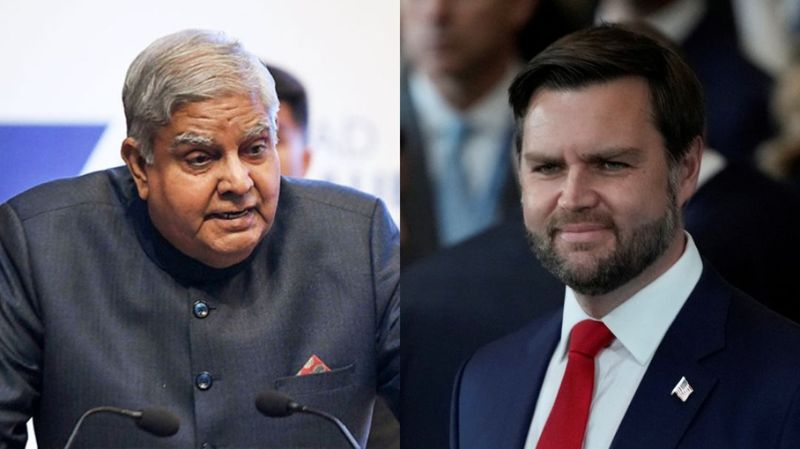
Two Vice-Presidents — India’s Jagdeep Dhankhar and America’s JD Vance — have taken on their respective judiciaries, not with subtlety but with full-throated public attack. In doing so, they have brought a long-simmering institutional friction to the surface. This isn’t just another round of power play. It’s a warning shot.
India’s VP Dhankhar is unhappy with the Supreme Court. He says it’s acting like a “super Parliament” by issuing timelines to the President for deciding on state Bills. In his view, judges are overstepping their mandate. They interpret the law, they don’t issue executive deadlines.
Speaking to Rajya Sabha interns, he lamented that only the President takes an oath to “defend” the Constitution — others, including judges, merely promise to “abide” by it. For him, that difference matters. It shapes who can tell whom what to do. He didn’t stop there. He accused the judiciary of operating without accountability — no FIRs in corruption cases involving judges, no asset disclosures and unlimited use of Article 142 to issue sweeping directions. He called Article 142 a “nuclear missile against democratic forces.” The message was clear: Courts have gone too far, and it is time for Parliament to push back.
Dhankhar’s frustration stems from a broader narrative — one where the judiciary is often seen stepping into a vacuum left by a gridlocked or dominant Parliament. But when courts start filling gaps left by the executive, the executive doesn’t like it. And Dhankhar, a lawyer-turned-legislator turned VP, has taken it upon himself to push back.
On the other hand, US Vice-President JD Vance had a public meltdown over a court order that embarrassed the Trump administration. A federal appeals court blasted the government for its “shocking” failure to bring back Kilmar Abrego Garcia, a wrongly deported father detained in El Salvador’s prison, CECOT.
The court’s opinion, written by Reagan-appointee Judge J Harvie Wilkinson, didn’t mince words. He accused the administration of acting without due process, ignoring court orders and flirting with lawlessness. He even invoked Eisenhower’s example from the desegregation era to show what real executive fidelity to the courts looks like.
Vance didn’t like that. He took to social media, fuming that someone with a “valid deportation order” shouldn’t be in the US, despite the government itself admitting that the deportation was a mistake. His comments fit a pattern — Trump-era officials showing disdain for judges who stand in their way, mocking rulings and talking about impeachment of “activist” judges.
These aren’t isolated incidents. They reveal a pattern of institutional confrontation that’s getting sharper.
In India, Dhankhar’s criticism is part of a larger narrative that accuses the judiciary of being unelected and unaccountable, yet wielding vast power. The executive resents the court stepping into legislative and administrative matters — from electoral reforms to gubernatorial delays.
In the US, the judiciary is facing outright defiance. Courts have ordered the government to act. The government has shrugged. Abrego Garcia remains in El Salvador despite a SC ruling. Instead of compliance, we’ve heard insults — from calling judges “radical lunatics” to dismissing court directions as political games.
At the heart of both situations is one uncomfortable truth: the executive doesn’t like being told what to do, especially not by unelected judges. In both countries, the courts are not staying silent.
India’s SC has, by and large, chosen the route of reasoned restraint. It speaks through its judgments, sometimes scathing, but always measured. Its message: where Parliament fails, we must step in. Not because we want to rule, but because someone has to uphold the Constitution.
In the US, the judiciary is more direct. Judge Wilkinson’s opinion reads less like a judgment and more like a philosophical defence of constitutional governance. He warns of “anarchy” if the executive keeps ignoring court orders. He reminds readers that due process is not optional — even for someone accused of being a gang member. Even when elections give the executive a strong mandate, it doesn’t mean the Constitution takes a holiday.
Judge Wilkenson rules, “This is a losing proposition all around. The Judiciary will lose much from the constant intimations of its illegitimacy, to which by dent of custom and detachment we can only sparingly reply. The Executive will lose much from a public perception of its lawlessness and all of its attendant contagions. The Executive may succeed for a time in weakening the courts, but over time history will script the tragic gap between what was and all that might have been, and law in time will sign its epitaph….”
Thus, courts are not claiming perfection. But they are asserting their role — as guardians of the law, not servants of political convenience.
In India, Dhankhar has hinted that constitutional amendments may be necessary. Article 145(3), which requires Constitution Bench rulings on substantial constitutional questions, was drafted when the court had only eight judges. Today, with 30-plus, Dhankhar argues the threshold needs to be revisited.
The idea of revisiting Article 142 — so often used by courts to do “complete justice” — is also gaining traction among those in power. There may be attempts to clip its wings.
In the US, reform debates are less about amending the Constitution and more about judicial ethics, term limits and court expansion. But the deeper issue is executive accountability. If court orders can be ignored without consequence, then any talk of reform becomes moot.
This isn’t just elite squabbling between institutions. This is about the nature of democracy itself. If the executive can dodge accountability — by calling judges names, ignoring orders or complaining about interference — then the balance of power collapses. If courts overstep consistently — by becoming de facto legislators — they risk losing their legitimacy.
It’s a delicate dance. But it needs both partners.
In both India and the US, the judiciary has become the last resort for many. Citizens turn to courts when government machinery fails, Parliament is gridlocked or basic rights are under threat. This burden is not one that courts always welcome — but it is one they often bear.
Democracy is not a tug-of-war for dominance. It is a relay — where each branch has its leg to run. When the baton is dropped, everyone loses.
Dhankhar wants to rein in judicial power. Vance wants to lash out at judges who push back. But both must remember — when the judiciary retreats too far, history shows us what fills the vacuum. And it’s rarely democratic.
The people expect more. Not perfect judges. Not infallible executives. Just a system that works — and stays within its bounds. Before the tug becomes a tear.
State Stalwarts
DEFENCE MINISTER
Minister Rajnath Singh
ALL HUMANS ARE ONE CREATED BY GOD
HINDUS,MUSLIMS,SIKHS.ISAI SAB HAI BHAI BHAI
CHIEF PATRON ALL INDIA SANJHA MORCHA
LT GEN JASBIR SINGH DHALIWAL, DOGRA
SENIOR PATRON ALL INDIA SANJHA MORCHA
MAJOR GEN HARVIJAY SINGH, SENA MEDAL ,corps of signals
.
.
PATRON ALL INDIA SANJHA MORCHA
MAJ GEN RAMINDER GURAYA ,MADRAS REGIMENT
sanjhamorcha303@gmail.com
PRESIDENT SOUTH ALL INDIA SANJHA MORCHA
COL SS RAJAN BOMBAY SAPPERS,
PRESIDENT UTTARAKHAND ALL INDIA SANJHA MORCHA
COL B M THAPA ,BENGAL SAPPERSS
PRESIDENT HARAYANA STATE CUM COORDINATOR ESM
BRIG DALJIT THUKRAL ,BENGAL SAPPERS
PRESIDENT TRICITY
COL B S BRAR (BHUPI BRAR)
PRESIDENT CHANDIGARH ZONE
COL SHANJIT SINGH BHULLAR
.
.
PRESIDENT PANCHKULA ZONE AND ZIRAKPUR
COL SWARAN SINGH
INDIAN DEFENCE FORCES
DEFENCE FORCES INTEGRATED LOGO
INDIAN AIR FORCE
Air Officer C-in-C WESTERN AIR COMMAND
AIR MSHL S PRABHAKARAN AVSM VM
AOC-IN-C, EASTERN AIR COMMAND
Air Marshal Inderpal Singh Walia
AOC-in-C SOUTH WESTERN AIR COMMAND
Air Marshal Vikram Singh
AOC-IN-C, SOUTHERN AIR COMMAND
Air Marshal J.Chalapati
AOC-IN-C TRAINING COMMAND
AIR MARSHAL SK GHOTIA VSM
AOC-IN-C MAINTENANCE COMMAND
Air Marshal Jagdish Chandra
Flag Officer Commanding in Chief, Western Naval Command
ice Admiral R Hari Kumar, PVSM, AVSM, VSM
Flag Officer Commanding in Chief, Eastern Naval Command
Vice Admiral Sanjay Bhalla, AVSM, NM
Flag Officer Commanding in Chief, Southern Naval Command