A total of 405 incidents of cross-border firing have taken place in the Indo-Pak border area in Jammu and Kashmir in 2015, said MoS for Home Haribhai Chaudhary. Of the incidents, 253 took place on the International Border and 152 others along the Line of Control. During these incidents, 16 civilians were killed and 72 houses were damaged, added Chaudhary.
All posts by webadmin
At commanders’ meet, IAF looks to enhance ops
Tribune News Service
New Delhi, April 11
The Indian Air Force (IAF), which is currently battling its lowest strength of fighter jets in a decade, today started its bi-annual “commanders conference” to enhance its operational capability.The five-day conference will be discussing various means and methods to improve operational capability, including the induction of new fighter jets. Minister of State for Defence Rao Inderjit Singh inaugurated the conference this morning.IAF Chief Marshal Arup Raha updated the minister on operational status of the IAF, security measures in vogue and the progress on infrastructure development, including upgrade of airfields.The IAF showed how it has increased the aircraft serviceability and the corresponding increase in flying tasks of the IAF.The IAF chief explained the focus areas and the future roadmap. Defence Secretary Mohan Kumar and Secretary (Defence Production) AK Gupta were also present at the meeting.During this conference, senior leadership of the IAF would deliberate on issues pertaining to air operations, maintenance, human resources and administration. Aspects of support provided by the Defence public sector undertakings through indigenised production of prime equipment would also be discussed in a daylong session on April 13.The IAF will be discussing the light combat aircraft, the Tejas, with high-level delegation from Hindustan Aeronautics Limited

5-day bi-annual event
- The Indian Air Force started its bi-annual ‘commanders conference’ on Monday
- The five-day conference will be discussing various means and methods to improve operational capability, including the induction of new fighter jets
- Senior officials will deliberate on issues pertaining to air operations, maintenance, human resources and administration
PAK SCAN: INDIA’S VORACIOUS ARMS APPETITE
INDIANDEFENSE NEWS

by Sultan M Hali
And its need to blame others

BSNL app to help customers make landline calls via mobile
New Delhi, March 17
State-owned BSNL today unveiled an app through which its customers travelling abroad will be able to connect their landlines through mobile and make calls through them without attracting ISD charges.The Fixed Mobile Telephony service, to be operational from April 2, will, however, attract monthly charge. “Under FMT, we have virtually turned fixed lines into mobiles. Now, BSNL customers will be able to seamlessly connect their fixed line phone and mobile phone through a BSNL mobile application,” said BSNL CMD Anupam Shrivastava.“After installing the app, customers will be able to use their mobile phone to make calls using fixed line connection from anywhere in the world from April 2 onward,” he said. Customers will be able to use landline phones to make calls using mobile network as well.“We are working on tariff for this add-on service. It will be fixed charge on monthly basis for both pre-paid and post-paid customers. However, customers will have to pay call rates as per the network they use,” Shrivastava said. If they use landline network, then landline plan rates will apply and if they use mobile network then they will have to pay as per their mobile phone bill plan, he said.Under this technology, BSNL has plans to introduce SMS facility on landline phones. “In 2-3 months, BSNL will start providing SMS facility on landline phones. Like calling facility under FMT, people will be able to send and receive SMS on landline phones as well,” BSNL CGM Anil Jain said. BSNL’s another facility — fixed mobile convergence — unveiled today, will enable customers to connect up to four devices, mobile and fixed line phones, with each other. — PTI
HC refuses to quash FIR against UK Army officer
Saurabh Malik
Tribune News Service
Chandigarh, March 17
The Punjab and Haryana High Court has refused to quash the FIR against a lieutenant in the British Army, Jagjit Singh Lahiri. Declared a proclaimed offender (PO), he is accused of “inciting youth to commit serious crimes such as eliminating certain religious heads”.In his plea before Justice Rajan Gupta, Lahiri’s counsel Anurag Chopra claimed that the petitioner went to London as a student before appearing in an examination for recruitment in the British Army where he was selected.The FIR was registered in October 2011 in Jalandhar under provisions of the Unlawful Activities Act, Arms Act and Section 120-B of the IPC.Chopra claimed that the investigation was carried out in an illegal manner. Referring to the Unlawful Activities (Prevention) Act, his counsel contended that sanction, as envisaged by the legislation, was not obtained. State counsel Rajni Gupta contended that the allegations against the petitioner were serious; and he was declared a PO.
China silent over presence of troops in PoK along LoC
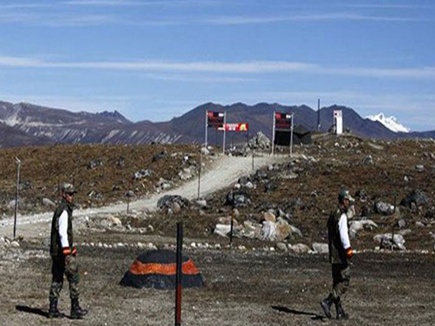
BEIJING: China on Monday did not deny reports that its troops were present in Pakistan-Occupied-Kashmir (POK) along the Line of Control (LoC), with the foreign ministry here saying it was not aware of any such deployment.
The foreign ministry’s stand, however, was clear on the reports of an incursion by Chinese troops across the Line of Actual Control (LAC) – it denied that People’s Liberation Army (PLA) soldiers had crossed it.
China’s official media warned India that it cannot afford tense situations along the borders with both Pakistan and China.
“There is no such thing as going beyond the border. We re g ret that the media keeps hyping up the relevant issue ,” foreign ministry spokesperson Lu Kang said on Monday.
Asked about the presence of PLA soldiers in PoK, Lu was vague. “I have not heard about the incident mentioned,” he said. In response to a question on whether the presence of PLA troops was connected to work on the $46-billion China-Pakistan Economic Corridor (CPEC), over which India has conveyed its protest, Lu merely reiterated China’s stand on the Kashmir issue.
“China’s position on the Kashmir issue is consistent. The relevant issue is left over from history between India and Pakistan. We hope the two countries can properly resolve the issue through negotiation and consultations,” Lu said. Lu added, “We hope relevant media will report objectively and truly about the China-India relationship, and do more to improve friendly relations.”
India’s incredulous defence Dinesh Kumar

Workers & engineers from Mazagon Dock cheer during the floating out of the first project 75 (Scorpene) Submarine, in Mumbai. India’s the largest importer of weapons, despite large sums of money being allocated to defence. PTI
Over the last three decades, India’s defence budget has grown exponentially. The defence budget for 2016-17 has been pegged at a staggering Rs 3,40,921 crore, which includes Rs 82,332 crore for defence pensions. Considering the phenomenal amount of the defence budget, two questions arise: Are the armed forces better prepared to fight a war? Do we feel more secure as a nation?A simple yes or no answer would be too simplistic and reductionist. Yet a qualitative and quantitative analysis of events continues to point towards a situation almost as grim as that in 1991-92 when India’s defence was adversely impacted by two landmark developments — (i) a severe resource crunch that had forced the country into economic reforms and (ii) the breakup of the Soviet Union, which until then was India’s dominant if not sole supplier of defence equipment. Ironically today the situation is grim despite India having the money as well as alternative sources for defence equipment. After a freeze on the purchase of big-ticket items for much of the 1990s (the purchase of Sukhoi-30 fighter aircraft was the only exception), India embarked on a major purchasing spree which has earned it the dubious distinction of become the world’s largest importer of defence equipment. In the last decade-and-a-half, India has added two major capabilities unprecedented in the sub continent — fuel-refuelling aircraft (FRA), aimed at elongating the airborne endurance of the Indian Air Force’s (IAF) frontline fighter fleet and Airborne Warning and Control Systems (AWACS), that can detect the enemy aircraft at longer distances. India has also added big-ticket items such as the purchase of INS Vikramaditya (formerly Admiral Gorshkov), India’s largest-ever aircraft carrier and lease of INS Chakra, a nuclear-powered submarine, from Russia; purchase of the P-8I Poseidon maritime reconnaissance-cum-strike aircraft, C-130J Hercules and C-17 Globemaster transport aircraft from the United States; and a contract for purchase of six Scorpene conventional submarines from France to name a few.These “impressive” purchases have, however, been overshadowed by events that have been both embarrassing and humiliating for India and its security apparatus. The failure to detect a surreptitious invasion by the Pakistani Army along a 150-km stretch of the Line of Control in the high-altitude Kargil region of Ladakh which was evicted at considerable cost of human life and money after two months of fighting (May-June 1999); the release of three dreaded terrorists for hostages taken aboard a hijacked Indian Airlines aircraft that was flown at gun point from Kathmandu to Kandahar via Amritsar, Lahore and Dubai (December 1999); a futile and expensive 10-month Operation Parakram that involved the biggest mobilisation of troops since the 1971 India-Pakistan War, following the December 2001 terror attack on Parliament (December 2001-October 2002), the 26/11 terror attacks by 10 Pakistani terrorists that exposed India’s dismally poor coastal security (November 2008) not to forget the monotonous regularity with which Indian Army cantonments and posts have been attacked by terrorists in Jammu and Kashmir along with the attack on the Pathankot air base last January. Ironically, most of these incidents have occurred during the previous (1998-2004) and current BJP-led NDA regimes.And yet, successive reports prepared by the parliamentary Standing Committee on Defence and the Comptroller and Auditor-General (CAG) have pointed to glaring deficiencies in India’s defence preparedness. The IAF’s fighter fleet has fallen to a record low of 33 squadrons against an authorised strength of 42 squadrons. The Navy’s submarine fleet is down to just 13, with most submarines over two decades old. The Navy’s fleet, last authorised 52 years ago in 1964, comprises 140 vessels and 236 aircraft and helicopters, 72 vessels and 222 aircraft and helicopters short of the recommendations of the 15-year Maritime Capability Perspective Plan (MCPP) for 2012-2027. By then most vessels and aircraft, which are already ageing, would have been decommissioned. Time and cost overruns abound. For example, the indigenously produced aircraft carrier which was supposed to be ready for induction by December 2010 is now expected to be ready by December 2018 with the cost having escalated almost six times from Rs 3,216 crore to Rs 19,341 crore. Indigenous production of the three stealth Guided Missile Destroyers and four anti submarine warfare Corvettes is similarly behind schedule, with costs having escalated. It is the same story for a series of smaller vessels comprising Offshore Patrol Vessels, Fast Interceptor Crafts, Landing Craft Utility and Fast Attack Craft that have been commissioned for indigenous production.The Army’ Artillery has not added a single new howitzer gun for the last three decades and the Infantry is struggling with an indigenously made 5.56 mm rifle, whose deficiencies were exposed during the 1999 Kargil War just five years after it was first inducted in 1994. The Army is struggling to raise its first-ever Mountain Strike Corps, sanctioned in 2013, by drawing equipment from the highly classified War Wastage Reserve (WWR), which are reserves set apart for anticipated use of weapons and ammunition during a war. Worse, even the current WWR is less than 100 per cent in respect to several weapon systems and equipment. The Army’s critical shortages in artillery guns, Infantry weapons, Sights and Fire Control equipment, engineer equipment, air defence equipment, medium-range surface-to-air missiles, self-propelled guns and helicopters, to name a few, all due to inadequate production capacities of the 40 Ordnance factories and nine defence public sector units and procurement process delays in well documented. Interestingly, the shortages are not in big-ticket items alone. The Army, which is actively deployed in counter-insurgency operations in J&K and in high- altitude warfare, continues to be short of 2.30 lakh bullet-proof vests since 2009, hand-held thermal imagers with laser-range finder, night-vision devices and weapon sights and special clothing and mountaineering equipment, including 2,17,388 high ankle boots and 44,700 baklava caps to name a few. During both the previous and current NDA regimes, India’s defence budget has remained partly unspent with large sums of the capital budget earmarked for defence purchases being surrendered. For example, during the Vajpayee-led government in 2000-01, which is a year after the Kargil War, the Ministry of Defence (MoD) could spend only 84.69 per cent of the defence budget, followed by 85.6 per cent in 2002-03. During the current Modi Government, the MoD spent only 85 per cent of its defence budget in 2014-15, followed by 91.3 per cent in 2015-16. Translated into monetary terms, the MoD surrendered as much as Rs 11, 595 crore from the defence Capital budget in 2015-16 and Rs 7,874 crore in 2014-15. The irony is that despite large sums of money being allocated to defence and India maintaining its record of being the world’s largest importer of weapons, slippages in defence preparedness are steadily increasing. There are huge gaps in India’s defence and security. There have been suggestions to link the defence budget with about 3 to 3.5 per cent of the GDP. The question is: How much is enough for credible defence. There is no doubt that India’s defence budget needs to be more realistic. Else, allocating otherwise large sums of money does not make sense. The continuing gaps in preparation for all spectrums of warfare will not only appear to make defence expenditure less purposeful if not ‘wasteful’, but, more critically, will not make India any securer.
dkumar@tribunemail.com
1965 war hero’s bust unveiled
CHANDIGARH: The bust of 1965 war hero Naik Darshan Singh was unveiled by Lt Gen KJ Singh, General Officer Commandingin-Chief (GOC-in-C), Western Command, in SAS Nagar on Monday.
GURMINDER SINGH/HTLt Gen KJ Singh, GOC-IN-C, Western Command, unveiling the statue of martyr NK Darshan Singh at the entrance gate of Darshan Vihar, Sector 68, in SAS Nagar on Monday.
Naik Darshan Singh of 5 Sikh Light Infantry had laid down his life in Mendhar sector of Jammu and Kashmir during the 1965 India-Pakistan War.
The citation recalled how Darshan had crawled forward while charging at the enemy, despite losing a leg in a mine blast.
While moving forward, the citation added, another mine explosion wounded Darshan severely, but the Naik dragged himself to an enemy bunker and threw a grenade into it.
Darshan also has a residential society in SAS Nagar named after him.
Addressing a gathering of serving personnel and veterans on Monday, Lt Gen KJ Singh paid glowing tributes to the martyr. The GOC-in-C also honoured Basant Singh, the martyr’s son. Lt Gen Singh also said the army was alive to the welfare of the martyrs kin and added efforts were underway to provide all services to the veterans under one roof at the Kendriya Sainik Sadan, SAS Nagar.
Army chopper crash-lands in Hoshiarpur fields

A policeman inspects an Army chopper that made an emergency landing at Maili village in Hoshiarpur on Friday. photo: malkiat Singh
Hoshiarpur, March 11
An Army chopper carrying four Army men was forced to make an emergency landing in a wheat field in Maili village near Mahilpur after it developed a technical snag, the police said on Friday.
“The helicopter made an emergency landing in the village at around 12:30 pm,” Hoshiapur Senior Superintendent of Police Dhanpreet Kaur said.
All four onboard are safe, although two suffered minor in injuries.
“There was no damage to the chopper,” the SSP said.
With four crew members on board, the chopper took off from Jalandhar cantonment on routine sortie today at about 11 am.
Major Guriqbal Singh and Lt Col B.S. Chohan received minor injuries in the incident, DSP (Chabbewal) Hardeep Kumar said, adding that they were given first aid.
Pilot Aditya Verma and Co-pilot Ajit remained unhurt, the police said, adding that they were taken to Jalandhar by Army personnel. — TNS/ PTI
SBI, other banks to go on strike on Feb 29