All posts by webadmin

New rules clipping tribunal wings come under HC lens

New rules clipping tribunal wings come under HC lens

Vijay Mohan

Tribune News Service

Chandigarh, August 5

New rules for various tribunals notified by the Centre recently have come under the judicial scanner. The rules purportedly undermine the independence of the quasi-judicial bodies and place them under the control of the very ministries that are respondents in cases filed against themTaking up a petition filed by an ex-serviceman and ex-president of Armed Forces Tribunal (AFT) Bar Association, a Division Bench of the Punjab and Haryana High Court comprising Justice Mahesh Grover and Justice Raj Shekhar Attri has issued a notice to the Centre.(Follow The Tribune on Facebook; and Twitter @thetribunechd)Averring that the new rules were in contravention of those laid down by the Supreme Court in the cases of Madras Bar Association and R Gandhi and of the High Court in Navdeep Singh versus Union of India, the petitioner, Surinder Sheoran, contended the government’s action threatened the basic fabric of independence of the tribunals in many ways.The petition states that insofar the AFT is concerned, the government has provided that the tribunal shall function under the Ministry of Defence and that the Defence Secretary, who is the first opposite party in every litigation, shall be a part of the committee for recruiting and re-appointing members of the AFT. He would also be responsible for removal and any inquiry against the members, which was specifically barred by the Supreme Court in Madras Bar Association’s case and by the High Court in Navdeep Singh’s case.Till now, an SC Judge could hold an inquiry against members, but the new rules provide that even absence of a representative of the judiciary in the selection process will not make the appointments invalid. It has also been stated that while the SC had directed a tenure of five to seven years for members to ensure stability, the new rules have decreased it from existing four to three years.The rules have also introduced a new clause wherein any person with experience in business, economics, commerce, finance, accountancy, etc can be an AFT member.What legal experts say

  • New rules contravene concept of separation of powers and judicial independence
  • Make tribunals, their members subservient to Union secretaries against whom orders are to be passed
  • Wrong to reintroduce clauses that have been repeatedly quashed by HCs and SC in a number of cases


Army recruitment rally::PUNJAB

Keeping in view tensed condition in the state, an army recruitment rally that was to be held from August 26 to September 6 was postponed. The rally is now being held from August 30 to September 10 at the Ferozepur cantonment. Aspirants from Bathinda, Muktsar, Ferozepur, Fazilka, Faridkot, Hoshiarpur, Jalandhar, Kapurthala and SBS Nagar can appear at the rally for recruitment. Giving this information, the Director, Recruitment, Surinder Heran, said the rally that was to be held on August 26 would now be held in September 3. Similarly, the rally that was to be held on August 27 will now be held on September 4, the recruitment that was to be held on August 28 will now be held on September 5 and the schedule for August 29 will be carried out on September 6. He added that no changes had been made to the rally that was scheduled from August 30 to September 2. He said only those candidates could participate in the rally who had registered online earlier.Aspirants throng job fairAs many as eight companies recruited candidates at the mega job fair being held at Maharaja Ranjit Singh Punjab Technical University. Approximately 1,100 candidates participated in the job fair on Thursday. More than 130 candidates were shortlisted by the evening. The transportation facility from the MRSPTU to the Bathinda bus stand was also provided to the candidates. The job fair was extended by two days and would continue till September 2. The recruitment process takes the applicants through many stages like aptitude test, pre-placement talk, seminar, group discussion and written test followed by an interview. The selected candidates will be intimated soon.


There is no military solution in J&K, separatist finances should have been targeted much earlier by Lt Gen Syed Ata Husnain

The most ineffective way of fighting your adversary in a hybrid conflict, like the one in J&K, is to fight it through only the military route. It will mostly ensure that you will restore temporary order and the situation will slip back to create mayhem around you and often under your own presence. However, in most parts of the world that is exactly how such modern day conflicts are fought and therefore are rarely won. It is so because the understanding of the term ‘hybrid conflict’ never focuses on the first word of the term but rather on the second. The common perception is that conflict has everything to do only with the military and hence is its purview and others have only a peripheral role. Actually the reverse is the truth. The word hybrid is the more important one and its scope extends to multiple domains which are multiplying by the day with new technologies and other dimensions of modern human existence. Violence at different levels and different locations keeps the conflict relevant and visible while an adversary delves into other domains silently and effectively. Among these domains are promotion of extremist radical ideology, creation of intense alienation, keeping the organs of government on tenterhooks and incapable of governance, intimidation of government agencies, media and private citizens, gun running and narcotics to sustain finances and lastly and perhaps most importantly maintaining financial conduits for the unimpeded flow of money into the conflict system. Without the latter no such hybrid conflict can be sustained beyond a few months.

Fighting hybrid conflict only militarily is the inability of a society to grow intellectually and appreciate the true potential of different forms of conflict. Killing terrorists is easy when we have a large enough force of soldiers and policemen. The invisible elements of hybrid conflict are far more dangerous than the seemingly more potent but largely visible elements such as cannon fodder terrorists who die in sufficient numbers to keep statisticians busy in their jobs.

A common question which even some intellectuals tend to ask me is – “why despite killing so many terrorists and losing so many soldiers, we cannot establish better control over Jammu & Kashmir”.  I hate to give you my answer because it actually trivializes the achievements of my fellow soldiers and that is something I am wont to do. Yet, someone has to take on the mantel to explain to the public that the type of conflict we are witnessing in J&K is not the good old conventional war which they are used to hearing about. While keeping our army and police forces engaged in the fight against terrorists and stone throwers there have been a range of activities taking place under the sponsorship and patronage of a host of other people. The Separatists have been projecting the cause for separatism through literature, social media, media patronage, mosque power, direct engagement and creation of structures which can be activated in minutes to respond to diverse situations. The campaign to radicalize Kashmiri society, denied by most Kashmiri citizens, has been a deliberate ploy to empower the mosque and link Pakistan’s deliberately chosen path of radical Islam to become the Valley’s new ideology. It happened right under the care of all elements who profess to know the Valley rather well. None of us could stop it because of our intellectual inability to realize what was shaping around us. In any case India’s security agencies were largely bereft of knowledge on religious ideology when radical Islamists across the border were planning and coordinating activities in the Valley with sheer impunity.

None of the above can be done by Separatists with the level of competence they have displayed without adequate financial backing and that is a truism for any such conflict. The ISIS could survive three years in Northern Iraq because of the looted finances from the Mosul treasury and the revenues of taxation and the oil refinery. Once most of that was spent it was no longer possible to continue in the same mode. For some of us who understood the nature of conflict in J&K and the actual strategy of Pakistan it was always a question of evolving our own strategy through ‘whole of government’ approach. Unfortunately the political class could not appreciate what its role was at the operational and strategic level. Its role in preventing the flow of finances to the separatist ranks and the obstacles in the way of ideological change taking place in the mosques would have made all the difference. The bane remained the perception that it was a conflict situation and was the responsibility of the security forces.

I have written many times so let it be  only a reminder that the Separatists have  far better network and organizational structures than even the army. There are elements in every ‘qasba’ and every town, the intelligence providers, backed by an army of lawyers, treasurers, ideologues, rabble rousers, stone throwers, drug addicts and of course terrorists. All of them survive on the additional income provided by the Separatists. There has been enough money coming in to finance a plethora of over ground workers, compensate families of terrorists, pay guides at the LoC or safe house owners and compensate stone throwers on an everyday basis.

Yet all these years the infrastructure was allowed to remain in place. Money came from foreign sources into legitimate accounts, cash was drawn by cards from accounts opened and existing in Delhi and more cash was even available through gift packets on Pakistan national day, at the Pakistan High Commission. This happened primarily because there was some element of faith in the Separatists that successive governments had reposed. The government was underwriting much of their personal expenditure in the hope they would eventually deliver. With the situation in South Kashmir having drastically changed the equations of control of the movement, the Government has finally acted and acted swiftly after a media inspired sting operation. It is good to see that both parties of the coalition government in J&K have supported the National Investigation Agency’s initiative with arrest of seven Separatist leaders. Details of the financial networks which is the darkest part of terror networks is bound to produce enough incriminating material to ensure that the leadership is sufficiently ineffective for long. Care must be taken to prevent VIP facilities and availability of communications to the leaders otherwise the entire gamut of operations may be compromised.

Finally, it appears that the whole of government approach is at last emerging in the J&K situation. Next should be curtailing of mosque power and for that the effective advice of moderate Muslim clerics from rest of India should definitely make a difference.  In the interim the Army and other security forces must continue the excellent run of counter infiltration and counter terror operations   to prevent the resurgence of gun power in the Valley. The ‘whole of government’ approach must continue hereafter in different domains with energy and understanding as never before.


India’s attempts to stem Chinese imports will fail

Build a broader trade plan since Chinese traders are adept at overcoming barriers

In trade as in cricket, batting against a chinaman is about countering the unorthodox and deceptive. India has made a renewed effort to try and set up non-tariff barriers to floods of Chinese-manufactured goods. In the past India has been among the most active users of anti-dumping duties and other standard WTO-approved methods to stem the flow of Chinese imports. New Delhi has now turned to the use of technical and safety standards against the Made in China hordes. India’s China trade was responsible for half of its entire trade deficit of $106 billion, in 2016. More importantly, this shortfall has grown exponentially since 2006. This has been driven by two factors.

One is a rising Indian appetite for Chinese equipment. The Modi government has increased tariffs on electronic products and is using the new standards to encourage domestic manufacturers to enter these fields. There is minimal evidence this is working. The many constraints facing Indian factory-owners in the form of high taxation, greater logistics costs, more expensive power explain India’s inability to make its own phones and chips. The other reason are the hundreds of non-tariff barriers that Beijing places against Indian and other imports.

India’s present attempts to stem Chinese imports are unlikely to have much impact. Chinese firms are adept at overcoming such trade barriers. What New Delhi should be looking at is a more comprehensive trade strategy regarding Beijing. Potentially, if India were to cause enough problems for Chinese imports, Beijing might be prepared to negotiate some sort of bilateral trade understanding. More sensible would be to build a global coalition to push for China to become more transparent about its use of subsidies, do more to protect intellectual property and so on. Either or both of these responses requires a degree of trade diplomacy that has not been evident in the Modi government. It is time New Delhi try to acquire such skills.


Border row with India put in perspective

The People’s Liberation Army’s parade on Sunday reflected the Chinese military’s latest efforts to strengthen its combat readiness and joint operation capability.

The PLA also used the occasion to publicize its achievements in armament modernization as nearly half of the weapons and equipment used in the event were presented for the first time in a parade, according to organizers.

The military sent 12,000 troops, about 600 land and naval weapons, and nearly 130 aircraft to participate in the parade, the first in the PLA’s history to celebrate its birthday, which falls on Tuesday. The event was organized by the PLA Central Theater Command on orders of the Central Military Commission.

Field parade

The event began at 9 am at a training field of the Zhurihe Training Base, Inner Mongolia, as President Xi Jinping, also chairman of the Central Military Commission, took a car to inspect troops from all military branches who were taking part in the event. After the president returned to a central stage built to review the parade, more than 200 soldiers, carried by assault vehicles, escorted flags of the Party, the People’s Republic of China and the PLA and passed the central stage.

Then 17 attack helicopters flew past the parade zone, forming the two Chinese characters of Aug 1, the birthday of the PLA. They were followed by another 24 helicopters that flew in a shape of the Arabic numerals of 90, which symbolized the 90-year history of the PLA.

Next, 18 transport helicopters, guarded by eight attack helicopters hovering low in the air, landed and deployed hundreds of soldiers at a rough training ground in front of the stage.

The demonstration of helicopters carrying troops to “penetrate enemy defense” was the first time the PLA has presented fighting maneuvers in a parade and also marked the public debut of the PLA Ground Force’s airborne assault unit.

Weapons used by the ground strike group were the Type-99A main battle tank, Type-08 and Type-04A infantry fighting vehicles, 122-milimeter and 155-mm self-propelled howitzers, 300-mm multiple rocket launcher as well as HJ-10 anti-tank missile carrier. All represent the best arms of Chinese land forces.

Next in line was the information support group. It showed some of the nation’s latest electronic warfare devices, such as electronic reconnaissance and electronic countermeasure vehicles, as well as anti-radar and communication-jamming drones, making public the PLA’s information operation capacity for the first time.

The third group represented the Chinese military’s special warfare prowess, with hundreds of elite commandos riding on dozens of light-duty reconnaissance and armored assault vehicles.

The fourth group – air and missile defense – featured early-warning radar, anti-aircraft missiles and anti-missile interceptors. The HQ-9B and HQ-22 missiles are new-generation weapons in China’s air and missile defense systems.

The next formation, the naval combat group, was composed of marine and naval missiles including the latest models – HHQ-9B air defense missile and YJ-12A anti-ship cruise missile.

Up in the sky, the bulk of the aerial combat group roared through the dust and exhaust produced by moving vehicles on the ground. The group comprising seven elements – early-warning and control aircraft, bombers, transport planes, refueling tankers, aircraft carrier-borne and land-based fighter jets as well as a mechanized parachute unit.

Aircraft taking to the sky included almost all of the PLA’s most advanced types, such as the J-20 supersonic stealth jet, the world’s third type of fifth-generation fighter jet, KJ-500 early-warning and control plane and Y-20 strategic transport jet.

The next two groups were logistical support and counterterrorism forces.


The last, perhaps also the most eye-catching, group was from the PLA Rocket Force. Five types of ballistic missiles including DF-16G, DF-21D and DF-26 were carried by wheeled launch vehicles.

According to the Rocket Force, DF-16G carries conventional warhead and has high accuracy, strong destructive power and a short preparation time.

The DF-21D land-based, anti-ship ballistic missile features a large coverage and good penetration and target-tracking capabilities. It is a milestone in the PLA’s effort to implant strategic capacity into its conventional ballistic missiles.

The DF-26, a new strategic deterrence weapon, is capable of conducting off-road launches of conventional and nuclear warheads in tough terrain. It can carry out a rapid nuclear counterattack and medium – to long-range precision strikes using a conventional warhead, the Rocket Force said.

Closeness to combat

Sergeant Major Ding Hui, a veteran tank driver who has taken part in four national-level parades – in 1999, 2009, 2015 and on Sunday, said the public can see via the Zhurihe parade what his unit, a mechanized infantry division, has gained through its combat-ready training in the recent years.

“You can see that we are well trained and equipped. Our training is now very close to actual battle. Our weapons keep improving – the Type-99A is the most advanced tank I’ve operated,” he said. “Compared with previous tanks, it is easier and more comfortable to use and can communicate with other units such as aircraft to call for reinforcement.”

Ding also said the tanks moved at a speed of 15 kilometers per hour in Sunday’s parade, faster than that in previous parades, which was maintained at 10 km/h. He said the higher speed was meant to demonstrate the “fighting status” of tanks.

Major General Tang Ning, deputy chief of staff of the Central Theater Command’s ground force, said the PLA Ground Force has been seeing huge strides in terms of information capacity and diversification.

Now, more combat units have air defense missiles and self-propelled guns in addition to their traditional weapons such as tanks and armored vehicles, Tang said. They have adapted to those new arms and modern joint operation, he said.

Major Mao Lei, an Air Force staff member in charge of training the paratrooper unit in the parade, said the composition pattern of his unit revealed its sense of combat readiness.

“During previous parades at Tian’anmen Square, we sent only one type of airborne tracked armored vehicle, but this time, our parade unit had not only the armored vehicle but also an airborne wheeled assault vehicle,” he said. “This was because their combination, rather than merely one of them, is what we would use for a real battle. We showed today what we would be like in an actual war.”

He said the Chinese parachute force has become capable of making long-range deployment of heavy-duty weapons thanks to the intensified training and deliveries of new equipment during the past five years.

“For instance, compared with the past, when we were capable of airdropping just one type of heavy-duty equipment in each operation, we are now able to deploy multiple types of such equipment in a single mission,” he said.

Lieutenant Colonel Qing Yingsong, an Air Force officer from the Central Theater Command who makes plans for bombers’ training, said the bomber units that appeared in the parade engage in regular drills to confront anti-aircraft, radar and electronic-warfare forces to hone pilots’ capabilities.

He said the units also conduct long-range flight training over the high seas to test their strike capability.

Qing’s colleague, Colonel Fan Huiyu, an Air Force researcher in the command, said the headquarters for air units in the parade used command and communications vehicles instead of fixed facilities in previous parades.

“This was because we treated this parade as an opportunity to verify our readiness for a real combat, which requires us to be mobile and to be able to respond quickly,” he said.

Contact the writer at zhaolei@chinadaily.com.cn


Howitzer mishap pours cold water on manufacturing plan

NEWDELHI: The death of two South Korean soldiers in a K-9 howitzer explosion three days ago has raised doubts about the performance of a Korea-origin artillery gun set to be built in India on the same platform.

REPRESENTATIONAL PICTUREKorean newspaper reported that there were more than 1,700 reports of K­9 artillery malfunctioning over the past five years.The Korean media questioned the reliability of the self-propelled howitzer, a gun meant for firing shells on high trajectories, after the incident occurred during an artillery training session in Gangwon province on Friday. Five others were also injured in the explosion.

Private sector defence major Larsen & Toubro and South Korean firm Hanwha Techwin are in the process of executing a $720-million contract for supplying 100 K9 VAJRA-T guns to the Indian Army.

The contract was signed on April 21, and the weaponry will be produced at Talegaon near Pune in Maharashtra. The guns are expected to be delivered in three years.

The Korea Herald reported on Monday that the Army has decided to halt training sessions with K-9 artillery until the exact cause of the explosion is identified. “According to a parliamentary inquiry in 2016, there were more than 1,700 reports of K-9 artillery malfunctioning over the past five years,” the news report said. The 155mm/52-calibre tracked self-propelled K-9 gun has a range of 40 km.

A report in the Korea Times said securities firms were rushing to downgrade their outlook for Hanwha Techwin in the aftermath of the explosion. India is the fourth country to opt for the artillery gun, after Turkey, Poland and Finland. “There may be something wrong with the K-9 howitzer. Regardless of the findings, the incident will certainly dampen Hanwha’s campaign to sell the weapon to foreign countries,” the Korea Times quoted an analyst as saying.

Former Army chief General Deepak Kapoor said the explosion was a cause for concern because the weaponry meant for the Indian Army would be built on the same platform. “But let’s be clear: We induct weapons only after rigorous testing in all types of conditions,” Kapoor, a former artillery officer, said.

Another Army officer said the K-9 cannot be dismissed as a “useless weapon” because of a single mishap.


Prudent conflicts by Lt Gen Bhopinder Singh

Prudent conflicts

Chinese soldiering traditions date back to the Shang dynasty (1600 BC), with seminal strategists like Wu Qi and Sun Tzu propounding classic military treaties and instincts for the modern day ‘Terracotta’ warriors of the PLA (People’s Liberation Army). Across the Tibetan Plateau and the natural barriers of the Himalayan ranges, lies an even more ancient civilisation with its own profundities on war and martial traditions that the British Raj amalgamated and chiselled into a fine institution, Indian Defence Forces, the most combat-exposed outfit in the world today. Genealogically, as the two nations emerged from the bondages of foreign invasions – a certain heterogeneity of masses, absolutist power and ideology, along with expansionist tendencies ensured that the independent People’s Republic of China became a much larger entity as compared to the vivisected nations of British India, including India.

The two geographically-contiguous but historically-distanced civilisations morphed into modern states with competing ambitions and opposite systems – a totalitarian construct of efficiency got pitted against the surety of democracy. Unsettled borders and geostrategic impulses led to a war in 1962, and frequent border ‘skirmishes’ and standoffs, like the one in Doklam. In 1962, India was to pay a price for the institutionalised ‘secondment’ of its Armed forces and its security imperatives, especially when the PLA sensibilities were the centrifugal forces of Chinese governance. Professional forewarnings by India’s serving DGMO and the-then, recently retired Chief, General KS Timmayya, “I cannot, even as a soldier, envisage India taking on China in an open conflict on its own,” were rubbished and replaced by a puerile ‘forward posture’. The expected consequences followed in 1962, but the invaluable lessons learnt for posterity and the security dimensions have since never been the same. Quick confirmation of the change was indirectly showcased in the 1965 war, but very directly confirmed in the ‘limited’ war against the Chinese in 1967 (Nathu La and Cho La).

Bhopinder Singh

Read more at: http://www.millenniumpost.in/opinion/prudent-conflicts-254644


Navy issues tender for buying 234 copters

New Delhi, August 22The Navy today issued global request for information (RFI) for procurement of 111 utility and 123 multi-role helicopters under the recently launched strategic partnership model for defence procurement.Official sources said the RFI had been issued to identify original equipment maker for both the utility helicopters as well as multi-role choppers, which are being procured as part of the Navy’s modernisation plan.The procurement of both categories of choppers would cost the government in excess of $15 billion, according to experts who said the two contracts could be one of the largest globally in recent times.They said the Defence Ministry was likely to soon issue RFI to select the Indian defence manufacturer, which will join hands with the foreign entity or entities for production of the choppers as mandated under the strategic partnership model.The last date to respond to the RFI issued today by the Navy is October 6. — PTI


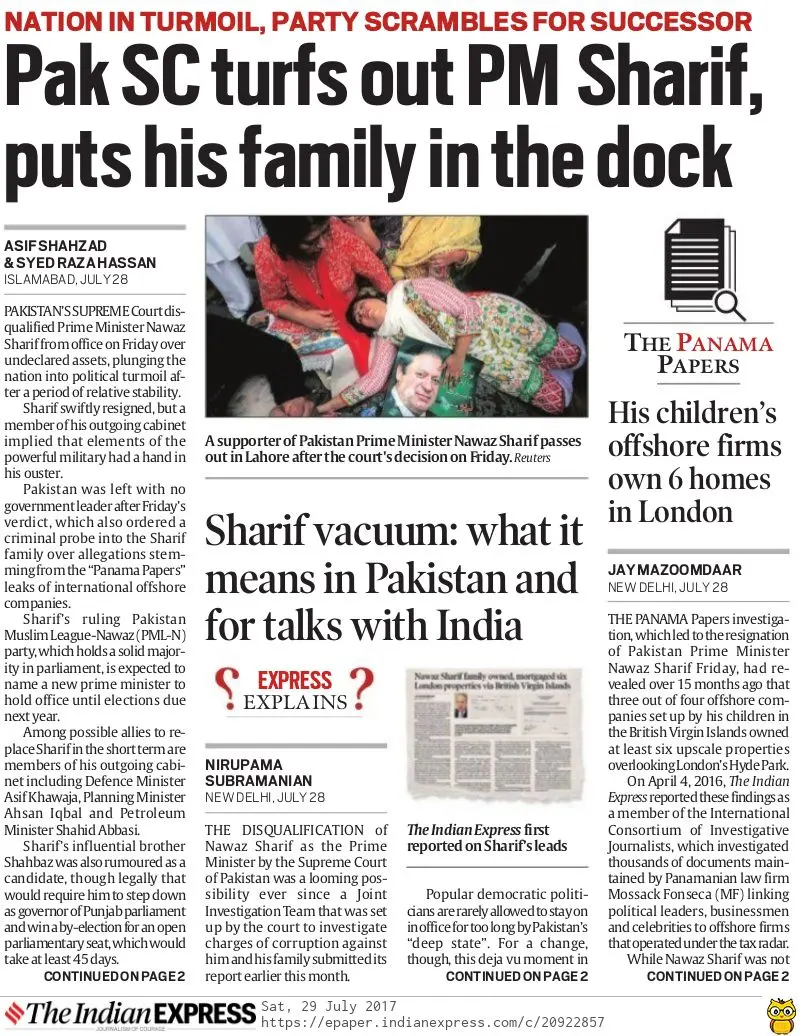
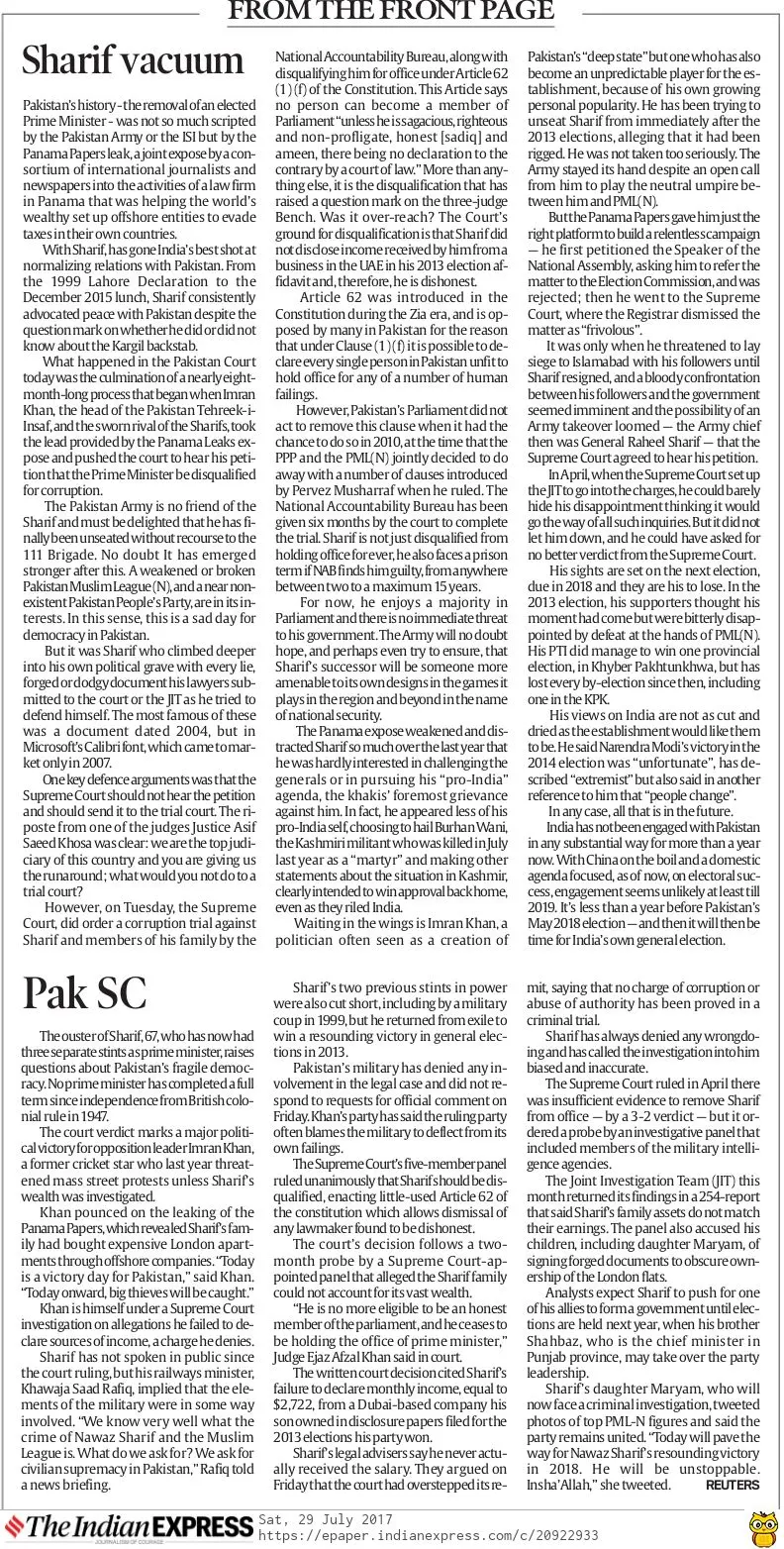
Pak top court ousts ‘dishonest’ Sharif PM resigns after disqualification; to face graft case along with children

Pak top court ousts ‘dishonest’ Sharif
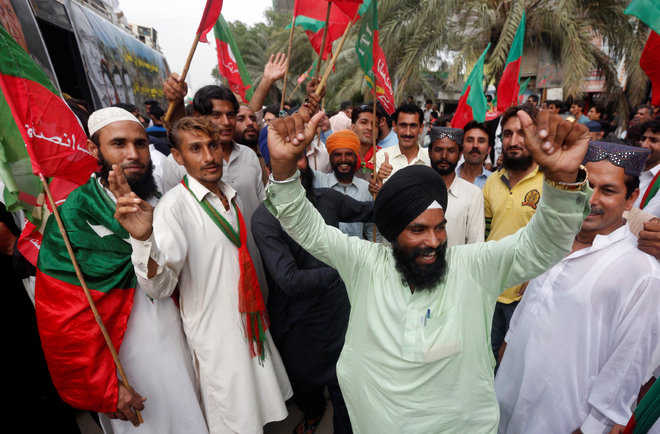
Nawaz Sharif’s opponents celebrate after the Supreme Court verdict in Karachi on Friday. REUTERS

Islamabad, July 28

Pakistan’s Supreme Court today disqualified Prime Minister Nawaz Sharif for dishonesty and ruled that corruption cases be filed against him and his children over the Panama Papers scandal, forcing the embattled leader to resign. It is the third time that the 67-year-old veteran politician’s term as premier has been cut short. Edit: Nawaz Sharif nailedThe verdict plunged Pakistan into a political crisis at a time when it is facing a brittle economy and a surge in militancy. As the unanimous verdict by the five-judge Bench was read out, a large number of Opposition Pakistan Tehreek-e-Insaf workers celebrated outside, chanting “Go Nawaz, go”.(Follow The Tribune on Facebook; and Twitter @thetribunechd)The court disqualified Sharif under Articles 62 and 63 of Pakistan’s Constitution that state that an MP should be truthful and righteous. “He is disqualified as a member of parliament so he has ceased to be holding the office of Prime Minister,” the Bench said. It ordered the Election Commission to issue a notification for Sharif’s disqualification. Subsequently, Sharif’s election from NA-120 constituency (in Lahore) was denotified. The federal Cabinet also stands dissolved.Shehbaz Sharif, the younger brother of Nawaz Sharif, was most likely to succeed him. No name has been announced for interim PM, who will fill the 45-day vacuum until Shehbaz, 65, is elected to the National Assembly. The Supreme Court disqualified Sharif for failing to declare “receivable” salary from a UAE-based company of his son in the 2013 nomination paper. It termed the salary, which was not paid to Sharif, as an “asset”. Following the verdict, a spokesperson of Pakistan Muslim League-Nawaz (PML-N) said Sharif had stepped down, “despite reservations regarding different phases of the Panama case proceedings”.The SC ordered the National Accountability Bureau to initiate a corruption case against Sharif, his sons Hussain and Hassan and daughter Maryam within six weeks and that the trial be completed within six months of the filing of the case. The court also ordered a criminal investigation into the assets of Finance Minister Ishaq Dar, Sharif’s trusted aide, and Capt Muhammad Safdar, Sharif’s son-in-law and a member of the National Assembly.Imran Khan of the Pakistan Tehreek-e-Insaf and a petitioner in the Panama case, hailed the verdict. The cricketer-turned-politician said: “It’s a moment of joy for Pakistan because for the first time the Supreme Court has disqualified the most powerful man in Pakistan, who has been ruling for 30 years.” Former military dictator Gen Pervez Musharraf, now living in Dubai, congratulated the nation. Chairman of Pakistan People’s Party (PPP) Bilawal Bhutto Zardari urged everyone to respect the verdict.No Pakistani PM has ever completed his term. It is the second time in its 70-year history that the SC has disqualified a sitting PM. — PTI 

clip

clip

clip

clip

http://epaper.indianexpress.com/c/20923034

clip


Army to review Purohit’s suspension from service after examining SC order

New Delhi, August 21

Lt. Col. Shrikant Prasad Purohit, who was granted bail by the Supreme Court on Monday in the 2008 Malegaon blast case, will have to report o his unit after walking out of jail and the Army will review his suspension from service after examining the court order, army sources said on Monday.They said Purohit will be placed under same restrictions as an officer in “open arrest” and his movement will be confined to his residential accommodation and camp of his unit.An officer is placed under open arrest when court martial proceedings are initiated against him. The Army had initiated a Court of Inquiry against Purohit in April 2009.Purohit spent almost nine years in jail for his alleged role in the Malegaon blast case. The apex court observed that there were contradictions in the charge sheets filed by different investigating agencies.The army sources said the Army headquarters will study the Supreme Court’s order granting him bail and accordingly a call will be taken on whether to revoke his suspension from service.They said Purohit will have to wear uniform while being in his unit but he may be permitted to wear plain clothes as well.Purohit, who was posted with a unit under Southern Command and was an officer from intelligence corp, was suspended from service soon after he was arrested in connection with the Malegaon blast case in in late 2008.”He will have to report back to his unit after getting out of jail. He can be attached to any other unit after that,” said a source.According to defence regulation service rules, while under suspension, an officer will be placed under the same restrictions as an officer in open arrest.Six people were killed in the blast on September 29, 2008, at Malegaon, a communally-sensitive textile town in Nasik district of north Maharashtra.The apex court set aside the April 25 verdict of the Bombay High Court denying bail to Purohit, but imposed certain restrictions while granting him relief after he spent eight years and eight months in jail. PTI