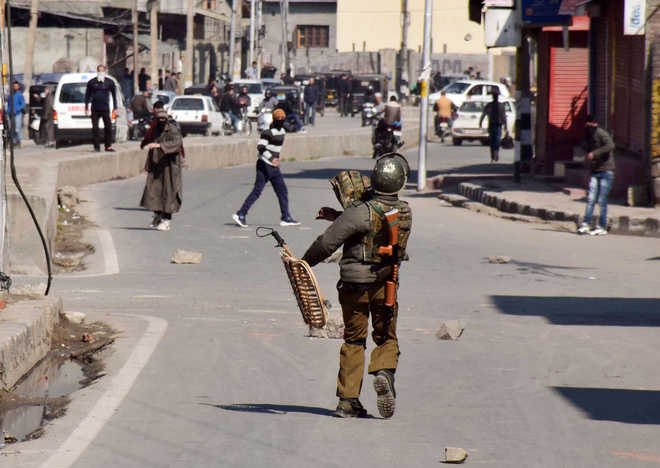
Youth throw stones at security men in Srinagar on Tuesday to protest the killing of civilians in Shopian. Tribune Photo: Amin War
Majid Jahangir
Tribune News Service
Srinagar, March 6
After an Army Major filed a complaint, the police have registered a case of attempt to murder against the persons killed in a shootout in Shopian on Sunday evening.The Army in its docket (complaint) to the police immediately after the incident, which left six persons dead, said apart from a militant, three persons were killed in the initial shootout. It said the three persons were “probably” overground workers (OGWs).In his complaint, Major Parveen Menon of 44 Rashtriya Rifles said the Army had set up a mobile vehicle check-post near a school at Pahnoo on Sunday evening when two cars tried to run through the check-post. “The troops at the check-post challenged the occupants of the cars but they did not stop and instead fired from inside the car on the troops, with the intent to kill them. In the exchange of fire between the Army men and the occupants of the cars, one militant was killed and probably three OGWs were killed and one weapon was recovered,” Major Menon said.The FIR, a copy of which is with The Tribune, says the complaint was verbally corroborated with the contents of the written report.“The contents of report have been read out to the complainant. The written report and verbal disclosure of the complaint attract offences under Section 307 (attempt to murder), Ranbir Ranbir Penal Code, and Sections 7/27 of the Arms Act. Hence an FIR is registered and investigation entrusted to a Sub-Inspector,” the FIR read. It further said the case was of a special nature. A senior police officer said the FIR had been registered in the case. “This is just a first information report. Various versions, including that of the Army, eyewitnesses and relatives of the deceased would be included in the investigation,” he said.Recently, the police was involved in a controversy after it lodged an FIR against an Army unit when three civilians were killed on January 27 in Army firing in Shopian district. On March 5, the J&K Government told the Supreme Court that Major Aditya Kumar had not been named in the FIR in connection with the incident.
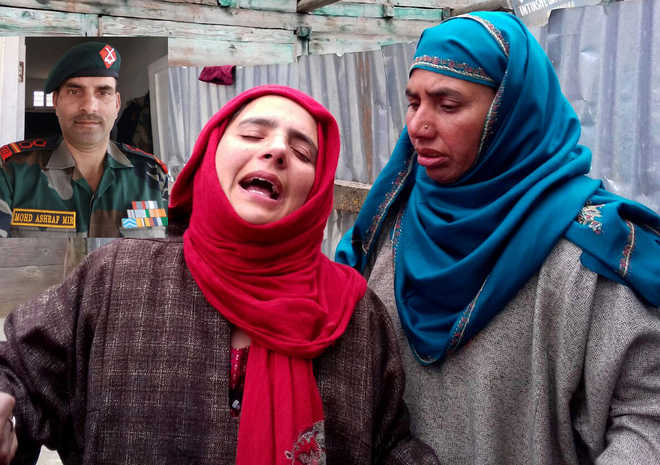
The grieving family members of Subedar Mohammad Ashraf Mir at Maidanpora on Sunday. Tribune Photo: Amin War
Majid Jahangir
Tribune News Service
Srinagar, February 11
A pall of gloom has descended on the villages of four Kashmiri soldiers who were martyred in a fidayeen attack at the Sunjuwan Army camp in Jammu.Subedar Mohammad Ashraf Mir of Maidanpora, Lolab, and Havildar Habibullah Qureshi of Batapora Hyhama, both from the frontier Kupwara district in north Kashmir; Lance Naik Mohammmad Iqbal Sheikh from Nageenpora, Tral, Pulwama, and Lance Naik Manzoor Ahmed from Kulgam district, were killed in the gunfight. Lance Naik Iqbal’s father was also killed in the attack.As the families waited for the bodies of the soldiers, residents of adjacent areas rushed to the villages of the martyrs.At Maidanpora, over 110 km from Srinagar, villagers started visiting the Mir family after the news about his death in the Jammu attack spread.“We came to know that he died on Saturday,” Subedar Mir’s father Ghulam Mohideen Mir said, adding that he was the only bread-earner of the family.Mir pitched for dialogue between India and Pakistan to stop the bloodshed in J&K.“Innocent people are getting killed each day and this should stop. They should talk and resolve issues,” Mohideen said.Subedar Mir, 43, was home when fidayeen barged into his quarter. A family member said militants shot him dead as he was preparing for pre-dawn prayers. His three children and wife, too, were at the quarter when he was shot dead on Saturday.The family of Havildar Qureshi at Batapora in Kupwara is also in mourning. A few family members were upset with the Army for not disclosing them about the death of the soldiers.“We came to know about (the death) through the media on Saturday. There was no news from the Army even today,” said another relative.In Tral, the Sheikh family was waiting for two bodies. Lance Naik Iqbal, 32, and his father were killed in the gunfight. He is survived by his wife and an infant son.
CM enquires about injured in hospital Jammu: Chief Minister Mehbooba Mufti visited Army Hospital, Satwari, on Saturday evening and enquired about the condition of those injured in the Sunjuwan Army camp attack. The Chief Minister met the injured and wished them speedy recovery. She also interacted with the doctors attending to the injured. She promised the injured all support of the government. TNS
Air force officers apprise mayor of issues, assured of timely resolution
WASTE OUTSIDE AIR FORCE OFFICERS’ HOUSE, WILD GROWTH OF GRASS, AMONG OTHER ISSUES WERE RAISED AT THE MEET
CHANDIGARH: A joint meeting was held on Friday between the officers of the Air Force and mayor Davesh Moudgil in the office of Air Officer commanding in chief (AOC) 3 Base Reserve Depot (BRD), Chandigarh.
The problems being faced by Air Force were discussed in the meeting.
The Air Force authorities informed the mayor that there are huge quantity of malba in Air Force houses in Sector 31 and 3BRD Station. Davesh Moudgil directed Ankur Bansal, sub divisional officer, MC, to co-ordinate with the Air Force authorities and intimate them about designated places for lifting the malba.
The Air Force authorities requested the mayor for cleaning the vegetation in the Air Force Houses in Sector 31.
The mayor directed MC chief engineer and XEN, horticulture, MC, to take requisite action.
The mayor assured the Air Force authorities that an open air gym will be started in Sector 31 within 6-8 months.
On the request of the Air Force officers, mayor directed the chief engineer and director and executive engineer, horticulture, that horticulture waste be lifted from the affected areas. The mayor also directed the concerned officers to ensure proper water supply in the area and also to take care of the open drain opposite main gate of Behlana village.
The mayor also directed the officers to look into the other problems of the residents of Sector 31, who are mostly Air Force employees, on a priority basis.
Pakistan has killed the LoC ceasefire, India’s response shouldn’t be half-baked by LT GEN SYED ATA HASNAIN (RETD)
Representational image of an Indian Army soldier | Commons
There is enough space for us to innovate between regular pinprick-type LoC actions and a low-intensity conflict limited to J&K.
Four Indian soldiers of 15 Jammu and Kashmir Light Infantry have been martyred, including a young officer. On 4 February 2018, the Line of Control (LoC) in the Bhimbar Gali sub-sector of Rajouri erupted with gunfire between the Indian and Pakistan army troops.
We retaliated with vigour and in a few days, we will hear of a possible trans-LoC operation or heavy fire assault which will lay low a couple of Pakistani soldiers in the vicinity of BG.
This has routinely been our response ever since Pakistan chose to brazenly breach the unwritten ceasefire accord of November 2003. That response by us is essentially tactical in nature. Tactical operations have a local and temporary effect and are good only for quid pro quo; they give a chance to flex muscles and rhetoric.
In the prevailing environment, anyone experienced in the complex dynamics of LoC operations will tell you that unless tactical operations are innovative, and planned for a larger effect, the strategic outcome is questionable.
To have a strategic effect, we need clarity on just what Pakistan is intending to achieve by keeping the LoC alive.
It’s been explained many times that for Pakistan, turbulence in the Kashmir hinterland or the LoC is a part of its strategy to keep the pot boiling and remind the international community of the existence of the Jammu and Kashmir issue. Since the Indian Army manages time and again to restore stability in the hinterland, and negates Pakistan’s ability to calibrate terrorist operations at will, the LoC remains the only location where Pakistan can exercise a degree of higher initiative.
After all, its operations are launched from across the LoC, from an area under its own control. The heat along the LoC with ceasefire violations and targeting of Indian patrols is also Pakistan’s way of messaging its support to the people of Kashmir.
Fresh thinking must emerge on the basis of experience so that the damage inflicted on the adversary becomes difficult for them to absorb. We must ensure that the adversary can no longer keep its losses under wraps. The cost of misadventure must be made unacceptable.
It is clear that General Pervez Musharraf’s ceasefire of November 2003 never met the approval of his corps commanders. The policy is now completely in reverse since 2014. In the ten-odd years when the ceasefire became less effective since 2008, our emphasis and focus should have been on hardening defensive infrastructure along with necessary countering of terrorist infiltration. However, the former was comparatively ignored.
The fine art of LoC operations was also partially compromised. The institutional knowledge which existed since 1971, and included that indefinable notion—’moral ascendancy’—as a battle-winning factor, somehow eroded as the Army was on an overdrive of sub-conventional operations outside the domain of the LoC.
Most experienced veterans are unified in their opinion that graduated response to Pakistan’s continuing misdemeanor only contributes towards keeping our strategy tactical. To escalate it to the operational-strategic domain the following specifics are almost mandatory.
An acceptance that the ceasefire has now ceased to exist.
Vertical escalation through employment of coordinated fire assaults over extended periods employing heavy weapons without remorse. This would involve an escalation many notches higher.
Horizontal escalation to extend the scope to different areas along the LoC, especially in areas where we exercise total domination such as the entire Neelam Valley. Let the threat to Pakistan’s defences escalate enough for it to majorly consider a hurried redeployment of its internal security formations. It can even escalate to Kargil.
Sufficient trained resources to strike at will at multiple targets beyond the LoC.
Adequate preparation for adversary response, including caution against border action teams targeting patrols and logistics.
Immediate infusion of funds for transformational execution of hardening of defensive infrastructure, including the fast track construction of civilian bunkers for border villages. Such management was done by the NDA government in 2003 too. LoC infrastructure must become impregnable. It has been ignored over the years.
There will surely be differing opinions with doubts on India’s ability to keep a tight control over the possibility of escalation into a possible full blown war. But Pakistan is neither wanting a war, nor is it prepared for it. Its ploy about tactical nukes must be taken as a bluff and our nuclear response must be spoken about more often.
There is enough space for us to innovate between regular pinprick-type LoC actions and a low intensity conflict limited to Jammu and Kashmir. Without a well-considered response, a half-baked quid pro quo will keep the situation in Pakistan’s advantage. There is an opinion that DGMO talks should be held at the earliest to de-escalate the situation. Such talks in the past have produced temporary reprieve and must be looked upon as a parallel response if they do materialise. The window towards engagement can always be open but from a position of strength and not weakness.
Lt. Gen. Syed Ata Hasnain (Retd), a former GOC of Srinagar-based 15 Corps, is associated with the Vivekanand International Foundation and the Institute of Peace and Conflict Studies.
Over 14,000 bunkers to come up for civilians along border
New Delhi, February 6Amid flare-up along the western border with continued firing from the Pakistani side, the Central government today announced that it had approved the construction of as many as 14,460 bunkers for the civilians living in forward areas along the Indo-Pak border in J&K.Union Minister of State (MoS) for Home Hansraj Ahir said the Ministry of Home Affairs (MHA) had approved a proposal for the construction of 14,460 bunkers to mitigate the hardships of the people living along the International Border and the Line of Control due to cross-border firing.“These include 1,431 large community bunkers and 13,029 individual bunkers in the districts of Samba, Jammu, Kathua, Poonch and Rajouri. The project is being implemented by the J&K Government,” he said in a written reply to a question in the Lok Sabha.Pakistani troops have been repetitively violating the ceasefire since the beginning of 2018. At least four BSF personnel were killed in cross-border firing by Pakistan last month.Responding to a question in the Lok Sabha, another junior minister in the MHA Kiren Rijiju said in all, 515 infiltration cases from across the border into J&K had been reported in 2017, in which 75 militants were killed. In 2016, the number of such cases was 454, in which 45 militants were killed, he added.Rijiju said security forces had taken appropriate measures by strengthening the overall security, including operational grid with enhanced human intelligence and use of technical intelligence grid, at the borders as well as in hinterlands to deal with such insurgency activities.
400 security men killed in 3 years Were fighting militancy, Left-wing extremists | 111 fell victim to communal violence
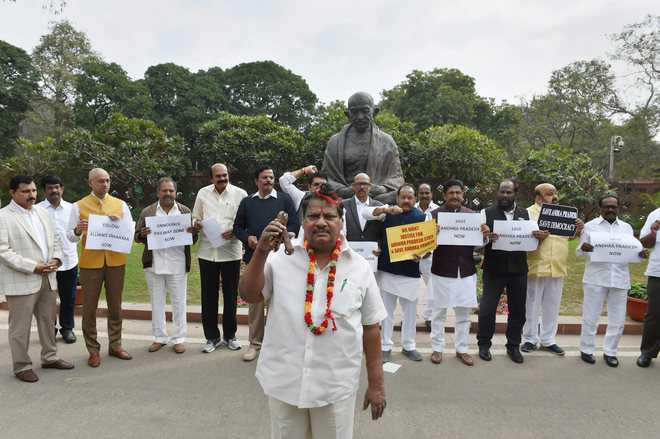
TDP MP from Chittoor N Sivaprasad (foreground), with other members from Andhra Pradesh, at a protest demanding special package for the state, in New Delhi on Tuesday. PTI
Tribune News Service
New Delhi, February 6
The government today informed the Lok Sabha that 400 security personnel were killed fighting militancy in Jammu and Kashmir and Left-Wing extremists in Naxal-affected areas in the past three years, while 111 persons were killed in 822 communal incidents in the country in 2017 with UP registering the highest number of such incidents.Responding to a question, Minister of State (MoS) for Home Hansraj Ahir placed before the House the figures, saying: “A total of 400 security personnel were killed fighting militancy in Jammu and Kashmir and Maoists in Left Wing Extremism-hit areas in the past three years.”In the written reply, Ahir said 72 civilians and 201 security personnel were killed in terrorist violence in Jammu and Kashmir in 2015-17. In case of Left Wing Extremism (LWE) areas, 572 civilians lost their lives and 199 security forces personnel were killed in the past three years, he added.Replying to another question, Ahir said there were 342 incidents of violence in Jammu and Kashmir in 2017, in which 80 security personnel were killed. As many as 213 terrorists were also killed. He said there were 133 encounters in 2017 and 97 terrorists were arrested. “In 2018, so far, there have been 28 incidents of violence in Jammu and Kashmir in which four security personnel and eight militants have been killed,” he said.Meanwhile, answering a question on communal violence in the country, the minister said 111 persons were killed and 2,384 injured in 822 such incidents in the country in 2017. He went on to add that the highest number (195) of such incidents were reported in Uttar Pradesh where 44 persons were killed and 542 injured.Giving details about poll-bound Karnataka, he said the state reported 100 communal incidents last year in which nine persons were killed and 229 injured while there were 91 incidents of riots in Rajasthan in which 12 persons were killed and 175 injured.
Govt tells Lok Sabha
The government on Tuesday informed the Lok Sabha that in 2017, 342 incidents of violence occurred in J&K, claiming lives of 80 security personnel; 213 terrorists were also killed
111 persons were killed in 822 communal incidents in the country in 2017 with UP registering the highest number of such incidents.
New Delhi could buy 3,000 anti-tank guided Spike missiles from Israel
THE TALKS FOLLOW THE GOVT’S CANCELLATION THIS JAN OF A US $900MILLION ORDER TO MAKE SPIKE MISSILES IN INDIA THROUGH FULL TRANSFER OF TECH
NEW DELHI: The Narendra Modi government will begin talks to buy Israeli anti-tank guided missile Spike, with a meeting between Israel’s visiting defence secretary Major General (retired) Udi Adam and his Indian counterpart Sanjay Mitra on Monday.
Adam’s two-day visit beginning Monday is set to be significant as South Block officials said the defence ministry will negotiate to buy at least 3,000 Spike missiles manufactured by Rafael Advanced Defense Systems through a government-to-government (G2G) route.
This will meet the army’s urgent requirements and fill the gap before the indigenous Nag anti-tank missile system is inducted.
The talks follow the government’s cancellation this January of a US $900-million order to make Spike missiles in India through full transfer of technology.
The defence ministry hopes to buy the Israeli missile at a cheaper price as the tech transfer clause will not exist now.
The Defence Research and Development Organisation (DRDO), which is developing the Nag, has no objection to the government’s plans to buy the Israeli missile so long as the tech transfer term is not applied.
The Nag’s heat-seeker guidance system is at a test stage and the missile’s commercial production is likely to take some time.
Lieutenant General YVK Mohan, General Officer Commanding (GOC), 9 Corps, today met Chief Minister Jai Ram Thakur at the Circuit House here and discussed issues of mutual concern.An Army spokesperson said General Mohan took over as the GOC, 9 Corps, on January 18.Among others who attended the meeting were Health and Family Welfare Minister Vipin Parmar, Industries Minister Bikram Singh, Food, Civil and Consumer Affairs Minister Kishan Kapoor and government officials. They discussed the current security situation, land lease cases and the Dharamsala War Memorial renovation and infrastructure development. Both sides highlighted the joint achievements of civil and military forces in the fields of security and disaster relief. General Mohan thanked the state government for its support to the armed forces, its veterans and war widows.
Don’t commit suicide, govt committed to debt waiver: Capt to farmers
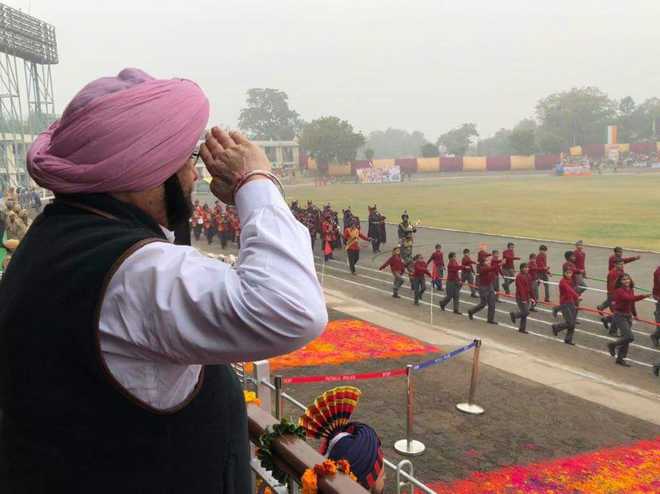
Capt Amarinder Singh takes salute from the march past at Patiala. Tribune photo
Tribune News Service
Patiala, January 26
Chief Minister Capt Amarinder Singh on Friday appealed to the state’s farmers not to commit suicide saying his government is committed to the total implementation of its farm debt waiver programme by November 2018.He also launched the release of benefits under a unique scheme aimed at the inclusive growth of the distressed sections of society.In his brief speech after taking the salute and unfurling the national flag at the Republic Day parade at the YPS Stadium here, Amarinder assured the beleaguered farmers of the state that each of the 10.25 lakh farmers covered by the debt waiver scheme would receive its benefit by November this year.
Underlining his government’s commitment to the development of Patiala, which had been “sidelined” by the erstwhile SAD-BJP government completely during its 10-year rule, the Chief Minister announced a development grant of Rs 45 crore for rural areas and Rs 5 crore for urban areas over and above the Rs 100 crore already announced by him for the upgrade of infrastructure in both urban and rural segments of the district.Holding the Akalis solely responsible for the ruin of the state’s economy, Capt Amarinder pointed out that when his government demitted office in 2007, the total debt burden on state was Rs 46,000 crore, which had now mounted to Rs 2,08,000 crore due to the misrule and ill- conceived policies of the SAD-BJP government.Listing out the various initiatives taken by his government to bring about the development of the state, which had been totally ruined by the Akalis, Capt Amarinder inaugurated a Rs 2000 crore project to repair 16,000 km rural link roads. This was the first time that the state government was investing such a huge amount for the development of rural link roads, he added.
Launching the benefits under the Mahatama Gandhi Sarbat Vikas Yojana, with the aim to ‘Wipe every tear from every eye’ as envisioned by Mahatma Gandhi, Amarinder said the programme’s objective is to give the distressed sections the help they needed, socially or economically or psychologically.
The government had identified a large number of such needy people who had so far been deprived of the pro-poor initiatives, he said, adding that of these, two lakh people would start getting the benefits of 20 different schemes of the government from today onwards.Extending Republic Day greetings to people, Amarinder recalled the historic moment in 1950 when India adopted its Constitution.He said the government had also decided to waive loans up to Rs 50,000 of Punjab Backward Classes Land Development and Finance Corporation (Backfinco) given to the beneficiaries.Amarinder also launched the e-POS scheme to cover the state’s fair price shops to replace the earlier blue card system for distribution of atta-dal.The Chief Minister lauded the visually and hearing and speech impaired students who participated in the parade and presented a taekwondo show. He announced Rs 1 lakh per school/college which participated in the cultural function, from the CM’s fund.The CM honoured freedom fighters and their families with shawls and sweets. He also honoured 67 eminent personalities from different walks of life for their outstanding contributions in their respective fields.
Ex-serviceman, sports quota in Class I, II jobs withdrawn
In a major jolt to ex-servicemen and outstanding sportspersons aspiring for Class I and II jobs in Haryana, the state government has withdrawn its order on quota for them.According to an order issued by the Chief Secretary today, the instructions had been withdrawn from “date of its issuance (January 23, 2018)”.Though no official reason has been given for the withdrawal of the quota for the ESM and sportspersons, a senior government functionary told The Tribune that it had been done on account of certain ‘technical issues’.The state government would re-examine the issue and rectify the legal lacunae in the order so that there was no legal complications at a later stage, he said.Claiming that the state government was committed to providing quota to these two categories, the functionary asserted that the circular had been withdrawn for the “time being” and would be “re-issued” in due course after examining its legality.The Haryana Government had decided to provide 5 per cent horizontal reservation to ex-servicemen (ESM) and one per cent horizontal reservation to outstanding sportspersons in direct recruitment in the Class I and II jobsA circular issued by the Chief Secretary’s office had stated that in case no candidate was found suitable for appointment even on re-advertisement, the vacancies reserved for the ESM of a particular category would be filled from among the same category candidates.For example, if a suitable candidate belonging to the SC is not available in the ESM category, the post could be filled from among the candidates of the SC. The same condition would apply to other categories
Why no quota
Though no official reason has been given for the withdrawal of the quota for the ESM and sportspersons, a senior government functionary told The Tribune that it had been done on account of certain ‘technical issues’.
State Stalwarts
DEFENCES FORCES RANKS
ARMY, NAVY, AIRFORCE RANKS
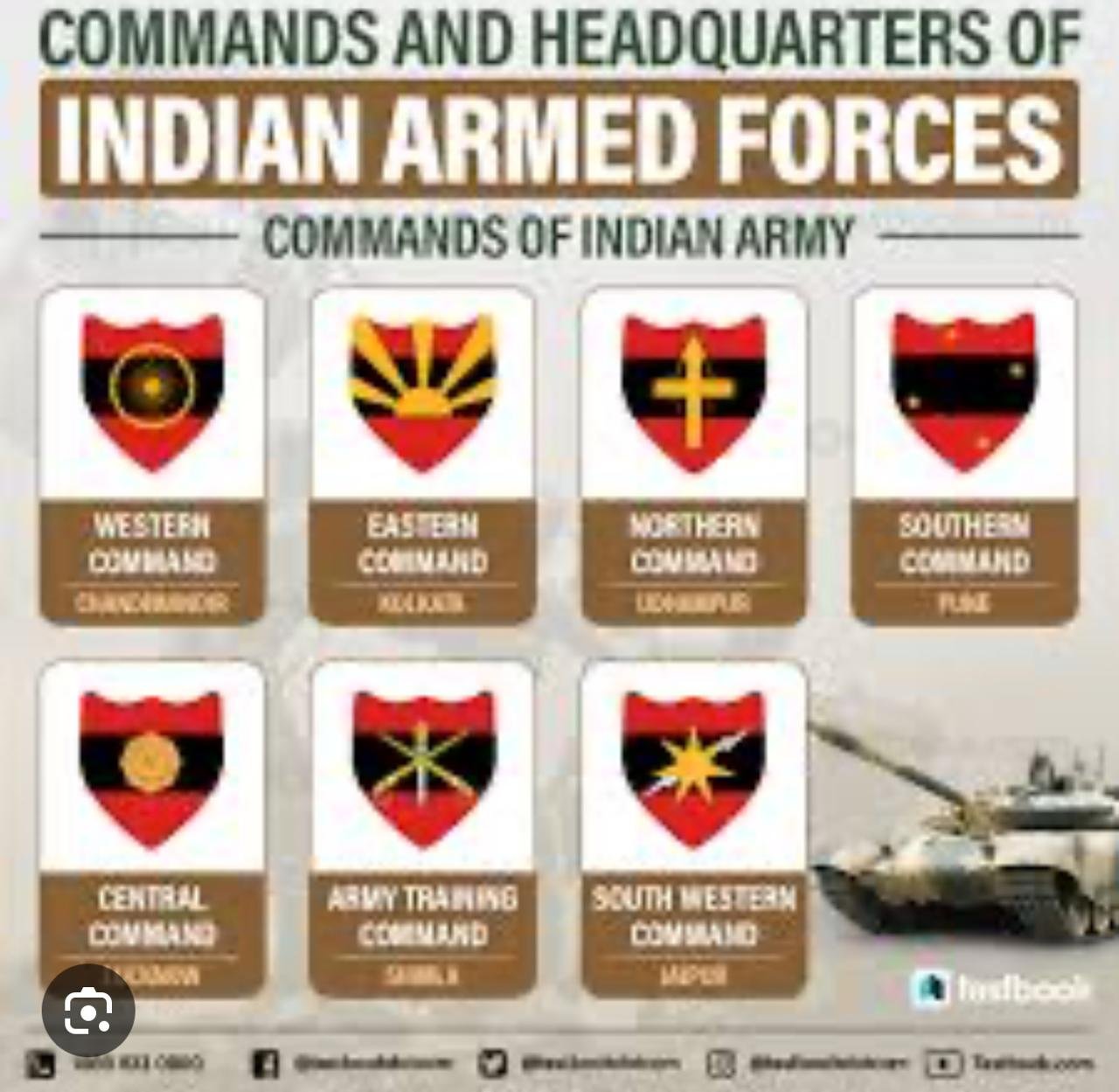
FORMATION SIGNS
FORMATION SIGNS
ALL HUMANS ARE ONE CREATED BY GOD
HINDUS,MUSLIMS,SIKHS.ISAI SAB HAI BHAI BHAI
CHIEF PATRON ALL INDIA SANJHA MORCHA
LT GEN JASBIR SINGH DHALIWAL, DOGRA
SENIOR PATRON ALL INDIA SANJHA MORCHA
MAJOR GEN HARVIJAY SINGH, SENA MEDAL ,corps of signals
.
.
PATRON ALL INDIA SANJHA MORCHA
MAJ GEN RAMINDER GORAYA , CORPS OF
sanjhamorcha303@gmail.com
PRESIDENT HARAYANA STATE CUM COORDINATOR ESM
BRIG DALJIT THUKRAL ,BENGAL SAPPERS
PRESIDENT TRICITY
COL B S BRAR (BHUPI BRAR)
PRESIDENT CHANDIGARH ZONE
COL SHANJIT SINGH BHULLAR
.
.
PRESIDENT PANCHKULA ZONE AND ZIRAKPUR
COL SWARAN SINGH
PRESIDENT SAS NAGAR (MOHALI)
COL BALBIR SINGH , ARTY
INDIAN DEFENCE FORCES
DEFENCE FORCES INTEGRATED LOGO
FORCES FLAGS
15 Th PRESIDENT OF INDIA SUPREME COMMANDER ARMED FORCES
Droupadi Murmu
DEFENCE MINISTER
Minister Rajnath Singh
CHIEF OF DEFENCE STAFF (2nd)
General Anil Chauhan PVSM UYSM AVSM SM VSM
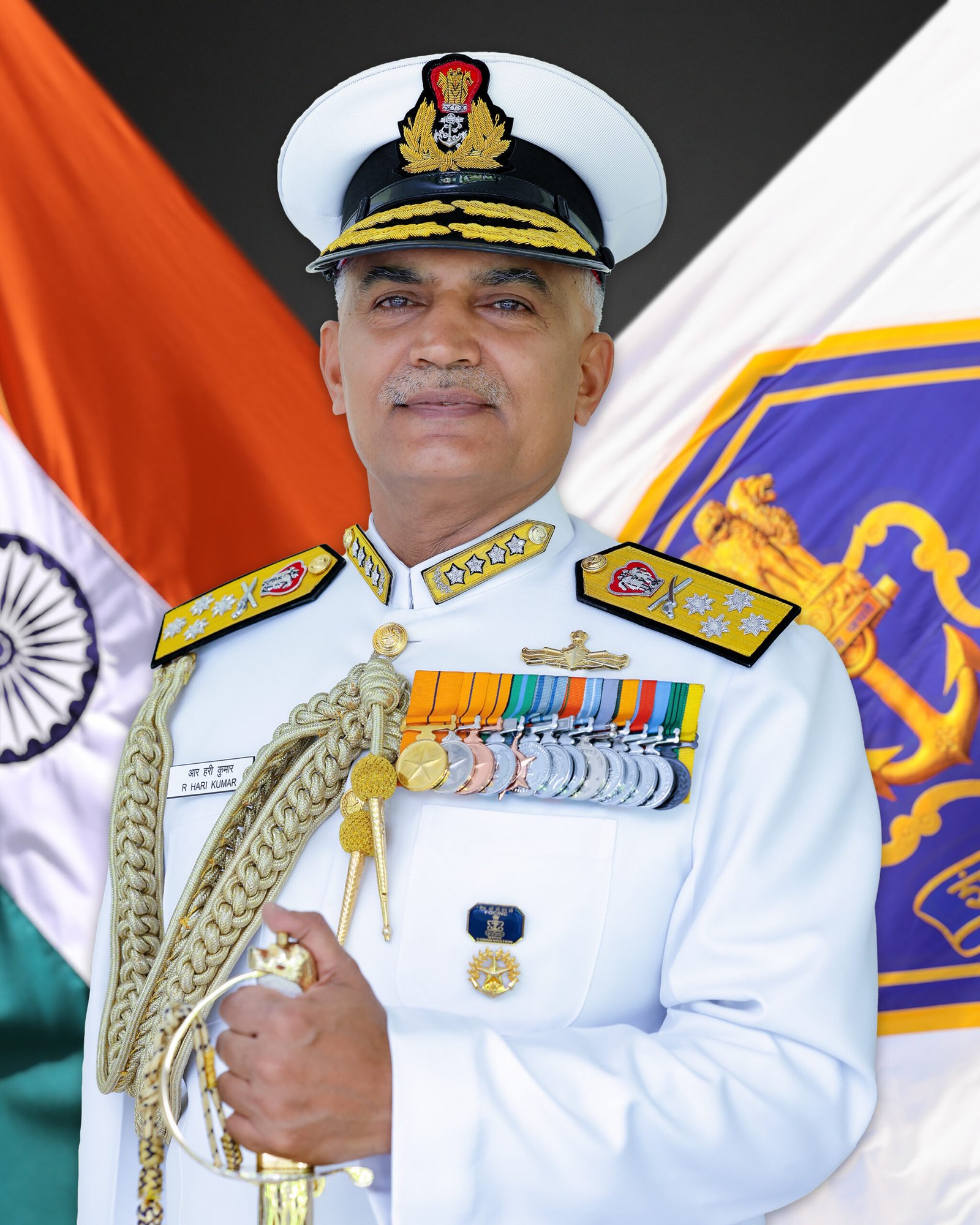
INDIAN FORCES CHIEFS
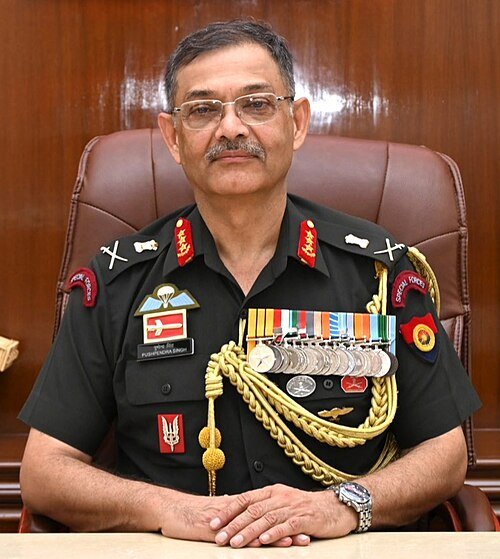
CHIEF OF ARMY STAFF(29th)
General Upendra Dwivedi, PVSM, AVSM (30 Jun 2024 to Till Date)