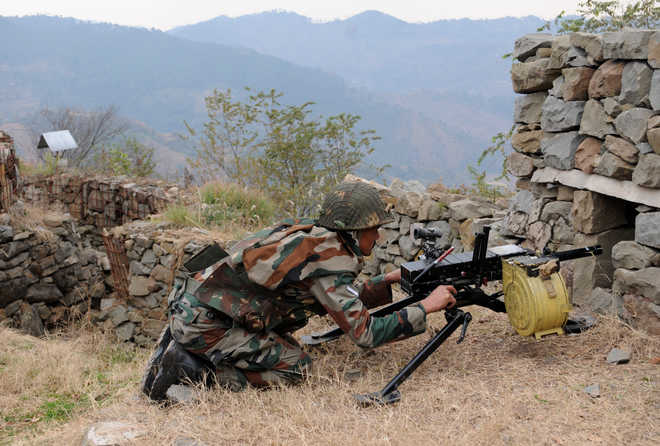
In India, even within the intellectual community, security is synonymous with borders or terrorists. Seldom is it viewed from a comprehensive angle.
Therefore, although this analysis is about external and internal security from the geopolitical and geo-strategic angles (mostly the robust and kinetic type), it would be unfortunate if it did not commence with a broad understanding of Comprehensive National Security (CNS).
CNS is all about taking measures to ensure that the path to the chosen aspirations of a nation is not obstructed. Anything, which obstructs that path, is actually a threat to the nation’s security.
The situation in the Persian Gulf region may not necessarily impinge threats on India’s borders. However, if it prevents the flow of oil or gas, it definitely adversely affects our energy security, which has a bearing on the achievement of our national aspirations.
Similarly, an ethnic agitation for reservation is essentially a law and order problem, not even one of public order. On the face of it, it is hardly an issue of national security. Yet, if Rs 30,000 crore worth of property is burnt in three days, it surely affects our national aspirations.
Likewise, there are cases of human security involving farmer suicides or rural migration, which adversely affect national security. If CNS is understood with these explanations, we can safely proceed to deal with the described aspects of external and internal security, without a guilt hangover.
External security
India’s geo strategic location may not give it the advantage that Pakistan has, of facilitating direct access to the heart of Asia or vice versa. However, India does sit like a crown on the Indian Ocean with the ability to exploit and control the most strategic sea lanes, which carry vast quantities of international trade and energy.
That gives quantum strategic advantage. If we consider the Indian subcontinent as an entity for strategic analysis we need to look at some unique geo-strategic aspects.
Two characteristics of this region need to be understood. Firstly, it is the southern ‘near abroad’ region of China that offers scope for China’s direct reach into the Indian Ocean from different points of the sub continental expanse.
Secondly, it provides both, the maritime and the continental bridge between the East and the West. Thus it has the scope to control the flow of seaborne traffic through the Indian Ocean.
This is particularly significant in view of the fact that China is yet developing. It is dependent very largely on the flow of energy through the Indian Ocean to keep its high levels of manufacturing, which sustain its economy.
Those manufactured goods also need worldwide markets, which have to be accessed in reverse through the very same routes. Thus China is dependent on good relations with India and for contingencies where that may not happen, given India’s own regional ambitions, it is important for China to have good relations with India’s neighbours through cultivation.
China is a relatively land locked country; this statement needs qualification. Its access along a long coastline in the east is to the seas that do not matter in its economic security; they do in other strategic domains, which in comparison matter less. Thus exists the importance of both Pakistan and Myanmar that give China land access to the Indian Ocean.
MJ Akbar, India’s minister of state for external affairs, is often known to utter a famous quip. He states that standing at New Delhi one can see a stark difference; to the east there is relative calm and stability, while to the west is relative chaos and unpredictability.
This in many ways sums up the predicament of India’s external security because of the sandwich effect of competing forces with the fulcrum being India. It manifests in some deductions, which form the framework of India’s approach.
In no particular order of priority, the first is the need for India to stabilise its energy security and secure its large diaspora existing in West Asia. This means that political and diplomatic relations with West Asian nations need to be strong and enduring.
Much of the 75 per cent of energy imports come from Wet Asia. The stability of the Gulf region, where an eight million strong diaspora exists and on which India is dependent for majority of its energy imports, is crucial for India.
It also receives annually approximately $35 billion in remittance from the region, assisting in financial stability. Paradoxically it is also dependent on Israel for its defence technology and other defence-related imports.
The relationship between Israel and most West Asian countries remains rooted in past problems, especially the Palestinian issue, which emerges centrestage from time to time.
Balancing the relationship with Israel and its West Asian neighbours is thus essential, although this is now facilitated by a far better equation than the past, especially with the Saudi-Israel relationship having assumed strategic proportions.
Prime minister Modi’s balancing act of strengthening India’s relationship with the Gulf countries through three years of proactive engagement before embarking on his visit to Israel, was a reflection of statesmanship.
In the above balancing act, a sub factor is important in the form of India’s enduring need for a strong relationship with Iran, which has political and ideological differences with the majority of Arab countries of the region.
Apart from some energy imports from Iran, India needs it as a balancing entity in troubled Afghanistan to obviate the run away advantage to Pakistan, which enjoys a special strategic status due to its shared border with that country.
Iran’s Chabahar port can help India overcome the Pakistani cussedness of denying it overland routes to Afghanistan, Central Asia and the North South Corridor of Russia. This advantage can only accrue with a strong working relationship with Iran.
However, the latter is virtually an international pariah due to its estranged relationship with the US and its allies, besides Israel and Saudi Arabia. The July 15, 2015, Nuclear Deal has helped, but only partially and with the coming of president Donald Trump has once again become an uncertain agreement.
This poses India a major challenge. When PM Modi was visiting Israel, some analysts wondered why India could not play intermediary to smoothen Israel-Iran relations and thus facilitate improvement in the US- Iran equation.
The issue is fraught with problems due to India’s dependence on a strong relationship with the Gulf Cooperation Council and cannot be leveraged for any advantage.
An issue, which often emerges, is the sentiment of Indian Muslims. The large majority being Sunni, equanimity in relations is also important.
Pakistan remains an anathema and a serious challenge due to its increasing strategic confidence and independence. The Afghanistan imbroglio has helped it resist US pressure. The diluted US influence has pushed Pakistan more firmly into the Chinese fold and consequently given it greater ease to pursue proxy war and other anti-India activities with impunity.
Indian efforts to diplomatically isolate Pakistan through US pressure may appear successful with recent US actions and threats, but this is unlikely to go the full way due to US dependence on Pakistan for its presence in Afghanistan.
Calls for likely Indian deployment of its army in Afghanistan need to be taken with caution as India already has ‘two and a half fronts’ in terms of physical threats. Opening another front would seem imprudent unless there is a strong coalition support, which is unlikely.
In the north, China continues its blow-hot blow-cold policy of pursuing its strong economic relationship with India and combines it with coercive actions at the Line of Actual Control (LAC) each year.
It fears Indian maritime capability in the Indian Ocean, as its own PLA Navy is yet to acquire a full status blue water capability to contest faraway in the Indian Ocean region, well away from its bases.
To overcome its vulnerability, it wishes to ensure that India’s maritime power does not grow. It hopes this can be achieved by ensuring that its military standoff remains pegged to the continental domain with yearly walk-ins at the disputed border.
The challenge before India lies in the domain of strategic balancing between the land-based and the maritime forces with the Indian Air Force remaining the force multiplier for both.
The desire to move up by a few notches in capability in the continental domain is supported by its intent to move from dissuasion to deterrence with reference to China. The real challenge for India lies in the rapid improvement of maritime capability without compromising in air and land-based military capability.
Look East has been a policy that India has wished to adopt and sustain. This is due to the growing economic clout of ASEAN and the East Asian nations.
In addition, the US has for long desired a shift of focus from the west to the east to balance the growing sphere of China’s power. Thus far, India’s Look East policy, although far more robust than the past, has remained without realisation of full potential, essentially aimed at not irking China.
Although it is yet early to say so but the Doklam standoff may have provided India an altered calculus in pursuance of partnerships without too much concern for China’s sensitivity. However, the Indian media’s quick pronouncement of victory once the mutual disengagement commenced on August 28 was a poor understanding of the strategic domain.
The idea of ‘no victor, no vanquished’ does not create the aura or romance of conflict. I classified it as ‘Advantage India’ and nothing more, primarily because China did not succeed in gaining its strategic objectives.
While caution must not be thrown to the winds, the necessity of strong partnerships based on growing realities of China’s irksome power cannot be overemphasised. India will be much less hesitant hereafter in pursuance of its interests in the East. Strategic equations with Japan, Vietnam and the US itself should become partnerships.
Need for NSS and policy decisions on defence structures
With growing improvement in India’s strategic culture and far greater public interest in matters of national security, this domain should no longer be kept reserved only for government and security agencies.
There is a yearning for debate on issues in the security domain. Among them are border and internal threats, capability and capacity development, intelligence, cyber-related issues, strategic exploitation of space, civil- military relations, defence procurement and manufacturing and personnel management issues, to name just a few.
A basic rudimentary document on the lines of the first Indian Army Doctrine issued in 2004 could whet initial appetite for intellectual debate and discourse, which must take place in universities, civil services and defence institutions and even corporate organisations that appear to be emerging as potential areas for strategic thought.
What needs to be understood is that NSS would only be a doctrinal guideline to give a direction on the government’s line of thinking in the comprehensive security domain.
It does not constrain the government’s decision-making in contingencies. However, some transparency in this domain will give a boost to public confidence and perhaps improve the overall approach through debated inputs.
For the sake of better military security, the recommendations of the Kargil Review Committee need a revisit. The implementation was stalled at a point after initial enthusiasm and needs to be re-visited even if a fresh Group of Ministers has to review it.
Among these, the most important one remains the integration of the ministry of defence (MoD) to give it a uniformed presence. Enough models around the world are available provided there is an appreciation of the need by the political leadership.
The various steps undertaken by the current government to speed up procurement and give defence manufacturing a greater indigenous colour, have been partially effective. However, bureaucratic hurdles continue and effectiveness remains in question. The recent decision to delegate financial powers of Rs 40,000 crore to the Indian Army’s vice chief to procure essential shortfalls in ammunition and ancillaries is a bold step.
Will the arrangement continue, is the question. Similarly the surge of interest in the Border Roads Organisation (BRO) and its inability to fulfil the charter related to border infrastructure is only a recent phenomenon after Doklam.
While constant review of the China Study Group’s recommendations of infrastructure is carried out, the urgency to act remains the greatest challenge. The BRO needs serious restructuring to bring it in line with the Indian Army’s professionalism and the mixed army/civil cadre itself needs review as personnel management issues take priority in its professional orientation.
The need for a military corporate industrial complex under the Make in India concept must necessarily replace the aging and inefficient complex of public sector undertakings such as those under the Ordnance Factories Board.
This will ensure optimum availability of military wherewithal such as ammunition and body armour. Sustaining a national war effort will have to be with the full and complete working efficiency of such an industrial complex on a footing akin to what the armed forces themselves undertake.
In the external security domain, India’s greatest challenge lies in meeting collusive threats from China and Pakistan with a half front being added by ongoing insurgency/terror problems, which can be exploited by adversaries.
War gaming and contingency planning at the military strategic level along with briefings to the apex political leadership have been a norm.
However, it is time more extensive national level war gaming involving crucial organisations such as Indian Railways, Indian Oil and Air India besides core ministries, are also involved. Exercise Brasstacks in 1987 was reputed to be such an exercise in its first phase.
Internal security
It needs no rocket science to know that in a nation with a multi-faith, multi-cultural, multi-lingual and multi-ethnic construct, there would be intense competition among communities for respective space.
Unfortunately, the political discourse instead of overcoming this constraint and working towards exploiting its otherwise many advantages has pushed towards creation of greater fault lines for the sake of vote banks.
The reservations issue is now threatening the plural and tolerant character and vigilantism in narrow domains is leading to major security challenges.
India’s respect in the international community earned through sensitive handling of these challenges thus far may get diluted. This affects the overall security environment as well as public and business confidence and sentiment.
Security lies in the ability of Indian citizens proudly wearing their nationality abroad and being a cynosure for their reputed tolerant and plural culture. The media has a challenge before it to help retain India’s strong international reputation and promote it even further.
I have often been asked by international institutions of repute to speak on India’s undoubted ability to retain its principled unity in diversity and the lesson that offers for nations with similar make on a much smaller canvas.
India’s significance enhances considerably when it is observed that 65 per cent of its population is below the age of 35. While this contributes positively, the negative aspect is equally applicable. There is nothing as destructive as youth power when the youth is unskilled and uneducated.
Among the other major challenges for India in the internal security domain are its continuing nagging problems in the North East, Jammu & Kashmir and the tribal heartland, often referred as the Red Corridor.
All of them have different dynamics in terms of nature of aspirations, levels and type of violence, and the methodology applied thus far in overcoming them.The common thread here has been our inability to take the measures beyond the counter violence phases when security forces have placed a cap on dangerous dimensions of violence by anti-national elements.
In the North East, it is primarily Manipur, Nagaland and areas of Lower Assam that remain a worry. The failure to bring diverse militant groups to realise the huge potential in waiting for the region and its people, should the infrastructure for overland connectivity to South East Asia be realised, has prevented peace and stability.
While Nagaland has moved half way, it’s conflicting interests with Manipur remain. The inability of the central government to sell the benefits of peace, calls for a renewed focus well beyond kinetic means. Time for this is at a premium.
This is because post the ongoing standoff with China, the dynamics of Beijing’s approach could change drastically. One of the areas that China would seek to weaken India’s security is in the internal security of the North East.
It would attempt to coerce Myanmar into assisting in this intent. Notwithstanding the 2015 accord with NSCN (IM), the entire approach to the North East needs a comprehensive review.
The political outreach initiated by the government of India would need a deep psychological content to motivate the people of the North East. There are many positives, which have developed in the recent past and need to be cashed upon. The enhanced visibility of many young and dynamic people from North Eastern states in sectors such as hospitality, travel and tourism goes far in mainstreaming the states and creating a positive image in the minds of heartland India.
The government must continue to encourage private industry to hire more people from the region. A challenge that would remain live is whether India can be a part of the Bangladesh, India, Myanmar, China (BIMC) initiative in connecting the four countries.
This has been proposed by China, but although it will benefit the North Eastern states, the degree to which it may assist Chinese influence in these areas is uncertain.
J&K has witnessed positive and negative dynamics over 28 years. Positive because the Indian Army has several times brought the situation to a status of stability and military domination, awaiting political initiatives and ground breaking outreach to the people.
It remains a sponsored proxy conflict zone because the nation and state have failed to innovate and seize the moment. Resolution with Pakistan does not appear on the horizon. Thus our intent here should be to isolate the issue, prevent Pakistan from internationalising it, work towards once again stabilising the security situation to an optimum level, undertake outreach programmes to the people and seek internal political initiatives to mainstream the estranged elements of the population.
That remains the broad doctrinal guideline. Within this lies tremendous scope for flexibility. The challenges lie in being different and yet attract enough fence sitters and pro-India elements to feel motivated enough to join the campaign to mainstream the people.
An opportunity appears to be emerging once more with the run of counter terror success that the joint operations of the army, JK Police and CRPF have enjoyed over the last three months.
Any serious security practitioner who knows irregular warfare will remind us that there is an awkward paradox here. Opportunities come fleetingly, which need to be recognised and exploited.
Yet there is no surety that such opportunities actually present the true picture. In 2012 South Kashmir appeared to indicate rapidly returning peace, suggesting that some troop pullout could give back a peace dividend to the people.
Such pullout actually led to greater destabilisation leading to the disastrous situation of 2016. The sheer complexity of the J&K situation is difficult to comprehend without a closer ear to the ground and premature sounding of success is always shrouded in danger.
In the face of this challenge the government would be best guided by a conversion of the prime minister’s urging on Independence Day to a doctrinal advisory to its agencies, forces and the state government; the by now quite well known and catchy urging – “Na goli se, na gaali se, Kashmir jeetenge gale lagaane se” (Not by bullets, not by abuse, we will win Kashmir by embracing the people).
The doctrine must necessarily include the role of the state government of J&K and the political community, as well as that of the two other parts of the state, Jammu region and Ladakh.
An intra-state dialogue and strengthening of fabric could contribute towards taking Kashmir out of the precipitous situation, which presented itself at the beginning of the year.
Lastly, a review of the Red Corridor. Teething problems in the counter insurgency campaign due to the inability of the armed police forces appear to be receding. Countering the violence and affording full domination by the central armed police forces for a sustained period will not be possible unless these forces are equipped with more modern fighting wherewithal, including a few helicopters.
Moreover, the tactical level proficiency being slowly achieved has to be matched with greater operational and strategic understanding if the socio economic problems at the heart of the Maoist problem have to be resolved.
As India grows economically, the dividend must be an improved national security environment that allows the nation to aspire for a legitimate position of strength. Stable borders and a vibrant society make a heady combine. Yet, it is one, which guarantees the right degree of security for the nation.






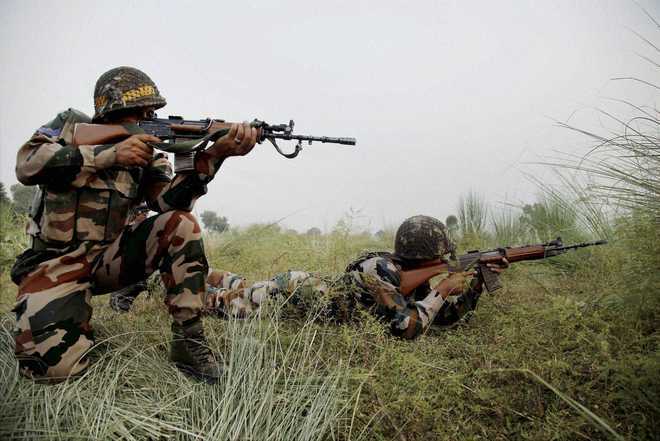
 PTI PHOTO