All posts by webadmin

Gentlemen cadets become officers

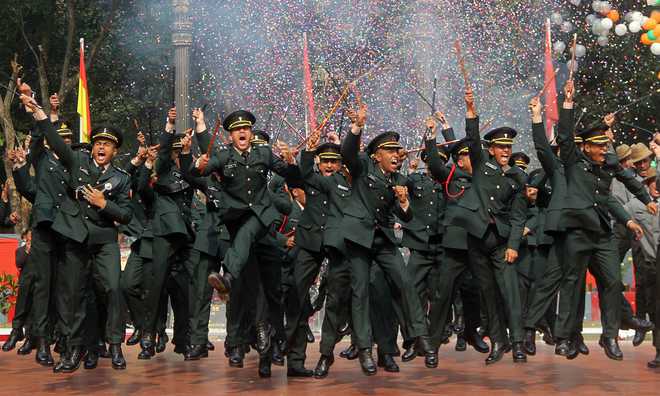
FRUIT OF LABOUR The young officers had been in the IMA for one and a half years undergoing the autumn training course

DEHRADUN: A total of 409 gentlemen cadets , including those from abroad, completed the Passing out Parade on Saturday at the Indian Military Academy before being commissioned into the armies of their respective countries after completing the autumn training course.

VINAY SANTOSH KUMAR/HT PHOTO■ Newly commissioned officers celebrate after the Passing out Parade at Indian Military Academy in Dehradun.

The gentlemen cadets had been in the IMA for around one and a half year. Seventy-eight cadets from Maldives, Tajikistan, Kazakhstan, Afghanistan, Bhutan, Nepal and Sri Lanka also graduated from the IMA.

The gentleman cadets assembled in the drill square of the Chetwode Building where they conducted the march past to the military tunes of “Colonel Bogey” and “Sare jahan se achha’. The parade was reviewed by Bangladesh army chief General Abu Belal Muhammad Shafiul Huq.

The Chief of Army staff Banner was handed over to the Nowshera company for being overall first among 16 companies. The coveted sword of honour went to Chandrakant Acharya, who also won the Gold medal bestowed to the cadet standing first in Order of Merit. The silver medal went to Amarpreet Singh Dhatt.

The Silver medal for the gentleman cadet standing first in order of merit in the Technical Graduate Course was given to Barnna Yadagiri. Alexandar Simonaitis from Kazakhstan was awarded the Silver medal for standing first in order of merit among foreign gentleman cadets.


166 Gentleman Cadets commissioned as Army officers

166 Gentleman Cadets commissioned as Army officers
Gentleman Cadets celebrate after their graduation ceremony at the Officers Training Academy in Gaya on December 9, 2017. — AFP

Gaya, December 9

A total of 166 Gentleman Cadets were on Saturday commissioned as officers in the Army during the 12th passing-out parade at the Officers Training Academy (OTA), Gaya.

Of the 166 newly inducted officers, four are foreigners while 14 belong to Assam Rifles.

Lieutenant General Mohammad Sharif Yaftali, Chief of Staff, Afghan National Army, was the reviewing officer of the passing-out parade, while Lieutenant General B S Negi, General Officer Commanding-in-Chief, Central command, was the chief host.

Yaftali was welcomed in customary Army’s buggy by Lieutenant General B S Negi and OTA and Gaya’s Commandant Lieutenant General V S Srinivas.

The reviewing officer gave away the awards to Cadets who performed well during the training. Dharmesh Kumar was awarded ‘Sword of Honour’ for his best performance in the TES-30 course.

Addressing the function, Afghanistan’s Army Chief of Staff congratulated Gentleman Cadets for their fine drill show and gave them best wishes for the future.

“Cadets should imbibe the qualities of being a disciplined soldier to be successful in career”, Yaftali admonished them.

The OTA, Gaya is the third pre-commissioning military academy in the country and was raised on July 2011 apart from Dehradun and Chennai.

The OTA was established,  near Paharpur village on the Gaya-Dobhi main road, to train both new entrants and serving Army personnel in different modes of conventional as well as non-conventional warfare. PTI


‘Navy is battle arm of future to take on China’

CHANDIGARH: Any power that has ruled the world has done so on the strength of its navy. The Indian Navy, seen as the neglected service among the three arms of battle, is now proving to be vital for the progress of India, the only country that has an ocean named after it.

It is in this backdrop that viceadmiral Satish Soni set the ball rolling at a panel discussion on the ‘Shape and Contours of the Indian Navy of the Future’ at the Military Literature Festival here on Friday.

“With the blue economy taking shape and over 90% of trade through sea in a not-so-friendly neighbourhood up North, the enormous responsibility of securing the coastlines rests with the navy,” said Soni.

“Post-26/11, the Indian Navy can raise the threshold of any adversary,” he said.

BEING AMBITIOUS

The recent inauguration of the first phase of the Chabahar port, opening up a transit route between Iran, Afghanistan and India that bypasses Pakistan, also shows the change in perception. Brigadier RJS Dhillon said, “Today, sea lanes are as crowded as Delhi’s traffic lanes. Monitoring is tough. An all-out war is not feasible but to maintain supremacy we need, what US president Woodrow Wilson said in 1918, ‘absolute freedom at all times in peace and war beyond eight nautical miles’.”

Dhillon added, “It’s the Indian Ocean but not India’s ocean. Build combat capability but be ambitious and take on China’s growing influence. We need a relook beyond the Straits of Malacca. Force structuring for the long term and working on economic and industrial modernisation should be the strategy.”

BEST TO INDIGENISE

Lt Gen Aditya Singh, a former commander-in-chief of the Andaman and Nicobar Command, said, “India was troubled by land borders so the attention went there. The spin-off of the neglect is that the navy has been the best to indigenise and is the most self-contained of the three services.”

Commodore Ranjit Rai, whose book was released by Punjab chief minister Captain Amarinder Singh, said the navy had become the epitome of construction and had produced its own nuclear submarine and underwater missile in Sagarika.


Paramotors, military bands lend festive touch to Sukhna

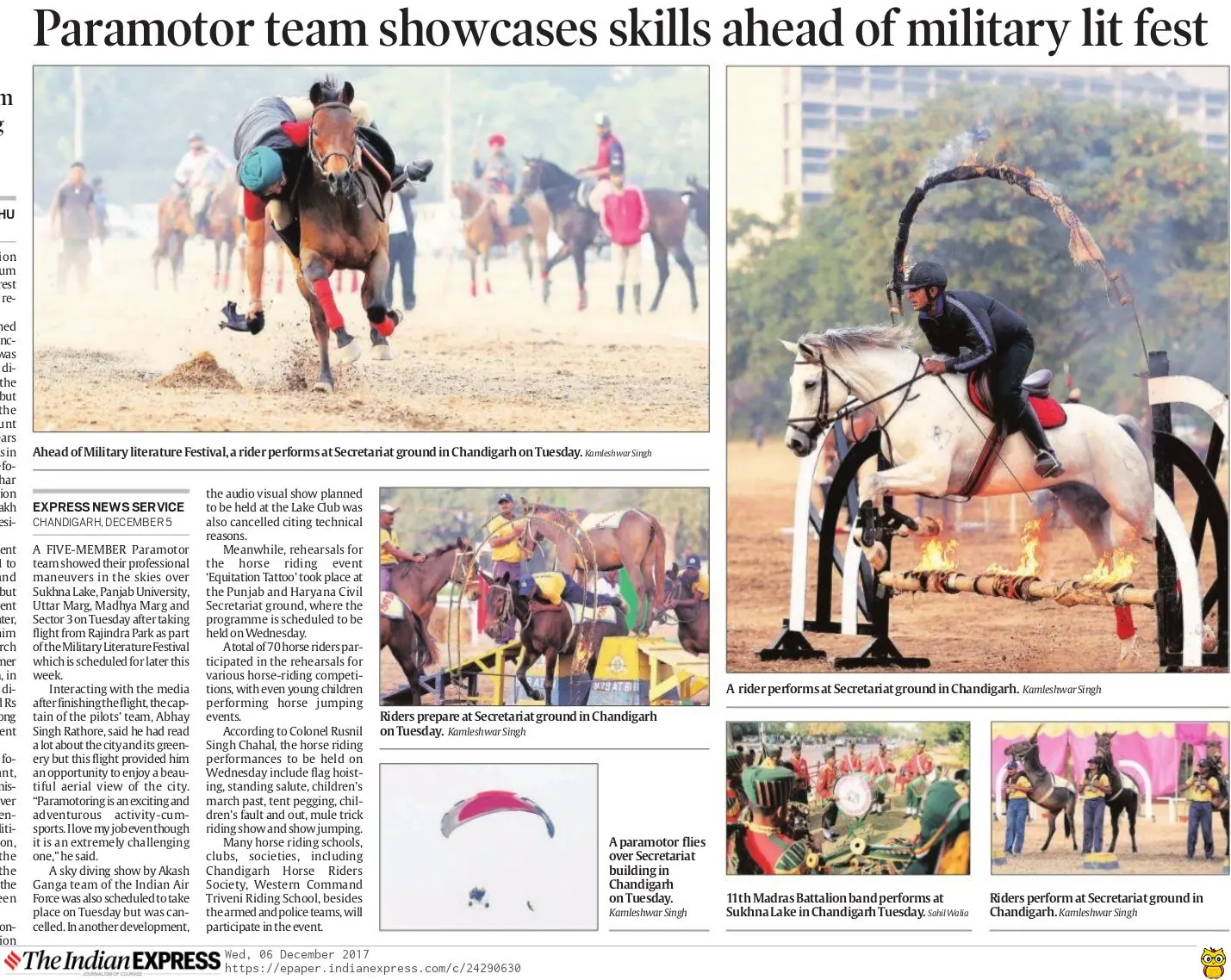
CHANDIGARH: A dash of festive colour and music was added to the Sukhna Lake area on Tuesday as paramotors displayed their skills and military bands entertained people in the run-up to the Military Literature Festival.

SANJEEV SHARMA/HTA soldier displaying his skills during the rehearsal in the run­up to the Military Literature Festival near the Punjab and Haryana Secretariat ground in Chandigarh on Tuesday.

A five-member team of paramotors flew over Panjab University, Uttar Marg, Madhya Marg and Sector 3 after taking flight from Rajindra Park.

Interacting with the media after the flight, the captain of the pilots’ team, Abhay Singh Rathore, said he had read about the city and its greenery but this flight provided him an opportunity to enjoy a beautiful aerial view of the city.

Rehearsals for the horse-riding event, Equitation Tattoo, were held at the Punjab and Haryana Civil Secretariat ground, where the programme is scheduled to be held on Wednesday.

Seventy horse riders, including children, took part in the rehearsals of the show jumping.

All events are free and open to the public.


3 Param Vir Chakra awardees at Military Literature Festival

clip

COUNTRY’S FIRST
MILITARY LIT FEST BEGINS ON FRIDAY; CAPT AMARINDER TO CHAIR INAUGURAL SESSION; DARLYMPLE, VIR SANGHVI AMONG AUTHORS TAKING PART

CHANDIGARH: The only three living winners of the Param Vir Chakra (PVC), the country’s highest gallantry award, will be taking part in the twoday Military Literature Festival that starts with Punjab chief minister Capt Amarinder Singh chairing the inaugural session at the Sukhna Lake Club here on Friday.

ANIL DAYAL/HTAn armyman rehearsing for an equestrian event to be held at the Punjab and Haryana Civil Secretariat ground on Wednesday in run­up to the two­day Military Literature Festival that begins at Sukhna Lake Club in Chandigarh on Friday. >>P2

PVC winners Capt Bana Singh, Naib Subedar Sanjay Kumar and Subedar Yogender Yadav will be attending sessions on both days of the festival. Capt Bana Singh was awarded the PVC for recapturing the highest Pakistani post on the Siachen Glacier, the Quaid Post, on June 26, 1987, that has since been named after him. Naib Subedar Sanjay Kumar and Subedar Yadav were awarded for their acts of gallantry during the Kargil war in 1999.

While Capt Amarinder will be chairing the hour-long panel discussion with veterans on the First Kashmir War, 1947-48, at 11.30am, there will be a parallel session on the Indian Navy of the future that Commodore C Uday Bhaskar (retd) and Admiral Arun Prakash (retd) will address.

Senior journalist Vir Sanghvi will be conducting an interactive session with military historians and authors, including Thomas Fraser and Tom Donovan.

After lunch, Punjab governor VP Singh Badnore will chair a discussion on Defensive Battles of Rajasthan, while there will be a parallel session on Indian Military and Society in which Lt Gen Vijay Oberoi, a former vice-chief of the army staff, will be taking part.

On December 9, author William Dalrymple will be taking part in a session on the Anglo-Sikh Wars. Former army chief General VP Malik will be holding a parallel session on military diplomacy, while yet another session on military writing in Punjabi will be held simultaneously.

Former Southern Command army commander Lt General Depinder Singh will be taking part on a discussion on the Indian Peace Keeping Force (IPKF) in Sri Lanka at 12.30pm.

Delhi University student activist Gurmehar Kaur will be taking part in a session on ‘The Latest Military Challenge – Social Media’. She is the daughter of Capt Mandeep Singh, who was killed after militants attacked a Rashtriya Rifle camp in J&K in 1999.


A state run by terrorists

Saeed’s release proves Pakistan has taken a turn for the worse

It is no surprise that a Pakistani court has allowed Lashkare-Taiba (LeT) chief Hafiz Saeed to walk the streets again. From the start, his detention was little more than an eyewash by the Pakistani administration in response to the global criticism of LeT’s role in the 26/11 Mumbai terror attacks. Saeed was not formally charged with terror crimes; his detention was based on minor public order rules. His release is likely an outcome of a changed domestic political landscape in Pakistan. LeT is the terrorist group most closely associated with the Pakistani military, so any serious action against Saeed was unlikely. The battle over his detention helped highlight Pakistan’s state sponsorship of terror to the rest of the world and promoted a broader, long-term policy of isolating Pakistan within the international community.

What precipitated Saeed’s release is the power struggle between Pakistan’s former Prime Minister Nawaz Sharif and the military establishment. One could almost say the failure of the government to press a charge against Saeed signifies Sharif’s decline. The judgment is just as much a reflection of the military’s heightened power. Part of the military’s strategy is promoting a cluster of political parties to undermine Sharif’s party, the Pakistan Muslim League (Nawaz). These include a political party structured around LeT. With Pakistani general elections scheduled for next year, it was necessary for Saeed to be released so that the LeT chief could effect the transition from a pretend prisoner to an authentic politician.

While Saeed’s release is reprehensible, it should be recognised that his conviction on terror charges would have meant a fundamental shift in the mindset of the Pakistani military establishment. His release indicates that if there is any change, it is only for the worse. Rawalpindi’s generals seem to have concluded that it makes sense to bring Saeed and his murderous cohorts into the political mainstream. Pakistan may now cease being a state sponsor of terrorism and instead become a state run by terrorists.


US aid to Pakistan falls 76% in 17 yrs after 9/11

NEW DELHI: US aid and military assistance for Pakistan has plummeted from more than $2.2 billion a year during the period immediately after the 9/11 terror attacks to a little more than $500 million in 2017 and is set to fall further next year, reflecting the strain in ties between the two sides.

The total civilian and military assistance for 2017 was estimated at $526 million, a steep fall from the figures of the past decade. The total assistance in 2018 is expected to be even lower – $345 million, including $134 million in security-related assistance and $211 million in economic aid, according to figures collated by the Congressional Research Service (CRS).

Despite a sharp dip in relations following the killing of al-Qaeda chief Osama bin Laden in the Pakistani garrison town of Abbottabad in 2011, US assistance increased over the next two years to a little more than $2.6 billion a year before falling rapidly.

During the period between 2002 and 2011, the total aid — including economic support funds, foreign military financing, Coalition Support Fund reimbursements and anti-terrorism funding – was worth a total of $22.14 billion.

This included $8.8 billion in reimbursements from the CSF and a total of $5.7 billion in security-related aid. The CSF is used to reimburse Pakistan for logistical and operation support for US-led military operations in Afghanistan. The killing of Osama in a compound located close to a military academy had a significant impact on funding from the CSF.


WHERE ARE WE TAKING INDIA LEGACY :: ARE WE LESS THAN MOGULS OR WORSE TO ERASE INDIAN HISTORY

THE VEDIO GIVES INSIDE OUT OF THE CONTRIBUTION OF DAYAL SINGH MAJITIA , A WELL KNOW APOLITICAL LEADER EVER BORN IN INDIA.

WHERE ARE WE TAKING INDIA, IS INDIA NOW VANDE MARATAM ONLY AND NOTHING ELSE. WHY ARE WE PLAYING AND DISTORTING HISTORY AND ERASING A NOBLE SOULS CONTRIBUTION TO THE SOCIETY FOR EDUCATION.

WHY CAN’T  GOVT BUILD NEW COLLEGE WITH THE NAME “VANDE MARATAM OR JAN GAN MANN, OR SADAR PATEL OR DIN DAYAL UPADIYA . IT SEEMS THE AIM IS TO RUIN THE INTERNAL FABRIC  OF THE SOCIETY WITH CHEAP IDEOLOGY  AND DEGRADED MORALS.


HC reserves verdict on plea to recruit women in TA

New Delhi, November 30The Delhi High Court today reserved its verdict on a PIL alleging discrimination against women in the recruitment for the Territorial Army (TA), the second line of defence after the regular army.“Judgment reserved”, a Bench of Acting Chief Justice Gita Mittal and Justice C Hari Shankar said after arguments on behalf of the Centre, the petitioner and the amicus curiae appointed by the court.Petitioner Kush Kalra, in his plea, has alleged “institutionalised discrimination” against women for not being recruited in the TA. The court had earlier asked the Centre and the Army why women were not considered fit for the TA, in which actor Mohanlal and cricketers Kapil Dev and MS Dhoni are honorary members holding senior ranks. — PTI


Epic Battles: Revisiting Jaswantgarh And Rezangla Of 1962 On Their Anniversaries by Syed Ata Hasnain

The Jaswantgarh war memorialThe Jaswantgarh war memorial
Snapshot
  • Fifty-five years ago, this day, the heroic battle of Jaswantgarh was fought and here’s an account of how 4 Garhwal Rifles along with the Garhwali Bhullas stood up to the aggressor with valour.

17 and 18 November 1962 are two days enshrined boldly in India’s abundant military heritage. These two dates, so close to each other, symbolise valour and sacrifice of the highest order; they relate to the Sino-Indian Border Conflict 1962. As the Chinese People’s Liberation Army (PLA) fought a largely unprepared Indian Army, thrust into battle at foreboding heights in winter, post after post and defended area after another fell in the way of its advance. Almost a month after the Chinese launched their invasion on 20 October 1962 in NEFA and Ladakh gaining large tracts of territory and forcing the Indian Army to withdraw, two brave units fought an epic battle, each to bloody the Chinese and restore the image of the Indian Army. Coincidentally, one battle was in each of the two theatres of conflict – NEFA (now Arunachal Pradesh) and Ladakh.

A bust of Major Shaitan Singh (Medovar/Wikimedia Commons)A bust of Major Shaitan Singh (Medovar/Wikimedia Commons)

On 18 November 1962, in the forward defences of Chushul in the Eastern Ladakh sector, an Ahir company of 13 Kumaon under the command of Major Shaitan Singh, Param Vir Chakra (posthumous), withstood a series of attacks on its position and imposed heavy casualties on the enemy. This company occupying defences at Rezangla, provided depth to the Chushul Bowl, which was defended by 114 Infantry Brigade. In the morning of 18 November 1962, the Chinese PLA contacted the defences of one of the forward platoons. From then onwards it was a battle of attrition between them and the Kumaonis. Outgunned and outnumbered, the Kumaonis stuck on with the age old doctrine adage – ‘last man, last round’. Inspiring this obstinate stand and refusal to withdrawal was the company commander Maj Shaitan Singh who too was finally martyred. 13 Kumaon lost 114 all ranks and nine were severely wounded. This was a classic case of employment of sound sub unit tactics and it resulted in hundreds of PLA soldiers being killed. 13 Kumaon was bestowed with the battle honour Rezangla, the only honour granted for operations in Ladakh.

The second battle honour of 1962 was bestowed on 4 Garhwal Rifles (Garh Rif), for the heroic performance of the unit at Nuranang now called Jaswantgarh on 17 November 1962. It was the only battle honour won by a unit in the eastern theatre in 1962. 4 Garh Rif is my unit; raised by my father in 1959. I was its 14th Commanding Officer. This write up is not a tactical explanation of the battle of Jaswantgarh. It is simply a rendering of a layman account for public knowledge of what really happened and how the unit stood out so valiantly. It is my dedication to the three officers, four Junior Commissioned Officers (JCOs), 147 other ranks and seven non combatant tradesmen who were martyred at the Battle of Jaswantgarh. I knew almost all of them having been a six year old with the unit when it was raised. The unit is celebrating and marking the 55th anniversary of the battle on 17 November 2017, located far into the mountains of Jammu and Kashmir (J&K) where this year on Independence Day it was again the recipient of the largest number of honours and awards for its spectacular operation against infiltrating Pakistani terrorists. The operation was quoted to me by none other than Gen Bipin Rawat, Chief of Army Staff (COAS); he described the conduct as a copy book model for counter infiltration operations.

Before going on to provide a non tactical explanation of the battle of Jaswantgarh, it may be motivating for the reader to be aware of what Lt Gen BM Kaul wrote about the unit in his book The Untold Story. Describing the performance of units on the eastern front, he wrote “if more units of the Indian Army had fought the way 4 Garh Rif did, the history of the 1962 War may perhaps have been different”

In mid 1962 the unit was serving at Ramgarh, Bihar, and had just returned from counter insurgency operations in Nagaland. In September, it received its mobilisation orders and moved to Chardwar, near Rangia, Assam. As the Chinese threat increased progressively, the unit moved up from Tezpur and was deployed north west of the Tawang Chhu river. It did extensive patrolling and dominated the Tawang area. C company under its company commander, Maj (later Col) Hasta Bahadur Rai, patrolled the upper reaches of Tawang to prevent any infiltration.

When the Chinese attacked on 20 October 1962, the operations commenced from Thagla on the flank and then moved on to Bumla. The aim was to outflank and get to Tawang at the earliest before resting the front on the Tawang Chhu River to allow road building, move up of artillery and build up of logistics. Maj Rai’s company went out of communication with the battalion HQ and fell back much later as the withdrawal to own side of Tawang Chhu commenced through the bridge of Jang. (Please refer to the not to scale sketch in which most landmarks being referred here are reflected).

Schematic sketch showing the advance of the Chinese to Sela between 20 October and 20 November 1962.Schematic sketch showing the advance of the Chinese to Sela between 20 October and 20 November 1962.

The first phase of the Chinese operations ceased with the fall of Tawang. 4 Garh Rif was not involved in any of the serious fighting till then. It had reinforced Bumla with a company for a short while before operations commenced, but it withdrew on orders well before. With the Indian Army defeated and pushed back behind the Tawang Chhu, HQ 4 Infantry Division under Maj Gen MS Pathania issued orders for the occupation of Sela, the highest pass in the area, and its preparation as the new main position. In order to do this, it was necessary to keep the Chinese reconnaissance parties at bay and prevent them from crossing the Tawang Chhu.

It was also necessary that should the Chinese decide to attack earlier there should be sufficient organised defence ahead of Sela, the new main position where the ultimate battle would be fought for the restoration of the prestige of the Indian Army and the defeat of the PLA. Such a task is performed by what is called ‘covering troops’ by deploying ahead, absorbing the initial weight of the attack and preventing contact with the main defences. 4 Garh Rif was given the onerous task of occupying Nuranang, between Sela and Jang, as a covering position and performed the role of covering troops.

An inscription at the war memorialAn inscription at the war memorial

In current times you can drive from Tezpur to Tenga, break journey for the night before you start the next day, the arduous but highly picturesque drive to Sela (13,500 feet) via Roopa, Bomdila and Baisakhi. As you descend from Sela towards Jang, approximately 11 km away is a huge memorial, dedicated to the battle for the covering position at Nuranang fought valiantly by the unit. It succeeded in giving the Chinese a bloody nose. The memorial has changed shape and size many times but it has never lost the reverence of the local people, the Monpas nor that of the hordes of travellers who now halt to stretch, photograph, consume glasses of tea and pay obeisance at the virtual shrine which has emerged over a period of time. The shrine next to the memorial is that of Jaswant Baba. It’s a post martyrdom personification giving him great reverence. Jaswant was a rifleman of 4 Garh Rif. He earned a Mahavir Chakra posthumously for his gallant action at Nuranang. In his memory and honour, Nuranang is now called Jaswantgarh; it’s actually the location of the battlefield which is called by that name.

Here is a description of that heroic display by the unit at Jaswantgarh:

After the fall of Tawang, as the unit withdrew through Jang, almost the last unit to do so, the iron bridge over the river Tawang Chhu was finally destroyed as a reserved demolition. Alfa company under the command of 2/Lt (later colonel) S N Tandon was deployed at the current location of the memorial at the plateau which falls steeply towards the road going down to Jang. The battalion HQ, a company and the three-inch mortars were deployed approximately 1.5 km towards Sela, along the track. One company occupied the high ground to the north across the road and beyond the deep depression through which the Nuranang river flows. The fourth company was towards the south and slightly west of the memorial area covering the southern approach.

By 16 November 1962, the defences were in reasonable state although there was little overhead protection. The defences were being constantly shelled by the Chinese who had good observation from across the Tawang Chhu. Our artillery observation post officers also did likewise against PLA deployment. In the interim the CO, Lt Col (let Maj Gen) BM Bhattacharjee, decided to send some patrols to dominate the forward zone. One of these patrols led by 2/Lt Vinod Goswami volunteered to cross the Tawang Chhu by improvised means to ascertain strength and deployment of the PLA and if possible to capture a Chinese prisoner. The patrol moved by stealth, performed its task. While returning it targeted a PLA bunker and captured a sentry alive. Unfortunately, while bringing the prisoner across the Tawang Chhu it became extremely difficult to handle him as he was also wounded. He was finally abandoned believed dead. Goswami led some other daring missions during the run up to the battle at Jaswantgarh.

Finally on the night of 16/17 November, almost in sync with operations at Rezangla, the Chinese commenced phase two of their offensive. Probing actions against Alfa company were made by Chinese dressed as Monpa women but the troops (Bhullas) responded in time. Through 17 November and till the night of 17/18 November the location came under five heavy attacks and all were beaten back. After the third attempt, the Chinese managed to deploy a heavy machine gun (HMG) on the left (southern flank of Alfa company and its fire made it impossible for the Bhullas to fight effectively. This was the crucial moment. A party of three volunteers was formed. It comprised L/Nk Trilok Singh, riflemen Gopal Singh and Jaswant Singh. This party moved first by stealth and then under covering fire. In a hand to hand melee lasting several minutes the HMG was silenced and the crew was killed.

The bold action involved Trilok providing covering fire from a short distance away while Jaswant and Gopal assaulted and beheaded the PLA detachment with khukris. While recovering the weapon and dragging it back, Jaswant was killed by a burst. Trilok similarly died when the Chinese targeted him realising that it was his fire which had enabled the action. Gopal succeeded in returning with the weapon. The area around Alfa company and the slope towards Jang was strewn with a large number of bodies of PLA soldiers. The fourth and fifth PLA attacks were equally ferocious virtually following the tactics of human waves. However, Number 3 Platoon of Alfa company, under Sub Jatan Singh held on tenaciously.

As the battle was enjoined and the Garhwalis were creating history, the Chinese probed the flanks from a wide arc infiltrating self contained troops into the depth areas north and south of Sela. The pass was well stocked for battle and nearing completion of its defences, which were spread on both shoulders. Unfortunately there remained a perception in the mind of senior commanders about the invincibility of the Chinese soldier and an image of them being 10 feet tall, persisted. The masterful resistance by the Garhwalis at Jaswantgarh could not alter that perception.

As reports of Chinese infiltration came into HQ 4 Infantry Division there was panic, and orders to withdraw from Jaswantgarh were issued even as 4 Garh Rif was ready for more. It had sustained very few casualties, in fact, just three killed and a few wounded. Its three remaining companies were largely untouched except for shelling. However, through 18-19 November the unit withdrew on orders and reached Sela. There, the Commander 62 Infantry Brigade, the famous Brig Hoshiar Singh, briefed Lt Col Bhattacharjee. Two columns for the withdrawal to Bomdila were formed one each under the Commander and the CO. Two companies each of 4 Garh Rif formed the protection of each columns, which had many HQ personnel and stragglers withdrawing in panic.

The two columns ran into a series of Chinese ambushes as they tried cross country movements. In one of the ambushes, Brig Hoshiar Singh is reputed to have been wounded and captured. His refusal to submit to his captors is reputed to have enraged them leading to him being killed in cold blood. The Chinese strength of infiltrators far outnumbered the strength of the withdrawing columns. The attrition on the ambushes was intense and the troops dispersed in small groups many crossing into Bhutan on the west and made their way towards the rear, suffering intense cold with many cases of frost bite. Many were taken prisoner, including Lt Col BM Bhattacharjee and the Adjutant Capt Dharam Pal. Major HB Rai, 2/Lt SN Tandon and 2/Lt RP Singh were among the prisoners. 2/Lt VInod Goswami, Lt Hari Kishen Dev and Capt BK Nath(RMO) were killed at unknown places and time during the withdrawal.

The Garhwalis proved heroic in the custody of the Chinese too. They were singled out for maltreatment because of their stiff resistance at Jaswantgarh. Capt Dharampal was tortured and placed in isolated confinement due to his numerous attempts at escape. He was my first CO when I was commissioned in 1974. The strength of martyrs of the unit amounted to three officers, four JCOs, 147 ORs and seven non combatised tradesmen. A very large number became winter casualties. When the unit assembled at Ramgarh, the new CO Lt Col IS Rawat, KC had to virtually carry out re-raising. All citations were sent under his pen after meticulously charting out events from interviews with the men. The unit had lost its war diary and all its property. The citations led to award of two Maha Vir Chakra (MVC), 7 Vir Chakra (VrCs), 6 SMS and a host of other awards. Lt Col BM Bhattacharjee and Rifleman Jaswant received the MVC; among the VrC winners were L/Nk Trilok Singh, Rifleman Gopal Singh, 2/Lt SN Tandon, 2/Lt VINOD Goswami and Subedar Jatan Singh Gusain. The unit was finally awarded the battle honour Nuranang which is colloquially called Jaswantgarh.

Unfortunately the local people have created a myth around the battle of Jaswantgarh, crediting the resistance and heroic action only to Jaswant Singh and two young girls, Nura and Sela, who allegedly helped him resist the Chinese. Local folklore has it that the Chinese finally captured Jaswant Singh and beheaded him, taking his head away as trophy. These tales have their own place and have been written about and romanticised by media; even a film is being made about the myth of Jaswant Singh.

The only truth lies in the historical record of The Garhwal Rifles and the great spoken reputation that the Garhwali Bhullas acquired after the heroic battle of Jaswantgarh. Today, on 17 November, on the 55th anniversary of the battle, we, the members of the community of the Jaswantgarh Battalion bow our heads in reverence to our ancestors and resolve never to let down the reputation and name of the Nation and the Regiment.

This has to end with the war cries of the Garhwalis and Kumaonis.

Kalika Mata Ki Jai! (war cry of the Kumaonis).

Bol Badri Vishal Lal Ki Jai! (victory to the followers of Badri Vishal). Badri Vishal is the personification of Lord Vishnu, the presiding deity of the Garhwalis.

Jai Hind!

The author is a second generation officer of 4 Garhwal Rifles, the unit which fought at Jaswantgarh. He was its 14th Commanding Officer.