The unprecedented rise in the water level of Pong Dam has unleashed fresh turmoil in Fatehpur and Indora tehsils, submerging areas that had never before witnessed flooding since the dam’s construction in the early 1970s. With inflows breaking all previous records this monsoon, the reservoir has spilled over its natural boundaries, cutting off dozens of low-lying villages.
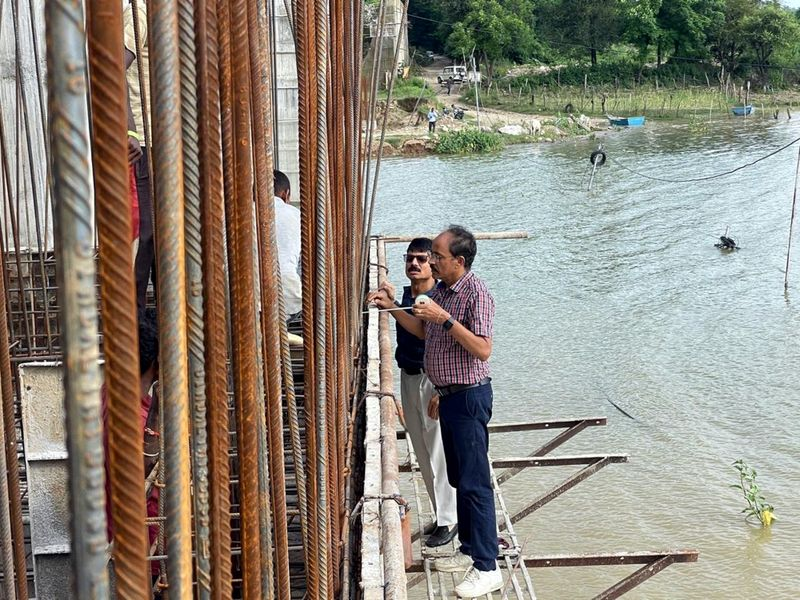
In Guler, an under-construction bridge now lies submerged, snapping vital road links to Nandpur, Barial, Luderet Katholi, Sugnara and Nagrota Surian. The swelling Gaj river, pushed back by the dam’s waters, has further blocked access to Amlela and Ghar Jarot, leaving residents dependent on Nagrota Surian virtually stranded. Local mobility has almost ground to a halt.
The rising waters have also swallowed the legendary Bathu temples, which briefly appear during dry months.
Adding to the community’s woes, the newly inaugurated Eco Park at Dehra, a Forest Department initiative, has been inundated. Divisional Forest Officer Sunny Verma said the park has been shut to visitors for safety. “Backwaters have entered the premises, forcing us to remove swings, statues and other installations as a precaution,” he explained. With upstream rainfall still feeding the reservoir, authorities remain on high alert.
Amid devastation, Lahaul-Spiti women provide food, shelter to flood-hit tourists, truck drivers
The tribal district of Lahaul-Spiti witnessed widespread disruption and destruction due to continuous heavy rainfall from August 25 to 27.
The intense downpour triggered multiple landslides and flashfloods across various parts of the district, leading to the blockage of Manali-Leh highway and several other link roads, leaving hundreds of tourists, locals and travellers stranded in remote areas.
In response, the district administration, under the leadership of Deputy Commissioner and chairperson of the District Disaster Management Authority, Lahaul-Spiti, Kiran Bhadana, swiftly launched coordinated relief and rescue operations.
The efforts involved joint collaboration between the Border Roads Organisation (BRO), the Public Works Department (PWD), the police, local women’s groups, voluntary organisations and residents.
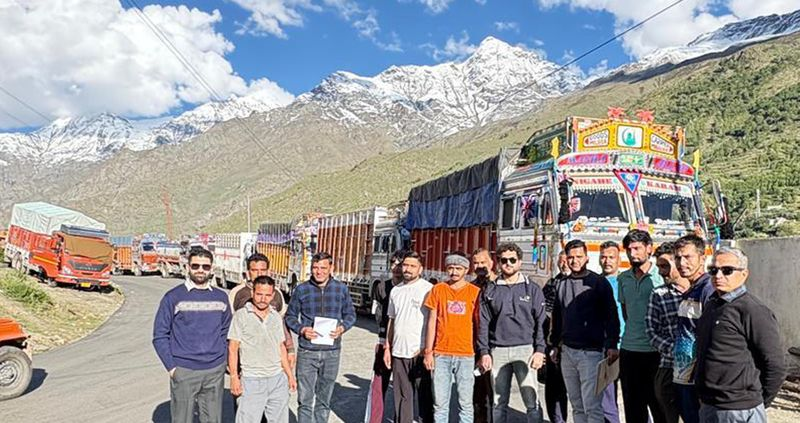
According to the DC, cooked meals were distributed to stranded people on the first day from Keylong. Later, the Sissu Mahila Mandal set up a community kitchen (langar) to provide food to trapped tourists and truck drivers. Essential relief materials such as dry rations, blankets, quilts and sleeping bags were distributed to those in need.
The DC said in critical medical cases, three seriously ill patients, including a pregnant woman, were rescued and transported to the Regional Hospital, Keylong. They were later airlifted to Kullu Regional Hospital on Thursday, with the medical team accompanying them throughout the operation, ensuring proper care during the evacuation.
“Significant rescue operations were also conducted at various locations 250 to 300 individuals were stranded between Pagal Nala and Teling Nala; 148 passengers in 107 vehicles were trapped between Jispa and Stingri; and 80 to 90 people were stuck near Udaipur,” she added. All of them were provided with food and temporary shelters by the administration.
“A group of 13 students and four teachers from Kolkata were accommodated in the PWD Rest House in Keylong,” the DC said.
“Efforts to locate missing persons bore fruit as three pilgrims from Mooring village, headed to Manimahesh, were found. One has safely returned home, while the other two are continuing their journey with local shepherds, depending on weather conditions,” she said.
The DC said the majority of tourists were safely transported to Manali and not a single tourist was stranded in the Lahaul valley. Now, the focus would be on moving stranded carrier vehicles, including trucks from the Lahaul valley, towards their respective destinations, she added.
The DC said a special rescue team was being dispatched to Miyar Valley to evacuate 30 to 35 stranded Gaddis (nomadic shepherds). The team is expected to reach the valley soon and carry out the operation to bring them back safely. “The restoration of essential services was carried out on a war footing.”
“Telecom services were restored on Wednesday while the power supply resumed on Friday. Teams from BRO and PWD have been working round-the-clock to reopen blocked roads, and many key routes have already been cleared,” said DC Bhadana.
Despite the harsh weather and tough terrain, she personally visited the affected areas, supervised rescue and relief efforts, and boosted the morale of frontline workers. She also coordinated with various departments to ensure timely restoration of electricity, water supply and mobile connectivity.
A 65-year-old farmer in Lalru was reportedly swept away in the Jharmal rivulet this morning.
Locals said Janak Singh Saini was returning from his fields across the rivulet in his cart. As he tried to cross it, the cart overturned. He, along with the bullocks, was swept away in the strong current. The cattle were found later but there was no trace of Janak. Police officials said they were searching for the victim.
Landslides, waterlogging and damage to key roads reported in the district
The record rain that lashed Panchkula on Thursday night caused landslides, waterlogging and damage to key roads in the district.
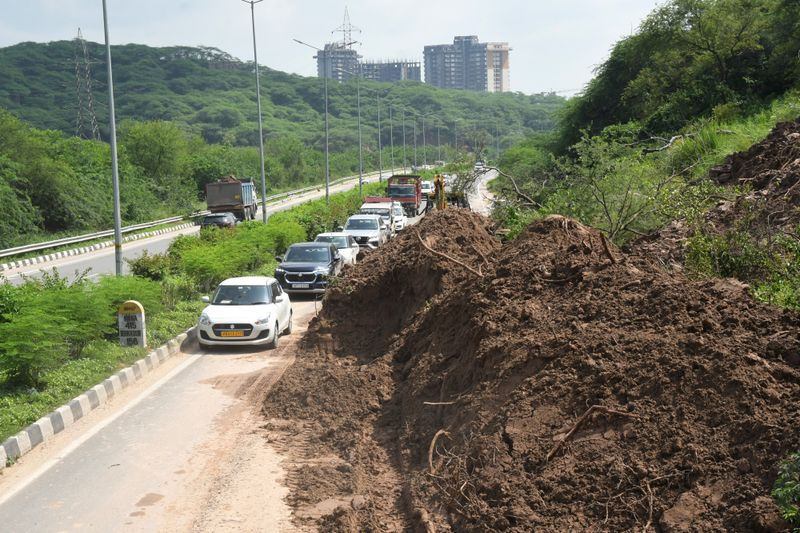
A major landslide disrupted traffic on the Panchkula-Morni road. The Industrial Park-Barwala road caved in. Authorities cleared the debris to restore normal traffic movement of traffic.
A section of the highway near the Jhuriwala dumping ground also caved in due to waterlogging.
Experts expressed concern that rainwater seeping through the garbage at the dumping site is contaminating the subsoil. They fear, it could pollute tubewell water used for drinking purpose across Panchkula. Residents have urged for immediate testing of water samples.
A large portion of the bridge on the Khatauli-Alipur road was washed away. A swollen tributary of the Ghaggar river caused extensive damage to road infrastructure, snapping connectivity of local areas with the Panchkula.
Meanwhile, images circulating on social media highlighted cracks near the newly built Ghaggar bridge connecting Peer Muchalla and Sector 26. Earlier also during the onset of monsoon this year, the same part of the bridge had suffered damage.
Engineers, however, told The Tribune that part of the embankment was washed away, not the bridge.
Severe waterlogging was also reported in Sector 15. Uprooted trees blocked the Sectors 11-14 road, leading to traffic chaos during the morning hours.
Meanwhile, teams of the Panchkula administration carried out repairs to restore road connectivity. However, experts warned that recurring soil erosion at the embankments points to a structural weakness, requiring long-term rectification measures.
17 schools closed
DC Monika Gupta has announced the closure of several schools in Morni, Raipur Rani and Barwala on Saturday as heavy rain left their premises waterlogged. Government Senior Secondary Schools in Barwala, and Parwala; primary schools in Marog, Khopar, Bijlag, Sahlon, Samlotha, Shilyon, Chaplana, Chhamla, Teepra, Runja Dakar, Slahon Redua, Mohri and Plasara; and middle schools in Singhwala as well as Prempura will remain closed.
Pak army chief says flood-hit Sikh religious sites, including Kartarpur, to be restored fully
Pakistan army chief Field Marshal Syed Asim Munir on Friday said Sikh religious sites, including Darbar Sahib, Kartarpur, hit by the massive floods would be restored to their original shape.
Field Marshal Munir, the Chief of Army Staff (COAS), visited flood-affected areas of Punjab province, including Sialkot sector, Shakargarh, Narowal and Kartarpur, to review the flood situation and the ongoing rescue and relief efforts, according to a statement by the army.
Pakistan’s largest province, Punjab, has been reeling under severe floods for almost a week. As of Friday, at least 22 people have died over the last 24 hours and at least 1,700 villages across the province, including the Sikh sacred site of Kartarpur, were inundated.
The COAS was given a comprehensive brief on the prevailing situation and the preparations in view of the next spell of rains.Munir interacted with the affected Sikh community of the area and “assured them that all religious sites, including Darbar Sahib, Kartarpur, affected during floods will be completely revived to their original condition on priority,” the statement said.
The Sikh community welcomed the COAS at the Sialkot sector and thanked him for the services being extended by the civil administration and the Army during the calamity.
Pakistan opened the Kartarpur Corridor in November 2019.
Around 4.1 kilometres from the Pakistan-India border, the corridor links Pakistan’s Gurdwara Darbar Sahib, where Guru Nanak lived and died at the start of the 16th century, to Dera Baba Nanak in Punjab’s Gurdaspur district.
The 4 km-long corridor provides visa-free access to Indian pilgrims to visit Gurdwara Darbar Sahib.
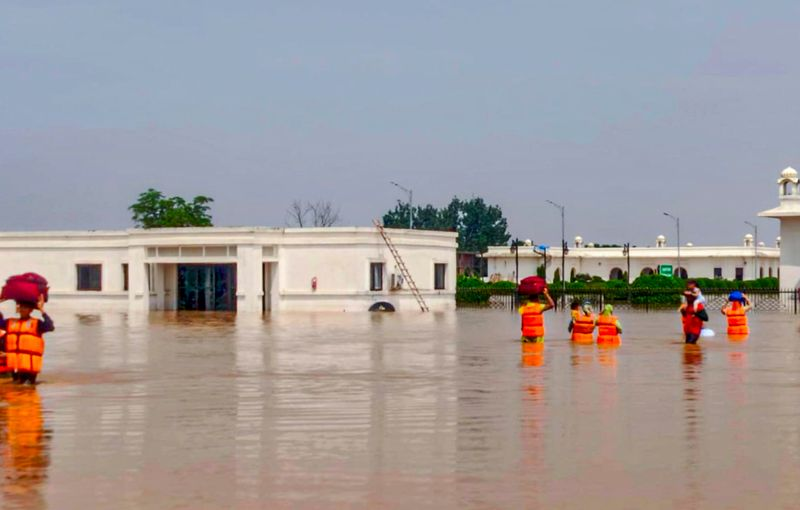
Local administration and the army personnel on Wednesday rescued around 150 officials and Sikh pilgrims stranded after floodwaters from the Ravi submerged the entire complex of the Kartarpur corridor, including the Gurdwara Darbar Sahib.
Army deployed in Sultanpur Lodhi as water level rises in Beas river
More than 2,000 farmers, families waiting for evacuation from flood-affected areas
Panchal said the State Disaster Response Force (SDRF) team today evacuated 100 persons from flood-affected villages.
Panchal said 60 persons were shifted by followers of Rajya Sabha member Balbir Singh Seechewal to safer places. He said situation was under control and there was nothing to worry about safety of affected persons still living in marooned villages.
Seeing the gravity of situation Panchal requisitioned the Army to help the district administration in the evacuation process. Water level in swollen Beas river further rose to 2.30 lakh cusec this morning endangering lives of 2,000 persons living in marooned villages in the mand area of Sultanpur Lodhi. Seechewal followers and the administration pressed eight motor boats into service for evacuating people from flood-affected villages.
SDRF teams were also deployed to save the lives of affected families who were earlier reluctant to leave their houses as they feared that burglars would strike at their residences in their absence.
Seechewal said now affected farmers were asking to rescue them on seeing water level rise from 8-10 feet in the Beas river. He said there was shortage of motor boats. Eight boats were insufficient to evacuate such a large number of people, he said.
A breach in temporary bundh raised by farmers inside dhussi bundh further widened to 700 feet, said officials. Meanwhile, city residents today heaved a sigh of relief as rain stopped today and sun brought some respite for them.
Water release from Pong Dam damages crops in Kangra district
Continuous rains coupled with the release of water from Pong Dam have caused large-scale destruction in the lower areas of Kangra district, damaging agriculture, horticulture and property.
More than 250 hectares of crops and orchards, including mango, litchi, orange, maize, paddy, pulses, oilseeds, sugarcane and poplar, have been washed away.
A heavy soil erosion has been reported as dam water entered villages along the Beas river, sweeping away houses and damaging property worth crores. Several transformers and an 11 KV power line were also damaged, disrupting electricity supply. More than 16 roads remain blocked, as on date, in the area.
According to officials of the district administration, 20 panchayats in Indora and Fatehpur sub-divisions have borne the brunt of the floods. The combined effect of dam water release and swollen local rivulets has intensified the destruction.
Deputy Commissioner of Kangra Hemraj Bairwa said that all the concerned departments were working together to mitigate the damage, but rising water levels continue to cause heavy losses.
Floodwaters from the Beas River have submerged agricultural fields in over 35 villages across Punjab after heavy rainfall and water discharge from Pong Dam
Panchkula records 112.5-mm rainfall, Mohali 79 mm, UT 35.8 mm
The overnight downpour threw normal life out of gear with Chandigarh, Mohali and Panchkula facing a flood-like situation. The incessant rain started late Thursday night and continued till the wee hours of Friday.
Most parts of the tricity were submerged in knee-deep water. Several roads in the tricity were damaged, forcing the authorities to close vehicular traffic on these stretches.
Though the residents woke up to a sunny day, the overnight downpour caused massive traffic jams in the morning. In Chandigarh, the Madhya Marg grid, Tribune Chowk and Transport Chowk witnessed serpentine queues of vehicles, while several road stretches leading to Panchkula, railway station and IT Park, which suffered major damage due to waterlogging, were closed to traffic.
Reports of trees and poles falling on vehicles and public property were also received. The IMD issued a yellow alert for heavy rain till Tuesday.
Record rain in Panchkula
Panchkula witnessed the record rainfall of 112.5-mm, which was not only the season’s highest but also the heaviest in the north region.
Traffic jam at the Housing Board Chowk in Chandigarh.
Chaos on Madhya Marg
Chandigarh: Chandigarh witnessed massive traffic jams on Madhya Marg on Friday morning, as the overnight rain left roads waterlogged. A few adjoining roads had to be closed for safety reasons near the Sector 26 light point. Traffic snarls were also witnessed during office hours near the PGI and the Sector 17-9-8-18 lightpoint. The situation was further compounded by uprooted trees and cave-ins.
Lightning strikes in Sector 7-C
Lightning struck a spot in Sector 7-C on Thursday night. No one was injured. A few cars parked outside houses were damaged. — TNS
A flooded street in Phase 11, Mohali, on Friday.
Water enters Mohali houses
Mohali: Phase 11 residents staged a protest after rainwater flooded the ground floor of LIG and MIG houses. Residents complained that their household goods were damaged. Fire tenders were rushed to the area to drain the rainwater from the houses. Angry residents staged a sit-in on the road and raised slogans against Mohali MC, Punjab government and GMADA. The blockade was lifted after Mohali MC commissioner Parminder Pal Singh and senior police officials reached the spot and pacified the residents.
Farmer swept away in Lalru
A 65-year-old farmer in Lalru was reportedly swept away in the Jharmal rivulet this morning. Locals said Janak Singh Saini was returning from his fields across the rivulet in his cart. As he tried to cross it, the cart overturned. He, along with the bullocks, was swept away in the strong current. The cattle were found later but there was no trace of Janak. Police officials said they were searching for the victim.—TNS
The Indian Air Force has escalated its operations for flood relief and rescue in north India which had commenced on August 27, focusing primarily on the severely affected Punjab and Jammu regions.
Mi-17 and Chinook helicopters have conducted at least 55 sorties to evacuate stranded civilians and personnel from the Indian Army and Border Security Force from inundated areas in Dera Baba Nanak, Pathankot and Akhnoor sectors.
The C-130 transport aircraft have also been deployed to facilitate rapid movement of specialised National Disaster Response Force (NDRF) teams into the affected zones. Air assets are strategically tasked to maximise coverage and support.
The operations have enabled the rescue of 215 individuals and delivered 7,300 kg of essential relief material in the affected areas in the past three days, an IAF spokesperson said on Friday.
On Friday, in a daring and skillful mission, helicopters of IAF evacuated nine marooned civilians, including children, from the flood-hit Dera Baba Nanak area in Punjab by winching them to safety from the roof of a house surrounded by water.
Current efforts are concentrated in northern Punjab, where the situation remains critical due to continuing high water levels, which has hampered surface connectivity. The relief missions are being executed in close coordination with the Indian Army, Border Security Force, NDRF and the local administration to ensure timely evacuation and distribution of supplies.
Meanwhile, a number of Army columns deployed in Punjab and Jammu continued with their relief and rescue operations, evacuating marooned persons, rendering medical aid and providing food and other essential supplies.
Engineers of the Tiger Division laid a 110-foot Bailey bridge in just 12 hours to revive the road link over Tawi bridge in Jammu, the eastern span of which was severely damaged by floods. Overcoming washed-out approaches and limited workspace, vehicular movement was restored under challenging conditions, an Army officer said.
In flood-affected Dera Baba Nanak, the Army’s Panther Division soldiers are reaching every corner in their rescue operations, while in the Ferozepur sector, the Golden Arrow Division rescued a large number of families from Ruknewala, Dhiraganaand, Dilche Palla and Megha villages.
7,689 evacuated; drones drop essential supplies
As many as 7,689 people have been rescued from flood-ravaged areas, said an official statement on Friday.
Special DGP (Law and Order) Arpit Shukla said 20 choppers of the Army had been stationed to evacuate people. “Drones are being used to trace people, and also to deliver food packets and other essential items,” he added.
Shukla said Pathankot, Hoshiarpur, Gurdaspur, Kapurthala, Tarn Taran, Fazilka and Ferozepur were among the worst-hit districts in the state. The officer said the Punjab Police had set up relief camps at flood-affected areas, wherein food and medicines were being provided for those evacuated. Fodder was also being provided for the cattle, he added. — TNS
State Stalwarts
DEFENCE MINISTER
Minister Rajnath Singh
ALL HUMANS ARE ONE CREATED BY GOD
HINDUS,MUSLIMS,SIKHS.ISAI SAB HAI BHAI BHAI
CHIEF PATRON ALL INDIA SANJHA MORCHA
LT GEN JASBIR SINGH DHALIWAL, DOGRA
SENIOR PATRON ALL INDIA SANJHA MORCHA
MAJOR GEN HARVIJAY SINGH, SENA MEDAL ,corps of signals
.
.
PATRON ALL INDIA SANJHA MORCHA
MAJ GEN RAMINDER GURAYA ,MADRAS REGIMENT
sanjhamorcha303@gmail.com
PRESIDENT SOUTH ALL INDIA SANJHA MORCHA
COL SS RAJAN BOMBAY SAPPERS,
PRESIDENT UTTARAKHAND ALL INDIA SANJHA MORCHA
COL B M THAPA ,BENGAL SAPPERSS
PRESIDENT HARAYANA STATE CUM COORDINATOR ESM
BRIG DALJIT THUKRAL ,BENGAL SAPPERS
PRESIDENT TRICITY
COL B S BRAR (BHUPI BRAR)
PRESIDENT CHANDIGARH ZONE
COL SHANJIT SINGH BHULLAR
.
.
PRESIDENT PANCHKULA ZONE AND ZIRAKPUR
COL SWARAN SINGH
INDIAN DEFENCE FORCES
DEFENCE FORCES INTEGRATED LOGO
INDIAN AIR FORCE
Air Officer C-in-C WESTERN AIR COMMAND
AIR MSHL S PRABHAKARAN AVSM VM
AOC-IN-C, EASTERN AIR COMMAND
Air Marshal Inderpal Singh Walia
AOC-in-C SOUTH WESTERN AIR COMMAND
Air Marshal Vikram Singh
AOC-IN-C, SOUTHERN AIR COMMAND
Air Marshal J.Chalapati
AOC-IN-C TRAINING COMMAND
AIR MARSHAL SK GHOTIA VSM
AOC-IN-C MAINTENANCE COMMAND
Air Marshal Jagdish Chandra
Flag Officer Commanding in Chief, Western Naval Command
ice Admiral R Hari Kumar, PVSM, AVSM, VSM
Flag Officer Commanding in Chief, Eastern Naval Command
Vice Admiral Sanjay Bhalla, AVSM, NM
Flag Officer Commanding in Chief, Southern Naval Command