All posts by webadmin

A corridor of concern by Vivek Katju

A corridor of concern
Game changer? Pak army has hailed CPEC as the “fruit” of Gen Sharif’s vision.

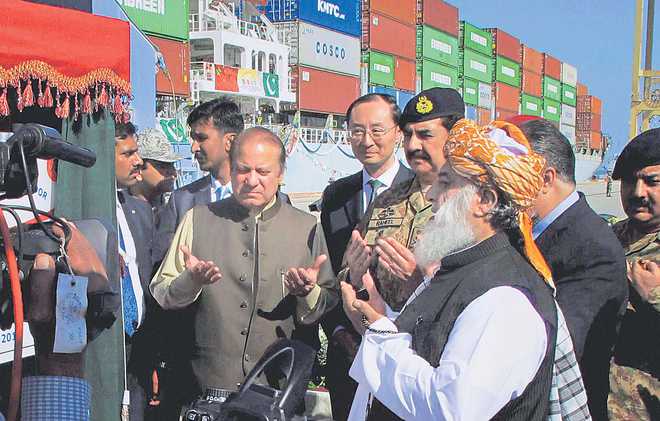
IN October 1994, Gen Naseerullah Babar, Pakistan’s influential interior minister in the Benazir Bhutto government, sought to open trade and transit routes to Central Asia by sending a convoy of the Pakistan army-owned national logistics cell trucks across chaotic Afghanistan into Turkmenistan. The convoy led by the ISI’s leading Afghanistan operative, Colonel ‘Imam’, was stopped by Mujahideen commanders before Kandahar but the fledgling Pakistan-promoted Taliban chased the commanders away and captured Kandahar. The Taliban, as Pakistan’s instrument, was on its way to control Afghanistan in the next few years but Pakistan’s historic aim of using its location to become a trade and transit route for Central Asia continues to remain a distant dream. Will the same fate befall the China-Pakistan Economic Corridor (CPEC) which Pakistan is touting as a “game changer” for the country? Or will it evolve into an effective trade route via the Gwadar Port, on Pakistan’s Makran coast, to Xinjiang and northwest China? These questions are now pointedly relevant, for, on November 13, Gwadar was opened up, albeit for the present largely symbolically, for trade activities under the CPEC. PM Nawaz Sharif and army chief Raheel Sharif werepresent on the occasion; this, at a time, when tension between Nawaz and the army is running high. Significantly, the Pakistan army’s information wing hailed the CPEC as the “fruit” of General Sharif’s vision.The absence of the Chinese leadership at Gwadar though indicates that the occasion was designed to quell growing scepticism about the CPEC in sections of Pakistani opinion. This is also borne out by what Maj-Gen Muhammad Afzal, director-general of the Frontier Works Organisation (FWO) of the Pakistan army — responsible for the construction of a large part of the CPEC’s road network  — told Pakistan’s leading newspaper, Dawn: “We pushed it to counter the despondency that was coming to surround the project. Too many people were airing views that this project is not viable or not going to materialise”.In typical army fashion, reminiscent of the Babar convoy, the FWO decided to organise one Chinese convoy and two from Pakistan to reach Gwadar to load cargo on two ships berthed there. The cargo largely from China was destined to the EU, the UAE, Sri Lanka and Bangladesh. The Chinese convoy crossed into Pakistan via the Khunjerab Pass and travelled on the Karakoram highway and reached Gwadar, as did the Pakistan convoys originating in Lahore and Sialkot through Balochistan. Instead of the Punjab-Sindh alignment of the CPEC the route through Balochistan to Gwadar was deliberately chosen. This was to signal to the Baloch that their interests would not be neglected. It is also to indicate to China and other countries that the Pakistan army which has raised a special force for the CPEC and its projects was competent to ensure its security.Chinese President Xi Jinping formally announced the CPEC during his visit to Pakistan in April 2015. It will involve an investment of around $50 billion to develop the port, vastly upgrade a large part of the road system of Pakistan that would link the port to the Chinese border and add around 11,500 MW of power at a cost of $33 billion. The latter will be undertaken by private Chinese entities on a commercial basis. The CPEC also envisages upgradation of Pakistani railways with the ambitious aim of joining it with Chinese railways in Xinjiang. Gas pipelines are also contemplated along the Karakoram Highway into Xinjiang. There is little doubt that the Chinese and the Pakistani leaderships are committed to quickly pursue the different energy generation as well as the road linkage projects. Work has begun on many of them but political questions as well economic are being raised about the CPEC. The Baloch are particularly concerned that the CPEC will be one more instrument to exploit their resources and further change the province’s demographics to their disadvantage. Some voices are being raised about if the CPEC will ever develop the volume of traffic to become commercially viable. Cost projections of freight overland on the CPEC and from Gwadar are not as yet known. The terrain too in Gilgit-Baltistan is very difficult. Despite the scepticism the Chinese consider the CPEC  as of strategic value and will seriously develop its connectivity component, especially the Gwadar Port. They will take a long term view and not look for short or medium term commercial viability. It will thus transform the foundation of Sino-Pak ties which was hitherto based on shared hostility towards India. Now a positive element, independent of India, is being added to this relationship. This has major strategic consequences for India. Some tensions have grown in US-Pakistan ties as the latter has continued to refuse to rein in the Afghan Taliban. Consequently, Pakistan has leaned even closer to China. On its part China is deeply concerned at growing India-US ties across all sectors and is worried about the Indian role in the latter’s approach to “contain” it. This has pushed China to draw Pakistan still closer and to clearly signal its stakes in Pakistan’s stability and well being through the CPEC. China has also obliquely cautioned India against seeking to disrupt the CPEC. India has objected to it as it will go through Pakistan-occupied areas of J&K.How far will this forward approach infuse Chinese actions on developing Gwadar as a naval staging post? Certainly, Pakistan, which has never hesitated in offering its facilities to the US, will not be reluctant to allow China to use Gwadar in this manner. It will be prudent for Indian strategic planners to take this aspect in their calculations as they look to India’s role in the Arabian Sea and the Indian Ocean. A signal to China and Pakistan that respect for security of important interests is a two-way street will not be out of place. In the connectivity game the CPEC is an undoubted boost for Pakistan. However, it does not help in furthering its objective in gaining connectivity to Central Asia via Afghanistan. This is notwithstanding plans for Afghanistan getting connected to the CPEC in the future. President Ashraf Ghani has said as long as Pakistan continues to deny India and Afghanistan full mutual access he will not agree to Pakistan using Afghanistan to freely transit to Central Asia.Meanwhile, India needs to energetically work on the Chabahar Port for assured access to Afghanistan. There seems to be little progress in the past six months since Prime Minister Narendra Modi joined the Iranian and the Afghan Presidents to witness the India-Iran agreement to develop Chabahar. India can only be tardy in implementing the deal at the cost of its national interest.The writer is a former Secretary, Ministry of External Affairs
Now, over to diplomacy ————-Gen Ashok Kumar Mehta (retd)

Now, over to diplomacy
Mean business: The strikes have signalled our readiness to violate the sanctity of LoC.

IT is quite bizarre. Pakistan’s brazen denial of India’s smart and sharp punitive raid by both the military and civilian leadership has put New Delhi in a quandary about any military riposte. The situation is confusing. GHQ Rawalpindi was extremely surprised by India’s punitive retaliation. While Pakistan’s Inter Services Public Relations maintains that the LoC has not been crossed and army chief Gen Raheel Sharif has called it malicious propaganda. Pakistan TV channels have added to the opacity by showing doctored footage of captured Indian soldiers. Some media reports say the attack was a ground trespass in which eight Indian and two Pakistani soldiers  were killed. Hafiz Saeed has said: “Let us teach Indians surgical strikes.” He wants the Pakistan army to liberate Kashmir. By denying that the LoC had been crossed, a response might be averted.On the face of it, the strategic message is that no escalation is being contemplated and it is business as usual. Domestically and internationally, Pakistan is in one big mess. While General Sharif’s popularity is soaring and his term is coming to an end in weeks, the battle for succession is waging in the minds of the army, the public and PM Nawaz Sharif. Despite the army clarifying that the General will retire by November-end, nobody is sure the transition will be bloodless. The economy is in bad shape, the campaign against terrorism is not going well and Mr Sharif’s standing is slumped. Pakistan has never been so isolated regionally and internationally as it is today. Presidential favourite Hillary Clinton’s latest pronouncement that she fears a jehadi coup in Pakistan and suicide nuclear bombers roaming the streets paints a scary nuclear scenario. Given these conditions, a Pakistan army adventure should not be surprising ‘at a time and place of its choosing’, though without significant escalation. Overt or covert tit-for-tat strikes should be expected in the form of spectacular fidayeen attacks on military camps or more measured strikes inside J&K.World attention was grabbed by India’s retributive, preemptive raid described as a calibrated counter terrorism operation. It was not condemned by even some of Pakistan’s best friends like China, Saudi Arabia, Qatar and Bahrain. Cleverly choreographed and kept below the escalatory threshold, it sent the right message to Pakistan that henceforth its cross-border terrorism (CBT) will not go un-responded. It is the domestic audience which has been overwhelmed by the punitive retaliation. Dileep Chand, the taxi driver who brought me back after one of the many angry and emotional TV studio indictments of Uri, asked me whether India would retaliate. Before I could answer, he shot back: “Our leaders indulge in empty threats.” He was old enough to have lived through the cyclic ignominy of the attacks on Parliament and Mumbai and the numerous Pathankots and Uris over the last three decades. Dileep Chand is a happy man now.The cross-border operation was symbolic to signal our readiness to violate the sanctity of LoC, something we didn’t do even during Kargil — to make the Deep State rethink its strategy of employing non-state actors as instruments of coercion. As more Uris will happen, our capacity to deal with them has to expand. Former NSA MK Narayanan has revealed that our retributive capabilities are inadequate and that the options of striking terrorist training camps in the PoK were considered unviable after Mumbai in 2008 following a cost-benefit analysis. He said at that time India lacked the capability of conducting spectacular raids, rescue missions and extractions like Entebbe, Mogadishu and Abbottabad, adding that “the reality is that India’s security agencies and the armed forces still do not have adequate capabilities of this kind notwithstanding claims to the contrary”.Defence Minister Manohar Parrikar has admitted that mistakes have been made in Pathankot and Uri. He has also talked about using a terrorist to fight a terrorist and putting back in place the dismantled deep assets in Pakistan. Similarly, NSA Ajit Doval has warned Pakistan “if there is another Mumbai there will be no Balochistan”. These capabilities should be constructed.India has not invested in transparent and clandestine punitive capabilities despite it being bled for the last 30 years, if not 70, by Pakistan’s CBT. According to the latest Pew Research Centre poll,  62 per cent of Indians want military force to be used to defeat terrorism; 63 per cent want India to spend more on defence. An online poll post-Uri suggests that 67 per cent Indians want the application of kinetic force. According to Credit Suisse, India has the fourth-largest militaries in the world and unarguably one of the most competent and yet it has not been employed effectively. That said, it is clear that certain necessary and urgently needed capabilities have not been developed. Who is to blame? The military, of course, but even more, successive governments that have starved it of funds and requisite political direction. The announcement last week by Finance Minister Arun Jaitley that the defence budget will be increased has not come a day too soon.PM Modi should devote more time and resources on the defence of the realm. Without sanitising the periphery and the homeland, his goal of building a prosperous and secure India cannot be realised. There was no reason for him to meet his Service Chiefs individually and collectively four times before going to Kozhikode, had he visited the War Room ab initio more frequently. In fact, on assuming office, he should have asked the military chiefs, two questions: readiness to respond to the next Mumbai type attack; and dealing with CBT. He should also have attended a war game or two to imbibe the nuances of a nuclear overhang. Had he done all this, contingency plans and rehearsals of a fitting reply commensurate with existing capabilities would have been ready for immediate use and not 10 days later.The retributive strike is not going to end CBT. The battle to alter the behaviour of the Deep State has been joined. For now, the Pakistan media is toeing its army’s line that the Indian Army did not cross the LoC. This make-believe allows Pakistan to not respond and escalate the situation. We should not try to rub GHQ Rawalpindi’s nose to the ground but leave it with the face-saving exit option. At the same time, we should be prepared for  retaliation, mainly in J&K. The military should keep its powder dry and let active diplomacy take the front seat, though India’s dilemma will remain crafting retribution over the next Uri.The writer is a founder member of the erstwhile Defence Planning Staff


Air Force officer conducts talk on disaster control for students

Air Force officer conducts talk on disaster control for students
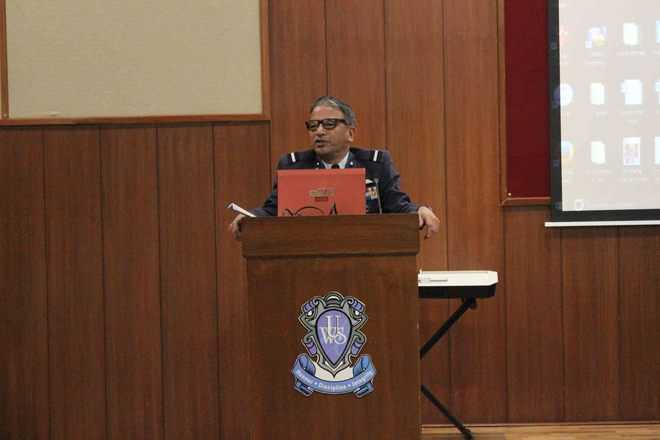
Air Commodore Nitin Sathe, Chairman of Air Force Selection Board, Dehradun, delivers a lecture on disaster mangement at Uniosn World School in Dehradun on Tuesday.

Tribune News service

Dehradun, November 16

Air Commodore Nitin Sathe conducted a session on disaster management for students of class X to XII of Unison World School on Tuesday evening.His session revolved around one of his two published books and an enthralling incident of his life— disaster management after Tsunami 2004— that he experienced at Bande Aceh, near Andaman and Nicobar Islands.Sathe described the initial signs, destruction and aftermath of the Tsunami that struck the coasts of Indonesia on December 24, 2004. Apart from this, he informed the students about the actions that were taken to revive life on the island and the resurrections over two years. Small and impressive lessons were propagated all throughout his speech, leaving a few eyes welled up with tears and a few minds thoughtful about the unfortunates in life. Towards the end of his lecture, Sathe spoke about ‘Predict, Prevent and Prepare-the three Ps of Disaster management’.Air Commodore Sathe is an alumnus of the National Defense Academy, Khadakwasla, and is at present the president of the Air Force Selection Board, Dehradun.


Ranbir is my legally adopted son, says a proud retired Col

Deepkamal Kaur

Tribune News Service

Jalandhar, October 1

A young Lt-Gen Ranbir Singh, DGMO, Indian Army, along with his wife and son.

Former Deputy Director, Sainik Welfare, Lieut-Col Manmohan Singh (retd) is a busy man these days as several people from across the region have been calling on him to congratulate him on the feat of his adopted son Lieut-Gen Ranbir Singh, DGMO, Indian Army, who strategised the surgical strikes across the LOC two days ago.At his residence in Urban Estate here, the Lieut-Col said, “Since we did not have any child, I legally adopted my brother’s son Ranbir, whom we fondly call Babbu, at the age of three and a half years. My brother, who retired as a JCO, was residing at Ambala Jattan village near Garhdiwal in Hoshiarpur. Since there was no good education facility there, we brought him here and sent him to St Joseph’s Convent School, Lajpat Nagar, right from LKG.”Taking out old pictures, he recalls, “Ranbir was very intelligent but a bit lazy. I had to push him out of the bed early and he maintains the habit. At the Class V level, I made him study rigorously and prepare for admission to Sainik School Kapurthala. There he worked hard and got through in the National Defence Academy (NDA). He went to Khadakwasla, then the IMA in Dehradun and got commissioned in the Army in December 1980. He has been the only infantry general to have commanded an armoured division after Gen Sundarji.”He proudly tells, “Till date, he maintains all habits that I passed onto him. He is regular with early morning walks. I am a teetotaller and he too is. He is an avid book reader till date.”Says Lieut-Col Manmohan Singh, “He got married to a Marathi girl. They have a son, who is studying in the Delhi College of Engineering. My brother (Lieut-Gen Ranbir’s biological father) passed away at 50, while his wife and two daughters are in Vancouver for the past 20-25 years.”He further said, “Ranbir keeps coming here every four months or so. But this time, he won’t come till the tension defuses. Having been promoted as Lieut-Gen six-seven months ago, he was tipped to be the Corps Commander and get posted here. The incumbent here Lieut-Gen BS Sehrawat and Ranbir have been batchmates. In any case, he will have to serve as a Corps Commander for a year to be eligible as the Chief of Army. He has been accompanying Defence Minister Manohar Parrikar on his foreign tours. He has shown his capabilities and is among the front-runners now.”Lieut-Col Manmohan, who has been training youth for entry to Defence, paramilitary forces and police for the past over two decades, said he had been in Delhi with Lieut-Gen Ranbir a week ago and he remained very busy. “He comes home late even now. He calls me up daily after returning from work. He called me even on the day when they conducted the strike.”


IWT: Another Indo-Pak showdown in the offing?

NEW DELHI: India and Pakistan are possibly headed for another showdown on water after New Delhi said on Thursday it wouldn’t be party to a court of arbitration process on Kishenganga and Ratle hydroelectric projects, a demand by Islamabad that has been accepted by the World Bank.

The World Bank had brokered the Indus Waters Treaty (IWT) in 1960 and has a specific role in the resolution of differences. Kishanganga is a tributary of river Jhelum and the 330 MW project is coming up in Bandipora in J&K. The 850 MW Ratle project is on the Chenab in Doda district.

In a communication to the World Bank on Thursday, India said the stand taken by it to start two parallel process simultaneously—initiating the court of arbitration (COA) process as demanded by Pakistan and setting up neutral expert as demanded by India—was not “legally tenable” under IWT. “Our stand is very clear. We have asked World Bank to stop the process. What happens if the COA and neutral expert give contradictory judgment? Under the IWT, the judgment of the neutral expert can’t be revoked by the COA,” said a senior government official.

However, not heeding to India’s request, World Bank on Friday held a draw of lots in its headquarters in Washington to determine who will appoint three umpires to sit on the COA. The COA has seven members, two arbitrators each to be appointed by India and Pakistan, and three ‘umpires’ nominated by certain global dignitaries. If parties can’t agree on who will nominate the ‘umpires’, a draw of lots decides which three of the global dignitaries will nominate one ‘umpire’ each.

But the World Bank asked both countries to “agree to mediation” to resolve issues regarding the two projects. “What is clear, though, is that pursuing two concurrent processes under the treaty could make it unworkable over time and we therefore urge both parties to agree to mediation that the World Bank Group can help arrange. The two countries can also agree to suspend the two processes during the mediation process or at any time until the processes are concluded,” senior vice-president and World Bank group general counsel, Anne-Marie Leroy, told PTI.

On Thursday, external affairs ministry spokesperson Vikas Swarup said the government will examine options. India’s grouse is that the World Bank hasn’t followed the procedures in the treaty. India says Pakistan’s objections are technical and the bilateral Permanent Indus Commission (PIC) can address them. If PIC can’t resolve the matter, it is termed ‘difference’ and is addressed by neutral experts appointed on request by either party to World Bank.


Pak Army chief warns of ‘befitting response’ to any misadventure

Pak Army chief warns of ‘befitting response’ to any misadventure
The General flexes his muscle. Reuters

Lahore, October 1

Asserting that the highest state of vigil is being maintained along the Line of Control (LoC), Working Boundary and the international border, Pakistan’s Army Chief General Raheel Sharif has warned that any misadventure by Islamabad’s adversary will meet the most befitting response from the country.Sharif made the remarks during a visit to the Combat Reaction Training facility on Friday, established in the vicinity of Lahore Garrison.“Any misadventure by our adversary will meet the most befitting response from Pakistan. Pakistan can’t be coerced through any amount of malicious propaganda,” Dawn quoted Sharif as saying.His statement came amid heightening tensions between Islamabad and New Delhi in wake of terror attack in Uri sector in Jammu and Kashmir in which 19 Indian soldiers were killed.Indian Army conducted surgical strikes on terror launch pads across the Line of Control (LoC) in response to the terrorist attack at Uri sector.Two Pakistani soldiers and over 30 terrorists were reportedly killed in the attack.In a statement released by Inter-Services Public Relations (ISPR), the army chief exhorted all formation commanders to lay more emphasis on combat readiness, adding that training in peacetime is the only guarantor of winning a war, if imposed. ANI


India may deploy N-capable Rafale jets on China, Pak borders’

‘India may deploy N-capable Rafale jets on China, Pak borders’
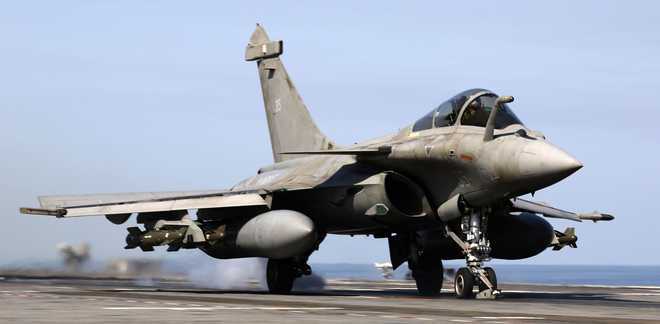
File photo of a Rafale fighter jet

Beijing, September 30

China apprehends that India will deploy the 36 nuclear-capable Rafale fighter jets to be acquired from France in the border regions of China and Pakistan to enhance its deterrence capability, a media report here said.

India will deploy the new French-made fighters in the disputed areas bordering Pakistan and China, state-run Global Times reported quoting Shenzhen Television.

A recent report by Stockholm International Peace Research Institute (SIPRI) said India is the largest arms importer in the world, the newspaper said.

(Follow The Tribune on Facebook; and Twitter @thetribunechd)

Increased arms imports into the Asian region are primarily due to the unstable security environment in the Middle East and concerns from China’s neighbours over its rise.

The Rafale fighters in flyaway condition carry tactical nuclear warheads, and this means India’s nuclear deterrence capability will be greatly improved, Shenzhen Television reported.

“India also wants to purchase the Rafale technology from Dassault but France refused, meaning France has no intention to help India promote its military industrial system,” Zhao Gancheng, director of South Asia Studies at the Shanghai Institutes for International Studies said.

While India is rapidly expanding its military capabilities spending an estimated $100 billion on new defence systems, many other countries with an advanced military industry are also competing for India’s market, such as Russia, the US and Israel, the daily quoted SIPRI report as saying.

Zhao said before this deal with France, India was also considering the US-made F-16s.

“India picked French-made jet fighters because they are cheaper and have a nuclear-deterrence capability,” he said.

SIPRI’s list of the top 10 arms importers for 2011-2015 has nine Asian or Asia-Pacific countries.

Many of China’s neighbours are also on the list of top 10 importers, such as Vietnam, South Korea and India, he said.

“Due to the South China Sea dispute and the increasing power of the Chinese navy, countries like Vietnam and the Philippines are very concerned, but the US is not helping China solve the problem peacefully,” said Song Zhongping, a Beijing-based military expert.

“The US government and media are hyping the ‘China Threat Theory,’ trying to convince countries in Asia that China is on the offensive,” he said. — PTI


The options before India KC Singh

The options before India
Now up in arms: The India-Pakistan bonhomie has been short-lived.

PRIME MINISTER Narendra Modi surprised India, the world, and certainly his host Pakistan Prime Minister Nawaz Sharif when he stopped over in Lahore en route to India from a Central Asian tour on the Christmas of 2015. India-Pakistan relations touched the warmth last seen during Vajpayee’s Lahore visit in 1999. But reality can often delude perception.On January 2, 2016, a fidayeen attack on the Pathankot air base, causing minimum loss of assets and lives, jolted India back to reality. Pakistan’s reaction was surprisingly empathetic, offering to investigate the role of conspirators in Pakistan. A Pakistan investigation team was welcomed by India in March 2016, including allowing them to visit the air base. This process stalled when an Indian team was denied similar access to Pakistan.January to July was a period of political drift in both J&K and Pakistan. Chief Minister Mufti Mohammad Sayeed died in January, five days after the Pathankot attack, and his daughter Mehbooba assumed office only in April. The Valley was drifting towards alienation as the agendas of the BJP and the PDP meshed poorly. Also in April, Nawaz Sharif left for London for a heart surgery. Rumours swirled of a soft coup and his imminent retirement. He did return in July, but enfeebled politically. In March, Pakistan arrested a former Indian Navy captain, Kulbhushan Yadav, in Balochistan, alleging abetment to terror. Once unrest exploded in the Valley after the killing of Hizbul Mujahideen leader Burhan Wani on July 8, Pakistan went on the rampage to discredit India internationally, alleging human rights breaches. It also fanned trouble by unleashing leaders of terror groups masquerading as heads of religious and educational charities. The Pakistan army also ratcheted up their trans-Line of Control induction of trained militants. Pakistan, for the umpteenth time, was misreading both the situation and the capacity of India to deal with it. Between July and August 15, Delhi concluded that Pakistan policy needed major re-calibration as the Pakistan government had succumbed to its army’s thesis that Kashmir had regressed to the 1990s’ level and time was ripe to compel India to make territorial concessions. A multi-layered counter-asymmetrical warfare strategy, which actually should have been on PM Modi’s table within months of assuming office, began to emerge. His Red Fort speech, after tentative articulation earlier in an all-party meeting, asked Pakistan to look within at its atrocities in Gilgit-Baltistan, PoK and Balochistan. The PM followed it up at Kozhikode and External Affairs Minister Sushma Swaraj in her address to the UN General Assembly on September 26. The ministries of water resources, commerce, etc., also swung into action. The full-spectrum response was to remain within treaty obligations, but interpreting them restrictively. The Uri attack complicated the government’s task as the BJP’s jingoistic pre-Lok Sabha election rhetoric resurfaced to haunt it. Their core followers expected instant and disproportionate response for the death of 19 soldiers. Ram Madhav, the bridge between the BJP and the RSS, sought “jaw for a tooth”. The government realised correctly that military options had only bad or worse outcomes. For instance, they would only strengthen Pakistan army’s domestic support, perhaps obtaining for retiring army chief Gen Raheel Sharif an extension. The army was given the freedom to respond locally — euphemism for Special Forces action. Modi soothed the aroused national feelings baying for Pakistani blood. Simultaneously, the focus was turned on Pakistan’s own rights record. Hints were dropped that India may give asylum to top Baloch leaders of the Bugti and Marri clans fighting Pakistan army’s depredations. The aim is to hurt Pakistan both materially and morally, as also have instruments that can be calibrated in response to Pakistan’s conduct. In Kozhikode, Modi shrewdly turned Bhutto’s slogan of “a thousand year war” into a call for war on poverty, illiteracy and unemployment in both nations. Among the emerging elements of the new doctrine is withdrawal of the MFN status. This may not hurt Pakistan much and may only enrich traders in the UAE who will become the conduit for the trade, but it signals new intent. The review of the Indus Waters Treaty contrariwise goes for Pakistan’s jugular. Many ill-informed comments have assumed it to be unilateral abandoning of the treaty. India has been oversensitive in the past to Pakistan’s objections to developing run-of-the-river hydel projects that the treaty allows. For instance, Baglihar on the Chenab was taken by Pakistan to a Swiss arbitrator, who ruled in 2007 largely in India’s favour. That design should be standard for future projects and India can ignore expected automatic bemoaning by Pakistan. That design allows pondage, which gives India leverage as the time of filling, if it coincides with the sowing season in Pakistan, can be used to cause havoc. This happened inadvertently the last time. Another salvo is Modi deciding to skip the SAARC Summit in November in Pakistan. This can be followed-up by a meeting of those SAARC members — Bangladesh, Afghanistan and Bhutan to start with — which have articulated concerns about the export of terror from Pakistan and joined India in boycotting the summit. Sub-regionalism, on thematic or territorial basis, will isolate Pakistan regionally. The aim thus is to punish Pakistan bilaterally and isolate it regionally and internationally. It would not happen overnight, or be easy, as China and its new ally Russia will buttress Pakistan, as indeed may Iran and some members of the Gulf Coordination Council like Saudi Arabia and the UAE. But smart diplomacy trumps armed response for which the military power differential between India and Pakistan needs to be wider than it is currently. The Economist notes that despite the defence budget of India being six times that of Pakistan at $ 51.3 billion, “India has proved strangely unable to build serious military muscle”. George Washington said: “To be prepared for war is one of the most effective means of preserving peace.” That entails more than acquiring 36 Rafale fighters in an ad hoc purchase. Meanwhile, the BJP must remember that ultimately the fight is over the hearts and minds in the Valley. No counter strategy will deter Pakistan if the wound at home is not healed or new ones opened by “rakshaks” of one cause or another. The writer is a former Secretary, Ministry of External Affairs


Well Done ; Indian Army barges into Mosque for playing anti-India Slogans and Songs on Loudspeakers

On Friday morning, some youths at Arhama Manigam used the public address system of their local mosque to play freedom songs and slogans which irritated Commanding Officer of 5 Rashtriya Riffles.

According to local sources, Army men cordoned off the mosque and entered in. “Soldiers entered the mosque, ransacked loudspeakers system, broke window panes and dragged us out”, a youth said.

A local youth said, the Indian Army men lost their patience and beat up the youth to pulp before some village elders came out to rescue us.

At least 40 people suffered injuries– among which a mother-son duo and fourteen others have been shifted to SK Institute of Medical Sciences in critical condition– after an Indian army unit ‘barged into a mosque and beat up people’ in Jammu and Kashmir’s Ganderbal district.

The men and women deserved the ruthless thrashing by the Indian Army for living on Indian soil and using a Mosque as a propaganda tool for shouting Freedom slogans.

At least 40 people including a 60-year-old woman Mukhte Begum along with her young son Riyaz sustained injuries. Most of the injured were treated at Public Health Centre in Manigam while the woman, Mukhte, along with fourteen others were termed critical and referred to SK Institute of Medical Sciences in the disputed region’s summer capital.

Meanwhile, Army’s Commanding Officer reached the health centre in Manigam and threatened medicos and para team not to attend the injured.

People were saved from the wrath of the Army only after the intervention of police.

In the other parts of the district, violent protests broke out after Friday prayers in which an SHO along with seven police cops and 5 CRPF men were injured. In Kujar Fatehpora, youths in large number fought stone battles with police and clashes at Saloora, Gangerhama, Khann Harran, Giraj, and Beehama resulted in the injuries to many.

People in large numbers at Tulamull took out a peaceful procession and shouted slogans favouring freedom of Kashmir.

comments by Kusum Arora

Like never before the Indian army has attacked a mosque for playing anti-India songs and chanting slogans. In a shocking incident local youths in Arhama Manigam mosque used a public meeting chanted anti India slogans and played songs in loud speaker. The Commanding Officer of 5 Rashtriya Riffles could not stand the anti-India slogans and barged into the mosque along with his men and broke the loudspeaker, mikes and audio sets.

In the clash, 40 people were injured who tried to attack the army and have been admitted to Public Health Centre in Manigam. Some people were critically injured and were admitted to SK Institute of Medical Sciences. According to some locals, the army waited for a while but when the slogans did not stop they had to enter into the mosque. Few people had to say that the men and women deserved beating for staying in Indian soil and calling out anti-India slogans.

The village elders later intervened and requested army to return back. The police also stopped the army from further attacking the slogan chanters. Following the development, many youths in part of Manigam protested and pelted stones which injured 7 police men and 5 CRPF jawans. Violent clash was also seen in Saloora, Gangerhama, Khann Harran, Giraj and Beehama areas which injured many police. The people chanted AZADI slogans against India and demanded freedom to Kashmir.

It is easy to blame army for barging into the mosque, but what we need to understand is army is not trained to be mere SPECTATORS when country is under attack. Our country did not spend crores training them to be peace messengers holding a rose. And for those who do not understand the language of peace, stick is used.

The routine habit of seculars is to first break law and then play victim card. India has seen enough theatrics in the name of secular politics. And this is exactly why separatists and law breakers demand the withdraw of AFSPA in Jammu Kashmir, so they have free hand to perform all their anti-India activities.


The Uri attack is a wake-up call for the strategic security community::::Gen Syed Ata Hasnain

The militant attack on an Indian Army base at Uri in Baramullah district in north Kashmir early on Sunday had more casualties than probably what even its planners had expected. This is because of secondary effect: 13 soldiers were burnt to death in their tents and shelters. The incident has impacted the nation’s psyche forcefully, and justifiably so. The call for retribution against Pakistan is intense. It will have to be satisfied as Pakistan’s carefully crafted policy of calibration to avoid crossing India’s tolerance level has gone awry. This happened twice before, after the attacks in Mumbai and on India’s Parliament. Yet, this time the effect on the public has been stronger because of the cumulative impact of the Pakistani-sponsored attacks in Poonch on September 10 and then Uri, and the 72-day-long street agitation in Kashmir, which has paralysed governance and disempowered the political community.

Click here for full coverage of Uri

The Uri incident is unlikely to have much effect on the Army’s unconventional task except enhancement of security. The real impact will be in the military-diplomatic relations with Pakistan. For a change, however, both Indian generals and diplomats want action against Pakistan. But they do not want a knee-jerk response but a planned offensive with strategic impact.

Read: Here’s how India can respond to the Uri terror attack

The conceptual nature of this response should be hybrid. It can start with a diplomatic one, but it should be energetic enough to make an impact on world capitals. Pakistan attempted this strategy after the Burhan Wani incident but its diplomatic stature is low and so the effect has been marginal.

India’s experienced diplomatic corps has a large number of well-connected, veteran ambassadors and they must be used for this high-energy campaign. The United Nations General Assembly starts today and the platform must be used to name and shame Pakistan. At the very least, sanctions should be demanded against Pakistan. Post-Uri, one fallout is certain: There will be no revival in the peace process or normalisation of relations with Pakistan.

Militarily, there are several options but launching a conventional operation against a nuclear neighbour must be weighed against potential dividends. The escalatory aspects resulting from actions that are lower in the ladder of options could lead to conventional limited or calibrated operations.

Surgical trans-LoC strikes: The Army has the capability to launch and absorb any response but the nation must be prepared for a near-permanent abrogation of the informal ceasefire that has been going on from November 2003.

The impact of this on people living near the LoC will be huge. Between 2003 and 2016, India did little to protect villagers from shelling. Sooner than later, the J&K’s political class will demand stoppage of hostilities. So the will to continue the fight against Pakistan has to remain intact.

Deeper strikes by Special Forces: Such strikes are an invitation for escalation of hostilities to a higher level and so this can only be a standby option.

Unconventional use of 4th Generation Warriors: This has been suggested by Gen Shankar Raychowdhury but it is not easy. Clandestine sub-conventional operations in undetermined areas will need time and energy and such operations have to be planned much in advance. This proxy war in Kashmir will not end soon and so the government must develop capability for such a response.

Hybrid warfare: India is facing this type of warfare and needs to develop a response. Strategic communication and information warfare to target people in Pakistan has become a compulsion.

Whichever is the response of the Indian government, the question that must be asked is this: Is that response something the Deep State has itself desired from its actions? For example, a study must be done to see whether we gain from the abrogation of the ceasefire or it is to Pakistan’s tactical advantage to enable infiltration.

Read: ‘India jumps the gun’: Pak media criticise ‘knee-jerk reaction’ after Uri attack

Last, but not the least, the government must take stock of the LoC fencing and surveillance equipment because most of them are more than 15 years old and not designed for daily use. The Centre must tell us when it last procured the thermal-imaging devices. Over the years, we have gained experience but critical audit of such tactical measures must be done regularly.

The Uri attack is a wake-up call for the strategic security community. If push comes to shove, the most robust of options will form the essence of India’s response.

Gen Syed Ata Hasnain is former GOC of the Srinagar-based 15 Corps. He earlier commanded the Uri brigade. He is now associated with Vivekananda International Foundation and Institute of Peace and Conflict Studies

The views expressed are personal