All posts by webadmin

Pak shelling triggers migration in Hiranagar sector

Pak shelling triggers migration in Hiranagar sector
Border residents moving to a safer place at Kunthal village in Kathua district. Tribune photo

Sanjay Pathak

Kathua, October 21

Continuous shelling on border Bobiya and Pati villages on the Zero Line along the international border in the Hiranagar sector has triggered migration of locals.The shelling started around 9.35 am today and has been going on intermittently, reports said.Official sources said the district administration had launched an operation for the safety and rescue of the border residents. Due to the intermittent firing and shelling, the administration has decided to fully vacate Bobiya and Pati villages which fall in the firing range.“The administration has sent its bullet-proof vehicle to Bobiya and Pati villages and shifted residents of the villages to a temple at Kunthal village in Hiranagar and Higher Secondary School, Hiranagar,” a source said.Deputy Commissioner, Kathua, Romesh Kumar and MLA, Hiranagar, Kuldeep Kumar along with civil and police officers visited Bobiya village today to assess the situation.“We are fed up with repeated migration and suffering. India should take a one-time hard step to end our miseries,” said Surjeet Singh, a resident of Bobiya, who has taken shelter at the migrant camp in Kunthal village.“Just after 20 days, we have again been forced to migrate from our homes,” he added.Rani Devi, another Bobiya resident, said: “Due to the migration, our children are suffering. Their studies have been badly affected and their future seems bleak.”Meanwhile, the Kathua Deputy Commissioner and the Hiranagar MLA held a meeting with the villagers and promised them all help.


14 yrs on, Kaluchak memories haunt again

14 yrs on, Kaluchak memories haunt again
Security personnel keep vigil during Army Chief Dalbir Singh Suhag’s visit to the Army camp in Nagrota on Wednesday. Tribune Photo: Inderjeet Singh

Dinesh Manhotra

Tribune News Service

Jammu, November 30

Tuesday’s terror attack at Nagrota, which claimed lives of seven Army men, including two Majors, has once again brought back memories of devastating terror attack of May 14, 2002, at the cantonment town of Kaluchak on the Jammu-Pathankot national highway. The worst-ever terror strike in J&K had left over 35 soldiers, their wives and children dead.Fourteen years after the incident, terrorists managed to reach near the family quarters at Nagrota. Their aim was to repeat another Kaluchak by targeting family members of the soldiers but they could not.Fortunately, it was bravery and presence of mind of the wives of two Army officers that terrorists’ nefarious design to repeat Kaluchak at Nagrota was frustrated.“The brutality of terrorists, which we witnessed on May 14, 2002, was revived after Tuesday’s incident at Nagrota,” said Ravinder Singh, who runs a shop near Kaluchak.Even after passing of 14 years, signs of terror’s cruelty have still not been erased from the block of family quarters which the terrorists had managed to enter after storming the Army formation. “The block, which witnessed bloodshed and destruction 14 years back, still wears a deserted look,” Brij Nath, a local of Kaluchak said while recounting how three terrorists, who were dressed in Army uniforms, had lobbed grenades and fired on the soldiers, their family members, including small kids.Sources in the intelligence agencies said the initial investigation had established that the terrorists, who attacked the Army formation at Nagrota, had conducted a thorough recce before executing their plan. “It appears that terrorists were well aware about the location of the family quarters which was their target,” the sources said.As reported earlier, soon after the terrorists entered the Army unit located at Nagrota they were desperate to enter the family quarters where they could take the families of the soldiers and officers hostage.However, due to the bravery of two women, who were staying in the family quarters along with their newborns, the nefarious designs of the terrorists were frustrated.The wives of the two Army officers displayed exemplary courage as they blocked the entry of their quarters with all household items, making it difficult for the terrorists to break into the houses.

Fidayeen aimed for families

  • The terror strike in Nagrota brought back memories of devastating terror attack of May 14, 2002, at the cantonment town of Kaluchak on the Jammu-Pathankot national highway which left over 35 soldiers, their wives and children dead.
  • On Tuesday, the three fidayeen terrorists managed to reach near the family quarters at Nagrota and their aim was to repeat another Kaluchak by targeting family members of the soldiers.
  • Fortunately, the presence of mind of the wives of two Army officers nixed the nefarious designs of the terrorists.

ARMED FORCES TRIBUNAL : A BANE OR BOON FOR MILITARY?

Recently by a judgement of one of the bench of Armed Forces Tribunal a THREE STAR ranked officer was demoted to ONE STAR rank.
It would be pertinent to view this decision of AFT in the context that for promotion to the TWO/THREE STAR rank, the promotion board is normally headed by the respective Service Chief. Other members of the board are the GOC-in-Cs/FOC-in-Cs/AOC-in-Cs, PSOs at respective Service HQs and a specialist THREE STAR ranked officer. Composition of the promotion boards may vary only marginally in terms of members in each Service. Needless to emphasize that promotability of every TWO/THREE STAR ranked officer is APPROVED by the SENIOR MOST HIERARCHY of that particular Service. Therefore any reversal of decision taken by the promotion boards comprising of the entire hierarchy of each service by Armed Forces Tribunal effectively states that ALL MEMBERS INCLUDING SERVICE CHIEF of that particular Service were/are incompetent/dishonest/biased/lack integrity and many other negative personal  traits, both individually and collectively. It does not stop here. Promotion of TWO/THREE star officers is approved by Min of Defence ( Raksha Mantri and Defence Secretary are invariably in the loop in case of Three Star definitely).
Ironic it would appear that AFT benches comprising of retired Judge and a retired THREE STAR (normally)  (total 2 individuals) have been entrusted with demonical powers of  setting aside a considered opinion of nearly a dozen (may be more) senior most appointments of each service, thus  unequivocally calling the entire military hierarchy dishonest, lacking in integrity, incompetent and much more in the name of DISHING out justice.
Was the ARMED FORCES TRIBUNAL created for such incongruent conduct, behaviour and question the entire hierarchy of a particular Service by appearing to be SUPER JUDGES next only to the almighty GOD?
If the judgement of the AFT in above case is assumed to be rational, the entire promotion board ought to be dismissed from the Service for demonstrated professional profligacy, dishonesty and total lack of integrity.
Both decisions viz clearance for promotion by the two successive promotion boards       (Brigadier to Major General and Major General to Lt General) and reversal by the AFT can obviously not co-exist. Or can it? As is the case in this instance.
Even if we were to believe that the decision of AFT was the ‘RIGHT’ decision based on factual evidence, but the insanity of AFT’s decision stems from the fact that in reversing the decision the AFT members have deliberately and knowingly (not unwittingly) attempted to destroy the institution of military. No individual, irrespective of his/her status, can ever be bigger than the institution.
There cannot be better instance of ‘SELF-GOAL’ than the military leadership’s desire to establish the ARMED FORCES TRIBUNAL. Incidentally it was not forced on the military by a ‘BABU’ or a politician. We simply wanted to behave like a COPY-CAT by having AFT because ‘BABUS’ had the CENTRAL ADMINISTRATIVE TRIBUNAL(CAT). Incidentally CAT came into existence after a constitutional amendment vide article 323A.
Armed Forces Tribunal, which came into existence in 2007 has done nothing extra-ordinary to cover itself with glory in nearly a decade of its existence. Indeed it has provided an opening to the dozen odd THREE STAR ranked officers another five years of leisure at government expense.
There is absolutely nothing that could not be resolved within the laid down rules of each Service. Establishment of AFT has resulted in more indiscipline and false belief amongst service personnel that each and every decision of service HQs can be challenged. Is this state of affairs acceptable and more importantly does it augur well for the military in the long run?
Reversal of Service HQs decision on matters of promotion/postings etc by the AFT cannot, should not and must not be compared to reversal of lower court decision by higher court. In judicial hearing/decision making there is normally a single judge (except in case of benches at high/supreme court). In case of military the promotion board comprises of dozen odd senior most appointments of the military. To question their collective wisdom/decision by a single judge, who is largely unaware of matters military, is nothing short of judicial fratricide.
A word about members of AFT bench must be placed for an inquisitive reader and follower of the laws of the land/institutions. Each of the THIRTEEN AFT bench comprises of a retired Judge and a THREE STAR (normally) ranked officer as ‘nothing more’ than an Administrative Member.
The Judges of this great nation (from lower to supreme court) are protected by one of the most DRACONIAN ACT called Judicial Officers Protection Act (JOPA), which enables them to reverse the judgment (for reasons best known only to themselves) of a lower court/of a smaller bench without any accountability to anyone whatsoever, based on the same evidence, which had resulted in conviction/acquittal and vice-versa, notwithstanding ‘crocodile tears’ shed on account of non-appointment of judges to higher courts. Indian judiciary is one of the worst ‘self-serving’ organization of this country, which insists on selecting its ‘own people’. No other democracy in the world follows the collegium system as is in vogue in our great nation. The ‘self-righteous’ approach of Indian Judiciary is evident from their knee-jerk reaction towards establishing a National Judicial Commission.
Military opted to do a ‘self-goal’ by seeking and accepting appointment of a civil judge in Armed Forces Tribunal. No civilian judge, irrespective of his/her exposure/experience can comprehend military needs.
Perhaps it may not be too late to disband this monolith, which threatens to destroy and tear the  still largely unscathed disciplined fabric of Indian Military. In making this recommendation I am willing to take the wrath of the ‘dirty dozen’ THREE STARS, who will have no further employment after having retired at 60. Do not worry about the judges. They will find some opening, be it heading a consumer court or  become member/head of numerous judicial commissions forever alive in our great nation.
As I write this piece, let me assure the ‘nay-sayers’ and ‘silencers’ that this incident alone has not forced me to recommend dissolution of AFT. My interest in this domain is self-explanatory, since I wrote about MAT more than a decade back. I have closely monitored the AFT decisions (without claiming to be a ‘know-all). AFT was established to ensure that while individual grievances were redessed on priority but at the same time institutional standing was not compromised. In the instant case, irrespective of genuineness of the AFT decision, the institution of Military has been abused publicly. Perhaps saner action would have been to approach the current Army Chief, apprised him about the impending AFT decision and requested him to advise the officer (who was demoted) to put in for premature release. In this action a vacancy of Lt Gen would have been created and hopefully the ‘wronged’ officer promoted, if he was still in service. Most importantly ‘DIRTY-LINEN’ would not have been washed in public domain. Statistics, if viewed pragmatically, give clear evidence of efficacy or otherwise of the supposed more efficient mechanisms introduced for betterment of organisation as well as individuals. A mere look would indicate that after AFT came into being number of cases filed by military persons on absolutely frivolous issues may have risen considerably ( as told to me in off the record conversation by a three star, who held the post of AG at Army HQ that number of cases have trebled- authenticity not guaranteed). Thus it is evident that the moment a superior gives unfavourable decision, the individual runs to challenge the decision in AFT because it is more accessible than civil courts. Needless to add that constitution of AFT has actually caused to create more indiscipline in the rank and file of officers and men. It is for this reason it is recommended that AFT should be disbanded as soon as practicable because it has failed to meet organisational aspirations. Individual aspirations, always and everytime, are subservient to organisational needs.
Indeed the grievances of a military personnel must be addressed. In order to meet this very pressing need, I had recommended establishing a MILITARY ADMINISTRATIVE TRIBUNAL (MAT) in 2004. Article was sent to each Service Chief and Raksha Mantri. Only one Service HQ acknowledged receipt saying that MAT is not required on the lines proposed since AFT was already in pipeline. Entire text of my proposal for establishing MAT is attached below.
Gp Capt TP Srivastava
02 November, 2016
9818926254

TERROR ATTACKS CAN BE PREDICTED. HERE’S HOW

After India’s surgical strikes on terror cells across the border in September, militants attacked the Nagrota Army base in November, raising disturbing questions on the ability of security agencies to second guess terror. Perhaps it is time New Delhi took a closer look at new age tools developed by researchers to fight terro.

Security agencies across the world employ more than 40 math models to stay a step ahead of terrorists. Jonathan Farley, professor at the University of the West Indies, uses the lattice theory — a branch of mathematics that deals with ordered sets — to ascertain the probability of how many members need to be ‘taken out’ before a terrorist cell can be disrupted. This, in turn, helps to determine the structure of an ‘ideal’ terrorist cell which is most resistant to the loss of its members. Mathematicians Stephen Trench and Hannah Fry of the University College, London base their model on the Hawkes process (used in earthquake prediction programmes): It assumes that terror strikes occur in clusters and an attack is likely to be followed soon after by others — like after-shocks following an earthquake.

Neil Johnson of Miami University and his team mix maths and social media to predict terrorist attacks. Their algorithm detects signs of imminent terror strikes by monitoring social media posts used by radical groups. Prof. Johnson says social media serves as a recruitment platform for extremists and even seemingly innocuous online conversations on extremist topics could portend violent terrorist acts.

By studying pro-ISIS posts , for instance, he found strong linkages between terrorist-inspired posts and the likelihood of terror attacks happening. In fact, he says, it’s possible to see people “materialising” around certain social groups to share information in real-time, just like “crystals form in a test-tube”. This technology could help security agencies track sympathisers who get together at random before becoming terrorists themselves. Thus online ‘lone wolf’ actors act on their own only for short periods of time. After a while, a “coalescence process” begins in the online activity of such individuals and they become identifiable with different groups, or “aggregates”. Prof. Johnson calls this the “ecology of aggregates,” which allows his algorithm to track the trajectories of individuals through it.

But of especial interest to India would be the Temporal-Probabilistic Rule System developed by Venkatramana Subrahmanian, University of Maryland, which not only predicts terror attacks but also suggests counter strategies. The programme is based on the Stochastic Opponent Modeling Agents (SOMA) and the multiplayer game theory models. Both are built on data reflecting hundreds of variables relevant to terror groups in South Asia like the LeT, JeM, and SIMI.

SOMA identifies environment conditions favourable for the group’s actions and predicts the probability ‘P’ that it will carry out action ‘A’ with intensity ‘I’, when some condition is true in the environment. The multiplayer game theory correlates sets of actions that each player can perform and assigns a “payoff” for each combination of actions that a group can take.

This yields something called a ‘payoff matrix,’ showing all possible combinations of actions, and the payoffs for each scenario. In the LeT game theory, these actions include covert action or coercive diplomacy that policy makers could use. So in a hypothetical situation with five players (LeT, Pak military, Pak civilian government, US, and India), for each combination of actions these players could take, the model evaluates how good or bad that scenario could be for them.

Prof. Subrahmanian’s programme derives from Nash equilibria and calculates both ‘pure’ equilibria— where each player may or may not take an action, and ‘mixed’ equilibria—where each player can take probabilistic combinations of action. We found that of all the Nash equilibria in which LeT behaves well (i.e., does not carry out attacks),” says Prof. Subrahmanian, “the US and India both use covert action against LeT and/or coercive diplomacy with respect to Pakistan, and there is no additional military/development aid to Pakistan.”

During World War II, the United States Navy neutralised Germany’s U-boat threat by asking chess grandmaster Reuben Fine to analyse the probability of U-boats surfacing at certain points in the sea.

And Britain recruited several chess masters to devise a mathematical model to crack the German Enigma code, which virtually won the war for the Allies.

More than six decades later, the free world is again turning to mathematical models and the science of probability to help fight a new enemy: Terrorism.


Retiring military officers abuse disability benefits

NEW DELHI: Top military officers nearing retirement are abusing disability benefits to extract higher and tax-free pension, HT has learnt. The revelations come at a time when the government is under fire over “sharp cuts” in benefits for disabled soldiers.

The military’s medical services wing warned the government two years ago about an “alarming trend” of absolutely fit generals, admirals and air marshals exploiting the welfare measure by getting themselves placed in the lower medical category.

A medical downgrade entitles a soldier to better retirement benefits. “I would like to apprise you of an alarming trend evolving in the services, with regards to claims for disability pension being preferred by senior officers of the rank of lieutenant general and major general and their equivalent,” Lt Gen BK Chopra said in a letter to the defence secretary. He was then heading the armed forces medical services.

These senior officers, who have stayed in Shape-1 medical category throughout their career, suddenly present (themselves) with diseases… at the fag end of their service,” said the communication dated December 16, 2014. HT has a copy of the letter.

The ministry was aware of the problem and attempts were being made to make the system more rigorous, a defence ministry official said on Monday.

Chopra’s letter reveals how military doctors are under pressure from top officers to write their medical reports. “Specialists and medical officers working in hospitals under their command find themselves constrained to oblige these officers,” the letter said.

Sources said the claims for disability pensions have shot up significantly during the last 10 years following the implementation of the sixth pay commission report in 2006 that enhanced benefits.

Chopra, who retired in June 2016, told HT that he pursued the matter for one and half years after writing the letter and the details that emerged were shocking.

“A detailed scrutiny of records showed that before 2006 hardly any top officers claimed disability pension. But by 2015, about 21% of them were claiming benefits. If someone has disability, they should declare it earlier in service and not a few months before retirement,” Chopra said.

Last week, defence minister Manohar Parrikar referred the issue of calculating disability pension for soldiers to the anomalies committee of the seventh pay commission, amid a controversy over defence personnel drawing lower benefits compared to their civilian counterparts. Chopra’s letter said, “I would like to reiterate that disability pensions have become an easy & attractive source of tax-free supplementary income rather than the lifeline to wounded veterans.” It said the officers were eyeing lower medical category mostly with diseases such as osteoarthritis, spondylosis, diabetes and hypertension.

Apart from disability pension, senior officers also seem to be milking another medical provision, the letter pointed out. It said top officers who retired in Shape-1 were submitting “post discharge claims” for disabilities “they claim to have contracted while in service”. The provision was being misused by few veteran officers who claimed disability benefits for diseases such as corns in their feet, eczema, a skin disorder, and hearing loss, the letter said.

In the past, officers took pride in leaving service in top shape but the trend was on the decline, an army officer said.


NEED TO STOP THE TAMASHA AT JANTAR MANTAR

 From: Colonelrajan Srinivas <colonelrajan44@gmail.com>
Date: 1 November 2016 at 11:14
Subject: Recommencement of Relay Fast for Justice (RFFJ) at Jantar Mantar wholly un-necessary
To: Maj Gen Satbir Singh SM <satbirsm@yahoo.com>, Maj Gen Satbir Singh <satbirsm@gmail.com>, 

breakl line

Respected Veteran Gen Satbir Singh,

Jai Hind.

1.       It is indeed sad to hear that you have decided to re-commence ‘Relay Fast for Justice’ (RFFJ) at Jantar Mantar on 1 Nov 2016, for grant of OROP.

2.       I feel sad because I am unable to fathom as to how come you are so naïve not to know that re-commemncement of RFFJ at Jantar Mantar is wholly un-necessary on account of the following:

(a)        Having filed a case in the Hon’ble Supreme Court with regard to OROP, the matter is sub judice (under judicial consideration and therefore prohibited from public discussion elsewhere); and, that one must not do anything that can even remotely be construed as exerting pressure on the Hon’ble Supreme Court; thus inviting a rap by way of Contempt of Court.

(b)        Justice L Narasimha Reddy, Chairman One Man Judicial Committee, instituted by the Govt to look into anomalies in the grant of OROP has submitted its report only couple of days ago, ie. on 26 Oct 2016; and, it would be reasonable to assume that the Govt would take a min of three months to process and act on the recommendations of the Report.

3.   It is sad to hear from two Veterans of the rank of Maj Gen, both Founder Members and Members of the present Governing Body, duly elected during the last AGM in Nov 2014, that you do not listen to them or to their advice; and that, you bulldoze your way and take unilateral decisions in the GB Meetings, based on majority vote, given that the GB as it exists to day is packed with your camp followers.

4.    I wish, good sense prevails on you to listen to your colleagues, who have been with you through thick & thin.

 Regards,

Col Rajan

Bangalore, 9449043770


Chetak Corps pays tributes to martyrs on Vijay Diwas

Chetak Corps pays tributes to martyrs on Vijay Diwas
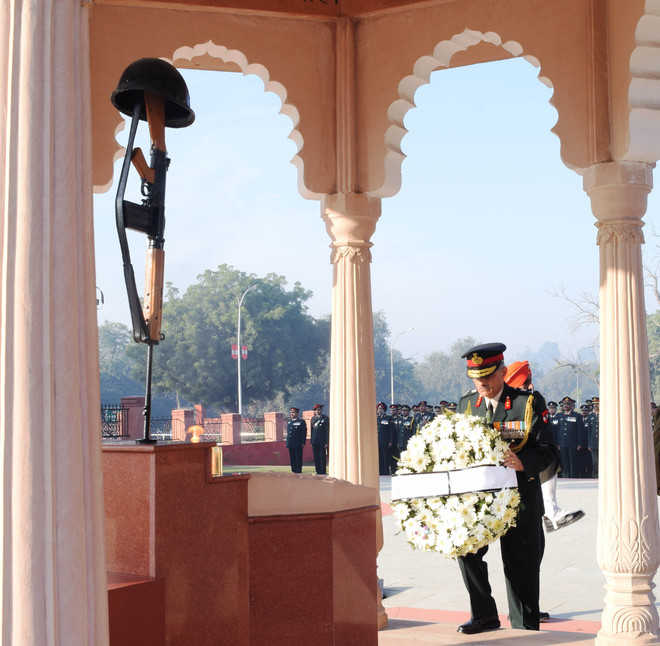
Lt-Gen Ashwani Kumar, General Officer Commanding, Chetak Corps, during a wreath laying ceremony at Yodha Yaadgar War Memorial in Bathinda on Friday. A Tribune photo

Tribune News Service

Bathinda, December 16

Chetak Corps commemorated the 45th anniversary of Vijay Diwas at the Bathinda Military Station.The commemoration began with a wreath laying ceremony at Yodha Yaadgar War Memorial by Lt-Gen Ashwani Kumar, General Officer Commanding, Chetak Corps and other serving personnel in remembrance of soldiers who made the supreme sacrifice in the service of the nation.Tributes were paid to soldiers who took part in the 1971 war and brought glory to the country.Vijay Diwas (victory day) is celebrated every year on December 16 to mark India’s victory in the Indo-Pak war of 1971.The war ended after the Eastern Command of the Pakistani army signed the Instrument of Surrender in Dhaka, marking the liberation of Bangladesh.


Dispel The Spectre of War; Rein in The War Mongers

cdb09f24-f386-46cd-8b85-6ef9bc4450f8
MAJOR GENERAL SG VOMBATKERE


India’s September 29 cross-LOC strike was conducted professionally, as expected of the apolitical army of the Indian Republic. Pakistan’s predictable response is denial of its ever having happened.

It could have been left at that, but the government and the opposition (such as it is), encouraged by TRP-hungry TV channels provoking certain publicity-hungry military veterans, have been using the apolitical army’s professionalism to make political or personal capital of the success of the operation, thus stoking war hysteria among a vocal minority. 

More specifically, Defence Minister Manohar Parrikar stated that it was he who enabled the Army to realize its own power and capability. Further, notwithstanding Prime Minister Narendra Modi discouraging chest-thumping over the success of the strike, Parrikar is freely indulging in it, even suggesting that enlargement of the conflict is possible. 

Somewhat more worrying is the fact that USIBC (US-India Business Council) sees “tremendous [business] opportunity” for USA’s military-industrial corporations, as tensions heighten between India and Pakistan. Whether or not India and Pakistan are presently economically or logistically capable of entering into even a short war (as in 1965, 1971 or 1999), the assurance of business in military hardware is being surreptitiously ensured. 

In addition, there is sufficient unfortunate precedent for countries entering into war or conflict simply to divert public attention from domestic problems, and India and Pakistan (and US and China too) presently have that motivation. 

Chinese artfulness overshadowed PM Modi’s “jhula diplomacy” at Sabarmati soon after he had assumed charge as PM. Even as the two sipped tea, Chinese troops were intruding into India near Depsang la in Ladakh, and most of PoK’s Gilgit was already occupied by Chinese PLA troops. 

PM Modi’s 2016 Independence Day mention of Pakistan’s problems in Balochistan, followed by an important Balochi seeking asylum in India, and most recently a Balochi “official” proposing creation of a Balochi government-in-exile in India, has clearly turned China more openly against India, because its CPEC terminates in Gwadar port on Balochistan’s Arabian Sea coast.

Some strategic thinkers suggest that India “taking on” Pakistan actually amounts to challenging China, thus opening our northern and eastern fronts in addition to our western front with Pakistan. It must be recalled that with the Lhasa railway in operation, China has excellent logistic support for its military already deployed on India’s Tibetan border, within comfortable missile range of India’s populous heartland cities. Further, we must not fail to note that when India proposed reworking the Indus Water Treaty to “punish” Pakistan, China immediately brought up its control over Yarlung Tsangpo (Brahmaputra) waters to effectively kill the proposal. 

India had drawn close to USA with PM Manmohan Singh’s initiative for strategic partnership with successive US presidents Clinton, Bush and Obama, when LEMOA and CISMOA, both of military importance, were proposed. There being no substantive difference between the (essentially neoliberal) strategic-economic outlooks of the NDA-1, UPA-1 & 2, and NDA-2 governments, today these two Agreements are on the verge of being operationalized. This has worsened India-China relations. 

Pakistan peevishly demanded similar “treatment” from the US. All this has driven the Pakistani State – the present elected government ostensibly in the driving seat, but with the steering wheel, accelerator and clutch-and-gears controlled by its army – ever closer to China, which has over the years provided it nuclear technology, weapon-delivery systems and hardware. 

A section of India’s electronic media has sought to humiliate Pakistan by tom-tomming the eminently successful September 29 cross-LOC strike, even as India has launched a diplomatic offensive to isolate Pakistan in the international community. With East Pakistan gone (1971) and Balochistan – 40% of its land area – now “on the block”, Pakistan feels threatened and cornered, but is predictably defiant in the warmth of China’s support. 

India’s choice of close (albeit subordinate) strategic partnership with the US has alienated both China and Russia, which have been moving closer together because of the common threat represented by the US in the Pacific and NATO in Europe.

Pakistan is moving closer to both China and Russia, and the strategic lines are being drawn more clearly. At the same time, India-Pakistan relations are in a tail-spin, with India talking about Balochistan while Pakistan talks of the Kashmir unrest, and both beat war drums. 

With terror-exporter Pakistan effectively run by its India-hating military-ISI combine, and badly hit by its own Frankenstein monster on the one hand, and a strongly right-wing government in India embattled by a make-or-break political situation at home on the other hand, the sub-continent appears close to escalation of military hostilities, possibly even war. 

By talking at each other rather than with each other, India and Pakistan are doing what can only profit military-industrial corporations which manufacture and supply military hardware, and smell business opportunity in the deaths and wounds of the inevitable victims of war. 

War is the product of forces in the international political stratosphere, caused by default or design of politicians, and prosecuted by generals who are far from the battle-fronts. 

Battles are fought by middle-rank and junior officers, JCOs and soldiers, who are the primary casualties. No soldier of any country in his right senses wants war, even if he trains and prepares assiduously for it, and proudly rises to the occasion like the Indian officers and soldiers have repeatedly done. 

The common citizen of every country wants peace and social tranquility, not war. But today, the Indian sub-continent is teetering on the edge of war. It is therefore the crying need of the hour for all right-thinking citizens in India and Pakistan to speak up and prevail upon their respective governments to de-escalate tensions and begin talks, rein in the war-mongering sections of the media and the public, and initiate appropriate diplomatic measures without, at the same time, lowering the military guard. 

This is eminently doable if military efficiency and prowess is not subordinated to domestic or international political expediency. As far as India is concerned, “NO WAR” should be the opening mantra if we want peace and development according to “sab ka saath, sab ka vikas”, coined by PM Modi. 

(Major General S.G. Vombatkere, VSM, retired as Additional DG Discipline & Vigilance in Army HQ AG’s Branch.)


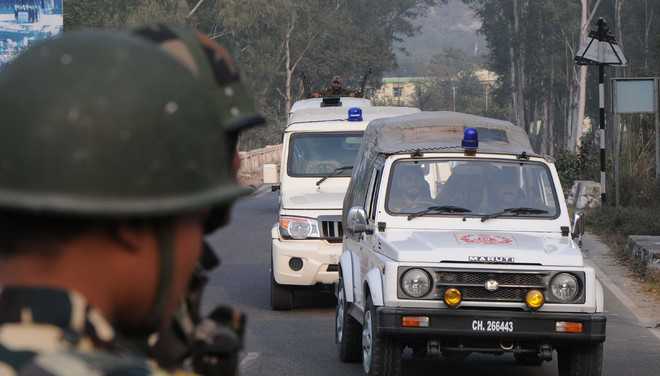
Allow the Valley to heal by Arun Joshi

Allow the Valley to heal
scarred & broken: Only a determined attempt at course-correction will help.

NEW DELHI is busy in its revelry under the “masterstroke” of demonetisation in the country, with an illusion-filled claim that all acts of terrorism in Kashmir have come to an end with the “surgical strike” on black money and counterfeit currency. Pakistan has been rendered penniless for sponsoring terrorism on this side of the border as its fake currency notes have no takers. It is wishful thinking that Kashmir has returned to days of peaceful paradise.The bitter fact is that Kashmir is slipping out of India, psychologically. There is a drastic change in the mindset of the people who have seen the worst kind of atrocities being inflicted from both sides over the past four-and-a-half months. What has hurt them most  —more than the killings — is the blinding of young stone-throwers, some of them innocents caught in the shower of pellets, sitting in their homes, while watching the protests as curious onlookers. They do not go into the cause — the violent protests with stones and petrol bombs, but talk of the security forces excesses. They don’t make any distinction between the local police, paramilitary force personnel or the Army. All these are clubbed together as the “Indian forces” or the 

“government forces”.

Physically, more terrain has been occupied by the anti-India elements. There are more local militants and the ground swell for insurgency is overflowing. People empathise with the militants. Countless masses who attend the funerals of slain militants are volunteers — certainly not coerced men and women. By any stretch of imagination, it is a very serious situation, the repercussions of which would be felt in the next couple of years, unless there is a determined attempt at course-correction by the government.What is being pointed out is that normalcy has fnally returned to the Valley. Schools open at weekends, examinations are on, public transport has started plying, more and more shops have started opening during daytime, and separatists have been forced to moderate their protest calendar. This welcome return to the unmistakable signs of normal day-to-day life needs to be analysed with clear glasses.One part of it is that the people who had lent their support to the shutdowns and protests have developed a fatigue factor. Even normal life had become a dream for them. Daily clashes, torching of government property, particularly schools, and the stones that dented vehicles and injured travellers, deserted streets, and 24×7 gloom had caused depression to set in among the people. And they wanted to come out of this depression. What did they do? Knock the doors of separatists because the rulers told them that their efforts would yield no results unless separatists gave a green light.The second part was a spree of arrests and raising the number of security personnel, mostly Army troops, to quell the disturbances. Stone-throwers had retreated more than six weeks ago to escape the arrests. Some of them had shifted outside the Valley, others were scared of violent clashes after having seen the consequences. The element of the use of force and heavy presence of soldiers cannot be overlooked. Today, there are more footprints of soldiers and paramilitary forces in the Valley  than ever before.Kashmiris want to live a normal life. They have natural instincts like any other race to generate economic activity and pursue fruitful careers, and live without any fear of midnight knock or stones shattering their houses and vehicles or boulders and timber log keeping them as besieged people. They wanted freedom from this suffocating atmosphere, which visited them this year following the killing of Burhan Wani, a militant leader, in July. Burhan Wani was a product of radicalism. He preached radicalism. He had called for the setting up of Caliphate in Kashmir in which the “revolution” was to be carried out by killing policemen and snatching their weapons. His social media face got the boost than his actual height and robust physique. That social media image was imprinted among young Kashmiris who trusted him with his face on Facebook profile or the words on Twitter. But now things have moved far beyond, where even if Burhan Wani was to take new birth, he would find himself overtaken by the events and radicalism among youth. He would look like a follower rather than the leader of the radical ideology.And let it be put straight and clear that the Indian surgical strikes in Pakistan-occupied Kashmir have shown that those were no game-changer really. Pakistan has not stopped terror activity nor was it in need to retaliate with surgical strikes. That would not have been a useful proposition for it. And so it is continuing with infiltration and terrorists are attacking police stations and police camps.On November 25, the Indian Army lost a soldier in an encounter at Bandipore in north Kashmir and two policemen were killed in an ambush at Kulgam in south Kashmir. Pakistan has activated its sleeper cells. There are plenty of them in and outside the system. This is the real danger. Violence along the Line of Control can be responded with heavy gunfire and mortar shelling, as the Indian Army did on November 23 to “unleash heavy retribution” for Pakistan’s cowardly act (of mutilating the body of one of the three soldiers killed in the Macchil sector in Kupwara district in north-west Kashmir) on Tuesday.The Indian assault left three Pakistani soldiers dead and also nine travellers. And Pakistan was quick to move the United Nations. The UN, which is the most disliked institution by India as far as its intervention in Kashmir is concerned, was ready with sermons that the “Kashmir issue be resolved by India and Pakistan as per the peoples’ wishes”. These kind of international statements on Kashmir strengthen those who believe that they can pin down India on Kashmir. They are losing faith in dialogue with New Delhi. This is a dangerous situation. The opening of markets and public transport ferrying commuters are not the signs of hearts having been conquered. Much more needs to be done.