China’s bid to expand influence in Lanka a concern for New Delhi
Navy Chief Admiral Dinesh K Tripathi on Monday began a four-day visit to Sri Lanka to hold talks with the top military brass of the island nation for expanding bilateral defence ties in the maritime domain.
The Navy chief’s visit comes amid concerns in New Delhi over China’s persistent attempts to expand its strategic influence in the island nation. In Colombo, Admiral Tripathi will also meet Sri Lanka Prime Minister Harini Amarasuriya and hold talks with the three service chiefs and other senior officials.
The talks will be focused on a broad spectrum of matters with emphasis on maritime security, capability enhancement, training and identifying avenues to strengthen bilateral cooperation, officials said.
“The Chief of Naval Staff’s engagements in Sri Lanka are structured at deepening bonds of friendship, paving the way for enhanced understanding in key areas of shared strategic and maritime interests, in line with the vision of ‘MAHASAGAR’,” an official readout said.
“The visit reaffirms the time-tested India-Sri Lanka relations, anchored on mutual respect, maritime trust and a shared vision for peace and stability in the Indian Ocean Region,” it added.
Admiral Tripathi will also participate in the 12th edition of Galle Dialogue at Colombo on the theme ‘Maritime Outlook of the Indian Ocean under Changing Dynamics’. India has been eyeing to further expand maritime security cooperation with Sri Lanka.
In June, state-run Mazagon Dock Shipbuilders Limited (MDL) decided to acquire a controlling stake in Sri Lanka’s Colombo Dockyard PLC under a $52.96 million deal, a move that is expected to expand India’s strategic presence in the island nation.
Indian Navy regularly interacts with its Sri Lankan counterpart through medium of annual defence dialogue and staff talks. The two navies also hold Sri Lanka-India Naval Exercise (SLINEX), passage exercises and regularly engage in training and hydrography exchanges.
57 years after soldier’s discharge on medical grounds, widow gets pensionary benefits
It was observed the case fell under Section 197 of the Pension Regulations, which allow disability pension to an individual who is invalided out of service on account of a disability which is neither attributable to nor aggravated by service
About 57 years after her late husband was invalidated out of the Army on medical grounds, the Armed Forces Tribunal has held that the soldier was entitled to disability pension and his widow should get the due benefits.
The now deceased soldier, Lance Naik Umrawat Singh was enrolled in the Army in September 1961 and took part in the India – Pakistan War of 1965. However, he underwent severe mental stress and strain on account of being posted on the borders for long periods of time, court records said. He developed ‘schizophrenic reaction’ and was boarded out of service in December 1968 after seven years and three months of service.
His claim for grant of disability pension was rejected. Subsequently, he enrolled in the Defence Security Corps in September 1972, but was discharged in November 1972. He finally passed away in January 2011.
The authorities had contended that since the requirement for grant of pension was 15 years, he did not fulfil the criteria for service pension. Further, not only his disability was held to be neither attributable to nor aggravated by military service, but was also assessed to be below 20 per cent, which is not eligible for disability benefits.
The Tribunal’s Chandigarh Bench comprising Justice Sudhir Mittal and Lt Gen Ranbir Singh observed that Umrawat’s case fell under Section 197 of the Pension Regulations, which allow disability pension to an individual who is invalided out of service on account of a disability which is neither attributable to nor aggravated by service. Or to an individual who is invalided out of service on account of a disability which is attributable to or aggravated service, but the disability is assessed at less than 20 per cent, or to an individual placed in low medical category who is retired or discharged from service for lack of alternative employment compatible with his low medical category.
Thus, it is evident that the deceased soldier was entitled to the grant of invalid pension with effect from December 1968, and accordingly, his widow is entitled to the grant of ordinary family pension with effect from February.2011, the Bench ruled.
Two of last 12 Maoist leaders killed in Chhattisgarh gunfight
n a significant blow to the already depleted leadership of Naxals, two key Maoists — Katta Ramachandra Reddy (aka Raju Dada) (63) and Kadari Satyanarayana Reddy (alias Kosa Dada) (67) — were on Monday killed in an encounter by the security forces in Abujhmad area of Chhattisgarh’s Narayanpur district.
Both of the killed Maoists were natives of Karimnagar district of Telangana and key Central Committee members of CPI (Maoist). They also carried a bounty of Rs 40 lakh each.
According to the police sources, the gunfight took place on Monday morning during a search operation. The security forces had launched the search after they received inputs about the movement of Maoists in the Abhujmad forest along the Chhattisgarh–Maharashtra border.
After several hours of gun battle, the ultras retreated in the forest, leaving behind the bodies of the two Naxal leaders. The security forces also recovered one AK-47 rifle, one INSAS rifle, one Under Barrel Grenade Launcher, some Maoist literature and other daily-use items from the site.
Hailing the operation, Home Minister Amit Shah, in a post on X, said, “In the Abujhmad region of Narayanpur along the Maharashtra-Chhattisgarh border, our forces eliminated two Central Committee Member Naxal leaders – Katta Ramachandra Reddy and Kadri Satyanarayan Reddy. Our security forces are systematically dismantling the top leadership of the Naxals, breaking the backbone of red terror.”
Sources informed that Raju Dada, also known by aliases Gudsa Usendi, Vijay and Vikalp, had been active for 40 years and was currently a member of the Maoist Central Committee, the highest decision-making body of the banned organisation.
Kosa Dada, also known as Gopanna and Buchanna, a Central Committee member, was considered a key strategist of the outfit and served as the operations planner for the Dandakaranya Special Zonal Committee, where he had been active since the early 1990s. Both of them had been involved in major ambushes and attacks targeting security personnel across Bastar, the police said.
Their killing has further reduced the Central Committee of CPI (Maoist) to 10.
The Tribune on September 19 had reported how the killing and surrender of some key Naxals in the recent past had hit the Maoists hard, with only 12 top Central Committee members left. Kadari Satyanarayana Reddy and Katta Ramachandra Reddy were among these 12 leaders.
Now with the killing of these two on Monday, the Maoist leadership has further depleted, even as voices of surrendering and initiating peace talks with the government seem to be rising from within the Naxals’ fold.
The CPI (Maoist) Central Committee also received fresh setbacks last week, when on September 12, a top Naxal leader, Modem Balakrishna, was shot dead in a gun battle with security forces in Chhattisgarh. Pothula Padmavathi (known as Kalpana), Mynakka, Mainabai and Sujatha, a senior-most underground leader of the banned CPI (Maoist), had surrendered before the Telangana DGP on September 13. She had been underground for 43 years.
Maoist Sahadev Soren was killed in an exchange of fire with security forces at Karando in Jharkhand on September 15. One of the top CCM members, Soren was killed along with two of his comrades. He carried a reward of Rs 1 crore on his head.
Another key Naxal leader, Nambala Keshav Rao, aka Basavaraju, was earlier shot dead in a gunfight with security forces in Chhattisgarh’s Gariyaband on May 21 this year.
Now with the elimination of Katta Ramachandra Reddy and Kadari Satyanarayana Reddy, only 10 top Central Committee leaders now remain absconding. These are Muppala Lakshmana Rao, Mallojulla Venugopal, Thippiri Thirupathi (reportedly the new CPI (Maoist) general secretary), Pulluri Prasad Rao, Paka Hanumanthulu, Pusunuri Narahari (all from Telangana), Misir Besra, Anal Da (both from Jharkhand) and Madavi Hidma as well as Majjidev (both from Chhattisgarh).
Muppala Lakshmana Rao was said to be keeping unwell, police sources said.
Senior Maoist commander Madavi Hidma has reportedly been appointed as secretary of the Dandakaranya Special Zonal Committee of CPI (Maoist), which is considered one of the most powerful decision-making bodies of the outlawed party.
ar Assn rejects proposal to shift HC to new premises
The Punjab and Haryana High Court Bar Association’s General Body today shut the door on shifting the High Court to a new site, opting to retain the institution within its current premises instead. The decision was taken through a show of hands, amidst warnings from the court about severe space constraints that could make relocation unavoidable.A Bench of the HC had earlier asked Bar president Sartej Singh Narula to place before the court the Bar’s opinion on whether it was willing to shift. The Judges had clarified that they were open to relocation, provided the General Body of the Bar Association agreed.
“Executive Committee has passed a resolution that they are ready and willing to search for an alternative site for the High Court. Let the resolution of the Executive Committee be placed before the General Body, which, if passed, would definitely be accepted by the Court, not otherwise,” the Bench headed by Chief Justice Nagu had asserted.
The matter, as such, was placed before the General Body this afternoon, where the relocation proposals and other issues were discussed. Initially, formal voting was contemplated, but the General Body chose to decide through a show of hands.
The development is significant as the court had previously acknowledged the acute shortage of space in its existing complex, while discussing the proposals to move the High Court to Sarangpur or the IT Park. But the rejection by the Bar today virtually closed the door on any immediate relocation.
“We are forced to think about an alternative site for the High Court…. Such a good building you have. It’s a unique building. I have not seen such a building in the entire country. And yet you are compelling people to leave this building by your adamancy,” the Bench had earlier asserted, while making clear its stand.
Currently, the High Court functions with 69 courtrooms against a sanctioned strength of 85 judges. The Bench, during the course of hearing, was informed that the number of functional courtrooms could rise to 89 if certain staff occupying existing courtrooms were relocated.
The Bench is now virtually left with two proposals: converting adjoining forest land into non-forest area to allow expansion of the current premises, and constructing a new judicial complex opposite the High Court Bar Room.
The UT Administration has already approved the plan to construct 16 additional courtrooms across two floors, along with two basement levels for parking, which would provide nearly two lakh square feet of additional space.
On the issue of forest land conversion, UT senior standing counsel Amit Jhanji has all along been maintaining that de-reservation could not be considered. He pointed out that the proposed land was an eco-fragile patch of reserve forest notified under the Indian Forest Act, 1927, forming part of the Sukhna Lake/wetland catchment. Also, it falls within the eco-sensitive zone of the Sukhna Wildlife Sanctuary as per the Environment (Protection) Act notification of January 10, 2017.
Additional Solicitor-General of India Satya Pal Jain, on the other hand, has been stating that the real obstacle is not legality but a lack of willpower. “People who have to do it lack willpower,” he remarked during a hearing, highlighting bureaucratic inertia as the key challenge in expanding the High Court’s infrastructure.
Decisions taken at the meeting
The General House of the Bar Association unanimously decided not to shift the High Court to Sarangpur or any other alternative site.
The Bar Association will pursue de-reservation of adjoining forestland to enable the expansion of the High Court at its current location.
The continuation of the High Court at its present site is considered in the best interest of the legal fraternity, litigants and justice administration.
Copies of the resolution are to be forwarded to the Chief Justice and judges of the High Court, Union Law Minister, Chief Ministers of Punjab and Haryana, and the UT Administrator for consideration and necessary action.
Aero Sports Rules amended, safety norms made stringent
The state government has amended the Himachal Pradesh Aero Sports Rules, 2022, to make norms for adventure sports more stringent and safe, especially for those who take a joy ride with a professionally-trained pilot.
The Department of Tourism and Civil Aviation had issued a notification on September 20 to seek suggestions and objections to the amendment within 30 days. These amended rules will be called the Himachal Pradesh Aero Sports (Amendment) Rules, 2025. The amendment has been made in the clause j of sub rule (3) of Rule 5 of the Himachal Pradesh Aero Sports Rules, 2022.
As per the amendment, the pilots undertaking tandem flights will have to complete simulation during the flights paragliding safety course. Pilots will now have to complete this course before seeking a tandem licence. The pilots already registered with the Department of Tourism and Civil Aviation have been given time to complete the simulation safety training course for paragliding by August 31, 2026.
Aero sports, especially paragliding, are a big attraction, particularly for tourists in Himachal. Paragliding is being undertaken at various places like Bir-Billing near Baijnath in Kangra, in Kullu and Manali and several other locations. However, several people have lost their lives in various mishaps.
The amendment is aimed at making safety norms more stringent and the safety course mandatory for pilots, who are undertaking tandem flights, where a person takes a flight in a paraglider with a trained professional pilot.
As per the Himachal Pradesh Aero Sports Rules, 2022, a person can undertake aero sports only after registration with the Tourism Department. It is after approval from the technical committee regarding proper training and safety of the equipment being used that a person is issued a licence.
However, there have bene instances where people, who are not registered with the Tourism Department, have been found to be undertaking aero sports. Though at times even trained pilots meet with mishaps, the greater problem is when there are accidents during tandem flights.
There have been several mishaps, especially in Kullu where tourists enjoying a tandem flight with a trained pilot have died in accidents. The amendment is basically aimed at averting such mishaps by way of proper safety training for pilots, who are undertaking aero sports as a commercial activity for tourists.
Pakistan bombs own village in Khyber Pakhtunkhwa, kills 30 civilians
Govt, military silent on attack | Tribals to launch protest | Rights panel seeks probe
At least 30 civilians, most of them women and children, were killed in the early hours of Monday when airstrikes hit the village of Matre Dara in the Tirah Valley of Khyber Pakhtunkhwa, according to Indian intelligence sources.
The strikes, which began around 2 am, reportedly involved JF-17 fighter jets dropping at least eight China-made precision-guided bombs on the remote settlement. Witnesses described scenes of destruction, with bodies scattered in the streets and survivors digging through the rubble of collapsed homes with their bare hands.
“Entire families have been wiped out. Most of the victims are women and children who had no chance to escape,” a source said.
The Tirah Valley, near the Afghanistan border, is an area where Pakistani forces frequently target militants from the Tehreek-e-Taliban Pakistan (TTP) and allied groups. The military describes it as containing “dozens of TTP hideouts”. However, such operations have often been criticised by human rights organisations for causing high civilian casualties.
There was no official comment from the Pakistani government or military on Monday’s incident. The strikes were not even reported by Pakistani media. A local police officer, speaking on condition of anonymity, confirmed that airstrikes had targeted at least four houses suspected of being belonging to TTP militants.
Sohail Afridi, a member of the provincial assembly from Khyber district, accused the security forces of carrying out a “carnage”. In a post on X that included a video showing dead children, he wrote, “Scenes of destruction in the Tirah Maidan Akakhail Shadla Matre Dara area after jet bombing by security forces.” In an apparent reference to the Pakistani government, Afridi said the killing of children and innocent people has become a routine for the “oppressors occupying this state”.
This is not the first recent incident of its kind. A week earlier, four children were killed and five others injured in a quadcopter attack, which the Pakistan Army denied conducting, instead blaming the TTP. In May, 22 persons, including seven children, were injured in a similar strike.
Following the airstrikes, tribal elders from the Afridi community reportedly convened a meeting to discuss plans for protests and a possible siege of a nearby air force base in Peshawar.
The Human Rights Commission of Pakistan (HRCP) expressed outrage and demanded an investigation. It said, “The HRCP is deeply shocked to learn that civilians, including children, have been killed allegedly as a result of aerial bombing in Tirah, Khyber district. We demand an immediate, impartial inquiry and that those responsible be held to account.”
DURING the 1965 India-Pakistan war, 4 Mountain Division was deployed at Khemkaran in Punjab’s Majha region. Among 4 Division’s most distinguished battalions was 4 Grenadiers. Lt Hari Ram Janu, my course-mate at the NDA, was the Forward Company Commander of this battalion’s C Company. He had been in service for two years and three months. His platoon commander, 2nd Lt BK Vaid, had less than a year’s service.
The company was deployed on the Khemkaran-Chima road. A roadblock had been laid. In the afternoon on September 10, 1965, two jeeps followed by a tank were seen coming up the road from Khemkaran. The jeeps came to a stop near the roadblock.
The forward jeep had two stars on it; an officer stood up and shouted to the nearest Grenadiers trench that had three men and a light machine gun (LMG): “Throw down your weapons; you are surrounded!” The Bren gunner stood up in the trench and froze; he was astonished to see a senior officer standing next to the driver. 2nd Lt Vaid ordered the gunner, “Fire, open fire!” The gunner finally opened fire at the officer and the driver. Both collapsed.
The items recovered from the jeep included an officer’s beret, star plates and a swallow-tailed pennant; it was presumed that Maj Gen Naseer Ahmad Khan, GOC of Pakistan’s 1 Armoured Division, had been killed. This was confirmed because the rescue tank commander had shouted for the ‘General’ and there was a wireless intercept to the effect that ‘Bade imam sahib’ had been killed. The three young men in the trench were Naushad, Sulleman and Shafi.
What had transpired was that the GOC, confused about the whereabouts of the Indian forces, had given his jeep to his Artillery Brigade chief Brig Ahsan Rasheed Shami, who volunteered to carry out a reconnaissance. It was he who stood up to challenge the occupants of the trench and was shot.
The Brigadier’s map case and an operational order marked “top secret” was also found. It was the order for Pakistan’s operation to bypass both the 4 Division and 7 Division defences and then capture the Beas brigade, severing the GT road and communications to all 11 Corps formations.
When the Western Army Commander, Lt Gen Harbakhsh Singh, arrived at the 4 Division HQ on September 11, the Op order and the map were shown to him. I was then instructed to take the documents back to the Command HQ. It wasn’t a pleasant task as the papers were soaked in blood. Along with these were the officers’ identity cards and personal effects. On reaching the Command HQ, I handed them over to the Chief of Staff and they were immediately sent to the Army HQ in New Delhi.
After detailed discussions and a late dinner, Lt Gen Harbakhsh Singh, left at 2 am to take rest. We were to leave for 11 Corps at 5 am. Around 3 am, I was in my sleep when I heard the telephone ring. I answered it and a voice asked for the Commander. I asked him to identify himself. In response, he shouted, “I’m the Chief. Who else do you think!” I said, “Sorry, Sir. I will get the Commander for you.” I called up but got no response. I told my roommate, Capt Jiti Choudhry of Hodson’s Horse — who had been ADC (aide-de-camp) to Gen Daulat Singh — that I was going to the Commander’s room and that when I rang up, he should put the call through.
Lt Gen Harbakhsh was asleep when I entered his room. I shook him awake, saying, “The Chief is on the line, Sir”. Jiti put the call through. I stood by as the Commander spoke. The Army Chief said: “I have seen the Pak Op order for the dash to the Beas. I suggest you withdraw 11 Corps formations to hold a line on the Beas river.” The Commander responded in the negative: “I’ve just come from 4 Division. The situation has stabilised. The 2nd Armoured Brigade is now under its command and 3 Cavalry is also now with 4 Division.” It was decided that the Commander would postpone his visit to 11 Corps and the Chief would visit him at the Command HQ at Ambala.
At 10 am the next day, the Chief arrived at Ambala. A lengthy discussion took place on various matters, but the contentious issue of the Western Command’s withdrawal to the Beas, thereby giving up a large area of Majha (including Amritsar and Tarn Taran), was not taken up as the situation had changed overnight. Had a pliant Commander been in charge, a large chunk of Punjab would have been lost and the morale of the Army would have hit a new low just three years after the Chinese debacle.
Earlier, on September 8, Pakistan’s 1 Armoured Division confronted the battalion at Bhura Kuhna and Asal Uttar. Around 9 am, an LMG section deployed about 20 yards from the road shouted that two tanks were approaching their position from the direction of Khem Karan and were about 200 yards away. Company Quarter Master Havildar Abdul Hamid’s RCL (recoilless rifle) detachment was around 30 yards to the right of the Company HQ. Lt Janu called out to him to engage the tanks as soon as he could see them. Hamid got the lead tank with his first shot. The following two tanks were abandoned intact by their crews. At 11 am, following a severe artillery barrage, another tank attack took place. Hamid once again knocked out the lead tank. The following tanks were also abandoned. The troops attacking B Company disengaged and withdrew.
By 11:30 am, a column of 1/9 Gorkhas withdrew from Bhura Kuhna due to an enemy armoured assault. Around noon, enemy tanks entered the 4 Grenadiers’ battalion defences at Chima and opened fire at close range. The RCL platoon commander, despite being wounded, ordered his detachments to engage the enemy tanks. Hamid’s detachment knocked out two of the tanks that made an attempt to overrun their defences. Another attack was also repulsed, with the enemy losing two more tanks in the process. The battalion suffered six casualties. At 3 pm, a squadron of Centurion tanks of 3 Cavalry reached the spot and forced the enemy to withdraw from Bhura Kuhna. At 2:30 pm, a third attack, this time on B Company, took place and two more tanks were shot by the RCL detachment.
At 9 am on September 9, a fleet of four F86s strafed the area. This was followed by tank attacks at 9:30 am, 11:30 am and 2:30 pm. Hamid accounted for two tanks, and Havildar Bir Singh of B Company two more.
On September 10, the most important day of the Asal Uttar battle, enemy artillery started its bombardment of the Grenadiers at 6 am. One tank led the way on the road, followed by one on either side. The tanks were spotted at 200 yards, but Lt Janu ordered Hamid not to engage them till they were closer. Hamid then destroyed the leading tank, the other two being abandoned by its crew.
At 9:30 am, Hamid shot two more tanks, and while he was sighting the third, both he and the enemy fired simultaneously, hitting each other and killing both crews. 4 Grenadiers had shot 15 tanks and held its ground despite being under constant armoured attack. It received the Battle Honour ‘Asal Uttar’ and the Theatre Honour ‘Punjab 1965’. Hamid was posthumously awarded the Param Vir Chakra for his gallantry during this battle.
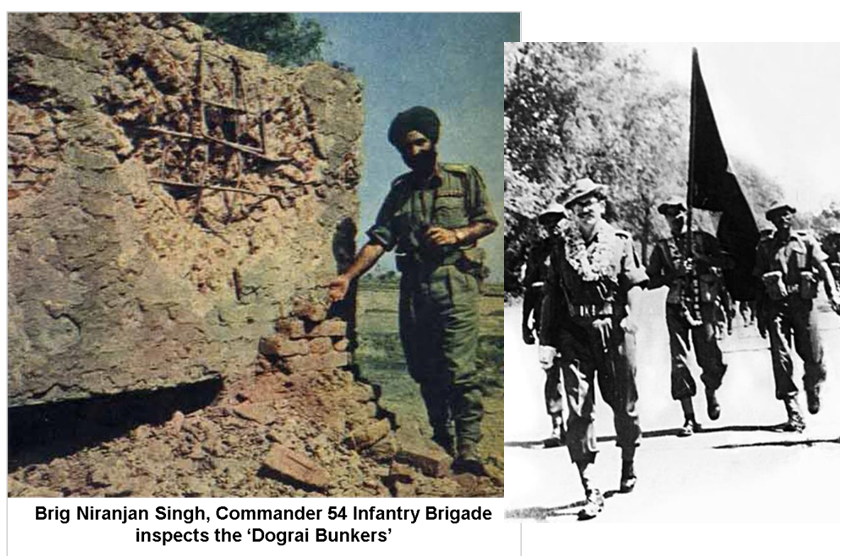
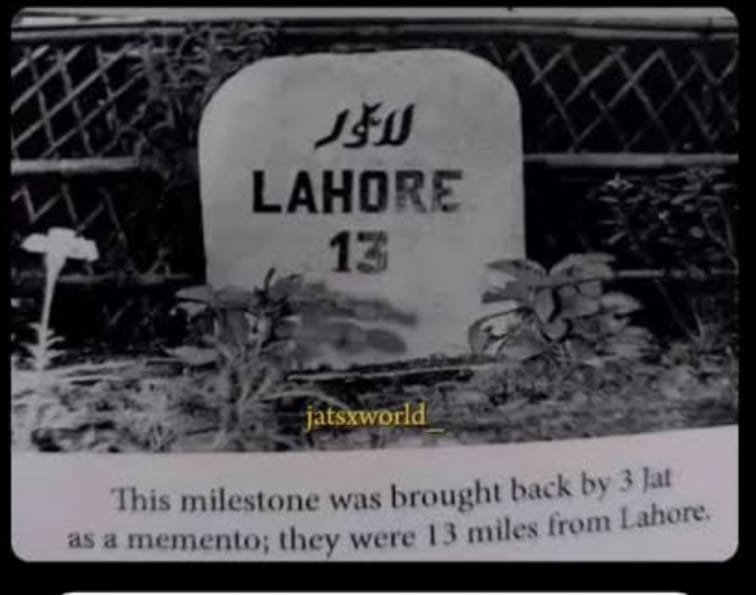
On 17 Sep 3 JAT was ordered to recapture Dograi as a part of a fresh 15 Infantry Division offensive. After detailed planning and probing attacks, Dograi would be retaken inch by inch once again in a gruesome battle. 3 JAT was in the Assembly Area by 1.15 AM on 21 Sep. 13 PUNJAB who had attacked MILE 13 enroute could not make much headway. This attack however divided the enemy’s attention from the 3 JAT attack giving them immense tactical advantage. 3 JAT assault began at 2 AM with two companies Charlie and Delta leading. Delta Company found the old village empty and wheeled right to new Dograi. Charlie Company came under intense fire from the canal bank. One platoon of Delta Company, following Charlie Company, charged through to attack the depth positions.
The enemy, a mixed company of 12 Punjab and 18 Baluch were routed. The fight was ferocious; of the seventy three men of Charlie Company who had charged the enemy, only twenty seven were left on their feet. This initial success was followed by house-to-house clearance and bloody mopping up operations. By 4 AM the enemy was gripped by panic and started running away. 3 JAT mounted their light machine guns on rooftops and picked off the fleeing enemy.
Bravo Company following Charlie Company passed through to attack the demolished bridge on Ichhogil Canal. They were met with intense fire …. the leading section was completely wiped out. This did not deter the Company; they soon ejected the enemy platoon guarding the east bank. Alfa Company was tasked to hit the enemy’s tank harbour. They dashed ahead to surprise the enemy while the main attack was building up, two enemy tanks were captured. The regiment regrouped quickly on the objective and prepared for a counterattack by the enemy.
The first of four counter attacks began with an intense barrage of artillery fire at about 4.30 AM. The JATs were waiting and responded fiercely killing the Counterattack Force Commander. The morning brought fresh surprises. Nearly two companies of 16 Punjab (Pak) were found to be still occupying defences in MILE 13 from where they were engaged in a firefight with 13 PUNJAB. 3 JAT was likely to be sandwiched between the counterattacks and these Pak companies holding well prepared defences.
Captain Jagtar Sangha, Squadron Commander of SCINDE HORSE lined up two troops (8 Tanks) abreast the GT Road and charged the defences at MILE 13 with all guns blazing. Two of his tanks were hit with strim grenades but the charge was pressed home. The defenders of 16 Punjab were so unnerved that they broke ranks and ran. Many were taken prisoners including Lt Col GF Golewala, the Commanding Officer (CO). The second counterattack came at 7 AM with intense shelling of Dograi and MILE 13. Swift and accurate retaliation with RCLs and Artillery firing in direct firing role unnerved the attackers and destroyed a number of their tanks.
The Pakistanis remained determined, and counter attacked again at 10 AM. A squadron of Pakistani tanks attempted to outflank 54 Infantry Brigade from the North. RCLs of 1 JAT and 1/3 GORKHA Rifles of 38 Infantry Brigade deployed in the North were grouped to face the assault. An intense Infantry Tank battle ensued, the enemy tanks charged through the defences of one of the forward companies of 1 JAT, passing over their trenches. The brave JATs stood firm. After nearly an hour, the Pakistani withdrew leaving behind six burning hulks. There was also no respite in Dograi, the enemy continued shelling and snipers made movement through the rubble of Dograi for reorganisation and casualty evacuation difficult. By evening 3 JAT was reinforced by a draft from the JAT Regimental Centre and two companies of 13 PUNJAB.
Nightfall brought ominous signs of a fourth counterattack. Alfa Company however discovered the enemy assembly area and using machine guns launched a spoiling attack against the enemy disintegrating his plans. Morning of 23 Sep revealed 65 bodies of soldiers from 8 Punjab (Pak). By night 22 Sep four counterattacks were beaten back with heavy losses to the enemy. Respite from fighting came with cease-fire in the early hours of 23 Sep. Islamuddin a Pakistani soldier who had once served in 3 JAT came to the west bank of Ichhogil canal on afternoon of 23 Sep and shouted across, “Only my old battalion could have done this!” What better tribute? The exceptional leadership and courage of the CO Lieutenant Colonel Desmond Hayde was acknowledged with the award of a Maha Vir Chakra
. The Battle of Dograi was fought in cold blood with determination and guts. In both battles for Dograi, 3 JAT suffered 5 Officers killed and 9 wounded, involving practically all officers of the battalion; 1 JCO killed and 8 wounded and 82 other ranks killed and 214 wounded. The battalion won three Maha Vir Chakras, four Vir Chakras, seven Sena Medals, 12 Mention-in-Dispatches and 11 Chief of Army Staff’s Commendation Cards. The casualty figures and decorations bear witness to the outstanding performance by indomitable 3 JAT in the face of heavy odds. The enemy suffered heavy casualties of 509 killed, 400 wounded while 100 soldiers and officers were taken as Prisoners of War (POW).
State Stalwarts
DEFENCE MINISTER
Minister Rajnath Singh
ALL HUMANS ARE ONE CREATED BY GOD
HINDUS,MUSLIMS,SIKHS.ISAI SAB HAI BHAI BHAI
CHIEF PATRON ALL INDIA SANJHA MORCHA
LT GEN JASBIR SINGH DHALIWAL, DOGRA
SENIOR PATRON ALL INDIA SANJHA MORCHA
MAJOR GEN HARVIJAY SINGH, SENA MEDAL ,corps of signals
.
.
PATRON ALL INDIA SANJHA MORCHA
MAJ GEN RAMINDER GURAYA ,MADRAS REGIMENT
sanjhamorcha303@gmail.com
PRESIDENT SOUTH ALL INDIA SANJHA MORCHA
COL SS RAJAN BOMBAY SAPPERS,
PRESIDENT UTTARAKHAND ALL INDIA SANJHA MORCHA
COL B M THAPA ,BENGAL SAPPERSS
PRESIDENT HARAYANA STATE CUM COORDINATOR ESM
BRIG DALJIT THUKRAL ,BENGAL SAPPERS
PRESIDENT TRICITY
COL B S BRAR (BHUPI BRAR)
PRESIDENT CHANDIGARH ZONE
COL SHANJIT SINGH BHULLAR
.
.
PRESIDENT PANCHKULA ZONE AND ZIRAKPUR
COL SWARAN SINGH
INDIAN DEFENCE FORCES
DEFENCE FORCES INTEGRATED LOGO
INDIAN AIR FORCE
Air Officer C-in-C WESTERN AIR COMMAND
AIR MSHL S PRABHAKARAN AVSM VM
AOC-IN-C, EASTERN AIR COMMAND
Air Marshal Inderpal Singh Walia
AOC-in-C SOUTH WESTERN AIR COMMAND
Air Marshal Vikram Singh
AOC-IN-C, SOUTHERN AIR COMMAND
Air Marshal J.Chalapati
AOC-IN-C TRAINING COMMAND
AIR MARSHAL SK GHOTIA VSM
AOC-IN-C MAINTENANCE COMMAND
Air Marshal Jagdish Chandra
Flag Officer Commanding in Chief, Western Naval Command
ice Admiral R Hari Kumar, PVSM, AVSM, VSM
Flag Officer Commanding in Chief, Eastern Naval Command
Vice Admiral Sanjay Bhalla, AVSM, NM
Flag Officer Commanding in Chief, Southern Naval Command