All posts by webadmin

With Doklam, ends 2nd longest India-China standoff along LAC ‘Don’t leave ground’ is the lesson for New Delhi after 31 years

With Doklam, ends 2nd longest India-China standoff along LAC
Bhai bhai’ again: India and China have agreed to withdraw their troops from the disputed Doklam territory. file photo

Ajay Banerjee

Tribune News Service

New Delhi, August 28

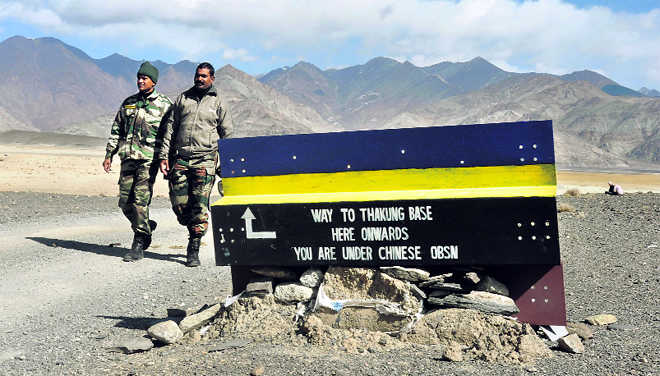
India and China today ended what was their second longest standoff along the un-demarcated Line of Actual Control (LAC). An important lesson was repeated that militarily it’s important to stand ground against China.In this case, India was standing in for friend Bhutan. The end of the 74-day stand-off at Doklam plateau came after a small statement from the Ministry of External Affairs (MEA) this morning.(Follow The Tribune on Facebook; and Twitter @thetribunechd)On its part, the Indian side had dug in its heels in the military stand-off at Doklam. It was reminiscent of a similar event at Sumdrong Chu (October 1986 to May 1987) in north-western part of Arunachal Pradesh.The eight months at Sumdrong Chu were the longest stand-off between the two armies. In comparison, the one at Doklam lasted just 74 days even though things had been simmering since May this year when China stopped the Mansarvoar Yatra through Nathu La in eastern Sikkim. In October 1986, Chinese leader Deng Xiaoping warned India that China would have to “teach India a lesson”. Almost similar were the words this time. On the Indian side, indications were clear that it will let diplomacy prevail over the “bayonets”.The key difference between 1986 and now was the changes in India-China relations. Post the Sumdrong Chu incident, the then Prime Minister Rajiv Gandhi had paid a visit to China. It was peak of the ‘Cold War’ (1945-1991) between the US and the then USSR. India, though officially non-aligned, was seen with the ‘Soviet camp’.Since 1993—the time line, incidentally, coincides with the economic rise of India and China—the two countries have had a few key treaties, which have ensured peace along the LAC. There have been a series of agreements that dictate the conduct of soldiers and also how a high-powered committee with members of both sides will sort out matters.These treaties came in handy this time for negotiators. Also in the past decade, India has “militarily tailored” its defences along the Himalayas. A repeat of the 1962 debacle was just not possible in 2017.In early 2004, India stepped up efforts to secure areas along the 3,488 km long LAC—the de facto boundary—aligned on an east-west axis in the Himalayas.


India-China ties in the near term will remain uncertain

Beijing’s political and military leaders will evaluate the Doklam face­off and plan to salvage their damaged pride

As Indian and Chinese diplomats begin repairing the bilateral relationship damaged by China’s threats and vitriolic propaganda during the over 70-day face-off at Doklam, Delhi-based Chinese diplomats led by Chinese Ambassador Luo Zhaohui are trying to portray that there is scope for “reconciliation” and “cooperation” and China and India “can dance together”.

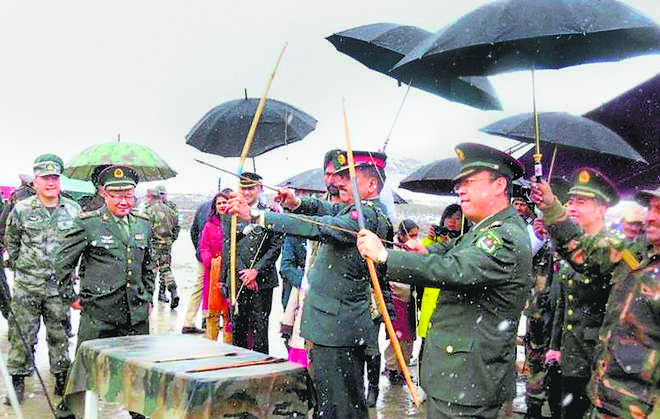
A disconnect is apparent, however, with the People’s Liberation Army (PLA) and China’s powerful propaganda apparatus adopting a different stance than China’s diplomats. China’s official media continues to allege that India is wary of Pakistan’s ‘rise’ and that the US is manipulating India. Unlike prior to the face-off at Doklam, PLA border personnel exchanged no pleasantries with Indian counterparts on China’s National Day on October 1. Neither has China proposed dates for the annual ‘Handto-Hand’ exercises between the two armies, which are now unlikely to be held.

Stymied by the unanticipated action of Indian forces stopping the road construction, the PLA is smarting at the decision to withdraw. In all probability when India did not yield ground despite sustained Chinese propaganda using language and threats not seen in over 40 years, Chinese President Xi Jinping concluded the PLA would not achieve a decisive victory against India and agreed to the withdrawal of troops. Anything short of victory would have been a humiliation for China, the Chinese Communist Party (CCP) and Xi Jinping, especially before the 19th Party Congress scheduled to be held from October 18 to 28, 2017.

China’s actions were deliberate. Certainly approved by the CCP’s highest body, the Politburo Standing Committee, the propaganda offensive revealed their thinking about India. China’s authoritative news agency Xinhua additionally revealed that Xi Jinping had decided in May – long before the Doklam face-off began – to dismiss General Fang Fenghui, Head of the Joint Staff Department under the Central Military Commission (CMC), because of corruption. Reports that he was removed because he instigated, or opposed, the withdrawal of forces on August 28, are incorrect. Xi Jinping also publicly flourished his control over the PLA by last month appointing long time associates to head the PLA ground forces, Air Force and new Rocket Force and appointing another 20 General officers to new positions.

The withdrawal has had repercussions inside China with clear indications that people are upset. Soon after the withdrawal on August 28, Chinese Foreign Minister Wang Yi became the first senior Chinese leader to assert that Doklam is Chinese territory and that China will resume building the road. On August 30, Yue Gang, a retired Colonel of the PLA’s General Staff Department and frequent commentator on military matters, said while the events where Xi Jinping and Modi were to meet had offered a way out “there are different interpretations as to which side actually compromised more.” Quite significantly, he added, “Despite Beijing’s deliberate ambiguity, China has apparently made substantial concessions in order to end the dispute. India has got exactly what it has wanted. It was a humiliating defeat for China to cave in to pressure from India despite all the tough talk.”

There are numerous comments on China’s social media as well. Their not being deleted suggests some tacit official support. Netizens have asked why there has been no “apology” from India and whether China gave up “legitimate rights such as building the road?” Others expressed concern “whether India’s withdrawal is unconditional” and asked “for a clear explanation.” Meanwhile, a rumour spread in China claiming that China had purchased India’s acquiescence to the withdrawal by giving it a loan of US$20 billion! Highlighting the Chinese leadership’s concern, separate denials were issued by the spokesman of China’s Ministry of National Defence Colonel Ren Guoqiang, spokesperson of China’s Ministry of Foreign Affairs (MFA) and the CCP’s official mouthpiece, People’s Daily. In a widely circulated video clip the Editor-inChief of Global Times, He Jixin, declared the people are unhappy with the ‘withdrawal’.

India-China relations in the near term are likely to be uncertain. Till China sees it will benefit by working with India, it would be prudent to expect that China’s political and military leadership will evaluate the faceoff at Doklam and prepare plans to salvage damaged pride. China will naturally choose a time and place of its advantage.

Jayadeva Ranade is a former additional secretary in the Cabinet Secretariat and is president of the Centre

for China Analysis and Strategy. The views expressed are personal


The way around China

The way around China
In Knots: China has, no doubt, landed itself in a military and diplomatic pickle.

G Parthasarathy

DENG Xiao Ping, who survived Maoist repression and became China’s supreme ruler from 1978 to 1997, set the stage for dumping Maoist communist dogma and releasing the creative energy of Chinese entrepreneurship. He rationalised discarding orthodox Communist ideology, proclaiming: “It does not matter if a cat is black or white, as long as it can kill mice.” Deng was the “helmsman” of China’s breath-taking economic growth, which transformed his country into the world’s economic powerhouse, within three decades.Deng urged caution in the conduct of security policies. Shortly after the 1989 Tiananmen massacre, Deng advised his countrymen: “Observe calmly, secure our position, cope with affairs calmly, hide our capabilities and bide our time”. Deng had practical reasons for rendering this advice to his countrymen. China was badly mauled during the Ussuri river clashes with the Soviet Union in 1969. Worse still, was the humiliation China suffered following Deng’s visit to Washington in 1978, where he was feted, wined and dined by President Carter and the barons of American business. Shortly thereafter, he proclaimed: “Vietnam is a hooligan. We must teach it a lesson.”  It was, however, China which was taught a lesson by Vietnam, when it invaded its neighbour in 1979.Deng faced a similar setback in 1986, when China’s PLA occupied vacated Indian posts in Sumdorong Chu/Wangdung in Arunachal Pradesh. India responded by airlifting forces to the McMahon Line, along the Sino-India border. Deng warned India in 1986 that it would be taught a “lesson” if it did not withdraw its forces, with US Defence Secretary Caspar Weinberger acting as an intermediary. New Delhi, however, stood firm and a military stalemate followed. External affairs minister ND Tiwari visited Beijing in May 1987 and clarified that India was not interested in escalating tensions, while holding out the possibility of a visit to China by PM Rajiv Gandhi. The visit took place in November 1988, with Deng personally welcoming the “young” Indian PM and setting the stage for seeking a new relationship with India. Chinese troops, however, pulled back fully from Sumdorong Chu only in 1993. China’s misadventure in Sumdorong Chu led to Arunachal Pradesh soon becoming a state of the Indian Union in 1987.Much has changed in the last three decades in China. It is now an economic powerhouse with a GDP five times that of India and defence spending six times that of India. China has impressive defence production facilities and armed forces with huge firepower. But, China’s economic rise has also led to the country discarding Deng’s prescription of “hide our capabilities and bide our time”. China is now flexing its economic and military muscle across Asia, while also using its maritime power across the Western Pacific and Indian Ocean Regions. The use of maritime power has been accompanied by China defining its maritime borders arbitrarily, drawing a “nine dotted line”, to occupy and build military bases on several islands, hundreds of miles from its shores, which are legally claimed by its neighbours. Its maritime boundary claims, many coercively enforced, have included unilaterally defining its maritime boundaries with South Korea, Japan, Taiwan, the Philippines, Vietnam, Brunei, Malaysia and Indonesia. Beijing has, however, been circumspect, in not biting off more than it can chew, on in its maritime boundaries with Japan!China has coerced a number of ASEAN countries, compelling them not to join partners like Vietnam and Indonesia, which have demanded that Beijing should adhere to rulings of the UN Arbitration Tribunal on its maritime boundaries. This fear of Chinese power has torn ASEAN solidarity apart, with many ASEAN members refusing to accept any critical references to China in the recent ministerial conference in the Philippines. Not content with establishing its hegemony in Southeast Asia, China has also moved to contain and erode India’s influence in South Asia and the Indian Ocean. The ambivalence of the Trump administration on containing Chinese power and its revocation of the Trans-Pacific (economic) partnership has raised serious doubts about American reliability as an economic and military partner in East and Southeast Asia. China has benefited immensely from this.Pakistan is predictably the primary instrument for China’s policy of “containment” of India. The China-Pakistan Economic Corridor, stretching from the PoK to the port of Gwadar,  has been accompanied by a decision to enhance Pakistan’s maritime power, with a decision to supply eight frigates and eight submarines to Pakistan. Across India’s eastern shores, China has outmanoeuvred the US, Japan and India by strengthening its political and economic influence in the economic and political policies of Aung San Suu Kyi. It is set to build the strategic port of Kyaukpyu in the Bay of Bengal, while shaping its maritime silk road by taking over Hambantota Port in Sri Lanka. Riding on hubris, China, however, gravely miscalculated what the response of India and Bhutan would be to its intrusion in Doklam.By its intrusion in Doklam, Beijing violated written agreements with Bhutan signed in 1988 and 1998, which pledged to “maintain status quo on the boundary as before March 1959”, and “refrain from taking unilateral action, or use of force, to change the status quo on the boundary”. It also violated the December 2012 “common understanding” reached by Special Representatives of India and China, agreeing to maintain the status quo, pending a tripartite agreement on the location of the India-China-Bhutan tri-junction. China has now landed itself in a military and diplomatic quagmire. The Sikkim-Bhutan border is the worst location for China for a confrontation with India. India has huge advantages in terrain, logistics, firepower and numbers in this area. Any military misadventure could destroy the image of invincibility the Chinese have assiduously built, while bullying weaker maritime neighbours.China can possibly undertake intrusions in sections of its borders with India, where it enjoys logistical advantages. India has to be prepared for this. In the meantime, imaginative diplomacy is required to ensure China is given a face-saving way out from its present predicament. A visit by Mr Modi to China for the forthcoming BRICS Summit would largely depend on his reading of Chinese intentions and flexibility. Much will, however, depend on how President Xi Jinping decides to deal with domestic challenges he is likely to face during the forthcoming Communist Party Congress, scheduled for later this year.

IMA cadet from Bathinda dies 6 others collapse; court of inquiry ordered to fix responsibility

Dehradun/Bathinda, Aug 19

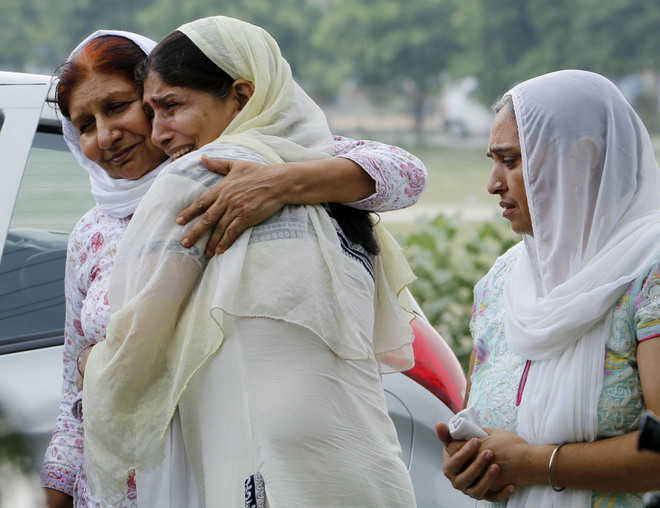
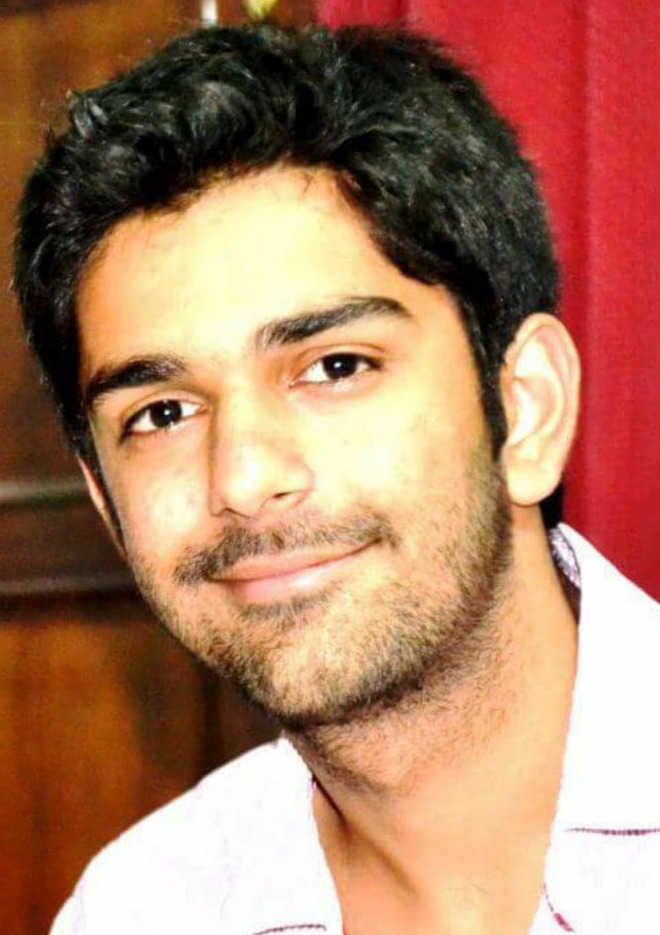
A Gentleman Cadet of the Indian Military Academy (IMA), Dehradun, Deepak Sharma (22) of Bathinda, reportedly died of exhaustion during a 10-km cross-country race, a regular feature of the IMA training, on Friday. Six other cadets collapsed too.At 2 pm, the cadet fainted in Badshahi Bagh area neighbouring UP’s Saharanpur district, a few kilometres from the final destination. He was administered first-aid. As his condition deteriorated, he was rushed to the nearest Lehman Hospital in Vikasnagar where doctors declared him ‘brought dead’. (Follow The Tribune on Facebook; and Twitter @thetribunechd)The body was sent to Coronation Hospital, Dehradun, for postmortem. The status of the other six cadets could not be ascertained, but an officer claimed they were not in the  Military Hospital this morning. The Army has ordered a court of inquiry to ascertain facts  and fix responsibility. The incident turns focus on the level of fitness of cadets as well as the training methods and conduct of instructors. In Bathinda, the deceased’s brother-in-law, Dr Rajiv Kapila, claimed Deepak was physically fit and could not have collapsed. “His camp started on August 14. A day earlier, he sounded cheerful over the phone.”Deepak had joined the IMA in January after completing studies at GNDU. — TNS


HEADLINES::::09 OCT 2017

  • CAPT AMARINDER ALL OUT TO RESTORE RESPECT,DIGNITY,PRIDE OF EX-SERVICEMEN IN PUNJAB WRITE TO DC’S. JALLUNDER DC RESPONDED
  • IN PUNJAB, CONG HAS A STRONG, POPULAR LEADER IN CAPT: TULLY
  • MAHARANI SAHIBA PRANEET KAUR SHOWS CONCERN ABOUT WELFARE OF EX-SERVICEMEN AT :PATHANKOT RALLY
  • IN J&K, A BATTLE OF WITS WITH ‘FIDAYEEN’ BY LT GEN SYED ATA HASNAIN
  • IMAGES OF SOLDIERS’ BODIES IN PLASTIC SACKS TRIGGER ROW
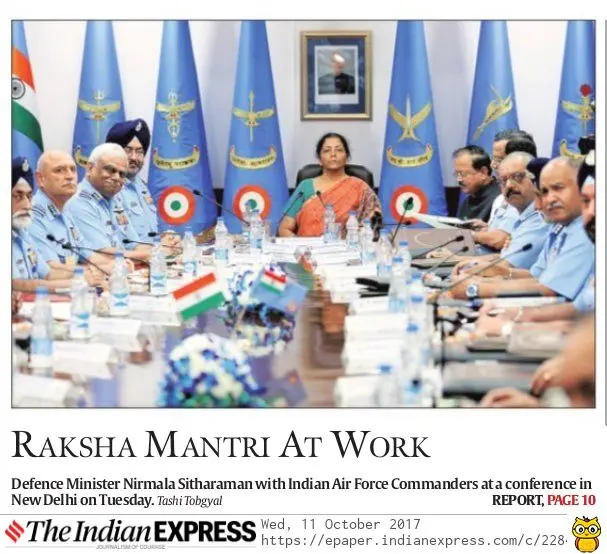
  • WE’RE BATTLE-READY: IAF CHIEF
  • 92 BASE HOSPITAL: A LIFE SAVER TO THE INDIAN ARMY BRAVEHEARTS AND MANY MORE BY LT GEN SYED ATA HASNAIN
  • SECURING PERMANENT DEFENCES IN PUNJAB
  • SOLDIERS, SPIRITUAL LEADERS TWIN PILLARS OF NATION: PRESIDENT
  • NOTHING ‘SIMPLE’ ABOUT GST POLITICAL TEMPTATIONS COMPLICATE RESOLUTION
  • CIVILIAN OFFICERS DEMAND SEPARATE HEAD FOR MES
  • STRIKING A BALANCEBY VIVEK KATJU
  • ARMY TO CHANGE INTAKE NORMS FOR OFFICERS, BETTER DEAL FOR SSC AIM: TO RAISE SHORT SERVICE CADRE STRENGTH, YOUNGER COMBAT FORCES
  • NS MAKES AERIAL SURVEY OF DOKLAM-NATHULA AREA
  • PAKISTAN HAS GONE OUT OF KASHMIR EQUATION: EX-RAW CHIEF DULAT
  • HOT PURSUIT: WHAT INDIA COULD LEARN FROM RUSSIAN HISTORY

DOKLAM Diplomacy it is: Delhi Says will continue to engage with China

Diplomacy it is: Delhi
MEA: Incidents (like in Ladakh recently) not in anyone’s interest. File

Tribune News Service

New Delhi, August 18

Amid the continuing stand-off on Doklam, India today reiterated it will continue to engage with China to arrive at a mutually acceptable solution while emphasising that peace and tranquillity on the border is an important pre-requisite for “smooth bilateral relationship’’.In response to a question, Ministry of External Affairs (MEA) spokesperson Raveesh Kumar underscored New Delhi’s standpoint on the issue that remains unresolved since India prevented Chinese troops from building a road in the tri-junction border with Bhutan.(Follow The Tribune on Facebook; and Twitter @thetribunechd)Reacting to reported incident between Indian border personnel and Chinese troops in Ladakh on August 15, the spokesperson said without elaborating on its nature, “Such incidents are not in the interest of either side.”Under the existing agreed system in place, he said two border personnel meetings took place at Chushul and Nathu La between the Indian border guards and Chinese troops.When a correspondent referred to the incident as stone pelting, the spokesperson clarified he was not confirming it to be either stone pelting or use of rods.Published reports said troops on either clashed with fisticuffs and stone-pelting resulting in some personnel receiving injuries after land-based patrols on either side came face to face north of Pangong Tso lake in Ladakh region of Jammu and Kashmir.To a question on the current floods in eastern parts of India and sharing of hydrological data from China, Kumar said although the arrangement was for Beijing to share data on flow of rivers Brahmaputra and Sutlej between May 15 and October 15, no data has been received this year till now.He, however, said non-sharing of such data by China could not be linked to the current standoff as there could be technical reasons for it.


Manmohan worked hard for country: AAP

Tribune News Service

Anandpur Sahib, October 5

Aam Aadmi Party (AAP) spokesman Himmat Singh Shergill drew a comparison between former Prime Minister Manmohan Singh and incumbent PM Narendra Modi in the style of their working.“Manmohan Singh had worked hard for uplifting the economic condition of the country. It is another matter that he never bragged about his achievements,” said the AAP leader, who was here to convene a meeting of party workers.Shergill, who lost the 2014 Lok Sabha and 2017 Assembly elections, lashed out at Modi, saying he did not leave any stone unturned in claiming credit for even small developments.On the reasons behind AAP’s defeat in the Assembly elections, he said the SAD-BJP alliance and the RSS played a role in damaging the party’s prospects. He claimed the RSS had instructed its cadre to vote for the Congress.On Anandpur Sahib MP Prem Singh Chandumajra, the AAP leader said the MP had failed to bring any change to the constituency. “Chandumajra is known for making announcements which never take shape,” he alleged.


Viceroy’s House : Expect to be bored, confused

he intention seems sincere, but this historical drama about the 1947 partitioning of the British Indian Empire is weighted down by a verbose script, leaden direction and a tacked-on fictional romance straight out of a Z-grade Bollywood melodrama.

A still from Viceroy’s House.More inept than inspiring, Viceroy’s House monotonously sets about depicting the political and religious schisms that led to the division of the country into two independent nations.

The primary setting is the palatial titular mansion, which served as the seat of government as well as the residence of Lord Mountbatten (Hugh Bonneville).

The last viceroy to serve in India, he has been dispatched to New Delhi to oversee the transition to self-rule of India and the newly founded state of Pakistan.

Mountbatten has his work cut out for him, amid escalating tensions between the populations and the new leadership — Jawaharlal Nehru (Tanveer Ghani), Mahatma Gandhi (Neeraj Kabi) and Muhammad Ali Jinnah (Denzel Smith).

Curiously, there are no allusions to the alleged affair between Lady Mountbatten (Gillian Anderson, impressive) and Nehru.

Unable to rise to the challenge of conveying the complexities of this time in our history, director Gurinder Chadha ends up trivialising the struggles of the people on both sides of the new divide.

The pat resolution to the ‘impossible’ relationship between the Hindu valet (Manish Dayal) and the Muslim ladyin-waiting (Huma Qureshi) is indicative of the tendency to sentimentalise issues of vital importance.

The handsome production design (courtesy Laurence Dorman) is offset by an overwrought background music score by AR Rahman, who needs to reinvent himself.

With the singular exception of the late Om Puri as the blind father, the rest of the Indian ensemble is unremarkable.

On the other hand, there are terrific supporting turns by British stalwarts Simon Callow (who plays the reluctant official in charge of mapping the Indo-Pak territories) and Michael Gambon, as the Machiavellian General Hastings.

The premise remains pertinent in the current conflicted global situation. Unfortunately, Viceroy’s House is a less-thancompelling account of the strifetorn last days of the Raj.

For those who might be interested, a dubbed version in Hindi, titled Partition: 1947, is also being released this week.


Srinagar Attack: Terrorist Disguised Himself in CRPF Uniform to Ambush Soldiers

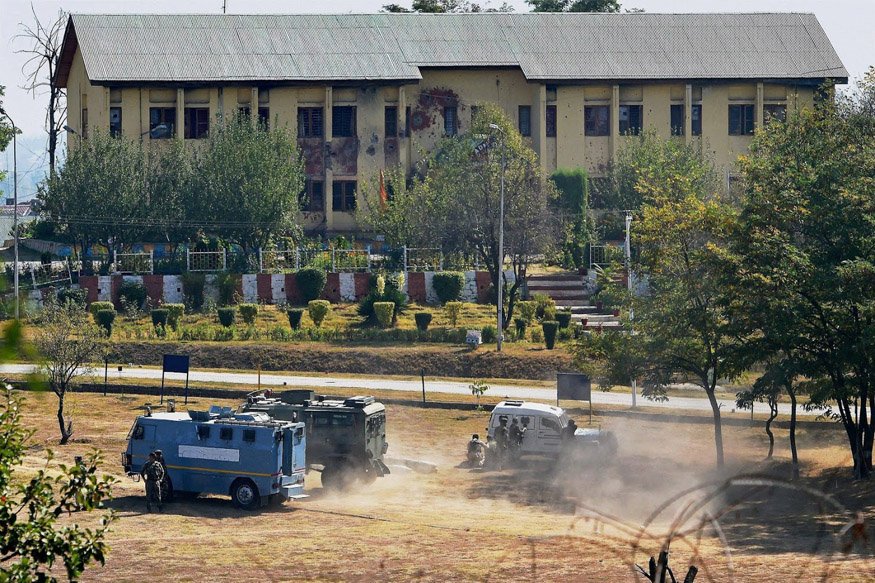
Srinagar: Security personnel during an operation at the  building were militants were believed to be hiding after they stormed a BSF camp early morning near Srinagar International Airport on Tuesday. PTI Photo by S Irfan (PTI10_3_2017_000050B)
Srinagar: Security personnel during an operation at the building were militants were believed to be hiding after they stormed a BSF camp early morning near Srinagar International Airport on Tuesday. PTI Photo by S Irfan (PTI10_3_2017_000050B)

An assistant sub-inspector of the BSF was killed and four security personnel were injured in the attack on the security camp, which is close to the Humhama airport

Srinagar: The last of the three terrorists to be killed in the attack on the BSF camp near Srinagar on Tuesday had disguised himself as a CRPF personnel before mounting a final assault on the soldiers stationed at the base.

An assistant sub-inspector of the BSF was killed and four security personnel were injured in the attack on the security camp, which is close to the Humhama airport. According to an official, after the first terrorist was killed, the two others ran into two buildings – the mess and the administrative block – and started firing from there.

While the terrorist who ran towards the mess was killed in retaliatory firing by the security personnel, the third one came out of the administrative block wearing CRPF-like camouflage and tried to slip into the defensive perimeter set up by the security forces.

He also positioned himself facing the administrative building and signalled a CRPF soldier to come closer. The soldier, assuming that it was a colleague who had run out of ammunition, moved towards him to supply more ammunition.


It was then that the terrorist turned around and tried to shoot down as many CRPF men as he could, but was neutralised in retaliatory fire, said the official.

The gun battle had lasted close to 10 hours. Pakistan-based terror outfit Jaish-e-Mohammad called a local news agency and claimed responsibility.

However, police sources said that the fidayeen squad has taken a lot of precautions to hide their Pakistani links. Police also believe that the attackers are from the same group that killed eight security personnel in Pulwama on August 26.

“This group infiltrated from the Sakhdar side in Jammu region. We suspect 6-7 more terrorists from the group could still be in the valley,” IG Muneer Khan said in a press conference at the BSF battalion headquarters.