All posts by webadmin

Open military lit fest to foreign veterans: Capt

Open military lit fest to foreign veterans: Capt
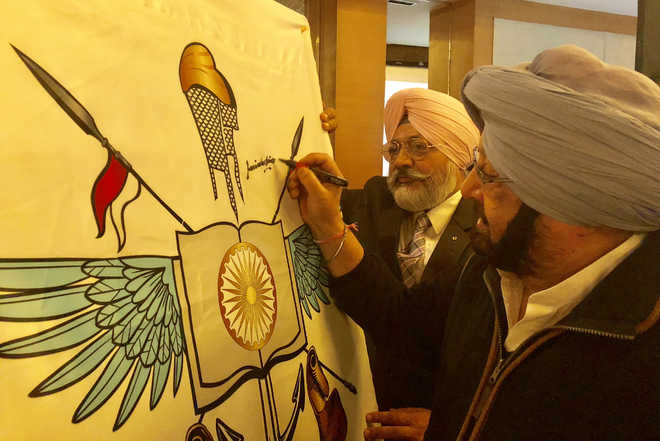
Chief Minister Capt Amarinder Singh signs off the first Military Literature Festival in Chandigarh on Thursday. Tribune photo

Tribune News Service

Chandigarh, December 15

Signing off the first Military Literature Festival (MLF) held here last week, Chief Minister Capt Amarinder Singh yesterday called for making the event more holistic through the participation of authors and veterans from other nations, including Pakistan.“It would be interesting, for instance, to see the 1965 war veterans from India and Pakistan come face to face to share their experiences in a new environment,” the CM said while addressing a gathering.Tracing the journey of the festival from its conception to its eventual conduct, Capt Amarinder said the event proved to be an exciting platform to promote understanding and awareness among the people, especially youth, about India’s defence forces. He hoped the festival would imbibe a spirit of nationalism among youth and encourage them to join the defence forces.“Being part of the armed forces is a matter of pride for every Indian and this festival would go a long way in strengthening that feeling among youngsters,” he said while extending his government’s support to scale up the event.Lt Gen TS Shergill (retd), senior adviser to the CM, said the Military Literature Festival Society had been set up as a permanent body and would continue to initiate various activities to promote exchange of ideas and experiences in this field.


Major shake up being given to Defence Ministry: Sitharaman

Major shake up being given to Defence Ministry: Sitharaman
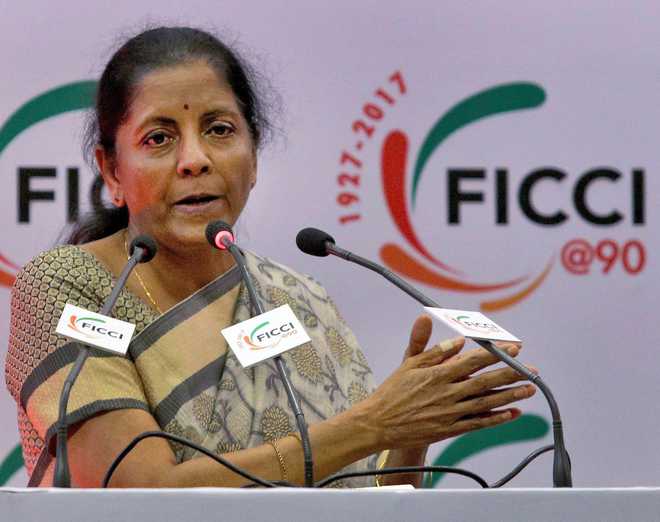
Union Minister for Defence, Nirmala Sitharaman addressing at the 90th Annual General Meeting of FICCI, in New Delhi on Thursday. PTI

New Delhi, December 14  A “shake up” is being given to the Defence Ministry to speed up various acquisition projects, ensure transparency and clear backlogs for key programmes, Defence Minister Nirmala Sitharaman on Thursday said.In an address at an industry chamber, she also said the government is seriously examining functioning of around 39 ordnance factories and possible ways to boost their productivity, including through joining of hands by the private sector.She said the efforts are on to ensure that the defence acquisition council (DAC) clears all the backlog relating to various procurement by December 31, emphasising that speeding up of decision making process has been one of her focus areas.The DAC is Defence Ministry’s highest decision making body on procurement.“There is a sense of making sure that every aspect of this large ministry is given a shake up,” Sitharaman said, adding the aim is to make a difference so that the ministry, which was sort of a cocooned, do things in a faster and transparent way.On various acquisition projects, she said, “I may be confident enough to say that by December 31, at least DAC would be on the top of it in the sense that no more waiting list would be with me.” She was addressing a FICCI event.Sitharaman, who assumed charge of the ministry in September, also said ensuring transparency is a major priority area for her.“The biggest compliance issue which we are definitely 100 per cent following is to have greater transparency, put everything in the public domain and make sure that every decision stands up to the principle of accountability,” she said.Her comments came in the backdrop of the Congress accusing the government of flouting laid down norms in sealing a deal to purchase 36 Rafale fighter jets from France.The party had recently raised several questions about the deal, including the rates, and accused the government of compromising national interest and security while promoting “crony capitalism” and causing a loss to the public exchequer. The government had rejected the allegations.Asked about handing over of the strategically located Hambantota port to China on a 99-year lease by the Sri Lankan government, she only said India has been watchful of all the developments in the neighbourhood.On ordnance factories, she said government was doing a major review of their work and examine whether they can have joint venture or benefit from technology transfer.Talking about the Defence Research and Development Organisation (DRDO), Sitharaman said it should identify the patentable products so that they can be used commercially.Referring to the strategic partnership model, she said it was brought to support the domestic defence industry and to ensure that India, which is now a leading importer of military hardware, becomes a defence exporter.The strategic partnership was unveiled nearly four months back under which domestic defence manufacturers can tie up with leading global defence majors to manufacture specific military platforms like fighter jets.Sitharaman also said the government was in the process of identifying “organically grown” defence industry clusters in various parts of the country so that they can be supported.“We are planning to tell them about the requirement of the armed forces for the next 40-50 years so that they can lay a roadmap for their capacity building,” she said.She also said start-ups in the defence sector will be given encouragement. — PTI


Rohingya crisis will be resolved amicably: B’desh Army Chief

Rohingya crisis will be resolved amicably: B’desh Army Chief
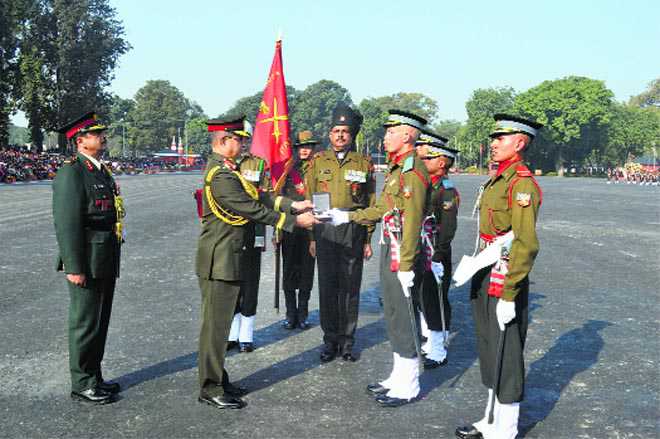
Bangladesh Army Chief Gen Abu Belal Muhammad Shafiul Huq presents an award to a winner at the Indian Military Academy in Dehradun on Saturday. Tribune photo

Tribune News Service

Dehradun, December 9

Bangladesh Army Chief Gen Abu Belal Muhammad Shafiul Huq has hoped for an amicable solution to the Rohingya refugee crisis, asserting that his country has good relations with Myanmar.“Yes there is an issue, which we will resolve amicably”, he told journalists when asked about the Rohingyas refugee influx. Gen Belal was interacting with the mediapersons on the sidelines of the passing-out parade at the Indian Military Academy, Dehradun, which he attended in the capacity of a Reviewing Officer today.The Bangladeshi General’s statement comes at a time when a large population of Rohingya Muslims from Myanmar have taken refuge in Bangladesh. He said it was a special day for both India and Bangladesh as he had been given the honour of reviewing the IMA’s passing-out parade and said the two nations shared strong ties and had even gone for joint military exercises in the past.The Bangladesh Army Chief also held that the his country had a zero tolerance policy towards terrorism reaffirming his country’s commitment to fighting terrorism. Earlier, addressing the Gentlemen Cadets at the Drill Square in front of the Chetwode building, the Bangladesh Army Chief expressed his gratitude to the Indian Army men for their role in the 1971 Bangladesh war of liberation. He said Indian Army officers and soldiers worked shoulder to shoulder with freedom fighters for the liberation of Bangladesh. He also remembered Bangabandhu Sheikh Mujibur Rahman, who led the movement for the liberation of Bangladesh. He said both India and Bangladesh not only shared borders but kept long cultural and historical ties and described his presence at the parade as a momentous occasion for both countries. 


Experts: China’s ambitions may jeopardise India’s interests

Lt Gen Depinder Singh addresses the audience as Col Anil Kaul looks on during their session at the club. Tribune Photos: Ravi Kumar/Vicky Gharu

Tribune News Service

Chandigarh, December 8

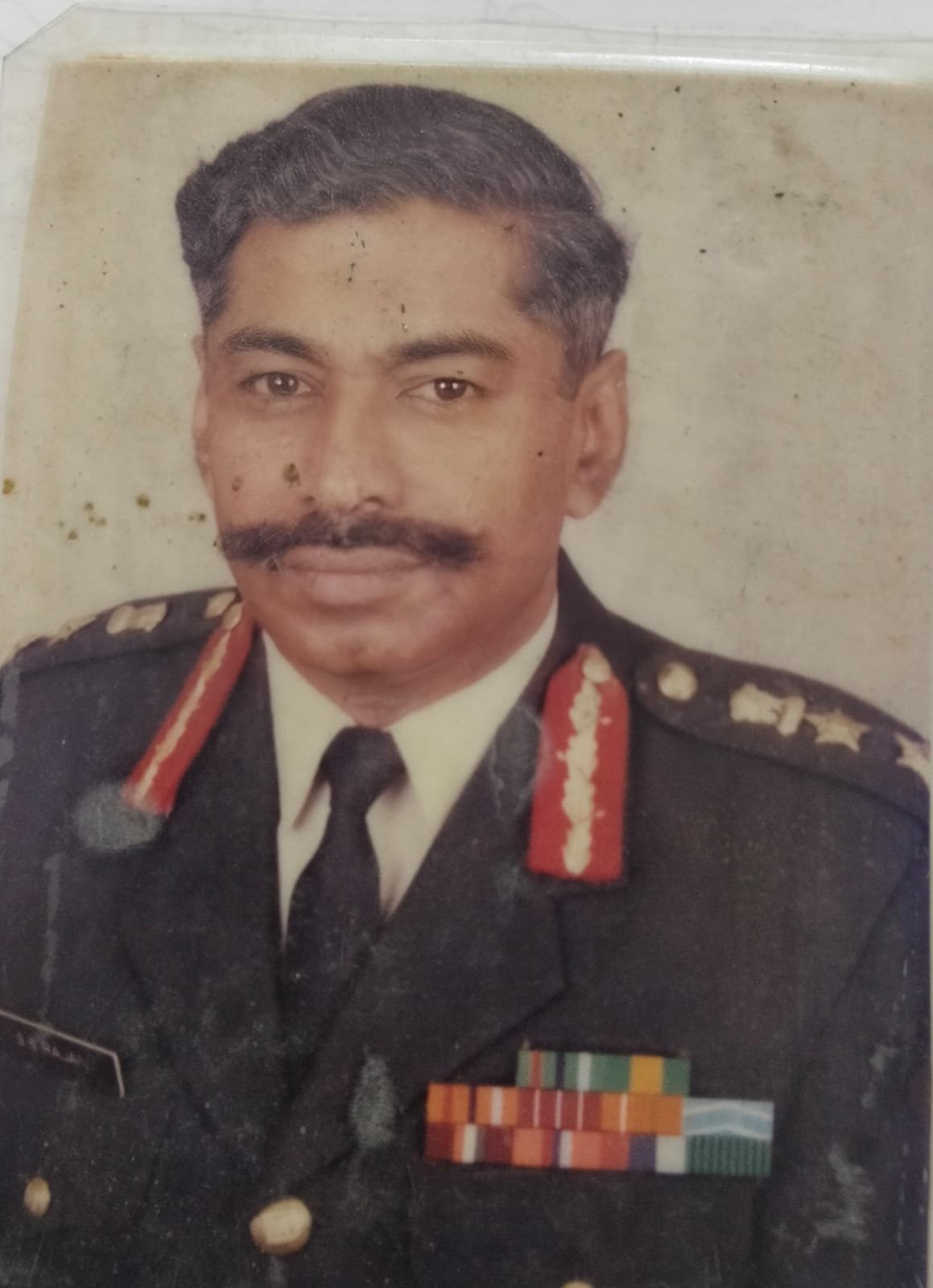
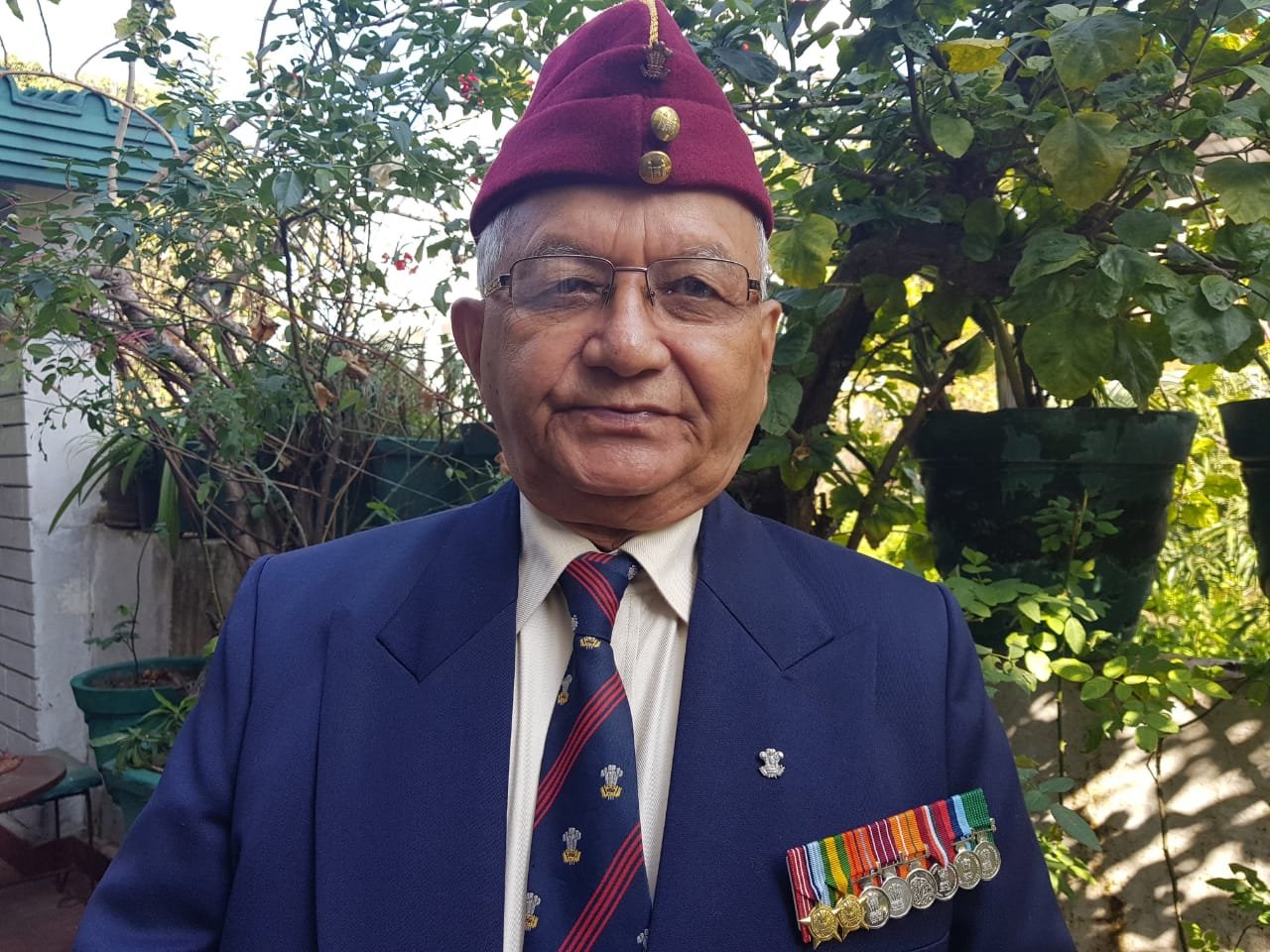
The present quadruple of India-Australia-Japan-United States is not enough to deal with the challenge that China poses in the Indian Ocean and we have to bring in Europe and Vietnam on board.This was stated by former Indian diplomat G Parthasarthy at a session on ‘Strategic perspective on China’ during Military Literature Festival here today. He said the Indian Ocean was of a great concern to China and it might like to take control of the ocean, as 80 per cent of its petro-chemical trade was through this region.He said China would not settle the border issue with India. “We have to be prepared to defend our borders. Patience and diplomacy is the correct approach towards dealing with China,” he said.He said: “China is an ambitious country which envisions being unchallenged in Asia and being on a par with the United States globally. China has managed to dominate Asia through a clever mix of diplomacy and coercion.”Cautioning that the China-Pakistan nexus was much stronger than believed, he said: “Building up Indian maritime power is crucial”. He said for the first time, there had been resistance in Pakistan against China’s ‘One belt and One Road’ project due to its economic implications.Lt Gen JS Bajwa (retd) said the recent development of China holding back funds for its ambitious China-Pakistan Economic Corridor that links Western China hinterland with sea, could mean that it is trying to get India on board for the project. He said while China was satisfied with its politico-economic system and with what it has achieved, it would not take any such steps which could harm its interests.Maj Gen BK Sharma said: “China’s forays into the Indian Ocean have implications on the strategic environment in South Asia, which needs to be balanced.” Stating that the India-Japan-Australia-US quadruple needs to be strengthened, he said India should also work towards building strategic trust with China.Claude Arpi, a Chinese expert, said though China has been traditionally wary of having minorities in the armed forces, the trend has reversed. Speaking on lessons learnt from the Indian Peace Keeping Force in Sri Lanka, Lt Gen Depinder Singh, the then General Officer Commanding-In-Chief  (GOC-in-C), Southern Command, said when the force went in, the government had no clear-cut political objectives and the individual training of the soldiers was found to be wanting. The force initially had a high tri-service component, but as time went and there was little action, the Navy and Air Force elements began to reduce steadily on the pretext of employing resources elsewhere. Col Anil Kaul, a decorated veteran, spoke about his combat experience in Sri Lanka.Experts also discussed the role of Indian soldiers in the World War I. These included military historian Alan Jeffreys from the UK, Lt Gen PK Singh, Director United Service Institute, Prof Rakesh Datta from Punjab University, journalist Rahul Bedi and writer Pushpinder Singh Chopra. Various aspects of the first war of independence in 1857 were also discussed at another session.GL Batra, father of Param Vir Chakra recipient Capt Vikram Batra, spoke about the communication with his son from the battlefield during the 1999 Kargil conflict. He said the stories of martyrs and war heroes need to be immortalised for the benefit of future generations. Rachna Rawat Bisht, Rahul Singh and Shiv Aroor spoke about their books covering tales of gallantry. Col Balwan Singh, decorated with the Maha Vir Chakra in Kargil, spoke about the physical and psychological aspects of bravery and the motivation behind the acts of gallantry.


CRPF, ITBP taken off VIP security, CISF to take over

Mukesh Ranjan

Tribune News Service

New Delhi, December 8

With a view to keep two specialised central forces – CRPF and ITBP – focussed on their respective core areas, the Ministry of Home Affairs (MHA) has decided to take them off VIP security. This in turn will now mean that providing security to VIPs will be the responsibility of Central Industrial Security Force (CISF) and National Security Guard (NSG).Confirming about the MHA decision, a senior official said by the end of next year the two forces –Central Reserve Police Force (CRPF) and Indo-Tibetan Border Police (ITBP) – which have under them about 100 VIP protectees, would hand over the security baton to CISF.Quoting the MHA order, the official said: “The personal protection duties have been reviewed by the ministry and it has been decided to take CRPF and ITBP off from the VIP security duty.”According to the official, the order further said, “The task shall progressively be assigned only to Special Security Group (SSG) of CISF, which has been specifically created for the purpose.” It went on to add: “NSG will continue to provide security to the high-risk protectees as decided from time to time.” The NSG security is being provided to a limited number of protectees.As per the figures provided by the MHA around 75 persons are being provided security by CRPF, which include protectees like BJP chief Amit Shah, Union Minister Nitin Gadkari, Centre’s Special Representative for talks in Kashmir Dineshar Sharma, RJD chief Lalu Prasad and Reliance Industries chairman Mukesh Ambani. The force was roped in to provide VVIP protection in 2014 when NSG had shown its reluctance to deploy black cat commandos for personal protection.The NSG currently protects 14 high-risk category VVIPs. NSG’s Special Rangers Group (SRG), with personnel drawn from Central Armed Police Forces (CAPF) and state police forces, is deployed for guarding high-risk VIPs/VVIPs.

High-profile protectees

  • Nearly 75 persons are being provided security by CRPF, which include protectees like BJP chief Amit Shah, Union Minister Nitin Gadkari, Kashmir Interlocutor Dineshar Sharma, RJD chief Lalu Prasad and Reliance Industries chairman Mukesh Ambani
  • ITBP protects 17 high-profile dignitaries, including Supreme Court judges, J&K Chief Minister Mehbooba Mufti, NC patriarch Farooq Abdullah, former Chief Minister Omar Abdullah and CPM MLA Yusuf Tarigami

Army to get 409 officers today

Dehradun, December 8

As many as 409 Gentlemen cadets from different states are set to take the “Antim Pag” (final step) on course to becoming Army officers during the passing out parade at the Indian Military Academy here on Saturday.With 76 Gentlemen cadets belonging to Uttar Pradesh alone, the state tops in terms of contribution to the academy this year, followed by Haryana (58) and Uttarakhand (38). The other top contributors are: Bihar (25), Punjab and Maharashtra (24 each), Rajasthan (23), Delhi (22), Madhya Pradesh (19), Himachal Pradesh (18) and Karnataka (15).As a precursor to the passing out parade, the wreath-laying ceremony was held at the academy’s War Memorial today. Academy’s Commandant Lt Gen SK Jha along with officers and the Academy Under-Officer on behalf of the passing out course laid wreaths and offered floral tributes to the gallant martyrs. — TNS


Warfare not all about fighting: Badnore

Punjab Governor and UT Administrator VP Singh Badnore.

Chandigarh, December 8

Punjab Governor and UT Administrator VP Singh Badnore today said the Military Literature Festival could be a powerful platform, especially for the younger generation, to know and learn about the country’s rich and glorious military legacy, as well as get motivated to become a part of the armed forces. The Governor pointed out that many millennia of warfare had spawned tales and poems of courage, honour and sacrifice that were sung to this day. Warfare, however, was not all about fighting but was also about avoiding conflict, he said while referring to Sun Tzu’s dictum that the finest battle is the one that is won without having been fought.Badnore also honoured Capt Bana Singh, Subedar Yogendra Yadav and Naib Subedar Sanjay Kumar, the three living recipients of the Param Vir Chakra (PVC), the highest award for gallantry. There are a total of 21 PVC recipients.Punjab Finance Minister Manpreet Singh Badal said Punjab was proudly known as the sword arm of India.  He hoped that the festival would go a long way in imbibing a spirit of patriotism and nationalism among youngsters, besides motivating them to opt for the armed forces as their career. The General Officer Commanding-in-Chief, Western Command, Lt Gen Surinder Singh, said the festival would be upgraded to elicit maximum participation of the military academia and experts from across the country to make civilians aware of the military’s glorious past and to keep society updated on various military activities.   The festival is being organised jointly by the Punjab Government, the Chandigarh Administration and the Western Command. — TNSGuv for more such events Punjab Governor and UT Administrator VP Singh Badnore, the man behind the proposal for holding the Military Literature Festival in the city, now wants more such important events hosted in the city. A leading global watch maker has been asked  to host its vintage car rally in the city, Badnore told The Tribune on Facebook live chat.


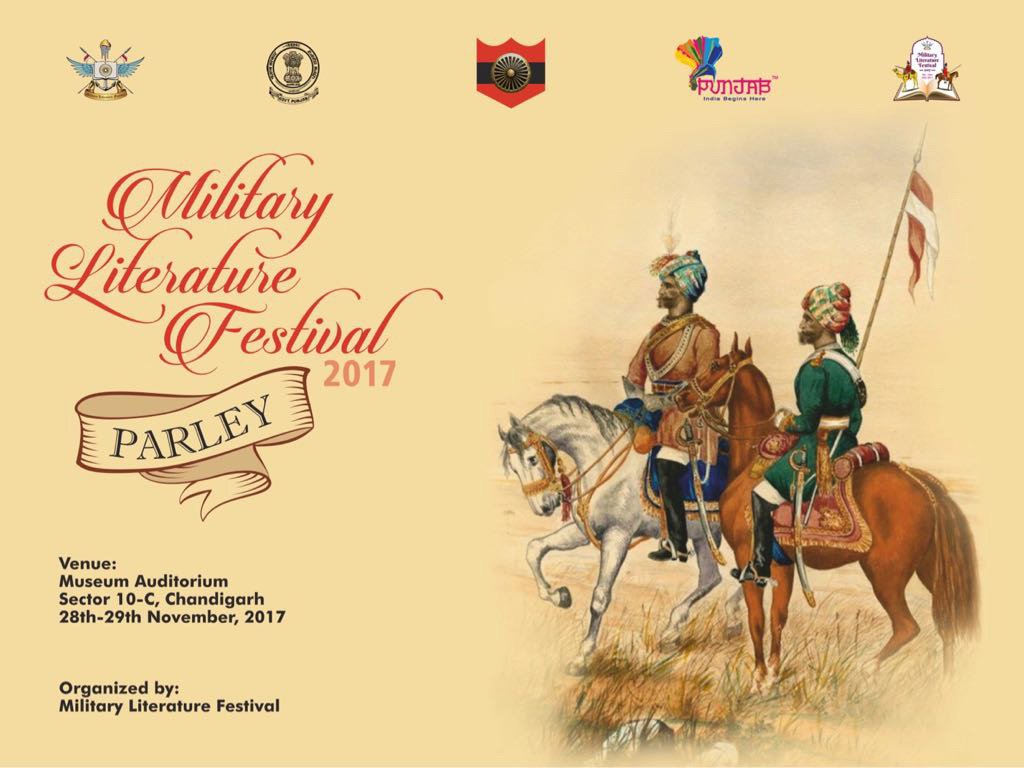
REGISTER YOURSELF FOR INDIA’S FIRST MILITARY LITERATURE FESTIVAL IN CHANDIGARH —-28TH&29 NOV 2017::

 FOR REGISTRATION OPEN SITE

Moving-animated-down-arrow


http://WWW.MILITARYLITERATUREFESTIVAL.COM


THE MILITARY LITERATURE FESTIVAL

Opening Ceremony 08 December 10:00 to 11:00 Lake Club
Tea 08 December 11:00 to 11:30 Lake Club
Panel Discussions 08 December 11:30 to 13:45 Lake Club
Lunch 08 December 13:45 to 14:35 Lake Club
Panel Discussions 08 December 14:45 to 18:15 Lake Club
Mega Social Evening 08 December 19:00 onwards Capital Complex
Dinner (By Invite Only) 08 December 20:00 onwards CM Residence
Panel Discussions 09 December 10:00 to 13:30 Lake Club
Lunch 09 December 13:30 to 14:30 Lake Club
Panel Discussions 09 December 14:30 to 16:45 Lake Club
Closing Ceremony 09 December 17:00 to 18:00 Lake Club
Tea 09 December 17:00 to 17:30 Lake Club
Dinner with Concert (By Invite Only) 09 December 20:00 onwards Hotel Mt View

#

IMG-20171123-WA0058

#


Pakistan’s weapons programme surest route to nuke-level war: Report

Pakistan’s weapons programme surest route to nuke-level war: Report
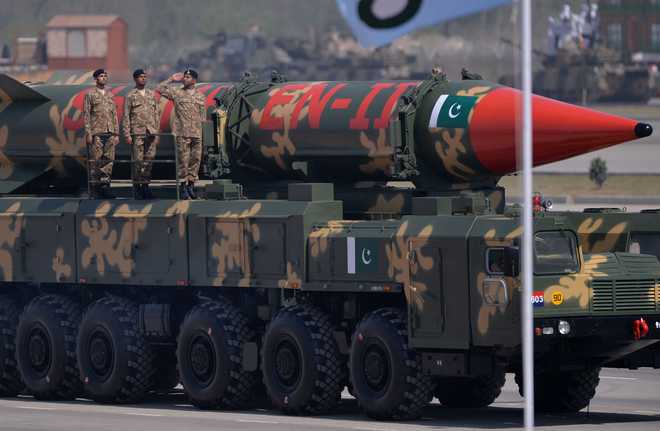
Pakistan does not appear to have operationalised its tactical nuclear-warfare plans yet, the report said. AFP file

Washington, November 26

Pakistan’s tactical nuclear weapons programme is not only dangerous for safety and security of the region, but also it is the surest route to escalating conventional war to the nuclear level, according to a report by an American think tank.

(Follow The Tribune on Facebook; and Twitter @thetribunechd)

In its report ‘Asia in the Second Nuclear Age’, the Atlantic Council, however, said Pakistan does not appear to have operationalised its tactical nuclear-warfare plans yet.

“Pakistan’s tactical nuclear-weapons programme is dangerous for safety and security reasons, and also because it is the surest route to escalating conventional war to the nuclear level. However, Pakistan does not appear to have operationalised its tactical nuclear-warfare plans yet,” said the report released this month.

The greatest threat in the region comes not from the development of large, sophisticated, and diversified nuclear arsenals, but from the continued stability of the institutions guarding them. “In this regard, the future stability of Pakistan remains a wild card,” said the report.

In the last four decades, the Pakistani deep state’s pursuit of low-intensity conflict in Afghanistan and India, via the vehicles of radical jihadi non-state actors, has produced terrible blow back effects on Pakistan itself.

Noting that both the Pakistani state and civil society have become the targets of terror attacks, it said some of the attacks have occurred, with insider help, on sensitive military bases where nuclear weapons are likely stored.

“The possibility that Pakistan’s nuclear weapons could be stolen — or that schisms in Pakistan’s military might cause nuclear command-and-control failures — is not as fantastic as it once seemed,” said the report.

Authored by Gaurav Kampani and Bharath Gopalaswamy, the report concludes that in the nuclear dynamic in the Indo- Pacific region, India and Pakistan are novice developers of nuclear arsenals; the weapons in their inventory are first- generation fission weapons.

Likewise, their delivery systems are the first in the cycle of acquisitions, the report said, adding that their hardware acquisitions generate outside concern because of the scope of their ambitions.

Observing that both nations plan to deploy a triad capability, the report said nonetheless, this ambitious goal and the selection of technologies underline the central lesson of the nuclear revolution, which is force survival (to enable an assured second-strike capability).

It said force survival through secure second-strike capabilities is also China’s goal.

“It is the only nuclear power among the three that is actually modernizing, i.e., replacing aging delivery systems with newer and better designs,” the report said.

“Thus far, the evidence suggests that Chinese and Indian explorations of multiple re-entry vehicle technologies are aimed at reinforcing deterrence through the fielding of more robust second-strike capabilities,” the report said.

It said that this conclusion is also supported by the fact that neither India nor China has, nor is developing, the ancillary intelligence, surveillance, and reconnaissance (ISR) systems necessary to execute splendid first-strike attacks. PTI

Why Pak’s elite park wealth abroad

‘Blaming and shaming should be a side business. The focus needs to be on opening channels and creating an environment where offshore account holders find repatriation of their wealth back in Pakistan to be the most economically viable option.’

Why Pak’s elite park wealth abroad

while Panama leaks corruption cases have consumed public attention and power yielders wrestle in courts, the business elite fears that Panama/Paradise leaks may further polarise society across the class divide and pollute the business environment.The future strategy, businessmen said, should be to suppress the temptation of a witch-hunt. “Blaming and shaming should be a side business. The focus needs to be on opening channels and creating an environment where offshore account holders find repatriation of their wealth back in Pakistan to be the most economically viable option,” a businessman said. They detested projecting all offshore account holders as scoundrels. They stressed upon the need for evolving some mechanism to distinguish fair operators from foul. The private sector regretted the country’s environment that forced people to shift their assets overseas. According to initial estimates, the collective wealth of Pakistanis hidden overseas is around $300-$500 billion. Of this, about $200bn is said to be in Switzerland. Currently, the GDP of the country, projected by the World Bank, is around $300bn. Underplaying the astonishing volume of asset transfer and the income disparity dimension in Pakistan, free market advocates insisted that the real culprits were government’s unstable policies, the corruption/inefficiency of the tax machinery and the precarious security situation. Chief Economist Dr Nadeem Javed did not see an issue if transparency could be ensured. “We are for free flow of resources for optimal returns. As long as people see a comparative advantage they will be inclined to transfer their wealth to options that promise the best returns. It doesn’t mean indemnity from law. Within legal boundaries, everyone, rich and poor, should have the right of choice,” he said.Naheed Memon, head of the Sindh Board of Investment, mailed a long complex response. “It is not illegal but regulation, access to information laws and technology is cleaning up the grey areas. If you argue that putting money abroad increases global wealth that is then reinvested to improve human welfare through better business, you may think this crackdown is political and populist. I am a proponent of growth and progress but the idea of siphoning off wealth and running undisclosed businesses is, to me, bordering on unjust,” she said.”Instead of celebrating success we tend to penalise achievers out of sheer contempt (sour grapes phenomenon),” commented a top businessman whose name was on the latest list. “If you want something good to come out of this global thrust for greater transparency you must try and be objective. Instead of jumping to conclusions, the situation demands evidence-based planning and adjustments,” he added. As much as the private sector dismissed it there is no denying that Pakistan is perceived to be a poor country with an astonishingly rich elite. The leaks of offshore accounts of Pakistani individuals and companies did highlight the anomaly. It also exposed the nexus between law firms and financial institutions and a web of complex transactions, all shrouded in mystery.Let us answer some key questions.Where do the leaks came from?The data originally came from legal service providers (Mossack Fonseca, active in Panama; and Appleby, which has offices in Bermuda, the Cayman Islands, the British Virgin Islands, the Isle of Man, Jersey) in offshore industry, helping clients to set up companies overseas with low or zero tax rates. These documents were obtained by a German newspaper. Under an agreement, it was forwarded to the US-based International Consortium of Investigative Journalists (ICIJ), which studied millions of documents to identify investors. The list includes 643 Pakistanis, 450 in Panama Papers and 193 in Paradise Papers. They are estimated to own 5 per cent of the total hidden $10 trillion global wealth.What is peculiar about offshore accounts?It is an overseas account operative at a place where Pakistan’s regulations are not applicable and through which individuals and companies can route money (profits, assets) to take advantage of lower taxes.

Why should we care?

First, the volume is humongous, entailing a very high opportunity cost in terms of loss of investible funds in a country struggling with low investment-to-GDP ratio. Second, the burden of tax avoidance of rich in an expanding economy is borne by the poor and salaried class. “The government functions have to be financed. The government recovers what they lose from the rich by squeezing the vulnerable multitude through indirect taxation,” commented an economist. Transparency is almost always good and lack of it is conducive to promoting and perpetuating injustice. Who is hiding their wealth?Panama and the second list include names of politicians, businessmen, bankers, brokers, realtors, doctors, lawyers, management hierarchy, bureaucrats, and senior military men.  Is there a defence for tax havens?The small island governments say that they indirectly force governments to apply constraints in applying tax rates. They say they facilitate the global circulation of wealth by offering services to asset owing entities. Joseph Stiglitz, however, considered them a threat to global governance as they facilitate money laundering, corruption and an unacceptably high level of wealth inequality.By arrangement with the Dawn