Jammu, December 8
Timely action by soldiers saved life of many children when a school van was hit by a Tata Sumo in Poonch district yesterday.
“Around 9 am yesterday, a school van was hit by a Tata Sumo near the Gajna Nullah in the Bhatadurian area. A party of the Army acted swiftly and evacuated the injured to Government Hospital, Surankote for treatment,” said a defence spokesperson.
Imtiaz Ahmed (8) and Farashat Imtiaz (6), both from Sanjiote village were seriously injured but received timely medical attention due to swift evacuation by the Army, the spokesperson said. — TNS
All posts by webadmin
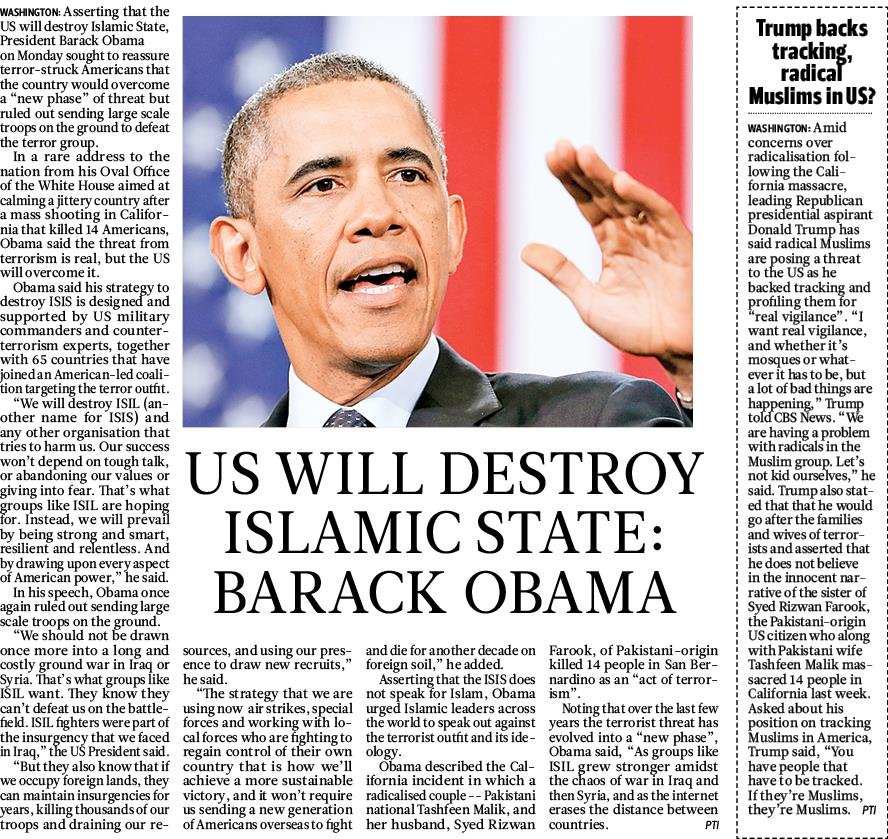
Will destroy anyone trying to harm us: Obama
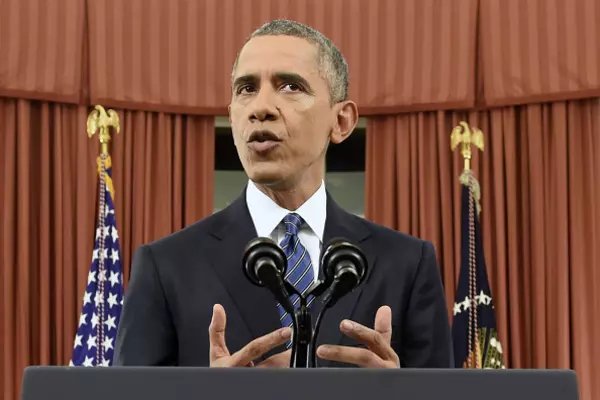
Here is the transcript of President Obama’s speech on Sunday, as provided by the White House.
THE PRESIDENT: Good evening. On Wednesday, 14 Americans were killed as they came together to celebrate the holidays. They were taken from family and friends who loved them deeply. They were white and black; Latino and Asian; immigrants and American-born; moms and dads; daughters and sons. Each of them served their fellow citizens and all of them were part of our American family.
Tonight, I want to talk with you about this tragedy, the broader threat of terrorism, and how we can keep our country safe.The F.B.I. is still gathering the facts about what happened in San Bernardino, but here is what we know. The victims were brutally murdered and injured by one of their co-workers and his wife. So far, we have no evidence that the killers were directed by a terrorist organization overseas, or that they were part of a broader conspiracy here at home. But it is clear that the two of them had gone down the dark path of radicalization, embracing a perverted interpretation of Islam that calls for war against America and the West. They had stockpiled assault weapons, ammunition, and pipe bombs. So this was an act of terrorism, designed to kill innocent people.
Our nation has been at war with terrorists since Al Qaeda killed nearly 3,000 Americans on 9/11. In the process, we’ve hardened our defenses — from airports to financial centers, to other critical infrastructure. Intelligence and law enforcement agencies have disrupted countless plots here and overseas, and worked around the clock to keep us safe. Our military and counterterrorism professionals have relentlessly pursued terrorist networks overseas — disrupting safe havens in several different countries, killing Osama bin Laden, and decimating Al Qaeda’s leadership.
Over the last few years, however, the terrorist threat has evolved into a new phase. As we’ve become better at preventing complex, multifaceted attacks like 9/11, terrorists turned to less complicated acts of violence like the mass shootings that are all too common in our society. It is this type of attack that we saw at Fort Hood in 2009; in Chattanooga earlier this year; and now in San Bernardino. And as groups like ISIL grew stronger amidst the chaos of war in Iraq and then Syria, and as the Internet erases the distance between countries, we see growing efforts by terrorists to poison the minds of people like the Boston Marathon bombers and the San Bernardino killers.
For seven years, I’ve confronted this evolving threat each morning in my intelligence briefing. And since the day I took this office, I’ve authorized U.S. forces to take out terrorists abroad precisely because I know how real the danger is. As commander in chief, I have no greater responsibility than the security of the American people. As a father to two young daughters who are the most precious part of my life, I know that we see ourselves with friends and co-workers at a holiday party like the one in San Bernardino. I know we see our kids in the faces of the young people killed in Paris. And I know that after so much war, many Americans are asking whether we are confronted by a cancer that has no immediate cure.
Well, here’s what I want you to know: The threat from terrorism is real, but we will overcome it. We will destroy ISIL and any other organization that tries to harm us. Our success won’t depend on tough talk, or abandoning our values, or giving into fear. That’s what groups like ISIL are hoping for. Instead, we will prevail by being strong and smart, resilient and relentless, and by drawing upon every aspect of American power.
Here’s how. First, our military will continue to hunt down terrorist plotters in any country where it is necessary. In Iraq and Syria, airstrikes are taking out ISIL leaders, heavy weapons, oil tankers, infrastructure. And since the attacks in Paris, our closest allies — including France, Germany, and the United Kingdom — have ramped up their contributions to our military campaign, which will help us accelerate our effort to destroy ISIL.
Second, we will continue to provide training and equipment to tens of thousands of Iraqi and Syrian forces fighting ISIL on the ground so that we take away their safe havens. In both countries, we’re deploying Special Operations forces who can accelerate that offensive. We’ve stepped up this effort since the attacks in Paris, and we’ll continue to invest more in approaches that are working on the ground.
Third, we’re working with friends and allies to stop ISIL’s operations — to disrupt plots, cut off their financing, and prevent them from recruiting more fighters. Since the attacks in Paris, we’ve surged intelligence-sharing with our European allies. We’re working with Turkey to seal its border with Syria. And we are cooperating with Muslim-majority countries — and with our Muslim communities here at home — to counter the vicious ideology that ISIL promotes online.
Fourth, with American leadership, the international community has begun to establish a process — and timeline — to pursue cease-fires and a political resolution to the Syrian war. Doing so will allow the Syrian people and every country, including our allies, but also countries like Russia, to focus on the common goal of destroying ISIL — a group that threatens us all.
This is our strategy to destroy ISIL. It is designed and supported by our military commanders and counterterrorism experts, together with 65 countries that have joined an American-led coalition. And we constantly examine our strategy to determine when additional steps are needed to get the job done. That’s why I’ve ordered the departments of State and Homeland Security to review the visa waiver program under which the female terrorist in San Bernardino originally came to this country. And that’s why I will urge high-tech and law enforcement leaders to make it harder for terrorists to use technology to escape from justice.
Now, here at home, we have to work together to address the challenge. There are several steps that Congress should take right away.
To begin with, Congress should act to make sure no one on a no-fly list is able to buy a gun. What could possibly be the argument for allowing a terrorist suspect to buy a semiautomatic weapon? This is a matter of national security.
Advertisement
Continue reading the main story
We also need to make it harder for people to buy powerful assault weapons like the ones that were used in San Bernardino. I know there are some who reject any gun safety measures. But the fact is that our intelligence and law enforcement agencies — no matter how effective they are — cannot identify every would-be mass shooter, whether that individual is motivated by ISIL or some other hateful ideology. What we can do — and must do — is make it harder for them to kill.
Next, we should put in place stronger screening for those who come to America without a visa so that we can take a hard look at whether they’ve traveled to warzones. And we’re working with members of both parties in Congress to do exactly that.
Finally, if Congress believes, as I do, that we are at war with ISIL, it should go ahead and vote to authorize the continued use of military force against these terrorists. For over a year, I have ordered our military to take thousands of airstrikes against ISIL targets. I think it’s time for Congress to vote to demonstrate that the American people are united, and committed, to this fight.
My fellow Americans, these are the steps that we can take together to defeat the terrorist threat. Let me now say a word about what we should not do.
We should not be drawn once more into a long and costly ground war in Iraq or Syria. That’s what groups like ISIL want. They know they can’t defeat us on the battlefield. ISIL fighters were part of the insurgency that we faced in Iraq. But they also know that if we occupy foreign lands, they can maintain insurgencies for years, killing thousands of our troops, draining our resources, and using our presence to draw new recruits.
The strategy that we are using now — airstrikes, Special Forces, and working with local forces who are fighting to regain control of their own country — that is how we’ll achieve a more sustainable victory. And it won’t require us sending a new generation of Americans overseas to fight and die for another decade on foreign soil.
Here’s what else we cannot do. We cannot turn against one another by letting this fight be defined as a war between America and Islam. That, too, is what groups like ISIL want. ISIL does not speak for Islam. They are thugs and killers, part of a cult of death, and they account for a tiny fraction of more than a billion Muslims around the world — including millions of patriotic Muslim Americans who reject their hateful ideology. Moreover, the vast majority of terrorist victims around the world are Muslim. If we’re to succeed in defeating terrorism we must enlist Muslim communities as some of our strongest allies, rather than push them away through suspicion and hate.
That does not mean denying the fact that an extremist ideology has spread within some Muslim communities. This is a real problem that Muslims must confront, without excuse. Muslim leaders here and around the globe have to continue working with us to decisively and unequivocally reject the hateful ideology that groups like ISIL and Al Qaeda promote; to speak out against not just acts of violence, but also those interpretations of Islam that are incompatible with the values of religious tolerance, mutual respect, and human dignity.But just as it is the responsibility of Muslims around the world to root out misguided ideas that lead to radicalization, it is the responsibility of all Americans — of every faith — to reject discrimination. It is our responsibility to reject religious tests on who we admit into this country. It’s our responsibility to reject proposals that Muslim Americans should somehow be treated differently. Because when we travel down that road, we lose. That kind of divisiveness, that betrayal of our values plays into the hands of groups like ISIL. Muslim Americans are our friends and our neighbors, our co-workers, our sports heroes — and, yes, they are our men and women in uniform who are willing to die in defense of our country. We have to remember that.
My fellow Americans, I am confident we will succeed in this mission because we are on the right side of history. We were founded upon a belief in human dignity — that no matter who you are, or where you come from, or what you look like, or what religion you practice, you are equal in the eyes of God and equal in the eyes of the law.
Even in this political season, even as we properly debate what steps I and future presidents must take to keep our country safe, let’s make sure we never forget what makes us exceptional. Let’s not forget that freedom is more powerful than fear; that we have always met challenges — whether war or depression, natural disasters or terrorist attacks — by coming together around our common ideals as one nation, as one people. So long as we stay true to that tradition, I have no doubt America will prevail.Thank you. God bless you, and may God bless the United States of America.
Army’s former havildar held in ISI spy case
Shaurya Karanbir Gurung
Tribune News Service
New Delhi, December 4
A retired Army havildar, Munawwar Ahmad Mir, was arrested today by the Delhi Police’s crime branch for allegedly being involved in an ISI-supported racket spying on the Army and Border Security Force deployments in Jammu and Kashmir.
“A team of the inter-state cell of crime branch had gone to J-K in search of other persons involved in this racket. The team arrested a retired havildar of the Indian Army, Munawwar Ahmad Mir, from Rajouri for being part of the espionage racket,” said Ravindra Yadav, Joint Commissioner of Police (Crime Branch).
Mir had joined the Army in 1995 and took retirement in 2011 after serving with the J-K Light Infantry and Rashtriya Rifles (RR), which is involved in counter-terrorism operations in the state. Mir has also served at several places across India.
The crime branch will produce him in a local court in J-K to seek his transit remand to bring him to Delhi for further interrogation.
Dialogue only way to achieve better Indo-Pak ties: UN chief
United Nations, November 29

Improved relations between India and Pakistan could create a more conducive environment for the two nations to stem the threat posed by terrorism, UN Secretary-General Ban Ki-moon has said, asserting that dialogue is the only way for them to resolve the differences.
“I am convinced that dialogue is the only way forward for improving relations between Pakistan and India. I have urged leaders of both countries to resolve all differences through talks and have offered my good offices to that end,” Ban told PTI.
He noted that he has publicly called on both countries to exercise restraint in dealing with any incidents.
Given the significant threat terrorism has become to international peace and security, Ban said an improved environment between India and Pakistan could help both nations to tackle the threat posed by the scourge.
“I believe that an improved relationship between India and Pakistan could create a more conducive environment for both countries to stem the threat posed by terrorism,” he said.
Pakistan Prime Minister Nawaz Sharif, in his address to the UN General Assembly debate this year, had proposed a four- point peace initiative to which External Affairs Minister Sushma Swaraj had responded that Pakistan should address just “one issue” of giving up terrorism. The UN chief said that he is aware of the proposals on resuming talks between the two countries presented by leaders of both countries during the General Debate at the United Nations Headquarters this September.
“Terrorism has become a significant threat to international peace and security and is causing huge losses every day, as evidenced by recent horrific attacks in places such as Lebanon and Paris,” he said.
“Member States must work together towards curbing and eradicating this menace,” he said. He noted that Pakistan has suffered many terrorist attacks for which its people have paid a heavy price and the country’s authorities have been making efforts to combat terrorism on its soil.
What UN Secy-Gen said
Dialogue is the only way forward for improving relations between Pakistan and India. I have urged leaders of both countries to resolve all differences through talks and have offered my good offices to that end
An improved relationship between India and Pakistan could create a more conducive environment for both countries to stem the threat posed by terrorism
Verdict on command exit model reserved
Legal Correspondent
New Delhi, November 26
The SC today reserved its judgment on the Centre’s appeal against the Armed Forces Tribunal’s verdict quashing Army’s promotion policy under the command exit model.
A Bench comprising Justices TS Thakur and Kurian Joseph passed the order at the conclusion of several days of arguments that saw the Centre’s assurance that additional posts of colonels would be created for non-combat officers affected by the policy.
Additional Solicitor General Maninder Singh and advocate R Balasubramanian said 141 additional posts would be offered to non-combat officers. The command exit policy was framed in 2009 on the recommendations of AV Singh committee for reducing the age of colonels in combat units in line with the practice in Pakistan, China and Japan.
Ex-serviceman murdered at Pohlo Majra
Our Correspondent
Khamano, November 23
A retired Army man was found murdered at Pohlo Majra village, near here, today. The deceased has been identified as Bhag Singh (75), a resident of the same village.
Police officials from Khamano and Fatehgarh Sahib reached the spot. The SHO, Sukhvir Singh, said they got information in this regard at about 8 am and a police party visited the spot. The found the body of Bhag Singh lying in a pool of blood. The body bore multiple injuries. Fatehgarh Sahib SP (D) Rajwinder Singh Sohal and DSP-Khamano Ajinder Singh also visited the spot.
The SHO said they had recovered the mobile phone of the deceased from the spot and a finger print team was also pressed into service. The police have registered a case of murder against unidentified persons in this regard are investigating the matter. He said the body was handed over to his relatives after post-mortem.
Paramilitary men dejected over pay panel proposals
Shaurya Karanbir Gurung
Tribune news Service
New Delhi, November 22
Several paramilitary forces personnel are dejected over the Seventh Central Pay Commission’s (CPC) proposals as some of their crucial demands have not been appropriately recommended.
These demands are non-functional financial upgradation (NFFU), bringing the basic pay of Second-in-Command (2IC) officers on a par with the Indian Army’s Lt Col, improvement in the modified assured career progression (MACP) scheme and removal from the contributory pension scheme, wherein personnel have to contribute 10 per cent of their salary for pension accumulation.
The pay panel in its report has recommended that NFFU should be extended to paramilitary and defence forces, due to the promotional stagnation in their ranks, however, two members have not supported this. NFFU ensures when an IAS officer is posted at the Centre with a specific grade pay, the officers belonging to the batches of Organised Group A Services (OGAS) that are senior by two years or more to the IAS officer, and have not reached that particular grade pay, would be granted the same grade pay on non-functional basis from the date of the posting of the IAS officer at the Centre.
The paramilitary forces personnel are not satisfied as the report states, “The number of non-functional upgrades may be limited to two, as it is in the case with Organised Group ‘A’ Service. These two upgrades should, logically, be at the two levels just above those where the system of time-bound promotions ceases. These are also the stages at which the stagnation levels are high.”
“We feel a sense of betrayal as clauses added by the Seventh CPC’s recommendations dilute the NFFU recommended by the Sixth CPC. The Seventh CPC fails to understand that no time-bound promotion exists in paramilitary forces and are only vacancy based, unlike in the defence forces,” explained a paramilitary force officer.
The Central Reserve Police Force, Border Security Force (BSF) and Assam Rifles had demanded that their 2IC be placed in Pay Band-4, like their counterparts, Lieutenant Colonel in the Army. The CPC has termed this demand as irrelevant.
Reasons for disappointment
Paramilitary personnel feel the Seventh CPC’s recommendations dilute the non-functional financial upgradation (NFFU) recommended by the Sixth CPC
The Seventh CPC fails to understand that no time-bound promotion exists in paramilitary forces and are only vacancy based, unlike in the defence forces
The CPC has termed the demand of placing their second-in-Command (2IC) officers on a par with the Indian Army’s Lt Col in Pay Band-4 as irrelevant
Army’s ‘Tornadoes’ ride their way to glory
Tribune News Service
Bengaluru, November 15
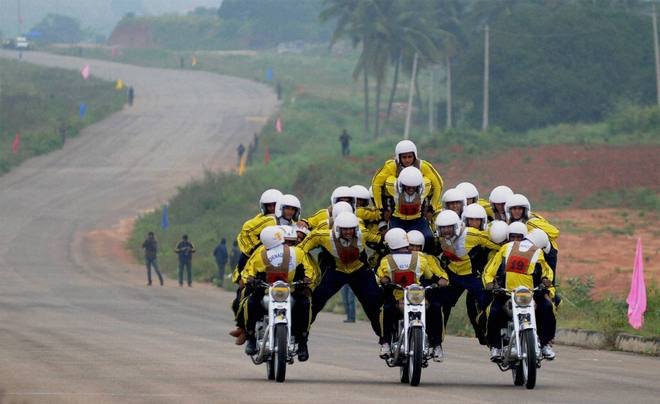
“Tornadoes”, the motor cycle display team of Army Service Corps, led by Lieutenant Colonel KK Nair today created a Guinness world record by covering a distance of 1 km in 56.23 seconds in human pyramid formation comprising 32 men.
The previous record for similar feat was held by the Corps of Signal who had covered the distance in 60 seconds. On the previous occasion, 30 personnel atop three motorcycles had taken part in the display.
The “Tornadoes” established another world record when a human pyramid consisting 12 members on two motorcycles covered a distance of 1 km in 49 seconds bettering the previous record of 54 seconds held by the Corps of Signals.
The Tornadoes also set up new records in hand-free riding of the motorcycle while sitting on front mudguard (mudguard ride) nonstop on zig-zag 19 km of road, riding motorcycle nonstop standing on zig-zag 19 km of road, riding motorcycle nonstop while lying on the seat and riding motorcycle kneeling down on the seat.
The performances took place at the NICE Road here in the presence of Lieutenant General SPS Katewa Commandant, ASC Centre and College, BK Dixit, Addl Chief Conservator of Forest and Chief Evaluation Officer, Karnataka Evaluation Authority, Brigadier Rajeev Minocha, Commandant, ASC Centre (South) and a large number of civil and military dignitaries.
The display team was raised in 1982 after having given a stupendous display of daredevilry during the 1982 Asian Games.
The records by Tornadoes include forming a moving human pyramid consisting of 181 men on 11 pyramids.
China trains monks in anti-espionage ops
Beijing, November 13
China is training Buddhist monks and nuns in Tibet to carry out anti-espionage operations along the remote India-China border to prevent attempts to create “conflict” by “ethnic separatists”, in a veiled reference to the Dalai Lama and his supporters.
“Twenty-two monks and nuns from three temples in Nyingchi, a city in southeastern Tibet, close to the Sino- Indian border, received the three-hour lecture at Lamaling Temple on the counter-espionage law by local and national security officials,” state-run news portal Tibet.cn reported.
The lecture conducted in the Himalayan region along the border with India was about how to abide by the counter-espionage law and the legal consequences of violating the law, it said.
“Nyingchi is of special importance to anti-espionage efforts because there are many military sites,” said Penpa Lhamo, deputy head of the contemporary studies institute of the Tibet Academy of Social Sciences.
Monks and nuns are considered vulnerable to espionage activities, as many senior officials in China often visit eminent monks. And temples have always been a focus of government to maintain the stability of Tibet, said Li Wei, an anti-terrorism expert with the China Institutes of Contemporary International Relations. — PTI
Rajnath to visit Beijing from Nov 19
Home Minister Rajnath Singh will undertake a five-day visit to China beginning November 19
He is likely to take up with the Chinese leadership incursion particularly in the Ladakh sector and smuggling of arms into the North-East
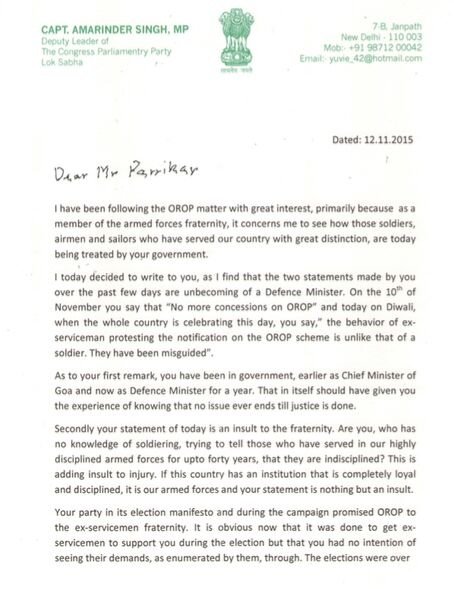
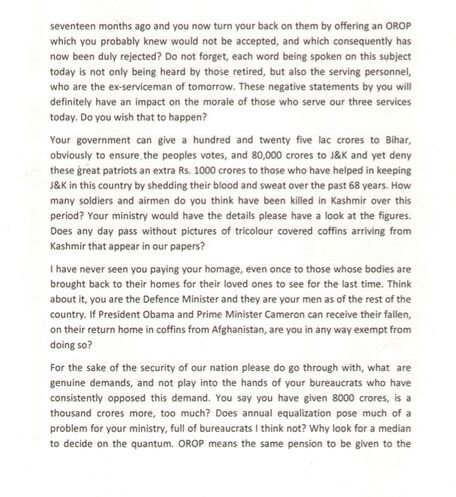
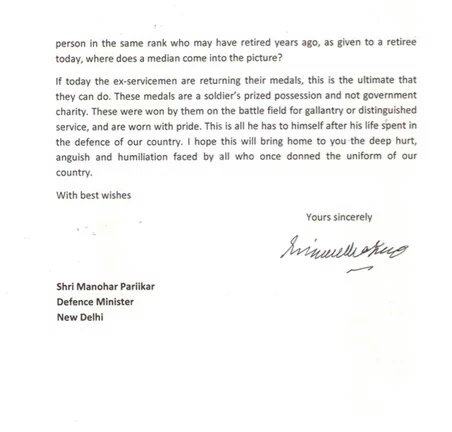
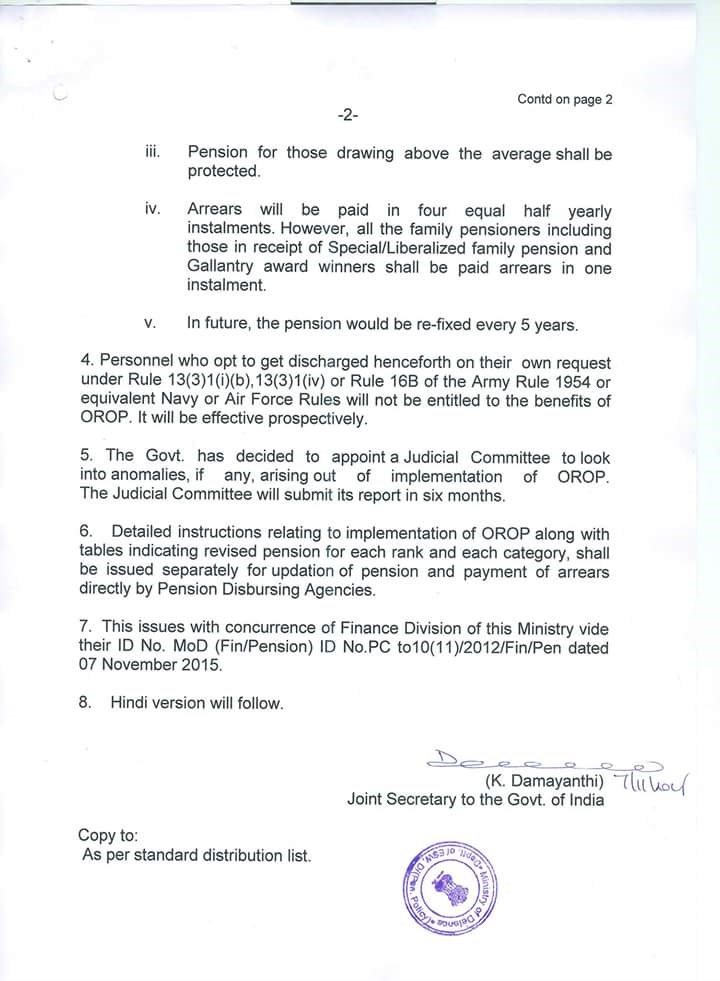
CAPT AMRINDER WRITES TO SHRI MANOHAR PARRIKAR
13 NOV 2015