All posts by webadmin

Pak hits new low, targets three schools along LoC

217 students rescued from all 3 schools by 730pm. Great job by team. A narrow escape at Bhawani (sic). SHAHID IQBAL CHOUDHARY, Rajouri DC, on Twitter

JAMMU: Pakistan sunk to a new low when its army targeted schoolchildren in at least three schools along the Line of Control (LoC) in Nowshera sector of Rajouri district on Tuesday. The Pakistan army also pounded Indian posts and forward villages along the de-facto border in neighbouring Poonch, prompting India to retaliate in equal measure.

Rajouri senior superintendent of police Yougal Manhas told Hindustan Times that over 200 children had to be evacuated to safety in bulletproof vehicles in Nowshera.

“Even at 5.45pm, intense shelling is on. In a day-long exercise, we rescued 11 children from a school, 50 from another and then there was the third school where children had to be kept inside due to severe shelling. It all happened in Bhawani area of Nowshera sector,” the SSP said.

He said heavy shelling was reported in Bhawani, Sair and Kadali villages of Nowshera sector. “At least 11 students were trapped in the middle school and nearly 50 in the high school in Sair. Around 150 students were confined in a high school in Bhawani. With great caution, we eventually rescued the children,” Manhas said.

SECURITY PERSONNEL RUSH TO SPOT

Rajouri deputy commissioner Shahid Iqbal Choudhary rushed to Bhawani to take stock of the situation and evacuation.

“All the schools in 23 villages close to the LoC and new areas which came under Pakistan shelling on Tuesday have been closed indefinitely. We are keeping a watch on the situation. Five relief camps are already in place where 840 families comprising around 3,500 villagers are residing,” Choudhary said.

“Field officers have been deputed for coordination and those staying close to the LoC have been asked to stay indoors,” Choudhary said, adding that close to 5,000 people in the district have been adversely affected by the firing from the other side of the LoC.

At around 7pm, Choudhary tweeted, “217 Students rescued from all 3 schools by 730pm. Great job by team. A narrow escape at Bhawani (sic).”

Defence spokesperson Lt Col Manish Mehta said there was an unprovoked ceasefire violation was initiated by Pakistan in Bhimber Gali and Poonch sectors at 6.45am on Tuesday before the Pakistani troops opened heavy fire, including mortars, around 1.50pm in Nowshera.

On Monday, Pakistan army violated the ceasefire in Balakote and Poonch sectors, killing a minor girl and a soldier besides injuring four others. Pakistani forces also violated the ceasefire in the Manjakote sector.


Pak plans ‘takeover’ of charities run by Mumbai attack mastermind Saeed

Pak plans ‘takeover’ of charities run by Mumbai attack mastermind Saeed
Mumbai attack mastermind Hafiz Saeed. AFP file

January 1

Pakistan’s government plans to seize control of charities and financial assets linked to Islamist leader and Mumbai attack mastermind Hafiz Saeed, who Washington has designated a terrorist, according to officials and documents reviewed by Reuters.

(Follow The Tribune on Facebook; and Twitter @thetribunechd)

Pakistan’s civilian government detailed its plans in a secret order to various provincial and federal government departments on December 19, three officials who attended one of several high-level meeting discussing the crackdown told Reuters.

Marked “secret”, a December 19 document from the Finance Ministry directed law enforcement and governments in Pakistan’s five provinces to submit an action plan by December 28 for a “takeover” of Saeed’s two charities, Jamaat-ud-Dawa (JuD) and the Falah-e-Insaniat Foundation.

The United States has labelled JuD and FIF “terrorist fronts” for Lashkar-e-Toiba (“Army of the Pure” or LeT), a group Saeed founded in 1987 and which Washington and India blame for the 2008 attacks in Mumbai that killed 166 people.

Saeed has repeatedly denied involvement in the Mumbai attacks and a Pakistani court saw insufficient evidence to convict him. The LeT could not be reached for comment.

The December 19th document, which refers to “Financial Action Task Force (FATF) issues”, names only Saeed’s two charities and “actions to be taken” against them.

The FATF, which is an international body that combats money laundering and terrorist financing, has warned Pakistan it faces inclusion on a watch list for failing to crack down on financing terrorism.

Asked about a crackdown on JuD and FIF, Interior Minister Ahsan Iqbal, who co-chaired one of the meetings on the plan, responded only generally, saying he has ordered authorities “to choke the fundraising of all proscribed outfits in Pakistan”.

In a written reply to Reuters, he also said Pakistan wasn’t taking action under US pressure. “We’re not pleasing anyone.

“We’re working as a responsible nation to fulfil our obligations to our people and international community.” Spokesmen for the JuD and FIF both said they could not comment until they receive official notifications of the government’s plans. “We don’t have any intimation about any crackdown so far,” FIF spokesman Salman Shahid told Reuters. “No one has asked us about our work or assets.” Saeed could not be reached for comment. He has frequently denied having ties to militants and says the charitable organisations he founded and controls have no terrorism ties. He says he promotes an Islamic-oriented government through doing good works.

First major move

If the government follows through with the plan, it would mark the first time Pakistan has made a major move against Saeed’s network, which includes 300 seminaries and schools, hospitals, a publishing house and ambulance services. The JuD and FIF alone have about 50,000 volunteers and hundreds of other paid workers, according to two counter-terrorism officials.

Participants at the meeting raised the possibility that the government’s failure to act against the charities could lead to UN sanctions, one of the three officials said. A UN Security Council team is due to visit Pakistan in late January to review progress against UN-designated “terrorist” groups.

“Any adverse comments or action suggested by the team can have far-reaching implications for Pakistan,” the official said.

The December 19th document gave few details about how the state would take over Saeed’s charities, pending the plans submitted from the provincial governments. It did say it would involve government entities taking over ambulance services and accounting for other vehicles used by the charities.

It says law enforcement agencies will coordinate with Pakistan’s intelligence agencies to identify the assets of the two charities and examine how they raise money.

The document also directs that the name of JuD’s 200-acre headquarters, Markaz-e-Toiba, near the eastern city of Lahore be changed to something else “to make it known that the Government of “Punjab (province) solely manages and operates the Markaz (headquarters)”.

The move to seize the charities could spark some concern from the powerful military, which has proposed plans to steer Saeed and the JuD into mainstream politics. The military did not respond to a request for comment.

In August, JuD officials formed a new political party, the Milli Muslim League, and backed candidates who fared relatively strongly in two key parliamentary by-elections.

The JuD publicly disavows armed militancy inside Pakistan, but offers vocal support for the cause of rebel fighters in Indian-administered Kashmir and has called for Pakistan to retake Kashmir. Nuclear-armed India and Pakistan have fought two wars over the disputed region.

Washington, which has offered a $10 million reward for information leading to Saeed’s conviction over the Mumbai attacks, warned Islamabad of repercussions after a Pakistani court in late November released him from house arrest.

Punjab’s provincial government had put Saeed under house arrest for 10 months this year for violating anti-terrorism laws. Reuters


Kharga Corps celebrates 46th Raising Day

Kharga Corps celebrates 46th Raising Day

Ambala, October 6

Image result for Kharga Corps

The Kharga Corps celebrated its 46th Raising Day here in Ambala Cantonment today. With the prospect of war with Pakistan looming ominously, the corps was raised in October 1971 in Krishna Nagar, West Bengal, with an intention to fight in East Pakistan (now Bangladesh).Pressed into full-fledged action within months of its raising, the corps proved its mettle in battle, capturing important towns of Khulna, Jessore, Jhenida, Magura, Faridpur and great swathes of territory between the Ganges and Padma rivers. Subsequently, the corps shifted westwards and its headquarters is located in Ambala since 1985.Armed to the teeth with a formidable arsenal, the Kharga Corps is equipped with the most modern tanks, artillery gun system, and variety of mission-oriented arsenals. It is one of the most potent corps of the Indian Army.It is called the Kharga Corps because of its unique formation sign. The day was celebrated solemnly with wreath laying by the Corps Commander on the War Memorial in remembrance of martyrs. —TNS


Denigrating Nehru by S Nihal Singh Sangh ——Parivar’s aim while approaching 2019

Denigrating Nehru
new heroes: Promoting Deen Dayal Upadhyaya as an icon is part of the President’s brief.

S Nihal Singh

AN attempt to denigrate Jawaharlal Nehru, the maker of modern democratic India, has been put in high gear with the installation of the new President of the ruling BJP’s choice, Mr Ram Nath Kovind. In his inaugural address, he pointedly omitted Nehru in recalling the good and the great of the Independence movement while elevating the Sangh Parivar ideologue, Deen Dayal Upadhyaya, to rub shoulders with Mahatma GandhiThe Sangh Parivar’s problem with Nehru is an old one because everything he stood for — a cosmopolitan mind open to ideas and ideals, whatever their source, and a nationalism rooted in secularism — is anathema to the Parivar. That the Congress he led fell short of these ideals is another matter.Starting with the young, the BJP-led government would rather make Nehru a non-person in common with the practice of traditional Communist regimes which made persons not in favour disappear from history’s pages. But since Nehru played such a key role in modern Indian history, the BJP is indoctrinating the very young unfamiliar with the Independence struggle that he did not exist.The Sangh Parivar’s dilemma is that since its own movements played such a peripheral part in the freedom movement with its ambivalent postures towards a free India — the RSS was in the doghouse for a time in newly-independent India — it has no Independence icons. Apart from appropriating Mahatma Gandhi and Sadar Vallabhbhai Patel, the number two to Nehru, among others, it is hoping that the makers of the Parivar’s ideology, such as it is, will serve the purpose of markers in the New India it wants to create.The BJP’s victory in the 2014 general election, thanks largely to RSS cadres and Mr Narendra Modi’s effective campaigning and planning, was for the RSS manna from heaven. It had come to power at the Centre for the first time under its own steam. The leader chosen by the BJP was cradled in the RSS and the road thus opened was too tempting not to move towards realising its dream of a Hindu India.The contours of the RSS ideology as it is shaping up is becoming clearer even if Mr Modi has to trim it at the edges to rule over a diverse country. RSS ideologues start on a defensive note in the face of historical evidence that in recent centuries, India has been ruled by a succession of Muslim rulers, despite stubborn pockets of heroic resistance. Then came the British who ruled over India for two centuries forming their own Indian army and giving what Napolean called toys — titles big and small — to those who would help the imperial power.One lesson the RSS has drawn from this history is to pretend that the Mughal period did not exist. The other was to imbibe a culture of physical fitness employed figuratively by the obligatory morning drill wearing khaki shorts (now changed to trousers) and using staves for guns.The RSS’s second defence mechanism was to create history of a golden age of renaissance in ancient India, with planes flying, operations being performed for head transplants and various forms of modern technology already prevalent in the blessed land of old India.These sentiments underpin the RSS philosophy that India has to teach the world, not learn from it. It follows therefore that the narrow form of nationalism it espouses is the best in the world. And since all these virtues spring from the sagacity and penance of Hindus, they should lay down the law. After all, in their view, all minorities are converts from Hinduism.To rule a country as ethnically and religiously diverse as India on the basis of this foundation of beliefs he largely shares is Mr Modi’s problem. His difficulties mount as cow vigilantes murder and run riot behaving as if the Hindu rashtra had already arrived. No wonder that Muslims in particular are feeling insecure, as retiring Vice-President Hamid Ansari took pains to point out distressing BJP supporters, including his successor.The anti-Nehru campaign gathers force in the meantime. The Nehru memorial is to house representations of all former Prime Ministers. Cultural and social research organisations have acquired pro-BJP heads contributing their might to embellishing the myths of the glories of India.India is not singular in this “retro” movement. US President Donald Trump is one example and two European countries have also shown the way. Hungary under the leadership of Mr Viktor Orban is a believer in an “illiberal democracy”. Poland with its new conservative party in power is making short work of its impartial judicial system. They are both members of the EU, which is seeking to discipline them, to little effect thus far.In India, preparations for the 2019 election will decide the pace at which the Hindutva movement will spread. The BJP’s singular fixation is to win the remaining states. Witness the extraordinary step by Mr Modi in seeking to bring Tamil Nadu’s two AIADMK factions together even as rival Sasikala is cocking a snook at the process from her Karnataka jail cell. Mr Nitish Kumar is already in the net at the expense of the Bihar grand coalition and is now being asked formally to join the National Democratic Alliance.The Sangh Parivar believes that the momentum is with it as the date for the next general election approaches. Removing Nehru from the pedestal he rightly occupies as the key maker of modern India has to be demolished, BJP president Amit Shah recently damning him for borrowing Western ideas. The danger for the BJP is that Nehru’s legacy still lives and is part of national consciousness.The stance of President Kovind in prioritising Sangh Parivar philosophy, despite his disavowal of party loyalties, will be determined by his future moves. Promoting Deen Dayal Upadhyaya as a national icon is in his brief. If the Sangh Parivar is allergic to Nehru, he should not lend his voice to a partisan agenda.


Respected Veterans,

Jai Hind.

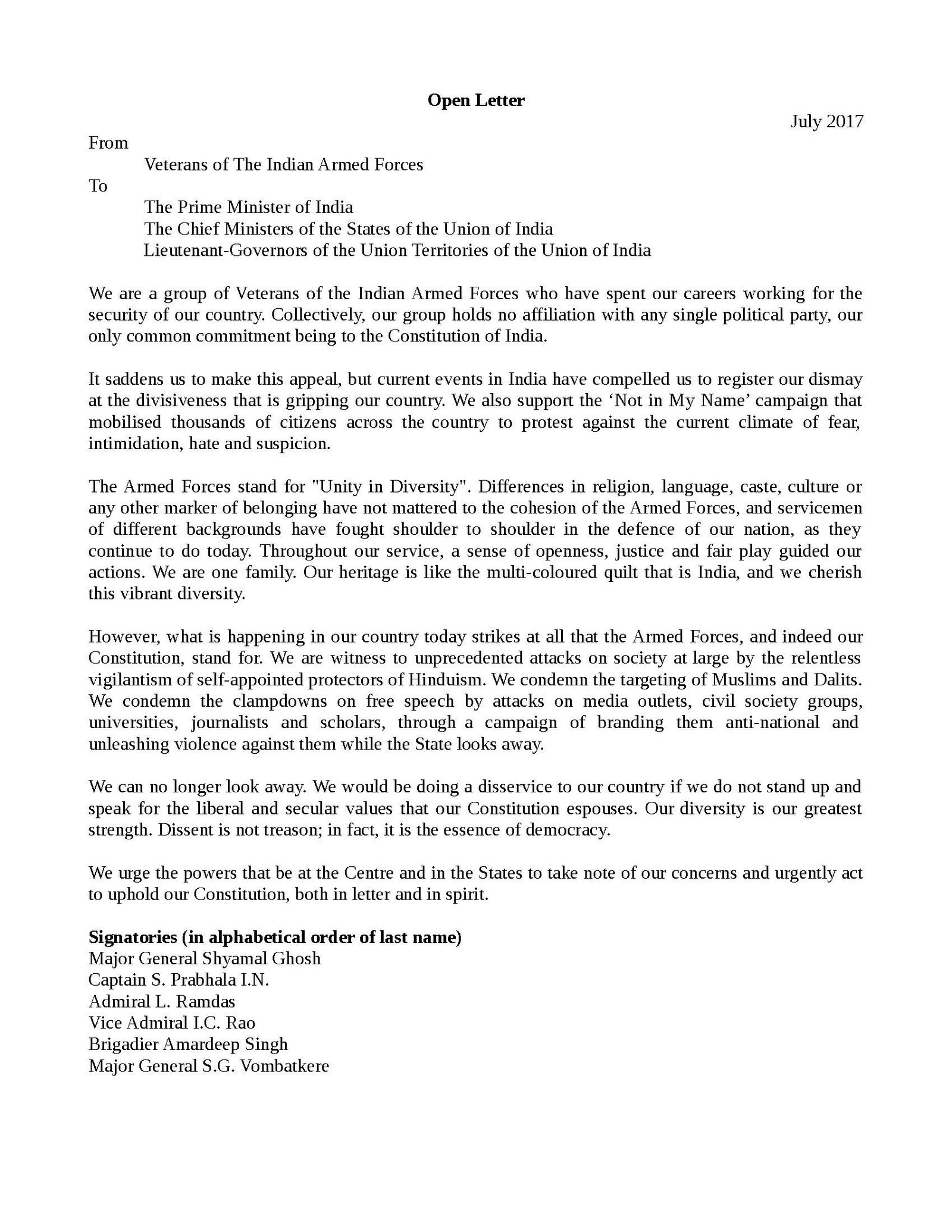
Please find ATTACHED, an Open Letter addressed to the Hon’ble PM, signed by the following six Military Veterans.

Ø    Major General Shyamal Ghosh.

Ø    Captain S. Prabhala I.N.

Ø    Admiral L. Ramdas

Ø    Vice Admiral I.C. Rao

Ø    Brigadier Amardeep Singh

Ø    Major General S.G. Vombatkere

The letter expresses dismay at the recent acts of intimidation and violence by certain ideologues creating a climate of fear and suspicion while the State looks away.

We, veterans of the Armed Forces, are inheritors of a glorious tradition of esprit de corps among persons of different backgrounds, be it of religion, caste or language. It is therefore incumbent on us to speak up for the democratic and secular values enshrined in our Constitution. To remain silent would be a disservice to our cherished values.

If you agree with the sentiments expressed in the Open Letter, kindly send an email to <constitutional.dharma@gmail.com>saying “I agree. Please include me as a signatory”. While doing so, please give your rank at the time of retirement and your full name.

In addition, after deleting my e-mail ID, I request you to forward this covering note and the ATTACHED Open Letter to your veteran friends and colleagues to gather more support for the cause. Our intention is to give wide publicity to the Appeal after a reasonable number have signed in. For the present, therefore, kindly do not circulate this outside of the veterans community.

colRajan

Col SS Rajan

Bangalore, 9449043770

click to open pdf file below


Moving-picture-down-arrow-on-spring-animated-gifVETERANS’ OPEN LETTER

VETERANS' OPEN LETTER


Special trains for Patna Sahib from Punjab

HE PUNJAB GOVT HAD SOUGHT PERMISSION FROM THE RAILWAYS TO RUN SPECIAL TRAINS FROM AMRITSAR, BATHINDA AND PATIALA TO PATNA SAHIB

CHANDIGARH : Decks have been cleared for special trains to take devotees for the 350th birth anniversary celebrations of 10th Sikh Master Guru Gobind Singh from Punjab to Patna Sahib and back.

The Punjab government had sought permission from the Indian Railways to run special trains from Amritsar, Bathinda and Patiala to Patna Sahib following chief minister Amarinder Singh’s directives.

The Railways has given permission to the state to run the trains to Patna on December 22 and back on December 27, an official spokesperson said here.

The formal permission from the Indian Railway Catering and Tourism Corporation (IRCTC) was received by the state transport commissioner (STC), the spokesperson said.

The trains from Amritsar, Bathinda and Patiala will leave on December 22 and reach Patna Sahib the next day.

The train from the Amritsar Railway Station will leave at 9.45 am and reach Patna Sahib at 11.45 am, the one from Patiala will leave at 9.30 am and reach at 11 am and the third special train from Bathinda would depart at 9 am and reach at 11 am on December 23.

These special trains would start from Patna Sahib on December 26 and return to their respective destinations on December 27.

Nearly 1,500 devotees are expected to travel in each of these trains. Government officials and a team of doctors will be available onboard the trains, the spokesperson said.


clip


Army equipped to fix ammunition shortage, but needs to monitor quality by Gautam Moorthy and Syed Ata Hasain

In the first of a two part series on ammunition shortages in the army, Gautam Moorthy and Syed Ata Hasain write that governments in the past appeared to believe the threat of conventional war to be negligible enough not to warrant even making up of deficiencies, let alone a sustained build-up. Read the second part. 

Gautam Moorthy & Syed Ata Hasnain

Two major heart-warming decisions by the government: the first came before the Doklam standoff and the second even as the Chinese continue to blow hot and hot with intimidation, threats and rhetoric.

The Army has been delegated special financial powers by the government to make up its critical deficiencies in ammunition and spares. This was received with much satisfaction among those whose responsibility it is to ensure that the fighting troops get the wherewithal to implement the military goals set out for them.

Setting a figure of Rs 40,000 crores for this is not a small sum even though making up critical deficiencies may need much more.  Then the Ministry of Defence (MoD) demanded an additional of Rs 20,000 crores, presumably for the current annual defence budget  for the purpose of once again making up deficiencies in ammunition and spares. The latter presumption is a fair one considering that acquiring weapon systems at this stage to meet the Chinese threat may be too little, too late.

Some have even put a number on it: about Rs 98,000 crores if we wish to make up ammunition for the 40 day-reserves by 2019.

Governments in the past appeared to believe the threat of conventional war to be either non-existent or negligible enough not to warrant even making up of deficiencies, let alone a sustained build-up. Or perhaps the view was that we have lived with the deficiency for many years and could do so for some more, in the absence of ‘real threats’. The real threat seems to be upon us now and the procedure to release and delegate additional funds has been in progress for the last few months.

The current government has fathomed the seriousness of the issue and has moved to empower the Vice Chief of the Army Staff (VCOAS) to move ahead without the Army having to look over its shoulder. It is a critical decision for the Army whose current holdings of major war fighting equipment cannot be effectively brought to bear on the enemy and would be rendered ineffective in the absence of critical spares and ammunition.

So what has actually been done? First of all, and perhaps a case of better late than never, the government has finally accepted the inability of the ordnance factories to meet the annual targets set by the army, targets that the factories themselves agree to. Ten separate contracts in respect of various ammunition items have been signed under the delegated financial powers of the VCOAS.

To diversify the supply chain, the army is procuring ammunition from private industry as well as public sector undertakings (PSUs), a domain that was entirely of the Ordnance Factory Board (OFB) until now.  It is also in keeping with the Make in India philosophy. ‘Requests For Proposals’ for various types of ammunition items, 22 in all, have been issued to Indian companies for the first time in history since Independence. Invitation of
bids have been asked for supplying yearly quantities, for a contractual period of ten years under ‘Manufacture of Ammunition for Indian Army by Indian Industry’ initiative.

Full powers have to be given to the Army HQ to procure operationally critical ammunition and spare parts. Additional steps include monitoring of delivery to the Army by the manufacturers by fixing numerical targets instead of financial targets, strict budgetary controls, an eagle eye focus on quality and an increase in storage capacities.

Critical equipment, ammunition and spares have to be put in the hands of the fighting formations early enough, perhaps as early as to empower and enable our formations not to be deterred by the bellicose Chinese threats and propaganda.

Consequent to the devastating fire that took place last year in the ammunition depot at Pulgaon near Nagpur that killed 19 people, the MoD, has approved a procedure for disposal of dangerous ammunition and regularisation of losses for defective ammunition to bring in accountability in the functioning of ammunition factories that are under the OFB, which till now were not held accountable. However, much remains to be done on the major issue of quality checks during manufacturing.

Lt. Gen. Syed Ata Hasnain (Retd), a former GOC of Srinagar-based 15 Corps, is associated with the Vivekanand International Foundation and the Institute of Peace and Conflict Studies. Twitter: @atahasnain53

Lt Gen Gautam Moorthy, former DG Ordnance Services, is now a part of the
Armed Forces Tribunal at Kolkata. Twitter: @GautamMoorthy ‏


India-China standoff: What is happening in the Chumbi Valley?By Lt Gen H S Panag

Depending upon the situation, we must mobilise to call China’s bluff and be prepared for border skirmishes or even a limited war.

“Yatung was a small spread out town… we were received by representatives of the Chinese General in Command at Lhasa, and of the Dalai Lama and Panchen Lama.” Thus wrote Jawaharlal Nehru to the Chief Ministers of India on October 15, 1958, describing his stay at Yatung for two days in September-October 1958, during his to and fro journey to Bhutan through the heart of the Chumbi Valley. Today it seems like a fairytale, but for 50 years up to 1954, we had an Indian Army Infantry Battalion located at Yatung with a detachment at Gyantse. These were gradually withdrawn after the Panchsheel Agreement was  signed on 27 April, 1954. We continued to have our Consul General in Lhasa and Indian Trade Agency trading posts at Yatung, Gyantse and Gartok upto 1962 when they were wound up.

Chumbi Valley has been in the news for a couple of weeks owing to reports about the Chinese intrusion into the Doklam (Donglang according to China) Plateau. There has been some confusion created about the place of intrusion with names like “trijunction”, “Doka La”, “Sikkim Border”, “Donglang”, “Mount Gipmochi (Gyemo Chen)” and “Doklam” used by the angry People’s Republic of China (PRC) and People’s Liberation Army (PLA) spokespersons, and our media.

Where is Doklam Plateau?

Doklam Plateau is an 80-89 square km plateau with average altitude of 4,000-4,500 meters, located in Western Bhutan. It is a salient of Bhutanese territory that juts north into the Chumbi Valley with India (Sikkim) to the north-west, west and south-west and Tibet to the north, east and south-east. The trijunction of India, Bhutan and Tibet is on the north-western edge of the Doklam Plateau where the Batang La post of India is located and north-west of which along the crest line are the Indian defences of Sikkim.

What is the military significance of the Chumbi Valley and the Doklam Plateau?

Salients on borders whether towards own or enemy’s territory have military pros and cons. Chumbi Valley is a 100-km dagger-shaped north- south salient that lies between India (Sikkim) to the north-west, west and south-west, and Bhutan to the north-east, east and south. Some 100 km south of the dagger point is Bangladesh and, in between, lie 70 km of rugged mountainous terrain of India/Bhutan and the Siliguri Corridor, which at its narrowest point is only 30-km wide and has a number of rivers running in north-south direction. On the face of it, at the strategic level, it gives the PLA a launch pad to choke India’s vital lines of communications running through the Siliguri Corridor to the North East. But this will require a major offensive by five to six divisions as part of an all-out war, with holding forces to contain the north western, western and eastern flanks. Given the existing road communication, limited deployment space as the Chumbi Valley at Yatung is only 25-30 km wide as the crow flies, vulnerability to air power and Indian counter-offensive from the flanks, this hypothetical threat is a non-starter.

In fact, the Chumbi Valley is more vulnerable to an Indian offensive or counter-offensive from the north-west and west from Sikkim and ‘by your leave’ complementary offensive via Bhutan from the east. Again this can only happen in a major war, the probability of which is very low. Nations armed with nuclear weapons do not generally risk an all-out conventional war, though probability of border skirmishes or a limited war cannot be ruled out.

The Doklam Plateau gives the PLA the advantage of outflanking from the south west, the defences of Sikkim, where we have a major terrain advantage vis the Chumbi Valley. The implications are strategic. We not only lose our major advantage of a strategic offensive / counter offensive from Sikkim but also give the PLA a launch pad for an offensive through the Rangpo River valley towards Kalimpong without violating the neutrality of Bhutan. The probability of war may be low, but the bottom line is that India cannot afford to surrender its strategic advantage and create a vulnerability by allowing the PLA to take possession of the Doklam Plateau. It is pertinent to mention that all the disputed areas that the Chinese claim along the Line of Actual Control (LAC) are related to strategic or tactical advantages in event of a war.

What is the dispute in the Doklam Plateau?

Map released by the Chinese spokesperson*

*Map released by the Chinese spokesperson showing the disputed area as per its perception of the 1890 Anglo-Chinese Convention. The Trijunction is marked at Gyemo Chen (Mount Kipmochi). The dotted line on the map running through Sinche La shows the Indian and Bhutanese perception of the Trijunction and the boundary.

The LAC only defines the approximate border which has emerged out of the frontier regions over the last 100 years. Same is the situation on the Bhutan border. There is no mutually accepted International Boundary.  Even in respect of the de facto borders, there is no delineation agreement, which China has signed with India or Bhutan.  Ancient feudal and colonial treaties or agreements are cited to press rival claims. There is no de juresanctity of the border. Empirically, it is the de facto position, which reigns supreme with respect to borders. And the de facto position is signified by physical possession and presence. The problem with the borders with Tibet is that the rival claimants have not physically secured all their claimed areas. Hence, jostling for positions of advantage as part of the continuous competitive conflict is a constant feature which may take place by design or at times by default.

The de facto position is that India holds the posts of Batang La and Doka La  to the north-west of Doklam Plateau as part of its defences in Sikkim. India and Bhutan consider that the trijunction is located at Batang La. The Doklam Plateau is in the possession of Bhutan but it secures its possession with only one post at Zompleri, which is occupied only in summers. China claims the entire plateau and as per its version the Trijunction is at Mount Gipmochi (Gyemo Chen) which is 7-8 km to the south-east of the de facto present position. Since the Doklam Plateau is largely not physically held by the Bhutan Army, the PLA has been patrolling this area at will. India also patrols this area with a mutual understanding with the Bhutan Army to safeguard its vulnerable eastern flank. Indian and PLA patrols have confronted each other in this area in the past and matters were resolved by agreeing to disagree to maintain status quo for peace.

China bases its claims on the Anglo-Chinese Convention 1890 as per which the Sikkim-Tibet border was agreed upon. Ironically, Sikkim and Bhutan were neither invited to nor are signatories to the convention. This convention did not prevent China from starting confrontation at Nathu La in 1967. Moreover, China’s approach to various colonial treaties/conventions has been selective on one pretext or the other. China has officially acknowledged the various areas of dispute including the Doklam Plateau with Bhutan and 24 rounds of negotiations have been held. It has formally been agreed to by China and India, in 2012, that the Trijunction points between India, China and third countries will be finalised in consultation with the concerned countries. In 1988 and 1998, China and Bhutan have also formally agreed to maintain status quo with respect to the disputed areas pending final settlement. Notwithstanding the patrolling by both sides, this status quo has not been disturbed until June 2017.

Bhutan, being a small nation, has a special relationship with India based on formal treaties renewed over the 100 years. As per the 2007 treaty, India and Bhutan have agreed to cooperate with each other on issues relating to their “national interests” and not allow the use of their territory for activities harmful to national security and interest of the other. Shorn of diplomatic ambiguity, it implies that Bhutan will be guided by India with respect to its foreign and defence policy. De facto, India is responsible for the defence of Bhutan, but except for the Indian Military Training Team no Indian troops are permanently stationed in Bhutan. However, troops of both countries do carry out joint training on as required basis. On the borders, there is intimate cooperation between the Royal Bhutan Army and the Indian Army particularly in disputed areas like the Doklam Plateau. Bhutan, being a small country, was keen to settle the disputes on its western boundaries in favour of China in exchange of a favourable settlement for two northern areas of dispute. However, keeping in view India’s sensitivities it refrained from doing so particularly with respect to the two disputed areas of Doklam Plateau and Sinchulumpa-Giu-Darmana south and east respectively of the Chumbi Valley.

The present standoff

On June 16, China began construction of a road from Sinche La towards the Bhutan Army post of Zompleri. Indian troops from Doka La confronted the PLA troops in conjunction with the troops of the Bhutan Army. No fire arms were used, but, human chains were formed by both sides and “jostling” (pushing and shoving) which has become a common feature in such confrontations have continued on and of since then. Both sides seem to have reinforced the present positions with additional troops and the standoff continues.

While such ‘standoffs’ have taken place for prolonged periods in the Depsang Plains in 2013 and Chumar in 2014, the emphasis still was on diplomacy and having made the ‘political statement’, the PLA reverted to status quo. However, this time the official statements and Chinese media have been unusually belligerent giving short shrift to diplomatic niceties. Words and phrases like “do not forget 1962”, “PLA will teach India a lesson”, “no talks until Indian troops withdraw”, “option of war is open” and “either Indian troops return to their territory with dignity or will be kicked out of the area by the PLA”, have been freely used. India and Bhutan in typical diplomatic language have urged China to maintain status quo ante pre June 2017 and respect the interim agreements with respect to Trijunction points reached with India in 2012 and the 1988, and 1998 agreements with Bhutan to maintain the status quo pending final settlement.

Chinese Strategy

What are the reasons for this unusually belligerent stance of the Chinese? Are we heading towards border skirmishes or even a more serious confrontation?

The Doklam incident as also other border incidents in the past have nothing to do with the territorial disputes per se. Nations with credible conventional and nuclear deterrent, do not part with territory under their control whatever be the nature of the dispute. China is well aware of this, but selectively starts such confrontations to make ‘political statements’ and keep India on the edge. Such incidents always take place to coincide with major diplomatic events or as a response to perceived Indian actions that are contrary to Chinese world or regional view.

India is the only country in the region that has not accepted Chinese political hegemony. China views India as a competitor that challenges its preeminent position. Indo-USA strategic cooperation is seen as a threat. India is seen as the principal instigator of the Tibetan struggle for freedom. The presence of the Dalai Lama and the Tibetan Government in Exile at Dharamsala only reinforces the Chinese belief. The recent visit of the Dalai Lama to Tawang annoyed the Chinese no end. India, along with Bhutan, is the only country that has not become part of the much-touted One Belt, One Road. Prime Minister Modi was scheduled to meet President Donald Trump in the third week of June.

China decided to embarrass India in the Doklam area by trying to alter the status quo. It aimed at driving a wedge between India and Bhutan and thus chose to show its presence in Bhutanese territory, to which India also is very sensitive. China’s strategy is to make India lose face by forcing it to withdraw and thus wean Bhutan to its own sphere of influence.  Anything short of mutual withdrawal will leave China in de facto control of the Doklam Plateau outflanking and compromising the Indian defences in Sikkim.

What should be the Indian strategy?

This is a critical moment in Sino-Indian relationship. Any sign of weakness will have repercussions on the entire boundary question. Today, it is Doklam and tomorrow, it will be somewhere else. Acceptance of Chinese position in Doklam will lead to unacceptable ‘loss of face’ domestically and internationally.

China understands only one language and that is the language of strength. Our own experience of the 1967 confrontation in Sikkim and the Sumdrong Chu incident in 1986-87 proves this point. India must not back down unless it is mutual withdrawal to restore status quo ante pre-June 2017 and respect for past interim agreements to maintain status quo with respect to Trijunction points. In Doklam, we are in a position of advantage and from Batang La can cut off the PLA intrusion at Sinche La. We can build up much faster than China for any serious military confrontation. Depending upon the situation, if need be, we must mobilise to call China’s bluff and be prepared for border skirmishes or even a limited war. The tenor of the Chinese statements and our measured and nuanced response itself reflects that we have the psychological advantage.

There is no gain in saying that we must engage with China to settle the matter diplomatically and a direct military confrontation is the last resort. This is a defining moment, as giving in to Chinese bullying at this juncture will have serious repercussions for our rightful place in the comity of nations and our status as an emerging power.

HEADLINES ::::::26 DEC 2017 @ WWW.SANJHAMORCHA.COM

  • MEMORIES FLOW AS CAPT. AMARINDER HOSTS NDA BATCH MATES FOR A REUNION AFTER 58 YEARS
  • ARMY DENIES BODIES OF MAJOR AND THREE JAWANS, KILLED IN PAKISTANI CEASEFIRE VIOLATION, WERE MUTILATED
  • LANCE NAIK CREMATED WITH STATE HONOURS IN BATHINDA ZOOM BOOKMARK SHARE PRINT LISTEN TRANSLATE
  • PAK SNIPER SHOT; SHELLING ON LOC ARMY RETALIATES AFTER KILLING OF 4 SOLDIERS, INCLUDING MAJ; CEASEFIRE VIOLATED AGAIN
  • RAJOURI ATTACK: LANCE NAIK CREMATED IN TALWANDI SABO
  • SHAHEEDI JOR MELA BEGINS, CCTVS, DRONES KEEP VIGIL
  • Governor, Speaker pay tributes to Sahibzade
  • COW SMUGGLERS WILL BE KILLED: R’STHAN MLA
  • A PRECIOUS LESSON FROM PAKISTAN BY SHARAT SABHARWAL
  • PAK ‘HUMANITARIAN’ FACE, WITH GLASS INTERFACE
  • In new video, Jadhav hails Pak for meeting
  • WORLD’S LARGEST AMPHIBIOUS AIRCRAFT MAKES MAIDEN FLIGHT IN CHINA
  • PAK VIOLATES CEASEFIRE YET AGAIN, TARGETS ARMY POSTS IN POONCH
  • TWIN SURRENDERS ASHRAF JEHANGIR QAZI