All posts by webadmin

SC asks Centre to take possession and secure Adarsh apartments

The controversial housing society. PTI

New Delhi, July 22

The Supreme Court on Friday asked the Centre to take possession and secure the 31-storey controversial Adarsh apartments in Mumbai and issued notices to various stakeholders on pleas challenging the Bombay High Court order asking civic bodies to demolish it.The Centre gave an assurance to the court that the building would not be demolished.“We will secure the building and the land and there will be no demolition,” Solicitor General Ranjit Kumar, appearing for the Centre, assured the Bench when the counsel for the Adarsh Cooperative Housing Society sought a stay on the demolition order.A Bench comprising Justices J Chelameswar and AM Sapre also asked the Registrar General of the Bombay High Court to ensure that either he, or a registrar nominated by him, oversee the handing over of possession of the building on or before August 5.The Bench asked the Registrar of the High Court to ensure that all documents and records pertaining to the society are inventoried and handed over to the housing society simultaneously when the Director of Military Estate or his nominee takes over the possession of the building.“Issue a notice. There shall be no interim order… except the fact that the Government of India will take possession of the building in question within one week from today,” the Bench said.However, later, it extended the time for taking over the possession of the building till August 5.Earlier on April 29, the Bombay High Court had ordered demolition of the 31-storey scam-tainted Adarsh apartments in the heart of Mumbai and sought criminal proceedings against politicians and bureaucrats for “misuse” of powers, holding that the tower was illegally constructed.However, on a plea made by the Adarsh Housing Society, a division bench later stayed its order to pull down the building close to the sea at Colaba for 12 weeks to enable it to file an appeal in the Supreme Court, despite the Maharashtra government opposing it.In its order, the division bench had asked the Union Ministry of Environment and Forests to carry out the demolition at the expense of petitioners (Adarsh Society).The High Court had also asked the Centre and Maharashtra government to consider initiating civil and criminal proceedings against bureaucrats, ministers and politicians for misuse and abuse of power to get plots under the scheme, originally meant for the Kargil war heroes and war widows.The Adarsh scam kicked up a huge political storm after it surfaced in 2010, leading to the resignation of then Congress Chief Minister Ashok Chavan.In February this year, the Maharashtra Governor accorded sanction to the CBI to prosecute Chavan under the provisions of the Indian Penal Code in the case.In 2011, the state government had set up a two-member judicial commission headed by Justice JA Patil to inquire into the scam.After probing the issue for over two years, it submitted its report in 2013, which found that there had been 25 illegal allotments, including 22 purchases made by proxy.Later, the CBI, the Income Tax Department and the Enforcement Directorate (ED) also investigated the scam.In January 2011, the Union Ministry of Environment and Forests had issued a demolition order mainly on the ground that the society did not have CRZ clearance.Adarsh Society had filed a petition in 2011 in the Bombay High Court challenging the demolition order issued by the Union Ministry of Environment and Forests.The Defence Ministry also filed a petition in the high court seeking implementation of its demolition order, besides filing a title suit in the high court claiming that it was the owner of the plot on which the plush Adarsh Society building stands in South Mumbai. PTI


Indian tanks near China border may hurt investments: Chinese media

Indian tanks near China border may hurt investments: Chinese media
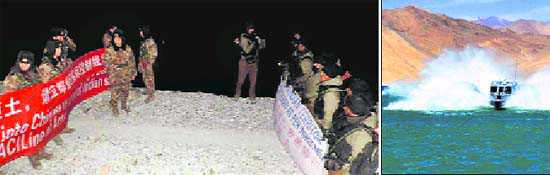
Chinese and Indian troops holding banners during a face-off along the LAC, and (right) an Indian boat patrols the Pangong Tso in eastern Ladakh. — Tribune file photos

Beijing, July 21

Criticising the reported deployment of battle tanks by the Indian Army near the Indo-China border, Chinese state-run media on Thursday said that the move may affect flow of Chinese investments into the country and called for joint efforts to avoid misunderstandings.

“A media report stating that nearly 100 Indian tanks have been positioned near the Indo-China border to counter any possible threat grabbed people’s attention as more Chinese firms are looking to increase their investment in India,” an article in the state-run Global Times said today.

“However, it is puzzling that while deploying tanks near China’s border, India still strives to woo Chinese investment,” it said.

“The deploying of tanks near the Indo-China border may hit a nerve within the Chinese business community, causing investors to weigh the threat of political instability when they make investment decisions,” it said.

(Follow The Tribune on Facebook; and Twitter @thetribunechd)

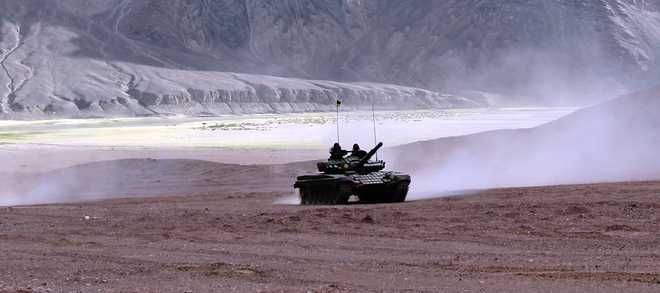
The article refers to reports of Indian Army deployment of tanks in the Ladakh border to catch up with China’s aggressive military and infrastructure build-up across the border.

China too reportedly has major mechanised units on its side of the border and tank deployment was aimed at ensuring parity, the reports said.The Global Times article said, “China and India share a large potential for economic and trade cooperation, and while this may make Chinese enterprises enthusiastic about investment opportunities in the Indian market, those firms should remain calm in the face of investing risks”.According to a Global Times report published in May this year Chinese investments in India grew six fold in 2015 to $870 million.India which is weighed down with over $46 billion trade deficit with China in about $70 billion annual trade has been pressing Beijing to step up investments and has removed a number of security-related issues for a smooth flow of Chinese investments.Acknowledging India’s efforts to improve investment climate, today’s Global Times article said, “the continuous efforts by India’s government to improve its foreign investment environment deserve applause, but now it seems there needs to be more focus spent eliminating investor’s misgivings over non-economic factors.”“During its own initial stage of industrialisation and urbanisation, China put aside political disputes and concentrated on economic development. To an extent, this may serve as a road map for India’s government,” it said.“In the long run, there is large potential for a successful relationship between China and India, especially in the manufacturing sector. In order for that possibility to become a reality, both China and India will need to work hard to clear up misunderstandings in a bid to lay a solid foundation for the sustainable development of economic and trade cooperation,” it said. — PTI


IN EASTERN LADAKH: PART-I Tank-full on the China front

Tank-full on the China front
Past three years have seen additions to mechanised forces and artillery guns, backed by tanks.

Ajay Banerjee

Eastern Ladakh, if  left unattended, could prove to be Indias jugular vein in a future war. The Line of Actual Control with China is not marked, its perceptions are contested by both sides. In 1962, the area saw pitched battles, those at Rezang La, Srijap were well-contested. While India is ramping up, Beijing already has its infrastructure with roads and upcoming rly link. War may be a far cry, but  both the armies are on their toes. The Tribune presents a five-part ground report seriesIt was in 2012 that India quietly changed its tactics and started accumulating a large number of forces in eastern Ladakh  facing China. Four years later, the accretions and infrastructure-push is literally in full swing in the area with a 826-km frontier with China.The Tribune visited key locations across the length and breadth of this strategic frontier, geographically defined by the military as the area from the Karakoram Pass in the north to Demchok in the south-east.   Its here that a possibility exists for China and Pakistan to launch a collusive two-front war against India. The Karakoram ranges in India, if occupied by China, can threaten New Delhis hold over Siachen as well as cut off the Depsang plains and Daulat Baig Oldie (DBO).In the past four-five years, ground troops have been added to pre-positioned locations along the Line of Actual Control (LAC), or the de facto border, that is not  marked on the ground. In the past 36 months, additions to mechanised forces and artillery guns have been made, backed by the T-72 Russian- origin tanks. Another tank unit is slated to move to eastern Ladakh. This adds a new dimension to any future war in the area that is marked by an average height of 14,000 feet, where oxygen is scarce.The  force accretion is seven to eight times more than it was in 1962. History of the Conflict with China, 1962 produced 30 years after the war by the Historical Division of the Ministry of Defence, says eastern Ladakh had just four battalions, including the JK militia (later renamed as Ladakh Scouts).

Lt Gen SK Patyal, Commander of the Leh-based 14 Corps, says: “We have to defend our international borders, whatever it takes in terms of  infrastructure  and accretion, we are doing in the best possible manner.”Sources point out that more than 50 per cent of the troop strength in Eastern Ladakh came in the past four-five years. Battalions are tasked to be on the Line of Actual Control (LAC) for a two year tenure. The area of responsibility is documented for the next to take over. For example, an advance party of a battalion which is to take over in August-end arrived at a post near the LAC in May.A back-up reserve has been created called the ‘loop battalions’. These are kept acclimatised for any need for induction at these rarefied-oxygen  heights of  14,000 feet.However, the biggest move is the tanks. The plateaus interspersed in the folds of the major mountain ranges — the Greater Himalayas, Karokaram, Ladakh and Zanskar — are ideal tank country, flat with ample places to hide in the folds of the valleys.Colonel  Vijay Dalal, who is commanding an armoured unit, says: “We have to use additives and use winter grade diesel. In the winter, every night the tanks parked in garages are revved up a couple of times to prevent the parts from freezing.”During the 1962 India-China war, five of the US-built AMX-13 tanks were airlifted. In his book ‘My Years with the IAF’, former IAF chief PC Lal explains the great difficulty faced in modifying the AN-12 transport planes to airlift the tanks.Not just the accretions, the fortified defences, new bunker-style positions, dot the mountain spurs along the LAC. New fortified roads that allow 50-tonne tanks to drive are showing up,  maybe India  is ‘designing a battlefield’ to suit its strengths. At least numerically, the Indian move promises to hold back any aggression by China.

(To be concluded)


Worst pay deal ever, say Army officers

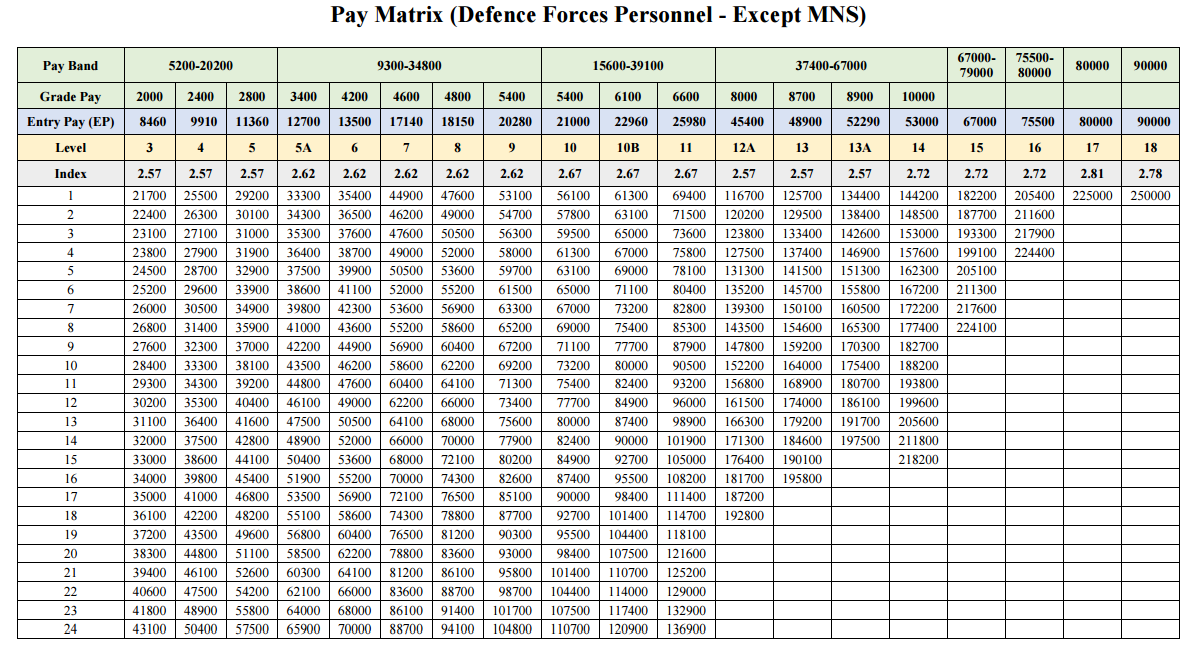
Military circles are struck with disappointment over the 7th Pay Commission recommendations announced by the Cabinet earlier this week, even as many are talking about exiting services in the face of less than adequate financial compensation.

Most military officers said it was the worst deal they had received from pay commissions since they joined service. They argue that the new revision has not rectified the already existing anomaly that the last pay commission caused to military officers.

“In every other service the concept of Non-Functional Upgrade (NFU) exists, whereby even if you don’t get a promotion your salary will keep going up, according to what the senior most among you receive. We alone don’t have it, though it is in the military that the promotional pyramid is the steepest,” one senior military officer said.

Also, the new pay matrix could also result in salaries of officers who do not get timely promotion stagnating after they hit the highest of a given matrix, they argued.

Many senior officers said the meagre hike would force the smartest among them to leave the service. “The sixth pay commission hike had helped us in retaining good officers because it gave substantial hike. However, this has been hugely disappointing. One of the first signs of this will be the increase in the number of people opting to leave the service,” a senior officer said.

An Army officer said a young full Colonel rank officer only got on average an increase of about Rs. 10,000 in hand. “When the Sixth Pay Commission was announced I got between 30 and 40 per cent increase. That was eight years ago,” he said. The Military Service Pay had only increased by just Rs. 2,000, and the total increase in salary other than that is just 14.22 per cent, he said. “Of that 30 per cent will straight go to income tax. So the effective increase is less than 10 per cent,” he said.

Others also point out that many of the lower ranks would be entering the income tax brackets for the first time, and would actually not receive the full benefits of the recommendations.http://m.thehindu.com/news/national/7th-pay-commission-worst-pay-deal-ever-say-army-officers/article8798037.ece


7th Pay Commission Pay Scale Calculator

“This Pay Scale Calculator Based on the Recommendations of 7th Central Pay commission “

At first We would like to extend our gratitude for your over whelming response for our simple ‘Expected Pay Calculator as per 7th Pay Commission‘ provided here by us. This was done by assuming that how the Pay and Allowances will be recommended by 7th Pay Commission almost one year before.

Like it was done before, now we have prepared a New Pay Scale Calculator based on 7th Pay Commission recommendations and You can use this calculator to know your Revised Pay and Allowances with effect from 1.1.2016.

  • Enter Your Current (6th CPC) Basic Pay (Band Pay + Grade Pay) and Select Your Pay Band with Grade Pay
  • Select Your Present HRA% and Select your Transport Allowance and also select your city as per the recommendations of 7th CPC
  • Click the ‘Calculate’ button to get your 7th CPC Revised Basic Pay, Matrix Level, Index Level, Revised amount of HRA, Revised amount of Travelling Allowance and the Total Revised Pay per month as per the recommendations of 7th Pay Commission.

Write us your comments about this calculator.

7th Pay Commission Pay Scale Calculator
Basic Pay as on 1.1.2016
(Including Grade Pay)
Select Your Pay Band
and Grade Pay
Select Your
Transport Allowance
Select Your
House Rent Allowance
Select Your City
Details given below*
Non Practicing Allowance
Note*: 7th CPC refers 19 Cities as Higher TPTA Cities:Delhi, Hyderabad, Bengaluru, Greater Mumbai, Chennai, Kolkata, Ahmedabad, Surat, Nagpur, Pune, Jaipur, Lucknow, Kanpur, Patna, Kochi, Kozhikode, Indore, Coimbatore and Ghaziabad
Click to view the Bunching Increment Benefit Tables

Pay Matrix Table for Central Government Employees

Pay Matrix Table for Defence Personnel

7th Pay Commission Fixation of Pay Initial Appointment on or after 1.1.2016

OROP PENSION ARREARS ESTIMATOR 2016


[Disclaimer: This calculator gives only approximate value on the basis of the recommendations of 7th Central Pay Commission and also shown the estimate figures only basis on your inputs. Reader are requested to refer 7th Pay Commission Report]

Pay-Matrix-Table-for-Defence-Personnel

7th cpc arrears calculator 2016

7 cpc pension calculatorEXPECTED DA FROM JULY 2016ceggis table finder7 cpc pay calculator 2016


Sharif wrote to 17 countries against India’s NSG membership: Aziz

Sharif wrote to 17 countries against India’s NSG membership: Aziz
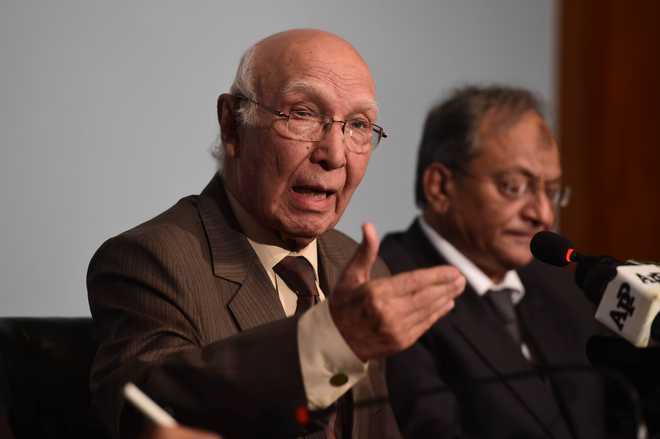
Pakistani Foreign Affairs Advisor Sartaj Aziz

Islamabad, June 27

Pakistan’s intensive diplomatic lobbying, including Prime Minister Nawaz Sharif personally writing to 17 Prime Ministers, prevented India from gaining entry into the Nuclear Suppliers Group (NSG), top Pakistani Foreign Affairs Advisor Sartaj Aziz said on Monday.

“Prime Minister Nawaz Sharif personally wrote letters to 17 Prime Ministers of different countries on the matter, which is on record,” Aziz told media at the Ministry of Foreign Affairs in Islamabad.

The NSG last week failed to reach consensus on India’s membership application after several members, led by China, of the international nuclear trade cartel insisted on adhering to the Non-Proliferation Treaty (NPT) condition for admission.

The statement came days after Foreign Office spokesperson Nafees Zakriya, during his weekly briefing, said that Pakistan was seeking backing from other countries and refuted claims that it was lobbying against India.

India and Pakistan are the two non-NPT states aspiring for membership of the 48-member international nuclear trade cartel.  — IANS


Pak’s selective fight against terrorism is dangerous

Pakistan’s widely read newspaper Dawn pointed out a major fault line in the country’s much-publicised anti-militancy Zarb-i-Azb (Sharp Strike) operation. It said: “Anti-state militants are being fought, while anti-Afghan or anti-India militants thrive on Pakistani soil.”It is a sort of reawakening of Pakistani society that has found its civilian and military leadership providing excuses to shelter terrorists. People are unhappy with the way the military leadership is engaged in selective anti-terrorism fight. This could prove dangerous. Pakistan has seen consequences of its own doing vis-à-vis militancy. History doesn’t need to be recalled in full to substantiate how terrorism was fostered and exported to other countries.Terrorism can never be dealt with on selective basis. Pakistan should have known it from American experience. The most powerful country is paying a price for having launched its anti-terrorist operations in a selective manner, ignoring wider impact on its society. Today the world is having more anti-American voices than days when Samuel Huntington wrote “The Clash of Civilizations”. Had he been alive today, the resonance of his classical work would have been titled differently – it is getting bigger than the clash of civilizations. The Orlando mass murder is still making headlines.By keeping and patronising the terrorists active on its soil may help Pakistan to gain billions of dollars from the United States to show that its fight against terrorism is on and it needs money for that. America has its own compulsions. Pakistan’s location, adjoining Afghanistan, Iran, India and China, makes it one of America’s most important allies. But now it is becoming dangerous because of its half-hearted war on terror.Pakistan should realise that it is her soldiers’ blood that is being shed – 490 of them have died in the two years of Zarb-i-Azb operation, which was launched after a devastating attack at Karachi airport in June 2014. The Pakistani army has used all kinds of weaponry, air bombardment to neutralise 3,500 militants. It was a war within Pakistan, and it was Pakistan’s own creation, for it first patronised terrorists, then started using them to bleed Afghanistan and India, and finally the monster of terrorism turned against it as well.Even today, there are questions: why is the Pakistan army not acting against the Haqqani network. Americans, who have been doling out money (recent one is the $800 million package), want to know what happened to the deadliest network wrecking the peace prospects in Afghanistan. There are questions about 26/11 and Pathankot too. Pakistan continues to live in denial for reasons best known to it.Some strategists have a blinkered view when it comes to India. It seems that Pakistan suffers from delusion of Pakistan becoming western Bangladesh. India has better things to do. It is not a state in war with itself. Pakistan is.Terrorism is not a friend of anyone. How long can militants be used as a foreign policy tool? This strategy has not paid off in Afghanistan. It is bound to fail in other places too. The cross-border firings on Afghan-Pak border have revealed this truth. If Pakistan thinks that by shedding blood of innocent Kashmiris or exploiting them has brought any change in number of people in love with Pakistan, it needs to hear the private conversations in Kashmiri homes where the brutal ways of Pakistani terrorists are denounced with contempt and anger. No one wants violence. Kashmiri society is sick of violence. It has realised that counter-insurgency fault lines are there because of sponsored terrorism from across the border. Their real sense of insecurity is born out of that.In 2004, then Prime Minister Manmohan Singh had declared, “No boundaries will be changed.” Pakistan should have heard this message loud and clear. Nothing will change. Pakistan will add to miseries of its own people and that of the people whose territory it is eyeing for water resources to irrigate fields of Western Punjab. If Pakistan was really a heaven, Kashmiri youth who had gone there in the 1990s would not have been making desperate attempts and taking risks to come back to their homes in the Valley.


Too close for comfort ::: China, with Pak, is obsessed with the strategic containment of India

Too close for comfort
Ganging up: China is backing Pak-sponsored terrorism against India.

NEW Delhi appeared “shocked” by China’s recent veto of action against Jaish-e-Mohammed (JeM)  chief Maulana Masood Azhar, when there was widespread support in the UN Sanctions Committee to act against him for his role in the Pathankot attack. The UN declared the JeM a terrorist organisation in 2001. The former Director-General of the ISI, Lt-Gen Javed Ashraf Qazi, acknowledged in the Pakistan parliament in 2004 that the JeM was responsible for the attack on the Indian Parliament — an action that took the two countries on the brink of war. This veto was, however, not an isolated action by China which has long backed Pakistan-sponsored terrorism against India.China’s contacts with radical Islamic groups backed by the ISI is nothing new. It was one of the few countries that had contacts with high-level Taliban leaders, including Mullah Omar, during Taliban rule between 1996-2000. There was even a Chinese offer to establish a telephone network in Kabul during this period. Moreover, after the Taliban was ousted from power in 2001 and was hosted by the ISI in Quetta, the Chinese maintained clandestine contacts with the Mullah Omar-led Quetta Shura. China recently joined the ISI to sponsor the so-called “Afghan-led” peace process with the Kabul government. Beijing appears convinced of the need to have an ISI-friendly government in Kabul. The mandarins in Beijing evidently favour such a dispensation, in the belief that the ISI will rein in the Taliban support for Uighur Muslim militants in Xinjiang. While India received overwhelming international sympathy and support during the 26/11 terrorist carnage, the Chinese reaction was one of almost unbridled glee, backing Pakistani protestations of innocence. The state-run China Institute of Contemporary International Relations claimed that the terrorists who carried out the attack came from India. Even as the terrorist strike was on, yet another Chinese “scholar” gleefully noted: “The Mumbai attack exposed the internal weakness of India, a power that is otherwise raising its status both in the region and in the world.”Not to be outdone, the foreign ministry-run China Institute of Strategic Studies warned: “China can firmly support Pakistan in the event of war… While Pakistan can benefit from its military cooperation with China while fighting India, the People’s Republic of China may have the option of resorting to a strategic military action in southern Tibet (Arunachal Pradesh) to liberate the people there.” Rather than condemning the terrorists and their supporters, Chinese foreign ministry spokesman Qin Gang urged India and Pakistan to “maintain calm” and investigate the “cause” of the terror attack jointly. The visiting chairman of Pakistan’s Joint Chiefs of Staff General, Tariq Majid, was received in Beijing like a state dignitary by Chinese leaders, with promises of support on weapons supplies ranging from fighter aircraft to frigates.China has developed strong lobbies in Indian business. Political parties, journalists and academics act as apologists for its actions, even when such actions constituted what can only be described as unrelenting hostility towards India’s national security concerns. Even the “Ayatollahs” of non-proliferation in the US, who rant and rave against India’s nuclear and missile programmes, suddenly lose their speech when it comes to condemning Chinese actions. These worthies have documented evidence on how China initially provided nuclear weapons designs to Pakistan for its enriched uranium warheads and also upgraded Pakistan’s uranium enrichment capabilities. More ominously, China provided a range of designs and materials to enable Pakistan to develop plutonium reactors, heavy water plants and plutonium separation facilities in the Khushab-Fatehjang-Chashma nuclear complex. This has enabled Pakistan to make light plutonium warheads and embark on the production of tactical nuclear weapons.This development has seriously enhanced the prospect of Pakistan triggering a nuclear conflict by the use of tactical nuclear weapons. Pakistan now no longer speaks of a “credible minimum deterrent”, but of possessing a “full spectrum deterrent”. There has been no other instance in the contemporary world of such large scale and unrestrained transfer of nuclear weapons capabilities, as what has transpired during the past four decades between China and Pakistan.  Worse still, while China balks at backing our entry to the Missile Technology Control Regime, virtually every ballistic missile in Pakistan’s inventory today is of Chinese origin.  The 750-900 km Shaheen 1 is a variant of the Chinese DF 15 missile.  Shaheen 2 and Shaheen 3, with ranges of 1,700 km and 2,750 km, are evidently variants of the Chinese DF 21A. The vehicle that transports and launches Shaheen 3 reportedly has a design identical to that of a missile supplied by China to North Korea in 2011.New Delhi should have no doubt that Beijing’s ties with Pakistan are primarily motivated by a burning desire for “strategic containment” of India. New Delhi appears to be still looking for a coherent strategy to pay back China in its own coin and raise the strategic costs for Beijing’s unrelenting hostility towards its security interests. India needs more proactive coordination of  its policies with those of key regional powers, like Japan and Vietnam, to meet challenges China now poses. India, Vietnam and Japan should jointly seek to coordinate these efforts with the US.  Washington, unfortunately, has a track record of striking its own deals with China, with scant regard for the interests of its partners. Moreover, while dealing with these maritime and strategic challenges, India has to simultaneously strengthen confidence-building measures on its borders with China. These CBMs have been useful, especially after President Xi Jinping’s visit to India, in maintaining peace and tranquility along the Sino-Indian border. It is inevitably going to take a long time before the border issue is sorted out with China, in accordance with the Guiding Principles agreed to in 2005.It is astonishing that in all these years, there has been no significant or sustained diplomatic effort by successive governments in India to focus attention on these developments. And the less said about our journalists and academics visiting the “Middle Kingdom” the better. They are generally busy singing paeans for the qualities of head and heart of their hosts, rather than bothering about such issues. While the invitation to Chinese dissidents for a meeting in Dharamsala could have been handled more professionally, China should be made to pay a price for meddling in developments in our northeastern states.

Militant, jawan killed in Kupwara gunfight

THE 23-YEAR-OLD SLAIN SOLDIER, A NATIVE OF JHUNJHUNU IN RAJASTHAN, WAS SERVING IN THE ARMY FOR PAST SIX YEARS

SRINAGAR: A militant and a soldier were killed on Wednesday in the ongoing gun battle at Machil sector in Kashmir’s Kupwara district while four other soldiers have been injured.

On Tuesday, five soldiers were injured when the army confronted a group of heavily armed militants near the Line of Control (LoC) as they were trying to infiltrate the border.

An army spokesperson said a search operation was underway and one weapon and some “warlike” stores were recovered.

Sources added that choppers were also used by the army for the purpose of locating the militants hiding in the dense forests.

Police said the body of the militant was not yet recovered from the site of the gun battle and an extensive search operation was on.

The slain soldier has been identified as Ajay Singh Choudhary, a 23-year-old ‘signalman’ who was a native of Jhunjhunu in Rajasthan.

He was serving in the army for the last six years and is survived by his wife, an army official said.

BEIJING SAYS
NO INCURSION,
TROOPS ON LAC’S
CHINESE SIDE

BEIJING: Soldiers from the People’s Liberation Army (PLA) were patrolling the Chinese side of the disputed frontier with India along Arunachal Pradesh, Beijing said on Wednesday, dismissing reports that hundreds of its troops had crossed the border last week.

Around 250 PLA soldiers reportedly crossed the Line of Actual Control (LAC) in Kameng district of Arunachal Pradesh on June 9, reports had quoted unnamed Indian defence officers as saying.

The incursion by Chinese troops was temporary and they went back to their own territory within hours, the reports had said. “The IndiaChina border has not been clearly demarcated. This was a regular patrol on the Chinese side of the LAC,” foreign ministry spokesperson Lu Kang said.

t is rare for incursions to take place – or at least to be reported – in the eastern sector along Arunachal Pradesh, which China claims and shows on maps as “south Tibet”.

The Indian defence officers said this was the first incursion in the region this year. India and China have an unresolved, heavily militarised border running about 3,488 km. Much of the confusion arises, according to diplomats and experts, because the border is not delineated, leading to competing claims.

China’s foreign ministry reiterated the same point while dismissing the reported incursion.


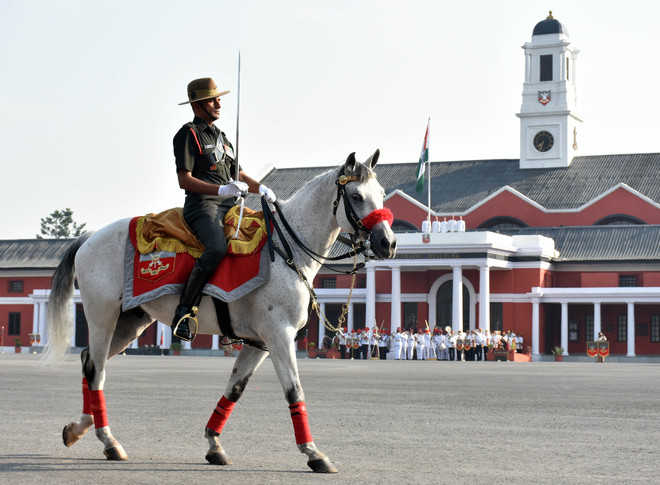
Grey charger of IMA and eye-catcher

Grey charger of IMA and eye-catcher

Dehradun, June 11

Besides the passing-out batch of 610 young and vibrant young officers, there was a horse that flawlessly took part in the passing-out parade and drills and impressed the gathering here today. Called the grey charger of the IMA, it was trained and inducted into the academy in June 2015. The grey charger, named “Tughlaq”, immaculately performed drills in its maiden passing-out parade. ‘Tughlaq’ gained the attention of proud parents, and relatives of happy GCs. It was born at the Army Breeding Centre, Hempur (Uttarakhand), in 2007 and underwent rigorous training before it was selected for the passing-out parade. Academy Adjutant Major Sumit Lagwal mounted on ‘Tughlaq’ during the entire course of the passing-out-parade. — TNS


India, US, Japan begin naval exercises in disputed waters

India, US, Japan begin naval exercises in disputed waters
A Coast Guard helicopter close to a Korean ship at the Indo-Korea exercise ‘Sahyog-Hyeoblyeog’, in the Bay of Bengal in Chennai on Friday. PTI

Ajay Banerjee

Tribune News Service

New Delhi, June 10

India on Friday joined the US and Japan to conduct week-long Naval exercises in the disputed East China Sea, around 5,000 km from here. The Navy personnel of three nations will practise submarine hunting and validate procedures at sea.In other words, collectively countering any adventurism by the People’s Liberation Army Navy (PLAN) of China. The move comes at time when Chinese submarines routinely foray in the Bay of Bengal and the Indian ocean.Japan is hosting the exercise called ‘Malabar’ near the Okinawa islands — located 370 km east of the Senkaku islands — controlled by Japan but claimed by China. It was only last year that Japan was made a permanent member of the ‘Malabar series’ of Indo-US exercises.

Both Japan and China have overlapping claims in these waters and even impose their respective air defence identification zones (AIDZ) over the islands. The US stands firmly with Japan on the matter and in December 2013 even sent its fighter jets to fly over the Senkaku when China unilaterally imposed an ADIZ of its own.Sources said the exercise was aimed at ‘strengthening’ India, Japan and the US naval cooperation. Specialists from the three forces will sit down to formulate procedures at sea and validate the same during the sea-phase of the exercise that will include scenarios of anti-submarine warfare, air defence and anti-surface warfare.More than 100 assets — warships, fighter jets, surveillance aircraft with capacity to spot submarines, amphibious plane, specialised helicopters — will be part of the sea-phase of exercise.The US will lead the way with its 1,00,000 tonne nuclear powered aircraft carrier, the USS John C Stennis, over 20 major warships, about 50 anti-submarine warfare helicopters, long-range maritime surveillance aircraft, the Boeing P8-A, and over 100 aircraft, including Boeing Super Hornet ship-deck based fighters.India is fielding its stealth frigates INS Shayadri and INS Satpura, fleet tanker INS Shakti and missile corvette INS Kirch. Apart from this, a detachment of Indian Marine Commandos (MARCOS) will participate in the exercise. Japan will field the JS Hyuga —a flat deck helicopter carrier with onboard copters; amphibious plane the ShinMaywa Industries and the PC 3 Orion planes.


East China Sea tension

  • Japan is hosting exercise ‘Malabar’ near the Okinawa islands — 370 km east of the Senkaku islands — controlled by Japan but claimed by China
  • Japan was made a permanent member of the ‘Malabar series’ of Indo-US exercises last year
  • Both Japan and China have overlapping claims in these waters and impose their respective air defence identification zones over the islands. The US backs Japan