All posts by webadmin

LOOKING BACK 1971 WAR Men who mattered

Men who mattered

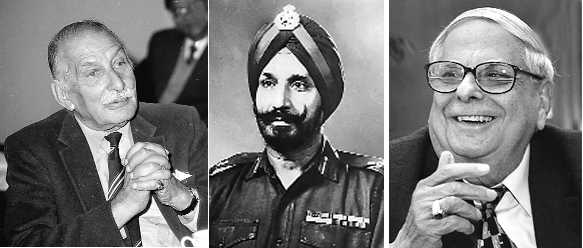
Field Marshal Sam Hormusji Framji Jamshedji Manekshaw (1914-2008) was the Army Chief during the war. This Amritsar-born Parsi will go down in history as India’s most outstanding Army Chief, who led the Army to a brilliant victory that witnessed the largest ever surrender after World War II and the dismemberment of Pakistan within less than a fortnight. Manekshaw, known to be forthright and bordering on being undiplomatic, told Prime Minister Indira Gandhi, in a Cabinet meeting, he needed time until December to prepare for the war and a guaranteed victory. When Indira chose to speak to him in private soon after the meeting, the intrepid General offered to resign. It was not accepted and Manekshaw was given time to prepare. He then went about preparing for the war, which included training and equipping the troops and the Mukti Bahini. Manekshaw, who declined Indira Gandhi’s suggestion that he take the surrender of the East Pakistan forces, had the grace to ask Lt-Gen Jagjit Singh Aurora, who was heading the Eastern Army Command, to not only take the surrender, but to take along his wife since it was such a momentous occasion. Manekshaw was also a recipient of the Padma Vibhushan and Padma Bushan, the country’s second and third highest civilian awards.Lt-Gen Jagjit Singh Aurora (1916-2005) was the General Officer Commanding-in-Chief of the Army’s Kolkata-based Eastern Command, who quietly directed the Army and the Mukti Bahini from his headquarters during the war, which culminated in the public surrender of his counterpart, Lt-Gen Amir Abdullah Khan Niazi. The moment is captured in the famous picture in which a stoic Aurora is overseeing Niazi signing the surrender document. He was awarded the Padma Bhushan in 1972 and later represented the Akali Dal in Rajya Sabha. Well before his death, he handed over the uniform that he wore on the day of taking the surrender along with Niazi’s flag to his regiment, the Punjab Regiment, and Niazi’s revolver to Indian Military Academy.Lt-Gen Jack Farj Rafael Jacob (1923-2016) was Lt-Gen Aurora’s number 2 as Chief of Staff of the Eastern Command. He hailed from a long line of Baghdadi Jews, who had moved to India from Iraq in the middle of the 18th century. Jacob played a pivotal role in negotiating the historic surrender of the Pakistani troops and in meticulously preparing for the war. In his seminal book Birth of a Nation: Surrender at Dacca, Jacob also revealed how he took the decision to race to capture Dacca (now Dhaka), the centre of gravity of the East Pakistan army, which inexplicably was never the focus in Manekshaw’s operational instructions. Eventually, 93,000 Pakistanis surrendered even though there were only 3,000 Indian soldiers pitted against 26,000 Pakistani troops in Dacca at that time. Jacob was later made Governor of Goa followed by that of Punjab during the Vajpayee government. — Dinesh Kumar


Is India at war with Pak, Amarinder asks Modi

2016_8$largeimg20_Saturday_2016_013635780

NO EVACUATION IN RAJASTHAN, GUJARAT MEANS CLEARING OF PUNJAB BORDER IS JUST TO DELAY POLLS, SAYS JAKHAR

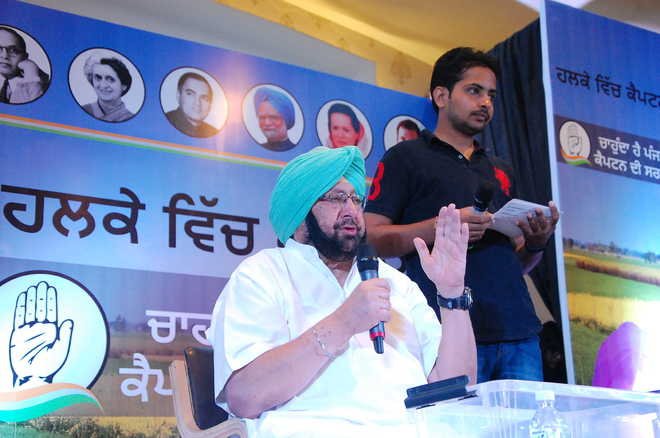
KHEM KARAN (TARN TARAN): Punjab Congress chief Captain Amarinder Singh on Tuesday asked Prime Minister Narendra Modi to clear whether India was at war with Pakistan even as he criticised the eviction of villagers from the border areas of Punjab.

Addressing meetings in Khem Karan and Tarn Taran along the International Border, the former CM said surgical strikes were carried out across the Line of Control (LoC) even during the Congress regime, but nobody tried to take political mileage out of it.

Expressing solidarity with border villagers, he assured his party’s support to them in this hour of crisis. The former CM said he would take a house on rent in the border village of Rajatal, 500 metres from the International Border, to stay with the villagers. He also asked the border villagers to stay put in their homes and carry on with their harvesting.

“I am concerned for the people of the border belt who are being asked to move out of their homes leaving their properties, crops and livestock behind,” the state Congress chief said.

He also promised to take up the problems being faced by the border villagers in Parliament’s next session. “If need be, we will stage a dharna in the Lok Sabha,” he added. ‘WHERE’S SUKHBIR IF THERE’S WAR THREAT’ CHANDIGARH: Punjab Congress chief spokesperson Sunil Jakhar has questioned the absence of deputy chief minister Sukhbir Singh Badal from the state for four days when its border belt was evacuated over war threat.

“If there was war threat, he should have been in the state… or the evacuation was just a ploy to delay the 2017 assembly elections that the ruling Akali-BJP combine is sure to lose,” he told the media on Tuesday in Chandigarh, seeking Sukhbir’s whereabouts.

Jakhar said there was no evacuation in the border belt of Rajasthan and Gujarat. “So there’s no war threat in these states. The BJP-led government at the Centre has built up a war-like situation for advantage in the ensuing polls in Uttar Pradesh and Punjab,” he said. “The Punjab government has lost credibility and the imposed-evacuation tactic is taking the central government the same way.”

Demanding President’s rule in Punjab, Jakhar said the situation with Pakistan forced people to believe the government. “But if farmers are also evacuated, who will harvest the paddy crop that’s ready?” He said that previous Congress government at the Centre had carried out four surgical strikes in Occupied Kashmir but never disclosed it.


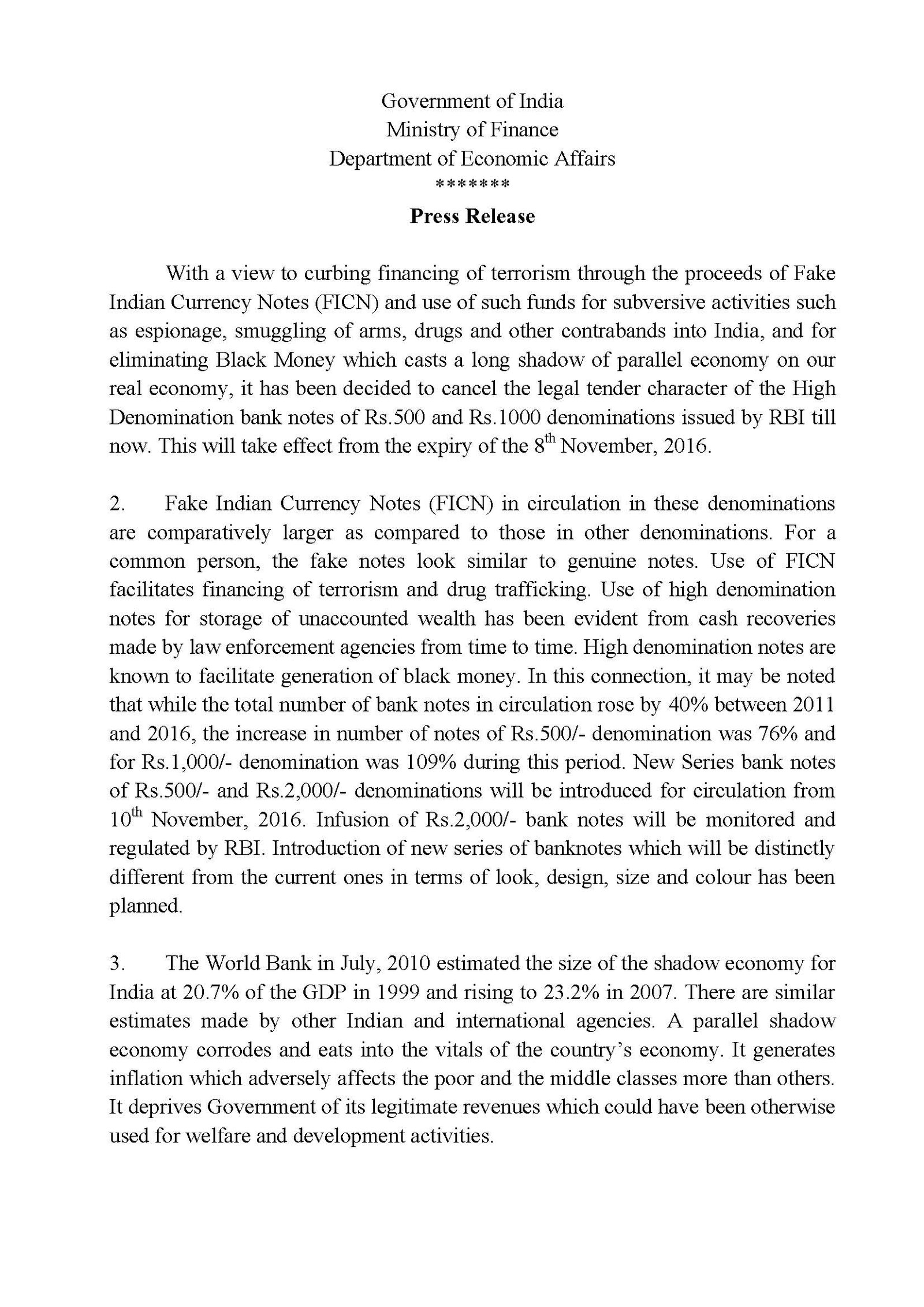
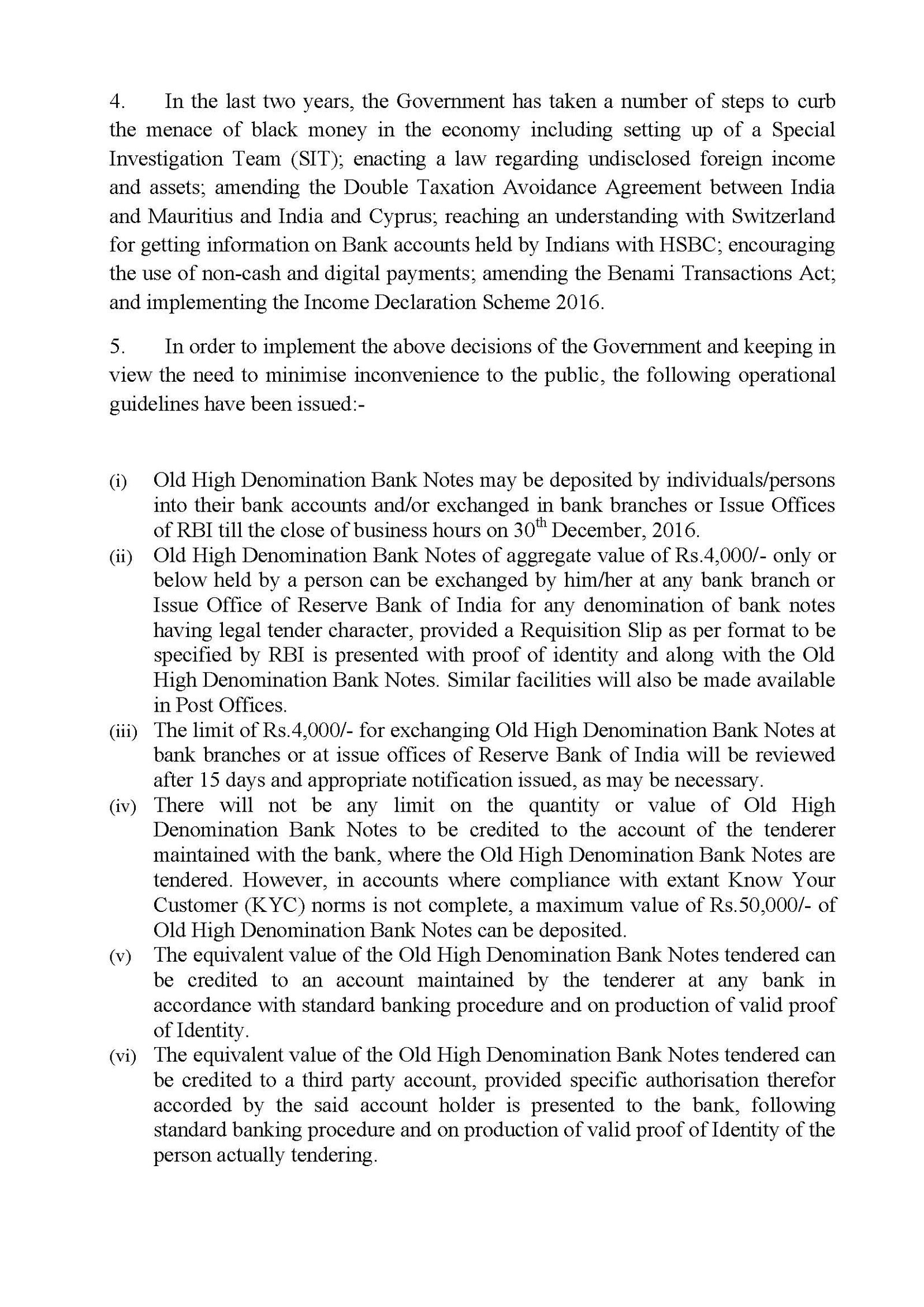
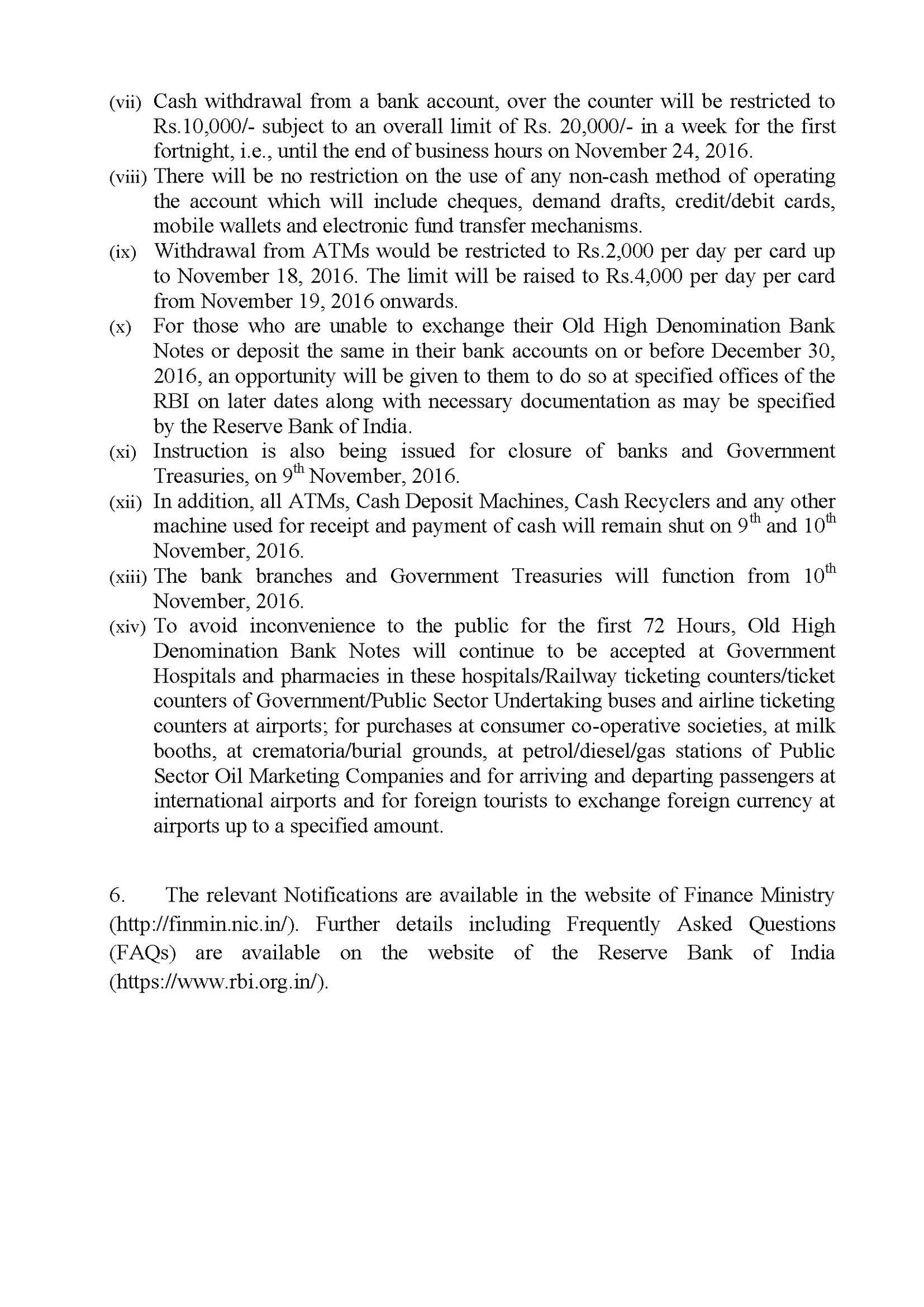
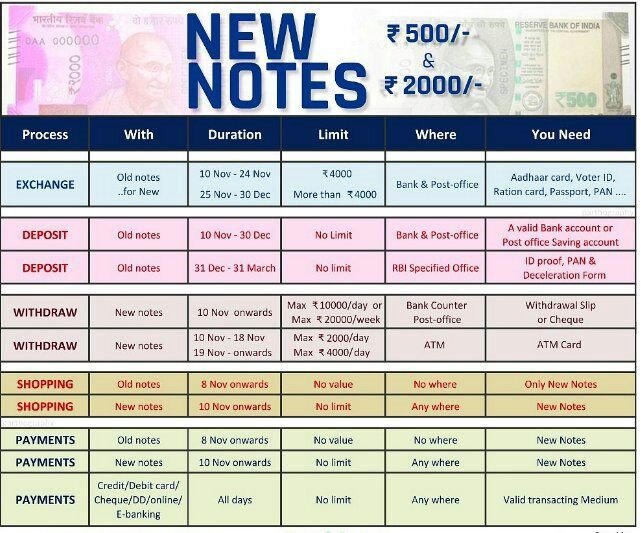
OLD NOTES EXCHANGE WITH NEW NOTES :: HOW AND WHEN ALLL

PRESS_Page_1 PRESS_Page_2 PRESS_Page_3

IMG-20161109-WA0009


A Generals’ India ::::The politician ceding democratic space byHarish Khare

A Generals' India

It is the Diwali day. The text message landed at 9.17 am: “Happy Diwali! Mins of YAS Sh Vijay Goel will celebrate Diwali with Army Jawans today 11.30am Rajputana Rifles Regimental Centre, Delhi Cant wid  NYKS students. Pl. cover.” At 4.30 pm, there is another text: Hello Kindly check your mail box for Press Release — “Vijay Goel celebrates Diwali with Army Jawans” along with pictures of the event. It is possible to infer confidently that other 60-odd Cabinet members were celebrating Diwali similarly in  the conspicuous company of this or that Army unit.  

Nor can any one of them be chided for this PR overkill because they have been commanded to do so. In fact, advertisements had been appearing for days prior to Diwali, drawing attention to a PMO-directed campaign, called “Sandesh-to-Soldiers”, exhorting the citizens to remember this Diwali “our courageous jawans who constantly protect our nation. Lakhs of people have already sent their messages, have you?” A few days earlier, the Chief Minister of Punjab, Parkash Singh Badal, was reported to have decreed that all officers be appropriately respectful to the soldiers and ex-soldiers whenever they visited a government office.

 The Economic Times (October 27) had reported how the BJP was preparing to send out Diwali greetings to soldiers’ households in Uttar Pradesh. Both Punjab and Uttar Pradesh are due to have assembly elections in a few months’ time. And, then, a few days after Diwali, we had on Wednesday a retired Army Subedar committing suicide, in support of the demand for  one rank, one pension (OROP). That a retired Army man should commit suicide was sad enough; it is even sadder and uglier that professional political leaders should have sought to draw political mileage out of this tragedy.  Earlier, the non-BJP political leaders were tut-tutting the government for wanting to do a bit of khoon ki dalali, now it was the turn of the BJP to pretend that a veteran’s suicide was nothing to get excited about and that it was in bad taste that someone should want to “politicise” the death.

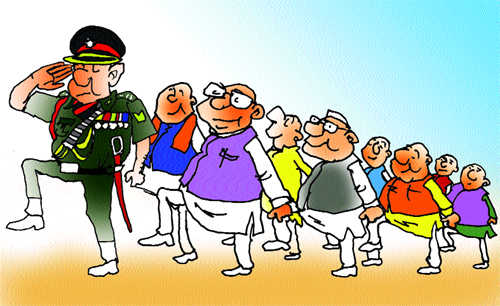
 How is the republican voices and constituency to view this extraordinary state-sponsored glorification of the military men, values and demands? Are we in the process of re-arranging the ensemble of institutional preferences? Examine, for instance, the Income Tax Department’s sales pitch. It takes out advertisements, showing a solitary solider standing guard over the forbidding mountainous border: “He is doing his duty…How about you?” The “he” is the Army Jawan, and “you” is the “tax deductor”, who is sternly reminded that TDS procedures must be totally complied with.  It is not too complicated to break the code of a new civil-military chemistry.  Legitimacy, political respectability and electoral advantage are being sought to be derived from the soldier and his shahadat (martyrdom). Unthinkingly, new space, new respect and new autonomy are being ceded to the Army brass and other security forces.   In the post-surgical strike days, various ministers and authorised spokespersons have made it clear:

(1) it is for the Army to decide whether or not to give the lie to Pakistan’s preposterous claim that there were no cross-border raids;

(2) it is for the Army to decide what should be the response to provocations, if any, from Pakistan; and

(3) that what the Army says or claims ought to be accepted, without any kind of reservation or dissent.    The Republic finds itself at a fork in the road, an unfamiliar stage which could, in the long run, produce only democratic unhappiness.  After all, all these years, generations after generations of Indians took pride in the fact that Jawaharlal Nehru and other democrats saw to it that the Army stayed in the barracks, and that the civil authority was firmly in control of matters of war and peace. The political crowd did not need to piggyback the soldiers. The fundamental reality was that the constitutional and political legitimacy accrued to the political elites only because they could garner for themselves a mandate to govern, and that too, in an open, fair and transparent electoral contest. There was a sacredness to this authority from the citizens and it entitled them to obedience and respect. “We, the people of India” were to be the ultimate and only sovereign. And, the political leader was deemed to be endowed with certain laudable skills and attitudes. He was respected as “a politician” because he undertook to understand the people’s issues and grievances.

A political operative who aspired to be recognised as a “leader” had to have the willingness to harmonise conflicting social values and claims to produce a kind of “public good.”  Coercion was not to be his calling card; persuasion and motivation were to be his first, second and third preferences.  Only autocrats rely on force and intimidation. All these years, there had been a complete consensus that the armed forces were a valuable institution, deriving its authority and parameters from the Constitution, and, that, as an institution, the armed forces were committed to democratic and secular values.  

The armed forces, to be fair, never asserted that they were outside the ambit of democratic accountability; nor did they demand a lion’s share in the national resources. Unlike in our neighbourhood, the armed forces never subscribed to a grammar of entitlements. This despite the fact that in the last three decades or so we have come to depend heavily on the coercive arm of the Indian state to restore a semblance of order in large parts of the country. Yet, we find ourselves witness to the process of re-arranging some of the working assumptions that have served the Indian republic well for all these years.  Unlike in Pakistan, where it were the Army Generals who made the judgement that the politicians were incompetent and incapable of safeguarding the best interests of their nation; we are not just deferring too much to the Generals, we are also redefining “competence”. Suddenly, it would seem that competence of a leader is to be judged by his willingness to allow the use of force. And, a willingness to let the “security forces” be the judge of how to use force, when to use it. 

And, once we let the “security forces” write their own ticket, the others who have capacity to initiate and inflict violence also take a cue. If the Army can give a “bloody nose to the Pakis”, so can the BSF; and if, the BSF can be allowed to over-react, why can’t the cops in Bhopal go on a shooting spree and gun down a few SIMI boys?  All this adds up to a new but troublesome acceptance of violence. Nehru’s India is forging a new identity under the shadow of joyful acceptance of conflict. Elements of a garrison state are being grafted on to the republic’s escutcheon.

Nagrota terror attack aimed at avenging PoK surgical strikes

Amir Karim Tantray

Tribune News Service

Jammu, November 30

The terror attack on an Army unit of the 16 Corps near its headquarters on a day when Pakistani army chief Gen Raheel Sharif was retiring, was aimed at taking revenge of surgical strikes carried out by the Indian Army in Pakistan-occupied Kashmir (PoK) on September 29.The Nagrota attack by a group of three militants after infiltrating from Pakistan on the International Border had a link with the statement of General Sharif who had warned India that if Pakistan carried out surgical strike, then it would find mention in Indian text books.“Surgical strikes carried out by the Indian Army were a blot on the career of General Sharif who wanted to avenge it while being in the office. It is no coincidence that two similar attacks were carried out by militants, one at Nagrota and another at the Chamliyal area along the border on a day when the General was handing over the baton to Gen Qamar Javed Bajwa,” highly placed sources told The Tribune. Carrying out surgical strikes inside PoK on the intervening night of September 28-29, the Army had killed over 35 militants who were waiting to infiltrate to India.He said the militants, gunned down at Nagrota, seemed to be a part of the larger group which infiltrated near the Chamliyal area of the Ramgarh sub-sector in Samba. After crossing the border, they had split into two groups to reach the encounter site with the help of sleeper cells. “The recoveries from these militants is huge which includes guns, thousands of rounds, UBGL grenades, improvised explosive devices, cutters, different type of knives, food, medicines etc. They could have been using these for several days,” said the sources.“Recoveries at the Nagrota encounter site and at Chamliyal are similar in nature. These suggest that they were a part of the larger group. Of these, three were eliminated by the BSF at Chamliyal and three at Nagrota,” the sources said. However, the question which needs to be answered is that how they reached the encounter site and who helped them. “After dividing into two groups of three militants each, they must have got the help from local sleeper cells who took them from the International Border to Nagrota in a vehicle by taking advantage of darkness. It is not possible for militants to move on foot, carrying a huge amount of explosive materials and ammunition,” the sources added.Two Majors and five soldiers were killed in this encounter which lasted for around 14 hours yesterday. The combing operation, which resumed this morning, was called off in the evening. A hostage-like situation had also emerged during the attack when two women with two toddlers and 12 soldiers were caught inside the two buildings where the militants entered. It was due to swift operation by the Army that all of them were rescued.The Army is not spelling out anything about the incident officially and is treading cautiously.2 officers’ wives displayed exemplary courageBravery exhibited by the wives of two Army officers, staying in the family quarters, helped in frustrating a major hostage crisis during the encounter that took place in the Nagrota area of Jammu on Tuesday.Soon after the terrorists, disguised in police uniform stormed the Army unit,  they were desperate to enter the family quarters so that they could take the kin of the soldiers and officers hostage. It was due to the bravery of these two women, who were staying in the family quarters along with their newborns, the plans of the terrorists were thwarted. The wives of the two Army officers, who were on night duty when the encounter broke out, displayed exemplary courage as they blocked the entry of their quarters with all household items, making it difficult for the terrorists to break into the houses.Defence spokesperson Lt Col Manish Mehta on Tuesday said, “Terrorists entered two buildings which were occupied by officers and their families. This led to a hostage-like situation. The situation was very quickly contained and thereafter, in a deliberate operation all were successfully rescued, which included 12 soldiers, two women and two babies.” — TNS

Kathua lecturer disrespects slain Army men, arrested 
Kathua: The police have arrested a lecturer of a degree college in Bani town of Kathua district for passing derogatory remarks against the Nagrota attack martyrs. He even hailed the terrorists as “freedom fighters” and warned the students of dire consequences in case they called the Nagrota attackers terrorists. The lecturer has been identified as Shahnawaz. The police have lodged an FIR. OC
Congress flays Deputy CM’s Nagrota attack statement 
Jammu: While the BJP maintained a distance from Deputy CM Nirmal Singh’s “irresponsible” statement on the Nagrota terror attack, the Congress took him to task for showing insensitivity towards the martyrs. The Deputy CM had stated that the Nagrota terror attack was “minor”. The Congress has termed the statement as “outrageous” and an “insult” to the martyrs. It said the BJP leader was insensitive to the sentiments of the people and the supreme sacrifices of our Army men. TNS

The martyrsMajor Gosavi Kunal Mannadir (33)
Pandharpur village, Solapur district, Maharashtra. He is survived by his wife Uma K Gosavi.Major Akshay Girish Kumar (31)

Koramangala, Bengaluru, Karnataka. He is survived by his wife Sangeeta Ravinderan.Havildar Sukhraj Singh (32)
Maan Nagar village, Gurdaspur district, Punjab. He is survived by his wife Harmeet Kaur.Lance Naik Kadam Yeshwantro (32)
Janapuri village, Nanded district, Maharashtra. He is survived by his wife Sheetal.Grenadier Raghvendra Singh (28)
Gadijatar village, Dholpur district, Rajasthan. He is survived by his wife Anjana Sikaewal.Rifleman Asim Rai (32) 
Ratanchha village, Nepal. He is survived by his wife Madhu Kala Rai.Naik Chittranjan Debbarma (37)
Garingpara village, West Tripura district, Tripura. He is survived by his wife Namita Debbarma.


Man jailed for objectionable WhatsApp post against modi:::::

AGRA: A court in Agra on Tuesday sent a man to jail in connection with posting objectionable posts against Prime Minister Narendra Modi. The accused, identified as Mohd Arif, is the group admin of WhatsApp group ‘Hum Hai Aharan Ke Log’ on which the post was uploaded. Police are in search of another accused, Azad Ali, after he uploaded the post on Monday. The accused is absconding after an FIR was lodged against him at Barhan police station. Sources said the objectionable WhatsApp


Pakistan violates ceasefire in Kathua, Samba and Jammu

Pakistan violates ceasefire in Kathua, Samba and Jammu
Giving a befitting reply. PTI file

Jammu, October 30

Pakistani Rangers pounded BSF posts and civilian areas using small arms and mortar shells in overnight ceasefire violations along the International Border (IB) in Samba, Kathua and Jammu districts.This was stated by a senior BSF officer.“Firing started from Pakistan side at 9.15 pm in RS Pura sector and continued intermittently till 3 am,” Deputy Inspector General (DIG) BSF Jammu Frontier Dharmendra Pareek said on Sunday.Small arms and mortar shells were fired by the Rangers but were not effective. The BSF retaliated appropriately to the firing, Pareek added.

(Follow The Tribune on Facebook; and Twitter @thetribunechd)

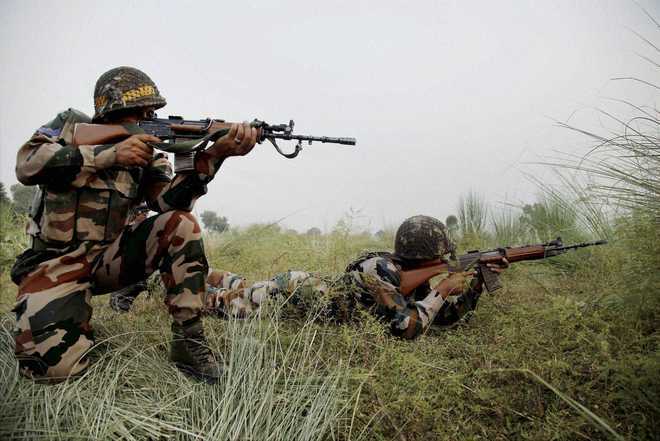
He said at 2 am Pakistan started firing in gaps in Hiranagar and Samba sectors which continued till 6 am.“The BSF retaliated appropriately wherever required,” he said.The firing stopped at 8.20 am in all parts of the International Border. There was no loss of life or injury, the DIG added.On Friday, two civilians were killed and as many injured when Pakistan targeted civilian areas and forward Indian posts along the LoC and IB in Jammu, Kathua, Poonch and Rajouri districts, following which Indian troops retaliated and killed 15 Pakistani soldiers.The BSF said as per the ammunition used in firing and shelling it appeared that Pakistani Army was supporting Pakistani Rangers along the IB.On October 25, at least 2-3 Pakistani armymen were believed to have been killed in retaliatory firing by Indian troops in the Noushera sector of Rajouri district.Over 60 ceasefire violations have taken place since surgical strikes by Indian Army on terror launch pads in Pakistan-occupied Kashmir. PTI


India spreading litany of falsehoods: Pak army chief

India spreading litany of falsehoods: Pak army chief
Raheel”s comments come as Pakistan continues to refute India’s surgical strikes on terrorist launch pads on its soil. File photo

Islamabad, October 6

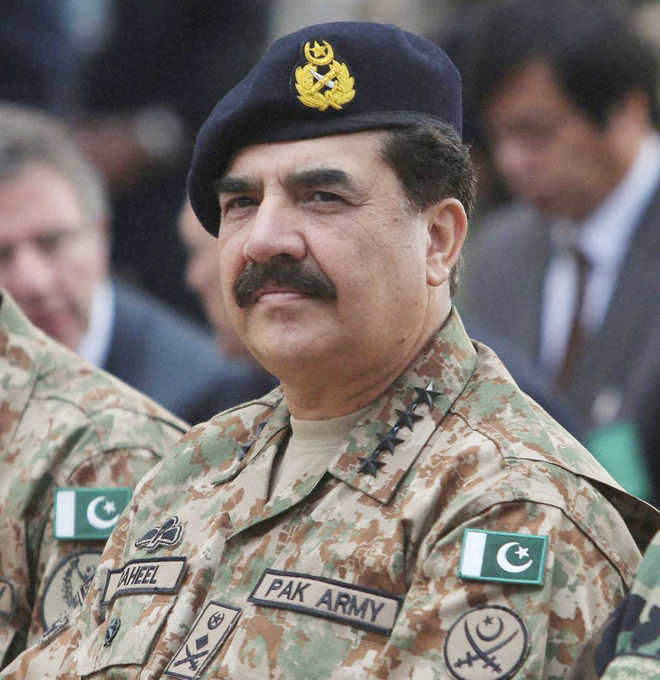
Pakistan Army chief General Raheel Sharif on Thursday accused India of spreading lies and warned that acts of “aggression” against the country would not go “unpunished”, as relations between the nuclear-armed neighbours continues to sour.

“We have recently witnessed an unfortunate display of utter desperation” playing out inside Kashmir and along Line of Control through a litany of falsehoods and distortion of facts by India”, Raheel said while addressing the passing out ceremony of Pakistan Air Force (PAF) cadets in Risalpur, Khyber-Pakhtunkhwa. “We expect international community to condemn Indian insinuations and fabrications about a nation that has made unparalleled contributions in the global fight against terrorism.”

(Follow The Tribune on Facebook; and Twitter @thetribunechd)

Raheel’s comments come as Pakistan continues to refute India’s claims of surgical strikes on terrorist launch pads on its soil. The strikes came as direct fallout of a militant attack on an army camp in north Kashmir Uri.

“Any aggression, born out of deliberate intent or even a strategic miscalculation, will not be allowed to go unpunished and will be met with the most befitting response,” Raheel said. “We will be highly relentless in defending our motherland against entire spectrum of threat. I am confident that with the united resolve of our nation and its armed forces, those inimical to regional peace will not be allowed to succeed. Their evil plots and plans will be defeated.”

Raheel claimed that “enemies” of Pakistan’s peace and prosperity have been distressed by the country’s “successes” and that they were now trying to “reverse the gain:’ and “derail” the progress “through direct and indirect strategy”.

Raheel said Pakistan was a “responsible” country that remained committed to following the policy of friendship with all other countries.

“While doing so, the armed forces of Pakistan remain fully prepared to give the most befitting response to any kind of internal and external threat posed to our nation,” he said.

“Their (enemies’) nefarious designs will not be allowed to succeed at any cost. Resolute efforts to consolidate our gains is the only way forward for which we will not leave any stone unturned,” Raheel said.

Reports of cross-border firing and truce violations continue to take their toll on the already strained relations between the two-nuclear armed neighbours.

In the latest act of terrorism, some gunmen attacked an army camp in Kashmir’s Langate, 75 km from Handwara, in the small hours of Thursday. All three militants were killed in the standoff that followed. — Agencies


The shame at Nabha Serious consequences for national security

Two days ago the Prime Minister was in Punjab. In the company of the Punjab Chief Minister and the Deputy Chief Minister, Mr Modi meditated on the Indus Water Treaty, Pakistan, black money, counterfeit currency, terrorism etc. His presence sought to impart a kind of certificate of good conduct to the Punjab Government. On Sunday morning the criminals at Nabha mocked at all these claims of good governance and “law and order”. The sheer audacity of the Nabha escapees and their accomplices in believing that they could carry out such a jailbreak is an advertisement of sort. The jailbreak was virtually a cake walk. The only saving grace is the immediate arrest of one of the escapees, Harminder Mintoo, of the Khalistan Liberation Force.What stood out clearly at Nabha was the cowardice of the jail staff and mismanagement of the so-called high-security jail. How easy it was for the gangsters to trick the jail staff into believing in their story. As the criminals opened indiscriminate firing, the jail staff failed to retaliate and stop the escapees in their tracks. But no one should be surprised at this meek surrender. It reflects a corrupt jail management culture in which prisoners are allowed access to mobiles, internet and drugs. This will not change with the suspension of a couple of jail officials. Post escape, the Punjab Police brought upon itself additional infamy when they fired at a car, killing an innocent young woman. Here they did not have the excuse of shooting in self-defence. All said and done Sunday was a bad day for the Punjab Police and its pretension to professionalism.By making it easier for prisoners to come out on parole the Akali-BJP government has invited the charge of doing it to use criminals in elections. Such is the credibility of the government that soon after the Nabha jailbreak Capt Amarinder Singh immediately suspected high-level complicity, while Home Minister Sukhbir Badal saw a Pakistani conspiracy to revive terror. Why should Pakistan’s dirty games impair the police capacity to act and do their job? All recent high-profile cases of murder have remained unsolved. None of the countless SITs have yielded any conviction. The sorry spectacle at Dinanagar, Pathankot and now Nabha should unnerve not just the citizens of Punjab but also our national security establishment.


Pak parties warn India on Indus treaty

Say revoking it will be ‘act of aggression’; slam ‘interference’ in Balochistan

Pak parties warn India on Indus treaty

Islamabad, October 3

Leaders of Pakistan’s political parties today warned that any attempts by India to unilaterally revoke the Indus Waters Treaty will be treated as an “act of aggression” and condemned India’s “interference” in Balochistan.In a joint statement, the leaders of the political and parliamentary parties at a special meeting chaired by Prime Minister Nawaz Sharif said they condemn the recent “unprovoked Indian aggression and repeated ceasefire violations that pose a threat to regional peace and security”.The leaders were briefed on the situation along the LoC by senior members of the Cabinet and Sharif, days after India conducted surgical strikes on terror launch pads in Pakistan-occupied Kashmir in retaliation to the Uri terror attack and repeated ceasefire violations by Pakistan.The leaders said they reject Indian efforts to “shift the focus from its brutal atrocities to suppress the indigenous uprising of the Kashmiri people to false claims of terrorism” across the Line of Control (LoC).Amid reports that India may review the 56-year-old Indus Waters Treaty, the leaders condemned the “stated intent by India to use water as a weapon against the people, not only of Pakistan but of the region, in flagrant violation of its international treaty obligations and state that any Indian attempts at unilateral revocation of Indus Waters Treaty shall be taken as an act of aggression”.The leaders from different Opposition parties expressed support to the government amid current tensions with India. They resolved that Pakistan remained firmly united in supporting the Kashmiri people’s right to self-determination.The leaders also condemned “India’s documented interference in Balochistan, a federating unit of sovereign Pakistan” besides attempts to “destabilise” Pakistan as substantiated by the capture and confession of serving Indian naval officer from RAW Kulbhushan Jadhav.On the postponement of the 19th SAARC Summit, which was scheduled to be held here in November, the leaders said they “regret Indian designs to scuttle all diplomatic efforts for bilateral and multilateral dialogue, including the refusal to engage constructively at the SAARC forum”. — PTI