All posts by webadmin

Hemkund Sahib to open on May 25

Dehradun: The portals of Sri Hemkund Sahib in Chamoli district will open on May 25. Army personnel reached Govindghat on Tuesday to proceed for Hemkund Sahib situated at a height of over 15,000 ft on Wednesday to clear snow from the yatra route. The Army team led by Subedar Iqbal Singh comprises havildars Sarbjit Singh, Ranjit Singh and Paramjit Singh and 25 volunteers of 418 Independent Corps and 117 Engineer Regiment, says Narinderjit Singh Bindra, vice-president of the Gurdwara Sri Hemkund Sahib Management Trust. TNSSwaraj to help bring body back from ItalyNew Delhi: External Affairs Minister Sushma Swaraj on Tuesday assured help to the family of an Indian, who died in Italy, in bringing back his body. A man named Didar Singh Bhatti, in a tweet, said Naik Singh was working in Ladispoli, Italy, to support his family in India. Naik Singh died in Ladispoli and his family is poor and cannot afford to get his body back for the last rites. They require help, he said, seeking Swaraj’s help. Responding to the request, Swaraj asked the Indian mission in Italy to help in bringing Naik Singh’s body back. PTI

Three killed inroad mishaps

Moga: At least three persons were killed in road accidents in the district. Amarjit Kaur (26), wife of Simarjit Singh, and her daughter Gurnoor Kaur were killed when the motorcycle they were riding on was hit a tractor-trailer at Khukhrana village in Moga district on Tuesday. They died on the spot. Two other family members, Manpreet Singh, who was driving the motorcycle, and Gurmail Kaur were seriously injured. In another mishap, a 22-year-old motorcycle-borne youth, Ramandeep Singh, died after being hit by an unidentified vehicle on the Lande-Jeon Singh Wala link road in Baghapurana subdivision of the district. TNSGosain killing: Four produced in NIA courtMohali: In the murder case of RSS leader Ravinder Gosain, four accused were produced in the National Investigating Agency (NIA) court at the Mohali Judicial Complex here on Tuesday. The accused, Manpreet, Ravi Pal, Amaninder and Anil, have been arrested recently in the case. The accused were produced in the court under tight security. According to sources, the court has granted police remand to all four accused till May 4. The sources claimed that the charge-sheet in the case would also be submitted in the court on May 4. TNS


Guardians of Governance: 6­month report released

Members rue resistance from political leaders, corrupt practices by govt officials, mismanagement of funds as the reason behind lack of implementation of schemes

From page 01 LUDHIANA: The Guardians of Governance (GoGs) project members released a six-month report card of their assessment of the administrative affairs during a press briefing held here on Thursday.

GURPREET SINGH/HT■ Guardians of Governance district project head Lieutenant Colonel HS Kahlon. retd, (second from right) during a press conference in Ludhiana on Thursday.The chief minister’s pet project Guardians of Governance (GoGs) seems to have rubbed the political leaders on the wrong side as hinted by some of project members .

The report has picked gaping holes in the claims made by the district administration in the implementation of the government schemes.

The report mentions that under Mahatma Gandhi National Rural Employee Guarantee Act (MGNREGA) scheme, it was observed that the labour force was used for de-weeding the village ponds and lakhs of money was wasted which could have been used for other developmental works.

“We found mismanagement of funds, wages which was being siphoned off to aides of sarpanches. Involvement of few banks in aiding this fraud has also been revealed,” said Colonel (retired) BS Bhangu, second in command of the project in the district.

Around seven GoGs posted at different levels in the district released this report which raises serious questions over the delivery of services to the ordinary people.As per the report, despite the district being declared open defecation free, people in Braich village defecate in the open.

The report also mentioned that most of the Reverse Osmosis (RO) plants in the villages lack maintenance as the filters in these plants have been rarely changed. “High-stage tanks have been constructed in almost all the villages but the equipment for chlorination is lying defunct,” said Bhangu.

‘ GOVERNMENT OFFICIALS INVOLVED’ Acknowledging the failure to implement the government schemes at micro-level, the project members accused government officials at lower- level of corruption.

“At village and block level, the officials in connivance the village representatives are indulging into corrupt practices.As of now, we have not specifically identified those individuals in our report,” said one of the members pleading anonymity.

“We have been facing resistance from political leaders of the ruling party who have also approached the chief minister in this regard,” said the member.

“The local MLAs think of us as their rivals. We do face resistance when we strike out the fake names from the list of beneficiaries for welfare schemes,” said another member.

‘EMOLUMENTS FOR SARPANCHES’ Sarpanches across the state have not been getting their monthly honorarium of ₹1,200 for the past four years. However, the state government will be soon releasing the emoluments for the sarpanches, said Lt. Col. (retired) Harbant Singh Kahlon, in-charge of GoG in Ludhiana. We will keep on informing the government of all the updates from the district, he said.


MHA needs Rs 3,50,000 cr for internal security, border guarding in 2020-25

MHA needs Rs 3,50,000 cr for internal security, border guarding in 2020-25

The capabilities of states alone are not adequate to meet the threats of insurgency and terrorism that have national and international links, the official said. File photo

New Delhi, April 22

The Home Ministry has projected a budgetary requirement of more than Rs 3,50,000 crore for internal security, mordernisation of police forces and other related responsibilities during 2020-25.

This was conveyed by Home Minister Rajnath Singh to Chairman of the 15th Finance Commission NK Singh here recently, officials said today.

The ministry has projected budgetary requirement of more than Rs 3,50,000 crore for the period 2020-2025 for internal security, central armed police forces, police modernisation, border security, disaster management and Union Territories, a ministry official said.

A detailed memorandum will be submitted to the Finance Commission later.

A presentation was made during the meeting which stressed that the responsibilities of the Home Ministry have increased manifold that include diverse and varied internal security challenges, even though public order and police are constitutional responsibilities of state governments.

The capabilities of states alone are not adequate to meet the threats of insurgency and terrorism that have national and international links, the official said.

The home minister has pointed out that his ministry also has other challenges that include improving sense of security amongst the public, making vulnerable sections such as women and children safer, improving effectiveness of police, meeting cyber threats, providing immediate relief and rehabilitation during natural disasters etc.

He said due to concerted and coordinated efforts of the central government and the state governments, there has been a significant and steady improvement in the overall security situation in the hinterland, in the mortheastern states and in the areas affected by Left-Wing Extremism.

The home minister said relentless efforts are needed to be made continuously in order to consolidate the gains and spread successes in the new areas.

The Finance Commission was briefed about the various schemes being implemented by the Home Ministry, which require continued capital expenditure such as modernisation of police forces, Crime and Criminal Tracking Network and Systems (CCTNS), immigration, visa, Foreigners Registration and Tracking (IVFRT), coastal security, border infrastructure, integrated check posts, another official said.

The commission was conveyed that further capital investment is also required to make appropriate use of new technologies for cyber security, border management etc, the official said. PTI


Commuted Pension – A Money Minting Business of the Government

Startled? Bitter but true. It is a harsh reality that the Government has made a profitable business out of the apparently innocuous ‘welfare measure’ called “Commutation of Pension”. Calculations show that the Government recovers much more than the amount it extends ostensibly as a welfare measure to the retiring personnel. The main reason projected by the Government for excess recovery is the ‘mortality risk factor’ as the balance recovery is waived in case of death. The hard fact remains that commuted pension is like any other advance/ loan on which the Government charges interest (currently 8%) at market rate! The Government keeps on chewing on the pension for 15 years though it recovers the full amount with interest in 10 years and 10 months (in case of post-1.9.08 retirees). In the case of earlier retirees, it fully recovers in less than 13 years. 

As per extant rules [Central Civil Services (Commutation of Pension) Rules, 1981], commuted pension is restored 15 years after the date of drawal of the commuted amount. This period of 15 years is arbitrarily fixed, without any legal or mathematical basis. This amounts to an unjust and immoral enrichment of the Government at the cost of the pensioners/ senior citizens. This affects all the services, irrespective of the rank/ level of the pensioner. What right/ justification has the Government got to overcharge the pensioners and recover even a penny more than what it has paid? The Government is behaving like a typical rural money lender and is knowingly milking the pensioners.

In the succeeding paragraphs, I will mathematically and legally prove how the pensioners are being fleeced. The calculations, made on the basis of one particular pay, are only illustrative but the principle/ method applies equally to all the ranks, leading to exactly similar results.

Retirees between 1986 and 1995

Ask a Free Legal Question at Tilak Marg Forum

The age of retirement during this period was 58 years. Such retirees have all completed the prescribed period of 15 years for restoration of pension. Since 1.3.1971 and until 1.9.2008, the Commutation Factor (CF) was 10.46 and the rate of interest was 4.75% p.a. Commutation allowed was 1/3rd of the basic pay. The basic pension of those who superannuated between 1.1.86 and 31.12.95 at the top of their pay scale (Rs.8,000), was fixed at Rs.4,000 and they got commuted pension of Rs.1,67,318 with a deduction of Rs.1,333 per month. The principal amount of Rs.1,67,318 was fully recovered in 10.46 years.

  • Considering the simple interest rate of 4.75% p.a., the total interest works out to Rs.36,250. This was fully recovered in 2.27 years [36250/1333 = 27.2 months or ~2.27 years]. Thus, total recovery period of the commuted amount works out to 10.46 + 2.27 = ~12.73 years. But the pensioner was made to pay for additional 15 – 12.73 = 2.27 years, amounting to Rs.36,250.


Retirees between 1996 and 2005

The age of retirement was raised to 60 years w.e.f. 1.5.98 after the 5th Central Pay Commission (CPC) report. Permissible commutation was also raised from one third to 40% of the basic pay w.e.f. 1.1.96. The Commutation Factor (CF) came down to 9.81 from 10.46. The rate of interest was 4.75% p.a. Those who superannuated between 1.1.96 and 30.4.98 at the age of 58 years at the top of their pay scale (Rs.26,000) got the commuted amount of Rs.6,52,704 with a deduction of Rs.5,200 p.m. Those who retired between 1.5.98 and 31.3.04 at the top of their pay scale (Rs.26,000) got the commuted amount of Rs.6,12,144 with a deduction of Rs.5,200 p.m. Those who retired on or after 1.4.04 after the merger of 50% DA with basic pay got Rs.9,18,216 with a deduction of Rs.7,800 per month.

  • Retirees between 1.1.96 and 30.4.98:- The principal amount of Rs.6,52,704 was fully recovered in 10.46 years. Considering the simple interest rate of 4.75% p.a., the total interest worked out to Rs.1,50,779. This was recovered in 2.42 years [150779/5200 = 29 months or 2.42 years]. Thus, total recovery period of the commuted amount works out to 10.46 + 2.42 = 12.88 years. But the pensioner kept on paying for further 15 – 12.88 = 2.12 years. Excess recovery was Rs.1,32,517.
  • Retirees between 1.5.98 and 31.3.04:- The principal amount of Rs.6,12,144 was fully recovered in 9.81 years. With interest rate of 4.75% p.a., the total interest works out to Rs.1,41,409. This is recoverable in 2.27 years [141409/5200 = 27.2 months or 2.27 years]. Thus, total recovery period of the commuted amount works out to 9.81 + 2.27 = ~12.08 years. But the pensioner kept/ keeps on paying for further 15 – 12.08 = ~2.92 years. Excess recovery = Rs.1,82,447.
  • Retirees between 1.4.04 and 31.12.05:- The principal amount of Rs.9,18,216 has already been fully recovered in 9.81 years. With the simple interest rate of 4.75% p.a., the total interest works out to Rs.2,12,114. This is recoverable in 2.27 years [212114/7800 = 27.2 months or 2.27 years]. Thus, total recovery period of the commuted amount works out to 9.81 + 2.27 = ~12.08 years. But the pensioner will keep on paying for further 15 – 12.08 = ~2.92 years. Excess recovery = Rs.2,73,670.

Retirees from 1.1.2006 to 1.9.2008

Since 1.3.1971 and until 1.9.2008, the Commutation Table remained unchanged. The Commutation Factor (CF) in 2006-2008 was 9.81 and the rate of interest was 4.75% p.a. The basic pension of those who superannuated between 1.1.06 and 1.9.08 at the top of their pay scale (Rs.80,000), was fixed at Rs.40,000. Their commuted pension amount was Rs.18,83,520 with a deduction of Rs.16,000 per month. The principal amount is fully recovered in 9.81 years.

  • Considering the simple interest rate of 4.75% p.a., the total interest works out to Rs.4,35,106. This is recoverable in 2.27 years [435106/16000 = 27.2 months or 2.27 years]. Thus, total recovery period of the commuted amount works out to 9.81 + 2.27 = 12.08 years. But the pensioner will keep on paying for further 15 – 12.08 = 2.92 years. Excess recovery = 2.92 x 12 x 16000 = Rs.5,60,640.

Retirees with effect from 2.9.2008

This category of pensioners is the worst affected. They suffered a triple jeopardy: (i) 16.5% lower commuted amount (ii) 68% higher interest and (iii) status quo in recovery tenure. The persecution is explained below.

A new Commutation Table was introduced from 2.9.08 which reduced the commuted amount drastically without reducing the recovery tenure. Despite a sharp rise in life expectancy, the Commutation Factor (CF) was downgraded from 9.81 to 8.194, thereby reducing the commuted amount by a whopping 16.5% !!! To add insult to injury, the rate of interest was enhanced from 4.75% to 8% p.a., an astronomical jump of 68% even in this low interest regime !!! This category of pensioners suffered the costliest advance/ loan called the ‘commuted pension’.

The basic pension of those who superannuated on or after 2.9.08 at the top of their pay scale (Rs.80,000) was fixed at Rs.40,000. Their commuted pension amount is Rs.15,73,248 with a deduction of Rs.16,000 per month. Had the Commutation Table not been revised, they would have got a higher commuted sum of Rs.18,83,520 as per the old CF of 9.81. Thus, they were/ are put to the first shock loss of Rs.3,10,272(-16.5%) at the outset, even before the recovery started/ starts !!!

  • Coming to the recovery part, the principal amount of Rs.15,73,248 will be fully recovered in 8.194 years. With interest @8% p.a., the total interest works out to Rs.5,10,417. This is recoverable in 2.66 years [510417/16000 = 31.9 months or 2.66 years]. Thus, total recovery period of the commuted amount is = 8.194 + 2.66 = 10.85 years. But the pensioner will keep on paying for further 15 – 10.85 = 4.15 years. Excess recovery = 4.15 x 12 x 16000 = Rs.7,96,800.

The following tables summarise the comparative position:-

Sl.

Retirement Period & Age

Commutation Factor

Interest

(% p.a.)

Basic Pension

Commuted Amount

Monthly Recovery

1986 to1995;

58 years

10.46

4.75

4,000

1,67,318

1,333

1.1.96 to 30.4.98;

58 years

10.46

4.75

13,000

6,52,704

5,200

1.5.98 to 31.3.04;

60 years

9.81

4.75

13,000

6,12,144

5,200

1.4.04 to 31.12.05

60 years

9.81

4.75

13,000

9,18,216

7,800

1.1.06 to 1.9.08;

60 years

9.81

4.75

40,000

18,83,520

16,000

2.9.08 onwards;

60 years

8.194

8

40,000

15,73,248

16,000

Sl.

Retirement Period

Commuted Amount + Interest (Rs.)

Recoverable in

Actual Recovery in 15 years

Excess Recovery (Rs.)

1986 to1995

2,03,568

12.73 years

2,39,940

36,250

1.1.96 to 30.4.98

8,03,483

12.88 years

9,36,000

1,32,517

1.5.98 to 31.3.04

7,53,553

12.08 years

9,36,000

1,82,447

1.4.04 to 31.12.05

11,30,330

12.08 years

14,04,000

2,73,670

1.1.06 to 1.9.08

23,18,626

12.08 years

28,80,000

5,60,640

2.9.08 onwards

20,83,665

10.85 years

28,80,000

7,96,800

In a nutshell, the commuted pension is fully recovered with interest in:-

  • 12.73 years in case of those who retired between 1986 and 1995;
  • 12.88 years in case of those who retired between 1.1.96 and 30.4.98;
  • 12.08 years in case of those who retired between 1.5.98 and 1.9.08;
  • 10.85 years in case of those who retired on or after 2.9.08.

Supreme Court Order of 1986

All the time, the Government is harping upon the Supreme Court Judgement of 9.12.86 in Common Cause Vs. UOI in Writ Petitions No. 3958-61 of 1983 under Article 32 of the Constitution of India. The justification given by the Government for excess recovery is two fold: (i) convenience of lump sum payment to pensioners and (ii) mortality risk factor. It is almost 29 years since the SC judgement was delivered while much water has flown down the Ganges since then. Several factors and circumstances, which were relied upon by the Apex Court, have undergone a sea change as elaborated in the analysis below:-

1)    As per an official release, the life expectancy in India currently is 67.3 years for males and 69.6 years for females. The average comes to 68.5 years. In 1986, when the Supreme Court judgement was delivered, life expectancy in India was only 57 years while the retirement age was higher than this (58 years). In 29 years after the judgement, there is a sharp upsurge in life expectancy by 11.5 years while the retirement age (60 years) is 8.5 years lower than the life expectancy of 68.5 years! This has reduced the projected risk factor (of non-recovery and waiver due to premature mortality) to almost zero. This factor alone demolishes the Government’s constant bogey of mortality risk factor.

2)    Even if a pensioner dies at the average life expectancy age of 68.5 years and the unrecovered commuted amount stands waived off, the Government is not a loser at all. The reason is that the family pension, which remains 100% only up to 7 years after retirement, i.e. up to the deceased’s presumed age of 67 years, is reduced thereafter by 40% after the death of the pensioner. This drop is exactly the same as the current commuted portion which is 40% of the basic pension. Thus, in the changed scenario, virtually no risk factor exists.

3)    When the age of retirement was raised from 58 to 60 years after the 5th CPC in 1996, the Commutation Factor (CF) came down to 9.81 from 10.46, thus lowering the financial liability of the Govt by 6.2% (though this drop was almost offset by the increase in the commuted value from 33-1/3% to 40% effected after the 5th CPC).

4)    As mentioned earlier, with effect from 2.9.08, a new Commutation Table was introduced which drastically reduced the commuted amount by as much as 16.5% because of the reduction in the CF from 9.81 to 8.194. Though the Government’s financial liability towards the commuted amount came down by 16.5%, the period of recovery was not reduced though it should also have been brought down proportionately by 16.5%, i.e. by 2.5 years. Thus, logically, even if we ignore other factors, the recovery period should have been brought down to 15 – 2.5 = 12.5 years.

5)    Apart from revising the Commutation Table, the rate of interest was raised w.e.f. 2.9.08 from 4.75% to the market rate of 8% which is almost double the previous figure. Thus, calling the commuted pension a concessional dole and a welfare measure is no more valid. The Government is claiming its full pound of flesh even in this low interest regime. In such a situation, why should the Government recover more than what it has advanced?

6)    A relevant portion of the SC judgement of 1986 is cited below:-

“In dealing with a matter of this nature, it is not appropriate to be guided by the example of Life Insurance; equally unjust it would be to adopt the interest basis. On the other hand, the conclusion should be evolved by relating it to the ‘years of purchase’ basis. An addition of two years to the period necessary for the recovery on the basis of years of purchase justifies the adoption of the 15 years rule. That is more or less the basis which appears to be equitable”.

This has two inferences:-

a)    No link of the concept of commutation can be made to life insurance. This demolishes the official stand that an element of insurance/ risk is made into the concept of commutation.

b)    The period of recovery for interest cannot exceed 2 years after the recovery of the principal amounton the basis of years of purchase. This leads to the following recovery periods for different retirees:-

Sl.

Retirees Between

Principal Amount is Recovered in

(Years of Purchase)

Total Recovery Period after Adding 2 Years for Interest Recovery

1986 to1995 and up to 30.4.98

10.46 years

12.46 years

1.5.98 to 1.9.08

9.81 years

11.81 years

2.9.08 onwards

8.194 years

10.194 years

7)    The Government’s argument that the period of 15 years was “fixed” by the Supreme Court is fallacious and misleading. A plain perusal of the judgement shows that this period was proposed by the Government itself during the pendency of the Writ Petition (as an offer of compromise) and the figure was simply accepted by the Court. No calculation chart was ostensibly submitted either by the Government or by the Petitioner to justify the proposal of 15 years but it was welcomed by all because till then, the recovery period was life long.

8)    A perusal of the judgement shows that 15 years is the upper limit while there is no lower threshold fixed. No bar has been placed by the Court on its reduction which can always be done in view of the changed circumstances like higher life expectancy, lower risk factor, revised commutation table, reduced commutation factor, increased interest rate, higher age of retirement and the changed scenario after the 4th, 5th and 6th Central Pay Commissions.

5th CPC Recommendation Rejected by the Government

The 5th Central Pay Commission, in Chapter 136, had specifically recommended reduction of the period of recovery to 12 years. The Commission had observed that the commuted value of pension receivable currently by an employee retiring at the normal age of 58 years was equal to 10.46 years’ purchase. It was, however, separately recommended that the age of superannuation be raised from 58 years to 60 years. Consequently, the commutation value in respect of employees superannuating at the age of 60 years and commuting a portion of pension within a period of one year would be equal to 9.81 years’ purchase. After adding thereto a further period of 2 years for recovery of interest in terms of the observation of the Supreme court, it was felt reasonable to recommend restoration of the commuted pension after 12 years. The Government rejected this recommendation summarily, without citing any plausible reason despite the Commission having given sound reasons for the same. 

Summary

Keeping in view all the factors and mathematical calculations, the exact period of restoration of commuted pension works out as under:-

a)    1st category of retirees (who retired between 1986 and 1995): They repaid the entire amount with interest in 12.73 years. The Government should refund the excess recovery made for 2.27 years with interest.

b)    2nd category of retirees (who retired between 1.1.96 and 30.4.98): They repaid the entire amount with interest in 12.88 years. Excess amount recovered for 2.12 years should be refunded with interest.

c)    3rd category of retirees (who retired between 1.5.98 and 1.9.08): Their repayment completes in 12.08 years. Therefore, their full pension should be restored thereafter. Excess amount recovered should be refunded with interest.

d)    4th category of retirees who retired on or after 2.9.08: Their repayment completes in 10.85 years. Their full pension should be restored thereafter.

The Forum of Retired IPS Officers (FORIPSO) gave a Power Point Presentation before the 7th Central Pay Commission last year and was able to convince it. These facts were also brought to the attention of the Government but these fell on deaf ears, forcing FORIPSO to file a PIL in Delhi High Court where it is pending.

About J.K. Khanna

J.K. KhannaJ.K. Khanna is a retired IPS Officer of Bihar Cadre, 1974-batch. He retired in the rank of D.G.Police in 2011. He is the Secretary of the Forum of Retired IPS Officers (FORIPSO) which is an all India body, representing 23 States.


Defence Expo 2018: Ashok Leyland bags Indian Army order for 10×10 vehicles to carry Smerch rockets

The Ashok Leyland HMV 10×10 is powered by an engine that has a power of 265 kW (360 hp) at 2200 rpm. It has a maximum speed of 90 km/hr. The fuel capacity of the tank is 350 litres and has a massive payload capacity of 32000 kg.

ashok leyland, andhra pradeshMinistry of Defence has given Ashok Leyland the contract to supply high mobility 10×10 vehicles for the Indian Army. (Reuters)

Ashok Leyland, Hinduja Group’s flagship firm, has got the contract from the Ministry of Defence for the supply of high mobility 10×10 vehicles. The high mobility vehicles will be used to carry smerch rockets in the Indian Army. The Indian Army was on a lookout for high mobility 10×10 vehicles for a long time now. The agreement comes on the sidelines of the DefExpo 2018 that is being held in Chennai. Ashok Leyland’s high mobility 10×10 vehicle is fully designed and developed in India. It is one the flagship products of Ashok Leyland under the ‘Make in India’ initiative. The Indian Army has placed the initial order worth Rs. 100 crore for the supply of HMV 10×10.

Speaking at the event, Amandeep Singh, Head of Defence at Ashok Leyland said, “We have won 12 tenders out of the total 15 tenders we participated in last year. This is a big win for us”. He also said that this contract will mark Ashok Leyland’s further inroads into the defence sector.

“We will make use of this opportunity to further develop mobility products for other weapons such as missile carriers, missile launchers, modular bridges and other critical loads”, he added. He also assured that Ashok Leyland will continue to partner with Indian defence forces to serve the nation.The Ashok Leyland HMV 10×10 is powered by an engine that has a power of 265 kW (360 hp) at 2200 rpm. It has a maximum speed of 90 km/hr. The fuel capacity of the tank is 350 litres and has a massive payload capacity of 32000 kg. The 10×10 HMV by Ashok Leyland will prove to be extremely useful for the Indian army in moving and carrying the smerch rockets. The smerch rocket is Soviet-made heavy multiple target launchers that have a maximum firing range of 90 km. Indian Army has around 40 smerch rockets under its operations.


Andhra rural innovators get a big push, courtesy retired Army officer

Suresh Dharur in Hyderabad

Retired Brigadier P Ganesham is on a unique mission. He travels to villages, identifies the rural innovators, nurtures their ideas and presents them to the world. ‘Palle Srujana’ (rural creativity), a Hyderabad-based voluntary organisation set up by the septuagenarian ex-serviceman and other like-minded individuals, is engaged in spotting the rural talent, aiding and promoting creativity at the grassroots level in the two Telugu states of Telangana and Andhra Pradesh. So far, they have identified more than 210 innovators across the two states, besides documenting close to 2,500 traditional practices.Among these, 13 innovators have won the Rashtrapati Award, and two have won the Padma Shri. The organisation has also helped 24 innovators patent their devices.”The innovators have collectively generated a turnover of close to Rs 4 crore, impacting more than Rs 5 lakh families,” says the retired Brigadier. The idea of Palle Srujana is that rural innovators leverage knowledge derived from nature for their livelihood. There is abundant creativity in villages to find solutions which are simple, affordable, sustainable and user-friendly.”It has been a great learning experience for me. In the last 12 years that I have been visiting the villages, I have always amazed at the level of talent and innovative spirit that exists in our rural areas,” he says. A group of Palle Srujana volunteers, comprising 20-40 people, undertake what they call ‘Shodh Yatra’ that would see them crisscrossing the villages and interacting with locals to identify the rural talent.Ch Mallesham, a school drop-out from a poor weaver family in Andhra Pradesh who figured in the Forbe’s list of seven most powerful rural Indian entrepreneurs, is among the innovators whose unique work has been brought to light by Palle Srujuna volunteers. He is inventor of Laxmi Asu Machine which automates the weaving process and dispenses with the strenuous movement of hands and legs.The humble machine, which Forbes said “ignited a revolution” in India’s weaving community, proved to be a boon for the weaving community in the backward Nalgonda district, famous for Pochampally silk sarees.Mallesham’s machine can make six saris worth of material in one day, and no human effort is required beyond placing thread on the machine and removing the material after the process is complete. It saves time and relieves stress. Domestic power supply is sufficient to run the 0.25 HP motor attached to the machine.The use of Asu machine has significantly improved the productivity and marketability of Pochampally silk sarees. Mallesham received Padma Shri last year. “This machine brought a ray of hope to the weavers and provided livelihood to many,” says Brig Ganesham. Another innovator Pandu Ranga Rao (33), who studied up to tenth standard, developed a natural air sealant for motorcycle and auto-rickshaw tyres which can resist punctures without damaging the tubes. The novelty of this sealant is that it is prepared using natural products and works equally good in summers and winters. He received a special innovation award from former President Pranab Mukherjee.”We have conducted 26 Shodh Yatras so far. We document rural knowledge, explain intellectual property rights and the importance of consent to them before patenting their device and showcasing it in exhibitions,” says Brig Ganesham.Ganesham, an engineering graduate, served in the Army for 35 years. He was awarded the Vishisht Seva Medal (VSM) by the President in 2005, before he retired in 2006.”As most of the Grassroots innovations are being developed with locally available raw materials, they are mostly not in a marketable state. In addition, most of the grassroots innovators solve their problems through their creativity and do not intend to sell them. Based on the readiness of the innovation, and the innovator, each innovation at Palle Srujana is categorized into three: Ready For Sale (RFS), Ready For Entrepreneur (RFE), and Ready For Prototyping (RFP),” explains Brig Ganesham.


China protests India’s ‘transgression’ in Arunachal; Army denies claim

China protests India’s ‘transgression’ in Arunachal; Army denies claim

Kibithu (Arunachal Pradesh), April 8

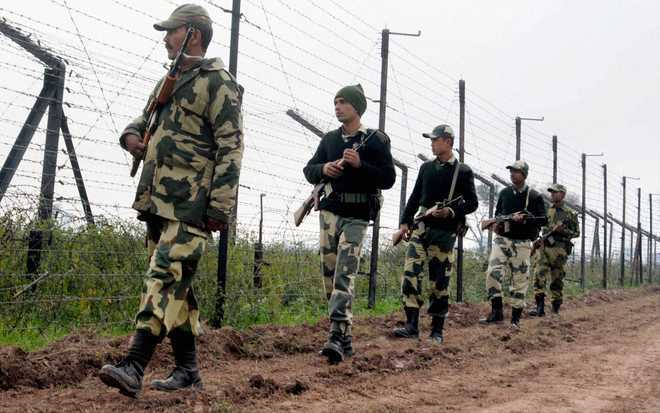
In yet another incident of discord, the Chinese military last month strongly protested against what it called the Indian Army’s “transgression” into the strategically sensitive Asaphila area along the disputed border in Arunachal Pradesh, but the Indian side roundly dismissed the complaint, official sources said.

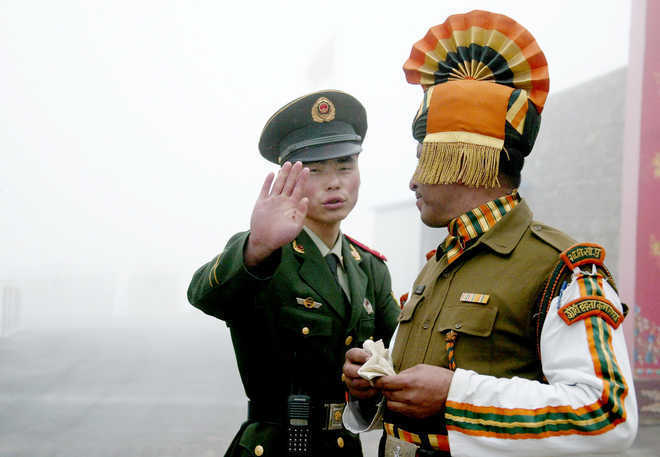
They said the Chinese side raised the issue at a ‘Border Personnel Meeting’ (BPM) on March 15 here but the Indian Army rejected it, saying that the area in the upper Subansiri region of Arunachal Pradesh belongs to India and it has regularly been carrying out patrols there.

The sources told PTI that the Chinese side called India’s patrolling in the area a “transgression” and the Indian Army objected to the terminology.

“China’s protest to our patrolling in Asaphila is surprising,” said a source, adding there were several instances of Chinese intrusions in the area which had been seriously taken up by the Indian side in the past.

Under the BPM mechanism, both sides can register their protest over any incident of transgressions as there are varying perceptions about the LAC between the two countries.

The delegation of China’s Peoples Liberation Army specifically mentioned extensive patrolling in Asaphila by Indian troops, saying such “violations” may escalate tensions between the two sides in the area.

However, rejecting the Chinese protest, the Indian side said its troops were aware of the alignment of the Line of Actual Control (LAC) and the Army would continue to carry out patrols up to the LAC, the de facto border between the two countries.

Perceptions of the border by India and China vastly differ in the area.

The sources said the Chinese military specifically mentioned large-scale Indian patrolling in Asaphila near Fishtail 1 on December 21, 22 and 23 last.

Indian and Chinese troops hold BPMs to resolve issues triggering tensions along the border.

There are five BPM points along the Line of Actual Control (LAC) at Bum La and Kibithu in Arunachal Pradesh, Daulat Beg Oldi and Chushul in Ladakh, and Nathu La in Sikkim.

The BPM on March 15 had taken place at the Daimai post on the Chinese side in the Kibithu area.

At the BPM, the Chinese also accused the Indian side of damaging its road building equipment when a road laying party left its gear in Tuting in December last year following a protest by India.

The Indian Army rejected the allegation, the sources said.

The Chinese road building team had crossed into Indian territory, about 1 km inside the Line of Actual Control in the Tuting area, in the last week of December.

The road construction team left the area after Indian troops asked them to stop the activity.

The team brought in two excavators which were later returned.

The sources said the Indian Army has increased war-fighting drills to deal with all possible scenarios along the LAC following the Doklam standoff.

“We are fully prepared to deal with any situation,” said a senior Army official.

Troops of India and China were locked in a 73-day standoff in Doklam from June 16 last year after the Indian side stopped the building of a road in the disputed area by the Chinese Army. The face-off ended on August 28.

Sources said India has deployed more troops and increased patrolling in the mountainous terrains along the borders with China following the Doklam face-off.

India is also strengthening its surveillance mechanism to keep an eye on Chinese activity along the borders in the strategically sensitive Tibetan region and has even been regularly deploying choppers to carry out recce.

The government has been focusing on strengthening its defences along the border with China.

In January, Army Chief Gen Bipin Rawat had said the time had come for the country to shift its focus from its borders with Pakistan to the frontier with China, reflecting the seriousness of the situation. PTI


‘India’s provocations on border will destroy foundation of mutual trust’

‘India’s provocations on border will destroy foundation of mutual trust’

Beijing, April 2

India’s “provocations” on the border with China will “destroy” the foundation of mutual trust and undermine bilateral ties, a Chinese analyst has said.

The statement comes after top Indian Army officials told PTI that the Indian troops have been deployed along the disputed Sino-India border in the Himalayan range to increase their patrolling at a tri-junction of India, China and Myanmar to prevent a repeat of a Doklam-like standoff.

Reacting to India’s increased deployment of troops along the border, Zhao Gancheng, director of the Center for Asia-Pacific Studies at the Shanghai Institute for International Studies, claimed that India’s “provocations” on the border will “destroy” the foundation of mutual trust and undermine bilateral ties.

“India keeps enhancing its military deployment along the border because it has never believed the border region will become peaceful,” Zhao was quoted as saying by the Global Times yesterday.

“India thinks that border conflicts with China will eventually happen,” Zhao said.

“India’s provocations will destroy mutual trust and aggravate the delicate regional situation,” Zhao added.

The mutual military distrust will ultimately undermine Sino-Indian relations in all sectors including diplomacy, economy and cultural exchanges, he said.

The Indian officials said the tri-junction, located around 50km from Walong, the easternmost town of India near the Tibet region, is extremely important for India to help it maintain its dominance in the nearby mountain passes and other areas.

A senior Indian Army official said Chinese troops did not enter the tri-junction too frequently but had developed a road infrastructure near the area which could be advantageous for the mobilisation of army personnel.

Troops of India and China were previously locked in a 73-day-long standoff in Doklam from June 16 last year after the Indian side stopped the building of a road in the disputed area by the Chinese Army. The face-off ended on August 28.

The area in Doklam, where China tried to construct a road, is a disputed territory claimed by both China and Bhutan. India sent its troops to stop the Chinese construction activity, saying it could be a threat to its strategic interests in the region.

Since the Doklam standoff, India has deployed more troops and increased patrolling along the borders with China in the Tibetan region. PTI


US sanctions hit Pak entities

NEW DELHI/WASHINGTON: The US has added seven Pakistani companies to a list of foreign entities that are subject to stringent export control measures, a move that Indian officials said would boost New Delhi’s bid to join the nuclear suppliers group (NSG), an elite club of countries that deal with trade in fissile materials and nuclear technologies. It could also undermine Pakistan’s ambition of joining the NSG.

The list identifies entities “reasonably believed to be involved, or to pose a significant risk of being or becoming involved, in activities contrary to the national security or foreign policy interests of the United States”.

Three of the companies were listed for “their involvement in the proliferation of unsafeguarded nuclear activities that are contrary to the national security and/or foreign policy interests of the United States”; two were found procuring supplies for nuclear-related entities already on the list and last two were suspected to be fronts for

listed entities. An eighth Pakistani entity is based in Singapore.

The 23 additions, including 15 entities from the troubled South Sudan, were published by the US department of commerce’s Bureau of Industry and Security, which leads the multi-agency

determination process, on Thursday in the Federal Register, the American version of Gazette of India. Although China and Turkey have cited procedural issues in adding new members to the NSG, both underline the ‘right of Pakistan’ to aspire to become a member of the club, which works on the principle of consensus to accept new members.

“We are not an NSG member, so we don’t exactly know what the deliberations are at the group. But our non- proliferation credentials are unmatched among other claimants,” said a senior Indian official familiar with India’s engagement with export control regimes.

“We have a safeguard agreement with the International Atomic Agency (IAEA) and got a clean waiver from the NSG based on our clean track record. We leave it to others to judge whether other claimants to NSG membership have requisite credentials.”

NSG is the only major export control regime that India is not a part of; New Delhi is a member of the Missile Technology Control Regime, the Australia Group and the Wassenaar Arrangement.

“India has a record of handling sensitive technologies and that’s the reason why the key export control groupings made us a member,” a second Indian official, who deals the same issues, said.


Unravelling China’s defence budget by Bhartendu Kumar Singh

As a ‘veil of ignorance and mystery’ covers the Chinese defence budget, there are no takers for its official figures. By all estimates, China spends much more than it reflects.

Unravelling China’s defence budget

Bhartendu Kumar Singh

Indian Defence Accounts Service

Until a few years back, China’s defence budget was eagerly awaited and reacted upon. However, of late, international reactions have been muted – like when China recently declared its defence budget for 2018 at $175 billion, up by 8.1 per cent over the 2017 figures. The single-digit growth rate has been there for three years, departing from the days of double-digit growth year after year. The absence of major reactions notwithstanding, China’s defence budget still remains mystery for outside world and needs to be decoded properly. China’s defence budget’s justifications as ‘conservative’ and ‘defensive’ are based on shaky platforms. China claims that it accounts for just one-fourth of the US military spending. This has been the core polemics and not long back, China was estimated to spend anywhere between two and three times of its official figures. Consistent efforts by international community ensured more transparency and reforms in China’s defence budget administration, accounting and reporting, thereby, reducing the gap between the competing claims. However, the ‘veil of ignorance and mystery’ continues to define Chinese defence budget and there are simply no takers for its official figures. By all estimates, China still spends much more than it reflects. China’s other claim that many other countries have faster defence budget growth ignores it own double-digit growth for almost two decades until 2013. China could again resort to such a trend in future. Similarly, China’s claims that it lags behind major countries on per capita military expenditure has no takers since reputed annual publications, like the Military Balance (published by the International Institute for Strategic Studies, London), have been publishing year after year all aspects of Chinese defence expenditure, along with that of other countries. Many countries spend much less than China on a per capita basis. India, for example, spends roughly one-third of Chinese per capita figures. China’s conservative declarations on defence spending notwithstanding, estimating its correctness is a futile exercise without reflecting the appropriate military standing of China. One example would suffice. Most attempts towards military strength index place Russia marginally ahead of China. However, China has already emerged as the most important military power after the US. Most importantly, it is closing in on the US and would surely even up by 2050. This leapfrogging is not possible without massive investments in military modernisation. China, therefore, indulges into cross-subsidisation of its defence budget. Perhaps, this speaks why it is placed in low transparency category (category 5) of defence budget by Transparency International, a global NGO. The higher side of the defence budget can be ascertained in several ways: 1 First, many economic aspects of the defence modernisation process have changed in last two decades. For example, the guns vs butter debate is no more contextual in China’s case. Given the huge economic base, even single-digit growth rate translates into a huge budgetary amount for the Chinese PLA. So, the PLA does not mind preferential treatment to developmental priorities, like the eighties and early nineties. Similarly, technology and arms imports have dropped down; decades of techno-nationalism have, instead, ensured that China is exporting them to earn foreign exchange and diplomatic influence.  2 Second, China has established self-sufficiency in most areas of weapons production. China’s domestic military-industrial complex (MIC) is producing artillery guns, fighter jets, tanks, submarines, ships and has a steady going project on domestic aircraft carrier. Xi Jinping has long-term plans to facilitate China’s leadership in strategic areas of weapons production, dual-use systems, high technology and advanced manufacturing. Moving beyond the realm of state-led growth, Xi is also encouraging private sector participation to plug the loopholes in financial and technological gaps in domestic arms production. Third, China has effected a transformation of the PLA: from being a manpower-oriented army capable of defending at best continental interests to a lean, thin and technology savvy army. It has undergone a complete change of command and control system through the establishment of a ‘theatre command system’ on the US pattern and is shedding extra manpower. The blue water capacity is now within reach and China is engaging foreign armies in more than 150 joint exercises every year. China has also established lead in aerospace and cyber command, something still beyond the reach of many aspiring great powers.  The impact of Chinese investments in military modernisation is visible in its approach towards neighbours, far-off countries and great powers. China is indulging in offensive realism and aggressive strategic culture, as is evident in South China Sea and the Indo-Pacific region. The US’ National Security Strategy (December 2017) named China as a revisionist power and placed it as a central threat along with Russia. A February testimonial before the US China Economic and Security Review Commission highlights how the Chinese PLA is challenging the US in its Pacific Command Operations and elsewhere. Other great powers are also feeling the heat of China’s military power projection in Asia and Africa. Such a forceful power projection is not possible through the official budget alone! It is debatable if China would ever usher in defence budget transparency as per international benchmarks. Therefore, more investment is needed in studying Chinese defence modernisation trends, its strategic arsenals, and above all, its posturing on major issues challenging Asian security. 

(Views are personal)