










Sanjha Morcha

BIBI HARSHARAN KAUR ATTAINED MYTRYDOM FIGHTING MUGULS AFTER SHE LIT THE FUNERAL OF ALL MARYTRED SIKHS IN CHAMKOR SAHIB BATTLE INCLUDING TWO SAHIBZADAS :24 DEC /10 POH

Sharan Kaur Pabla(Harsharan Kaur Pabla) was a Sikh martyr who was slain in 1705 by Mughal soldiers while cremating the bodies of the two older sons of Guru Gobind Singh, the 10th Sikh Guru, after the battle of Chamkaur. She was from the village Raipur Rani which is 2 KM from the famous town of Chamkaur[5] [6]

Historical Background: Guru Gobind Singh Escapes Chamkaur Fort

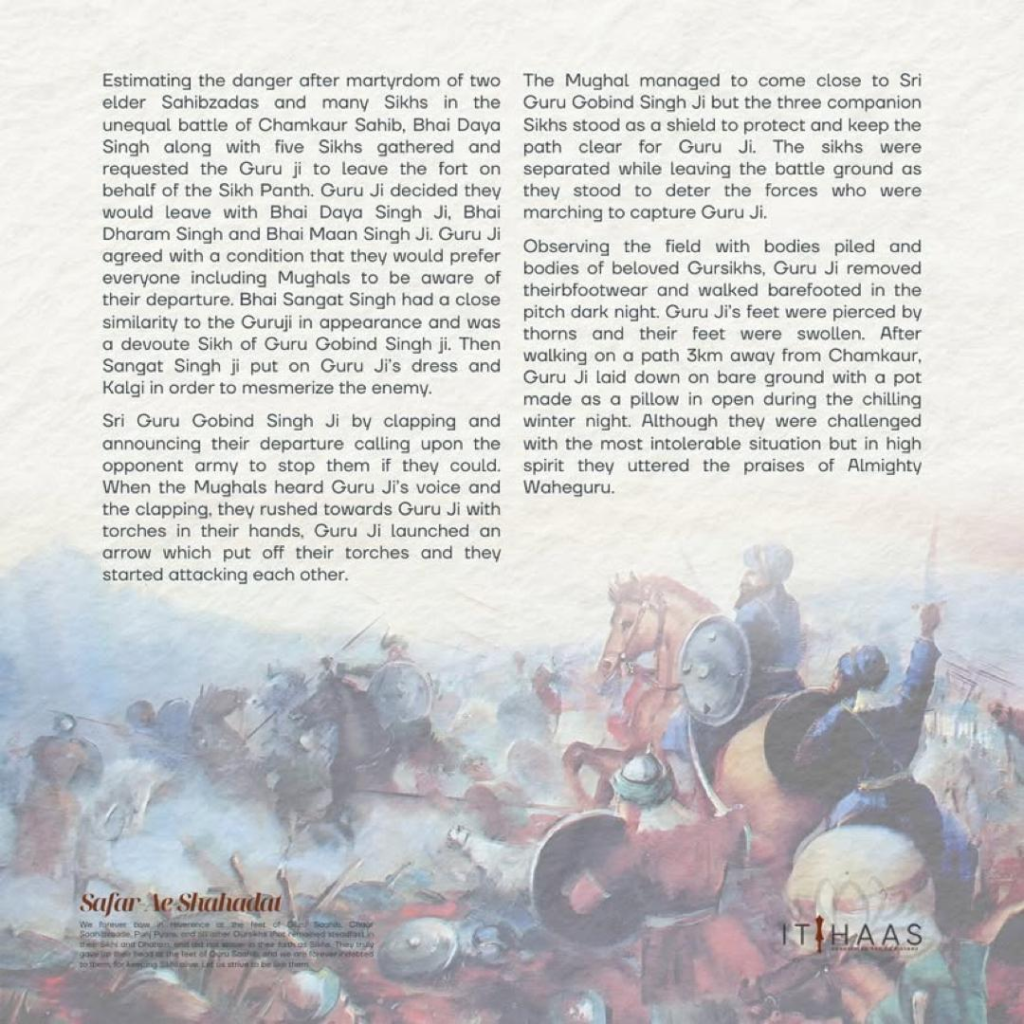
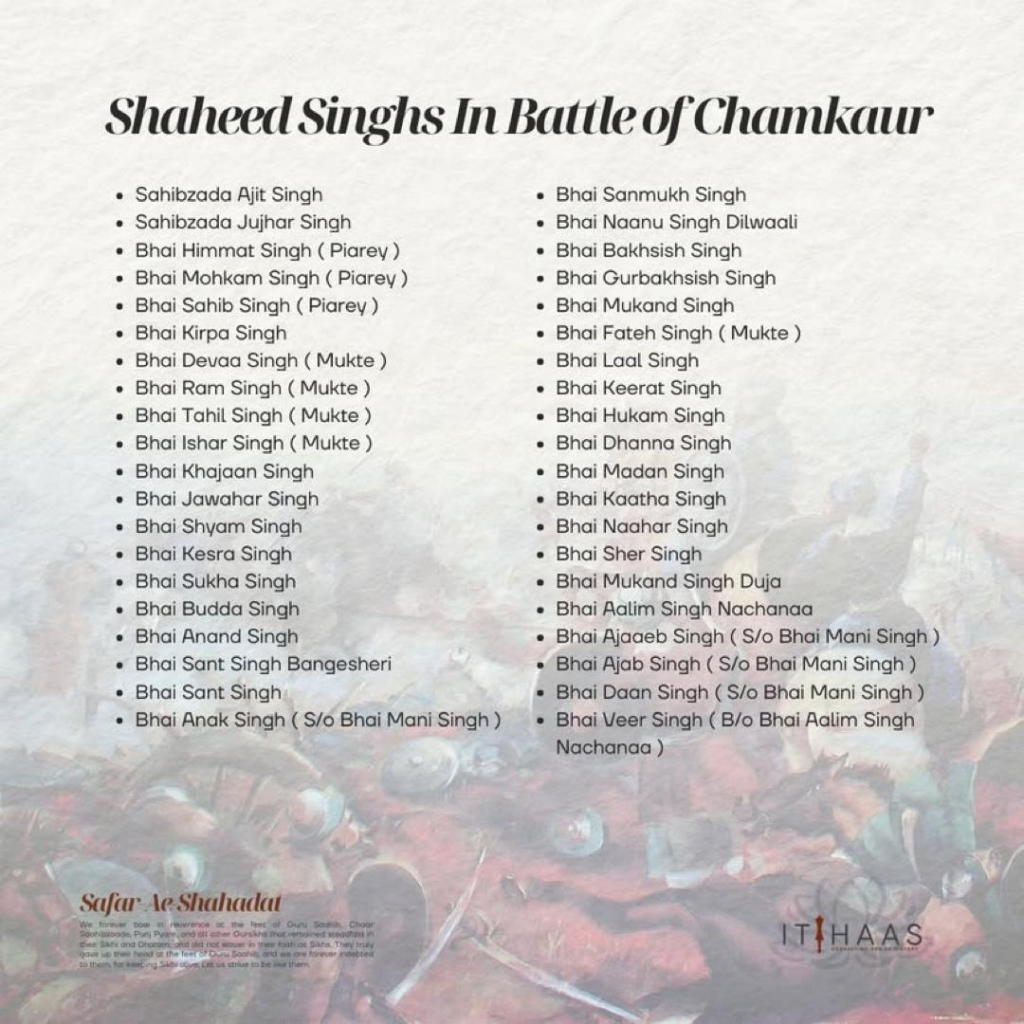
In the battle of Chamkaur Sahib, Guru Gobind Singh jee and 40 starving Singhs fought against the Mughal army. The battle, which took place in Chamkaur Sahib’s mud fort, lasted 72 hours and saw the loss of many Mughal soldiers, and also 36 of Guru Gobind Singh jee’s companions along with the two Sahibzaadey (princes). Fighting an army of hundreds of thousands, Guru Gobind Singh jee gave an exhibition of his battle skills. Guru jee, following the orders of the Panth Khalsa (in the form of the Panj Pyaare) left the fort on the night of December 22, 1705 along with Bhai Daya Singh jee, Bhai Maan Singh jee, and one other Singh, after giving his clothes to Bhai Sangat Singh jee to wear. Only Bhai Sangat Singh jee and Bhai Sant Singh jee fought the battle to its end. They too were martyred. Seeing Guru jee’s clothes on Bhai Sangat Singh jee, the Mughals were ecstatic. Taking him to be Guru Gobind Singh they cut off his head and took it to Delhi.

When Guru Gobind Singh ji moved on from the fort of Chamkaur. He briefly stopped at Raipur on his way to Machhiwara. Here Guru Sahib ji asked a lady by the name of Bibi Sharan Kaur Pabla to perform the last rites of the martyred Sikhs, which included two of Guru Gobind Singh’s own sons, Sahibzada Ajit Singh and Sahibzada Jujhar Singh.

Bibi Sharan Kaur Goes to Battlefield

Bibi Sharan Kaur Pabla.png

Cremates the Sahibzadas and her Husband along with other Martyrs of Chamkaur

As the Story Goes, Bibi Sharan Kaur Pabla performed the last rites of the two elder Sahibzadas, her husband Bhai Pritam Singh Pabla and other Sikh warriors who had laid down their lives in the battle.

In every village it was announced that Guru Gobind Singh had been killed. “Look here is his chopped off head! His family is also finished. His two sons were killed in the battle and the two younger ones will also die abandoned. The revolution has been crushed. No one should go to the Chamkaur Fort. No one should cremate the dead Singhs.”

A tight cordon was put around the Fort. As the soldiers were going from village to village making their announcement, the people were retreating in terror into their homes. However, in village Khroond, a daughter of Guru Gobind Singh jee, Bibi Harsharan Kaur, asked for her mother’s permission to perform the final rites for the Shaheeds (martyrs). Her old mother replied, “It is total darkness outside and soldiers are everywhere around the fort, how will you even go near?”

Hearing this, Kalgeedhar’s lioness daughter replied with resolve “I will avoid the soldiers and perform the cremation, and if need be, I’ll fight and die.”

The mother gave her courage and hugged her daughter, and then explained the maryada (tradition) to follow for the cremation. After performing Ardaas, Bibi Harsharan Kaur jee left for the Chamkaur Fort.

The battlefield, which saw iron smashing against iron, the bellows of elephants, the trotting of hooves, and calls of “Kill! Capture!” was now totally silent and enveloped in complete darkness. In such a situation, the 16 year old girl, Bibi Harsharan Kaur jee, avoided the guards and arrived at the Fort. She saw that bodies were lying everywhere and that distinguishing between Sikh and Mughal was very difficult. She still had faith and began to find arms with kaRas (iron bangles) and torsos with kachheras (Sikh undergarment) and heads with long kesh (unshorn hair). As she found a body, she would wipe the face of every shaheed (martyr). Both Sahibzaadey and about 30 shaheeds were found and then she began to collect wood. Fearing the approaching light of dawn, Bibi Harsharan Kaur jee worked very quickly and soon prepared a pyre. She then lit the fire.

Seeing the rising flames, the guards were shocked and advanced towards the pyre. Bibi Harsharan Kaur jee was seen in the light of the flames sitting beside the pyre. She was quietly reciting Keertan Sohilaa (prayer said at bedtime and funerals). The guards were shocked and confused as to how a lone woman could come into the fort on such a dark night. The guards asked in a loud voice, “Who are you?!”

Bibi jee: I am the daughter of Guru Gobind Singh jee.
Officer: What are you doing here?
Bibi jee: I am cremating my martyred brothers.
Officer: Don’t you know about the order that coming here is a crime?
Bibi jee: I know it.
Officer: Then why have you disobeyed that order?
Bibi jee: The orders of a false king do not stand before the orders of the Sache Paatshaah (True King)
Officer: Meaning?
Bibi jee: Meaning that I have respect for the Singhs in my heart and with the Guru’s grace I have done my duty. I don’t care about your King’s orders.

Hearing such stern answers from Bibi Harsharan Kaur jee, the infuriated Mughal soldiers attempted to capture her and attacked. Bibi jee grabbed her kirpaan (sword) and fought back with determination. After killing and maiming many soldiers, Bibi Harsharan Kaur jee was injured and fell to the ground. The soldiers picked Bibi Harsharan Kaur up and threw her into the pyre, burning her alive in 1705.

The next day the cordon around the Fort was lifted because it was clear that the Sahibzaadey and most of the Shaheed Singhs had been cremated. The ancestors of the Phulkiaan family, Rama and Triloka, then cremated whichever Singhs remained. The story of Bibi Harsharan Kaur jee reached Guru Gobind Singh jee Mahaaraaj in Talvandee Sabo (Takhat Sri Damdama Sahib).

Upon hearing of her daughter’s martyrdom, the old mother thanked Akaal Purakh. She said, “My daughter has proven herself worthy.” The story of the cremation of the Chamkaur Sahib Shaheeds will forever serve as a glowing star of inspiration for all Singhs and Singhnees.

Martyrdom of Bibi Sharan Kaur

Here are two accounts of Bibi Sharan Kaur Pabla’s Martyrdom.

  • According to one acccount, Bibi Sharan Kaur Pabla was so grief stricken that she herself jumped in the funeral pyre and ended her life.
  • According to another view she did not self-immolate but was pierced by a Mughal lance/soldier and thrown in the funeral pyre of the Sahibzadas, when she and her other accomplices from Raipur, were caught cremating the bodies of Sahibzadas. [3]

Identity

Sharan Kaur was a Saini and there are a number of Saini villages around Chamkaur Sahib where the monumental battle between Sikhs and Moghuls took place . Pabla is one of the major clans of Sainis.

Possible Ancestor of Sardar Nanu Singh Saini of Phulkiyan

She is also sometimes linked as a possible ancestor with Sikh nobleman of Phulkiyan, Sardar Nanu Singh Saini, whose family later owned sizeable land in the village Raipur. [4]

Bibi Sharan Kaur’s Husband

Bibi Sharan Kaur’s husband Bhai Pritam Singh, who was a Khalsa warrior, was with Guru Gobind Singh ji, inside the Chamkaur fort resisting the Moghul attack/onslaught. She discovered her husband among the dead. In total she is said to have collected bodies of thirty-two Khalsa soldiers, including the two elder Sahibzadas. She tried to cremate them in a single funeral pyre. As soon as the funeral pyre was lit she was discovered by Moghul and Ranghar soldiers who wanted the bodies of the “Shaheed” Khalsa soldiers – martyrs according to warrior tradition – to rot in open air in order to terrorise non-Muslim population who refused to apostasize or give out the whereabouts of Guru Gobind Singh ji. Another school of thought, is of the viewpoint that Bibi Sharan Kaur understood the intentions of the Moghul soldiers to outrage her modesty, she jumped into the funeral pyre of Sikh warriors, which included her own husband, to save her honour.[7]

Village of Chamkaur

This village also has the samadhs (funerary shrines) of the following Sikh martyrs:

  • Jathedar Naunihal Singh
  • Mastan Singh
  • Santokh Singh
  • Malkiat Singh.

Gurudwaras Commemorating Bibi Sharan Kaur’s Martyrdom

Gurudwara Sahib Bibi Sharan Kaur Ji Raipur.jpg
  • In 1945 a Gurudwara was built in village Raipur to commemorate Bibi Sharan Kaur. [8][1]
Gurdwara Amargarh Sahib in Chamkaur Sahib.jpg
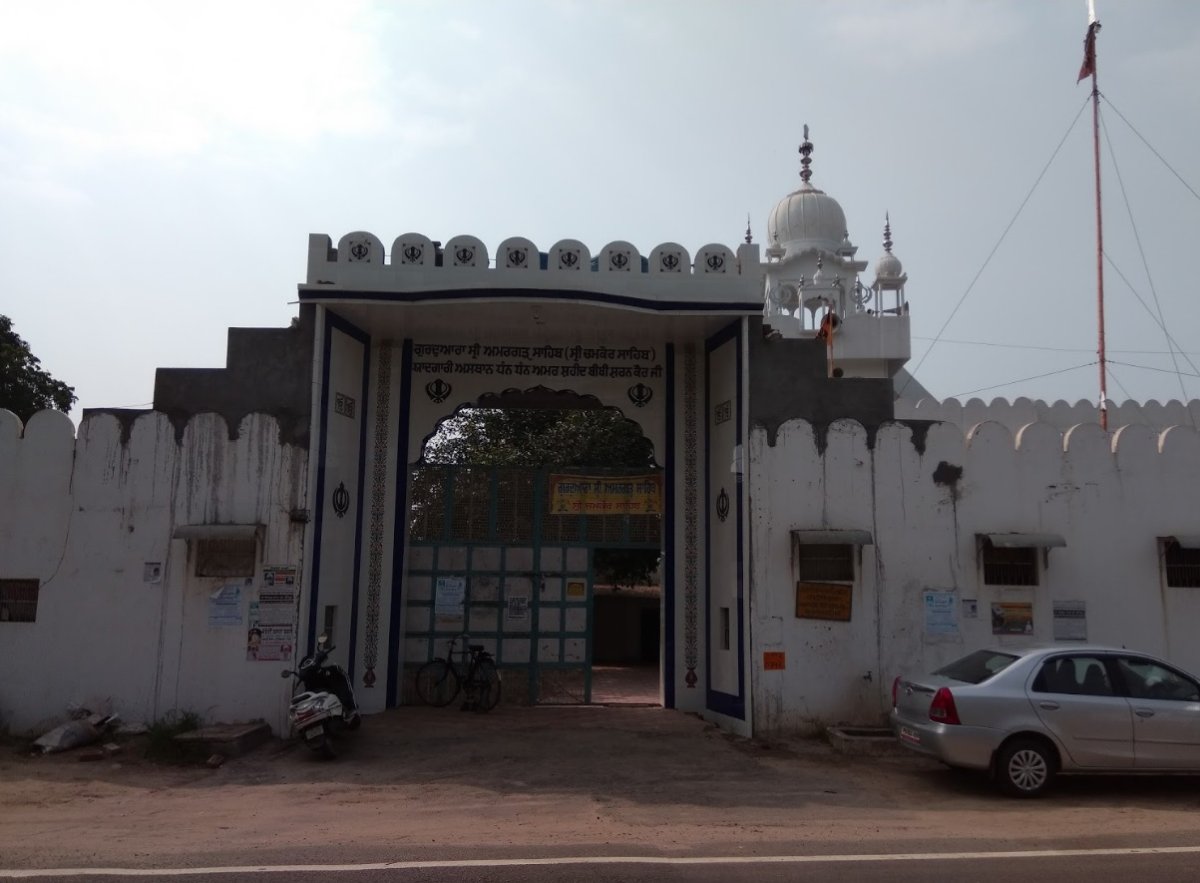
  • Gurdwara Amargarh Sahib in Chamkaur Sahib Is a Sacred Shrine where Mata Sharan Kaur performed the last rituals of Wadde Sahibzaade is situated on the banks of canal.[2]
Facing constant threat of avalanches, Army scouts for advanced detection and rescue system

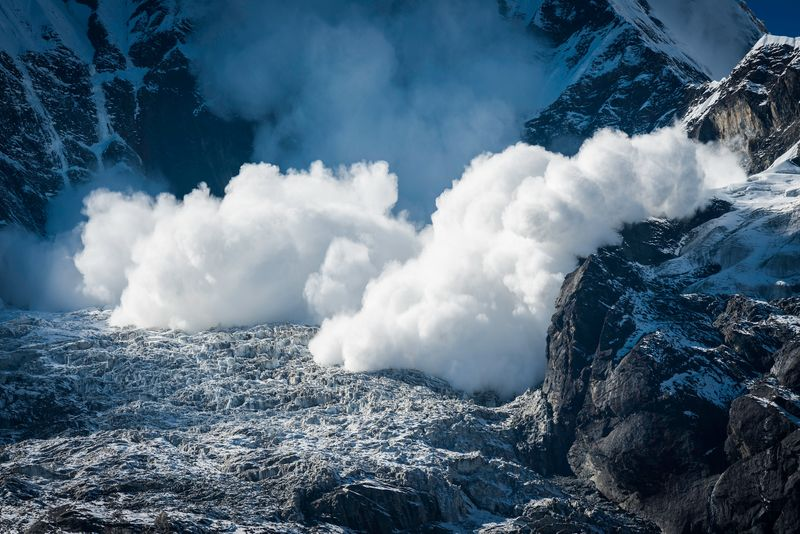
Faced with constant threat of avalanches in many snow-bound areas in the northern as well as north-eastern sectors, especially during winter months, the Indian Army is scouting for an advanced man-portable avalanche rescue system that comprises a search radar and electronic response beacon

The system comprises a rescue radar designed to detect personnel and equipment buried under snow in real time, and a reflector with an electronic transponder to return the signals emitted by the radar to pin point the location.

“The system ensures force protection in areas with adverse weather and climatic conditions and prevents non-operational casualties in snow bound areas. Equipped with advanced sensors and mitigation technology, this system enhances battlefield survivability and security of personnel against vagaries of weather,” a request for information issued by the Army on December 22 states.

The system is required to incorporate multiple victims marking feature in case of more than one buried individual and also include audio and video indication system and display for distance indication. It should have the option of being mounted on drones.

The high probability of avalanches as well as landslides and mudslides in many parts of Kashmir, Ladakh, Himachal Pradesh, Uttarakhand, Arunachal Pradesh and Sikkim poses a danger to troop movement and deployment. Extreme weather, storms, heavy snowfall and unstable terrain make avalanches a leading cause of non-combat casualties.

In September this year, three soldiers were killed when an avalanche hit an Army camp in the Siachen Sector. A captain was rescued after being buried for hours. The most notable incident in Siachen was in February 2016, when 10 soldiers were buried under snow at an altitude of 19,000. One soldier, Lance Naik Hanumanthappa Koppad, was finally evacuated after six days but he later succumbed to cold-weather injuries.

An avalanche struck an Army patrol at 14,500 in the Kameng Sector of Arunachal Pradesh in February 2022, killing seven personnel. It was only after several days that their bodies could be retrieved due to adverse weather conditions.

Among the worst incident in recent times was an avalanche that struck a training camp in Gulmarg in which 17 soldiers were killed during a skiing exercise. Multiple avalanches that struck Army camps during heavy snowfall in the Gurez Sector of Kashmir and adjoining areas killed 20 soldiers during January 2017.

The Army has been engaged in the mitigation of avalanche hazards for decades, with DRDO’s Defence Geo Research Establishment in Chandigarh playing a crucial role in the forecast of avalanches and developing technologies to minimise risk and damage.

The Army is working with the industry and the academia to develop newer technology for avalanche rescue that involves the use of drones, satellites and artificial intelligence. The Army has also been inducting equipment such as Avalanche Monitoring Radar that uses microwave pulses to detect avalanches and landslides in under three seconds through snow, fog and darkness within an area of a few square kilometers.

Victim detection and rescue equipment for locating buried personnel have also been procured. In 2022, the Army acquired 20 advanced Swedish avalanche rescue systems for precise location in deep snow.


Dhurandhar’ got real Army edge as military consultant ensured authenticity, accuracy

“Everything about the Army was projected correctly and reflected in a proper manner in the film”

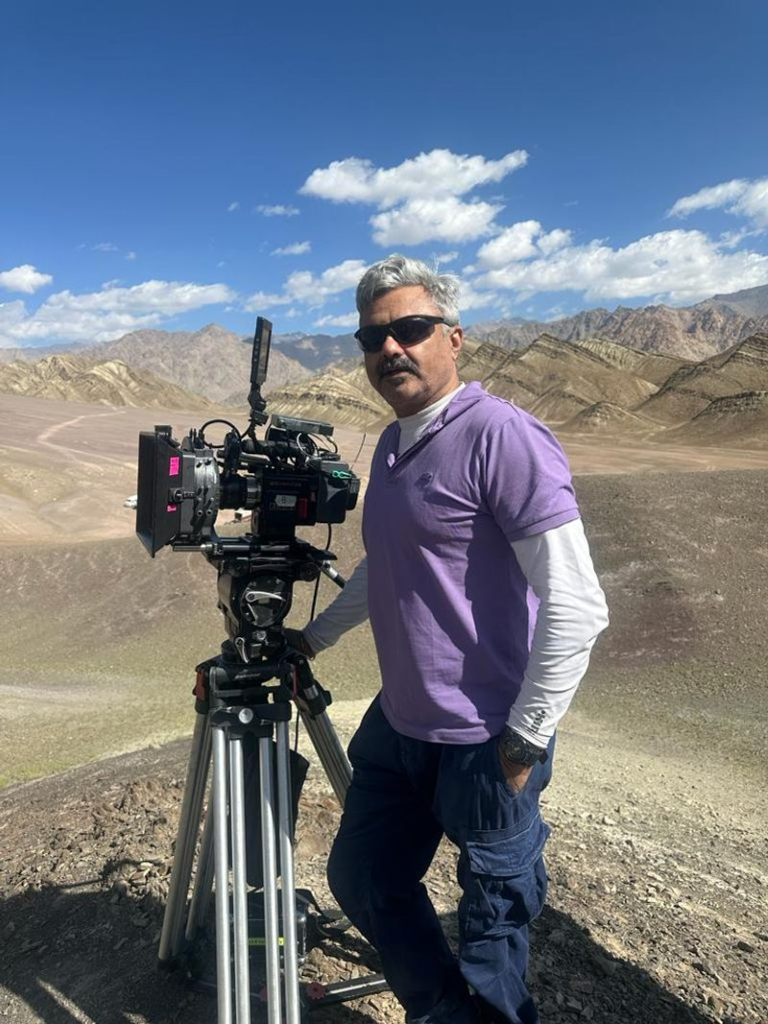
During the making of the film Dhurandhar, we ensured that everything about the Army was projected correctly and reflected in a proper manner,” Colonel Bhupinder Shahi (retd), who was engaged as a military consultant for the newly released Bollywood blockbuster movie said.

“In the world of military-based cinema, where every salute, every uniform detail, every battlefield tactic and every word spoken by a soldier must resonate with realism, the role of a military consultant, though often overlooked, becomes crucial,” Col Shahi told The Tribune.

“On the set, the military consultant becomes the moral compass and technical expert who trains actors in battlecraft, fieldcraft, communication protocols and body language, guiding the filmmaker through the nuances of military culture, chain of command, unit cohesion and the psychological makeup of a soldier,” he added. It also involves collaborating closely with costume designers and art directors for visual accuracy.

This was his ninth such project. Dhurandhar has been filmed extensively in Ladkah, where Col Shahi has served for eight years. “It is an authentic film and everything that has been depicted actually happened,” he remarked. Dhurandhar, meaning ‘Stalwart’ is a Hindi spy action thriller portraying a decade-long Indian intelligence operation where an undercover agent infiltrates Karachi’s criminal and political underworld.

Besides deployment in conflict areas like Kargil and Kashmir as well as counter insurgency environment, Col Shahi has also had stints with the National Security Guard and the Ladakh Scouts.

Commissioned into the Jammu and Kashmir Rifles in 1991, he took premature retirement in 2017 and after settling down in Mohali, has been involved as a consultant on matters involving the military in films. After retirement he initially worked with a travel firm and is presently an entrepreneur.

“My cinematic journey began with the film Shershah, which set a new benchmark for military accuracy in Indian cinema,” Col Shahi said. “In 2017, while serving in Leh, Maj Gen YK Joshi, who later became the Northern Army Commander, asked me to provide assistance to the makers of the movie which was based on the life of Capt Vikram Batra,” he said.

Captain Batra was posthumously decorated with the Param Vir Chakra in the 1999 Kargil conflict. “Vikram had served under me at the regimental center in Jabalpur and we had proceeded to the Kargil battle zone together,” he said. “We wrote the script for the film in Leh and then went to Vikram’s home town in Himachal Pradesh to collect more details about his life,” he added.

Kill, Veda, Freedom at Midnight, Waking of a Nation and Fauj are among other projects that Col Shahi has worked with. He started working on Dhurandhar in 2024 after being approached by an executive producer, Rahul Gandhi.

His task primarily for Dhurandhar was to help the movie producers get the required permissions from the Army and the Indian Air Force (IAF), and ensure that the script portrays the services in the correct, realistic and positive manner. He was responsible for liaising with the Army and Air Headquarters for the use of a MI-17 and Cheetah helicopter that were to be used in the shooting.


Himachal leads nation in substandard drugs, 49 samples fail quality test

CDSCO’s latest drug alert exposes serious manufacturing lapses

A nationwide quality audit conducted by the Central Drugs Standard Control Organisation (CDSCO) in coordination with state drug regulators has uncovered significant lapses in pharmaceutical manufacturing standards across the country. As many as 205 drug samples were declared ‘Not of Standard Quality’ (NSQ) in the drug alert issued on Wednesday evening, with Himachal Pradesh emerging as the single largest contributor.

Of the total substandard drugs identified, 49 were manufactured in various industrial clusters of Himachal Pradesh, accounting for a staggering 23.09 per cent of the national tally. Other states that figured prominently in the list include Uttarakhand (39 samples), Gujarat (27), Madhya Pradesh (19), Tamil Nadu (12) and Haryana (nine). Telangana and Chennai reported seven samples each, while Sikkim and Puducherry accounted for five each. Maharashtra reported four, Punjab and West Bengal three each and two samples each were traced to Mumbai, Andhra Pradesh, Jammu and Kashmir, Karnataka, Rajasthan and Uttar Pradesh. One drug sample from Kerala was also found to be substandard.

Within Himachal Pradesh, pharmaceutical units located in Baddi, Barotiwala, Nalagarh, Solan, Kala Amb, Paonta Sahib and Una have come under regulatory scrutiny for multiple deficiencies. In a particularly troubling finding, five drug samples from a single Kala Amb-based unit failed quality parameters, highlighting serious non-compliance with prescribed manufacturing norms.

The drugs flagged in the alert are widely used for treating common ailments such as bacterial infections including typhoid, lung, urinary tract and gastrointestinal infections, as well as respiratory disorders like cough, bronchitis, asthma and allergies. Medicines related to digestive health — acidity, ulcers, gas and constipation — also feature prominently in the list.

More concerning is the inclusion of drugs used to manage chronic and life-threatening conditions such as diabetes, hypertension, cardiac ailments, neurological disorders, skin diseases and inflammatory conditions. The affected categories span antibiotics, painkillers, anti-diabetic medicines, cough syrups, iron supplements and injectable drugs, amplifying the potential public health risk.

According to the CDSCO’s November 2025 drug alert, several samples failed the dissolution test, casting doubt on their absorption and therapeutic effectiveness. In some cases, the active pharmaceutical ingredient was found below prescribed limits, while others failed description and identification tests. Experts warn that such technical deficiencies can severely compromise drug efficacy and patient safety.

In response, authorities have ordered batch recalls and initiated risk-based inspections of the erring units. State Drugs Controller Dr Manish Kapoor confirmed that show-cause notices have been issued to all concerned manufacturers. “Any compromise on drug quality will not be tolerated. Protecting public health remains the government’s top priority,” he said, adding that field staff have been directed to conduct thorough investigations.

Advertisement


Patiala Police file forgery case after Punjab ex-IPS officer’s ‘Rs  8  crore scam’ suicide note

Following a surgery and other medical attention, the former cop continues to be under treatment with doctors monitoring him closely

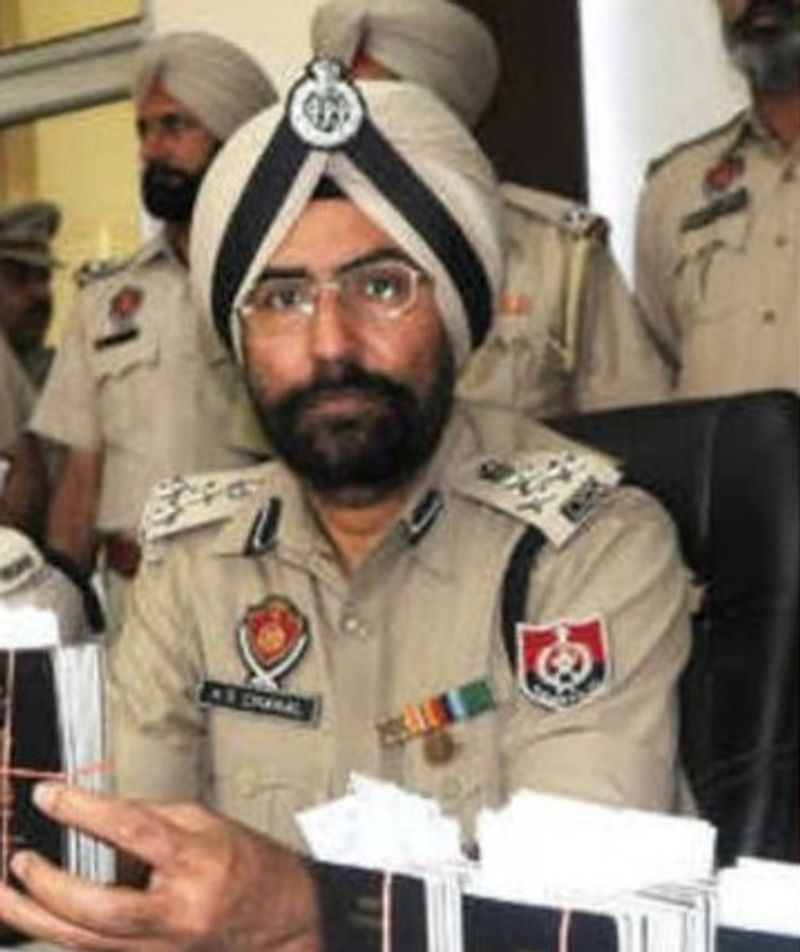
Patiala police have registered a case of forgery and other offences against the cyber frauds as was alleged by former Punjab-cadre IPS officer Amar Singh Chahal who allegedly shot himself on Monday after being “defrauded” of over Rs 8 crore by online scammers.

The IG continues to be in a critical state.

According to senior police officers, they have registered an FIR under sections pertaining to forgery and the IT Act on the basis of the suicide letter in which the former police officer had made serious allegations.

“We have registered an FIR and started a probe to ascertain the role of everyone involved,” said Patiala SSP Varun Sharma. “We will ensure that the cyber thugs are brought to justice and a probe has been initiated. We will ensure that all linked to the fraud are identified and arrested,” said Sharma.

Meanwhile, following a surgery and other medical attention, the former cop continues to be under treatment with doctors monitoring him closely.

According to senior officers who have been in touch with the doctors attending to the injured former IPS officer, his condition is critical and “the next 48 to 72 hours are crucial”. Chahal was rushed to a private hospital with a critical injury. 

In an alleged suicide note, he wrote, “I am in deep trouble. I have been scammed out of crores of rupees by very sophisticated investment and wealth managers. Most of the money I borrowed was from friends and relatives whom I am not able to face as I have no money to repay them. I am left with no option other than to take my life.”

Known to be a very helpful police officer, Chahal alleged that he had invested the money over the past decade, but instead of any returns, the company continued to ask for more money.

The former cop further mentioned that the main culprit used a picture of a CEO of a reputed company on his WhatsApp account and that “all transactions were made online through a bank”.

Before taking the step, the former Inspector General, who retired in 2019, wrote to the PM, Union Home Minister, Union Finance Minister and the Punjab DGP, highlighting the scam and how he was defrauded, and demanded a CBI probe.

In the note, Chahal mentioned: “I hope criminals will not go unpunished and my family will get justice. I also request all my friends from whom I borrowed money to let my family come out of the shock before they are in a position to repay the loans.”

“The site is named as F777 Wealth Equity Research Group and they have multiple numbers. I had borrowed over Rs 7 crore from friends and relatives and was ashamed to face them,” read the excerpts from the handwritten note that was sent to many people.

The former IG demanded that a CBI probe or an SIT be formed by the state police to arrest these online scammers who dupe gullible people of their hard-earned money.

Chahal is one of the accused in the 2015 Faridkot firing case.


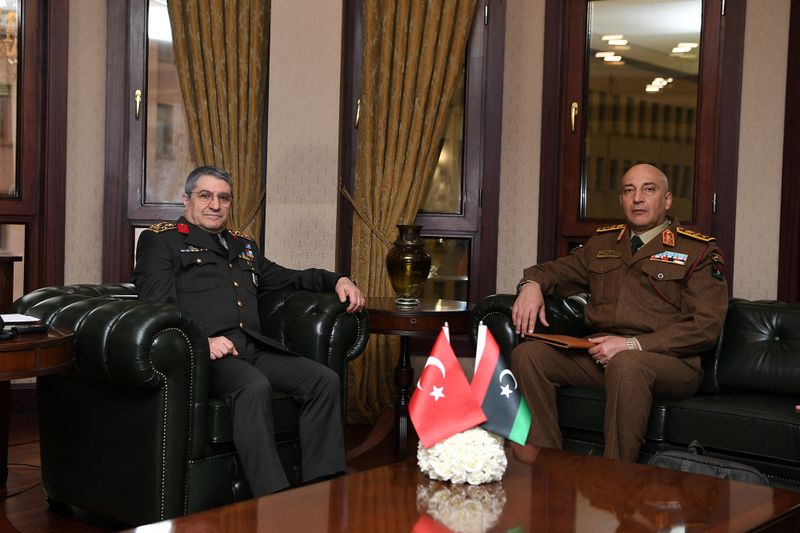
Libya’s military chief, 7 others killed in plane crash in Turkey

Libyan officials said the cause of the crash was a technical malfunction on the plane

Libyan officials said the cause of the crash was a technical malfunction on the plane.

The Libyan delegation was in Ankara for high-level defence talks aimed at boosting military cooperation between the two countries, Turkish officials said.

Libyan Prime Minister Abdul-Hamid Dbeibah confirmed the death of Gen Muhammad Ali Ahmad al-Haddad and the four officials, saying in a statement on Facebook that the “tragic accident” took place as the delegation was returning home. The prime minister called it a “great loss” for Libya.

Al-Hadad was the top military commander in western Libya and played a crucial role in the ongoing, UN-brokered efforts to unify Libya’s military, which has split, much like Libya’s institutions.

The four other officers who died in the crash were Gen Al-Fitouri Ghraibil, the head of Libya’s ground forces; Brig Gen Mahmoud Al-Qatawi, who led the military manufacturing authority; Mohammed Al-Asawi Diab, advisor to the chief of staff; and Mohammed Omar Ahmed Mahjoub, a military photographer with the chief of staff’s office.

The identities of the three crew members were not immediately known.

Turkish officials said the wreckage of the Falcon 50-type business jet had been found near the village of Kesikkavak, in Haymana, a district some 70 kilometres south of Ankara.

Earlier on Tuesday evening, Turkey’s air traffic controllers said they lost contact with the plane, which was en route back to Libya, after takeoff from Ankara’s Esenboga airport.

Turkish Interior Minister Ali Yerlikaya said in a social media post that the plane took off at 8.30 pm and that contact was lost 40 minutes later. The plane issued an emergency landing signal near Haymana before all communication ceased, Yerlikaya said.

Burhanettin Duran, the head of the Turkish presidential communications office, said the plane notified air traffic control of an electrical fault and requested an emergency landing. The aircraft was redirected back to Esenboga, where preparations for its landing began.

The plane, however, disappeared from the radar while descending for the emergency landing, Duran said.

Security camera footage aired on local television stations showed the night sky over Haymana suddenly lit up by what appeared to be an explosion.

While in Ankara, al-Haddad had met with Turkish Defence Minister Yasar Guler and other officials.

The airport in Ankara was temporarily closed, and several flights were diverted to other locations. Turkey’s Justice Ministry said four prosecutors have been assigned to investigate the crash, as is common in such incidents.

According to a government statement on Facebook, Libya will send a team to Ankara to work with Turkish authorities on investigating the crash.

Libya plunged into chaos after the country’s 2011 uprising toppled and killed longtime dictator Moammar Gadhafi. The country split, with rival administrations based in the east and west, backed by an array of rogue militias and foreign governments.

Turkey has been allied with Libya’s government in the west, but has recently taken steps to improve ties with the eastern-based government as well.

Tuesday’s visit by the Libyan delegation came a day after Turkey’s parliament approved to extend the mandate of Turkish troops serving in Libya for two years. Turkey deployed troops following a 2019 security and military cooperation agreement that was reached between Ankara and the Tripoli-based government.


HEAD LINES 23DEC 2025

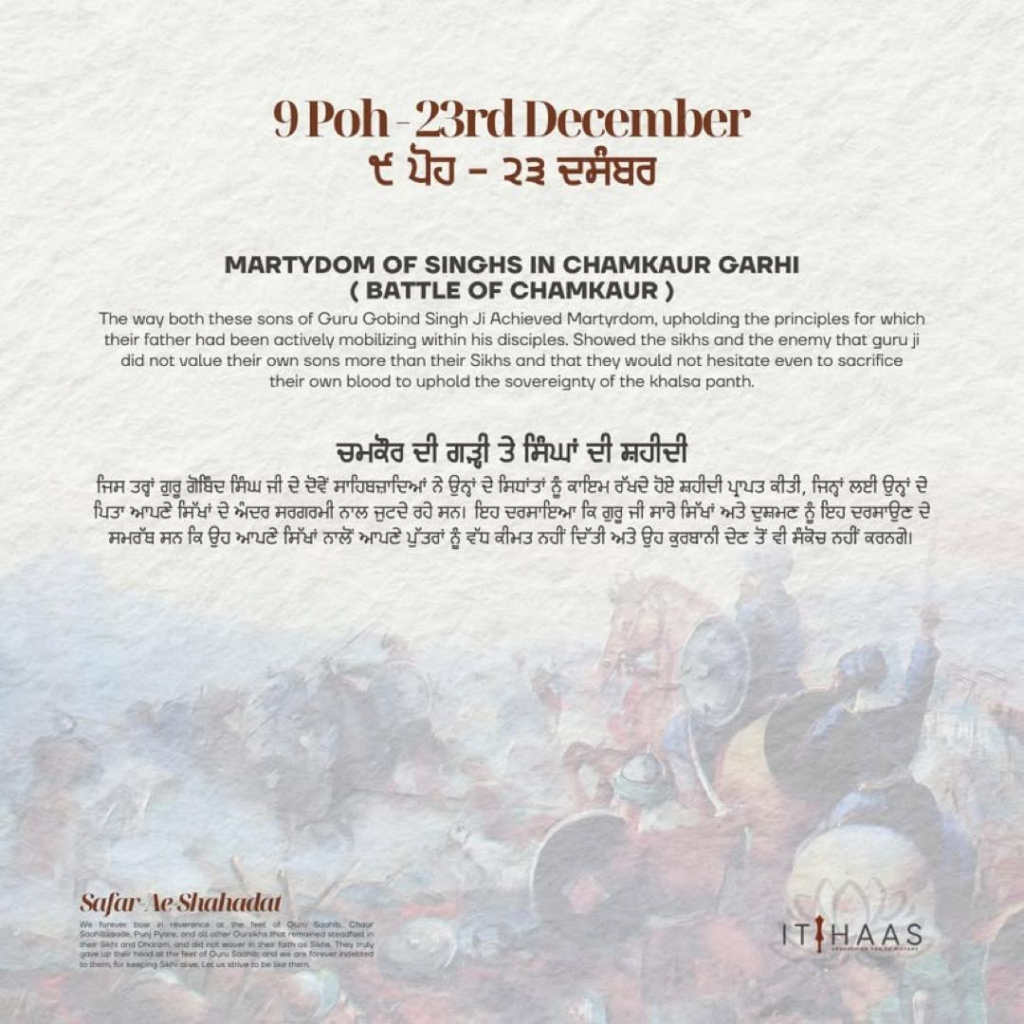
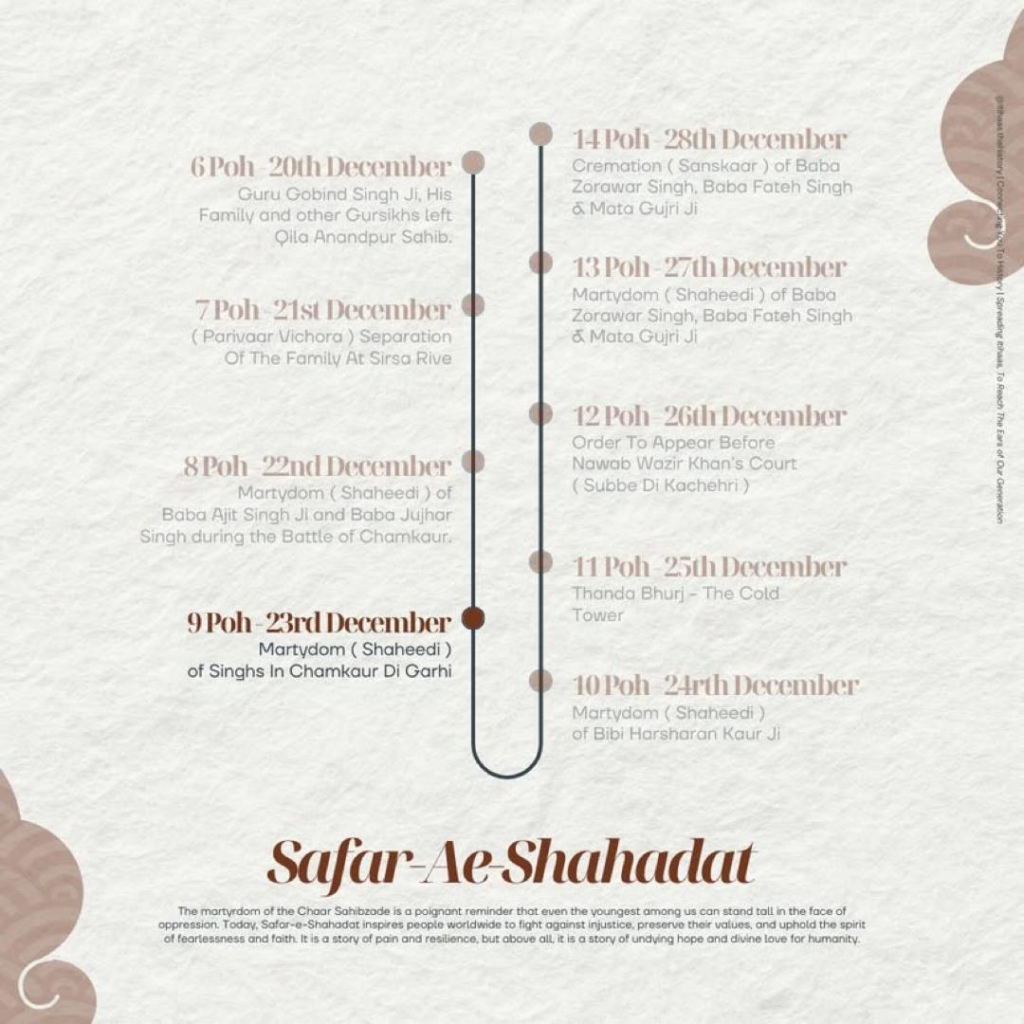
23 Dec Balance Sikhs Martyred at Chamkour sahib battle

Safar -Ae-Shahadat : Maj Gen Harvijay Singh

Martyrdom Day of Vadde Sahibzade: A legacy that defeated tyranny

Peer-e-Hind ravvad (“The “Peer” of Hind is leaving”). Ignoring the mortal remains of his sons (ਦੇਖਕੇ ਅਣਡਿੱਠ ਕੀਤਾ)

Fatehgarh Sahib district admn gears up for Shaheedi Jor Mela


Pakistan launches televised auction for PIA privatisation


Duped of Rs 8 crore, Punjab ex-IPS officer Amar Singh Chahal shoots self

Jammu & Kashmir: A Chinese telescope, a missing assault rifle and a child

Navy’s ‘stitched’ wooden vessel INSV Kaundinya to sail on December 29

some clips

HEADLINES FROM VARIOUS NEWSPAPERS


23 Dec Balance Sikhs Martyred at Chamkour sahib battle

December 23 marks the conclusion of the Battle of Chamkaur (fought around 21-23 December 1704), where Guru Gobind Singh and a small group of 40 Sikhs defended a mud fortress against a massive Mughal army. 

Key Martyrs and Details for Dec 23:

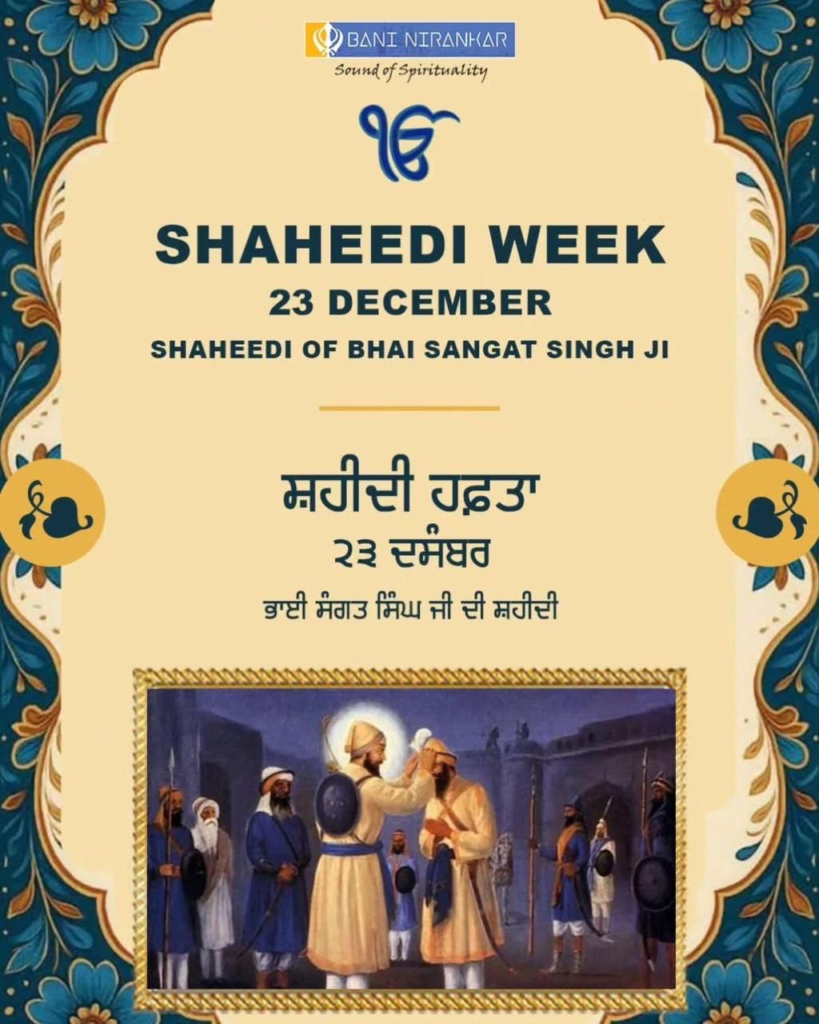
  • Final Stand: By the morning of December 23, the last remaining defenders, led by Bhai Sangat Singh (who disguised himself to look like the Guru to allow him to escape), were martyred.
  • Total Casualties: Approximately 35-40 Sikhs achieved martyrdom in the battle, including three of the Panj Piaras (Beloved Five).
  • Elder Sahibzaade: While the battle raged on the 22nd and 23rd, Guru Gobind Singh’s eldest sons, Baba Ajit Singh (18) and Baba Jujhar Singh (14), were martyred on December 22nd. 

Contextual Events on Dec 23:

  • Following the Guru’s safe exit from the fort on the night of Dec 22-23, the remaining defenders continued to fight until the last breath.
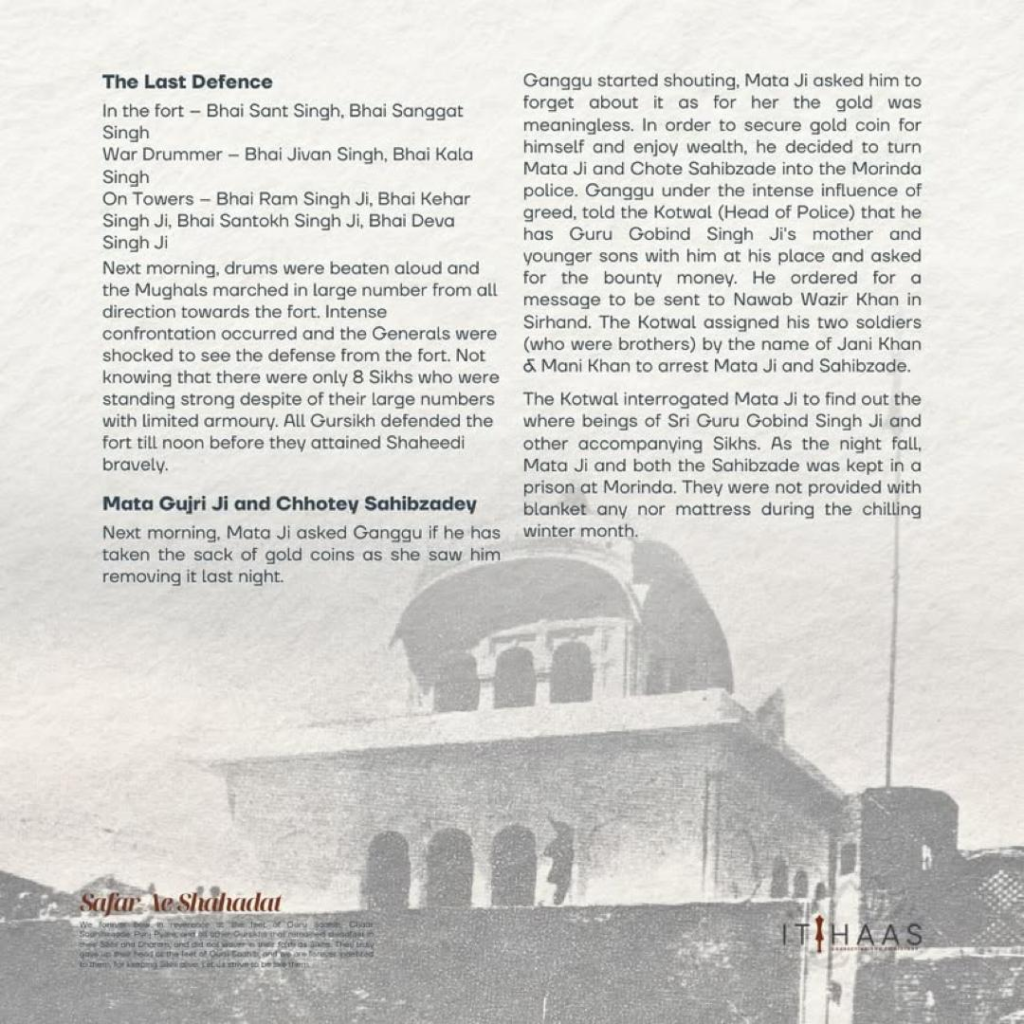
  • Younger Sahibzaade: Simultaneously, on December 23, the two younger sons, Baba Zorawar Singh and Baba Fateh Singh, were produced in the court of Sirhind after being captured but kept in Morinda small Jail for one night  
  • KOOTWALI SAHIB
  • Gurdwara at Morinda (Distt Ropar) 15 Km from Chamkour Sahib,as Kotwali sahib.After Gangu Teli (cook of Guru family) handed them over to Mugul Army for greed
  • Zafarnama
  • Zafarnama or “Epistle of Victory” is a letter that was written by Guru Gobind Singh to the then Mughal Emperor Aurangzeb. Zafarnama vividly describes what happened at Chamkaur, and also holds Aurangzeb responsible for what occurred and promises he broke.
  • After his escape from Chamkaur, the exhausted Guru is said to have been carried by two Pathans (Ghani Khan and Nabi Khan) to Jatpur where he was received by the local Muslim chieftain. He later went to Dina, and stayed at Mai Desanji’s house, where he wrote “Zafarnama” in Persian, in 111 verses.[17]

  • Dating
  • According to Hari Ram Gupta, the battle of Chamkaur was fought on the Bikrami date of Magh Shudi 7 Samvat 1761, which corresponds to 22 December 1704 in the Gregorian calendar. However, according to Pal Singh Purewal, this date conversion by Hari Ram Gupta was an error and the true date of Poh 8 corresponds to 7 December. According to Purewal, Gupta likely converted the date using a modern panchangs rather than a historical one corresponding to that era, historical shifts in calendar dates were not accounted for.[18][19]