



Sanjha Morcha

INDIA’S HIGHER DEFENCE REFORMS ON TRACK

by Nitin A Gokhale
The second stage of reforms in India’s higher defence management is likely to get off the ground over the next two three months with the military leadership in the process of finalising the contours of at least two joint theatre commands to be formed this year, as all indications suggest.
The Chiefs of Staff Committee (CoSC) under the Chairmanship of Chief of Defence Staff Gen Bipin Rawat is likely to discuss two studies authored by the Vice Chiefs of the Indian Navy and the Indian Air Force for the creation of the Maritime Theatre Command and an Integrated National Air Defence Command over the next few days.
From all indications available in the public domain, the Maritime Theatre Command (MTC), to be headed by a three-star (Vice Admiral) level naval officer will include the existing Eastern and Western Naval Commands, a scaled-down Andaman and Nicobar Command, the Southern Air Command and two brigades of the Army, capable of carrying out amphibious operations, besides two squadrons of the air forces’ maritime strike aircraft.
To be most likely headquartered in Karwar, which has one of the biggest naval bases in the country, the Maritime Theatre Command will have a vast area of responsibility stretching from the western Indian Ocean to the western Pacific (in keeping with India’s definition of the Indo-Pacific region). The Andaman Nicobar Command, India’s first tri-services command, in its 20th year currently, is likely to revert to being Fortress Andaman and Nicobar or FORTAN to be headed by a Lt General or equivalent officer in the other two services by turn. The head of FORTAN will report to the Flag Officer Commanding-in-Chief (FOC-in-C), Eastern Naval Command, according to the recommendation of the study on Maritime Theatre Command. While the Air Force element in the Maritime Theatre Command will be provided by the assets of the Southern Air Command based in Trivandrum, two squadrons of the IAF, comprising its maritime strike aircraft Jaguars and Su-30s, based in Jamnagar and Thanjavur respectively will also form part of the Maritime Theatre Command.
The Trivandrum-based 91 Brigade and the Port Blair based 108 Mountain Brigade will provide the Army element in the MTC. Both these brigades have been working in close tandem with the Indian Navy for years and are well-versed with the requirements of maritime operations, quite distinct from land-based manoeuvres.
While the structure of the MTC seems more or less settled, the details of the National Air Defence Command are yet to be firmed up. In fact, some conceptual issues require resolution before Air Defence National Command is structured. How will the mobile and short-range air defence resources of army formations be grouped for command? What will be the design for provisioning air defence for ships/ fleet at sea beyond territorial waters? These questions are apparently being debated. The headquarters of the new air defence command is likely to be located either at Allahabad or at Nagpur, reports say and it is certain to be headed by a three-star rank Air Force officer.
The Air Defence Command has also some practical difficulties to overcome since the air defence assets, systems and equipment that all the three forces hold currently is diverse and of a different vintage. In addition, the personnel of the three services handling air defence are trained differently. Combining all or most assets and getting everyone on one page will be a mammoth and time-consuming task, according to those dealing with the task of integrating the disparate elements.
There are some reports that an announcement of the creation of the two theatre commands may come as early as August after the Cabinet Committee on Security (CCS) approves it. The implementation may take some more time though. Once the first two theatre commands are rolled out, the top military leadership is likely to turn its attention to the creation of two or three more theatre commands to be headed by Army officers.
One school of thought is that there should be one theatre each for the western front (against Pakistan) and the entire northern front against China. However, given the twin challenges of a vast frontage of the northern borders and complexities of handling a proxy war waged by Pakistan in Jammu and Kashmir, another view is to have a Western Theatre Command (for Pakistan), Northern Command (to include Jammu and Kashmir, Ladakh and northern border west of Nepal), and an Eastern Command (starting from East of Nepal and extending to the Myanmar and Bangladesh borders). Discussions for finalisation of these commands are on currently but their approval may come in the third stage, according to all indications available so far.
The theatre commanders will become the operational commanders once the commands are rolled out and will be taking instructions from the CoSC, headed by the CDS and comprising the three Chiefs of Staff of the respective services. The Chiefs will thus continue to have a say in operational matters through the CoSC. However, they will mainly be responsible to raise, train and sustain the three services. All these steps are likely to get implemented progressively.
While the timelines may vary, what is certain is that jointness and integration of the three armed forces is now an irreversible process since the decision was approved by the CCS, India’s highest decision-making body on security matters way back in mid-2019. The ball was set rolling on 30 December 2019 with the appointment of Gen Bipin Rawat as the first Chief of Defence Staff (CDS).
The announcement of the creation of India’s first CDS was made by Prime Minister Narendra Modi from the Red Fort during his customary Independence Day speech on 15 August. While making the announcement, the Prime Minister said: “India should not have a fragmented approach. Our entire military power will have to work in unison and move forward. All the three (Services) should move simultaneously at the same pace. There should be good coordination and it should be relevant to the hope and aspirations of our people. It should be in line with the changing war and security environment of the world. After formation of this post (CDS), all the three forces will get effective leadership at the top level.”
As a follow-up, four months later, on 24 December 2019, the Government notified the appointment of the CDS. It also went a step further by creating a Department of Military Affairs (DMA) and made the CDS the Secretary of the Department within the Ministry of Defence (DMA). The CDS, now the Principal Military Adviser to the Government, is also the Permanent Chairman CoSC. Among many other tasks mandated to him, according to an official press note issued that day, the CDS is to function as the Military Adviser to the Nuclear Command Authority, bring about jointness in operation, logistics, transport, training, support services, communications, repairs and maintenance, etc., of the three Services, within three years, ensure optimal utilisation of infrastructure and rationalise it through jointness among the services, and finally bring about reforms in the functioning of three Services aimed at augmenting combat capabilities of the Armed Forces by reducing wasteful expenditure.
The DMA meanwhile, is now manned by a mix of civilian and military officials with a three star Army officer designated as Additional Secretary (No. 2 to the CDS, who is also Secretary, DMA) and three Major General rank officers drawn from each service serving as Joint Secretaries. Two civilian officers are also part of the DMA as Joint Secretaries. This arrangement is certainly a major departure from the past and is indicative of the change that is currently underway in the MoD.
Difficulties in implementation of major plans notwithstanding, India’s defence reforms are well and truly on track.
Nikhil A Ghokale is one of India’s foremost & respected defence analysts, unlike others who have partisan views, he is the author and founder of BharatShakti.in, a specialised defence website
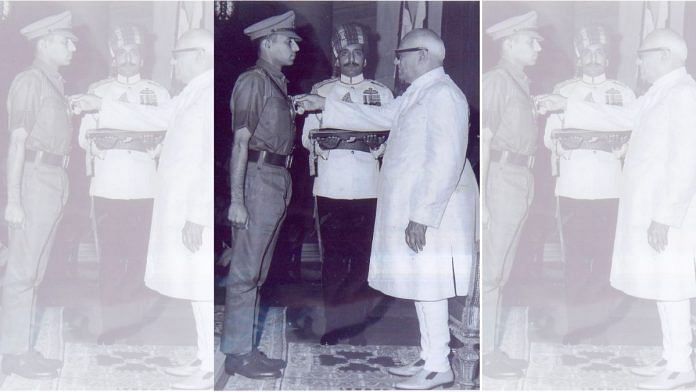

Vir Chakra awardee Panjab Singh passes away, but ‘Hero of Poonch’ leaves behind 1971 war legacy

Col Panjab Singh, who was a Major during 1971 war, received the Vir Chakra for his bravery during Operation Cactus Lilly, when his command repelled 9 Pakistani attacks over 2 nights.

Panjab Singh, a Major at the time, receiving the Vir Chakra for his bravery during the 1971 war | Photo by special arrangement

Panjab Singh, a Major at the time, receiving the Vir Chakra for his bravery during the 1971 war | Photo by special arrangementText Size: A- A+

New Delhi: Colonel Panjab Singh, a hero of the Battle of Poonch during the 1971 Bangladesh Liberation War, was cremated with full military honours under pandemic protocols after he passed away Sunday at Command Hospital Chandimandir Monday.

The retired officer, who was awarded the Vir Chakra, the third highest war-time gallantry award, died of post-Covid complications. He had recovered from the infection earlier.

Only last week, on 21 May, his elder son Anil Kumar had succumbed to Covid.

Born on 15 February 1942, the colonel was commissioned into 6th Battalion, The Sikh Regiment on16 December 1967.


Also read: 5 heroes of 1971 Bangladesh Liberation War who led India to decisive win over Pakistan


Col Singh’s legacy

Col Singh had taken part in the 1971 War which earned him the title ‘Hero of Poonch’.

During Operation Cactus Lilly of the 1971 War, the 6 Sikh Battalion occupied 13 km of frontage on the heights above Poonch, covering two strategic points, the loss of which would have directly threatened Poonch.

Singh, then a Major, was commanding a company deployed at Tund, which had been limited to a platoon. A platoon has 25 fighting soldiers while a company has around 100 of them. Several companies make up a battalion, which has around 500 fighting soldiers.

On 3 December 1971, Pakistani forces attacked the position with more than a battalion,  supported by artillery and mortar fire.

The next 72 hours was a classical defensive battle fought by the fierce soldiers of 6 Sikh under the command of Singh, an Army officer said.

The Battle account by Col Singh, which is part of the Officers Training Academy (OTA) journal, said the enemy had shouted charge many times during the night, but did not carry out an assault.

“Obviously his aim was to make us expend our ammunition and assault us at first light. I therefore ordered strict fire control. No one was to fire without my permission or my JCO (junior commissioned officer)’s permission,” Singh had written.

According to the citation on the Vir Chakra awarded to Singh, the enemy came as close as a few meters to India’s defenses.

“Col Panjab with complete disregard for his safety, moved from trench to trench and ensured that all weapons under his command engaged the assaulting force till the attacking force retreated, leaving behind their dead and weapons,” it reads.


Pakistani forces attacked the position nine times over two nights, all of which were similarly foiled. It was in recognition of this bravery that Singh was awarded the prestigious Vir Chakra on 24 December 1971.

After retirement, Col Singh was the director of the Sainik Welfare, Himachal Pradesh, and was also the vice president, Indian Ex Service League, Himachal Pradesh of Southern Area.

(Edited by Manasa Mohan)


Also read: Of course we won 1971, so 46 years later we can look at military facts more fairly


Winning people over, the Army way

People in the North-East are simple, warm-hearted and totally without avarice. The only way to end distrust is to be one with them, heart and soul

Winning people over, the Army way

Photo for representation only. – File photo

Lt Gen Raj Kadyan (Retd)

I was in school when the problem in Nagaland erupted. A family acquaintance posted there had been killed in an ambush. The news came, along with stories of Naga head-hunting and other alleged inhuman brutalities. I grew up harbouring a perception of savagery.

My first posting to Nagaland came in 1970. I landed there with considerable trepidation. I took over a post located on a forested hill a kilometre from the village. Many from the village were serving in the outlawed underground army. During the change-over, my predecessor took me to attend the Sunday church service. A section of men accompanied as escort. They took positions all around while we listened to the midday sermons inside. Attending church service was one of the prescribed methods of fraternisation.

After attending the church service a few times, I realised the incongruity. If locals had to be won over, it could not be done looking at them through the rifle foresights. I reduced the escort to just two men, and gradually did away with it altogether. After the service, I would walk into the non-Christian part of the village, incongruously called the ‘Hindu khel’. I would join them in drinking madhu, the rice beer that is made in every household. Having been a commando instructor, I had no difficulty in enjoying the snails that formed their staple snack; you picked one up from a pass-around bowl, sucked out the snail and threw away the shell.

Gradually, a routine was set. After games with the troops every evening, I would go to the village and visit different houses, drinking madhu with them. I played rural games and joined the village folk during their weddings as well as burials.

I returned to Nagaland in 1978 as a Commanding Officer. The battalion was deployed in a remote area of Tuensang district. We held a string of posts, guarding infiltration routes of insurgents from Burma. My headquarters were in Kiphire alongside the office of the Additional DC. His bungalow was just across the fence from our tented complex. Every evening, I would join his family for a game of badminton. He had three grown-up sons and two daughters. In time I became a part of the family. As a high point of her hospitality, the lady even learnt how to make chapatis and desserts that are alien to Naga diet. “I must take you to Changki,” the ADC, Lima Aiyer Ao, would often tell me, adding with a naughty wink while his wife smiled benignly, “The prettiest Naga girls come from that village.”

Lima was a great administrator who handled his charge with a firm hand, rules or no rules. He had a practical approach. I met many others during frequent dinners in his house and the contacts helped me greatly in performing my task.

My third stint in Nagaland was from 1995 to 1997 as a Major General. Having been there twice earlier gave me a running start. My friends, Mrs and Mr Lima, had since passed away but their sons and daughters, now parents themselves, often visited and stayed with us. We also hosted many other friends and my earlier acquaintances. At the end of my two-year tenure, we succeeded in bringing the insurgents to the negotiating table. The ceasefire, effected on August 1, 1997, is still holding. I have also visited the state privately after retirement.

Initially, our methods of dealing with insurgency were based on the US experience in Vietnam. The major difference was that unlike the Americans, we were dealing with our own countrymen. Our people in the North-East are simple, straightforward, warm-hearted, and totally without avarice. They are ever cheerful and live for the day.

One cannot win people over by applying abstract theories. The only way is to be one with them, heart and soul. And the Army has done just that. This non-gun contribution of the Army, with far-reaching consequences, unfortunately remains underrated.


Stalemate ends, Hisar to drop criminal cases against farmers

Stalemate ends, Hisar to drop criminal cases against farmers

BKU leader Rakesh Tikait leads a protest in Hisar on Monday. PTI

Deepender Deswal

Tribune News Service

Hisar, May 24

In a major boost to farmers, the district administration today agreed to withdraw all criminal cases registered against them in the district during the past month. The decision, taken at a meeting between farmers’ leaders and district and police officials in the mini secretariat here, ended the weeklong stalemate between the two sides.

After attending the meeting, Bharatiya Kisan Union leader Rakesh Tikait told mediapersons that the administration had accepted farmers’ demands and the FIR against 350 farmers on May 16 which included the attempt to murder charge would be withdrawn.

“The FIR registered on May 16 and three or four other cases registered against farmers in Hisar will be withdrawn as per the legal process which will start within a week. The administration will award compensation to the farmers whose vehicles were damaged during the May 16 clash,” said BKU leader Joginder Singh Ugraha.

He said the farmers would continue to boycott the BJP and JJP leaders across Haryana as per the call of the Samyukta Kisan Morcha. However, they had accepted the administration’s appeal not to damage public property.

The SDM, Hisar, Jagdeep Singh, who was also present at the meeting, said it was decided that the cases would be withdrawn tentatively within one month. A family member of the farmer Ramchander of Ugalan village who died of heart failure during the protest demonstration today would be given a contractual job in Hisar.

It took nearly two hours for the two sides to reach the agreement. In the meantime, about 10,000 farmers held a dharna at Krantiman Park, about 2 km from the mini secretariat. A heavy police force was deployed near the mini secretariat and residences of top bureaucratic, police and judicial officials in the district.


Agreement reached after 2-hour meeting

  • FIR against 350 farmers lodged on May 16 to be withdrawn as per legal process
  • Admn to award compensation to farmers whose vehicles were damaged
  • Farmers accept admn appeal not to damage public property

In Hisar, tense moments before truce

10,000 farmers gather | Talks held in heavily fortified mini-secretariat

Deepender Deswal

Tribune News Service

Hisar, May 24

The day started with a massive build-up of farmers and the police in the town as the apprehension of a clash loomed large. The mini-secretariat and residences of the senior bureaucratic, police and judicial offices were heavily guarded. Vajra Vahan, riot control vehicles and mounted police vehicles took position early in the morning.

‘Pro-stir Villages reporting deaths’

  • Vinod Mehta, media adviser to the CM, on Monday claimed villages that have been sending people to Kundli and Tikri borders for the farmers’ movement have witnessed a substantial number of deaths
  • He told the media 275 deaths took place between April 11 and May 10 in 25 villages of Sonepat, Karnal, Kaithal, Jind and Ambala districts which sent people to protest at the Kundli border

About 10,000 farmers riding tractors gathered at Krantiman park from Hisar and adjoining districts. Leaders said the purpose was to get criminal cases against farmers withdrawn today itself.

On May 16, the police had lathicharged protesting farmers who had gathered to oppose Chief Minister Manohar Lal Khattar’s visit to the city to inaugurate a Covid hospital. Subsequently, 300 farmers were booked for attempt to murder, among other charges.

Around noon today, the district administration sent the invitation for talks to farmers.

Subsequently, farmers’ leaders Rakesh Tikait, Joginder Singh Ugrahan, Gurnam Singh Charuni, Suman Hooda, Sikkim Devi, Anu Sura and Reeman Nain reached the mini-secretariat, where Deputy Commissioner Priyanka Soni and other officials were waiting at the entrance.

The meeting concluded around 5 pm. The farmers’ leaders emerged out of the mini-secretariat with smiles on their faces.

Ugrahan claimed to the media that the district administration had agreed to withdraw criminal cases against farmers, dispelling all apprehensions of a clash as the day passed off peacefully.

Sources say that during the meeting a police official took a tough stand and blamed farmers for the violence during the CM’s visit to Hisar on May 16.

The farmer leaders countered him by saying that the police had not removed the barricades and that they had failed to convey to protesters that the CM had left the venue.https://22de56154e32b51485c246649689b659.safeframe.googlesyndication.com/safeframe/1-0-38/html/container.html

During the meeting, the DC expressed regret over lathicharge on women activists, said a farmer leader.

The All-India Kisan Sangharsh Coordination Committee (AIKSCC), Haryana, termed the acceptance of demands as a “victory” for farmers’ mobilisation today.

Inderjeet Singh said the massive gathering resolved to intensify the farmers’ agitation at the Delhi borders and toll plazas.


Maj Gen Ranjan is Additional DG, NCC Directorate

Maj Gen Ranjan  is Additional DG, NCC Directorate

Photo for representation only. File photo

Srinagar, May 24

Major General Ranjan Mahajan on Monday took over as the ADG of the National Cadet Corps (NCC) Directorate for J&K and Ladakh, a defence spokesman said.

He is an alumnae of the IMA, Dehradun, and was commissioned in the Rajputana Rifles Regiment in December 1987. In his 34 years of service, the officer has tenanted prestigious command and staff assignments, including tenures in active operational areas, the spokesman added. — PTI


Court of inquiry into Mi-17 chopper case upheld

Court of inquiry into Mi-17 chopper case upheld

Photo for representation only

Chandigarh, May 24

The Armed Forces Tribunal (AFT) has upheld the court of inquiry instituted by the Air Force into an incident in which an Mi-17 helicopter was shot down near Srinagar airfield in February 2019.

Disposing of a petition of two IAF officers, the tribunal’s Bench, comprising Justice Rajendra Menon and Lt Gen PM Hariz, today held that the court of inquiry had been correctly convened by the competent authority as per the provisions of the relevant Air Force orders.

Group Captain SR Chowdhury, who was then posted as the Chief Operations Officer, and Wing Commander Shyam Naithani, then the Senior Air Traffic Controller at Srinagar Air Force Station, had contended that the terms of reference of the court of inquiry were contrary to relevant Air Force orders. The chopper was accidently shot down by an IAF missile in February 2019, killing six personnel, during Pakistan hostility following the Balakote episode. — TNS


23-year-old soldier hangs himself at Sriganganagar camp

23-year-old soldier hangs himself at Sriganganagar camp

Our Correspondent
Abohar/Sriganganagar, May 25

A 23-year-old soldier hanged himself in a camp at Army’s Birdhwal station in Sriganganagar on Monday, sources said.

Prabhdayal Singh from Punjab’s Mansa was found hanging from a gate in the camp. He joined the army five years ago.

Ram Kumar Legha, the Station House Officer of Suratgarh city police station, said authorities had handed over the body back to the army after autopsy.

An audio of the victim talking about his reasons for the suicide has also gone viral.

Police said they were yet to determine what drove him to kill himself.


LOSS OF INDIA TO THE FLYING COFFINS

Wars are unfortunate as it costs life for both the ‘victory’ and the ‘loss’. But do you know what is more unfortunate? The brave lives that aren’t scared of martyrdom in these wars losing their lives in accidents. It is the loss of lives of the IAF officers like Abhinav Chaudhary, whom we lost in a yet again MiG-21 crash at the open fields of Langeana village in the Moga district of Punjab on 20th May 2021.
The MiG-21 aircraft has been under controversy for decades now as it claimed the lives of many pilots. It has become infamous as the ‘flying coffin’ due to the same. In the year 2012, the then-Defence Minister Mr. AK Antony said that 482 out of the 872 MiG-21 have met accidents leading to the loss of lives of about 172 pilots, 39 civilians, and 8 service personnel since the 1970s. The number has gone up till this date. Though the Air Force constantly tries to upgrade the aircraft, thereby, upgrading MiG-21 to MiG-21 Bison, much result hasn’t been achieved. This is due to the obsolete frame and construct of the aircraft. This also makes finding the spare parts for the aircraft difficult. Nevertheless, whether it is the lack of budget or skewed priorities or loopholes in the governance that has made the Indian administration deprive the IAF of the latest upgrade aircraft compelling them to stick to the MiG is a matter that needs critical discussion.
These aircrafts were inducted into the Indian Air Force in the year 1963 under a transaction with the then Soviet Union. The aircraft played a decisive role in the 1965 war. It also became a game-changer in the Bangladesh Liberation War in 1972. However, around the 1980s the Soviet Union stopped the production of the MiG aircraft. Also, many countries around the world started phasing out and replacing the aircraft with other advanced technologies thus making India the only country with such a professional Indian Air Force that retained it. Since then, every few years and even months, the aircraft goes under a system failure resulting in unfortunate accidents.
Even though, these accidents due to MiG-21 being so frequent, it was in the year 2019, post-Balakot that the crash of the aircraft again came under the light. The Indian government recently has picked up with the pace of replacing the aircraft with others like the Sukhoi, Tejas, etc. Nevertheless, it is still not enough as this would leave us with less than the required 42 squadrons of aircraft which is the minimum requirement for India to prevent any hostile actions from the neighbourhood.
It is the defence system of any country that plays the most important role to enable a peaceful atmosphere within the territories. India losing its assets, that is, the men in uniform in these accidents is an abominable tragedy resulting from the negligence of governance for decades. Worse is the fact that these concerns, which must matter the most, get silenced amidst trivial political skirmishes that are leading the nation nowhere. However, giving the credit where it is due, the government must be appreciated for giving more financial powers to the three defence services to enhance their functioning. Also, the appointment of the Chief of Defence Staff would ensure systematic employment of resources where needed. These steps can reflect improvement in the future.
Coming to the present, innovative solutions and indigenous alternatives can be sought to reduce such tragedies. Times are tough as a lot is going around due to the pandemic. Nevertheless, valuing the lives of those who risk it for our peace and stability must not be compromised. It is time, the IAF and the government must look into this MiG issue and resolve it as soon as possible. The most appropriate condolence to the IAF officer Abhinav would be an assurance that no young and brave heart would lose his life again due to the inaction of the system in the future.


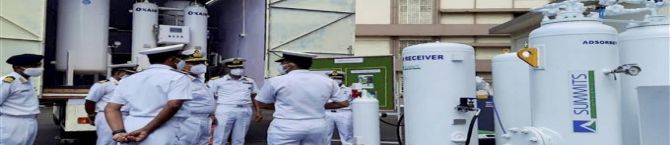
COVID-19: INDIAN NAVY BRINGS 340 METRIC TONS OF LIQUID OXYGEN, OTHER SUPPLIES FROM ABROAD

The supplies were brought by two warships from Singapore, Brunei and Qatar
The Indian Navy on Sunday brought to India 340 metric tonnes of liquid oxygen, more than 3,700 oxygen cylinders and other medical supplies from abroad as the country continued to reel under a severe second wave of the coronavirus pandemic. The supplies were brought by two warships from Singapore, Brunei and Qatar.
Indian Navy spokesperson Commander Vivek Madhwal said naval ship INS Jalashwa arrived at Visakhapatnam bringing 300 metric tonnes of liquid medical oxygen (LMO) and over 3,600 oxygen cylinders from Singapore and Brunei.
It was the largest consignment of LMO brought to India from abroad.
The ship also transported some other medical equipment including ventilators and empty cryogenic oxygen containers.
Another ship, INS Trikand, arrived in Mumbai carrying 40 metric tonnes of liquid oxygen and 100 oxygen cylinders from Qatar, Commander Madhwal said.
The two warships are part of nine ships deployed by the Indian Navy under operation ‘Samudra Setu II’ for shipment of liquid medical oxygen and associated equipment from friendly foreign countries in the Persian Gulf and South-East Asia.
The Indian Navy stepped up its efforts as ships from all three naval commands in Mumbai, Visakhapatnam and Kochi were deployed to bring oxygen and other medical equipment under operation ‘Samudra Setu II’ following a shortage of oxygen supply in the country triggered by rising COVID-19 cases.
Last year, the Indian Navy had launched Operation Samudra Setu as part of the Vande Bharat evacuation mission under which it brought back to India around 4,000 stranded Indians from Maldives, Sri Lanka and Iran.
The Indian Air Force also brought to India a large number of cryogenic oxygen containers and other medical equipment from several countries in the last few weeks.
On Saturday, the IAF brought oxygen containers from three countries.
An IL-76 airlifted three cryogenic containers from Bangkok to Hyderabad while four such containers were brought to Hindan from Frankfurt and four from Ostend in Belgium to Panagarh in West Bengal.
As India battles a devastating second wave of the coronavirus pandemic, around 40 countries have sent medical supplies including oxygen-related equipment to help it tide over the situation.
The leading countries that have supplied assistance to India included the US, Russia, France, Germany, Australia, Ireland, Belgium, Romania, Luxembourg, Singapore, Portugal, Sweden, New Zealand, Kuwait and Mauritius.