



Sanjha Morcha

Explained: What does the increase in Chinese transgressions mean?

Explained: What does the increase in Chinese transgressions mean?

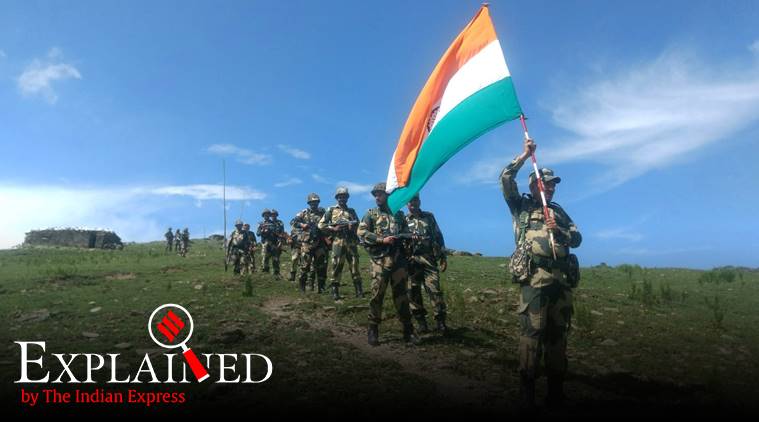
Soldiers near the Line of Actual Control (LAC) at Chushul, 59 kilometres from Pangong lake in Leh. (Express Photo: Shuaib Masoodi, File)

As tensions remain high between Indian and Chinese soldiers, the number of recorded Chinese transgressions across the disputed India-China border surged by 75 per cent in Ladakh in 2019, and the Chinese forays into Indian territory in the first four months of the current year have also witnessed an increase compared to the same period last year.

What exactly is a Chinese transgression?

A Chinese transgression across the border is recorded once the Indian border guarding forces in an area – either the Army or the ITBP – are “reasonably certain” that the Chinese soldiers had crossed over to the Indian side of the LAC. A Chinese transgression – in air, land or the waters of Pangong Tso lake – can be recorded, officials said, if it is visually observed by border posts, through use of surveillance equipment, in face-offs by patrols, indicated reliably by locals, or based on evidence left by the Chinese in the form of wrappers, biscuit packets etc to show their presence in an unmanned area.

What does the ‘Indian side’ of the LAC mean?

The border is not fully demarcated and the LAC is neither clarified nor confirmed by the two countries. Except for the middle sector, even the mutual exchange of maps about their respective perceptions has not taken place between India and China. This has led to different perceptions of the LAC for the two sides, and soldiers from either side try to patrol the area up to their perception of the LAC. Essentially, what Indians believe to be ‘their side’ is not the same as what the Chinese believe to be ‘their side’ – this is different from the Line of Control (LoC) between India and Pakistan where everything was agreed upon by the two armies following the 1971 War.

What are the various sectors on the India-China border?

India-China border is divided into three sectors, where the LAC in the western sector falls in the union territory of Ladakh and is 1597 km long, the middle sector of 545 km length falls in Uttarakhand and Himachal Pradesh, and 1346 km long eastern sector falls in the states of Sikkim and Arunachal Pradesh. The middle sector is the least disputed sector, while the western sector witnesses the highest transgressions between the two sides.

Also read | India builds road north of Ladakh lake, China warns of ‘necessary counter-measures’

Do the higher number of Chinese transgressions matter?

A higher number indicates that the Chinese soldiers are coming to the Indian side more often, and their movements are being observed and recorded by the Indian soldiers. This can be seen as an indicator of increased Chinese assertiveness, but as long as there are no major incidents, it means that the established border mechanisms between the two sides are working. So far, there has been no major standoff between the two sides after the 73-day Doklam standoff on Sikkim-Bhutan border in 2017.

But PM Modi and President Xi met in Wuhan, following the Doklam crisis, and passed some instructions. What were they?

Yes, Modi and Xi had met for their first informal summit at Wuhan in April 2018, where the two leaders had “issued strategic guidance to their respective militaries to strengthen communication in order to build trust and mutual understanding and enhance predictability and effectiveness in the management of border affairs”. They had also “directed their militaries to earnestly implement various confidence building measures agreed upon between the two sides, including the principle of mutual and equal security, and strengthen existing institutional arrangements and information sharing mechanisms to prevent incidents in border regions”.

Also read | China engaged in provocative, coercive military activities with neighbours, including India: White House report

Has the Wuhan spirit vanished?

That is hard to say but tensions between India and China have shot up suddenly in 2020, even as both countries grapple with containing the spread of COVID-19. A terse statement by the Chinese foreign ministry on Tuesday was responded to by the Indian foreign ministry in equally strong terms on Thursday. Besides tensions at Naku La in Sikkim and at Galwan river and Pangong Tso in Ladakh, Indians have been worried about the Nepal government’s recent behaviour on the border map issue. Army Chief General MM Naravane didn’t leave much to imagination when he said that Nepal was doing it at “the behest of a third party,” ostensibly referring to China.

📣 Express Explained is now on Telegram. Click here to join our channel (@ieexplained) and stay updated with the latest

Should one be worried?

India and China are both nuclear-armed countries with strong militaries. Although not a shot between them has been fired since 1976 or a military skirmish happened after 1967, the fact that Indian and Chinese soldiers are in an eyeball to eyeball situation at two places in Ladakh, with strong statements coming from both sides, can’t be construed as a very happy situation. Because matters on the border have always been resolved peacefully by the two countries in the past four decades, there is hope that the tensions will soon subside.


A chance to resolve India-China border dispute

India has done well in not only combating the coronavirus internally but also assisting nations in the region and beyond, including the US, in a much-needed outreach, enhancing its goodwill and linkages. The world order after Covid-19 is an opportunity for India to position itself as a global leader, asserting its just and rightful place. India will be the ‘balancing power’ and, hence, should leverage its position with China and the US.

A chance to resolve India-China border dispute

Lt Gen Vinod Bhatia (retd)

Director, Centre for Joint Warfare Studies

Having commanded the Sukna Corps, the recent face-off at Nakula in north Sikkim, reportedly leading to a scuffle and injuries to soldiers on both sides, came as a surprise. This was the first of its kind at Nakula, and was closely followed by a similar face-off and scuffle in eastern Ladakh, again reportedly resulting in the scrambling of Indian Air Force Sukhois, to deter Chinese helicopter activity. India shares a 3,488-km contested border with China.

On account of an improved connectivity, infrastructure development and access to the Line of Actual Control (LAC), the depth, frequency and intensity of such face-offs will increase, threatening a fragile peace which exists, with the last shot fired in anger in October 1975. Such incidents and standoffs like the one at Doklam in 2017 or Depsang and Chumar are the ever-present potential drivers of conflict between the two nuclear-armed neighbours — home to one-third of humanity.

The LAC is based on perceptions and, hence, bereft of a common understanding, leading to frequent transgressions and face-offs, with the potential to spiral into a skirmish and an avoidable conflict. China’s assertiveness on the LAC and India’s strong stance of ‘no blinking’ are likely to be the new normal.

The emerging world order after Covid-19 is an opportunity for India and China to resolve the ‘boundary question’, and seek a fair, reasonable and mutually acceptable solution. Winston Churchill once said, “A pessimist sees difficulty in every opportunity, an optimist sees opportunity in every difficulty.” Covid-19 is an opportunity for India to assert its rightful place in the emerging world order and, equally important, to resolve the vexed ‘boundary question’ with China. The last few months have changed the thought and behaviour patterns of society, people, nations and the world. Covid-19 has directly impacted the emerging world order, which is likely to witness a shift of power from the West to the East. The global architecture will witness major shifts as the West battles the pandemic not so successfully and China losing its leverages as it is believed to have caused the pandemic.

India, on the other hand, has done well in not only combating the coronavirus internally but also assisting nations in the region and beyond, including the US, in a much-needed outreach, enhancing its goodwill and linkages. The post-Covid-19 world order is an opportunity for India to position itself as a global leader, asserting its just and rightful place. India will be the ‘balancing power’ and, hence, should leverage its position with both China and the US.

The India-China relationship is one of the most fascinating relationships between two major powers, despite a contested boundary. The way they have managed the relationship ever since the war of 1962 is a remarkable achievement, despite the many sensitive border standoffs. This speaks of the salience of the confidence-building measures (CBMs). The prevailing equilibrium along the LAC is enshrined in the five principles of Panchsheel and the five treaties between India and China which detail the CBMs and military engagements ensure fragile peace and tranquility. However, the prevailing fragile peace is under stress and both countries will do well to delimit, delineate and demarcate the boundary.

The conceptual framework for the resolution of the boundary is defined in the 11 Articles of the April 2005 agreement on political parameters and guiding principles. India and China, with two strong leaders in Prime Minister Modi and President Xi Jinping, have the political capital and clout to resolve the issue. The two leaders have demonstrated mutual respect and chemistry not seen earlier, having met at an average of three to four times every year, including the path-breaking informal summit at Wuhan which resulted in the resolution of the 73-day Doklam standoff.

Modi has also demonstrated political will to implement tough decisions, be it the surgical and precision air strikes against terror camps in Pakistan or the abrogation of Articles 370 and 35-A in J&K. He has been re-elected with a massive mandate and can make a boundary resolution with China acceptable to the nation and the people.

The benefits that accrue of settled northern borders are obvious. It is also a fact that managing contested borders is a continuous costly drain on the armed forces and the ever-depleting defence budget. Once resolved, India will be able to optimise the defence forces, position itself as a military power and focus on the western borders by raising the costs of the proxy war by Pakistan, leading to relative peace.

Xi Jinping has followed many of Mao’s dictums and diktats, one of which envisaged China having inclusive land borders. Whether or not the mention of inclusive maritime borders was left out by default or design is a matter of debate. Accordingly, over the years, China has resolved the land border rows with 12 of the 14 nations, the exceptions being India and Bhutan.

Xi gave the first indication of a shift in China’s position to resolve the boundary row immediately after taking over as the supreme leader of China in March 2013. In a meeting with the then Prime Minister Manmohan Singh on the sidelines of the BRICS summit in Dublin on March 28, 2013, while discussing the boundary question, he said, “China and India should improve and make good use of the mechanism of special representatives to strive for a fair, reasonable solution and framework acceptable to both sides as early as possible.”

This was a major shift in the position as hitherto, both sides regarded the boundary question as a complex historical legacy which would take time to resolve. It is in the interests of both countries to resolve the matter.

The 22nd meeting of the special representatives, NSA Ajit Doval and Wang Yi, State Councillor, was held in New Delhi on December 21, 2019. An MEA press brief stated: “Both underlined the importance of approaching the boundary question from the strategic perspective of India-China relations and agreed that an early settlement of the boundary question serves the fundamental interests of both countries.”

If ever there is or will be a historic opportunity for the two Asian giants to resolve the contested boundary, it’s now, an opportunity provided by the pandemic.


Nepal map row: Has India provoked Kathmandu or is China instigating trouble for New Delhi?

India Wednesday sharply reacted to Nepal’s new official map that includes disputed territories, saying “such artificial enlargement of territorial claims will not be accepted”.

Illustration by Soham Sen | ThePrint
India Wednesday sharply reacted to Nepal’s new official map that includes disputed territories, saying “such artificial enlargement of territorial claims will not be accepted”. Nepal Prime Minister K.P. Oli said in Parliament that he was going to retrieve the land. Oli also said the Indian strain of coronavirus was more lethal than the Chinese. Army Chief M.M. Naravane had last week, without naming the neighbour, hinted that Nepal’s objection to the inauguration of a road to the Lipu Lekh Pass may have been prompted by China.

ThePrint asks: Nepal map row: Has India provoked Kathmandu or is China instigating trouble for New Delhi?


India has escalated tensions with Nepal and China is party to it

Kanak Mani Dixit
Senior Nepali journalist

This is a clear case of India having provoked Kathmandu. In fact, China is very much a party to this affair, on India’s side.

Nepal has historically regarded the 335 sq km triangle (Limpiyadhura-Kalapani-Lipu Lekh) as its territory, defined by the Sugauli Treaty with the East India Company, which has not been superseded. A bilateral foreign secretary-level committee exists to resolve Nepal-India frontier disputes, and Nepal has been demanding talks for years. Kathmandu had also sought to send a special envoy to Delhi in early December.

South Block has remained unresponsive to all approaches. Instead, India carried out four escalatory actions in a row. First, in May 2015 it signed an agreement with China to use the Lipu Lekh Pass for trade; Kathmandu immediately protested to both New Delhi and Beijing. Second, in November 2019 India published a new map that showed Kalapani within its territory. Third, India’s defence minister Rajnath Singh inaugurated a road link to Lipu Lekh amid Covid-19 and an ongoing political crisis in Kathmandu. Fourth was the statement by Indian Army Chief General M.M. Naravane, implying China had instigated Nepal to lay claims on the area.

We need immediate status quo in the Limpiyadhura triangle to help de-escalation between Nepal and India.


Nepal’s revised map an unfortunate attempt to artificially expand its territorial claims

Ashok Kantha
Former Indian Ambassador to China

I don’t see any provocation coming from India through construction of this road to facilitate Kailash-Mansarovar pilgrimage via the Lipu Lekh Pass. This area has historically been part of India which has been exercising effective control over it.

One may recall that the Lipu Lekh Pass was one of the border passes in the agreement on trade with Tibet, signed by India and China in 1954. In 1962, we closed the Lipu Lekh Pass, but in 1981, under a bilateral understanding with China, Kailash-Mansarovar pilgrimage was resumed through the Pass. In 1991, India and China restarted border trade across the Lipu Lekh Pass under another bilateral agreement. The alignment which our pilgrims and traders have been following for accessing the Pass has been made motorable now.

The Chinese have acknowledged the Lipu Lekh Pass as falling on the India-China boundary/LAC and signed agreements to conduct trade and pilgrimage with India through this pass. Limpiyadhura, which Nepal is now claiming, is on the India-China boundary, rather than Nepal-China boundary.

Nepal’s revised map is an unfortunate attempt to artificially expand its territorial claims. Perhaps this unwarranted move is linked to domestic politics, or it has been made due to nudging by China, or both. I don’t want to speculate. There are reports suggesting that China has been interfering in Nepal’s internal affairs, most recently through intervention by the Chinese ambassador to shore up support for the Oli government.


Nepal Prime Minister K.P. Oli is aggressively playing the China card against India

Kanwal Sibal
Executive council member, VIF, and former foreign secretary

Nepal publishing a map that shows Indian territory in the Kalapani area as belonging to it is highly ill-advised. It has created a situation from which it cannot step back. The diplomatic route to a solution has been jettisoned. India has summarily dismissed Nepal’s artificial claims to its territory. Nepal’s decision to
aggressively bring to the fore a sensitive territorial issue, which involves the route to Lipu Lekh Pass and the India-China-Nepal trijunction, is a serious provocation. It touches on India’s defence and security against China.

Nepal citing a new Indian map showing Kalapani in India to justify its decision distorts facts, as Indian maps have always shown this area as Indian. Intriguingly, China had similarly protested when India issued a new map showing changed internal boundaries in the north, after separation of Ladakh from Jammu and Kashmir. This suggests some Nepal-China connivance.

Nepal Prime Minister K.P. Oli, stubborn and unabashedly pro-China, is responsible for this development. He is playing even more aggressively the China card against India, which is an enduring feature of Nepal’s policy. He is mismanaging relations with India by adopting a virulent anti-Indian posture to help him in handling internal
dissensions.


Inappropriate to say China instigating Nepal against India. Nepal has border dispute with China too

Kamal Dev Bhattarai
Political editor, The Annapurna Express, Kathmandu

The Nepal-India border boundary dispute is becoming more complicated with more hardened positions being adopted by both sides. This is because of the lack of negotiations on time. For the longest time, both sides have recognised that there are boundary disputes in Susta and Kalapani. During Indian Prime Minister Narendra Modi’s visit to Nepal in 2014, both sides agreed to instruct their foreign secretaries to take up the matter.

In 2015, India and China agreed to boost border trade via Lipu Lekh, without consulting Nepal. Nepal strongly objected to the move and sent diplomatic notes to India and China. China promptly responded, but India remained silent. China said that there was room for improvement, and if necessary, it was ready to revise the India-China agreement. Despite the understanding that it is a disputed territory, India took unilateral steps one after another, from releasing map in November 2019 to inaugurating roads which made matters worse.

The statement made by Indian Army Chief M.M. Naravane last week was totally inappropriate. Nepal is taking up border disputes with China as well. It is inappropriate to say that China is instigating Nepal. Instead, Nepal feels that two giant neighbours, India and China, are taking unilateral decisions on Nepali territory. Nepal has issued the new map Wednesday with sufficient historical proofs in hand, including the Sugauli Treaty of 1816.

As far as Nepal Prime Minister K.P. Oli’s coronavirus remark is concerned, I think he was trying to say that people who came from China and other countries showed mild symptoms, but people traveling from India possess strong symptoms. Still, what Oli spoke about virus and other bilateral issues was inappropriate. Immediate dialogue without any pre-condition is the only way forward.


India, Nepal never worked on the agreed mechanism to solve the dispute. Road ahead only gets difficult

Nayanima Basu
Diplomacy Editor, ThePrint

This is a case of misunderstanding between two friends who share open borders and free movement of people. While most of the border issues have been settled between both the countries, the disputed areas of Kalapani and Susta remained unresolved.

Both sides had an understanding that the issue had to be resolved politically. But that never happened. The matter was kept on the back burner for long, before the Narendra Modi government came to power in May 2014.

The high-level dialogue mechanism, consisting of foreign secretaries of both the countries, to settle Kalapani and other issues was finalised by then external affairs minister Sushma Swaraj during her visit to Nepal in July 2014. This was subsequently committed by Prime Minister Modi when he first visited the Himalayan country in August 2014.

However, the agreed mechanism never saw light of the day. The inauguration of the new road to Kailash Mansarovar and Nepal PM Oli’s statement Wednesday, has left the relations strained. Now, even if both sides meet, as India had promised to meet after the Covid crisis, not much room is left for any kind of compromise or maneuvering.

As relations with Nepal become strained, India is facing additional pressure from China now concerning repeated incidents of scuffles in the border areas.


Amid border row with India, Nepal approves new map with Lipulekh, Kalapani, Limpiyadhura in it

Amid border row with India, Nepal approves new map with Lipulekh, Kalapani, Limpiyadhura in it

Kathmandu, May 19

Nepal’s Cabinet has endorsed a new political map showing Lipulekh, Kalapani and Limpiyadhura under its territory, amidst a border dispute with India.

The move announced by Foreign Minister Pradeep Kumar Gyawali came weeks after he said that efforts were on to resolve the border issue with India through diplomatic initiatives.

Nepal’s ruling Nepal Communist Party lawmakers have also tabled a special resolution in Parliament demanding return of Nepal’s territory in Kalapani, Limpiyadhura and Lipulekh.

The Lipulekh pass is a far western point near Kalapani, a disputed border area between Nepal and India. Both India and Nepal claim Kalapani as an integral part of their territory – India as part of Uttarakhand’s Pithoragarh district and Nepal as part of Dharchula district.

Gyawali said that the official map of Nepal will soon be made public by the Ministry of Land Management.

“Decision of the Council of Ministers to publish the map of Nepal in 7 provinces, 77 districts and 753 local level administrative divisions including Limpiyadhura, Lipulekh and Kalapani,” he wrote on Twitter on Monday.

Gyawali last week summoned the Indian Ambassador Vinay Mohan Kwatra and handed over a diplomatic note to him to protest against the construction of a key road connecting the Lipulekh pass with Dharchula in Uttarakhand.

India has said that the recently-inaugurated road section in Pithoragarh district in Uttarakhand lies completely within its territory.

Nepal’s Finance minister and government spokesperson Yuvaraj Khatiwada on Monday said that the Cabinet headed by Prime Minister K P Sharma Oli has approved the new political map of the country.

It was presented by Minister for Land Management Padma Aryal at a Cabinet meeting for endorsement at the official residence of Prime Minister Oli at Baluwatar here on Monday.

The government said it will soon publicise the new political map that incorporates the territories unilaterally kept by India on its side of the border.

Minister for Culture, Tourism and Civil Aviation Yogesh Bhattarai said that the Cabinet’s decision will be written in golden letters.

However, senior Nepal Communist Party and member of Nepal Communist Party Standing Committee Ganesh Shah said the new move may escalate unnecessary tension between Nepal and India at a time when the country is fighting the coronavirus.

“The Nepal government should soon start a dialogue with India to resolve the matter through political and diplomatic moves,” he said.

The new map includes 335-km land area including Limpiyadhura in the Nepalese territory.

The new map was drawn on the basis of the Sugauli Treaty of 1816 signed between Nepal and then the British India government and other relevant documents, which suggests Limpiyadhura, from where the Kali river originated, is Nepal’s border with India, The Kathmandu Post quoted an official at the Ministry of Land Reform and Management as saying.

President Bidhya Bhandari, addressing Parliament last week, reiterated that Limpiyadhura, Kalapani and Lipulekh belong to Nepal and appropriate diplomatic measures will be adopted to resolve the existing issues with India.

India and Nepal are at a row after the Indian side issued a new political map incorporating Kalapani and Lipulekh on its side of the border in October last year.

The tension further escalated after India inaugurated a road link connecting Kailash Mansarovar, a holy pilgrimage site situated at Tibet, China, that passes through the territory belonging to Nepal.

The 80-Km new road inaugurated by Defence Minister Rajnath Singh earlier this month is expected to help pilgrims visiting Kailash-Mansarovar in Tibet in China as it is around 90 kms from the Lipulekh pass.

“The road follows the pre-existing route used by the pilgrims of the Kailash Mansarovar Yatra,” spokesperson of the Ministry of External Affairs Anurag Srivastava said in New Delhi recently. PTI


Army caught in old hiring conflict — 3-yr Tour of Duty or 5-yr Short Service Commission?

The Army is keen on Tour of Duty to boost recruitment but a 2015 report, by a defence ministry panel, had recommended making the Short Service Commission more attractive.

Indian army

Representational image | Michael J. MacLeod
New Delhi: Even as the Army is looking at a three-year voluntary stint, or ‘Tour of Duty’, to boost recruitment, a five-year-old proposal to making the Short Service Commission (SSC) lucrative and practical is still pending.

The proposal had been formulated by a group of experts constituted by the Ministry of Defence.

While questions have been raised on the financial viability of the Tour of Duty and of carrying out training of individuals and losing them in the two-three years, the 2015 report had asked the ministry to revert to the minimum five years of short service rather than the now 10 years.

In an interaction with the media on 14 May, Chief of Defence Staff (CDS) Gen Bipin Rawat had said the Tour of Duty concept is still at a nascent stage and under the Army chief’s consideration. If it works out, it’s good, he said, but added that its viability needs to be studied.

“It will require a year of training. The tour of duty will be in Kashmir and the Northeast,” he said. “One year of training costs… Equipping him and doing everything for him and then losing him after four years. Is it going to balance out? It will require a study.”

As reported by ThePrint earlier, the Tour of Duty is for three-four years, which also includes training period. While the Army is keenly studying this, the CDS is looking at making the SSC more attractive.

Also read: IAF chief contradicts CDS Rawat, says plan is to buy 114 foreign fighters besides LCA Tejas


Solution could be in 2015 report

The solution to the recruitment debate could lie in the 2015 report.

The expert committee, in its 509-page report, had listed 75 recommendations in areas concerning service and pension matters, discipline and vigilance issues, matters concerning promotions and confidential reports, military justice, issues related to civilian employees and other potential areas of disputes.

It noted that the SSC is a very important scheme for individuals who would not like to make the defence services their permanent vocation and a scheme that would also cater to the shortage of officers in the three services.

For a long time prior to 2006, the SSC was applicable for a period of five years, extendable for another five years and then for a further four years.

A person released after five years was granted gratuity and also ex-serviceman status, having been released on completion of terms of engagement.

In 2006, however, ostensibly to make SSC more attractive, the earlier 5+5+4 years system was changed to 10+4 years, thereby making the initial tenure of 10 years mandatory for earning benefits, including ex-serviceman status.

“Though from the organisational point of view, a period of 10 years may seem important so as to retain officers for a sufficient period, however from the point of view of an individual, the said period in a way becomes exploitative since neither is a person granted pension nor guaranteed employment after 10 years thereby leaving him or her “neither here nor there” at an important phase of life thereby setting him/her back by 10 years as compared to other peers from civil life,” the committee noted.

It felt that to balance out the rights between the organization and individuals, “the scheme needs to be reverted back to 5+5+4 years so that a person has the option for release after 5 years of service to enable him/her to start afresh on the civil side with the additional skills gained in the defence services”.

Sources told ThePrint that the then defence minister Manohar Parrikar was actively discussing the idea of reverting SSC to the 5+5+4 system when he was moved out as Goa CM in 2017.

They said Parrikar wanted to bring SS officers on the contributory New Pension System (NPS) on par with civilians and further expand the scheme to bring down pension bill by keeping SS officers on NPS on par with a similar short service entry scheme of the Indian Coast Guard.


Also read: Not bullets but explosives cause maximum injuries to Army personnel: Study


10-year service makes it difficult to start afresh: Report

The report had also highlighted that it is difficult to start afresh in the civilian world once a SSC tenure ends. It must be appreciated that when a person is released from the military after 10 years of service, he or she is in his early 30s which is an age when it becomes difficult to start new innings, the report said.

“However, in case the organization feels that it is more beneficial to retain officers for at least 10 years, then additionally, to attract and retain talent, the Ministry could provide higher pay-outs and benefits to all those who serve for 10 years and still higher to those who serve till 14 years,” it added. “Hence, a graded structure of benefits can be incorporated for officers who serve for 5, 10 and 14 years.”

It also recommended a Contributory Pension Scheme on the lines of the NPS be considered for all future SSC officers who serve for a minimum 10 years.

Gen Rawat has said the military is looking at offering incentives to make the prospect more appealing for applicants.

“For an officer who will just serve for 14 years, you don’t want to give him a pension, what then can you do for them? Can you give him training that will make him stand on his feet?” Rawat said.

As an incentive, a lump sum amount should also be paid to the SSC officers on retirement, he added. “We are yet to decide on the amount,” he said.

Incidentally, the MoD has implemented two recommendations.

Earlier, only outpatient medical facilities were granted to short service officers in military hospitals but on recommendations of the committee of experts they were granted ECHS facilities with full outpatient facilities and truncated inpatient reimbursement for serious diseases.

Earlier, ex-servicemen status was granted only to those who completed the terms of SSC, for example five or 10 years, and not to those who sought release during extended terms. This was also deprecated by the committee and the Delhi High Court.

A clarification has been issued that SS officers who are released during extended terms will also now be granted “ex-serviceman” status.


Also read: CDS Bipin Rawat to work on items for import ban, artillery guns could be included


Additional troops deployed along Ladakh border

Additional troops deployed along Ladakh border

Ajay Banerjee

Tribune News Service

New Delhi, May 19

Over three weeks after fresh escalation of tension between Indian and Chinese troops in Eastern Ladakh, both sides have added additional troops at two locations — Galwan and north bank of Pangong Tso, some 110 km away from each other.

Flare-up trigger

  • Fresh tension erupted in eastern Ladakh three weeks ago
  • China has objected to two roads India has built in Galwan and at Pangong Tso

Eastern Ladakh shares a 826-km frontier with China. Galwan and north bank areas are usually patrolled and are at an altitude in excess of 14,000 feet.

The cause of the recent flare-up is said to be the two roads that India has built in recent past and China is said to be at a disadvantage at both the spots.

At Galwan, China does not have a road on its side and has amassed an estimated 800 troops on its side. At the north bank of Pangong, China is objecting to a road made by India between one of the eight mountain spurs that end at the lake. In Galwan, the 255-km Darbuk-Shayok-Daulat Beg Oldie (DS-DBO) section of the road between Leh and Karakoram Pass was completed last year and China has an issue with its alignment despite the road passing totally in Indian territory. At the north bank of Pangong Tso, the two sides clashed with each other on the intervening night of May 5/6. Pangong Tso, a 135-km glacial melt lake, straddles India and China at an altitude of 13,000 feet. Indian troops are at a location that India perceives as its territory along the disputed Line of Actual Control. The People’s Liberation Army of China disputes Indian claims at this particular location and their troops are stationed just across this claim line on what is their side.

Nepal revises map, says will reclaim Lipulekh

Kathmandu: Prime Minister KP Sharma Oli on Tuesday asserted that Lipulekh, Kalapani and Limpiyadhura belong to Nepal and vowed to “reclaim” them from India through political and diplomatic efforts, as his Cabinet endorsed a new political map showing the three areas as Nepalese territory. Addressing Parliament, Oli said the territories belong to Nepal “but India has made it a disputed area by keeping its Army there”. “Nepalis were blocked from going there after India stationed its Army,” he said. PTI


India and China hold military talks amid rising tensions at LAC in eastern Ladakh

Both India and China continue to patrol the LAC and try to restrict the other. However, no physical clash has taken place since the evening of 5 May.

China was unhappy about a road built near the LAC in Ladakh by India's Border Roads Organisation (representational image) | Photo: Commons

China was unhappy about a road built near the LAC in Ladakh by India’s Border Roads Organisation (representational image) | Photo: Commons
Text Size:  

New Delhi: India and China have held military talks through established channels, amid continued friction at the Line of Actual Control in eastern Ladakh, where troops from both sides have been challenging each other’s patrol on a daily basis. But sources told ThePrint that a solution is yet to be agreed upon.

Sources said the talks were held Tuesday, and that more will take place.

Clashes on the evening of 5 May, which left several soldiers injured on both sides, have led to tensions on the LAC. A large group of Chinese soldiers armed with sticks and stones attacked Indian troops on the northern bank of the Pangong lake, and destroyed some small temporary structures, setting off fresh tension along the LAC.

On 10 May, it was reported that even though the official disengagement happened on 6 May, additional troops have been moved up by both sides.

India and China have also built up additional infrastructure to cater to the increased number of troops, including setting up tents, sources said, adding that China has also moved in several vehicles and more monitoring equipment, and set up about 80 tents.

ThePrint had reported on 14 May that Indian and Chinese armies were working out the dates for the next formal discussions between “higher military authorities” in the Ladakh sector to sort out the tensions arising out of the recent violent face-off in the area.

Chinese state media reported that their troops have made the “necessary moves” and “enhanced control measures” at the Galwan Valley.


Also read: IAF’s Sukhois on sorties in Ladakh amid tensions with China but no jets ‘scrambled’


No face-off

While there is no “face-off” in a literal sense, additional troops have been stationed on either side of the LAC.

“There is no face-off. But whenever a situation arises, soldiers are moved from one location to another, depending on the need. No additional troops have been brought in from any other sector, but juggling of strength has taken place,” a source explained.

While Army chief Gen. M.M. Naravane has said there is no link between the clash in eastern Ladakh on 5 May and a fist-fight between troops in north Sikkim, multiple points of friction have come up in the eastern sector.

“Both sides continue to patrol through their perceived area of LAC and both continue to stop the other. However, no physical clash has taken place since the evening of 5 May,” a source said.

Sources explained that this is a regular feature during summer time, and proper channels have been established to ensure that the situation does not get out of hand.

Construction riled up China

Sources said India and China have increased the frequency of patrols along the LAC in eastern Ladakh, and also along the Pangong lake.

The 5 May clash between the troops happened on the northern bank of the lake, which resulted in several casualties on both sides. A clash had taken place in the same area last year too.

However, the main bone of contention in the sector this time is a series of border infrastructure construction activities that India is carrying out near the Galwan river in eastern Ladakh. Even though the construction is taking place nearly 10 km inside the perceived LAC, the Chinese have been objecting to it.

The road construction activities are important to India from a military point of view, vis-a-vis the key base Daulat Beg Oldi in sub-sector north in eastern Ladakh.

India’s Border Roads Organisation had built the Shyok-DBO road last year, much to China’s discomfort.

But sources say what really riled up the Chinese was the construction of a bridge over the ‘nallah’ (rivulet), which would also be useful to the locals.

Chinese state media had reported that the Indian side “built defence fortifications and obstacles to disrupt Chinese border defence troops’ normal patrol activities, purposefully instigated conflicts and attempted to unilaterally change the current border control situation”.


Also read: Pakistan’s 40-yr-old Gilgit-Baltistan dam project could finally be a reality, with China help


Separatist’s son among two ultras killed in J&K

Separatist’s son among two ultras killed in J&K

Majid Jahangir

Tribune News Service

Srinagar, May 19

In less than a fortnight, security forces dealt another blow to Hizbul Mujahideen by killing its top commander, the son of senior Hurriyat leader Ashraf Sehari.

Junaid Sehrai, an MBA passout from Kashmir University, was killed along with an associate in a gunfight in a congested old city area. Four security men were injured in the gunfight.

Junaid, 30, was the youngest son of the separatist leader and had joined militant ranks in March 2018. Ashraf is the chief of Tehreek-e-Hurriyat and one of the frontrunners to succeed Syed Ali Shah Geelani.

J&K DGP Dilbag Singh said the operation started last night in the Nawa Kadal locality and culminated with the killing of two militants this afternoon. “The two terrorists have been identified as Junaid Ashraf Khan (Junaid Sehrai) from Srinagar and Tariq Ahamd Sheikh from Pulwama,” he said.

“Junaid was Hizb divisional commander and active in four districts of Kashmir. He was wanted in at least six criminal cases,” he added.

The gunfight broke out when joint teams of the police and CRPF launched a cordon and search operation in the locality after input about the presence of two militants.

“Around 2 am, contact with militants was established. After initial exchange of fire, there was a lull. A fresh contact was established around 8 pm and in the exchange of fire, two militants were killed,” a police officer said. Four security men were also injured, he added.

At the encounter site there was total devastation as over a dozen houses were damaged during the gunfight.

“Forces carried out several blasts. Four houses were completely destroyed and others have suffered substantial or partial damages,” a local resident said. “People whose houses have been damaged have lost everything and couldn’t save anything. Our houses were vandalised by the forces and valuables, jewelry and cash are missing from there as well.”

However, DGP Singh said the operation was a clean one as only one residential house caught fire which was controlled immediately.

Big blow to Hizb

  • The killing comes a fortnight after Hizb operational chief Riyaz Naikoo was shot in south Kashmir
  • Hizb divisional commander Junaid Sehrai was an MBA passout from Kashmir University
  • His father Ashraf Sehrai, chief of Tehreek-e-Hurriyat, is likely to succeed Syed Ali Shah Geelani

Lt Gen Harwant Singh (Retd) Military Commentator THE news that the Army is considering a proposal to allow civilians to join the force for three years, claimed to be an effort to attract talented young people, is laughable. How does one attract good talent with the offer of just three years’ service? What will be the utility of an officer when taken in for such a short period is the question the higher command needs to address. The proposal is part of efforts to bring in reforms in the 13 lakh-strong Army. The military appears to be under pressure to cut its expenses in every possible manner. This is in keeping with the proposal to reduce the defence budget. The military’s higher command, in response to this demand from the government, is going about like a bull in a china shop rather than applying its mind and standing up for what is inescapable for national security. Several committees have looked into reorganising the Army, essentially to cut costs, reduce teeth-to-tail ratio, make the Army more efficient (lean and mean, a phrase often used) and improve the career prospects of the officer cadre. Still, there appears to be continuing pressure on the military to further decrease expenses. There is little realisation that in areas of national defence, as in life, some things do not come cheap. However, the government (MoD) has been cherrypicking only those recommendations of various committees that conform to its thinking and plans. Thus, many of the more useful recommendations of the Ajai Vikram Singh Committee and more recently those of the Shekatkar Committee have been left out. Since most of the recommendations are interlinked, so when you do ‘cherrypicking’, it leads to disruptions and complications and the end result is often the opposite of what was intended. The number of civilian employees paid out of the defence budget is around 3.75 lakh. These are from various groups such as the Defence Research and Development Organisation (DRDO), ordnance factories, Military Engineer Services (MES), defence PSUs. MoD, etc. Though they are around 25 per cent of the strength of the defence forces, in terms of pay, allowances and pensions, their take-home, in proportionate terms, is much higher. This is due to non-functional financial upgradation (NFFU) granted to these civilian employees and the availability of far more vacancies for them in higher pay bands, compared to those in the defence forces. Further, their advancement in career to higher pay bands (due to NFFU) comes with far shorter service than that of defence forces officers. Thus, an officer in Class A service — most of them among these 3.75 lakh are in this class — climbs to the pay band of a joint secretary to the Government of India with 19 years of service, while a Major General, unfairly equated with a joint secretary, gets to that pay band after around 29 years of service. This group of 3.75 lakh is the actual tail that needs drastic pruning and yet it has never been touched. In the defence forces, there are about 20 in the apex scale of pay, whereas among these civilians, with a far smaller cadre strength, the figure is well over 100. Nearly 70 per cent of the Army’s budget is tailored towards revenue expenditure, leaving little money for other essential requirement of modernisation etc. A former Chairman, Chiefs of Staff Committee, Admiral Arun Prakash (retd) highlighted this aspect in an article. What seems to be missed out is that revenue expenditure is 70 per cent because the budget itself is small (during 2019-20, it was about 1.46 per cent of the GDP). If the allocation for defence were to be 3 per cent of the GDP (as proposed by the Parliamentary Committee of Defence), this percentage would perhaps come down to 40 per cent or less of the defence budget. A review of the officer cadre involves the ratio between regular and short service cadre and rank structure of various appointments within the service. In the past, the Ajai Vikram Singh Committee recommended a ratio of 1:1.1 between the regular and short service cadre. The more appropriate ration should be 60:40 (60 per cent regular and 40 per cent short service). The authorised strength of the officer cadre of the Army is nearly 40,000. Presently, the shortage of officers is around 12,000; it has persisted all along and impacts the performance of units. Presently, the short service commission officers serve up to 10 years, extendable to 14. Such length of service has drawbacks and problems of readjustment and re-employment in civil life. Equally, such terms and conditions of service just cannot attract good material. On the proposed three years of service, the utility of officers employed for such a short period would be highly suspect. We will end up being flooded with officers of the Captain rank, released from the Army, who will be going around looking for odd jobs in the civil market, which will have its own impact on the military’s standing in civil society. To draw on the right material that can meet the demands of exacting standards of performance in the defence services, the terms and conditions offered for short service commission have to be attractive enough. Therefore, the duration of the short service should be five years with additional four months for training. Their academic qualification should be Class XII (science stream) or graduation. As regards their resettlement, a small percentage may be absorbed in regular commission and all others given assured admission and free technical education with stipend for the duration of their education. Some can be absorbed in CPOs and central civil services. Those who wish to altogether opt out should be given an appropriate one-time financial grant. These officers could be given CSD canteen facilities. Finally, from what has been appearing in the press, asking the military to accept second-grade weapons and equipment, reducing the strength of officers and men in units, and changing organisations of field formations throws up a dismal picture. Possibly, we are moving closer to our state that prevailed before 1962. The military’s higher command owes it to the nation to keep the country safe and stand up for national security interests.

CDS Gen. Bipin Rawat had said IAF was planning to buy the indigenous LCA Tejas instead of 114 ‘Make in India’ foreign jets.

Air Chief Marshal R.K.S. Bhadauria, head of the Indian Air Force | Photo: ANI

Air Chief Marshal R.K.S. Bhadauria, head of the Indian Air Force | Photo: ANI
Text Size:  

New Delhi: Four days after Chief of Defence Staff Gen. Bipin Rawat said the Indian Air Force was planning to switch over to the Light Combat Aircraft (LCA) ‘Tejas’ rather than pursue a global tender for 114 new fighter jets, Air Chief Marshal R.K.S. Bhadauria has contradicted him.

Bhadauria said Monday that the list of aircraft planned to be inducted by the IAF includes 36 Rafales, 114 multirole fighter aircraft, 100 advanced medium combat aircraft (AMCA) and over 200 LCAs in different variants.

Rawat had told news agency Bloomberg last week that the IAF “is switching to the LCA” when asked about the global tender for jets.

“The IAF is saying, I would rather take the indigenous fighter, it is good,” he was quoted as saying.

The CDS’ words came as a setback for the likes of Boeing, Lockheed Martin and Saab, who were in the race for the contract for 114 aircraft, which would be worth at least 15 billion dollars and would also entail technology transfer under ‘Make in India’.

However, IAF chief Bhadauria told news agency ANI Monday: “This project (114 jets) is in the middle-weight and is in the Rafale class, in this issue, we will deal with it in the Make in India region, with an increase in FDI, with support to the private sector. I think in future this will bring in technology which is required to support the aviation sector. I think it is important to have another generation of aircraft in terms of capability, technology as we go along (sic).”

Also read: Dassault, Boeing and Saab — the front-runners for IAF’s 114 fighter jet contract


Separate programmes

When the CDS had made his comments last week, they had come as a surprise to the Air Force and industry. Sources had explained to ThePrint that the 114 jets cannot be replaced by the 83 LCA as the two fighters are of different classes.

“The IAF projections take into account the 83 LCA Mk 1A, Rafale, the 114 foreign fighters under Make in India, and even the AMCA,” a source had said.

Another source, who was involved in the negotiations for 83 LCAs, said it was wrong to mix up two separate programmes.

Air Chief Marshal Bhadauria also said his force is planning to acquire 450 fighter aircraft for deployment on the northern and western frontiers of the country over the next 35 years.

Regardless, the IAF will not reach its sanctioned strength of 42 squadrons by 2042, its projections have revealed.

The best-case scenario is if the force inducts the Tejas Mark 2, the AMCA and 114 fighter aircraft, for which a request for proposal is still awaited.


Army reviewing policy to assign aides-de-camp to governors, cites shortage of young officers

An aide-de-camp in the armed forces primarily functions as a protocol officer, who looks after implementation of the protocols, and as an executive assistant.

Indian Army

New Delhi: The Army is reviewing its policy on providing aides-de-camp (ADC) to the governors of states as it faces an acute shortage of young officers, ThePrint has learnt.

In a letter earlier this month, the Army headquarters has asked military secretaries of all the commands across the country to review if ADC should continue to be posted on deputation with the governors of states, keeping in view their functional utility and the current shortage of young officers in the Army.

The Army has also told the commands an ADC may be required in states having substantial army presence.

While states such as Punjab, Rajasthan, Assam, Arunachal Pradesh and Nagaland have a large Army presence, states like Odisha and Jharkhand, have comparatively fewer Army establishments.

What is ADC in armed forces?

An aide-de-camp (official position) in the armed forces primarily functions as a protocol officer, who looks after implementation of the protocols, and as an executive assistant.

An ADC is also responsible for carrying out liaison with the local military authorities and looks after the professional requirements of the officer/governor he is attached to.

An ADC should have five to seven years of experience in the armed forces. He is selected on the basis of his professional performance and an interview.

Besides the governors of states, aides-de-camp are authorised to senior officers in the armed forces and the President of India.


Also read: Bipin Rawat’s plan to train jawans for officer role is Army admitting staff shortage, quality


President has five aides-de-camp

The President of India has five aides-de-camp — three from the Army, and one each from the Navy and the Air Force.

Each state governor has two aides-de-camp — one comes from either the Army/Navy/Air Force, and the other one from the state’s police force.

As many as 16 aides-de-camp are provided by the Army to the governors, while the rest come from the Navy and the Indian Air Force.

Earlier, Vice-Presidents were not assigned an ADC, but ever since Venkaiah Naidu took over as the Vice-President, he has been assigned two aides-de-camp from the military.

Over the last few years, several senior Army officers have been replacing their ADC with a staff officer, who has about 16-18 years of experience and is usually a “non-empanelled lieutenant colonel” because of a shortage of young officers in the Army, a senior Army officer told ThePrint.

Doing away with ADC system will be ‘worst decision’

The Army’s move to review the policy has evoked a mixed reaction. While some felt it would help address the redundancy of the job associated with the position, others said it is a legacy that should not be done away with.

A second senior Army officer told ThePrint the system of ADC to governors has “its roots in our legacy”.

“The service to the governor is the first point of military contact available to the state and one of the best selected officers is sent for the job. Continuing this is not only the interest of civil-military relationship, but also critical as the Army’s participation in democracy,” the officer said.

“Doing away with this out of narrow, perceptional gains will be the worst decision we can take, as it gives an exposure to the officers in military administration,” the officer added.

A third Army officer, however, said it is not yet a policy and at a preliminary stage. “Only views have been sought as of now on the idea,” the officer said.

Just a vestige of the past: Ex-Himachal governor

Some former governors were largely supportive of the idea to do away with the legacy of ADC.

Former governor of Mizoram Lt Gen. Madan Mohan Lakhera (Retd) told ThePrint: “There are so many times that the officer (police or military) ensures a smooth tour programme for the government (among other tasks). However, if the Army feels that there is a shortage of officers, military ADC can be withdrawn as the governor deals with mostly the civil population.”

V.S. Kokje, former governor of Himachal Pradesh, said the Army has initiated a good move.

“I feel it is just a vestige of the past. The roles performed by a military ADC attached to a governor can also be performed by others and they can contribute much more in their core jobs,” he said.

Nikhil Kumar, who has been the governor of both Kerala and Nagaland, however, said ADCs are personal secretaries to the Governor and are hence “an asset”.

“Special care is taken to select officers with a smart bearing and very good service record. He is expected to have high grade general knowledge and local sensitivities in his work as Personal Assistant of the Governor and is thus an asset,” he told ThePrint.

“He (the ADC) is also an Ambassador of his parent service/cadre expected to be at his best in assisting the Governor,” he added.


Also read: This is how more Army jawans can become officers under new Bipin Rawat plan