Sanjha Morcha

Three Param Vir Chakra awardees at Chandigarh Military Literature Festival

Three Param Vir Chakra awardees at Chandigarh Military Literature Festival

Punjab chief minister Amarinder Singh will chair inaugural session; Darlymple, Vir Sanghvi among authors taking part at two-day fest from Friday.

Param Vir Chakra winners Capt Bana Singh 9(eft), Naib Subedar Sanjay Kumar (centre) and Subedar Yogender Yadav (right) will be attending sessions on both days of the Military Literature Festival in Chandigarh.
     The only three living winners of the Param Vir Chakra (PVC), the country’s highest gallantry award, will be taking part in the two-day Military Literature Festival that starts with Punjab chief minister Capt Amarinder Singh chairing the inaugural session at the Sukhna Lake Club in Chandigarh on Friday.

PVC winners Capt Bana Singh, Naib Subedar Sanjay Kumar and Subedar Yogender Yadav will be attending sessions on both days of the festival. Capt Bana Singh was awarded the PVC for recapturing the highest Pakistani post on the Siachen Glacier, the Quaid Post, on June 26, 1987, that has since been named after him. Naib Subedar Sanjay Kumar and Subedar Yadav were awarded for their acts of gallantry during the Kargil war in 1999.

While Capt Amarinder will be chairing the hour-long panel discussion with veterans on the First Kashmir War, 1947-48, at 11.30am, there will be a parallel session on the Indian Navy of the future that Commodore C Uday Bhaskar (retd) and Admiral Arun Prakash (retd) will address.

Senior journalist Vir Sanghvi will be conducting an interactive session with military historians and authors, including Thomas Fraser and Tom Donovan.

After lunch, Punjab governor VP Singh Badnore will chair a discussion on Defensive Battles of Rajasthan, while there will be a parallel session on Indian Military and Society in which Lt Gen Vijay Oberoi, a former vice-chief of the army staff, will be taking part.

On December 9, author William Dalrymple will be taking part in a session on the Anglo-Sikh Wars. Former army chief General VP Malik will be holding a parallel session on military diplomacy, while yet another session on military writing in Punjabi will be held simultaneously.

Former Southern Command army commander Lt General Depinder Singh will be taking part on a discussion on the Indian Peace Keeping Force (IPKF) in Sri Lanka at 12.30pm.

Delhi University student activist Gurmehar Kaur will be taking part in a session on ‘The Latest Military Challenge – Social Media’. She is the daughter of Captain Mandeep Singh, who was killed after a Rashtriya Rifle camp was attacked by militants in Jammu and Kashmir on August 6, 1999.


Pakistan resorts to heavy shelling along LoC in Poonch, civilian injured

Pakistan resorts to heavy shelling along LoC in Poonch, civilian injured
The Indian Army was retaliating in a befitting manner.

Jammu, December 10

Pakistani troops continued to target civilian hamlets and forward posts along the LoC in the twin sectors of Poonch district of Jammu and Kashmir with intense shelling overnight, resulting in injuries to a civilian, officials said on Tuesday.

The Pakistani troops resorted to intense shelling and firing along the Line of Control (LoC) in the Shahpur Kirni and Balakote sectors overnight, triggering panic among civilians, they said.

“Pakistan initiated unprovoked ceasefire violation by firing from small arms and intense shelling with mortars along the LoC in the Balakote sector,” a defence spokesperson said.

The Indian Army was retaliating in a befitting manner, he added.

In the Shahpur sector, the Pakistan Army targeted villages with 120-mm mortar shells, triggering panic among the villagers, officials said.

Mohammad Showkat (30), a villager, was injured in the shelling and hospitalised late on Monday night, they added.

The Pakistani troops violated the ceasefire along the LoC in Poonch thrice on Monday. — PTI 


Military Literature Festival 2019 : Lessons of Burma Campaign are still relevant, panelists echo during discussion on second day of MLF

Image result for Military Literature fest 14 dec 2019"

Image result for Military Literature fest 14 dec 2019"

PunjabUpdate.Com

Chandigarh, December 14:


The lessons learnt from the use of armours in Burma Campaign are still relevant to the present day as it was one of the toughest wars fought by the armies.

 Besides, discussing the other strategic points in ‘Tanks Setting the Jungle Ablaze – Employment of Armour in the Burma Campaign’ panelists highlighted these points during the discussion.

 Stuart Wheeler, from Tank Museum, also showed a detailed presentation about the use of armours and strategy of British alliance armies against the Japanese army.

 Meanwhile, Moderator Major General AP Singh shared interesting tales of Burma war and another panelist Lt General PS Mehta emphasize the necessity of history preservation and learning experiences of war. Panelist Richard Smith said that even after more than 70 years, the practical learning outcomes of the Burma are still useful for the armies

                         Moderator Major General AP Singh, while opening the session, said that it was not possible to fight with the Japanese without using tanks and other armoured vehicles. He added that the techniques of Japanese soldiers like attacking the tanks with Samurai swords, anti tank rifles and sniper guns were also the major challenges for the cmbined armies.

 While narrating the tales of courage of soldiers, Major General AP Singh said that during the war there was an instance when there were very narrow lanes in the mountains and the commanders had to navigate the tanks by walking in front of them or looking out of the tanks even in the heavy shelling by the enemy. He added that despite of numerous causalities, the combined armies succeeded to reach their target.

 Telling another tale, Major General Singh said that the commanding officer of ‘A’ Squadron, 7th Hussars (Major Llewellen Palmer) persuaded a ferry-boat captain to tow a Stuart tank, bizarrely named ‘The Curse of Scotland’, across the river on a raft, which he did, but the ferry-boat crews refused to tow another. He added that as they had to destroy the abandoned 70 tanks fearing the use by the enemy. He added that later, stripped of its turret, this tank became the command vehicle of the Indian 7th Light Cavalry.

 Panelist Lt General PS Mehta said that Japanese army was comfortable to fight in the jungles without using tanks as they were fully aware of the region. He added that the Japanese used only one regiment of tanks including 14 tanks only.


Anti-CAB violence: Army, paramilitary troops conduct flag marches as uneasy calm settles over Assam

Anti-CAB violence: Army, paramilitary troops conduct flag marches as uneasy calm settles over Assam

uwahati, December 13

Goods flew off shelves as locals rushed to stock up essential items after shops and markets in Guwahati opened Friday morning amid reports that curfew has been relaxed, which were later dismissed by the authorities.

Long queues were seen outside shops at the Uzan Bazar, Chandmari, Silpukhuri and Zoo Road areas with people coming out in their cars and two-wheelers after some local channels reported that the prohibitory orders have been relaxed from 6 am to 1 pm.

Read

An Assam Police spokesman later clarified that there was no order about the curfew being relaxed and restrictions will be in force.

The restrictions were imposed at 6.15 pm on Thursday after violent protests against the amended Citizenship Act.

Security forces personnel who are manning each and every corner of the city, however, did not enforce closure of the markets and restrict movement of vehicles.

Long queues were seen outside grocery stores, shops selling poultry items and fish. Many said they were stocking items for at least three-four days in wake of the uncertainties amid the protests.

AASU chief advisor Samujjal Bhattacharya

We will not succumb to any pressure and our agitation will continue.

Several people were heard at the market saying they even got dressed for office after the reports of curfew relaxations. However, schools and offices remained shut.

Flag marches by the Army and personnel of the security forces are being conducted across the city.

Also, civic workers were seen clearing barricades, bricks and stones, burnt tyres and other things that dotted the city roads after the pitched battle between protestors and police on Thursday that left two persons dead.

Public transport, including buses, was off roads.

A large number of people, including artists, singers and filmstars, are observing a 10-hour fast called by the influential students’ organisation against the Citizenship Act from 6 am.

AASU chief advisor Samujjal Bhattacharya said that the protests will continue.

“We will not succumb to any pressure and our agitation will continue,” he said.

Assam has been on the boil for the past several days as thousands of people have come out on the streets to protest against the amendment of the Citizenship Act. Two persons were killed in police firing in the state on Thursday.

Indigenous people of the Northeastern states are scared that the entry of these people will endanger their identity and livelihood.

Various organisations of the region have launched a series of agitations against the Bill.

On Thursday, two persons were killed in police firing and thousands descended on streets defying curfew as Prime Minister Narendra Modi vowed his government was committed to safeguarding their rights.

Several towns and cities were placed under indefinite curfew, including Guwahati, the epicentre of protests, besides Dibrugarh, Tezpur, and Dhekiajuli. Night curfew was imposed in Jorhat, Golaghat, Tinsukia and Charaideo districts, officials said.

Internet services in 10 districts were suspended for another 48 hours beginning 12 pm on Thursday to prevent “misuse” of social media to disturb peace and tranquility, and to maintain law and order, officials said.

The state government had removed the Guwahati Police commissioner Deepak Kumar and appointed Munna Prasad Gupta in his place on Thursday.

Additional Director General of Police (Law and Order) Mukesh Agarwal was also transferred and replaced by ADGP (CID) GP Singh.

President Ram Nath Kovind on Thursday gave his assent to the Citizenship (Amendment) Bill, 2019, turning it into an Act.

According to the Act, members of Hindu, Sikh, Buddhist, Jain, Parsi, and Christian communities who have come from Pakistan, Bangladesh and Afghanistan till December 31, 2014, and facing religious persecution there will not be treated as illegal immigrants but given Indian citizenship.

The Citizenship (Amendment) Bill was passed by Rajya Sabha on Wednesday and by Lok Sabha on Monday.

Trains cancelled 

At least 106 passenger trains were either cancelled or short terminated by Northeast Frontier Railway (NFR) in view of disruptions in train movement following protests against the amended Citizenship Act since Wednesday, the NFR said in a statement said on Friday.

The NFR has cancelled up and down Guwahati-Dimapur BG Express, Sealdah-Agartala Kanchanjungha Express and the Howrah-Dibrugarh Kamrup Express that were supposed to operate on Friday and Saturday, the NFR statement said.

Some trains such as Guwahati-Jorhat Janshatabdi Express, up and down Tinsukia-Naharlagun Intercity Express, Rajendranagar-New Tinsukia Express, Sealdah-Silchar Kanchanjungha Express, have been cancelled on Saturday.

The Jorhat-Guwahati Janshatabdi Express, Bangalore-Agartala Humsafar Express, up and down Dibrugarh-Ekargaon Special, up and down Lumding-Tinsukia passenger, up and down Dimapur -Mariani passenger, up and down Simaluguri-Dibrugarh passenger and Jorhat-Tinsuka passenger have also been cancelled on Saturday.

The statement also said that trains from Ledo to Dibrugarh and back, Dibrugarh to Dangri and back, up and down New Tinsukia-Rangiya Intercity Express and the Rangiya-New Tinsukia Intercity Express, Tinsukia-Jorhat passenger, up and down Dibrugarh-Murkongselek passenger would not be operated on Saturday and Sunday.

The Rajdhani Express which left New Delhi on December 12 has been short terminated.

Services between Guwahati and Dibrugarh will remain partially cancelled.

The Dibrugarh-New Delhi Rajdhani Express of December 16 will remain partially cancelled, the release quoted NFR Chief Public Relations Officer Subhanan Chanda as saying.

In addition, the Chandigarh-Dibrugarh Express, which left Chandigarh on December 11 will be short terminated at Guwahati and will remain partially cancelled between Guwahati and Dibrugarh, while the Dibrugarh-Tambaram Express of December 15 will remain partially cancelled between Dibrugarh-Guwahati.

It will start from Guwahati on December 17, the CPRO said.

The Tripura Sundari Express will operate as a passenger special from Badarpur to Agartala with stranded passengers, he said.

The up and down Dharmanagar-Silchar passenger and Agartala-Dharmanagar passenger of Saturday were restored, Chanda added.

Anti-CAB protests in Arunchal

In Arunchal, students’ unions boycotted their examination to hit the streets across cities against the law.

Thousands of agitators, led by Rajiv Gandhi University Students’ Union (RGUSU) and Students’ Union of NERIST (SUN), marched from the varsity to Raj Bhavan, covering a distance of around 30 km on the hilly terrain.

Local people, along with those belonging to the Assamese community, also joined the rally here to protest against the controversial law, most of them raising slogans against the BJP-led government at the Centre.

In Arunchal, protesters claimed that Assam was the gateway to the northeast, and the region would suffer if the state gets affected.

The agitators submitted a memorandum to Governor BD Mishra, stressing that the amended Act would not be implemented in the state.

“We oppose the Citizenship Act and want its immediate revocation. The law will divide the region along religious lines and jeopardise the existence of the indigenous people,” one the protesters claimed.

Arunachal Pradesh Chief Minister Pema Khandu on Friday directed state officials to ensure strict checking of Inner Line Permits (ILP) in check gates across the state.

Khandu also asked Chief Secretary Naresh Kumar and Director General of Police RP Upadhyaya to instruct all the deputy commissioners and superintendents of police to be vigilant and conduct regular patrolling for ensuring safety and security of the state people, an official release said.

The chief minister has sought daily reports on the action taken in this regard, officials said.

The amended Citizenship Bill exempts tribal areas of Assam, Meghalaya, Mizoram or Tripura as included in the Sixth Schedule of the Constitution and areas covered under The Inner Line (ILP) regime, notified under Bengal Eastern Frontier Regulation, 1873.

Outsiders—including those from other parts of India—need permission to visit the ILP-regime states. The amended Citizenship Act will not apply to Arunachal Pradesh as the ILP system is in force in the state.

The administration was trying its best to provide petrol and diesel to the commuters at a prescribed limit per individual, a government official in Arunchal Pradesh said.

Protesters, however, claimed that Assam was the gateway to the northeast, and the region would suffer if the state gets affected.

Fuel goes up

Meanwhile, petrol and diesel crisis hit Arunachal Pradesh on Friday, especially in the state capital, as people queued up at fuel outlets, fearing that supply might get hit amid protests across the region.

The administration was trying its best to provide petrol and diesel to the commuters at a prescribed limit per individual, a government official said.

“All petrol depots in the state capital will be opened to the public for a few hours in the evening. The long queues at the fuel outlets have led to traffic snarls in the state capital,” the official added.



Lest we forget the gem

Tarlok Singh was chosen by Jawaharlal Nehru, the then Prime Minister of India, to be his first private secretary. He guided the affairs in the Planning Commission for 17 years. He was also a great economist

Lest we forget the gem

ndian Civil Service officer Tarlok Singh (centre) and his wife Kamla Tarlok Singh with the first President of India, Dr Rajendra Prasad.

P Lal

Not many would know that the TS Central State Library, Sector 17, Chandigarh, is named after a distinguished civil servant of Punjab — Tarlok Singh, ICS officer, who — as the Director-General Rehabilitation (September 1947-December 1949) — played a stellar role in re-settling about half a million families from Pakistan.

Tarlok Singh being honoured with the Padma Shri.

Later, he was chosen by Jawaharlal Nehru, the then Prime Minister of India, to be his first private secretary. He guided the affairs in the Planning Commission for 17 years, rising to become its member. He was a great economist, too, and of international fame. He was the only civil servant to have been decorated with all three Padma awards.

He was born on February 26, 1913, in Gujranwala, now in Pakistan. An alumnus of the London School of Economics (1933-1936), he was the favourite student of Professor Harold Laski, a noted economist, who had groomed luminaries such as Jawaharlal Nehru, KR Narayanan, VK Krishna Menon, and Pierre Trudeau, Canada’s former prime minister who served for more than 15 years.

Tarlok Singh joined the ICS in 1937 after clearing Indian Civil Services examination held in London. There were five streams of entry to the ICS then — separate competitive examinations in London, and in India; nominations; promotion from the Provincial Civil Service; and appointments from the bar. Tarlok Singh was, however, not very bright in his educational career in the beginning. His son, Jaideep Singh, himself an MBA from Harvard University and a former Professor in the Indian Institute of Public Administration, New Delhi, mentions in an essay, ‘Tarlok Singh-Some Reflections’, that in the younger days, his father had taken to cinema and theatre to the neglect of education with the result that he plucked in the matriculation examination.

Tarlok Singh, later, became an economist of repute and played a vital role in the economic regeneration of the nascent Indian state and also in the developmental processes of other newly independent nations after the collapse of colonialism post World War II. For his pioneering work in the field of economics, he was awarded the Soderstorm Medal for Economics by the Royal Swedish Academy of Sciences, Stockholm, in 1970.

He was awarded the Padma Shri (1954), Padma Bhushan (1962), and Padma Vibhushan (2000). His work as an officer in charge of resettlement finds laudatory mention in noted historian Ramachandra Guha’s ‘India After Gandhi-The History of the World’s Largest Democracy’. He notes that Tarlok Singh had the onerous task of allotting land to the refugees who had abandoned 2.7 million hectare in West Punjab, whereas only 1.9 million hectare left by Muslims were available in East Punjab. Tarlok Singh introduced the concepts of the ‘standard acre’ and the ‘graded cut’. The former meant a parcel of land yielding 10-11 maunds of rice, a maund being about 40 kilograms. In certain un-irrigated areas, four physical acres might mean one standard acre while in lush green canal colonies, they might equal the standard acre. The idea of the ‘ graded cut’ helped overcome the massive discrepancy between the land left behind by the refugees and the land now available — a gap of about a million acres. For example, for the first ten acres of a claim, a cut of 25% was imposed; for higher claims, cuts were steeper.

Pran Seth, a journalist and an erstwhile employee of the Punjab government, writes in his book, ‘Lahore to Delh-Rising from the ashes-Autobiography of an unknown Refugee from Pakistan’ that working under Tarlok Singh was a great education. He was a dignified man having an open mind and an open-door policy towards all refugees who came to see him. There were no security checks, no policemen at the door, no searching and no waiting for the already tormented refugees.

Tarlok Singh served in the Planning Commission as deputy secretary, joint secretary, and additional secretary, eventually rising to become its member (1962-1967).

He played a pivotal role in the preparation of the first three Five Year Plans. In fact, he was so pervasive in the Commission that the Commission came to be known as Tarlok Sabha. Montek Singh Ahluwalia, at one time a Deputy Chairman of the Planning Commission, while delivering the first Tarlok Singh Memorial Lecture on ‘ Role of Planning, A New Perspective’ associated the great names of Jawaharlal Nehru, PC Mahalanobis and Tarlok Singh with the planned development model of the Indian economy.

Tarlok Singh was intensely interested in the development of social sciences. After returning in 1974 from the UNICEF, where he worked as the Deputy Executive Director (Planning), he endeavoured to set up the Committee on Studies for Cooperation in Development in South Asia (CSCD) comprising research institutions and scholars in five counties of South Asia – Sri Lanka, Pakistan, Bangladesh , Nepal and India. The CSCD provided the framework for the formation of South Asian Association for Regional Cooperation (SAARC) which came into existence in 1985.

Another institution that Tarlok Singh created was the Indian Association of Social Science Institutions (IASSI). The IASSI has been organising Tarlok Singh Memorial Lectures since 2006. Among the books authored or edited by Tarlok Singh, eight in total, the most important one was: Poverty and Social Change: A study in the Reorganisation of Indian Rural Society which came out in 1945.

The contribution of Tarlok Singh in building India and tackling seemingly intractable problems in the years after independence has been immense. The modern generation would, most probably, not be aware of this great man of unimpeachable integrity, simplicity, modesty and capacity of relentless work.

Tarlok Singh breathed his last on December 10, 2005, at the ripe old age of 92. His legacy, however, lives on.


Yellow weather warning for rain, snow issued in Himachal

Yellow weather warning for rain, snow issued in Himachal
According to the Shimla Meteorological Centre, mid and high hills of the state will receive rain and snow between December 11 and 16, while thundershowers are expected to lash the plains and low hills from December 11 to 14. Tribune file

Shimla, December 10

The Meteorological Department has issued a ‘yellow’ weather warning for heavy rain and snow in Himachal Pradesh for December 12 and 13.

According to the Shimla Meteorological Centre, mid and high hills of the state will receive rain and snow between December 11 and 16, while thundershowers are expected to lash the plains and low hills from December 11 to 14.

The weather office issues colour-coded warnings to alert people ahead of severe or hazardous weather that has the potential to cause “damage, widespread disruption or danger to life”.Yellow, the least dangerous of all weather warnings, indicates the possibility of severe weather over the next few days.

Meanwhile, cold wave conditions continued unabated in Himachal on Sunday with Lahaul-Spiti’s Keylong recording the lowest temperature in the state at minus 6.3 degrees Celsius, Shimla Met centre director Manmohan Singh said.Kinnaur’s Kalpa recorded a low of minus 0.1 degree Celsius and the minimum temperature in Manali was 0.2 degrees Celsius, Singh said.

The minimum temperatures in Una, Kufri, Shimla and Dalhousie were 5, 5.6, 5.9 and 7.3 degrees Celsius respectively, he said. PTI


MILITARY LITERATURE FESTIVAL India on way to making own arms system: Badnore

India on way to making own arms system: Badnore

Tribune News Service

Chandigarh, December 13

Envisaging that India would become self-reliant on manufacturing its own defence equipment in the near future, Punjab Governor VP Singh Badnore today said the nation had come a long way since Independence.

Inaugurating the third edition of the Military Literature Festival, organised by the Punjab Government and the Western Command here, he said India was no longer dependent on food or aid from abroad, but continued to rely on war material from other countries.

“Slowly, we aim to become self-reliant in making our own weapon systems with cutting edge technology and already Rs 3,000 crore worth of defence equipment is being made in India. Very soon, we shall be securing our nation with indigenously designed and manufactured weapons and equipment.”

Pointing out that India had exhibited its competence in reaching targets far out in space and was evolving its own global positioning system and had the ability to watch its frontiers and beyond with satellite systems, Badnore said: “We are now in the process of making the Indian Ocean militarily safe for our country and securing our island territories as well as maritime traffic.”

Reminding the audience that the year marked the 20th anniversary of Kargil War and today was the day that terrorists had attacked Parliament in 2001, the Governor said India was capable enough of dealing with any kind of insurgency threatening peace, unity and integrity from within or across borders. “Our Armed Forces have demonstrated this with surgical strike in the mountains across the Line of Control and airstrike deep in Pakistan’s Khyber-Pakhtunkhwa Province,” he said.

General Officer Commanding-in-Chief, Western Command, Lt Gen RP Singh said that the festival provided an ideal opportunity for exposure to geopolitical issues and matters of national importance. Badnore also participated in a session on the Battle of Haldighati fought between Maharana Pratap of Mewar and the forces of Mughal emperor Akbar in Rajasthan.

Prominent amongst those present were former Chief of Army Staff Gen VP Malik, former Chief of Air Staff Air Chief Marshal BS Dhanoa, former Chief of Naval Staff Admiral Sunil Lanba, British Deputy High Commissioner in Chandigarh Andrew Ayre and Canadian Consulate General Mia Yen. Apart from a delegation from the UK and Canada, a number of serving and retired defence officers, military analysts, historians, authors and students are attending the festival.


Prominent faces

Prominent amongst those present on the inaugural day of the festival were

former Chief of Army Staff Gen VP Malik, former Chief of Air Staff Air Chief Marshal BS Dhanoa, former Chief of Naval Staff Admiral Sunil Lanba, British Deputy High Commissioner in Chandigarh Andrew Ayre and Canadian Consulate General Mia Yen.


3-day Military Literature Fest begins today ::13 Dec 2019

Tribune News Service

Chandigarh, December 12

logo-09-new-copy

As last-minute preparations were in full swing for the three-day Military Literature Festival that is scheduled to commence here tomorrow, inclement weather has cast a shadow of the vent.

As the city experienced heavily overcast skies with intermittent showers and a dip in temperature, the weatherman has predicted rain for tomorrow and hazy skies over the next two days.

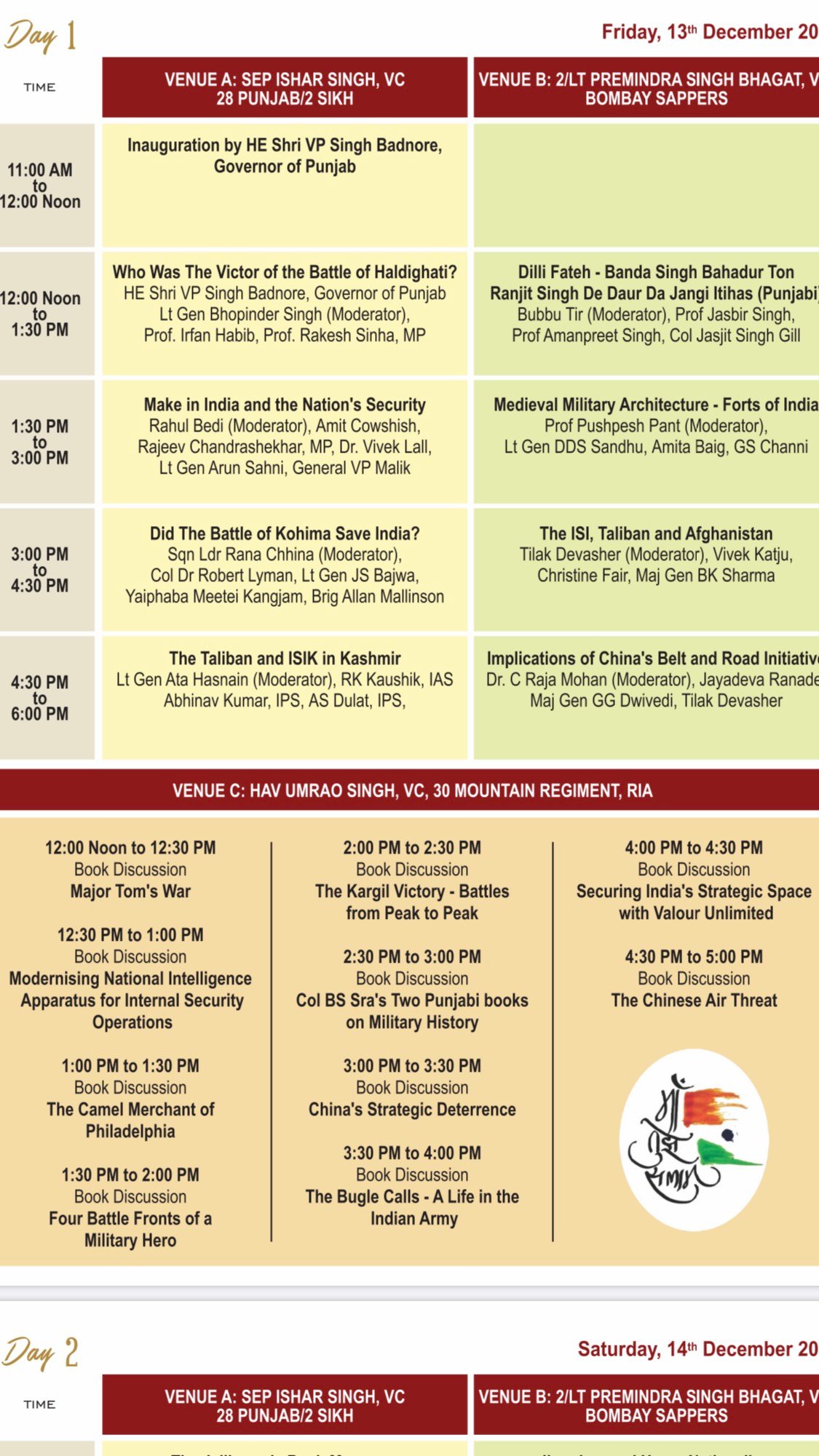
The festival will be inaugurated by Punjab Governor and UT Administrator VP Singh Badnore, at the Lake Club tomorrow. In addition to sessions on contemporary strategic and military issues like China’s belt and road initiative, Taliban in Kashmir and Afghanistan and defence industry in India, historical topics, book discussions audio-video shows will mark the event’s first day.

A display of weapons and equipment by the Army, an exhibition on military artefacts and martial heritage, book launches and martial dances will also be organised.

IMG_0621

unnamed (2)


MILITARY LITERATURE FESTIVAL India no longer shy of using hard power

India no longer shy of using hard power

on the lookout: India must develop infrastructure along the border, re-balance and modernise its forces and increase strike abilities. Reuters

Maj Gen Jagatbir Singh (retd )

Geostrategy is an important aspect of relations between countries and has greater relevance when it comes to neighbours. India and Pakistan have fought four wars since Independence. Each of these had been initiated by our adversary in a different manner and area. Pakistan has been handed a crushing defeat in all the contests, even though some analysts feel that the 1965 war had ended in a stalemate. The last war between the two nations was fought on the icy heights of Kargil 20 years ago, soon after both the nations had demonstrated to the world that they were nuclear powers. We have also been involved in an ongoing proxy war with Pakistan as it continues to support terrorist activities on our soil.

We have been building our relationships both in our neighbourhood and across the world based on the issues of convergence and shouldering greater global responsibilities. However, our stand on taking the next step forward in our relations with Pakistan has correctly been linked to its cessation of support to terrorism

After Kargil, Pakistan has had four army chiefs — Gen Pervez Musharraf, Gen Ashfaq Parvez Kayani, Gen Raheel Sharif and the current chief, Qamar Javed Bajwa, with all except one serving extended tenures. India, on the other hand, has had nine Army chiefs in the same period, including the current chief, Gen Bipin Rawat. It shows the influence of army in Pakistan. It was reiterated when Pakistan’s Law Minister recently resigned for a day to represent Gen Bajwa in the Supreme Court for his extension.

India may have had the upper hand in all the conflicts, but have failed as a nation to use this advantage while bargaining for a better deal. This is evident in India agreeing to take the Kashmir dispute to the UN in 1949 and hold an internationally-supervised plebiscite, which is yet to take place. In 1965, we gave up most of the tactical advantages secured after the sacrifice of our valiant soldiers. Also, in the Simla Agreement, we merely agreed to changing the name of the Ceasefire Line to the Line of Control, and leaving ambiguity regarding the area North of Pt 9842, resulting in Operation Meghdoot in Siachen in 1984 and our physical occupation of the Saltoro Ridge. Our troops continue to fight in the highest battlefield of the world.

This is the region where India, Pakistan and China share boundaries, links Pakistan to China and Afghanistan, and overlooks the Silk Route and is the source of immense reserves of water. Three rivers, namely the Indus, the Jhelum and the Chenab, flow through this region. It also connects the resource-rich region of the Middle East with the manufacturing region of China, and gives China the access to the Arabian Sea and the Indian Ocean.

Epicentre of tension

The location and geostrategic significance of Kashmir is directly linked to the interest taken in it by our neighbours. The Line of Control remains the epicentre of tensions between India and Pakistan. We need to do a quick security scan of this region. The US is in the process of pulling out of Afghanistan. This will create a vacuum for the ISI-backed Taliban reasserting itself. They will, however, have to guard against the rise of Al Qaeda and the ISIS as Pakistan will not want to see the US troops returning. The other danger lies in the rise of militias as was seen during Najibullah’s time after the Soviet pullout due to fiscal reasons. The economic sustenance of Afghanistan is important, otherwise the region will again witness instability and the direct fallout will be the increase in foreign terrorists in the Valley.

As far as Pakistan is concerned, it believes nuclear weapons give it the shield to carry out sub-conventional warfare as a tool of its policy. It feels it can carry out its policy of inflicting thousand cuts without evoking a reaction from India owing to its nuclear umbrella. It is continuing with Operation Topac, the brainchild of Gen Zia in 1988, but the fencing post Operation Vijay has helped in reducing infiltration. It feels its strategy of patronising terrorism can result in the breakup of India. Its government continues to be a puppet in the hands of the army and the ISI remains the instrument for all its activities.

Strong Pak-China ties

The Pakistan-China ties continue to remain as strong as ever and the creation of the CPEC (China-Pakistan Economic Corridor) and the development of Gwadar has only deepened the relationship. The CPEC, which runs through this area, not only gives China access to markets and a route for the transportation of resources but can also give it access to the agricultural lands of Pakistan in case there is a grave water crisis.

The other important aspect is water. Tibet is the water reservoir of the area — six of Asia’s largest rivers originate here, namely the Indus, the Brahmaputra, the Yangste, the Mekong and the Yellow river. Water is the most important resource, and unpolluted waters from the Indus, the Jhelum and the Chenab flow across the LoC into Pakistan. The 1960 Indus Water Treaty weighs heavily in favour of Pakistan — India can access only 19.48 per cent of this water. Pakistan has the world’s largest contiguous canal network, fed by the rivers that flow across Kashmir. Here, the hydropower generation potential is immense. Pakistan’s agriculture and economy is dependent on these rivers, and hence they are of vital importance to our neighbour. However, population growth, urbanisation and climate change are placing increased pressure on water.

China on the move

This is the only area in the world which is a triangular junction of three nuclear powers. China has developed infrastructure in the region and has the ability to move its troops swiftly. There have been three distinct phases in India-China relationship — bhai-bhai, bye-bye and now buy-buy. Under President Xi Jinping, China is striving to be the most powerful nation and is hardening its engagement terms. It has long-term strategic interests that are clearly defined and pursued. Pakistan continues to remain of great relevance to its strategy.

Today, China is India’s biggest trade partner, with the balance of trade tilted heavily in its favour. Our trade has grown from $200 million in 1992 to $94 billion. While we have areas of convergence such as trade, investments and climate change, the major area of disagreement remains the issues of unresolved borders as our perceptions vary. Deep-seated beliefs take time to change. We need to come to an understanding that will elevate our relationship to a different plane and that will overcome the Pakistan-China threat on our northern borders. The recent summits in Wuhan and Chennai are a pointer in this direction. Our borders need to be tranquil and the legacy issues need to be resolved. Both sides must understand each other’s concerns and be accommodating. The benefits of two countries, with the largest populations and among the largest economies, narrowing down their differences are immense. It will have global implications.

How should we overcome these challenges? We need to develop our infrastructure in the region, re-balance and modernise our forces based on the emerging threats, increase our strike capability and deal with internal issues. There needs to be greater prosperity for our people living in these areas.

Since the nuclear explosion of 1998, we have defeated Pakistan in 1999, generated enough economic growth to be of global relevance and have worked with multiple countries on different issues. India has grown closer to the US and signed the US-India nuclear deal in 2005. At the same time, we have dealt with the rise of Islamic fundamentalism. India’s threats in this region are both internal and external. The removal of Article 370 has helped in integrating this area with the rest of the country; Article 370 gave the feeling to certain elements that the Instrument of Accession gave them a window for independence. While we have been building our relationships both in our neighbourhood and across the world based on the issues of convergence and shouldering greater global responsibilities, our stand on taking the next step forward in our relations with Pakistan has correctly been linked to its cessation of support to terrorism.

Three recent events demonstrate a new resolve with regard to our intentions. The first was our ability to stand up to China in Doklam till the issue was de-escalated, second was the surgical strikes post Uri, and the latest being the air strike at Balakot on February 26. The use of air power has the ability to quickly escalate and de-escalate the situation. We showed we were willing to climb the escalatory ladder and had the capability to do so. We can no longer be seen as a nation reluctant to use hard power.

We need to understand and deal with the new realities of the 21st century. The future lies in our growing strength as a nation, the resolve of our leadership and the public mood. We must continue to focus on greater prosperity, inclusive socio-economic growth and enhancing the strength and capability of our armed forces in securing our borders. The pursuit of national interests in the changing global dynamics needs to be done. This will no doubt increase our influence not only in the immediate neighbourhood but also in the world.


Army sepoy arrested from Hoshiarpur for stealing rifles from MP

Army sepoy arrested from Hoshiarpur for stealing rifles from MP
Photo for representation.

Chandigarh, December 10

A 25-year-old sepoy serving in the Indian Army was arrested in Punjab for allegedly stealing two INSAS rifles and ammunition from army’s training institute in Pachmarhi in Madhya Pradesh, police said on Tuesday.

The stolen arms and ammunition have been recovered, according to Hoshiarpur Senior Superintendent of Police, Gaurav Garg.

Harpreet Singh, who was declared a “military deserter” in October by the army, was arrested from Chotala village near Tanda in Punjab’s Hoshiarpur district on Monday, said Garg.

He was booked under relevant sections of 380 (theft), 399 (making preparation to commit dacoity) and 411 (dishonestly receiving stolen property) of the IPC and the Arms Act, the SSP said.

His three accomplices, including one Jagtar Singh alias Jagga—son of Harbhajan Singh, who is an accused in the drones arms drop case in Punjab’s Tarn Taran in September, were also arrested, Garg said. 

Posing as army officers, the accused had stolen the rifles and ammunition in the early hours of December 6, sending the police into a tizzy and forcing them to sound a high alert.

Police claimed that Harpreet Singh, who belongs to Hoshiarpur’s Miani village, along with his accomplices had allegedly planned to loot some jewellery and garments shops and also steal cars to make a quick buck as he wanted to pay-off a debt of about Rs 60 lakh owed by his family.

“He wanted to make quick money through illegal activities,” the SSP told PTI over phone.

However, the police said that foreign hand behind the theft cannot be ruled out yet and the case is being investigated from all angles. —