Sanjha Morcha

Military Literature Festival-2019 : ‘The Kargil Victory: Battles from Peak to Peak’ throws light on Untold incidents of War

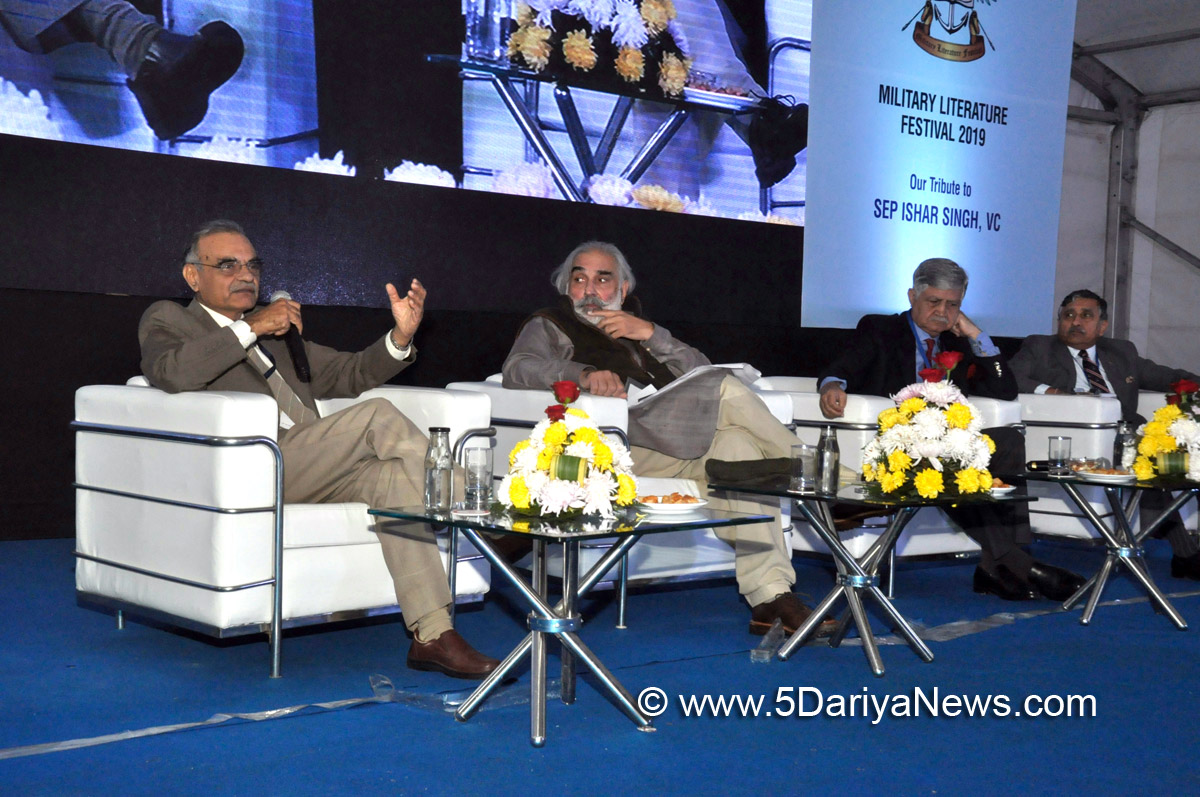
The Kargil War was one of the most difficult and challenging in Indian history which demonstrated unparalleled valour of the Indian Army.‘The Kargil Victory: Battles From Peak to Peak’ book written by Colonel SC Tyagi gives us a glimpse about ‘untold incidents’ of war which is a great source of inspiration for today’s youth.A panel discussion was carried out on the book during the first day of third Military Literature Festival in local Lake Club on Friday which was participated by Colonel PK Vasudeva, writer Colonel SC Tyagi and Vikramjeet Singh.In the session, the videos and photos of the ground reporting by renowned TV senior journalist Barkha Dutt on Star Plus at that time were also shown.On the question of Aditya, a seventh class student in the session, the writer said that this war was one of most difficult in the Indian History as the war was fought on 18,000 feet above sea level in which the enemy took advantage of height and it was not easy to fight with them.He said that in the bone-chilling cold, it was a herculean task to climb with the weapons. Vikramjeet Singh said that the book gives in-depth look and insight about Kargil War as the writer had ground zero personal experience which other journalists and writers had not gained the same. He said that the book is perfectly readable.


From the court ofMaharaja Ranjit Singh

From the court ofMaharaja Ranjit Singh

High-power dance and martial arts showcased

The Army is known for its valour but high power martial art and dance performances by various regiments showcased one facet of the forces that few know about at the inaugural day of the three-day Military Literature Festival-2019, organised at the Lake Club here.

The show, which left the visitors spellbound, was organised by the Unit 270 of the 474 Engineer Brigade under the leadership of Col Mohammad Rakib with Naib Subedar Bhupinder Singh in charge. Leading the show, 5 Madras Regiment led by Sepoy Ashok Kumar along with a team of 10 Army men enthralled the audience by performing Kalari Payattu, the ancient martial art that originated in Kerala. Khukri, the sharp edged weapon used chiefly by the Gurkhas of Nepal and India, was also on display as a team of 21 performers led by Naib Subedar Nima Tshering Sherpa from 2/5 Gorkha Regiment (Front Fighters), 69 Indian Infantry Brigade (INF BDE) did the Khukri Dance. As for Punjab, it was obviously the Gatka, associated by the Sikhs of Punjab, performed by 22 Punjab Regiment led by Subedar Dalwinder Singh and Naik Jagjit Singh.

He was declared the maharaja of Punjab in 1801 and occupied a kingdom that stretched from the borders of Afghanistan to those of the British Raj, so a special session was justified on the book, Camel Merchant of Philadelphia, by Sarbpreet Singh, which has stories from the court of the Lion of Punjab, Maharaja Ranjit Singh. Interesting facets of the emperor’s relationship with figures such as his mother-in-law Sada Kaur, and the truculent leader of his army, Akali Phoola Singh, came up for discussion on the occasion.

Rain plays spoilsport

Heavy rainfall and gusty winds played spoilsport at the fest on Friday. A few sections, including an organ donation awareness camp, could not attract many visitors as the weather worsened by the evening because of which the crowds thinned. A few of the stalls were dismantled as a precautionary measure too. However, that did not dampen the enthusiasm of the youth. Digvijay Singh, 18, from Panchkula, and four of his friends at the venue said this platform gave them the opportunity to interact with serving soldiers, officers, and veterans.

Want to see what a war hero wore?

The uniforms and awards of Late Lt Gen Sagat Singh, (14 July 1918 – 26 September 2001), who played an important role in the liberationof Goa and during the Bangladesh War, have been exhibited at the military fest.

Col Ran Vijay Singh (retd), son of the celebrated Army officer and his lawyer daughter Meghna Singh, travelled from their home town Jaipur to set up the exhibition. “The valour of my father inspired me and through his achievements I want to inspire the youngsters to join the forces,” Col Ran Vijay said.

Lt Gen Sagat Singh served in the Middle East during World War-II broke out and was later absorbed in the Indian Army.

Don’t miss the medals

An engineer and grandson of a Military Engineering Service officer, Narinderpal Singh has exhibited old and rare medals. A collector of rare weapons, manuscripts, and coins for the past 32 years, Narinderpal has sourced War medals from World War-I to the Kargil war through jewellers and auctions and from families of soldiers. “I have around 500 such medals and some of them have been sold by the second and third-generation families of the officers who have received them,” the collector said. He plans to set up a museum of his antiques soon.


Punjabis Have Always Resisted The Invaders Due To Their Resistance Spirit; Say Panelists

A panel discussion on the topic “Delhi Fateh Banda Singh Bahadur Toan Ranjit Singh De Daur Da Jangi Itihas” was held on the inaugural day of Military Literature Festival that started at Lake Club, here today. This panel discussion was moderated by eminent Punjabi writer Babbu Teer and the other panelists included Lt Col (Retd) Jasjit Singh Gill, historian Dr Amanpreet Singh Gill and academician Prof Jasbir Singh.During the panel discussion, educationist Prof Jasbir Singh spoke about the time of 18th century, starting from Baba Banda Singh Bahadur till the establishment of Sikh rule under Maharaja Ranjit Singh. He said that the Sikhs have always been known from their resistance towards invading forces. He said that it is a misconception that the pre-partition Punjab was considered to be the gateway to India and that is why, the Punjabis had their fighting spirit. Because several invaders had entered India from this route. He said that Punjabis have always stood against invaders and always fought for safeguarding their motherland as well as for the sake of their self esteem and pride.He said that if any person wants to learn more about the war history of that period, they can get several examples from “jangnama’s” as well as “wars” written in several languages of the region. Prof Jasbir Singh also said that when wars took place at that time in Punjab, people from all communities, religions and castes participated and their fought against the invaders as one.Lt Col (Retd) Jasjit Singh Gill spoke in detail about the lifespan of Adina Baig Khan, who founded Dinanagar town of Punjab. He said that Adina Baig Khan was a notorious character and was close to almost all rulers of that time. He also spoke about the professional military of Maharaja Ranjit Singh. He said that some people think that the army of Maharaja Ranjit Singh was trained by the Europeans, which is factually wrong as he always had a disciplined and well trained army. He also spoke that to understand history, one should stay away from politics, religion and myths.Historian Dr Amanpreet Singh Gill said that to win a war, more than the military strength, the people of that land need to have a thought process, where they cannot allow invaders to rule them. He also stressed that the Sirhand Fateh was a much bigger event than even Delhi Fateh as when Delhi was won, the Mughal rulers of that time were already going through testing times, whereas when Baba Banda Singh Bahadur won Sirhand, the Mughals were at their peak and had never even imagined that it could even be possible. He said that the Mughals at that time had a bigger army as compared to the one of Baba Banda Singh Bahadur, and despite this fact, he won. The other reason of Baba Banda Singh Bahadur’s victory was that all sections of society had supported him in war against the Mughals.He said that Baba Banda Singh Bahadur was also instrumental in winning the hearts of its people with the help of social as well as land reforms.Writer Babbu Teer said that even our tenth Guru, Guru Gobind Singh Ji had said that there is no harm to pick up weapons to fight the evil forces. She also spoke about the history of the period surrounding Delhi Fateh by the Sikh forces.


Army deserter, militant’s son held with 2 stolen INSAS rifle

Army deserter, militant’s son held with 2 stolen INSAS riflesin police net Harpreet Singh, Jagtar Singh and 2 others were nabbed from a Hoshiarpur village; the guns were stolen from Madhya Pradesh on December 5

HT Correspondent

letterschd@hindustantimes.com

HOSHIARPUR : An army deserter and the son of a Khalistani militant were among the four people arrested for stealing two INSAS rifles from an army training centre checkpost at Pachmarhi in Hoshangabad district of Madhya Pradesh on December 5. The arrests were made from Tanda town of Hoshiarpur district. The weapons they stole were also recovered.

Punjab Police were alerted by the army intelligence and Madhya Pradesh anti-terrorist squad (ATS) that Harpreet Singh, 25, who was absent from duty since October 15, had stolen two 5.56-mm rifles, three magazines and 20 cartridges from the sentries at the training centre.

Two-day search

A search operation was conducted for two days before Harpreet Singh was arrested from Chotala village and his accomplice, Jagtar Singh, alias Jagga, from Kandhali Narangpur village on Monday night.

Both Harpreet Singh and Jagga are natives of Miani village in Tanda, 30 km from Hoshiarpur. The police also arrested Karamjit Singh and Gurjinder Singh of Miani for their alleged role in the conspiracy.

Police sources said Jagga is the son Harbhajan Singh, a Khalistan Zindabad Force (KZF) militant, who was arrested in connection with a blast in the border district of Tarn Taran in September. It was later reported that China-made drones were being used to drop weapons in the border villages of the district from Pakistan.

In September, police busted the KZF terror module, which was conspiring to unleash terror strikes in the state, by arresting four people and seizing five AK-47 rifles, pistols, satellite phones and hand-grenades.

The four included Harbhajan Singh, who was arrested from Chohla Sahib village in Tarn Taran district.

RIFLES HIDDEN IN SUGARCANE FIELDS

Hoshiarpur senior superintendent of police (SSP) Gaurav Garg said that during the raids, the stolen rifles were recovered from a sugarcane field of Kandhali Narangpur village.

“Three teams were constituted under the command of the deputy superintendent of police, Tanda, DSP, Dasuya, and DSP, special branch. They were successful in catching the culprits,” the SSP said.

Harpreet was commissioned in the Sikh Regiment at Ramgarh in Jharkhand in December 2015. He was trained as bandsman at Pachmarhi and deputed as B-Flat clariant (musician) in June 2017.

Posing as army personnel, the two arrived at a check post in the early hours of Friday and asked the sentries on duty to call someone from inside the cantonment. After engaging the sentries in light chatter, the duo suddenly seized the two INSAS assault rifles and 20 cartridges from the check-post and fled.

Preliminary investigation showed that the duo had got down at Piparia station, 55 km away around midnight and taken a taxi for Pachmarhi. The police received information about the incident around 5am and were on high alert.


Book ‘Four Battlefronts of a Military Hero’ released at MLF

A book titled Four Battlefronts of a Military Hero authored by Colonel Surjan Singh Randhawa was released at the first day of the Military Literature Festival. The book was released by the diginitories present on the dias Lt. Gen. HPS Kler, Mr. Dinesh Kumar, Former Resident Editor. TOI and Pioneer.After the launch of the book Mr. Randhawa while addressing the gathering gave illustrious insights of the book by saying that a Military man is not only the warrior on the battle field but after retirement he also emerged as the true champion in another three important battles of his life which pertains to economic, social and family fronts. He said that that the message he gave in his book is that the soldiers were also human beings and they had to go through the rough phases of life after retirement. He said that a true soldier never give up and finally become a role model for his family and society . Mr. Randhawa said it was his fourth book and he had been writing on spirituality but this time in his recent book he tried to touch the inner core of a Military man which deals with morality, ethics and emotions. The author said that wives of the Militarymen were also real soldiers who so efficiently  manage the family with limited resources when the military men were at war. He said that the essence of the book is to absolutely connecting army with civilians and government.


Gandhi, Guru Nanak remind us war is never an option: Badnore

Gandhi, Guru Nanak remind us war is never an option: BadnoreAll prepared Punjab governor, however, said India was ready to deal with any kind of threat

HT Correspondent

chandigarh@hindustantimes.com

Chandigarh : The 150th birth anniversary of Mahatma Gandhi and the 550th Prakash Purab of Guru Nanak Dev made 2019 a landmark year, reminding people that the way of nations was that of ‘ahimsa’ (non-violence) and universal brotherhood where war was never an option, Punjab governor and UT administrator VP Singh Badnore said on Friday, while inaugurating the 3rd edition of the annual Military Literature Festival (MLF) at the Lake Club here.

India, however, was a strong nation, capable of dealing with any kind of insurgency threatening peace, unity, and integrity from within or across borders, Badnore said.

“Our Armed Forces have demonstrated this with a ‘surgical strike’ in the mountains across the Line of Control and an airstrike deep in Pakistan’s Khyber-Pakhtunkhwa Province.”

The country had come a long way since Independence in 1947, being no longer dependent upon food or aid from abroad. In fact, it was providing aid to other weaker nations, he added. “We have had to rely upon war material from other countries but slowly we aim to become self-reliant in making our own weapon systems with cutting edge technology. Already, ₹3,000 crore worth of defence equipment is being made in India,” the Punjab governor said.

On India’s space programme, Badnore said the country had proved that It was competent to reach targets in space, was evolving its own global positioning system and had the ability to watch its frontiers and beyond with its satellite systems. “We are in the process of making the Indian ocean militarily safe for our country, secure our island territories and our maritime traffic,” he added.

Earlier, in his welcome address, Punjab tourism and cultural affairs minister, Charanjit Singh Channi, said the MLF was an appropriate platform where youngsters were being inspired by decorated officers of the Indian Army.

In his address, GOC, Western Command, Lt General RP Singh, said that it was a matter of great pride and honour to be fully involved and associated with the festival right from its inception in 2017.

Badnore also honoured Subedar Major Yogendra Singh Yadav, who was awarded the highest military honour,the Param Vir Chakra, for action in Kargil.

The senior advisor to Punjab chief minister Capt Amarinder Singh, Lt General Tejinder Singh Shergill (retd), assertedthat MLF would go a longway in imbibing a spirit of patriotism and nationalism among youngsters.

Prominent among those present on the occasion included ex-Chief of Army Staff, Gen VP Malik (retd), ex-Air Chief Marshal BS Dhanoa and former Chief of Naval Staff, Admiral Sunil Lanba.


Military Literature Festival : Discussion on book: Camel Merchant of Philadelphia

A special session to discuss the accounts of the book ‘Camel Merchant of Philadelphia’ focusing on stories from the court of Lion of Punjab-Maharaja Ranjit Singh was organised on the first day of MLF. Mr. Sarbpreet Singh, author of the Camel Merchant of Philadelphia, said that this book explored the stories of Sikh court of Ranjit Singh, who was declared the maharaja of Punjab in 1801 and occupied a kingdom that stretched from the borders of Afghanistan to those of the British Raj. The author examined the emperor’s relationship with figures such as his mother-in-law, Sada Kaur, and the truculent leader of his army, Akali Phoola Singh.He further said that it unveiled the untold stories of Maharaja Ranjit Singh and other parallel personalities such as Raja Dhian Singh, Gulab Singh and Suchet Singh. There were the Sikh chiefs, among them the Sandhawalias and Attariwalas; the Fakir brothers Azizuddin, Imamuddin and Nurudeen. He said this book also entailed the stories of the queens, each more beautiful than the other, down to the mercurial Rani Jindan who was to play a major role during the fading years of the Sikh kingdom leading to the decline of Punjab.Talking about the title of the book, Mr Sarabpreet Singh said that he was working in the profession of marketing and technology so he chose this title to arose the curiosity about this book.He said that General Josiah Harlan – the Camel Merchant of Philadelphia who began life as a Quaker, achieved prominence within Ranjit’s court.


J&K admn to decide on leaders’ release

J&K admn to decide on leaders’ release: ShahCURBS Says Centre won’t interfere in the matter; situation normal
A closed market during a strike called by the Hurriyat Conference on World Human Rights Day, in Srinagar on Tuesday. PTI

HT Correspondent

letters@hindustantimes.com

New Delhi : Union home minister Amit Shah on Tuesday claimed that the situation in the Kashmir valley is normal and maintained that a decision on releasing detained political leaders will be taken by the local administration. Shah’s assertion that the central government will not interfere in the matter came after Congress leader in Lok Sabha Adhir Ranjan Chowdhury asked the government when political leaders, including sitting Lok Sabha member and former chief minister Farooq Abdullah, would be released.

“There is no need to keep anyone in jail even for a day more than that is required. As and when the local administration feels the time is appropriate, they will be released. Unlike in the past during Congress governments, there will be no interference from our side,” Shah told the Lok Sabha during Question Hour

Shah also cited the 11-year detention of National Conference leader and Farooq Abdullah’s father, the Sheikh Mohammad Abdullah, by the Congress government in the 1950s-1960s. Sheikh Mohammad Abdullah was arrested on August 9, 1953, in the Kashmir conspiracy case and on April 8, 1964, the state government dropped all charges and released him.

“But we will not follow their footsteps and the leaders will be released soon,” he added.

Apart from Farooq Abdullah, two other former chief ministers, Omar Abdullah and Mehbooba Mufti, along with several other political leaders have been detained since August 4, a day before the government nullified Article 370 that accorded special status to Jammu and Kashmir and bifurcated the state into two Union territories — Jand K and Ladakh .

Asked when the situation will return to normal, Shah shot back, “It is not normalcy for Congress even though no bullet was fired in the valley. At least 99.5% students appeared for exams but for Adhir Ranjanji this is not normalcy. At least 7 lakh people availed medical services in Srinagar. Curfew and Section 144 have been lifted from everywhere. But for Adhirji only parameter for normalcy is political activity. What about local body polls which were held?”

Chowdhury also pointed out that a Congress delegation, led by Rahul Gandhi, had not allowed to visit the Kashmir valley. Gandhi was present in the House.

The union home minister also attacked the Congress for predicting bloodshed after the abrogation of Article 370.


Policymakers Have Failed To Learn Lessons From Kargil: General VP Malik

DEFENCE EXPERTS BAT FOR GREATER THRUST ON DEVELOPMENT OF INDIGENOUS DEFENCE PLATFORMS TO ENSURE INDIA’S SELF RELIANCE UNDER MAKE IN INDIA

Lamenting the lacaidiscal attitude of political class towards the defence needs of the country, former Army Chief General VP Malik on Friday stated that due lessons had not been learnt from the Kargil War leaving the nation vulnerable on the security front. We should have by now built enough indigenous defence capacity platforms, said General Malik who headed the force during Kargil War, adding that Parliament should debate the reasons leading to this failure more than it was doing at the moment.Setting the stage on fire here during a panel discussion ‘Make in India and the Nation’s Security’ on the very first day of the Military Literature Festival (MLF), General Malik led the chorus on urgently streamlining the defence procurement processes making them facilitators and not hurdles in our endeavour to endow our forces with the cutting edge weaponary. Dispelling the notion that Army was fond of importing weapons from abroad, General Malik categorically said abject failure of our public sector to fully deliver the required weaponary was the only reason for this. Echoing the views Former Financial Advisor (Acquisition) with Ministry of Defence Amit Cowshish questioned the ambiguity and mistrust around objectives laid down under Make in India as far as defence acquisitions were concerned. There is no clear cut policy and framework to achieve avowed goals under the new slogan, he said adding that indiginisation cannot be the sole criterion to reduce costs. He advocated a dedicated overarching organisation to process and deliver on our defence needs in a time bound manner.Cautioning against the temptation to tag defence matters with mere sloganeering, Lt. General Arun Sahni urged for allocating more funds for upgradation of our warfare. We need a more serious approach where accountability is fixed for producing unusable products at the public sector institutions working in the sphere. The panelists also concurred that India should leverage its advantage of being the largest importer of weapons while dealing with foreign exporters. Earlier, moderating the session, Rahul Bedi highlighted the gross mismatch between our capabilities and achievements till now. On one side we have launched ballistic missiles and still we can’t make INSAS Rifles, he said alluding to the Make in India campaign.


How the amended Citizenship Act and NRC will alter the idea of IndiaAll of us will have to prove our Indianness. And the poorest and the Muslims will be the most hit

How the amended Citizenship Act and NRC will alter the idea of IndiaAll of us will have to prove our Indianness. And the poorest and the Muslims will be the most hit
The Northeast protests show that ethnicity, language and culture are as emotive, sometimes, even more so, than religion. It is a lesson in the complexity of India REUTERS

Barkha Dutt

The government insists that the amended new law on citizenship (the Citizenship Amendment Act or CAA) is not anti-Muslim. In fact, it claims that Indian Muslims are not even impacted by the legislation. Its stormtroopers on social media have been deployed to vociferously argue that those criticising the revamped rules — I am among them — are begrudging fast-track protection to persecuted religious minorities from neighbouring countries.

This is sophistry. It is also a convenient and deliberate cherry-picking of facts. To understand why India has just passed a highly discriminatory and blatantly prejudiced law, you must juxtapose the citizenship legislation with the Bharatiya Janata Party’s avowal of implementing an all-India National Register of Citizens (NRC).

Home minister Amit Shah has already declared that the NRC will help push out all “infiltrators” from India. In that case, the religion of the “infiltrators” should not matter, should it? An illegal migrant or outsider is an outsider, irrespective of whether she is Christian, Muslim, Sikh or Hindu, right? Well, not according to the BJP’s ideological and political calculations.

These calculations first went awry in Assam — the present epicentre of the protests against the CAA — when the court-supervised NRC experiment ended in results that were politically inconvenient for the party.

About 1.9 million people found themselves excluded from the NRC in Assam, but these were not just Muslim migrants from Bangladesh — the suddenly stateless included lakhs of Hindus as well. What may now happen is something like this. The citizenship law will throw a protective shield over the disenfranchised non-Muslims; the Muslim migrants will then be left to appeal before the foreigners’ tribunals. The new law also offers legal immunity to non-Muslims from Pakistan, Bangladesh and Afghanistan from jail, deportation and other criminal proceedings. In other words, the only people in internment centres will likely be Muslim migrants.

The twin projects of the CAA and NRC will fundamentally change India and the nation we have always prided ourselves on being. The government has presented the CAA as an act of generosity, but when it will be weaponised by the NRC, it will become a merciless instrument of bigotry. For those who say that this does not impact India’s 200 million Muslim citizens, let me ask, how can you be untouched by the signalling that there is now a hierarchy of faiths among our people?

If refugees have been living in abject conditions of poverty and statelessness — and I myself have met Hindus from Pakistan living for decades in dismal conditions in Rajasthan — and deserve the magnanimity of the Indian State, that should extend to all of them, irrespective of their religion. It should include Sri Lankan Tamil Hindus and persecuted Rohingyas of Myanmar. And if our national policy is that illegal entrants are infiltrators, overrunning our land and culture, and stretching our already tight resources, then that too should apply to all of those who come into India without papers and documentation and visas. How can the BJP argue this both ways?

It can, because very few outside the fishbowl of politicians and journalists have understood the linkages between the citizenship law and the NRC. The former, without the latter, is politically pointless. And once you join the dots between the two, it’s more than clear. Like we saw in Assam, we will all have to prove our Indianness, the poorest among us will be the hardest-hit, and the Muslims among us will be on the very margins.

The eruption in the Northeast, especially in Assam, is a timely reminder to the BJP about how complex a country ours is. The notion of the “outsider” is not just defined by religion alone. In Assam, they want both the Muslims and Bengali Hindus who came in after 1971 to go back. In other parts of the east, there is similar hostility towards the Chakmas. In an area where there are more than 200 indigenous communities, ethnicity, language, and culture are as emotive, and, sometimes more, than religion. For these protesters, the new law overturns the Assam Accord that set the cut off for citizenship at 1971, instead of 2014.

There is also the irony that the BJP, which declared a “One Nation, One Law” principle, while abrogating Kashmir’s special status, is unable to apply the citizenship law uniformly to the Northeast and has to create several exemptions. It is a lesson in the governance of India. Saying something in a manifesto is easier than doing it.

And it begs the question. Why do it at all? Why create a crisis from two decades of peace; why fix what isn’t broken; why upend the very idea of nationhood that distinguishes India from its neighbours; and why bring religion into who can be Indian or not?

The CAA plus NRC equation will change not just the arithmetic but the very philosophy of India.

Barkha Dutt is an award-winning journalist and author

The views expressed are personal