Sanjha Morcha

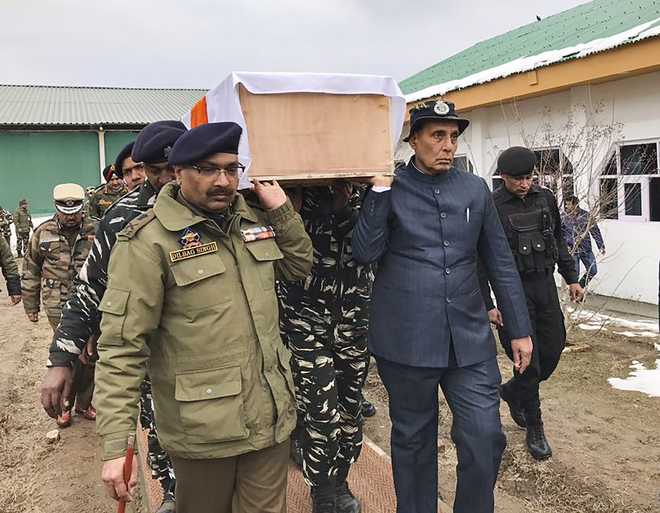
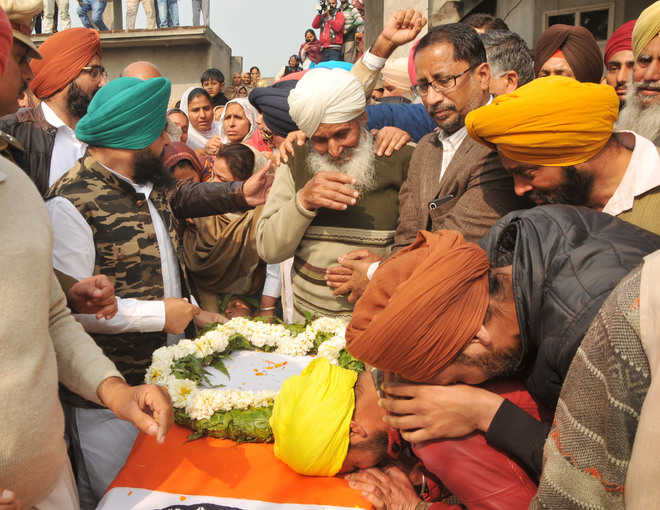
Rajnath Singh helps carry coffin of slain CRPF jawan

Rajnath Singh helps carry coffin of slain CRPF jawan

Home Minister Rajnath Singh and J&K DGP Dilbag Singh carry the coffin of a slain CRPF jawan during a wreath-laying ceremony in Budgam on Friday. Twitter/PTI

Srinagar, February 15

Home Minister Rajnath Singh on Friday helped carry the coffin of a slain CRPF jawan after he laid a wreath on the mortal remains of the troops, who were killed in a terror attack in Jammu and Kashmir, officials said.

Shortly after arriving from Delhi, the Home Minister attended a solemn function here where the remains of 40 CRPF personnel were kept in coffins, draped with Tricolour.

Singh helped carry the coffin of a slain CRPF jawan before it was flown out of Jammu and Kashmir in a special aircraft, an official present at the function said.

The Home Minister, Governor Satya Pal Malik, Home Secretary Rajiv Gauba, CRPF Director-General R R Bhatnagar, Jammu and Kashmir DGP Dilbagh Singh besides others attended the wreath-laying ceremony.

“The nation will not forget the supreme sacrifice of our brave CRPF jawans. I have paid my last respects to the martyrs of Pulwama. The sacrifice will not go in vain,” Singh said.

The dignitaries stood in silence till the coffins were loaded in a truck which went to the Srinagar airport, the official said.

Forty CRPF personnel were killed and five injured on Thursday in one of the deadliest terror attacks in Jammu and Kashmir when a Jaish-e-Mohammad suicide bomber rammed a vehicle carrying over 100 kg of explosives into their bus in Pulwama district.

The bus was part of a convoy of 78 vehicles CRPF travelling from Jammu to Srinagar.

Prime Minister Narendra Modi on Friday said those responsible for the attack will pay “a very heavy price” and security forces will be given a free hand to deal with terrorists.

In a hard-hitting speech, Modi said the “blood of the people is boiling” and forces behind the act of terrorism will be definitely be punished. PTI


No sovereign guarantee signed with Russia in S-400 deal, says IAF officer

A Russian S-400 anti-aircraft missile launching system is displayed at the exposition field in Kubinka Patriot Park outside Moscow on August 22, 2017.]867]6=78

A senior officer says on condition of anonymity that these clauses have not been there in any Inter-Governmental Agreements in last three decades.

In the backdrop of revelations that the Union government had waived of guarantees and anti-corruption clauses for France in the Rafale fighter aircraft deal, a senior Indian Air Force (IAF) officer said there were no pacts even in deals with Russia.

“There is no sovereign guarantee or integrity pact signed with Russians in the S-400 deal,” Air Marshal V.R. Chaudhari, Deputy Chief of Air Staff, said on Tuesday.

Responding to questions on the issue, Vice Chief of the Air Staff Air Marshal Anil Khosla said,“With Russia and the United States we have processes streamlined, while with others we are evolving the processes.”

Air Marshal Khosla was talking to the media on the IAF’s fire power demonstration ”Vayu Shakti” at Pokhran ranges end of this week.

Another senior officer said on condition of anonymity that these clauses have not been there in any Inter-Governmental Agreements (IGA) in the last three decades.

Difference in nature of deals with all countries

However, there is a difference in the nature of deals with all these countries. In the case of Russia, all defence companies are state-owned and deals are signed with their State corporation, doing away with sovereign guarantee.

In the case of Rafale, while the deal is through an IGA with the French government, the supply protocols were signed with French companies that are privately-owned.

With the U.S., IGAs are through the Foreign Military Sales (FMS) route of the Pentagon and there are no separate agreements with the industry that would warrant a sovereign guarantee.


Effort to support HAL has hit IAF capabilities: Dhanoa

Air chief says addl production of Su-30 is delayed by over two years

NEWDELHI: The Indian Air Force’s (IAF) efforts to support the stateowned aircraft maker Hindustan Aeronautics Ltd (HAL) has affected its fighting capabilities, Chief of Air Staff, Air Chief Marshal B S Dhanoa said in Delhi on Friday.

IAF has only cooperated with HAL; “as a service; we have made concessions for HAL, but will the enemy make any concession for us when we face them in battle?” he questioned.

The air chief was delivering the 10th Jumbo’ Majumdar International Conference at the Centre for Air Power Studies (CAPS) in New Delhi and was responding to criticism about the IAFs alleged dislike for the indigenous fighter made by HAL, Light Combat Aircraft, Tejas.

“IAF has not shifted any goal posts as alleged,” Air Chief Marshal Dhanoa said countering allegations that developments of the Tejas fighter suffered because the IAF changed specifications and requirements frequently.

On the contrary, the IAF chief said, “We have maintained the Air Staff Quality Requirements (ASQR or specifications) of the first 20 LCA Mk-I at standards issued in 1985.” And even then HAL has been able to manufacture only “10 fighters”, he added.

A HAL spokesperson declined comment on the air chief’s comments which come at a time when the state-owned aircraft maker is in financial distress of some sort and also when it is in the middle of the controversy surrounding the government’s Rafale fighter deal.

A HAL official who spoke on condition of anonymity asked: “Doesn’t IAF allow concessions and modifications to foreign vendors? Concessions are also given to Defence Research Development Organisation and the Aeronautical Development Agency. Why is HAL being singled out?.”

Putting HAL on the mat, Air Chief Marshal Dhanoa said upgrading of one squadron of Jaguar deep strike bombers, nearly two squadrons of Su-30MKi, India’s mainstay fighters, and one squadron of Mirage-2000, a multi-role fighter, all work being done by the stateowned firm, was far behind schedule. “Additional production of Su-30 is delayed by over two years and LCA production commitment (has been delayed) by over six years,” he added.

In addition, the air chief said in its quest for indigenisation, IAF has lost as many as 17 personnel including test pilots and engineers in air accidents.


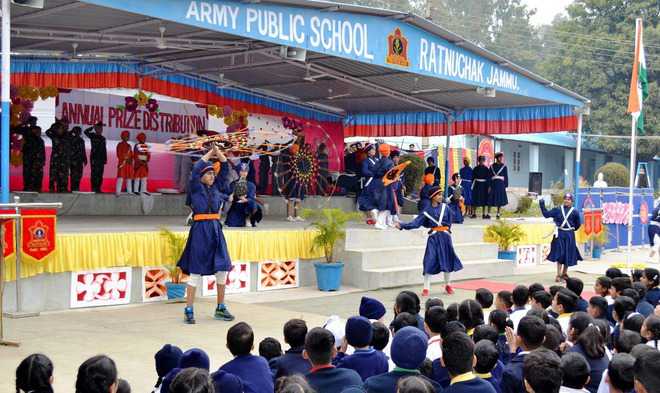
Army school celebrates annual day

Army school celebrates annual day

Students of Army Public School, Ratnuchak, perform during the annual day celebrations on Wednesday. Tribune Photo

Tribune News Service

Jammu, January 30

Army Public School (APS), Ratnuchak, on Wednesday celebrated its annual day with enthusiasm on the school premises. Officers of Military Station, Ratnuchak, and other dignitaries were present on the occasion.

The function commenced with the lighting of the lamp followed by hoisting of the national flag. The annual report of the school was presented by Principal Sonal Sharma.

Colourful cultural items were presented by students to mark the occasion. The meritorious students of Classes X and XII were awarded commendation certificates.


Missiles specialist Vice-Admiral Ajit Kumar is new WNC chief

Vice-Admiral Ajit Kumar P., a missiles specialist, took over as the new Flag Officer Commanding-in-Chief, Western Naval Command (WNC) of the Indian Navy, here on Thursday, an official said.

He succeeded Vice-Admiral Girish Luthra who attained superannuation after an illustrious career spanning nearly four decades with the Indian Navy.

At an impressive ceremonial parade held at the Naval Air Station Shikra, the outgoing and incoming WNC chiefs were accorded a guard of honour before the formal handing over, and later Vice-Admiral Luthra was “pulled out” in true naval traditions.

An alumnus of the Sainik School, Kazhakootam in Kerala, and National Defence Academy, Pune in Maharashtra, Vice-Admiral Ajit Kumar was commissioned in the Indian Navy on July 1, 1981.

A missiles and gunnery specialist, he has served onboard frontline warships of both the Indian Navy and abroad.

He has a rare distinction of commanding six warships—the guided missile corvette INS Kulism, guided missile frigate INS Talwar, guided missile destroyers INS Mumbai and INS Mysore, besides including two foreign fighter vessels.

Ajit Kumar has also completed a Naval Higher Command Course and is an alumnus of the prestigiouis Naval War College, Newport, US.

He has earlier served with the WNC in initial specialist and command appointments and as Chief Staff Officer (Operations), here.

Later, he was the Flag Officer Commanding of the Eastern Fleet, Commanding Officer of Gunnery and Missiles Training School, INS Dronacharya, Chief of Staff Southern Naval Command and Commandant of Indian Naval Academy, Ezhimala, Kerala.

Immediately prior to his new appointment, Ajit Kumar was the Vice-Chief of Naval Staff, Naval Headquarters, New Delhi.

In recognition of his services to the country, he has been decorated with several honours including Vishist Seva Medal (2006), Ati Vishisht Seva Medal (2014) and the Param Vishisht Seva Medal this year (2019). IANS


DSP, Armyman, 3 Jaish ultras killed in gunfight Officer was awarded for exemplary service only last month

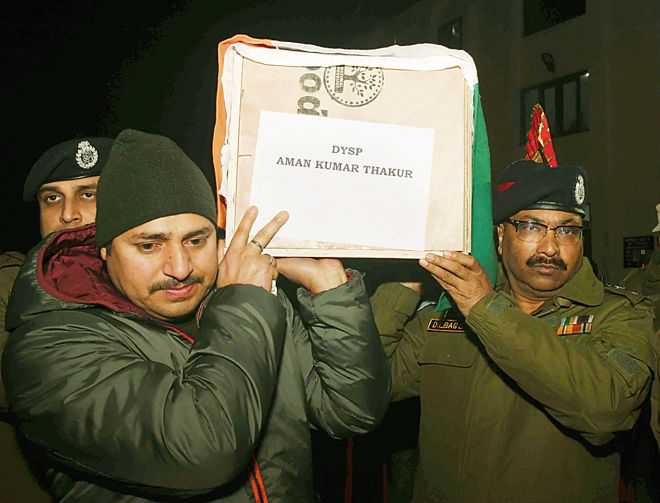
DGP Dilbag Singh and the brother of martyred DSP Aman Thakur carry the coffin. Amin War

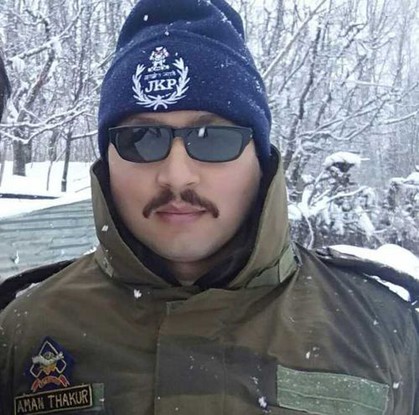
DSP Aman Thakur

Suhail A Shah

Anantnag, February 24

Deputy Superintendent of Police (DSP)  Aman Thakur, posted with the Special Operations Group, non-commissioned officer Havildar Sombir and three Jaish (JeM) militants were killed in a gunfight in Yaripora area of Kulgam district in South Kashmir today. A Major and a soldier were injured.

As men and women gathered at the encounter site, the security forces fired bullets, tear smoke shells and pellets to disperse the surging crowd, leaving at least seven injured. “We have shifted four of the injured to Srinagar — three with bullet wounds and one with a pellet injury in the eye,” a health official said.

The gunfight erupted at 2.15 pm in Tudigam village, minutes after a cordon and search operation was launched by a joint team of the security forces. The militants, hiding in a house, opened fire. A 2011-batch J&K Police Service officer, DSP Thakur was hit in the neck. He died while being flown to the Army hospital in Srinagar.

He hailed from Gogla district of Doda and is survived by his parents, wife and a six-year-old son.

Jammu and Kashmir DGP Dilbag Singh said: “We have lost a brave officer. A fighter, he led Sunday’s operation.”

Thakur was posted as the DSP (Operation) in Kulgam, a terrorist-infested area, two years ago. He was awarded the DGP’s Commendation Medal and Certificate for exemplary service only last month.


Sukhjinder’s pyre lit amid sloganeering

Sukhjinder’s pyre lit amid sloganeering

Sukhjinder Singh’s kin at his cremation in Tarn Taran. Photo: Vishal Kumar

Gurbaxpuri
Gandiwind (Tarn Taran), Feb 16

Martyr Sukhjinder Singh (35) was cremated with full state honours at his native village here on Saturday.

Residents of the village gave him a tearful adieu while his father Gurmej Singh lit the pyre. A large number of residents of the area were present on the occasion and paid tributes to the martyr.

The body of the martyr reached the local Civil Hospital late on Saturday evening and was brought to Gandiwind village in a convoy of the officials.

Besides the higher officials of the CRPF, Union minister Vijay Goel and Punjab Cabinet minister Sukhbinder Singh Sarkaria were among those who paid rich tributes to the martyr and laid wreaths on his mortal remains.

People raised slogans against Pakistan at the time of cremation.

Union Minister Vijay Goel said the Centre should look into the matter of releasing compensation to the families of paramilitary personnel at par with the military personnel.


Time for game-changing defence pacts with India: Lockheed official

Time for game-changing defence pacts with India: Lockheed official

Vivek Lall, Lockheed Martin’s vice president of strategy and business development, said the US and India are natural partners with shared interests across numerous political, economic and security issues. Reuters file

Washington, February 16

The time is indeed now to lean into game-changing defence partnerships with India, global aerospace giant Lockheed Martin’s top American executive has said.

Vivek Lall, Lockheed Martin’s vice president of strategy and business development, said the US and India are natural partners with shared interests across numerous political, economic and security issues.

A world-renowned aerospace and defence leader, he has been instrumental in several crucial India-US defence deals in the past one decade.He would be leading the executive delegation of the US-India Business Council (USIBC) to Aero-India show 2019 from February 20-24.

“The time is indeed now to lean into game-changing defence partnerships. India-US ties are growing ever closer and we are very encouraged by the positive trend we’re seeing in US-India relations, particularly on the defence and security front,” Lall told PTI.“Dr Vivek Lall, Vice President of Lockheed Martin Aeronautics service, is our leader this year and we are also pleased to have USIBC’s new Chairman of our Defence and Aerospace Committee Rich Weir of Northrop Grumman in attendance,” USIBC said in a statement.

Aero India is a wonderful opportunity for USIBC members and Lockheed Martin to meet senior US and Indian government officials, participate in business-to-business networking activities and attend seminars that provide insights into the opportunities and challenges associated with doing business in India’s aerospace and defence sector, Lall said.

“Aero India is also an ideal venue to highlight Lockheed Martin’s suite of security solutions and partnerships that support India’s defence needs, Make in India and India-US ties,” Lall said in response to a question.

Officials from the US Department of Defence are also scheduled to attend the annual aero show in Bengaluru. PTI


Russia’s love for Pakistan is back

Russian President Vladimir Putin’s recent overtures to Islamabad go well beyond Tsar Nicholas’ nostalgia for Central Asian affinities
Russia’s love for Pakistan is back

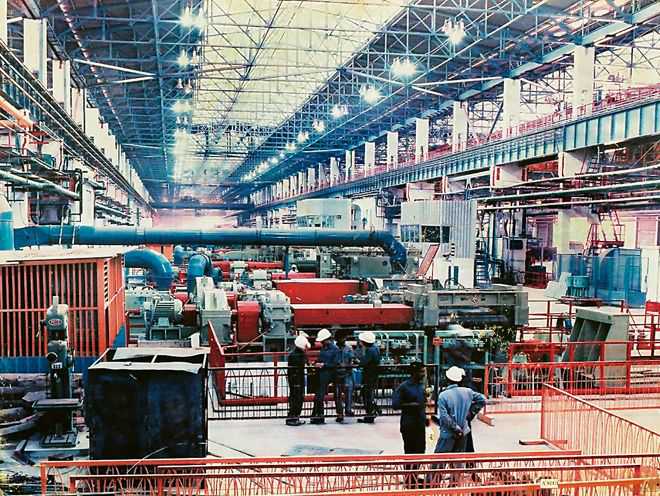
Moscow is keen on reviving Pakistan Steel Mills which has been shut for three years

FS Aijazuddin

Nicholas Romanov II (once Tsar of all Russias and now St. Nicholas) should congratulate Vladimir Putin (once a KGB operative and now Tsar of a truncated Russia) on reviving Russian presence in the areas that are now in Pakistan. In February 1891, Nicholas (then Tsarevitch) visited Punjab during his grand tour of the East. His scribe described Lahore as ‘picturesque in its oriental flavour’, resembling ‘Central Asia’. That cultural affinity may have inspired Putin to reconstruct a modern monument to Pakistan-Russia connections, albeit on uneven foundations.

Since 1947, Pakistan’s relations with Russia have alternated between Siberian winters and Black Sea summers. The first chill occurred when, in the 1950s, Pakistan played the US card to tantalise Soviet Union. In the 1960s, despite the U-2 spy-plane incident, the Soviets collaborated with Pakistan to conduct oil and gas exploration across Pakistan’s geography. (That was the age of pre-satellite espionage).

The Indo-Pak wars of 1965 and 1971, ironically, threw Russia and Pakistan together, first at the Russian-brokered peace conference in Tashkent in 1966 and then with the Trojan horse gift of the Pakistan Steel Mills (PSM). No one in Zulfiqar Ali Bhutto’s government had the temerity to examine PSM’s minutiae: the outdated technology, the onerous terms of finance; and the irreversible dependence on imported iron ore in preference to local ore from Kalabagh. The PSM project (conceived under duress) began in 1973 and took over 10 years to complete. After 30 years of mechanical negligence, it has accumulated losses and debts of almost Rs 500 billion.

A thaw in the Pakistan-Russia relations came almost without warning. In 2017, Putin decided to sell four Mi-35 — Hind attack helicopters — to Pakistan (could there have been a more provocative name?). If Putin had offered 400 tons of caviar to Pakistan, they would not have caused the same discomfort to India than these four helicopters did. The paradigm of Indo-US-Russian-Pakistani relations suddenly took on a new configuration. Previous alliances (India/Russia; Pakistan/US) were swapped into new partnerships spawned by unabashed self-interest.

Putin’s recent overtures to Pakistan go well beyond Tsar Nicholas’ nostalgia for Central Asian affinities. Maturely, Putin has chosen to forget the abrupt cancellation of his visit to Pakistan (scheduled for October 2012), citing a ‘lack of substance’.  Now seven years later, that substance has begun to solidify.

In January this year, a large Russian energy company, RAO-Engineering, expressed an interest in investing $2 billion in Pakistan’s cash-hungry energy sector. This was capped by an agreement this month between Pakistan’s Inter-State Gas Systems (ISGS) and Russia’s Gazprom. They signed a memorandum of understanding (MoU) to conduct a joint feasibility study regarding gas supplies from the Middle East to South Asian countries.

And this month, a Russian state enterprise, Tyazhpromexport, (undaunted by PSM’s insolvency and closure for the past three years), has proposed to the Pakistan government a plan for balancing and modernisation of the huge PSM complex. The plan envisages financing from a loan and support by Russian expertise to run the refurbished mill. It is the promise of a miracle that would have tempted even Lazarus to resurrect.

Will all these Russian MOUs and proposals reach fruition? Only President Putin knows for sure. He is shrewd. He has calculated that PM Narendra Modi may be re-elected, albeit with a reduced majority; Trump intends to quit Afghanistan but not the White House; President Xi Jinping is secure for life; and PM Imran Khan will wear boots for the next four years. Could there be a better time for the Russian bear to emerge from its hibernation and to give its Pakistani neighbour an ominous hug?




Suicide bomber, 22, lived 10km from spot Zoom

PULWAMA/NEW DELHI: The man who carried out the worst terror attack in Jammu and Kashmir in at least three decades is a 22-year-old school dropout from Gundibagh village in south Kashmir’s insurgency hotbed of Pulwama district, police records and government officials said.

Adil Ahmad Dar, who was given the name of Waqas commando by militant group Jaishe-Mohammad, dropped out of class 12 in a local school in Gundibagh in March 2017. The village is barely 10 kilometres from the spot where his car, laden with explosives, rammed into a bus carrying Central Reserve Police Force (CRPF) personnel.

In police records, Dar was recorded as a category C militant and after joining militancy in 2018, officials said he was seen with members of terror group Jaish-e-Mohammad, Hizbul Mujahideen and Lashkar-eTaiba. “He was not any top gun; he was just like any other militant of Pulwama, and went missing in 2018,” said a police officer posted in south Kashmir on the condition of anonymity.

Before he went missing, Dar occasionally worked at a local joinery mill. His father, Riyaz Ahmad Dar, runs a small shop in the locality. Local villagers said he dropped out of school after his cousin, who was also a militant, was killed in an encounter.

As news of the suicide attack spread, people gathered in Gundibagh and organised a funeral for Dar.

They prevented government officials from reaching the spot.

Dar is the third local “fidayeen” (suicidal) militant recruited by the Jaish-e-Mohammad for a big suicide attack. A militant named Fardeen Ahmad Khan, 16, of Tral was killed on December 31, 2017, when he, along with three foreign militants, sneaked into the CRPF training centre at Lethpora and killed five personnel.

Afaq Ahmad Shah,17, was the first local fidayeen who blew up an explosive-laden vehicle outside the 15 Corps headquarters at Badami Bagh on the outskirts of Srinagar, in early 2000, that killed eight troopers. He too was affiliated with Jaishe-Mohammad.