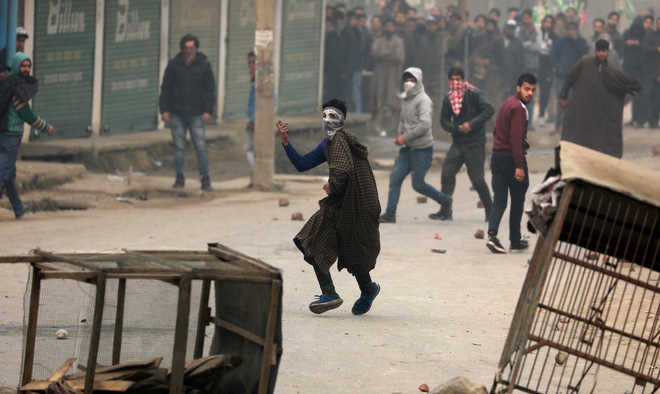
Youths throw stones at security personnel during clashes in the Valley. Tribune photo
Pune, December 25
Asserting that India should adopt a “clear-cut roadmap” to tackle the Kashmir issue, former DGP of Jammu and Kashmir K Rajendra Kumar has said the US pulling out troops from Afghanistan will have implications in the Valley and terrorist outfits may feel emboldened.
Kumar was delivering the Lalitaditya Memorial Lecture in Pune, organised by the Sarhad organisation. He also said that there was a need to send a stern message to Pakistan for its support to militancy.
“A stern message needs to be sent out to Pakistan in terms of retaliation. We need to make it more costly for Pakistan because today it is not feeling the pinch it should feel,” said Kumar.
He said India should deal strongly with Pakistan over the training camps and terrorist launchpads.
“Now the USA is exiting Afghanistan. It will have implications in Kashmir. It is only a matter of time before we will feel its implications in the Valley. After the US withdrawal, the terrorist organisations will feel pumped up, emboldened,” he said.
Seeing America’s withdrawal as a “sign of victory”, terrorist outfits can feel that New Delhi can also be defeated. So, there is an urgent need for India to adopt a “clear-cut roadmap” to deal with terrorism in Kashmir, he asserted.
The US is planning to withdraw 7,000 troops from Afghanistan. The American troops contribute to training and advising local forces fighting the Taliban and the Islamic State group.
Underling Pakistan’s active role in spreading terrorism in the Valley, the former IPS officer said Pakistan was not only sponsoring terrorism but also sending its nationals to Kashmir in the garb of fighting jihad. “No matter which government is in power, Pakistan continues to sponsor terrorism in the Valley,” he said.
He said militancy in Kashmir started with local terrorist organisations but now it was tilting towards Islamic extremism. “The Valley has a rich history of Sufism but over the years it has moved towards Wahabism,” he said, adding that efforts should be made to take Kashmir back to Sufism.
Suggesting measures, he said the state needed stringent laws to deal with anti-national forces and a concrete policy to encourage youths to give up militancy.
The surrender policy must ensure that youth who give up militancy are gainfully employed and discouraged from returning to it, he said. He also called for political outreach and empowerment of the civil society.
He said the social media had played a destructive role in inciting sentiments of the youth. — PTI
Big Brother watching Govt overreach encroaches on privacy:::opinion Tribune
The recent order by the Cyber and Information Security Division of the Ministry of Home Affairs giving 10 Central agencies the power to intercept and monitor information on computer devices has rightly been criticised by a cross-section of society. The order would empower such agencies to access computers of any individual or organisation, giving them the power of ‘interception, monitoring and decryption of any information generated, transmitted, received or stored in any computer’. Computers are the fulcrum of day-to-day lives and activities of individuals, and allowing any agency unbridled power to snoop over them smacks of an Orwellian overreach. There should be judicial oversight to any situation that requires a security agency to infringe on an individual’s privacy. Due process should never be threatened by the possibility of subversion due to expedience or for any other reason.
The country has started setting boundaries for international companies by asking them aggressively to locate their data centres in India, and thus curb the flow of information on Indian citizens internationally. Indeed, even financial services like Mastercard have now started purging data on Indian credit card holders from international servers, and there has been some movement in social media sites locating data centres in India. All this is to safeguard the privacy of Indian citizens and save their information from being traded by apps and cyber companies. Any encroachment of privacy is a matter of concern, be it from international conglomerates or the government. Indian citizens have a right to privacy and this must be respected.
The government’s defence that it has basically modified an earlier order to the same effect is a weak one. The language of this order allows any of these agencies to demand access to data stored in computers of any kind. Not only that, they can ask for the data to be decrypted and monitor data that is transmitted from computers. ‘Surveillance state’ fears expressed by Opposition leaders are real, and it is up to the state and its agencies to reassure the citizens.
Justice delivered Sajjan Kumar’s conviction a watershed
Congress leader Sajjan Kumar engaged in a criminal conspiracy, promoted enmity, and acted against communal harmony in the 1984 anti-Sikh riots, and has been sentenced to life by the Delhi High Court. The conviction of a senior politician marks a watershed in the quest for justice for the victims of the 1984 violence, even as it vindicates the stand of those who pursued justice relentlessly for 34 years to bring the guilty to book. The high court took the evidence of two eyewitnesses, and based on their testimony, reversed the earlier trial court verdict acquitting Sajjan Kumar, even as it upheld the conviction of the others accused in the case and enhanced their sentence.
The tide seems to have turned in favour of those seeking justice for the carnage that followed the assassination of the then Prime Minister Indira Gandhi. There was a conviction last month too. The sentencing of Sajjan Kumar — who was a Member of Parliament in 1984 and remained politically active for long thereafter — will surely send a chilling message to politicians who feel a sense of impunity even as they tear apart the country’s social fabric by instigating various groups of people against one another. Riot after riot has roiled India, often with the ‘blessing’ of the party in power at the time, with little consequence for the individuals who perpetuated the violence.
The latest conviction has been widely welcomed among Punjabis, including Chief Minister Amarinder Singh and state Congress chief Sunil Jakhar. However, it has obviously provided fodder to the BJP’s propaganda machine, more so since the verdict coincides with the swearing-in of Congress leader Kamal Nath as Madhya Pradesh Chief Minster. Nath, too, has been under a cloud for his role in the ’84 riots, but nothing has stuck so far. There will, no doubt, be fresh calls for justice by victims energised 34 years after the killings. The nation owes it to itself to let justice take its course, and demonstrate that those who had conviction in the system were not wrong.
For first time I feel this is my own country: Jagdish Kaur
Partially relieved by the conviction of Sajjan Kumar, Jagdish Kaur, the prime complainant in the case against the Congress leader, today said her fight for justice was far from over and she would struggle till the last breath of her life.
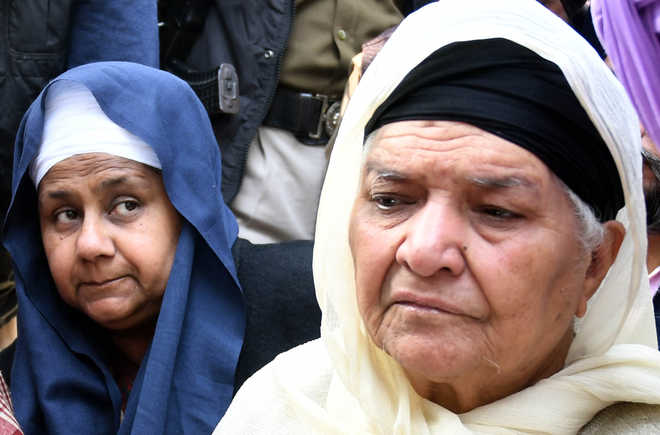
“I want Sajjan Kumar to hang. I have seen my son burn to death in front of my eyes. And this was done at the behest of Sajjan Kumar. I will go to the Supreme Court but I must say for the first time today I feel this is my own country. Till now I felt Indian laws were not for the 1984 riot survivors,” said Jagdish Kaur, flanked by cousin Jagsher Singh, both witnesses in the case the HC decided today.
She still remembers the afternoon of November 1, 1984, when “communally charged mobs incited by Sajjan Kumar” attacked her house in Delhi Cantonment’s Raj Nagar from all sides. “They had sariyas, other lethal weapons and pounced upon my son Gurpreet. My husband was dragged and his head crushed till he dropped dead. Gurpreet ran some distance before he was set on fire,” remembers Jagdish Kaur, wiping her tears.
She said after shifting her son’s body back into the house, she went to the police post to get help for cremation. “I still remember what the ASI said. He said ‘bhag yahan se, abhi to aur marenge,” recalls Kaur, who used furniture in the house to perform the last rites.
Even today Jagdish Kaur thanks her stars for sending her three small daughters and a son to a Hindu neighbour’s house for shelter.
“Not all Hindus wanted to kill Sikhs. These were only a few politically motivated crowds that wanted to earn brownie points in the eyes of their masters. I was saved by a Hindu, so were my cousin Jagdish Kaur’s four children,” remembers Jagsher, who lost three brothers to the carnage on November 2, 1984.
“It was November 2, a day after Jagdish Kaur lost her husband and 18-year-old son Gurpreet, a gold medallist in BSc. I had gone out of the house to park my bike when the crowds attacked. I ran and hid in a Hindu neighbour’s house. My brothers — Narinderpal Singh, Raghuvinder Singh and Kuldip Singh — were killed. The fight for justice has taken unbelievably long and it’s not yet over,” Jagsher Singh, now based in Gurdaspur, said.
For her part, Jagdish Kaur, who moved to Amritsar after riots, withstood threats and inducements to see this day. She slammed the Congress for appointing Kamal Nath, allegedly involved in the riots, as CM of Madhya Pradesh, saying, “I am not surprised. Sajjan Kumar also got top positions. This is their character. They have no value for human lives.”
Court on survivors’ courage
The accused have been brought to justice primarily on account of the courage and perseverance of three eyewitnesses — Jagdish Kaur, whose husband, son and three cousins were among the five killed; Jagsher Singh, another cousin of Jagdish Kaur, and Nirpreet Kaur, who saw the Raj Nagar Gurdwara being burnt down and her father being burnt alive by the raging mobs… the witnesses were fearless and truthful.
‘84 riots: HC blasts Delhi Police for ‘active connivance’ in carnage
New Delhi, December 17
The killing of over 2,700 Sikhs in the national capital during the 1984 riots was a “carnage of unbelievable proportions” and the way the Delhi Police acted at that time established their “apathy” and “active connivance” in the brutal murders, the Delhi High Court Monday said in stringent observations.
The high court, which convicted and sentenced senior Congress leader Sajjan Kumar to life term for “remainder of his natural life” in a 1984 anti-Sikh riots case, blasted the Delhi Police for its “abject failure” in probing the violence following the assassination of then Prime Minister Indira Gandhi.
It said that police had “indeed turned a blind eye and blatantly abetted the crimes committed by the rioting mob” and the probe conducted by them in these cases was a farce.
A Bench of Justices S Muralidhar and Vinod Goel noted it was “extraordinary” that despite there being as many as 341 deaths in the Delhi Cantonment area alone over the span of four days beginning November 1, 1984, only 21 FIRs were lodged, of which only 15 pertained to deaths or murders.
“Ultimately, only five bodies were recovered and that too was because of the intervention of Army,” the high court said, adding, it is “trite” that for each incident involving offence of murder, a separate FIR had to be registered.
In its judgement, the Bench said, “What happened in the aftermath of the assassination of Indira Gandhi was indeed carnage of unbelievable proportions in which over 2,700 Sikhs were murdered in Delhi alone”.
Referring to the case on killing of five Sikhs, the Bench said, “The law and order machinery had clearly broken down and it was literally a free for all situation which persisted”. It said there was no question of clubbing many complaints pertaining to several deaths in one FIR and it was strange that despite the widespread killing and bedlam in the area, no mention of this was found in the daily diary register (DDR) maintained by the police.
“It is clear, therefore, that in those chaotic conditions, the local police force was inadequate for the task at hand,” the Bench said, adding the DDR was completely silent about the commission of any cognizable offence although as many as 30 murders had occurred in Raj Nagar area itself.
“These circumstances establish the apathy of the Delhi Police and their active connivance in the brutal murders being perpetrated,” the Bench said.
The case relates to killing of five Sikhs in Raj Nagar part-I area in Palam Colony in South West Delhi on November 1-2, 1984 and burning down of a Gurdwara in Raj Nagar part II.
The high court said aftershocks of atrocities against the Sikhs were still being felt and the need for proper probe in these cases was also acknowledged by the apex court which had in January this year constituted a special investigating team to investigate as many as 186 cases.
“As pointed out by the trial court, the state machinery came to a complete standstill in those two or three days when the rioting mobs took to the streets and indulged in acts of violence and killings, and setting properties on fire,” it said.
The court noted that the “mayhem, destruction, and murders” that rocked Raj Nagar area ensured exodus of Sikhs and many of the males were either killed or were put in such a fear that they were scared to be seen in long hair and beards.
“There was a two-pronged strategy adopted by the attackers. The first was to liquidate all Sikh males and the other was to destroy their residential houses leaving the women and children utterly destitute. The attack on the Raj Nagar Gurdwara was clearly a part of the communal agenda of the perpetrators,” it said.
The high court directed 73-year-old Kumar and other five convicts to surrender by December 31, 2018, and not to leave Delhi.
Six accused, including Sajjan Kumar, who was a Member of Parliament at that time, were sent for trial in 2010 and three years later, the lower court had convicted five of the accused but acquitted the Congress leader of all the charges.
The high court convicted Sajjan Kumar for criminal conspiracy and abetment in commission of crimes of murder, promoting enmity between different groups on grounds of religion and doing acts prejudicial to maintenance of communal harmony and defiling and destruction of a Gurdwara.
The Bench also upheld the conviction and varying sentences awarded by the trial court to former Congress councillor Balwan Khokhar, retired naval officer Captain Bhagmal, Girdhari Lal and former MLAs Mahender Yadav and Kishan Khokhar. PTI
Pak court tells govt to send jailed Indian national home within a month
A top court in Pakistan has given one-month deadline to the federal government to complete formalities to deport Indian prisoner Hamid Nihal Ansari, whose three-year jail term will end on December 15.
Ansari, a 33-year-old Mumbai resident, is currently lodged in Peshawar Central Jail after being sentenced by a military court to three years’ imprisonment, for possessing a fake Pakistani identity card, on December 15, 2015.
He was arrested in Pakistan in 2012 for illegally entering the country from Afghanistan, reportedly to meet a girl he had befriended online.
A two-judge Peshawar High Court bench, comprising Justice Roohul Amin and Justice Qalandar Ali Khan, on Thursday heard an appeal filed by Ansari through a senior lawyer. The petition said the federal government hadn’t taken any steps for his release.
Ansari’s lawyer, Qazi Muhammad Anwar, said his client’s prison term would end on December 15 and he should be released on the morning of December 16.
Anwar informed the bench that the sentence of Indian national would complete after two days and both the Ministry of Interior and authorities of prison, where he was lodged, were completely silent about his release and deportation to India.
After hearing this, Justice Khan asked the Additional Attorney General to explain how they would keep the prisoner in jail after completion of his term.
“I wonder that after two days the jail term of the prisoner would be completed and the government did not complete requirements for releasing and deportation of the prisoner,” the judge observed after the additional attorney general informed the court that the documents for release and deportation of the prisoner were not ready.
An officer, representing the interior ministry, informed the court that a prisoner could be kept for one month while the legal documents were being prepared.
After knowing the legal position, the court directed the ministry to make all the arrangements within a month for releasing and deportation of the prisoner.
On previous hearing, the deputy attorney general recorded his statement on behalf of the interior ministry and said Ansari would be handed over to Indian authorities at the Wagah border after completion of his term.
Ansari had gone missing after he was taken in custody by Pakistani intelligence agencies and local police in Kohat in 2012 and finally in reply to a habeas corpus petition filed by his mother, Fauzia Ansari, the high court was informed that he was in custody of the Pakistan Army and was being tried by a military court. PTI
Stories etched in stone and steel :: War Memorials
Besides commemorating the bravery and dedication to duty of soldiers, war memorials also serve as living libraries that showcase the tales of decorated as well as the unsung heroes. These enlighten and inspire just like the written word. Vijay Mohan and Tribune reporters narrate the stories of some such memorials in the region
Rezang La War Memorial, Rewari
Rewari has the distinction of having an exclusive memorial dedicated to the martyrs of Rezang La battle, who fought against the Chinese in November 1962 in Ladakh. As many as 62 of the 114 Indian soldiers killed in this battle were from Haryana and 30 of these martyrs belonged to the Rewari region. With a ‘Sudarshan Chakra’ adorning the memorial’s edifice, the names of all martyrs have been engraved on stone along with comments of some senior officers regarding their gallantry.
Razang La, was one of the most decisive battles fought against the Chinese and is officially recognised as a “rare battle in military history” with the fighting being hard and bitter and troops going beyond the call of duty. The Chinese casualties are officially estimated at 500, while other sources put these between 500 and 1000.The memorial is looked after by a nine-member Rezang La Trust.
— Ravinder Saini
Army Heritage Museum, Shimla
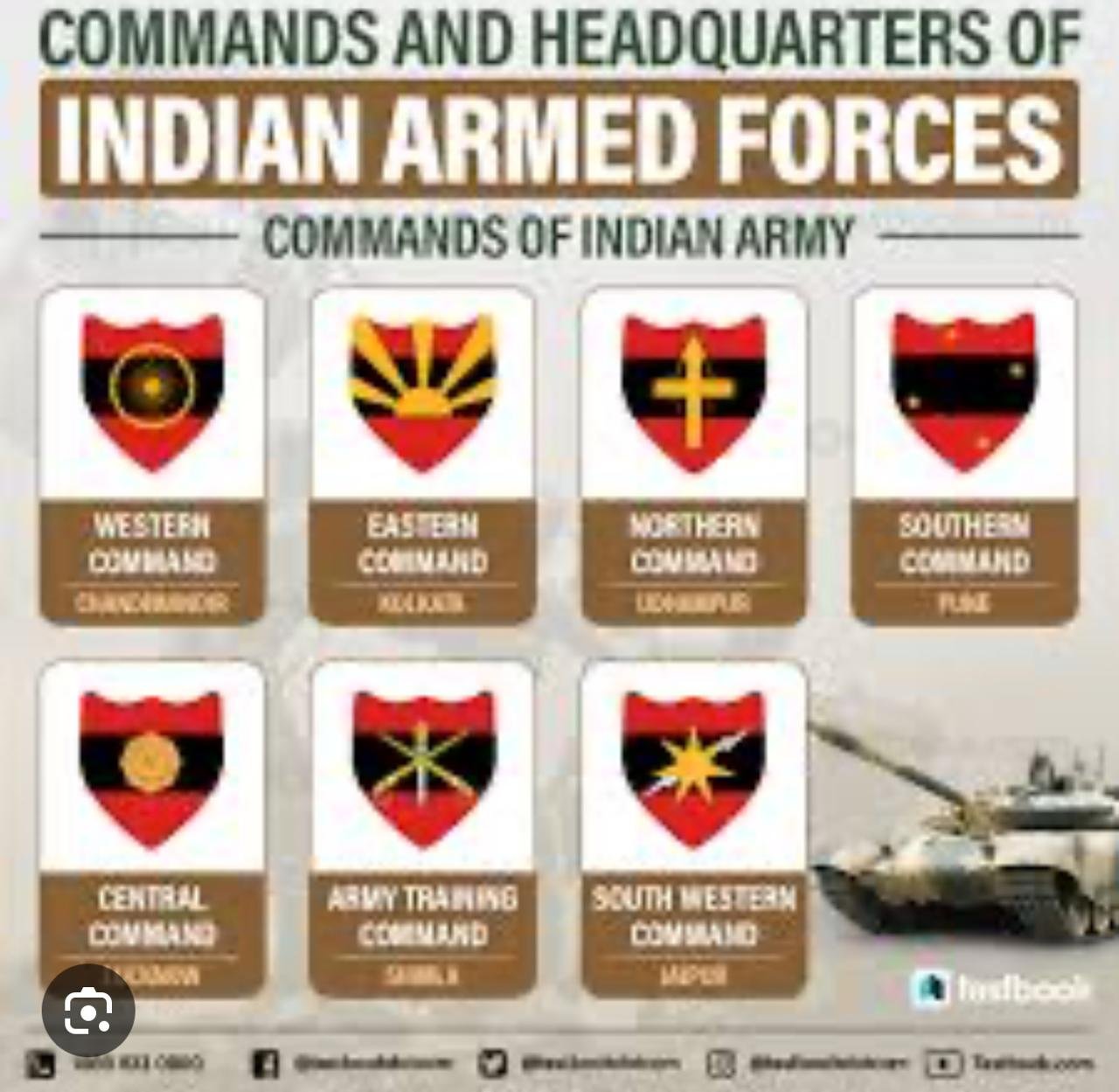
The 5,000 year history of courageous feats dating from the Mahabharata era to the present times is at display at the Army Heritage Museum at Shimla, which has also earned the distinction of being the only museum of its kind in the country. Established in 2006 by Army Training Command (ARTRAC), it houses rare artifacts such as the captured flag of 1st Bahawalpur Infantry Battalion of Pakistan, bust of Khuda Dad Khan, the first Indian to be decorated with the Victoria Cross, execution order of Mangal Pandey who raised the banner of rebellion against the British in 1857. A section is dedicated to the bravest of the brave and has photographs of all 21 Param Vir Chakra recipients, rolls of honour and models depicting battles of Laungewala and Tololing (Kargil).
— Bhanu P Lohumi
Martyrs’ Park, Dharamsala
The war museum at the Martyrs’ Park in Dharamsala was inaugurated before the last Assembly elections, but even a year later it is yet to be opened for public. Presently only the first floor of the museum has been furnished with busts of war heroes from the state, models of various gallantry medals, including the Victoria Cross and Param Vir Chakra.
The wooden outer structure is designed on the theme of old Himachali architecture. Like many other monuments in the state, maintenance is still an issue.
— Lalit Mohan
Chandigarh War Memorial
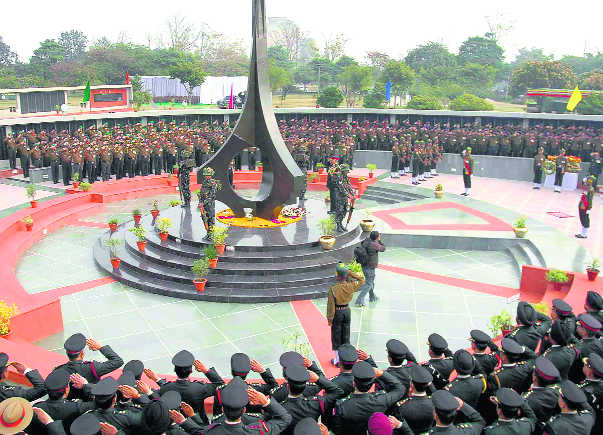
Perhaps the largest war memorial in the country with the names of about 10,500 personnel from the three services who died in the line of duty since 1947 inscribed on its walls, the Chandigarh War Memorial was inaugurated by the then President of India, Dr APJ Abdul Kalam in August 2006.
It has a unique architectural concept and design. The central edifice consists of three converging posts, signifying the Army, Navy and the Air Force, emerging from a terraced circular base. It lies within a sunken circular arena about six feet below the ground level, surrounded by granite walls bearing the names of martyrs from Punjab, Haryana, Himachal Pradesh and Chandigarh. The design was meant to be in continuity with the city’s landmark structures and also gel with the lush surroundings in which it is located. The plan for the memorial was conceived by the late Lt Gen JFR Jacob, who had commanded a division in the 1965 Indo-Pak war and later negotiated Pakistan’s surrender in 1971, when he was the governor of Punjab in 2004. Memorial ceremonies are held at the monument on important occasions like Martyrs’ Day.
Kargil War Memorial, Dras
The world’s second coldest inhabited place, Dras, is also the site of the memorial commemorating the sacrifices of those who fought in the summer of 1999 in the Kargil sector. The memorial has a huge epitaph with the names of all officers and soldiers who had made the supreme sacrifice in the conflict, code named Operation Vijay. Every year on July 26 — known as Kargil Vijay Diwas — a ceremony is held here to pay tributes to the martyrs.
Punjab State War Heroes Memorial and Museum, Amritsar
A 45-meter-high stainless steel unsheathed blade of a sword turned towards Pakistan is difficult to miss as one drives from Amritsar to the Attari-Wagah border. This tallest standing sword in India is the central vista of the Punjab State War Heroes Memorial and Museum located 16 km from the border between Amritsar and Lahore. Apart from this iconic sword, three tanks — a Pakistani Sherman captured in 1965 by the 7th Light Cavalry; a Pakistani Patton captured in 1971; and the Indian Centurion Tank that figured prominently in the 1965 and 1971 wars, a de-commissioned MiG-23 fighter and a scale model of INS Vikrant aircraft carrier are among a host of war trophies and rare artefacts that can been seen.
Spread over eight acres on the fringes of the Khem Karan battlefield where Pakistan’s 1 Armoured Division was decimated in the 1965 War, the complex was inaugurated in October, 2016. According to the original plan, nine display galleries, each depicting a significant period of battle in which Punjab stood to India’s defence — the times of Guru Hargobind , the Anglo-Sikh wars, the two World Wars, the India-Pakistan wars of 1947, 1965 and 1971, the India-China War of 1962 and the Kargil War in 1999, were to come up. Right now, visitors have access to only six. After skipping numerous deadlines apparently over funding, the work on the eighth gallery dedicated to 1999 Kargil War and fourth gallery depicting World War I, the Battle of Saragarhi and the Jallianwala Bagh massacre — is still underway.
— GS Paul
Siachen War Memorial, Nubra
The story of Siachen remains unparalled in the history of warfare. Nowhere have soldiers fought and held ground for so long under perilous conditions, where more men have fallen to the vagaries of nature than to enemy bullets. The Siachen War Memorial is situated the rugged, barren landscape of the base camp on the banks of the Nubra that flows from the glacier that forms the world’s highest battlefield. The names of all soldiers who have died in Operation Meghdoot since 1984, are etched here.
Punjab State War Memorial, Jalandhar
Dedicated to post-Independence war heroes, this memorial near the bus stand in Jalandhar remains neglected due to a reported tiff between the Jalandhar Improvement Trust and the Defence Services Welfare Department over whose responsibility it is.
There is a hexagonal raised platform around the Amar Jawan Jyoti, which has the names of gallantary award winners since 1947 engraved on black granite. Pictures of Param Vir Chakra recipients, Flying Officer Nirmaljit Singh Sekhon, Subedar Joginder Singh and Capt Gurbachan Singh Salaria, along with the details of their feats are displayed. There is a separate room for the heroes of Kargil War, which has about 28 pictures of martyrs from Punjabl. The memorial is in neglect and no longer remains much of an attraction and has only a few visitors in a month.
— Deepkamal Kaur
War Memorial, Hisar
Set up in March 1995, this memorial is dedicated to soldiers from Hisar district who had sacrificed their lives in various wars and operations. Located outside the mini secretariat, it has the names of martyrs inscribed on its edifice, led by the name and citation of Second Lieutenant Hawa Singh, who was decorated posthumously with the Vir Chakra in the Eastern Sector in 1971.
— Deepender Deswal
Programme – Military Literature Festival, Chandigarh 2018 :Venue – Lake Club
Ajay Banerjee
Tribune News Service
New Delhi, December 3
With Chinese warships regularly patrolling the Indian Ocean, the government has approved an expansion and upgrade plan for the Navy with 56 new ships and submarines.
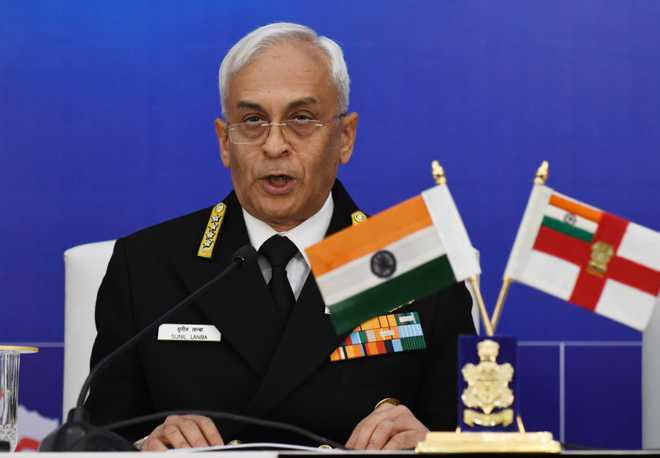
Navy chief Admiral Sunil Lanba, while addressing a press conference on the eve of Navy Day here on Monday, said, “The government has given approval to having 56 ships and submarines. Some of these will replace the existing fleet and include new ships like fleet ships, submarines and mine sweepers.”
He said the construction plan would be spread across a decade. This is in addition to the 32 ships and submarines under construction, as of now.
Navy Day is observed on December 4 to mark the famous ship-launched attack on Karachi during the 1971 Indo-Pak war.
Admiral Lanba said the attention of the entire world is focused on Indian Ocean region. We are the net security provider. We are committed to keeping the area clean of all traditional and non-traditional threats in the Indian Ocean.
On being asked about the naval preparedness for a simultaneous two-front war, the Admiral said, “We have overwhelming superiority over Pakistan at sea. In case of China the balance of power in Indian Ocean
is in our favour. Similarly, the balance of power in South China Sea is in favour of China.”
On the US assessment that China would be a big naval power by 2050, the Admiral said, “By 2050 we will also have 200 ships, 500 aircraft and be a world-class navy.”
He said the three chiefs had agreed on having a permanent Chairman Chiefs of Staff Committee (CoSC). On theatre commands, he said we needed a high defence organisation before we got to creating theatre commands. “We need one operational commander, the three chiefs cannot be operational commands.”
On being asked about the delay in taking action against Reliance Naval and Engineering Limited in supplying five offshore patrol vessels, the Admiral said there is no preferential treatment. “The bank guarantees have been encashed. The OPV contract is being examined.”
On the make in India efforts, he said as of now, in the past four years, 72 per cent of all contracts are given to India vendors.
On coastal security following the 26/11 Mumbai terror attacks, the Admiral said a pilot project on to fit Automated Identification System (AIS) transponders on fishing boats had been successful. “It will now be implemented across India. There are some 2.2 lakh fishing boats–under 20 metres in length–that do not have AIS transponders. The issue was to have low-cost transponders. I agree it has taken 10 years but soon we will have these transponders on
all fishing boats,” he said.
Court relief for ex-IAF chief in chopper case CBI told to cancel lookout circular against Tyagi
A Delhi court today directed the CBI to cancel the lookout circular (LOC) issued against former IAF chief SP Tyagi, an accused in the VVIP chopper scam. Special Judge Arvind Kumar directed the probe agency to inform the authorities concerned about it.
The CBI had issued LOC — to check if a person who is travelling is wanted by the law enforcement agencies — against Tyagi in 2013.
The CBI on September 1, 2017, had filed a chargesheet in the case in which Tyagi and British national Christian Michel were named as accused along with others. Eight others were also named in the chargesheet in connection with a bribery case in the VVIP chopper deal.
Tyagi (73) is the first chief of the Indian Air Force to be chargesheeted in a corruption or a criminal case by the CBI and he has denied all charges against him. On January 1, 2014, India scrapped the contract with Italy-based Finmeccanica’s British subsidiary AgustaWestland for supplying 12 AW-101 VVIP helicopters to the IAF over alleged breach of contractual obligations and charges of paying kickbacks to the tune of Rs 423 crore by it for securing the deal.
The CBI has alleged there was an estimated loss of 398.21 million euro (around Rs 2,666 crore) to the exchequer in the deal that was signed on February 8, 2010, for the supply of VVIP choppers worth euro 556.262 million. — PTI
Country not ready to see women in body bags: Army chief on difficulties of putting women in combat role
General Rawat questioned whether a women officer with commanding responsibilities can stay away from her post for long stating that she is on maternity leave.
New Delhi: Army Chief General Bipin Rawat on Saturday said there are women officers engaged in exercises like mining and de-mining operations and also manning the air defence system, but cited difficulties in assigning them frontline combat role. He said that in frontline combat there are risks of officers getting killed.
“See, I am not saying a woman who has children doesn’t die. She can also die in a road accident. But in combat, when body bags come back, our country is not ready to see that,” Rawat said.
“We have women officers as engineers, they are doing mining and demining work. In air defence, they are manning our weapon systems. But we have not put women in frontline combat because what we are engaged in right now is a proxy war, like in Kashmir,” he said.
He cited logistical reason also behind not posting women on frontlines. “Our orders are that a lady officer will get a hut in the COB, then there are orders that we have to cocoon her separately. She will say somebody is peeping, so we will have to give a sheet around her,” Rawat said.
Rawat questioned whether a women officer with commanding responsibilities can stay away from her post for long. “I am ready, it is not that army is not ready (for combat role for the women). Will she command? Ok, so now I make her a commanding officer. She is commanding a battalion. Do I put a restriction on her to say that in that command tenure you will not be given maternity leave? If I say that, there will be ruckus created?” he added.