









Sanjha Morcha

Look beyond each other’s flaws

Doklam standoff over, India and China should declare a 1,000­year cessation of hostilities

OMAKARAND R. PARANJAPE n Monday, the ministry of external affairs in a two-point statement on the “Doklam disengagement understanding” announced an “expeditious disengagement of border personnel at the face-off site.” Typically, China’s official Xinhua News Agency confirmed the news as India’s withdrawal of troops, without mentioning if its own troops would also back off. As India prepares for the 9th BRICS summit to be held at Xiamen, China, from September 3 to 5, this could decrease tension between the two nations.

But if the Indian Army chief’s comments are anything to go by, we should not be too optimistic, let alone be lulled into complacency. Delivering the General BC Joshi Memorial Lecture at Savitribai Phule Pune University on August 27, General Bipin Rawat warned that China is trying to “change the status quo” on our border and incidents like Doklam are likely to “increase” in future.

China’s belligerence towards India is nothing new. In the last few years, we have been unable to move even an inch towards resolving our disputes along the 3,488-kilometre border we share with China.

Thumbing its nose over India’s concerns, China has powered ahead with its $46 billion corridor through Pakistan-occupied Kashmir (PoK). This amounts to a refusal to accept that even PoK is a disputed area, let alone Balochistan, where the Gwadar port, the terminus of its uber-ambitious One Belt, One Road (OBOR) project, is located.

China has not only repeatedly blocked India’s membership to the Nuclear Suppliers Group or vetoed United Nations resolutions to label Masood Azhar a global terrorist, but has also cozied up considerably to Pakistan in the last few years. No wonder that when the 14th Dalai Lama visited the Tawang monastery in Arunachal Pradesh in April, China threated to intervene in Kashmir. Of course, there was no mention that China’s claims over Arunachal Pradesh arise out of its takeover of Tibet, which the Tibetan Government in Exile views as illegitimate and illegal.

How does one make sense of China’s allround bellicosity and muscle-flexing? According to defence analyst Brahma Chellaney, the roots of China’s “imperial overreach” lie in the “Chinese dream”. This is the Communist Party of China’s ambition to make the country the world’s leading power by 2049, the centenary of communist rule in that country. Its current general secretary, Chinese President Xi Jinping, is merely carrying out this mandate. In the upcoming 19th Party Congress, Xi is expected to be cleared to lead China for another five years.

Given that the US seems to be sliding from its pre-eminent position, this may seem, on the surface, to be a logical and realisable goal. After all, China may become the world’s leading economic power before 2049. It’s military ambitions, it appears, is to supplant the US over the next couple of decades. But economic and military power is not enough. China will also need cultural and political legitimacy, which it lacks now. Instead, China is becoming increasingly unpopular the world over, especially in Asia because of its intimidation of its smaller neighbours. By standing up for Bhutan at Doklam, it is India, which has behaved with surprising firmness in thwarting Chinese designs.

Given the recent appointment of the much-decorated and battle-tested 63-yearold General Li Zuocheng as head of the joint staff department, China wants to send the message that it will continue to act tough. Li has already met Pakistani army chief Qamar Javed Bajwa in Dushanbe, Tajikistan. With the Peoples Liberation Army primed up over the past few months for hostility, India must also prepare for any eventuality, not taking lightly China’s threat to teach it a lesson.

Ideally, however, India and China should declare a 1,000-year cessation of hostilities. Though, we have no idea what the world will look like 1,000 years from now, if our past record is anything to go by, our two civilisations have probably the best chance of surviving into the next millennium. Whatever the immediate differences, both India and China must recognise and regard each other not just as nations, but as great civilisations.

Chinese mandarins know that India’s hegemony in the subcontinent is a given. India too accepts China as an international superpower. Given our deep, historical, cultural ties and on-going geopolitical proximity, it is in the interests of both to build a stable and lasting friendship, based on mutual trust and respect. How to achieve this is a diplomatic and strategic challenge that both powers must embrace.

The forthcoming BRICS summit is yet another opportunity to move forward. If so, the de-escalation at Doklam is a welcome step


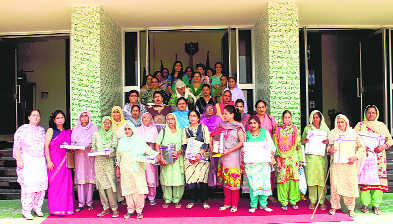
AWWA celebrates 51st anniversary

AWWA celebrates 51st anniversary
The Army Wives Welfare Association celebrated its 51st anniversary in Udhampur. Tribune Photo

Tribune News Service

Jammu, August 23

The Army Wives Welfare Association (AWWA) celebrated its 51st anniversary at Udhampur today. Raised in 1966, AWWA has evolved as one of the largest registered NGO of the country.Giving details, the PRO, Northern Command, said the AWWA Northern Command celebrated the occasion by organising a central function at the Chinar complex of the Udhampur Military Station.The celebrations were also concurrently held at other military stations in the Command Zone and the theme of the celebration was “Water Conservation”, wherein emphasis was laid on educating the families on the importance of water and various means for its conservation, he said.A documentary on water conservation was shown to provide knowledge on the management of natural resources and their care for the needs of the future generations and environment.Veer naris were felicitated during the celebrations. Regional president awards were conferred on some women for their outstanding contribution to the organisation during the year.In her message to members, Gowri Anbu, regional president, AWWA, re-iterated the overall AWWA theme of “Asha, vishwas and astha” and exhorted the fraternity to contribute to nation-building and undertake activities that not only enable the organisation to achieve its goal but also impact positively on society and the nation at large.


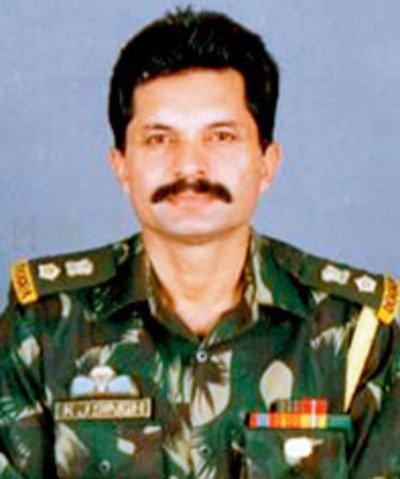
HOMAGE PAID TO MARTYR COL KJ SINGH SALARIA *SC,SM

Dogra Regiment Insignia.gif

15340009


CMsSYhkUsAAV6Ms


(

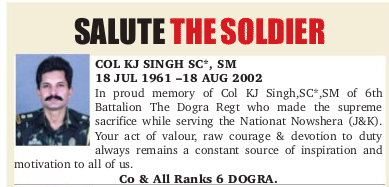
COL KJ SINGH SC*, SM
(18 Jul 1961 – 18 Aug 2002)
Late Col KJ Singh SC*, SM made the supreme scrifice on 18 Aug 2002 in the finest tradition of the ‘Dogra Regiment’ and In dian Army while fighting terrorists in Now shera, Rajouri (J&K). His act of valour, bra very and supreme courage always remains a constant source of insiration and motivation. “SOARING SIX” salutes our brave and cour ageous Commanding Officer, who lived up to the motto of ‘KARTAVYAM ANVATMA’. Remembered by: Col Anil Kumar, KC & All ranks 6 Dogra.


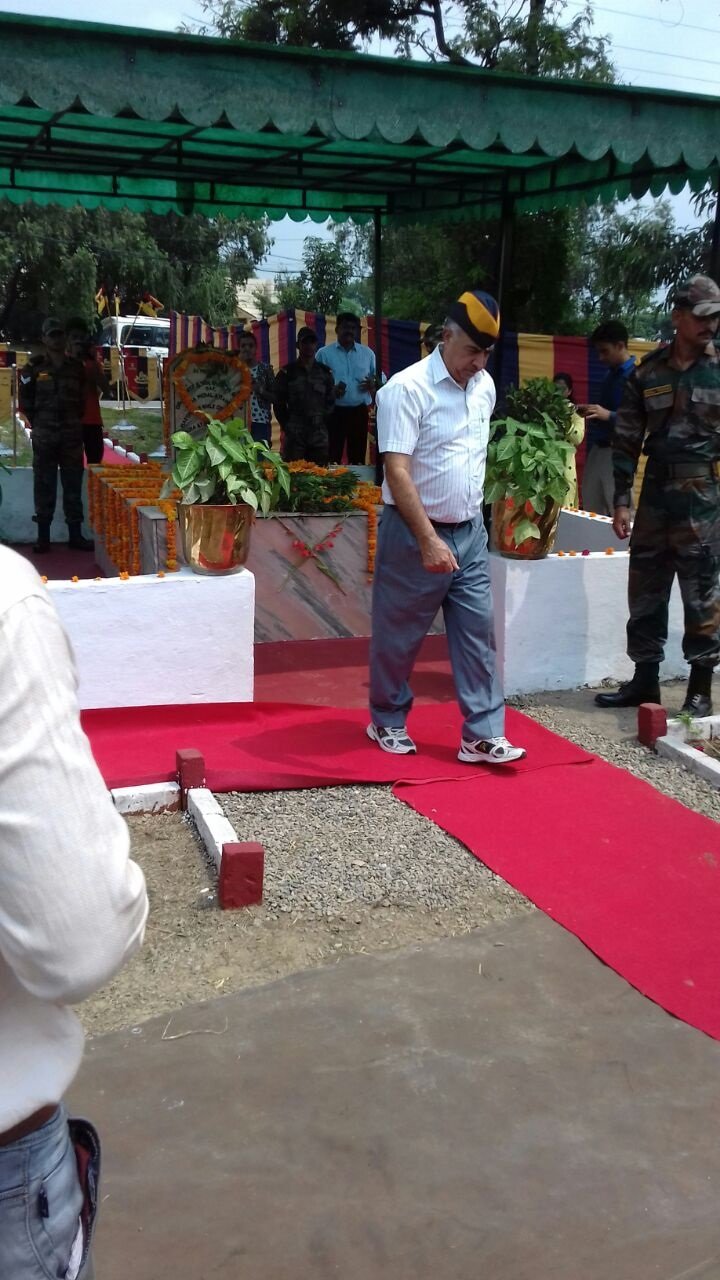
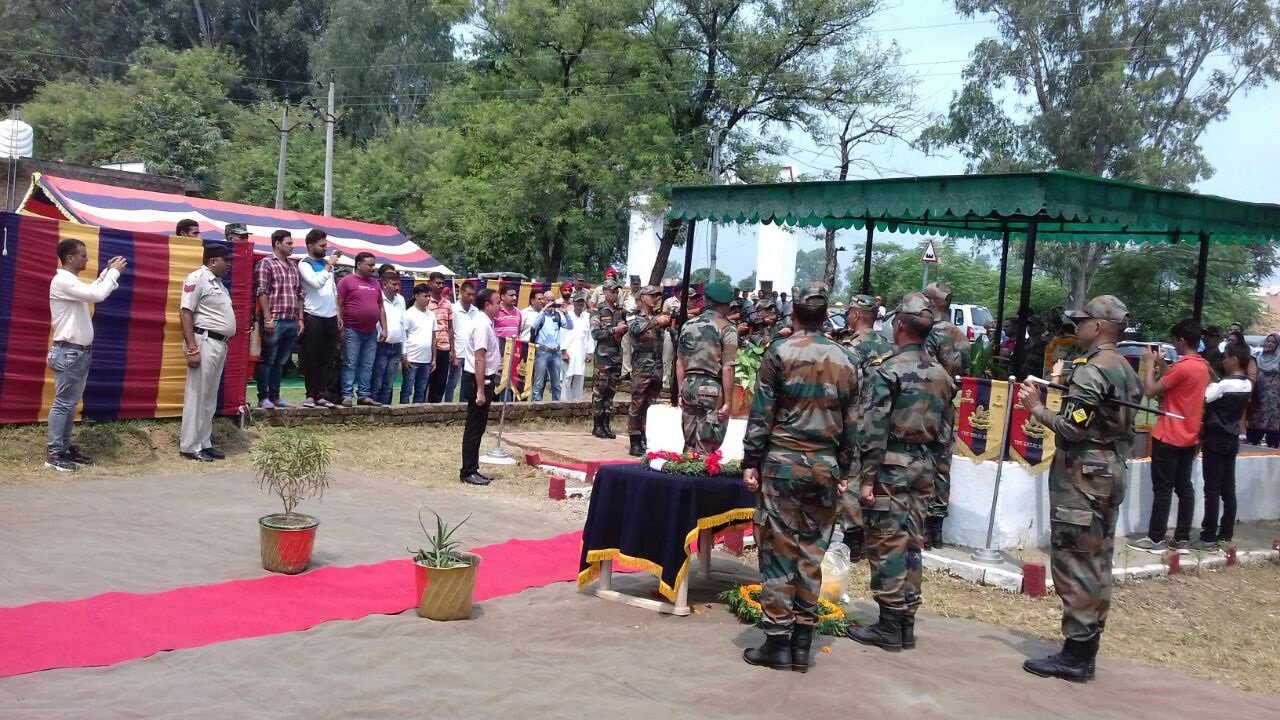
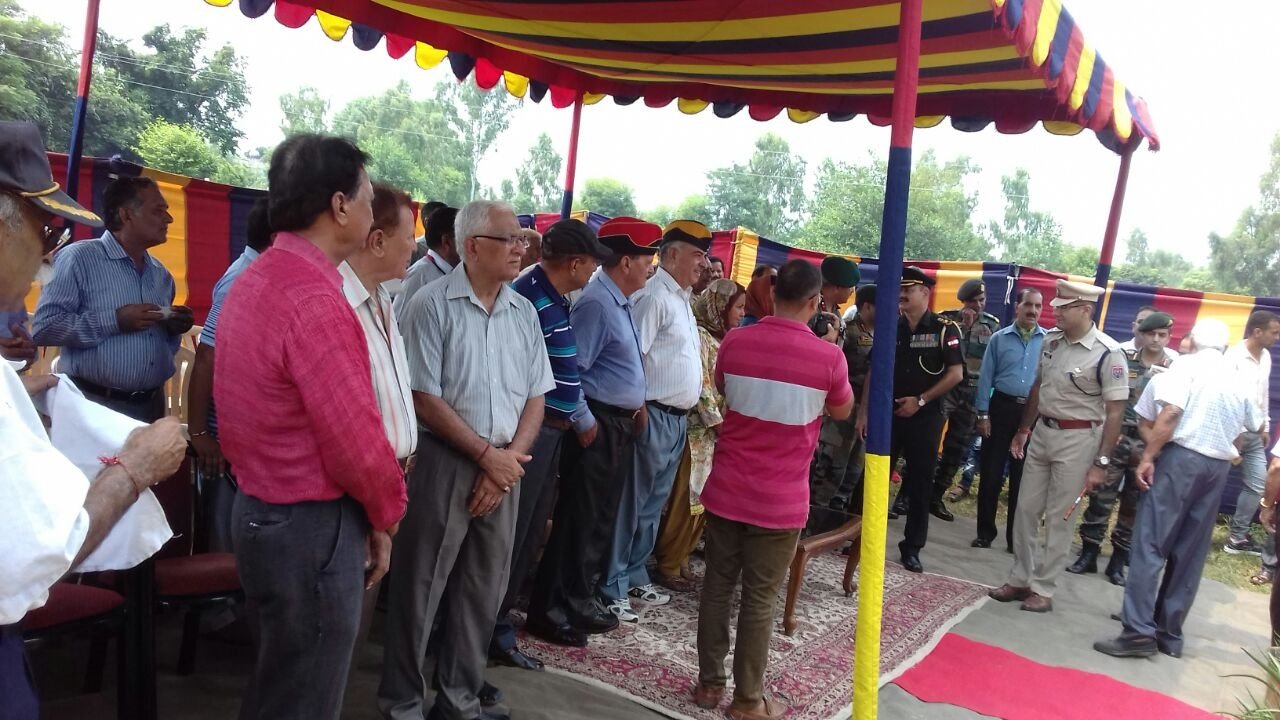
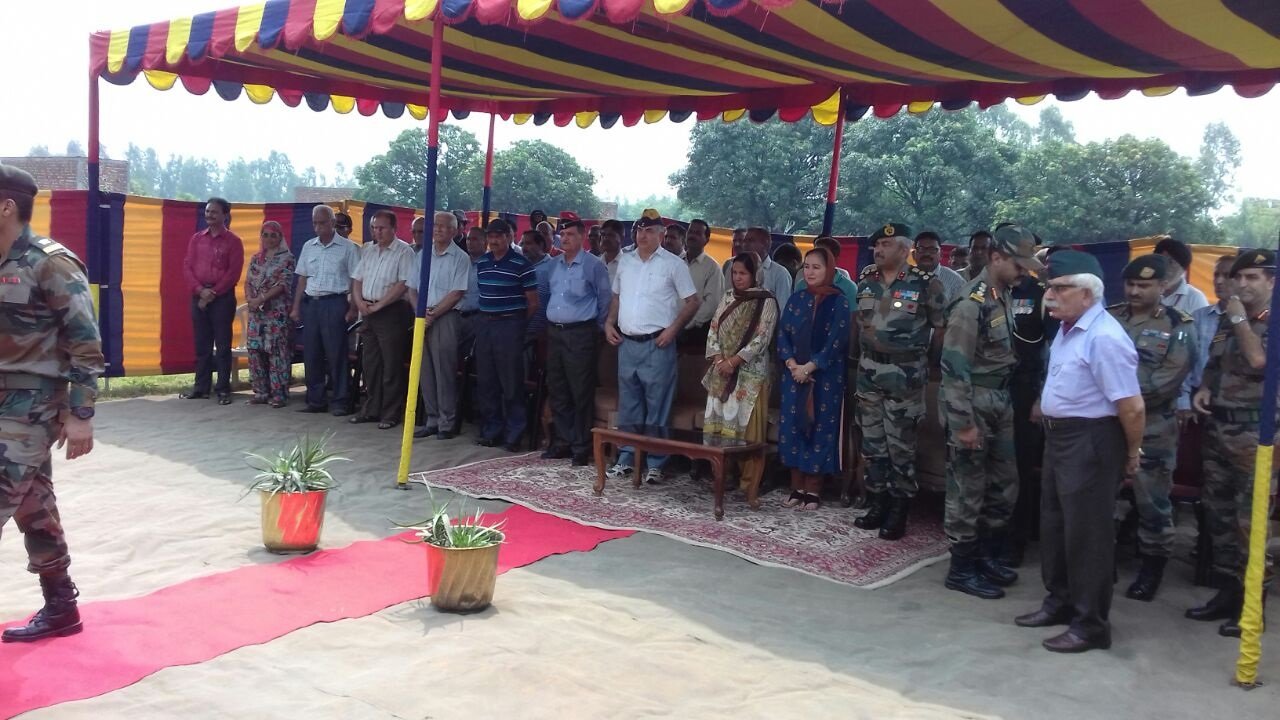
Homage  was paid to Martyr Col K J Singh SC*,SM and COAS commendation Card (Bar to SC) Co 6 Dogra at Village PAngoli ( Pathankot) on 18 Aug 2017.

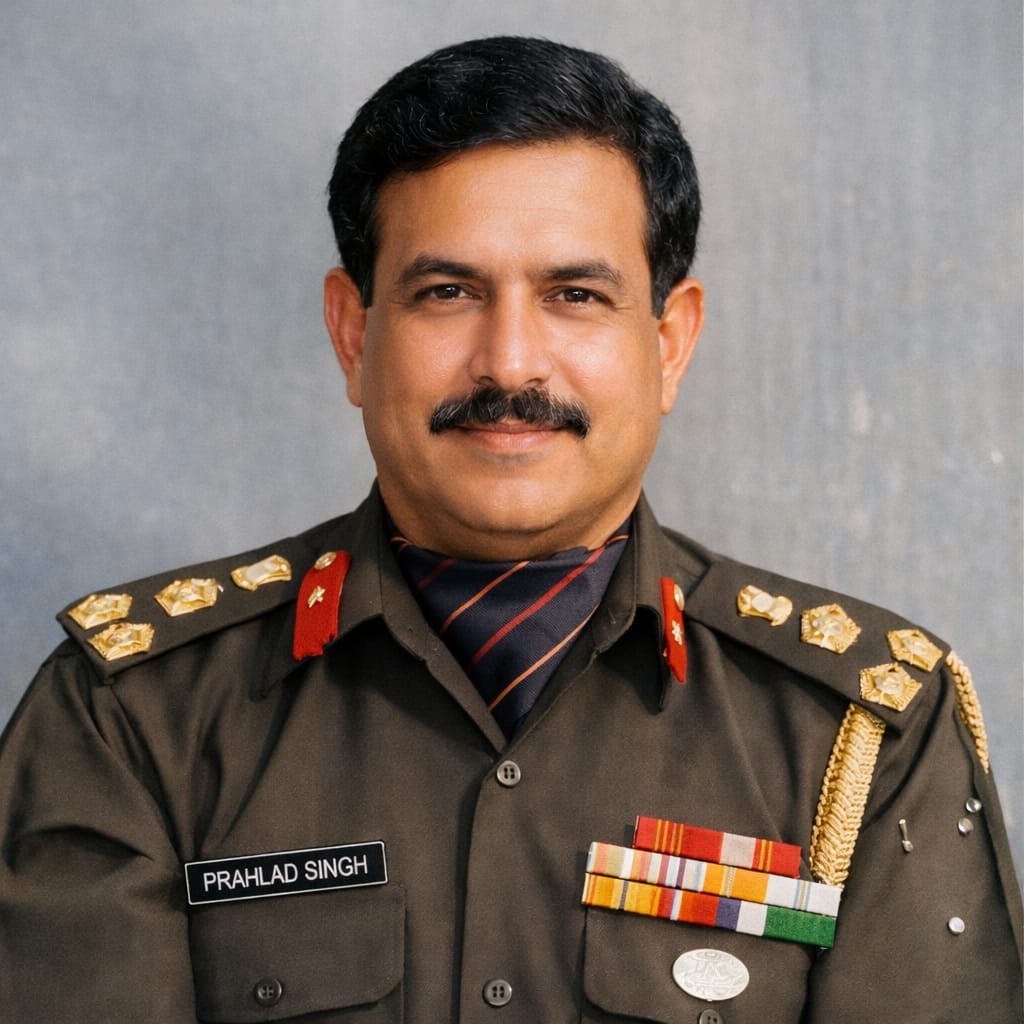
It was attended by Brig Prahalad SIngh , Chairman Sanjha Morcha and President UFEM ( Pathankot) welfare asociation along with many veterans and service personals from 6 Dogras

Brig Saini ,Dy GOC 29 Division and Commanding Officers from 6 Dogra,10 Dogra,2 Dogra and 19 Dogra were present apart from SP Pathankot

The importat of was that Mrs(Dr) K J Singh was also present and she flews from Banglore every year to Pay Homage to Her husband and their daughter is aslo married to Dogra Officer/

IMG-20170818-WA0028 IMG-20170818-WA0029 IMG-20170818-WA0030 IMG-20170818-WA0031


‘New India’: Rhetoric versus reality

For now it is just an alluring futuristic dream, being spun by a skilled political communicator

One of Prime Minister Narendra Modi’s great skills as a political communicator has been his ability to constantly summon up catchy buzzwords. If 2014 was the year of ‘achhe din’, Make in India and Swachh Bharat, 2015 was about Startup and Stand-Up India, 2016 was Digital India and 2017 is now about ‘New India’. But shorn of the artful messaging, what does ‘New India’ really mean?”

Is it a ‘new India’ when over 70 ill-fated children tragically die in a Gorakhpur government hospital, an annual monsoon ritual in one of the more backward regions of the country? Is the prime minister assuring us that Japanese Encephalitis will be conquered, that public investment in health will be doubled, or that primary health centres will be strengthened? The truth is, the public health system in the country is in the ICU.

Is it a ‘new India’ when Assam is flooded every year, when thousands are displaced in another annual catastrophe? Are we being assured that there will be a genuine effort to plug the encroachments of river banks, the lack of drainage, rampant deforestation, all of which contribute to the sorrows heaped upon hapless people by a swelling Brahmaputra?

Is it a ‘new India’ when government schools struggle to provide quality education to lakhs of students? In a statement in Parliament in 2016, the HRD minister acknowledged 18% teacher posts in government-run primary schools and 15% in secondary schools remain vacant. Is the government assuring an end to this teacher crisis in the immediate future?

Is it a ‘new’ India where agricultural landholdings are shrinking, where small and marginal farmers remain indebted to village money-lenders, where deepening agrarian distress means that even in a year of a bountiful harvest, farmers denied a remunerative price commit suicide? Is it a ‘new’ India where the government is in denial on the reality of a manufacturing slowdown and jobless growth, especially in a post-demonetisation universe? A recent study of the Centre for Monitoring the Indian Economy (CMIE) reveals that 1.5 million jobs were lost post-demonetisation in the first four months of 2017.

Is it a ‘new’ India where municipal authorities routinely fail to provide pothole-free roads, where every year dozens die in road accidents that could be avoided with better infrastructure and greater accountability? Is it a ‘new’ India where the backlog of cases continue to pile up in our courts, where the notion of speedy delivery of justice is a cruel joke being played on lakhs of petitioners?

Is it a ‘new’ India where fearful minorities are routinely subject to ‘patriotism’ tests, where sporting a cap and beard or eating beef, studying in a madarasa, reciting azaan or not singing Vande Mataram could provide automatic entry into the ‘anti-national’ club? Can a new India be built on ill-conceived cattle slaughter rules that seem to encourage vigilante groups to flaunt their muscle against cattle traders? The fact is, as a recent report on India Spend points out, Muslims comprised 86% the 23 Indians killed in 63 cow lynching related incidents since 2010: 97% of these incidents were reported post May 2014.

Is it a ‘new’ India where the prime minister promises to end bureaucratic and political corruption but where ‘local’ corruption and red-tapism still haunts the average citizen: India still ranks a lowly 79 least corrupt nation out of 175 countries in the Transparency International Corruption Perceptions Index. And if you believe ministerial corruption has ended, just travel to my home state of Goa where ‘rates’ for legislators switching sides to form a government are freely discussed.

Truth is, ‘new’ India is for now at least an undefined but alluring futuristic dream, one which is being strategically spun by a leader who knows that the promise of ‘achhe din’ that won him the 2014 general elections could never match the vaulting expectations it threw up. Rather than being devoured by past hype, the prime minister is cleverly changing the goalposts by embarking on another feelgood journey to woo the gen-next voter. Which is why the ‘new’ India artifice is not offering instant gratification but sets a five year target of 2022 by which time another election will have, in all probability, also been won! Post-script: Despite the ‘invented’ fantasy of a ‘new’ India, an India Today mood of the nation poll forecasts that the Modi-led alliance could win close to 350 seats if general elections were held now. Clearly, the hope of a better India embodied in the charismatic Modi persona is still attractive. Unless a divided and dispirited Opposition carves out its own compelling counter-narrative.


JCO, woman killed in Pak firing at LoC

JCO, woman killed in Pak firing at LoC
A file photo

Shyam Sood

Rajouri, August 12

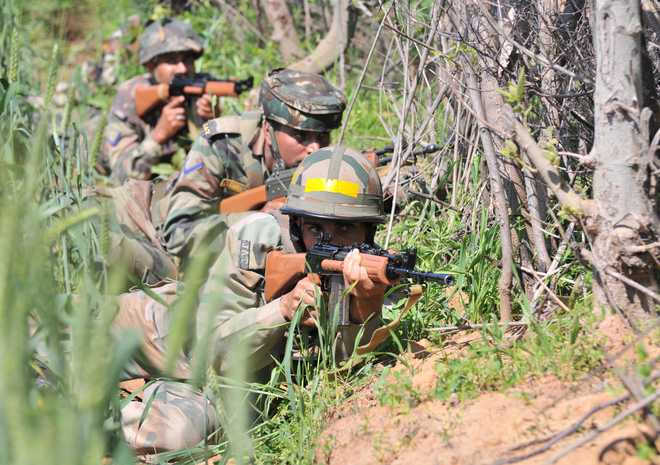
A Junior Commissioned Officer (JCO) and a woman were killed while a soldier was critically injured when snipers of the Pakistani army resorted to unprovoked firing at the Line of Control (LoC) in Poonch district today. In the afternoon, Pakistani snipers deployed at forward posts targeted Indian soldiers in the Barasingha area manned by Mahar Regiment.(Follow The Tribune on Facebook; and Twitter @thetribunechd)Naib Subedar Jagram Singh Tomar, 42, from a village in Morena district in Madhya Pradesh was killed while Sepoy Mohit was injured and shifted to a nearby Army medical centre, sources said.An Army statement released in Jammu said the Pakistani army initiated unprovoked firing on Indian Army posts in the Krishna Ghati sector around 5 pm, in which Naib Subedar Tomar  was grievously injured and later succumbed to his injuries.  He is survived by his wife, a son and a daughter.Naib Subedar Tomar is the 11th soldier of the Indian Army to have been killed while manning the LoC in Rajouri and Poonch districts during the past three months.The deceased woman was identified as Ruqia Bibi, a resident of Bakakot area of Mendhar sector in Poonch, the police said.


Shopian encounter: 2 jawans die, 3 hurt 

  • Two Army jawans were killed and three others were injured in a fierce gunfight in Shopian district of south Kashmir. There are reports that Hizb top commanders are trapped in the area
  • The gunfight erupted when an anti-militancy operation was launched at Awneera village, 70 km from Srinagar, on Saturday evening after an input that top Hizb militants were holding a meeting inside a mosque (With PTI inputs)


“You Will LOSE” – Chinese Experts Warn China against Waging a War With India By Yash Joshi

Amid the murmurs of a full-scale war with China, a section of Chinese experts have warnedChina against waging a war with India. The standoff at Doklam is over 40 days old now and with every passing day both India and more importantly China stand to lose. China is set to lose its lifeline, and the war eventually in case of an actual war.

According Macau-based military expert Antony Wong Dong “China is playing psychological warfare but it should realise that even if it defeated India in a war on land, it would be impossible for the PLA navy to break India’s maritime containment,” he said, pointing to the importance of the Indian Ocean as a commercial lifeline. Now, The Chinese import over 80% of its fuel consumption that travels through the Strait of Malacca and the Indian Ocean. The location of India is such that it lies in the heart of China’s energy lifeline and in case of a military conflict, there’s every chance that India will look to block China’s energy lifeline by using its location in a bid to cripple China. Also, India’s maritime containment is for all to see after the recent 10-day Malabar exercise which included USA, Japan and India holding a joint naval exercise and showcasing their maritime strength. A war with India will certainly destabilise the South China Sea which Chinese claim to be solely it’s, whose hegemony has been contradicted by USA, Japan, Vietnam and Philippines. USA recently, sent its warship to SCS as a show of support to Japan. One cannot rule out the involvement of USA and Japan to help India’s cause in case of a war with China.

Sun Shihai, an adviser to the Chinese Association for South Asian Studies, too echoed Wong’s views. He said he was concerned that the worst military stand-off in more than three decades would fuel anti-Chinese sentiment in India, as mistrust and hostility between the two countries run deep. If not properly handled, the border row could have a long-term impact on China’s efforts to expand its diplomatic and economic influence beyond the Asia-Pacific region with its “Belt and Road Initiative”, he said. China wants India to be a part of its One Belt One Road (OBOR) project as owing to India’s geographic location the success or failure of the ambitious project depends on India’s participation. Make no mistake, Chinese President Xi Jinping put immense pressure on India to join the project of which 29 countries are a part of but the Indian government didn’t yield. Liberals back home like Mani Shankar Aiyar and Sudheendra Kulkarni criticised the government for missing this opportunity. India’s opposition to the project is simple. The China Pakistan Economic Corridor(CPEC) that is a part of OBOR passes through Pakistan occupied Kashmir (PoK) and India can never be a part of such project. It is about India’s integrity and existence. CPEC tried to undermine India’s sovereignty and no Indian government would allow that. CPEC reflects China’s agenda of splitting PoK from India in its mission to achieve global leadership status. By joining OBOR, India would have had to forgo it’s claim to PoK. Also by continuously opposing India’s NSG bid and blocking India’s bid to declare Jaish-e-Mohammed leader Masoor Azhad to declare him a UN designated terrorist and now with the Doklam standoff, it will only push India further away from China and the handful of voices in India that supported China’s OBOR will also be muzzled. It is only likely that India will not even reconsider its stand on OBOR after the latest events.

China too is well aware of the futility of an all-out war for a desolate border area that remains frozen up for eight months of the year, it’s logistical cost being inestimable. The standoff is already having a knock-on effect. China’s intense psychological war “psywar” has led to a trade war between the two countries. The Regional Comprehensive Economic Partnership which was initiated by the members of ASEAN, was recently held in Hyderabad which saw a slowing down of discussions. The Chinese were hoping for this partnership to succeed amidst the pulling out of US from the Trans-Pacific partnership, a similar free trade agreement after Donald Trump became President. China was hoping that the success of this partnership which it promoted so zealously would further enhance its position as a global leader. But India threw a spanner in its works by denying to give greater market access to Chinese goods and instead demanded for greater market access for its skilled workers leaving China red faced.


Recently, The Chinese have been hurling empty threats on India like supporting the non-existent independence movements of Sikkim and Arunachal Pradesh. However back home, things for Chinese are not all rosy. Hong Kong remains unstable in the face of multiple democratic movements and Tibet continues to be volatile as always. Also, the $60 billion CPEC which passes through PoK will be under threat in case of a war. China will further risk the fate of CPEC and OBOR if it escalates tensions as India can pave hurdles on the progress of OBOR , a project in which China has already heavily invested in.

China is said to be extremely protective of its investments and India expects it to only hurl empty threats and not escalate tensions. Maybe that’s why China stopped Indian pilgrims from visiting Mansarovar but not trade through Nathu-la. China stopping the trade route might have invited a similar Indian response.

However, by not bowing down to Chinese “carrot and stick” policy, India has called China’s bluff. China wanted to control the narrative of the Doklam stand off and it’s increasingly clear that it is China who is on the back foot. By constructing a strategic highway that would have given the Chinese a militarily advantageous position, it expected Bhutan’s diplomatic protest but a bully being bully, Bhutan’s protest has fallen to deaf ears. But China half expected India’s swift military action in Doklam to bail out Bhutan and deny China holding a knife against it leading to a logjam.

India, in the face of vitriolic warmongering, has defiantly stood up to the Chinese and refused to budge. By calling the bully’s bluff, India has set an example for other Asian states to emulate. Chinese “psywar” has resulted in next to nothing and only hampered China’s hard-earned reputation. China wanted the narrative to focus on India’s aggression in Chinese territories and play the victim card like it did in 1962 and 1967. But with Bhutan’s support owing to India’s excellent diplomatic ties due to PM Narendra Modi’s endeavours, the narrative quickly changed to China being a bully and bullying a small nation (Bhutan) and India stepping in to help it’s one of the closest allies. China has caught itself in a mess completely of its own making and India must not let go China easily. Both countries can ill afford a war owing to the excellent trade partnership but China has more to lose. The longer this standoff drags on, more questions will be raised on the sustainability OBOR which China simply cannot afford. The upcoming autumn’s Communist Party Congress Which Xi Jinping is looking to head and cement his position as China’s most powerful leader since Mao Zedong, he cannot afford this issue to drag on and hamper OBOR and India should turn the tables on China and look to defeat China in its own game. By playing “psywar” with the Chinese and letting the issue to drag on till the harsh winter forces both the countries to retreat and restore the status quo, Xi Jinping and China will be left sulking and possibly Chinese losing their influence in Asia as South Asian countries will continually look to India’s brave defiance in face of Chinese aggression.

The Chinese experts are perhaps not wrong in warning China of raising the stakes against India and in all probability Chinese won’t unless it wants to self-destruct its economy. One must fear the health of these experts as free speech and open criticism of government is generally not met warmly in China. India on its part must ensure that there are no more Chinese incursions by teaching China a lesson in Doklam. If India succeeds in its mission, China will lose its fear factor that it prides itself of and uses to it to get favours from countries like Sri Lanka and Philippines.


HEADLINES 07 AUG 2017

  • VETERANS EMAIL REACTIONS TO MAJ GEN SATBIR HOLDING ON JM
  • ÈSM WELFARE MEET WAS ORGANISED BY STN CDR KANDRORI ON 06 AUG 2017
  • AMBALA MARTYR’S KIN TO APPROACH HIGH COURT WANT GALLANTRY AWARD FOR HIM
  • NEW RULES CLIPPING TRIBUNAL WINGS COME UNDER HC LENS
  • MARTYR LAID TO REST WITH FULL MILITARY HONOURS
  • THERE IS NO MILITARY SOLUTION IN J&K, SEPARATIST FINANCES SHOULD HAVE BEEN TARGETED MUCH EARLIER BY LT GEN SYED ATA HUSNAIN
  • TIDINGS FROM DOKLAM BY M. K. BHADRAKUMAR
  • OUR ARMY IS FAR FROM BATTLE-READY
  • 1,400 KM DUATHLON: A TEST OF GRIT IN MEMORY OF MARTYRS EXPEDITION MARKS 18TH ANNIVERSARY OF KARGIL CONFLICT
  • THE SECTARIAN DIVIDE IN ISLAM : HOW IT AFFECTS GEOPOLITICS AND INTERNATIONAL SECURITY BY LT GEN SYED ATA HASNAIN
  • SC MOVED FOR EARLY HEARING OF APPEAL IN BOFORS CASE

Major Pandey lays down life fighting terrorists in Shopian

Major Pandey lays down life fighting terrorists in Shopian
Major Kamlesh Pandey

Tribune News Service

Dehradun, August 3

A pall of gloom descended on Haldwani in the Kumaon division of Uttarakhand as soon as the news of martyrdom of Major Kamlesh Pandey in Kashmir spread in the region. Major Pandey attained martyrdom fighting terrorists at Shopian in Jammu and Kashmir today. Major Pandey’s family stays at Himmatpur Mohalla in Haldwani. His father Mohan Chandra Pandey is an ex-serviceman. The family hails from Almora district. Kamlesh did his primary schooling from his hometown. He passed   Class XII from Kendriya Vidhyalaya, Ranikhet. Starting his career in the defence services as an Airman in 2006, a hard working Kamlesh continued with his studies and did his graduation. He then cleared the Combined Defence Services and  became a commissioned officer in the Army in 2010. Kamlesh was promoted to the rank of Major a few months ago. Shanti Pandey, Kamlesh’s mother, was in a state of shock. A large number of Haldwani residents visited Kamlesh’s residence to offer their condolences.


Pak violates ceasefire in Nowshera

Jammu, August 30

Pakistani troops today targeted forward posts and villages in Rajouri district, officials said.Indian troops guarding the Line of Control retaliated and the exchange of fire between the two sides was going on when the last reports came in.Officials said the firing by Pakistani troops was reported in the Nowshera sector of the district around 10.35 am. There was, however, no report of any casualty, they said.Nowshera along with other sectors in Rajouri and Poonch have witnessed a sharp increase in truce violations by the Pakistani army this year.Hundreds of Nowshera residents are living in government relief camps at safer places since July after being displaced by cross-border shelling. On August 27, five persons were injured when Pakistani troops opened fire in the Shahpur sector of Poonch district.There have been 285 truce violations by the Pakistani army till August 1 this year. In 2016, the number was significantly less at 228 for the entire year, according to the Army figures. — PTI


Shoes in Tricolour boxes in Almora; locals suspect China hand

Shoes in Tricolour boxes in Almora; locals suspect China hand
File photo for representation only.

Dehradun, August 26

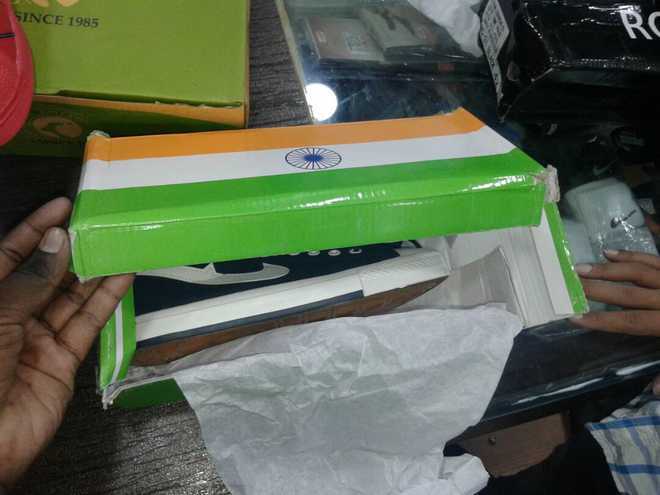
Twelve pair of shoes in boxes having the Tricolour design on the covers were recovered from a shop in Almora, with locals speculating they were dispatched by China, police said today.The shoe boxes with the design of India’s national flag were received by a local shop owner, who reported the matter to the police, Almora Superintendent of Police P Renuka Devi told PTI over phone.Locals speculate that the recovery of the shoe boxes from Almora, which is not very far from the Sino-India border in Pithoragarh, might be a handiwork of China to insult India, amid the ongoing stand-off at Dokalam.The consignment was received by the local shop owner from a distributor, named Tamanna Footwear, at Rudrapur in Udhamsingh Nagar district on Thursday, the SP said.The Rudrapur-based shop owner said, however, he received the consignment from a supplier in Delhi.“An FIR has been lodged against Tamanna Footwear as the national flag design on the footwear boxes seems intended to hurt Indian sentiments,” she said.The SP said nothing could be definitively said about the origin of the shoes or the boxes.“Investigations are on and we are trying to ascertain from where the boxes originated,” she said. — PTI