Sanjha Morcha

Patriotic fervour grips nation on 71st Independence Day

Patriotic fervour grips nation on 71st Independence Day
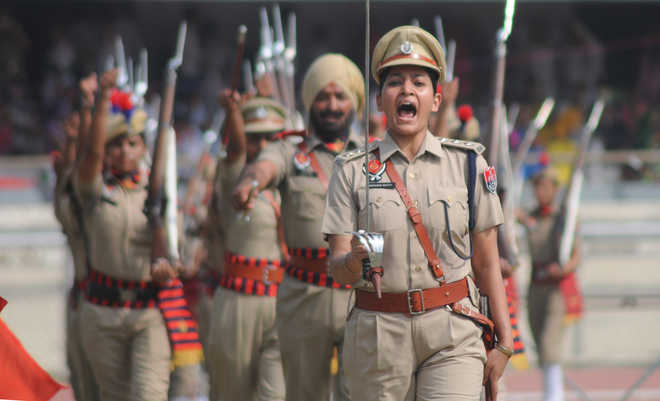
The celebrations in Ludhiana. Tribune photo: Himanshu Mahajan

New Delhi, August 15Patriotic fervour gripped the nation on the 71st Independence Day on Tuesday as people from across states and union territories came together to celebrate the occasion underlining the spirit of unity in diversity.As chief ministers hoisted the Tricolour amid tight security, they announced development programmes, flagged challenges confronting them and pledged to take their states forward.J&K CM Mehbooba Mufti used the occasion to talk about her state’s special status, express hope in country’s institutions and attacked Pakistan for fuelling violence in the state.On Article 35A, which has been challenged in the apex court, she said, “I am sure the Supreme Court will dismiss the present petition before it.”Mehbooba said the people of the state decided to accede to India as they found similarities in the pluralism that existed in the state and the country.She said many people across the country believed that J&K is the crown of India. “There is no doubt about it and it should remain like that,” she added.Meanwhile, mobile phone services and portable Internet services were snapped across Kashmir as a precautionary measure, officials said.Unfurling the national flag, UP CM Yogi Adityanath stressed the importance of Swachch Bharat Mission in tackling diseases like encephalitis as he regretted that children are dying even after 70 years of Independence.Addressing a gathering at the Chattarsal Stadium on the occasion, Chief Minister Arvind Kejriwal said the Delhi government would come out with a detailed plan to check spread of dengue and chikungunya in the next 10 days.He said the no-detention policy had ruined the education system and assured that the 60,000 students who had failed in Class 10 this year would be readmitted.Uttarakhand CM Trivendra Singh Rawat unfurled the flag and promised to honour the mandate given by the people by wiping out graft from the state. He said the government would work to achieve 100 per cent literacy in the state by 2019.Punjab Chief Minister Amarinder Singh assured farmers that his government would implement the promised farm-debt waiver scheme in about a month and appealed them not to consider committing suicide or taking any other extreme step.Gujarat Chief Minister Vijay Rupani announced setting up of 10 industrial estates for small industries, financial aid to fishermen, and free Wi-Fi on educational campuses.CM Devendra Fadnavis said the Maharashtra government aimed to make farmers debt-free and also announced that the homeless would be provided houses by 2019 as the Independence Day was celebrated with fervour across the state.However, the celebrations at some places in Maharashtra were marred by protests by farmers who sought to disrupt flag-hoisting over loan-waiver.In his address, Madhya Pradesh CM Shivraj Singh Chouhan said the state government aimed to make the state free of corruption and poverty by 2022. He also said every poor in the state would have a house of his own by 2022.Bihar Chief Minister Nitish Kumar expressed concern over the “grim flood situation” in his state and assured that the government would do everything to help people. He said the disaster-hit people had the first right on the state’s exchequer.People across West Bengal celebrated the day with colourful processions, parades and cultural programmes as Chief Minister Mamata Banerjee unfurled the national flag in Kolkata.Colourful tableaux depicting government schemes like Kanyashree, Sabujshree, Khadya Sathi and Sabuj Sathi were exhibited. A special tableau on the upcoming FIFA World Cup U-17, which will also be hosted in Kolkata, was also presented.As flood waters wreaked havoc in the state, Assam Chief Minister Sarbananda Sonowal said the main cause of the devastation by the Brahmaputra river is silt and sand carried by rivers from other states.The riverbed of the Brahmaputra is rising gradually and reducing its water carrying capacity, he said.“The prime cause of increasing silt and sand carried by rain water is deforestation in the neighbouring states. We have apprised the Prime Minister of the matter during his recent Guwahati visit,” he said.In Tripura, Chief Minister Manik Sarkar hoisted the flag at the Assam Rifles parade and cautioned against “a force trying to mix politics with religion”.In Itanagar, unfurling the Tricolour, Chief Minister Pema Khandu said the people of Arunachal Pradesh shared a special relationship with the armed forces, “who have stood by us in times of adversity and times of prosperity”.Odisha Chief Minister Naveen Patnaik suddenly fell ill while addressing the people at the Independence Day function but officials said he recovered soon. The CM left the parade venue only after taking salute.In Aizawl, Chief Minister Lal Thanhawla said Mizoram’s New Land Use Policy had brought development as the state celebrated the day with gaiety and enthusiasm.Meanwhile, Goa Chief Minister Manohar Parrikar appealed to the people to join hands with the government to make the state free of plastic by 2020.In southern states, Telangana CM Chandrasekhar Rao, in his Independence Day address, said the state government would soon take steps to give about 85,000 new jobs.

(Follow The Tribune on Facebook; and Twitter @thetribunechd)

Kerala CM Pinarayi Vijayan urged people to defeat attempts to “poison and dilute” the idea of nationalism, while his Tamil Nadu counterpart K Palaniswami said his government was working with the sole aim of public service “smashing all hurdles before us”.Karnataka Chief Minister Siddaramaiah said “imposition” of any language on a state is unconstitutional as he emphasised that the strength of the nation lies in the fact that all languages and communities not only co-existed, but also flourished by retaining their identities within the democratic set-up.


LIST OF PERSONNEL BEING CONFERRED GALLANTRY AWARDS ON THE OCCASION OF INDEPENDENCE DAY – 2017

KIRTI CHAKRA

1. IC-73531A MAJ PREETAM SINGH KUNWAR
2. SS-43887Y MAJ DAVID MANLUN (POSTHUMOUS)
3. 5047602N HAV GIRIS GURUNG (POSTHUMOUS)

SHAURYA CHAKRA


1. IC-71967M MAJ SATISH DAHIYA (POSTHUMOUS)
2. SS-42717H MAJ GOSAVI KUNAL MUNNAGIR (POSTHUMOUS)
3. JC-580725N SUB SHABIR AHMED
4. JC-414170P NB SUB SURENDRA SINGH
5. 4188533W NK CHANDRA SINGH (POSTHUMOUS)
6. 4578033Y L/NK RAGHUBEER SINGH (POSTHUMOUS)
7. 5250886X L/NK DEEPAK ALE
8. 13767992A L/NK KASHMIR SINGH
9. 15687392W L/NK BHANDORIYA GOPALSINH MUNIMSINH (POSTHUMOUS)
10. 2616368W SEP VENKATARAO ABOTULA
11. 2708834A SEP ARIF KHAN, GRENADIERS
12. 15225911X GNR RISHI KUMAR RAY
13. PID-036364 CONST MANZOOR AHMAD NAIK (POSTHUMOUS)

SENA MEDAL (GALLANTRY)


1. IC-61402N COL SAMARJIT RAY
2. IC-65751P LT COL ARUNKUMAR M
3. IC-64544W MAJ AMIT CHAMOLI
4. IC-66326W MAJ BHRAGU RAJ JANI
5. IC-68500W MAJ VARUN MAANDI
6. IC-68757F MAJ SAURABH CHAUDHURY
7. IC-69813F MAJ SUNIL SINGH, KUMAON
8. IC-70536N MAJ ABHIJIT DEORI
9. IC-70597L MAJ PARINAY BANSAL
10. IC-71085L MAJ ANOGH KUMAR CHANDA
11. IC-71390X MAJ SEKHAR KUMAR
12. IC-71459W MAJ MOHIT GREWAL
13. IC-71508N MAJ ADITYA VIKRAM SINGH
14. IC-71834W MAJ DEEPAK KUMAR UPADHYAY, SC
15. IC-72543H MAJ S ARUN
16. IC-72692W MAJ RISHI R
17. IC-73258W MAJ MALAY BAIDYA
18. IC-73515H MAJ BISHAL SINGH THAPA
19. IC-74906A MAJ PRADEEP KUMAR NIGAM
20. IC-75642W MAJ MANISH KUMAR YADAV
21. IC-75660Y MAJ ANKIT HARJAI
22. SS-42867Y MAJ SUMEER SINGH
23. SS-45482M MAJ PEEYOOSH PANDEY
24. SC-00640K MAJ JASBIR SINGH, ARMD
25. IC-77334P CAPT PRASOON SHARMA
26. IC-78348F CAPT SARANGTHEM SHYAM
27. IC-78817Y CAPT MITENDER YADAV
28. IC-79353Y CAPT JAIDEEP RAWAT
29. IC-80787L CAPT JASDEEP SINGH
30. SS-44873L CAPT MANOJ MALIK
31. SS-44990W CAPT RAKESH NAIR
32. SS-45306P CAPT UMESH LAMBA
33. SS-47626H CAPT AJIT LIMBU
34. JC-603041M SUB SHITAL PRASAD PUNN
35. JC-501049L NB SUB BALWINDER SINGH
36. JC-608107F NB SUB RAVIN KHANDAL
37. 13760447N HAV MOHD HUSSAIN
38. 13760972K HAV ISHWAR SINGH
39. 13764171A HAV ASHOK KUMAR
40. 2486816L HAV PRADEEP KUMAR
41. 4000066P HAV MADAN LAL (POSTHUMOUS)
42. 4076879Y HAV BRIJENDRA LAL
43. 4368172L HAV L PONGCHAI KONYAK
44. 5046806N HAV DAMAR BAHADUR PUN (POSTHUMOUS)
45. 3396369F L/HAV DAVINDER SINGH (POSTHUMOUS)
46. 13623331L L/HAV RAM KUMAR
47. 13764330M L/HAV RAISHAM SINGH
48. 2804152M NK TUPARE RAJENDRA NARAYAN (POSTHUMOUS)
49. 3197436K NK KULDEEP SINGH
50. 3999686L NK RADHA KRISHAN
51. 4192682F NK BHAGWAN SINGH RAUTELA
52. 4192720M NK PRAMOD KUMAR KANYAL
53. 4195610H NK HARISH SINGH CHUPHAL
54. 4573939A NK REVAT SINGH, MAHAR
55. 4574373K NK RAMBEER SINGH RAJPUT
56. 9108390L NK JAWEED AHMAD BHAT
57. 12984405N NK NASEER AHMAD MIR
58. 13625978X NK NANDA PRASAD
59. 14932294Y NK DILEEP KUMAR SINGH
60. 15337560P NK CHITTARANJAN DEBBARMA (POSTHUMOUS)
61. 2497303W L/NK PANJAB SINGH
62. 3004193L L/NK HANS RAM
63. 4005617Y L/NK RAKESH KUMAR
64. 4084852W L/NK SUKHPAL SINGH
65. 5049793M L/NK LAL BAHADUR THAPA
66. 5456130X L/NK RAJU CHETRY
67. 15169808X L/NK SAIKHEDE SAGAR ASHOK
68. 2503753M SEP PARAMJEET
69. 3007786H SEP BHAG SINGH
70. 3010595Y SEP PANKAJ SINGH
71. 3200871M SEP VISHAL CHAUDHARI (POSTHUMOUS)
72. 3202262F SEP BABALOO SINGH (POSTHUMOUS)
73. 3209481L SEP VICKY
74. 14848055Y SEP AJOY SARKAR
75. 14937791M SEP NEERAJ KUMAR
76. 5050884H RFN RABIN SHARMA (POSTHUMOUS)
77. 5251505X RFN BED SINGH RANA
78. 13770563K RFN ANGRAZ SINGH
79. 13770572L RFN RAVI KUMAR (POSTHUMOUS)
80. 13777554L RFN ABHINASH RAI
81. G/5006436W RFN RUHITESWAR CHANGMAI
82. G/5013646Y RFN KHAMPAI WANGSU (POSTHUMOUS)
83. G/5016453K RFN AMARNATH S
84. 4092134P PTR JAYVEER SINGH
85. 13776342N PTR VIKRANT PARIHAR

MENTION-IN-DESPATCHES

OPERATION MEGHDOOT


1. IC-56202N LT COL VIJAY KUMAR BAKSHI
2. 5353456N RFN ANUKET GURUNG (POSTHUMOUS)

OPERATION RAKSHAK

1. IC-69755H MAJ AKSHAY GIRISH KUMAR (POSTHUMOUS)
2. IC-71852Y MAJ GAURAV KINHA
3. IC-76379H MAJ SHAKTI SINGH
4. IC-76411M MAJ NARINDER SINGH
5. IC-76147K CAPT VARUN KRISHNAKUMAR
6. MS-17667X CAPT KUMAR ARUN
7. JC-460005W SUB SALUNKE SANJAY NARASING
8. JC-480701P SUB BRIJENDAR SINGH
9. JC-282317H NB SUB SHRI RAM
10. JC-413848Y NB SUB PADAM SUBBA
11. JC-413950F NB SUB BIRBAL SINGH
12. JC-522357Y NB SUB SAHDEV SINGH
13. JC-531945N NB SUB BEERENDRA SINGH
14. 3398304M HAV BALDEV SINGH
15. 3998858H HAV ANIL KUMAR
16. 5045851N HAV GUN BAHADUR KAMMU
17. 13623902Y HAV KONTHOUJAM INAOBA SINGH
18. 4482186L NK PARAMJEET SINGH
19. 5754424L NK JUDDHA BIR THAPA
20. 12974126P NK JAVID AHMAD MALIK
21. 13624847A NK BASANT
22. 13624854W NK AJAY KUMAR
23. 13763924P NK SANJEEVAN KUMAR
24. 16012707M NK BAHADUR SINGH
25. 2503351P SEP BIKRAMJIT SINGH
26. 9112611K RFN BILAL AHMAD DAR
27. 5050512X RFN MILAN THAPA
28. 13777667N RFN SANJAY KUMAR
29. 16019128H RFN PRADEEP KUMAR
30. 3013633P PTR DHARMENDRA KUMAR (POSTHUMOUS)
31. 4377501X PTR KALING MOYONG
32. 13628508X PTR IQBAL SINGH, SM
33. 15199324M GNR HARSIT BHADORIYA (POSTHUMOUS)

OPERATION ORCHID


1. IC-72362X MAJ VIKAS PANGHAL, SM
2. IC-75190Y MAJ RAHUL SHUKLA
3. SS-46005X MAJ VIKASH SINGH
4. 2507941L SEP MANPREET SINGH (POSTHUMOUS)


THE SECTARIAN DIVIDE IN ISLAM : HOW IT AFFECTS GEOPOLITICS AND INTERNATIONAL SECURITY by Lt Gen Syed Ata Hasnain

To study the sectarian divide in Islam you need to know the Middle East, one of the most complex regions of the world. You also need a degree of clarity on the geopolitical/geostrategic dynamics and the ideological fault lines which drive much of these in the region. As a backdrop to this essay a short brief on the above will help in clarity.

Besides other things which make the Middle East important it is its geographic location which sits astride the shortest routes (sea lanes) from the West to the East, the viability of having trade centres and the fact that it is the space which nurtured three major faiths of the world. The discovery of energy reserves only added to that importance which made the Middle East a crucial region for the economic and strategic stability of the world. Today it has become the hot bed of ideological and sectarian divide within Islam which is virtually holding the rest of the world to ransom.

Ideologically Islam has emerged as the dominant force in the Middle East even after the dismantling of the Ottoman Empire, the after effects of colonialism and the challenges of Israeli presence as an island within Islamic territories. Yet, the tribal hang over has never been far. Unity has been elusive and the march to modernism has only been in material terms, that too at peripheral levels. Islam remains deeply divided on political and sectarian lines robbing its people off the benefit of stability and growth. The hold of royalty and the clergy over the political fortunes of the Middle Eastern Islamic people has prevented them from achieving what could have been theirs many years ago.

It is the sectarian divide within Islam which drives much of the instability and is linked to almost all the current woes of the nations here, thus drawing in their wake competing forces from outside the region. Two aspects of the sectarian divide, the Shia – Sunni and the intra Sunni need to be understood to get a full measure of the problems.

First, the Shia versus Sunni. Where does this conflict come from? For the completely uninitiated it dates back to the death of the Prophet in 632 AD. He died without leaving a male heir. His first  follower and son in law, Ali Ibn Abu Talib (Hazrat Ali) was married to his daughter Fatima and had two sons Hussain Ibn Ali and Hasan Ibn Ali. It was considered by some that the Prophet had willed that his family alone would lead Islam or in other words the first Caliph after the Prophet’s death would be Ali. Equally the Prophet spent maximum time with some of his other close followers, chief among them being Abu Bakr. Thus when it came to succession since the Prophet had left no written will or directions his followers felt that the first leader to lead the people of Islam as the Caliph should be selected (elected) from among his followers. Abu Bakr thus became the first Caliph by popular choice. Ali’s claim that only members of the Prophet’s family could assume his mantel was rejected. He did go on to be the fourth Caliph by selection but by then the fracture lines had appeared and the Prophet’s family was hounded in the ambitions of power and expansion of the Islamic empire. Broadly those who follow the lineage of Islam through acceptance of Abu Bakr as the first Caliph are the Sunnis. Those who insist that Ali being a part of the Prophet’s family was the first legitimate Caliph (although took over as the fourth after Abu Bakr) are the Shias. This is as simplistic an explanation of a really complex set of circumstances which needn’t be spelled out here.

The divide would not have been so intense or hateful had it not been for the one iconic event of Islamic history, the Battle of Karbala where the remnants of the Prophet’s family led by his grandson Hussain were butchered for his refusal to pay obeisance to those opposed to the ways of the Prophet. For 15 centuries thereafter Islam has moved on but the divide among those who differ on the authority of the lineage has never been resolved; in fact it has worsened for some reasons explained below. The modern Middle East is divided into the Shia and Sunni strongholds with Saudi Arabia (the custodian of the holy shrines at Mecca and Medina) and a host of other nations ( Egypt, Jordan and the Gulf countries) being Sunni. Iran with the Shia crescent comprising nations such as Azerbaijan, Iraq (majority) and Bahrain (ruler Sunni but populace largely Shia) leads the Shia pack. The historical process by which each came to be as it is today has long drawn explanations beyond the scope of this write up.

It would have been simple if it was just a Shia-Sunni affair. The complication comes because Saudi Arabia is not just Sunni but follows a subsequent dispensation of Islam, hugely tainted today and known  as Wahabi (or Salafi)  Islam. There will be many who will challenge this simplistic idea of merger of the Salafi and Wahabi. For simplicity of understanding the Wahabi belief is essentially a revivalist philosophy which seeks to take Islam to its original roots, in the way it was when founded by the Prophet, as a movement against idolatry and other supposed anti-social malpractices. The label  Salafi comes from the Salaf or those who were the ideal followers of the faith the way the prophet followed it, and presumed to be the three generations that succeeded those followers. In the pre modern times the Salafi philosophy which frowned on any modern practices, such as emancipation of women or development of arts, was further developed under various  thinkers creating division after division within the Sunni community. A spin off was the Muslim Brotherhood (MB) in Egypt with its model of revivalism and political activism combined with Islamic charity work. While it spread its tentacles all over the Middle East its activism was shunned by monarchs and dictators whom it opposed.

The sectarian fault lines in the Middle East are extremely fuzzy and rarely sharp. Support and alliances are based on political convenience of the times rather than ideological unity and there is never any permanence in these. The geopolitics have, however, been largely dictated by the Shia- Sunni and the intra-Sunni conflict.

There was a Pan Arab/Islamic alliance against Israel which lasted many years. This was driven by a degree of passion with which there was involvement of Egypt, Jordan and Syria at the forefront and Saudi Arabia a bit player. Iran remained at the periphery being a beneficiary of US largesse during the time of the Shah.  In fact both Iran and Saudi Arabia were then apparent bit players in the geopolitics of the Middle East. It is the lethal combination of oil and ideology which changed things and it all happened simultaneously.

Egypt signed off from confrontation with Israel in 1978 and Jordan and Syria could not handle it alone to the extent they could earlier. In 1979 three iconic events of the second half of the 20th Century took place which sharpened the sectarian divide and brought the early manifestation of geopolitical confrontation in their wake. First the Iranian Revolution which brought the Shia clergy to power and a reversal of Iran’s US oriented modernism. Second was the Soviet invasion of Afghanistan, not directly linked to the Middle East but with serious implications and opportunities. The third and lesser known event was the takeover of the Grand Mosque by the renegade Ikhwan who tried to overthrow the Saudi monarchy through claims of the arrival of the Mahdi in the form of one of its leaders. In effect it was an indirect commentary on the House of Saud that it needed to be even closer to the ideology of the Salafis.

The results of the three almost simultaneous events strengthened the sectarian divide and their impact is being felt to the day. What were the exact implications? First the power of Saudi Arabia, enhanced by the energy crisis of 1973, then considered as the resurrection of Sunni power was now matched just across the Persian Gulf by the Shia power of Iran. Saudi Arabia thus far perceiving itself as the grand flag bearer of Islam was stung awake by the feasibility of the Shia model becoming stronger and having greater geopolitical influence. Second, the Ikhwan revolt sent the House of Saud to panic stations to promote revivalism and the Salafi model not only in Saudi Arabia and the Middle East but all over the world, for its own survival as much as to negate Shia influence.  This led to investment of time and money in as far away as Indonesia, Malaysia and South Asia.  Third taking off from the first two issues, the Soviet invasion of Afghanistan brought home the opportunity to Saudi Arabia to ally with the US and more importantly with Pakistan to ward off potential Iranian influence in its east and embed Salafism into one of the most populous Islamic regions of the world – Af-Pak, with potential to spread into the Muslim strongholds of India. Money power along with Arabic language and Salafi ideology moved into overdrive to contain the power of Shia revival. Pakistan was the happiest with this arrangement because it offered it sufficient scope to become a frontline state of the US and the surrogate of Saudi Sunni-Salafi revivalism in South Asia. Saudi money powered the search for nuclear capability and also the conversion of three million Afghan refugees to Salafi ideology. It sowed the seeds for the future employment of religious ideology as a weapon in J&K. Even more importantly it set the stage for Pakistan’s eventual conversion to a virtual theocratic state and thus the core centre for international radical and violent Islamic extremism. The power of sectarianism to lay waste an entire city is best exemplified by Karachi and many other urban centers of Pakistan where its substantial Shia population remains targeted. It makes Pakistan extremely wary of Iran which whom it shares a long boundary in its restive Baluchistan province.    The power of sectarianism has kept the divisions in Afghanistan wide open. Iran and India supported the Northern Alliance due to it being far less radical and opposing the Taliban which was backed by the Al Qaida. The US based its war with the Taliban on the back of the Northern Alliance for the same reasons. The Hazaras are Shia but the Tajiks and the Uzbeks are Sunni of a more moderate strain. All of them were a part of the Northern Alliance.

Saddam Hussain of Iraq was a Sunni but not of the Salafi strain. His Baathist party followed the secular, socialist model but his clash of interests with Iran and Saudi Arabia were beyond ideology. His defeat and removal upset the balance of ideological power in the Gulf and thereby the Middle East. Although secular by belief Saddam’s presence gave the minority Sunni Iraqis out of proportion power. Without adequate insight into the sectarian feelings of subjugation in Iraq the US sponsored Coalition Authority permitted overwhelming power to the Shia majority of the new Iraq; it formed the government although a power sharing formula existed. This was one of the major reasons for the rise of the ISIS initially backed by the Sunni militias.

The Shia Sunni conflict which has manifested into an Iran Saudi conflict of geostrategic interests has in recent years transformed into a series of proxy conflicts dotting the Middle Eastern landscape.  It is the Levant where one of the most vicious ones is in place even today drawing in multiple players such as the US, Russia and Turkey. The swathe of territory from Lebanon to West Iran scanning Northern Syria, Northern Iraq,  parts of Southern Turkey where areas claimed by the Kurds lie,  and touching the border of Iran. There is no distinctive stamp of Iranian Shiaism here but interests bring together Hezbollah in Lebanon, Allawite Syria (both Shia oriented) and Shia majority Iraq consolidated together in a Pan Shia conglomerate. Turkey is currently opposed to Saudi Arabia even as it is undergoing its own revolution in which the orientation of ideology remains largely uncertain; far from being Shia, it is also not Salafi. The Kurds have loyalties primarily to themselves but in alignment no one can say which way they will go; they have been hugely against any ISIS domination and have played no mean role in the defeat of the rogue non state group. The battle for the Levant has been on since the last six years and more vehemently after the advent of the ISIS which had made Northern Iraq and Northern Syria its stronghold. The rise of the ISIS was facilitated by the mistakes of the Shia dominated Iraqi regime. The subsequent vanquishing of the ISIS at Fallujah and now at Mosul  has been possible because of better understanding and cooperation with the Sunni militias. Russia’s involvement arising out of its need to protect its interests in the East Mediterranean and maintain presence of boots in the Middle East, has veered off towards a pro Shia support. It is with Iran, Syria (Bashir al Assad) and the Shia majority government of Iraq.

The polarized geostrategic environment is not in water tight compartments. Both the US and Russia support the Iraqi government. However, the US appears less concerned about Russia and more about Iran. Old enmity dies hard and Iran’s propensity to be unpredictable and fiercely independent cannot find US endoresement. Its alleged nuclear arms program has drawn the ire of the West and much more of the Saudi led Gulf Cooperation Council (GCC) and Egypt. The Saudi paranoia has led it into a meaningless, costly war against Iranian proxies in Yemen in an effort to prevent the spread of Iran’s influence. The war is unlikely to conclude in victory for either side.

Experiencing the complexities of the Middle East and conscious of the reducing US dependence on Saudi energy resources, former President Barak Obama tried to follow hands off policy towards the region. In 2011 he brought about withdrawal from Iraq. However, almost simultaneously the US attempts to bolster liberal democracy among the nations of the region through support to the Arab Spring came a cropper.  He attempted a softening of stance towards Iran leading to the signing of the Iran Nuclear Deal on 15 Jul 2015; this helped in de-isolating Iran and bringing a less radical President in leadership. However, it put the US on a path of dilution of its strong relationship with Saudi Arabia purely on grounds of the change in balance of power.

The above situation seems to have undergone a temporary   change with the recent much heralded Trump visit to the Middle East where President Trump attended a virtual summit of Sunni nations and placed himself strongly behind them thus once again returning to a ‘Shun Iran policy’. The Shia-Sunni and the intra Sunni divide has played a major role in the awkward alignment of relationships emerging from President Trump’s apparent decisions which have reportedly been based on insufficient research of the complexities of the Middle East situation. For example shortly after Trump’s visit four nations chose to break diplomatic relations with Qatar. All four, Saudi Arabia, UAE, Bahrain and Egypt are essentially Sunni (Bahrain’s ruling family is Sunni) while Qatar is also Sunni; Egypt is ruled by its Army which though supported financially by the Saudis and UAE is in power to keep the revivalist but revolutionary Muslim Brotherhood at bay. Muslim Brotherhood which has its branches all over the Middle East is supported by Qatar. The Saudis also detest the Muslim Brotherhood as it acts against royalty and does not believe in the division of mosque and state. The Saudi-Qatari rivalry is rooted in more than ideology with the Saudis unhappy with the prominent position being occupied by the Royal House of Qatar headed by Emir Sheikh Tamim bin Hamad Al Thani, its racing economy, high per capita income due to the gas and oil reserves and the fact that it is hosting the 2022 FIFA World Cup. The excuse put forward is that Qatar supports terror groups all over the Middle East and especially the elements of the Arab Spring through its high profile television channel Al Jazeera. The US has realized its mistake of supporting the whimsical Saudi action and even signed a 12 billion USD defence deal with Qatar thereafter. President Trump forgot that Qatar hosts a full forward base of the US Central Command, central to the US strategic presence in the Middle East. This standoff also aimed at Iran is sub sectarian in nature adding to the complexity of an already hugely complex strategic environment.

The inevitable question which should arise is about the future and the potential of any resolution of sectarian conflict within Islam. The answer can for a change clearly be in the negative. Islam has grown manifold in fifteen centuries and developed in diverse social ways in different parts of the world. However, to resolve its ideological divide it will need to shed the weight of history through a progressive, more tolerant and forward looking philosophy of existence which is not in confrontational mode with all other faiths. Such a possibility currently seems remote unless one views the current events as a churning before the forces of reformation take strength and take the faith through a unifying and self-healing exercise over a few generations. Only time will tell.

CLICK TO OPEN pdf File for actual article published

Link to DSA article – http://www.dsalert.org/DSA-Editions/August_2017_Lt_Gen_Syed_Ata_Hasnain_(Retd).pdf




India’s ‘China threat’ is to cover up internal failings: Chinese media

India is making up an imaginary “China threat” because of growing threats to its own national unity, a leading Chinese newspaper said on Tuesday.

“It is hard to understand India’s groundless ‘China threat’ theory,” said a report in the state-run Global Times by Long Xingchun, a research fellow at The Charhar Institute and director of the Centre for Indian Studies at China West Normal University.

“India probably just needs an enemy, even an imagined one. With multiple nationalities, religions and languages, plus intense internal conflicts and a strong centrifugal force pushing against national unity, India needs an external enemy as distraction.

“The previous arch-enemy Pakistan will no longer suffice as India grows into a big power. China, with large border areas in dispute and the memory of the 1962 war, naturally fills that place,” the report said.

The report questioned India’s decision to send troops into Doklam, which China says is its territory, leading to a dragging stand-off between the two armies. China has repeatedly told India to pull back its troops.

The report asked: “Is China really a strategic threat to India?”

It said the Siliguri Corridor on India’s northeast was on a plain rather than a plateau. “It only resembles a ‘chicken’s neck’ on a map, rather than a ‘neck’ in a geographical or military sense.

“Even if Chinese troops seize the 27-km wide corridor, this could in no way stop the movement of the Indian troops between the main bulk of Indian territory and its northeast. India knows this well enough and dwells on the ‘chicken’s neck’ to find an excuse for its intrusion into Doklam.”

It said New Delhi was worried that if its dragging border talks with China fail, Beijing will take back the areas claimed by China and held by India by force. “China is naturally seen as a threat.”

Accusing India of seeing South Asia as its backyard, the report said: “Close ties between China and Pakistan are a threat in India’s eyes although China maintains a neutral stance on the Kashmir conflict and encourages India and Pakistan to solve it in a peaceful manner.”

It said that while India worried about China’s growing naval might, Sri Lanka, the Maldives, Seychelles and Mauritius do not see a threat from Beijing.

The report said: “By preaching about the ‘China threat’, politicians gain votes, military officers gain budget, media gain circulation and scholars gain popularity…

“Taking China as a threat and adopting hostile measures against China, if overdone, may turn China into a real threat, and Indian elites should be careful how far they go.”


Lockdown in Punjab, Haryana, army called in, curfew in Sirsa

VERDICT TODAY Dera head to appear in CBI court, calls for peace, mobile internet, data, SMS services suspended; 22 trains cancelled; army called in Panchkula, Sirsa; all education institutions shut in 2 states, UT; HC pulls up Hry govt

CHANDIGARH: Punjab, Haryana and the Union Territory of Chandigarh went into lockdown on Thursday, shutting mobile Internet services, trains, schools, colleges and buses even as Dera Sacha Sauda head Gurmeet Ram Rahim Singh said he will be present in a CBI court during the pronouncement of verdict in an alleged rape case. The dera chief is an accused in the case.

APBSF personnel stand guard near the CBI court that will pronounce verdict in the rape case against Dera Sacha Sauda chief Gurmeet Ram Rahim Singh, in Panchkula on Thursday.

The two states and the UT administration, apprehensive of violence due to intelligence reports of dera supporters storing petrol, diesel and weapons, suspended mobile Internet and data services for the next 72 hours. The northern railways have cancelled 22 Chandigarhbound passenger trains with immediate effect. A joint control room has been set up in Chandigarh to deal with the volatile situation.

Army has been called in Panchkula and Sirsa where build-up of over 2 lakh and 1 lakh dera supporters, respectively, has kept the district authorities on tenterhooks. Later in the night, police started evicting dera followers from Panchkula and Chandigarh.

The Panchkula administration has requisitioned 25 columns of army from Ambala division, whereas two columns have been called in Sirsa where the dera headquarter is located. Curfew has also been imposed in Sirsa city and three nearby villages as a “precautionary measure”.

Haryana CM Manohar Lal Khattar spoke to Union home minister Rajnath Singh and defence minister Arun Jaitley requesting for additional forces.

The state government, which had failed to check the influx of dera supporters into Panchkula in the past two days despite prohibitory orders, got into action after being pulled up by the Punjab and Haryana high court for allowing them to reach the city where the special CBI court will deliver its verdict.

The high court said it could take action against the state police chief in case the state failed to ensure security. It also directed the central government to provide additional forces immediately to deal with any law and order situation, while also asking the dera to inform it about the efforts being made to defuse the situation.

The Haryana police have requested the DGPs, Punjab and Chandigarh, for making security arrangements to facilitate movement of Ram Rahim from Sirsa to Panchkula after his tweet that he will put in an appearance in the court. “Though I have pain in my back but I will abide by the law and appear in the court. I have firm belief in the God. Everyone should maintain calm,’’ read his tweet.

Dera spokesperson Aditya Insaan said the travel arrangements are being worked out by the administration and security agencies.

Punjab chief minister Capt Amarinder Singh also authorised the DGP to impose curfew, if necessary, to maintain law and order in the state.


Ethics in politic—-s Creeping immoral practices erode faith in democracy

Ethics in politics

To clean up the election process, the Election Commission and the Association for Democratic Reforms have made laudable efforts. But the humongous task cannot be accomplished without cooperation from the Centre. The BJP’s fight against corruption and black money does not seem to cover malpractices in elections. Making political funding transparent is not very high on its agenda. What happened during the recent Rajya Sabha election in Gujarat shows the party’s real face. The way it has captured power in Goa and Manipur may not pass the moral test.  Election Commissioner OP Rawat probably had all this in mind when he said on Thursday that “we are scripting a narrative that places maximum premium on winning at all costs — to the exclusion of ethical considerations.” It is not often that constitutional authorities speak out their minds or say without fear what needs to be said. Given the trolling the critics are subjected to by Modi bhakts in social media, not many dare to cross the Lakshman Rekha. In this context what Election Commissioner Rawat has said is daring: “In this narrative, poaching of legislators is extolled as smart political management, and strategic introduction of money for allurement, tough-minded use of state machinery for intimidation, etc, are all commended as resourcefulness.” The Election Commission has recovered from the low it touched when it overlooked poll code violations in Uttar Pradesh. The Commission redeemed its position when, exercising its constitutional power, it overruled the returning officer in Gujarat. The Association for Democratic Reforms has been making efforts towards cleansing the electoral process. Its latest report makes interesting revelations. The BJP has received the maximum donation of Rs 705.81 crore from 2,987 corporate donors in the last four years, while the Congress is way behind with Rs 198.16 crore from 167 corporate donors. That is on expected lines. What is not is that a party that is making PAN and Aadhaar compulsory for every financial transaction should itself be getting donations without PAN and address details. This is an issue the Election Commission can be accused of soft-pedalling. Opaque political funding is a bane of our democracy. 


Walking the tightrope in China by Sandeep Dikshit

Amidst the military face-off at Doklam, China invited four Indian journalists for a week to convey its side of the story. Such exchanges, called fam-tours, or familiarisation visits, for foreign opinion makers — including the media and Parliamentarians — are the staple of every government. China has practised sophisticated diplomacy since imperial times and the scheduling of this visit in the middle of a tense standoff conveyed its own message

Sandeep Dikshit

The first glimpse of Beijing for a traveller from New Delhi is always groggy. The six-hour airtime interrupted by in-flight catering is inadequate for a straight long nap. Runway congestion in Delhi this time added another hour of bolt-upright sitting in the tightly arranged economy section of Air China.For chaperoned tours of Beijing, as this one was, there is a set pattern. Beijing is a compulsory destination. The second city is added according to the priorities of the Government-of-day. During the days of Jiang Zemin, aligned with the Shanghai faction of the Chinese Communist Party, Pudong, China’s city of a thousand skyscrapers was a must-see destination. When the populist leader Hu Jintao became President, it was common practice to pencil-in a town-on-the make — usually in the interiors, such as Luoyang, the city of Longmen grettos and the White Horse Temple on its outskirts — or model village houses in which befuddled residents were as yet unused to the modern toilet. Even when the Shanghai was on the ropes, the Chinese can’t resist showcasing Shanghai’s dazzling, giant saucer-shaped high-speed train terminal or the superfast Maglev to the airport, with a top speed of 430 kmph.

Brimming hostility

But this tour was different. Official China has never been as angry. The previous face-offs between Indian and Chinese soldiers never ever made it to the Chinese media. Now column after column brims with hostility, homilies and invectives. One day a China Daily editorial meticulously lists all the red lines crossed by Indian soldiers and their strategists in Doklam; the next day the Global Times picks up the cue. We are the chosen medium for Chinese messaging on Doklam. At each interaction, the message is the same but delivered differently: army officials prefer the in-your-face approach. The run-up of the diplomats is artful, the detailing meticulous and the warning wrapped in a soft tone that hardly registers.

The message

Because the times are tense and the message should not be diluted by other sights and sounds, the curtain draws with a trip to the 3rd Garrison Division of the People Liberation Army. It is these men and women who would man Tiananmen Square should China again face a call to democracy. At 35 degrees, the heat bounces from concrete pave walks in the city. But the Garrison is set between green rolling hills. Sitting in an air-conditioned room, a sweeping glass panel separates the amassed soldiers as they assault targets and hit bull’s eye with every volley. Some among us four may be overreacting when they feel the terrain is similar to Doklam. This is one of the designated spots for interaction with foreign military delegates. This is established by a bank of wall-mounted photo frames. The Pakistani delegations take up several slots but there is a solitary Indian delegation as well which visited the Garrison two months before Doklam unfolded. The message about Chinese army preparedness was reinforced with a drive across the town to an imposing multistoried building with the usual electronic access control systems. The army headquarters is much bigger, our permanent minder from the All China Journalists Association informs us. This is merely their information office. The tenor of the reception everywhere in official China is uniform. Steel gates slide away to admit the vehicle; the way to the lift and then the meeting hall is lined by beauties attired in the velvety-red Cheongsam or the two-piece Pein Fu. One of them is always in attendance at the interaction; gliding up softly to fill the cup of green tea by the elbow.  As compared to the Indian media presence in non-western countries such as Russia or Tokyo, the contingent here is sizeable. Most were not informed about the rare roll-out of Chinese officials, some of whom they have never sighted in their decades-long postings. It falls on us to battle the patchy free WiFi available in hotels (comparatively free WiFi connectivity in India is a dream) and on the streets to pass on some juicy bits to keep the kitchen fires of Beijing-posted Indian scribes going. 

State of non-communication

Government-focused reporting invariably produces news driblets every day in India but it is risky business in China for its government will only speak when it wants to. And sometimes this state of non-communication can last months. Currently, the roles are reversed. The Indian embassy shows no inclination to reach out except for the Intelligence boys who are curious. The rumour is the Indian envoy is reticent for fear of media misreporting tripping up his promotion chances.The army men rarely pull their punches. “We have the determination. If India continues going down the wrong path, we have the right to protect the lives of our troops. We have had several face-offs but we never had to issue a position paper.” The Chinese are taking their paper missiles seriously. The army, like all its counterparts, has a think tank and all its expert hands seem to be exploring the implications of the Doklam standoff.

Soft power

If Day One belonged to the military, the next day was dedicated to soft diplomacy. It was early and the traffic in Beijing was yet to get into gear. A man leaned on the bonnet of his Toyota as he supervised ill-dressed rural migrants positioning flowerpots around the two-block-long Ministry of Foreign Affairs. This was not the usual run-of-the-mill media briefing at the hi-tech hall that so often features on TV news. Petite but steely, Wang Wenji had opted to meet at one of the tasteful low-ceilinged cubicle framed by paper and silk guóhuà paintings, alternating with shui-mo variants of strong black lines and dotted brushstrokes. This time the message will be camouflaged. Her sofa framed by a delicate silk-and-walnut folding screen, Wang details China’s considerable experience in settling its land borders and wonders why India, with Bhutan tagging along, is the only exception. But the message from the diplomat who has details about all of China’s frontiers on her fingertips is stern: no substantial talks till the Indians stop interfering in Chinese territory.  There was more of soft diplomacy to the afternoon, intended to show that China was not closed to winds and ideas from overseas. At China Radio International (CRI), again in a sprawling behemoth of a building, located off Beijing’s Fifth Ring Road, teems with foreigners. The Hindi division has quite a few Indians while the adjoining Bengali news service has denizens from Kolkata and Dhaka. A Mauritian along with a Sri Lankan slurps milky tea in the canteen. The glass ceiling is evident though. Foreigners can only aspire to be worker bees but there is scope for creativity and experimentation for CRI has embraced all the three mediums.

Warnings in smiles

The next day was again devoted to tough love messaging. At the China Institute of International Studies, the Chief is a former diplomat who again wraps warnings in smiles and dulcet tones. But his number two is of an excitable age. Hackles on the Indian side go up as he fulminates against the “invasion”, the “biased” Indian media and the hazards of turning a deaf ear to Chinese protestations. “Calm down,” an Indian journalist advises while others smile uncomfortably. It was the same room where Gorbachev and Deng Xiaoping had once initiated border talks that lasted for two decades. A similar sense of déjà vu would have been in evidence then. In the evening, three Colonels spearhead a full-scale assault. Billed as an “India-China media seminar”, the local media was actually the audience. Once the Colonels realised the Indian side, though not speaking for their government, was not inclined to absorb recriminations and was prepared to give back as good as it got, the proceedings became interesting, and heated. Accusations of India at odds with all its neigbours were met by a listing of China’s troubles in the oceans around its periphery, while the Chinese journalists fidgeted. A hastily-passed note from one regretted the “unfriendly” attitude of the army colonels. But the grins returned when the meeting broke up. The officers were meant to semaphore and once the task was over, there were no hard feelings. One who had served in Doklan confessed that “you are stronger there.” The hard feelings sought to be tempered with the Kung Fu Show, a lavishly-mounted fusion of the modern with the traditional. The good cop returned into play again the next day. A pre-dawn flight to Zhanjiang, roughly the distance between Chandigarh and Kochi, brought about a complete change of scenery. The stiffness of Beijing devolved into an informal atmosphere. More locals packed its restaurants, the vegetation was wild and abundant compared to Beijing’s carefully manicured lawns and familiar vegetables like bitter gourd and pumpkin shared gastronomic space with scallops and oysters harvested from the famed South China Sea. 

Propositioning galore

Zhanjiang was a relief from the constant propositioning outside hotels in Beijing and Shanghai. The routine in Beijing is a one-two approach. An older woman will gingerly approach the foreigner. In flawless English, she will claim to have arrived from another city while her younger accomplice, smiling demurely all the time, is positioned as a city resident who wants to have “fun” but is too shy to make the offer. In contrast, Shanghai is a la carte: from offers to facilitate beer for a dollar to a “good time” with a woman, or even a boy. But the end result is the same, as an undocumented Bengali who stitched footballs during the day and solicited in the evening, had confessed. The victim ends up in a Hutong, one of the city’s narrow lanes, where roughnecks set to work on him. An Intelligence operation is slightly different, it is said, but journalists are very low-value targets. avy men have travelled the world and have learnt to talk the language of reasonableness. The headquarters of the South China Sea is sprawling but as was the case at the 3rd Garrison Division, a ship smelling of fresh paint but now obsolete as compared to its newer peers is the designated showpiece for foreigners. If the two armies are facing off some distance away, China’s sailors gave no indication. Their brief was to point out the difference between US naval forays in South China Sea — within 12 nautical miles of claimed Chinese territory — and Chinese ships in the Indian Ocean where they steer clear of the waters of other countries. Having opened its first foreign base in Africa, the Chinese naval men had the option to swagger. But they were sticking to Paramount Leader Deng Xiaoping’s dictum: “Hide your strengths, bide your time.” Chinese airlines have expanded at breakneck speed and in the process overextended themselves. They had a valid reason for the next day’s meltdown: a freak hail storm in Beijing. The flight for Zhanjiang landed after six hours. But the enforced stay at the airport was pleasant even for a relatively small city. Chic-looking restaurants, especially at hotels and in malls, are yet to become expensive rip-offs. Back in Beijing, another two-hour confinement in the aircraft was in store. The next day it was time to leave. The healthy routine of breakfast at 7 am, supper at 6 pm and unsweetened tea at all times had to be reluctantly given up. And what about shopping, did you say? The flight delays meant there were just two hours on the last day. But with skills honed by bargaining in bazaars here, this was more than adequate. 

sandeep4731@gmail.com


Indian, Chinese troops exchange sweets at Nathu La on Independence Day

Indian, Chinese troops exchange sweets at Nathu La on Independence Day

Indian, Chinese troops exchange sweets at Nathu La on Independence Day
At the Nathu La. AFP file
Gangtok, August 15
There was no ceremonial meeting between officers of the Indian and Chinese armies on the Independence Day on Tuesday at the strategic Nathu La border amid the continued standoff at Doklam, but personnel from two sides exchanged sweets.
The Army and ITBP personnel took part in the informal exchange of sweets at Nathu La, barely 25 km from Doklam where the two armies are face-to-face for over two months now, Army sources said.
Earlier, a ceremonial meeting used to take place between the two sides on India’s Independence Day which was attended by officers of the Chinese Army.
The Army also celebrated the occasion by distributing sweets to the local people.
(Follow The Tribune on Facebook; and Twitter @thetribunechd)

Sikkim shares international borders with China, Nepal and Bhutan. It shares a 220.7 km border with China, 95.6 km with Nepal and 32 km with Bhutan, and is connected to the country through a narrow 27 km stretch of land known as the ‘chicken’s neck’.
Speaking at the day’s main function in Gangtok, Chief Minister Pawan K Chamling said the state’s location showed its strategic importance for the unity and integrity of the nation.
“Our people are like unpaid soldiers defending our motherland. Unbounded peace and harmony for people living in the border states are great assets for the nation.
“I am pleased to say that the state government of Sikkim and every Sikkimese citizen stand solidly behind the Centre to safeguard the integrity and sovereignty of our great nation,” he added. PTI


China planning to attack India with Pak help, claims Mulayam

China planning to attack India with Pak help, claims Mulayam
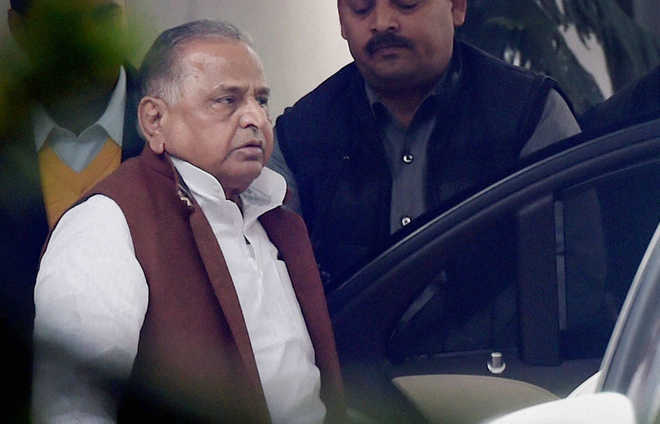
Mulayam Singh Yadav. File photo

Etawah (UP), August 15The country faces the “biggest” threat from China, former Defence Minister Mulayam Singh Yadav on Tuesday said, claiming that it is plotting to attack India in collaboration with Pakistan.“There are a number of threats before the country but the biggest threat is from China…it is continuously encroaching on our land and is planning to attack but is not able to advance because of our Army,” he said at a function here.“China is preparing to attack India in collaboration with Pakistan. This collaboration of China and Pakistan is dangerous for us…this matter should be taken seriously,” the Samajwadi Party patriarch said.Referring to the contribution of Lohia, JP and other socialist leaders in the freedom struggle, the SP founder said people have faith in the socialists and they need to raise their voice against injustice.There are a number of problems before the country like unemployment, poverty, farmers’ plight, women’s safety, terrorism and security of borders and all need to stay together in dealing with them, he said.Mulayam, who had been dethroned by his son Akhilesh from the post of party president earlier this year, however, did not respond to a suggestion made by his brother Shivpal Singh Yadav in his speech earlier that it was time for him to think about the party.Shivpal had said that those who claimed to have strengthened the party in fact weakened it and appealed to Mulayam that it was time now for him to decide as the “Samajwadis” of the state are looking to him for taking the party forward. — PTI


Pak PM calls on global community to play role in Kashmir resolution

Pak PM calls on global community to play role in Kashmir resolution
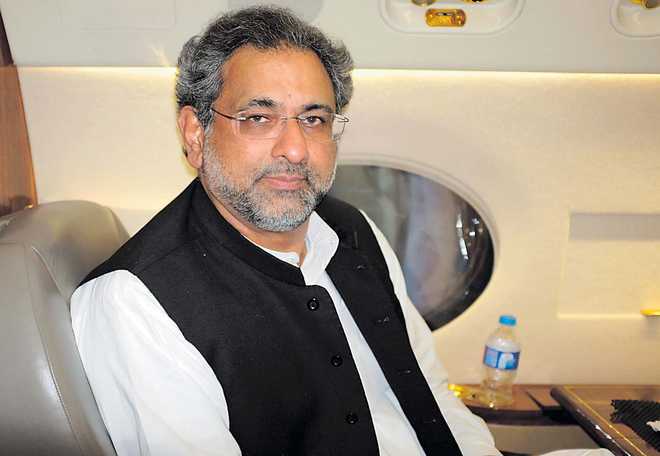
Pakistan Prime Minister Shahid Khaqan Abbasi. File photo

Islamabad, August 14

Pakistan Prime Minister Shahid Khaqan Abbasi on Monday urged the international community to play its due role in resolving the Kashmir issue with India.“It is incumbent upon the international community to play its role in the resolution of the regional conflicts, particularly the Kashmir dispute, in conformity with the UN Resolutions on the subject with a view to ensuring durable peace in the region,” Abbasi said in his address to the nation on the occasion of Pakistan’s Independence Day.

(Follow The Tribune on Facebook; and Twitter @thetribunechd)

He said Pakistan desired to have positive and constructive relations with all countries of the world, especially with its neighbours, on the basis of sovereign equality.“The people of South Asia have suffered enormously in the last 50 years due to the festering conflicts. Until and unless those conflicts are resolved amicably, the people of the region cannot achieve prosperity and progress,” he added.Praising the freedom fighters of the country, Abbasi said, “We are greatly indebted to our ancestors for their sacrifices and we can repay that debt only by making Pakistan a free and independent country.”He noted that the recent transition of power through a democratic process was quintessential of the accelerated strengthening of democratic values in the country.Abbasi stressed on strengthening and reinforcing the state institutions so that they could play their prescribed role within the limits of law and the constitution.Asserting that a strong economy could ensure a strong defence, Abbasi said a moderate society guaranteed stability of the state, where people enjoyed all their fundamental rights and national resources were equitably and judicious distributed.Pakistan was created out of a partitioned Indian subcontinent on August 14, 1947. ANI